STABILA: the history of the brand
In brief
- STABILA was founded in 1889 when Gustav Ullrich founded the Meterfabrik in Annweiler, after the spring joint patent filed by his father and his uncle in 1886.
- The STABILA brand was registered in 1929; the patents that shaped its levels came in 1952 (acrylic vial) and 1979 (vial sealing).
- The company has been expanding into lasers since 1994 and remains family-owned: more than 600 employees worldwide in 2026, including around 350 in Germany, and a reported revenue of around 100 million euros.
- Spirit levels are manufactured in Annweiler, with a stated capacity of up to 14,000 units per day; folding rules are manufactured in the Czech Republic and some of the lasers in China.
- On an electrician’s site, STABILA covers the spirit level, the electronic level and the line laser, each with a specific use.
STABILA is a German company founded in 1889 by Gustav Ullrich in Annweiler, in the Palatinate, under the name Meterfabrik, the meter factory.
The brand owes its expertise to several milestones in its history: the spring-loaded joint of 1886, which gave the folding rule its modern form, then the acrylic-glass vial of 1952 and the sealing of the vial into the profile in 1979.
Today, this family-owned company employs more than 600 employees worldwide, around 350 in Germany, and sells spirit levels, folding rules, distance meters and lasers in more than 80 countries. A word of caution about industrial origins: not all of these instruments come out of the same factory.
The turnover reported by the brand in 2026 is around €100 million. In this article, I trace that history and explain what it changes in practice when an electrician picks a level or a laser.
1889
founding of the Meterfabrik by Gustav Ullrich in Annweiler
1886
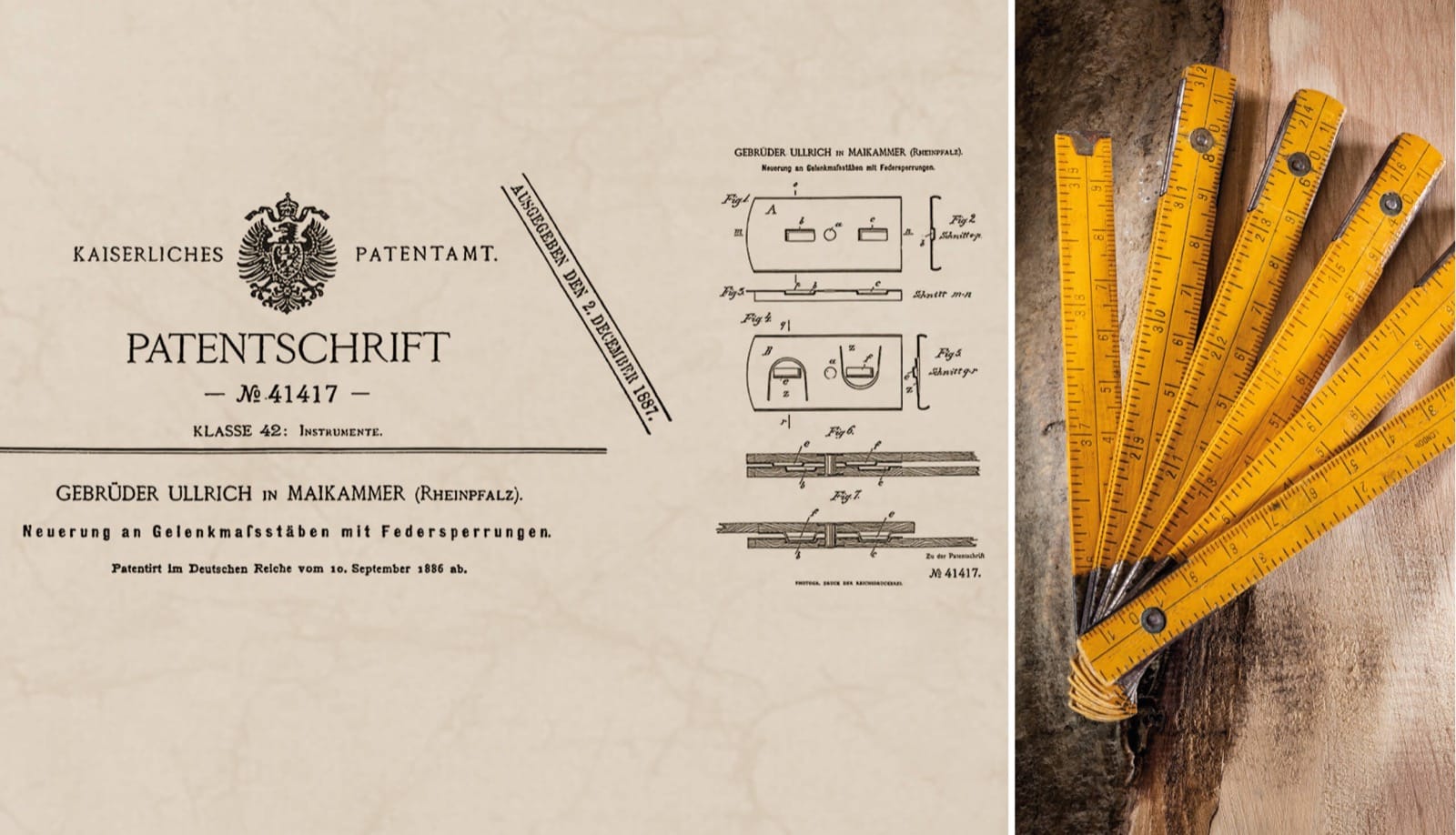
patent for the Ullrich brothers' spring-loaded joint
1929
registration of the STABILA trademark
1979
patent for permanently integrating the vials into the profile
14,000
spirit levels per day: maximum capacity announced in Annweiler in 2026
My visit to the factory and the STABILA Campus
I visited the STABILA factory in Annweiler on 25 August 2026, guided by Philipp Scholz, head of international development and training. The visit starts with the Campus, the official name of the centre where STABILA welcomes, trains and supports professionals and dealers.
The visit and the demonstrations were arranged by the manufacturer: I report the observations without presenting them as independent testing.
What sets the Campus apart: site scenarios recreated at full scale. A timber-framed model house with its roof window, a sand trench with pipes to lay: rotary lasers and laser levels are put to work in realistic conditions here, not just lined up on a display stand.
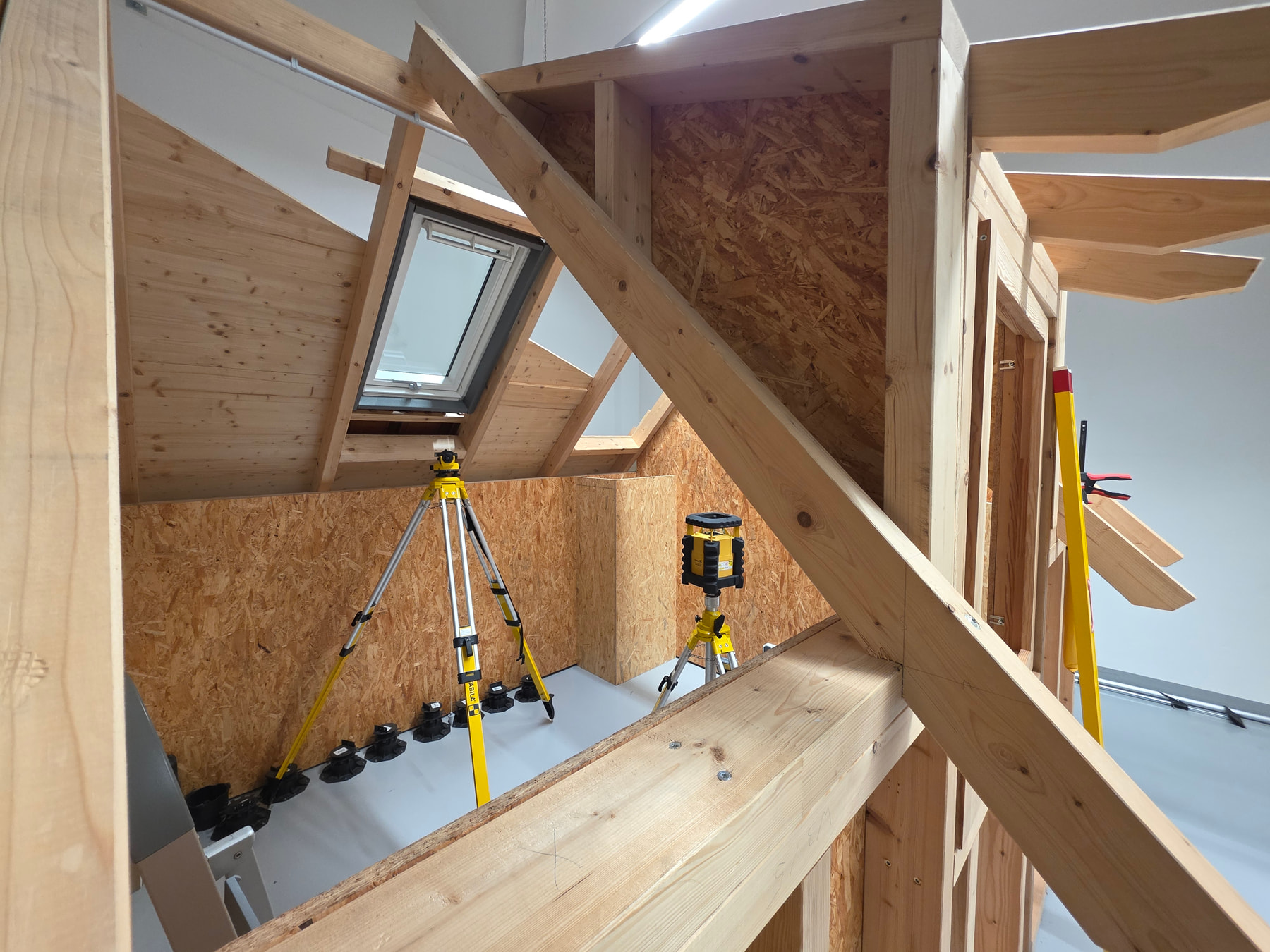
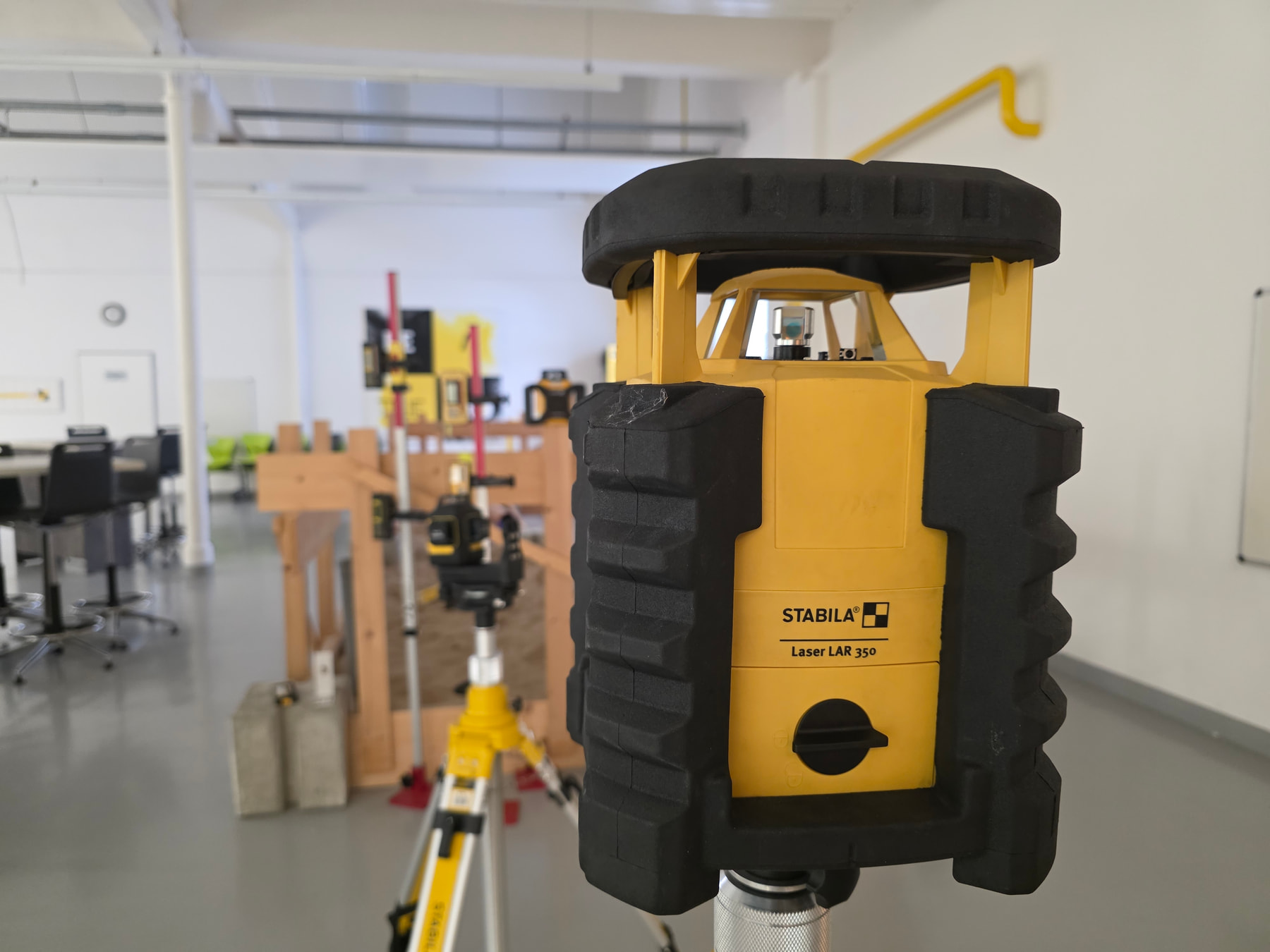
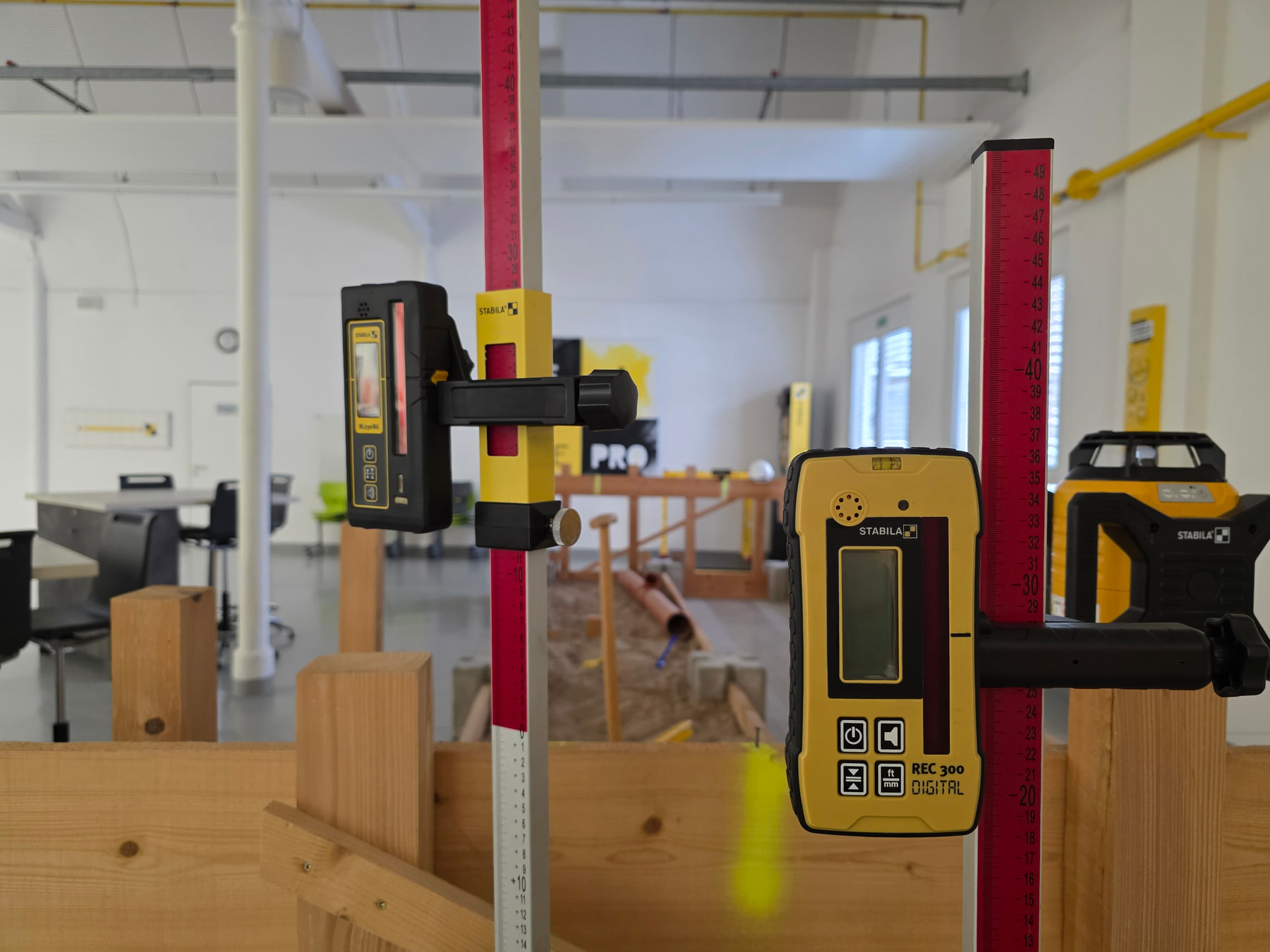
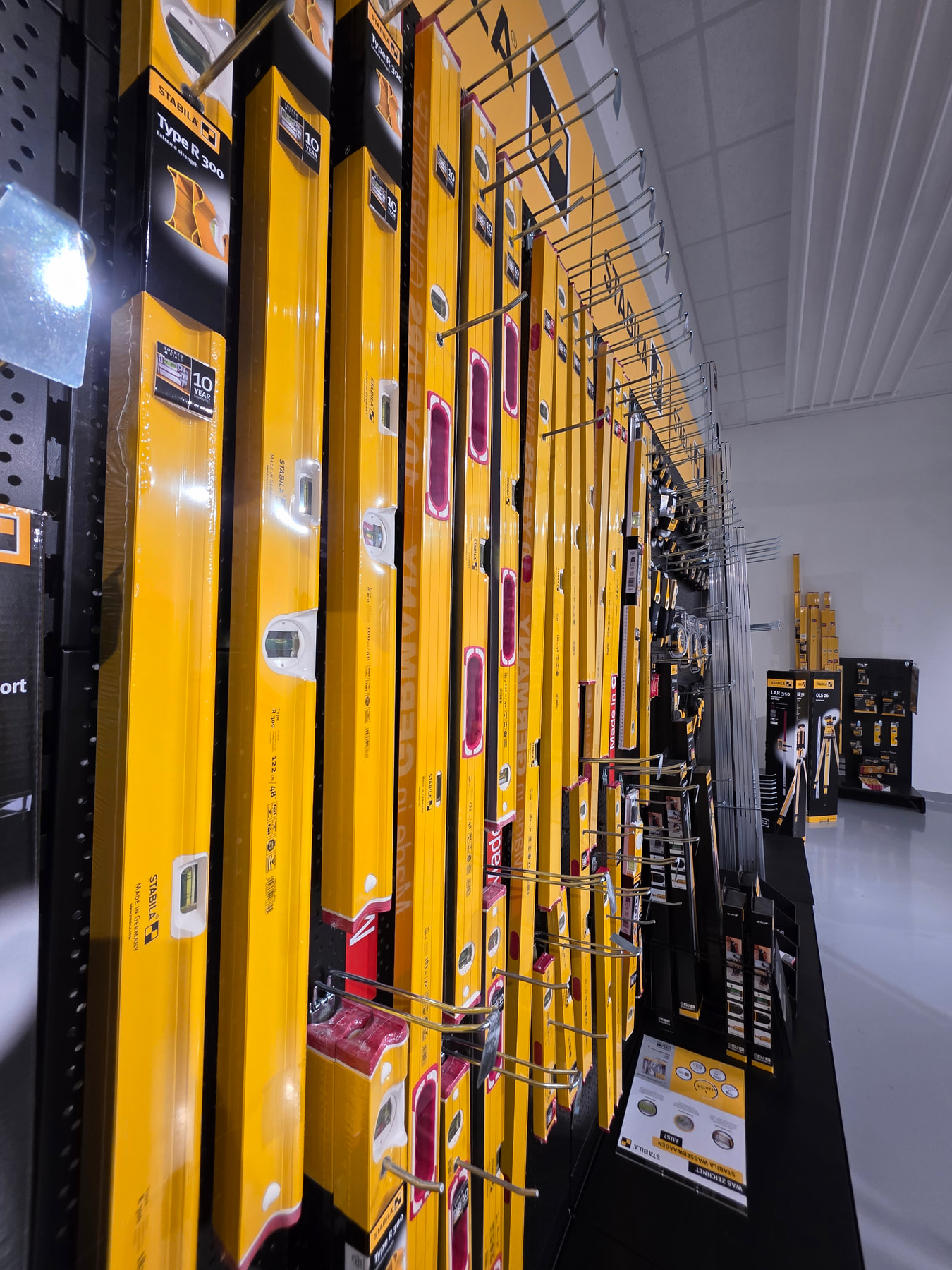
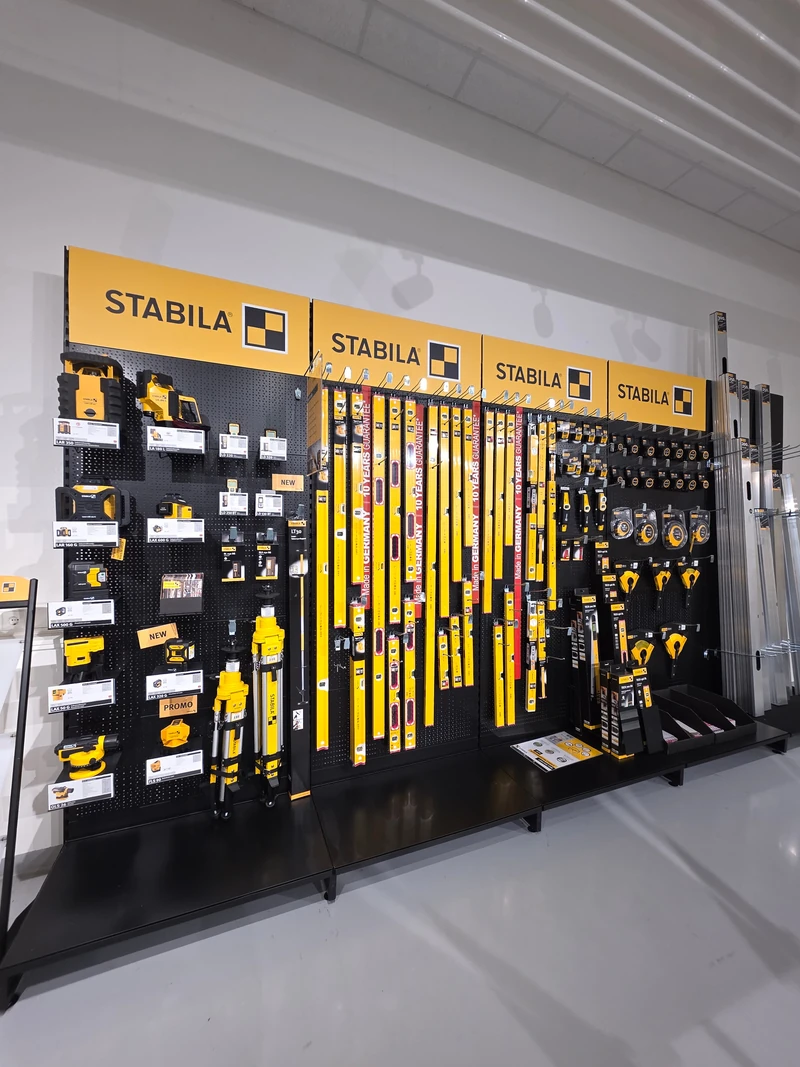
Another stop: the showroom wall, where Philipp presents the full range, from spirit levels in every length to pocket levels, lasers and tape measures, with Made in Germany and a ten-year warranty on the products concerned.
The most telling moment is still the demonstration of how the vials are assembled. A cutaway of a STABILA level shows its vial held firm in a block of epoxy resin that is integral with the profile. Other designs were also shown to illustrate the differences in how the vial is fixed.
Here I describe the STABILA principle without publishing any photograph that would make it possible to identify competing brands at the manufacturer’s premises.
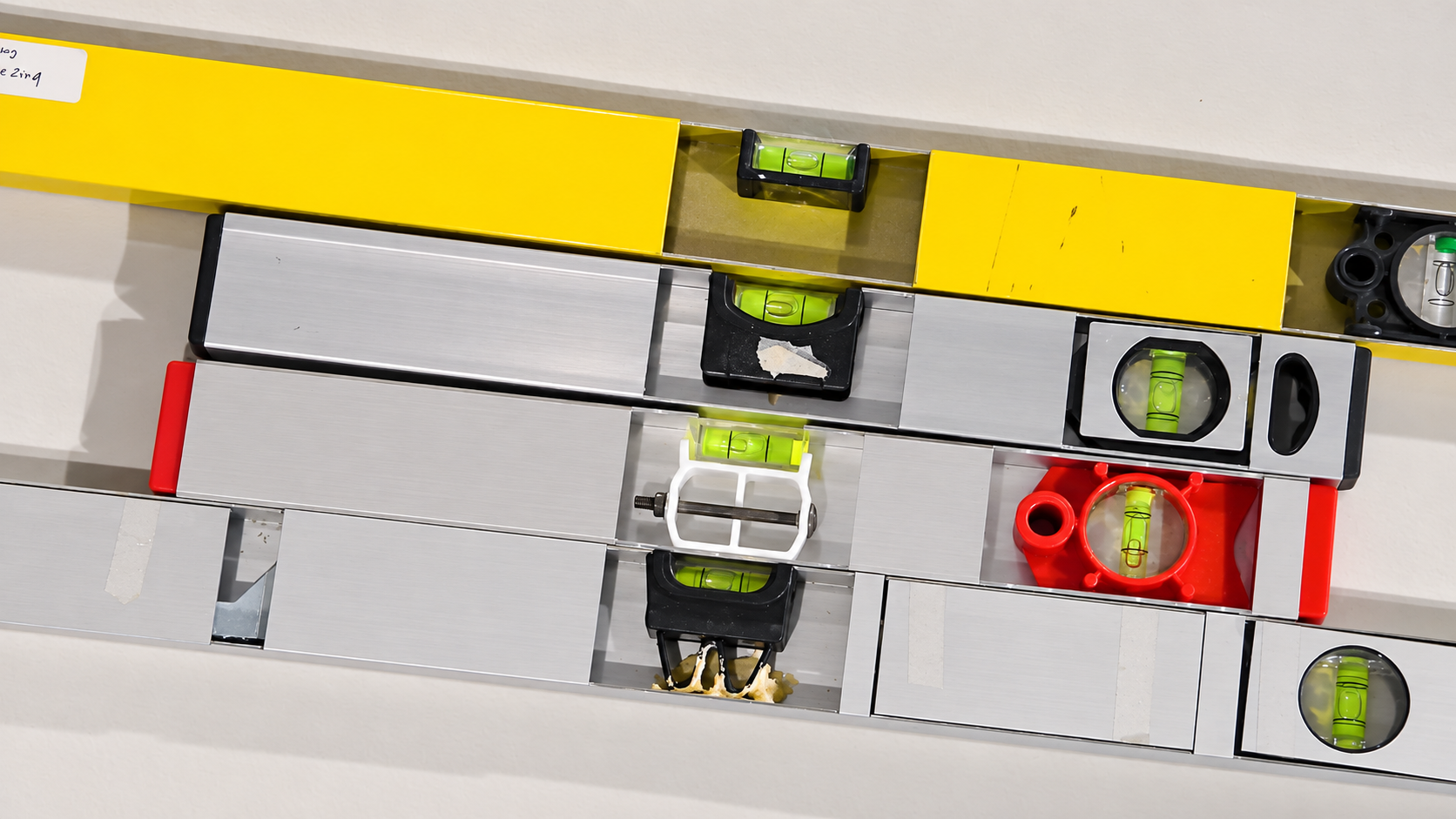
The difference is not a catalogue detail. In a level whose vial is not permanently secured to the frame, the vial can shift if the tool is dropped: the tool may then show a false horizontal without the user noticing. The sealing system patented in 1979 is designed precisely to limit this risk of internal movement.
However, a frame that has itself become distorted still needs to be checked, even on a STABILA.
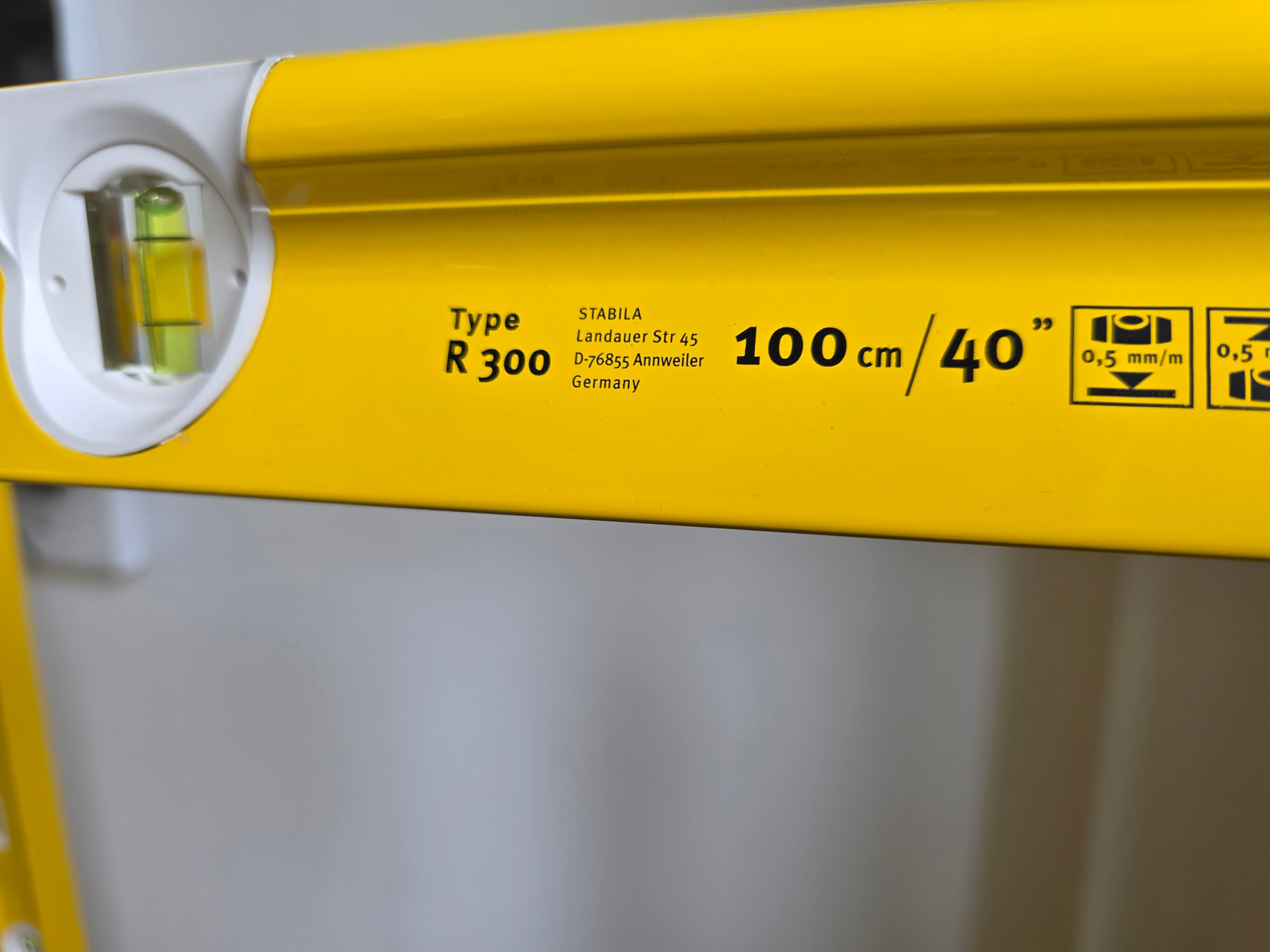
Maikammer to Annweiler: the Ullrich brothers’ rule factory
Folding rules in Maikammer
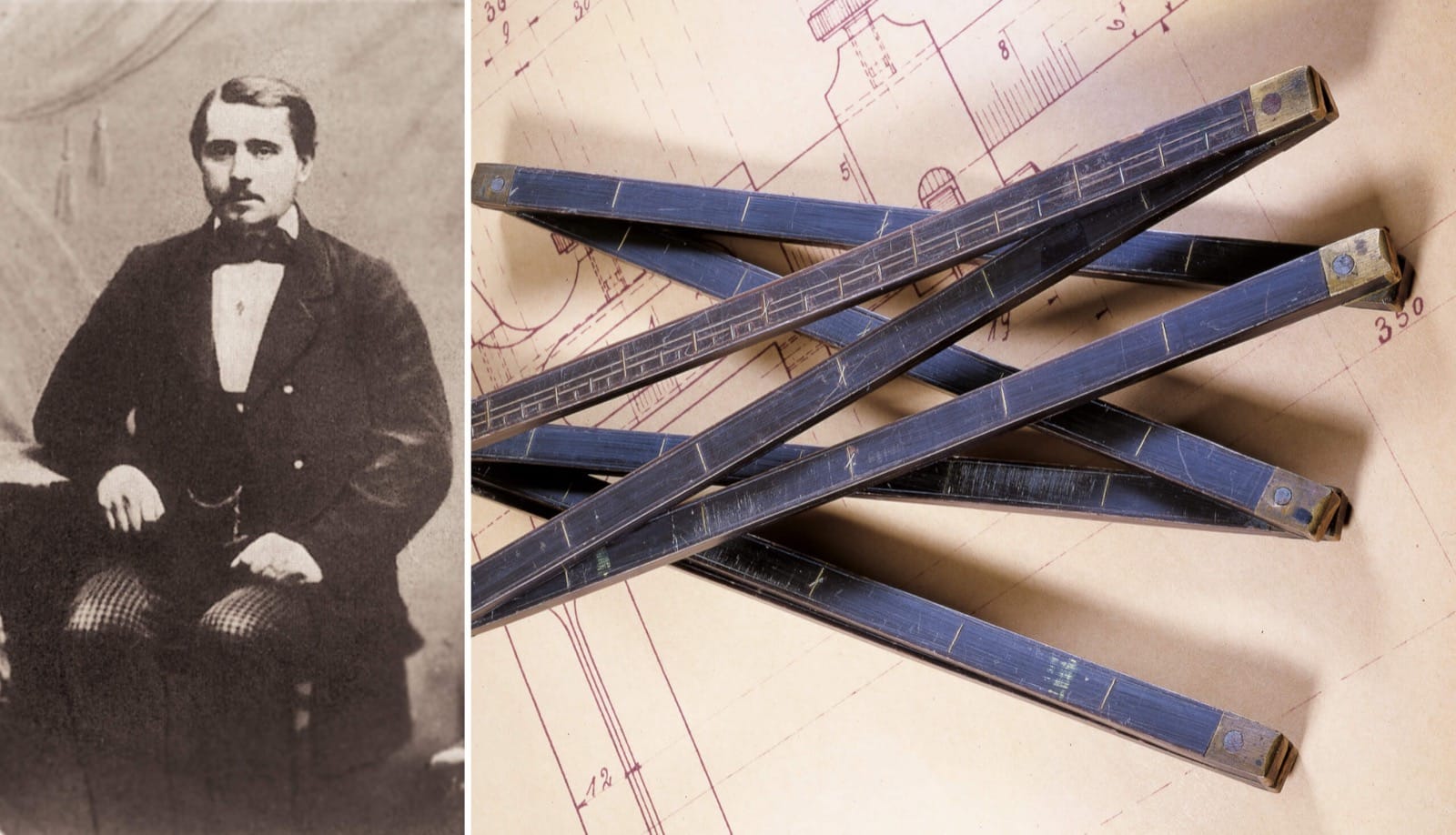
The story begins before the brand existed. In 1820, Leonhard Ullrich opened a business in Maikammer, in the Palatinate, and then passed it on to his sons. In the economic crisis of the 1850s, Anton and Franz Ullrich turned to wooden folding rules.
In 1886, the brothers filed a patent for a spring joint for folding rules. This spring replaced the simple hinge and kept the instrument from folding up on its own. STABILA considers this date the birth of the modern folding rule.

The move to Annweiler
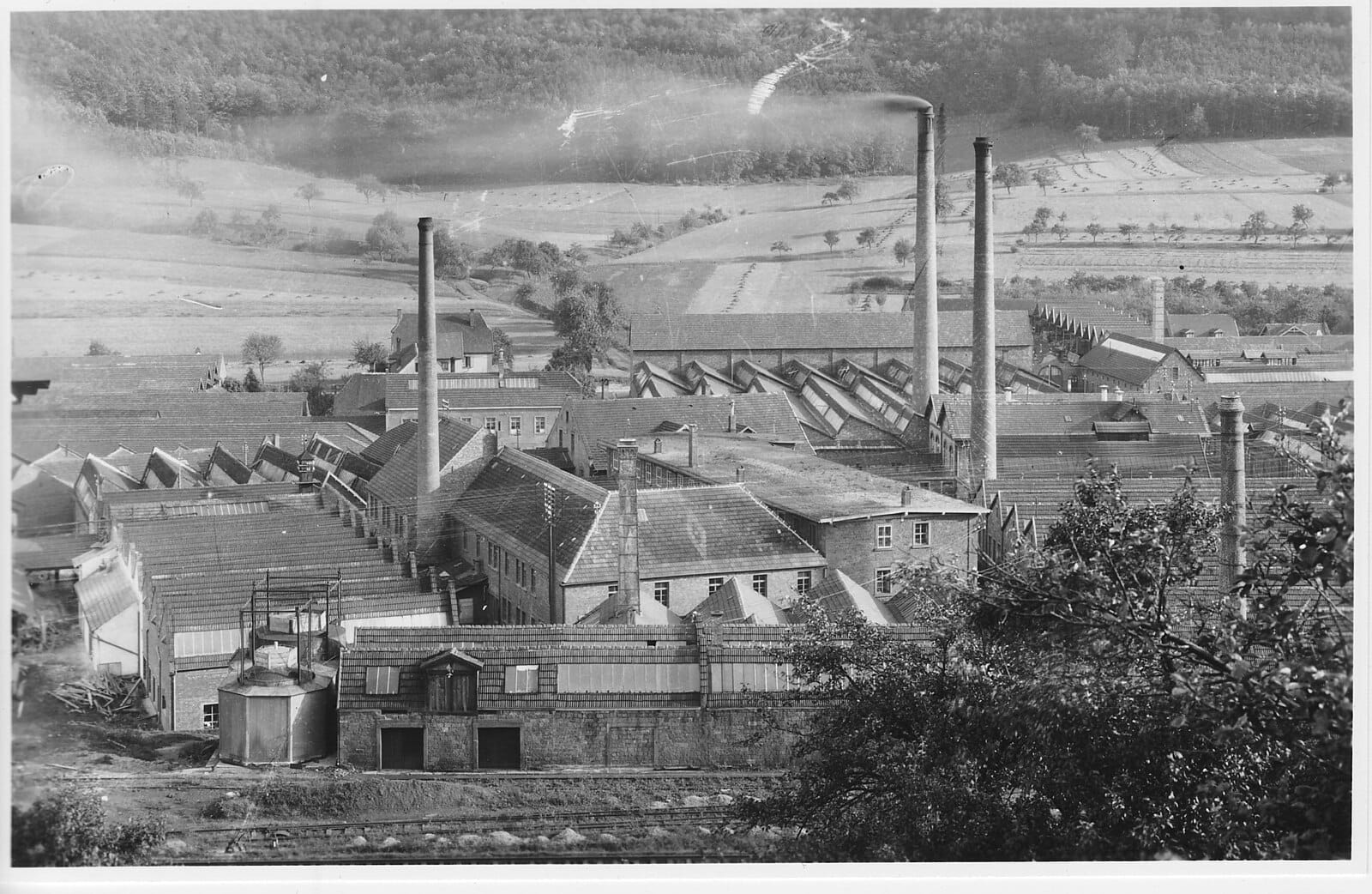
In 1889, Gustav Ullrich, Franz’s son, left for Annweiler, bought a 16,070 m² plot in March that housed an old straw factory, and set up the Meterfabrik there. The company’s first official mention dates from 25 October 1889.
The initial catalogue brought together spirit levels, folding rules, tape measures, plumb bobs and some ironwork. This early product range does not reflect where the company’s factories are today: wooden folding rules are now made in the Czech Republic.
Rapid growth
As early as 1890, the sister company Franz Ullrich Söhne was founded in Maikammer, and a workers’ settlement with nine buildings was built near the factory. By 1900, the company was already exporting a broad range of instruments to many countries, including to Russia by rail link.
Gustav Ullrich also bought a factory in Chalon-sur-Marne, France, to secure supplies of wood. The company thus owned a French industrial site for part of its history.
Info
The STABILA brand, the wars and aluminium
The birth of the STABILA name
The brand only appeared in 1929, forty years after the factory was established. Its name evokes stability: a promise that fits the measuring trade.
The First World War struck the company hard: its French factory was lost, some of the buildings served as a military hospital, and production gradually resumed in the 1920s.
The war and the destroyed archives
On 1 January 1945, an air raid on Annweiler damaged the town’s factories. An incendiary bomb destroyed the Meterfabrik archives. Earlier internal documents are therefore rare, and historians must also rely on official records.
The move to aluminium
In 1948, Günther Leipold, Gustav Ullrich’s grandson, became managing director. He developed levels made from cast aluminium, then from extruded aluminium profiles, replacing wood. Two patents subsequently played a role in the construction of STABILA levels:
| Year | Innovation | What it delivered |
|---|---|---|
| Year 1886 | Innovation Spring joint | What it delivered The folding rule stays open in use |
| Year 1952 | Innovation Acrylic glass vial | What it delivered A new vial design and light-alloy levels |
| Year 1979 | Innovation Permanent embedding of the vial | What it delivered Maintains its alignment with the profile |
| Year 1994 | Innovation Laser measuring instruments | What it delivered Development of electronic measurement |
Key dates in the manufacturer's technical history.
In 1952, the acrylic glass vial was patented; STABILA became the first German manufacturer of light-alloy spirit levels. The 1979 patent relates to the mounting: the vial is cast and permanently sealed into the profile. The current trade name is LOCKED VIALS.
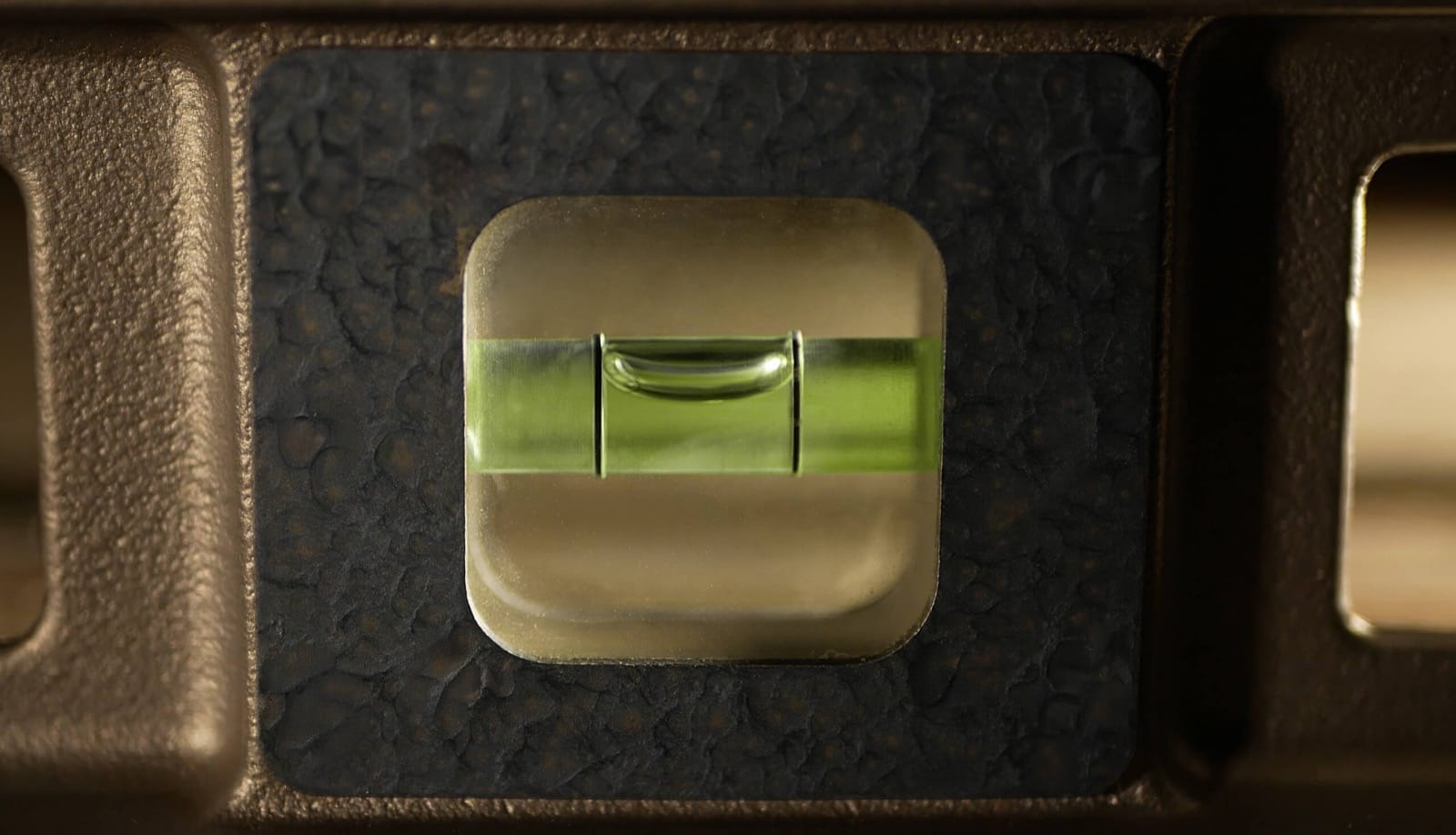
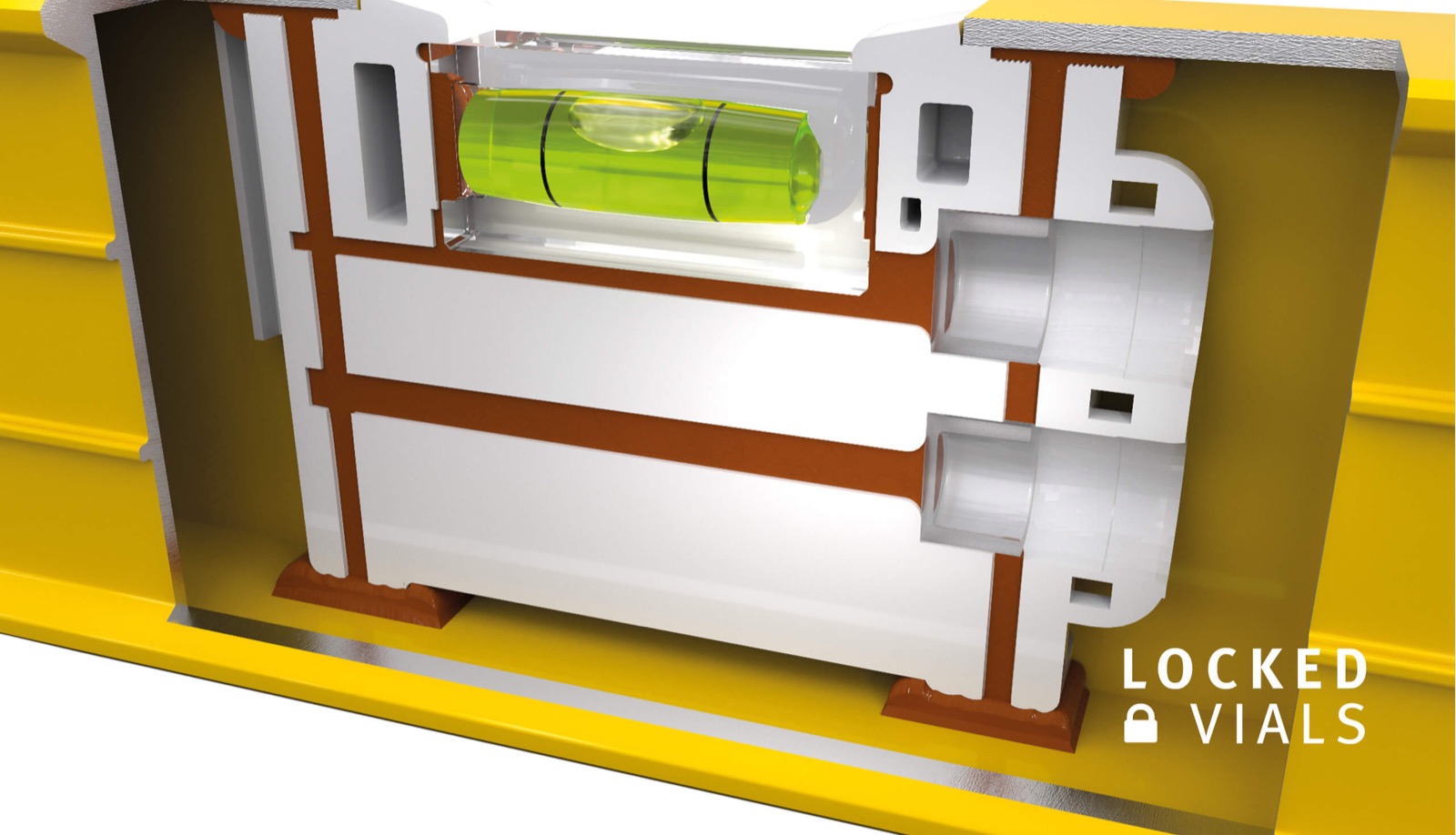
The 1979 patent permanently fixes the vial in relation to the profile.
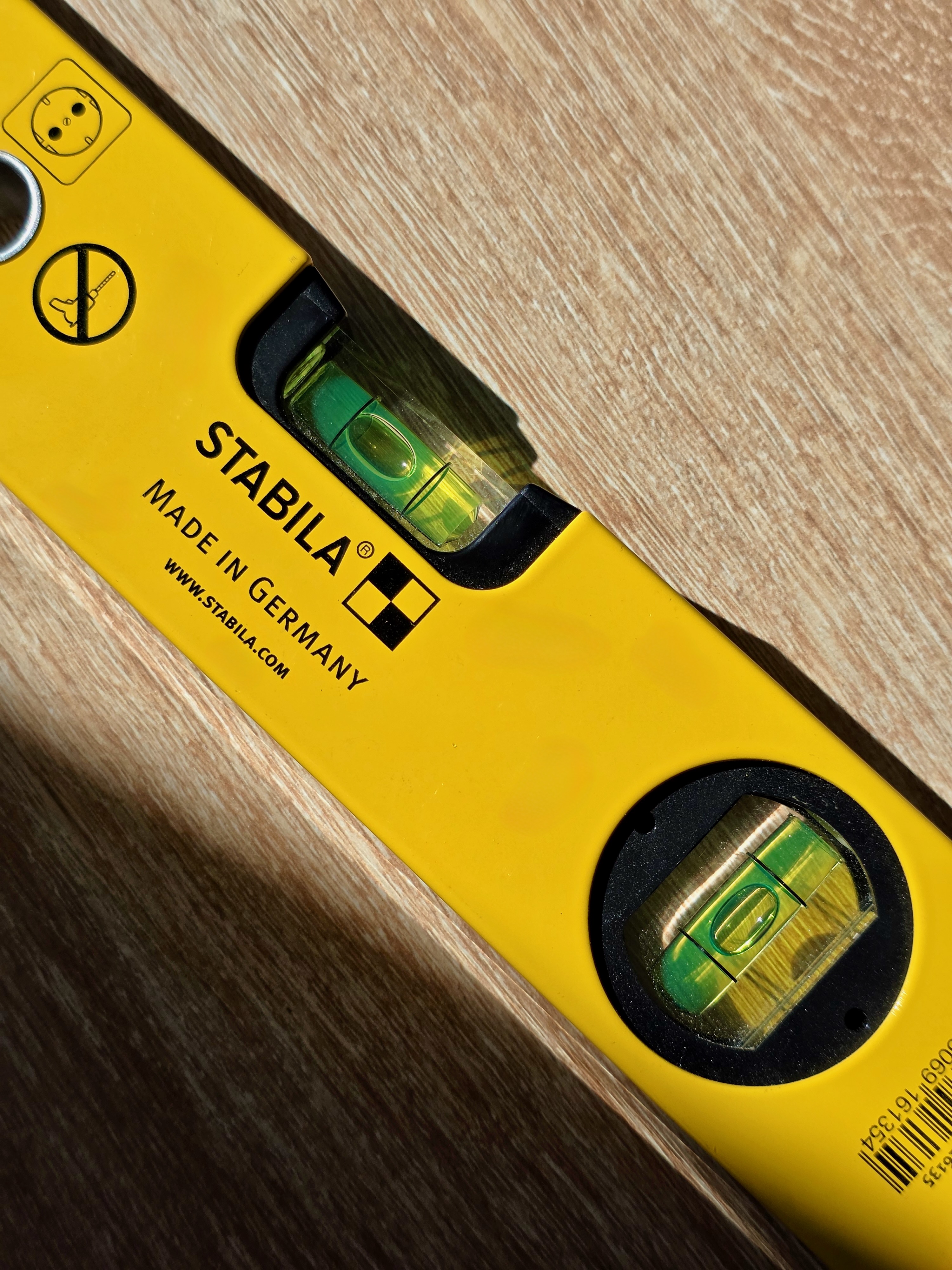
On current levels, the mounting method helps maintain alignment.
In some entry-level spirit level designs, the vial can be mounted in an add-on block; at STABILA, the manufacturer documents its sealing process in detail.
This difference in design explains the technical value of the visit, without extrapolating to every product from other brands or claiming that a manufacturer demonstration is equivalent to independent comparative testing.
STABILA states a ten-year manufacturer’s warranty on its aluminium profile levels, subject to the conditions specified by the brand. A deformed profile, in particular, is not covered the way a simple vial drift is.
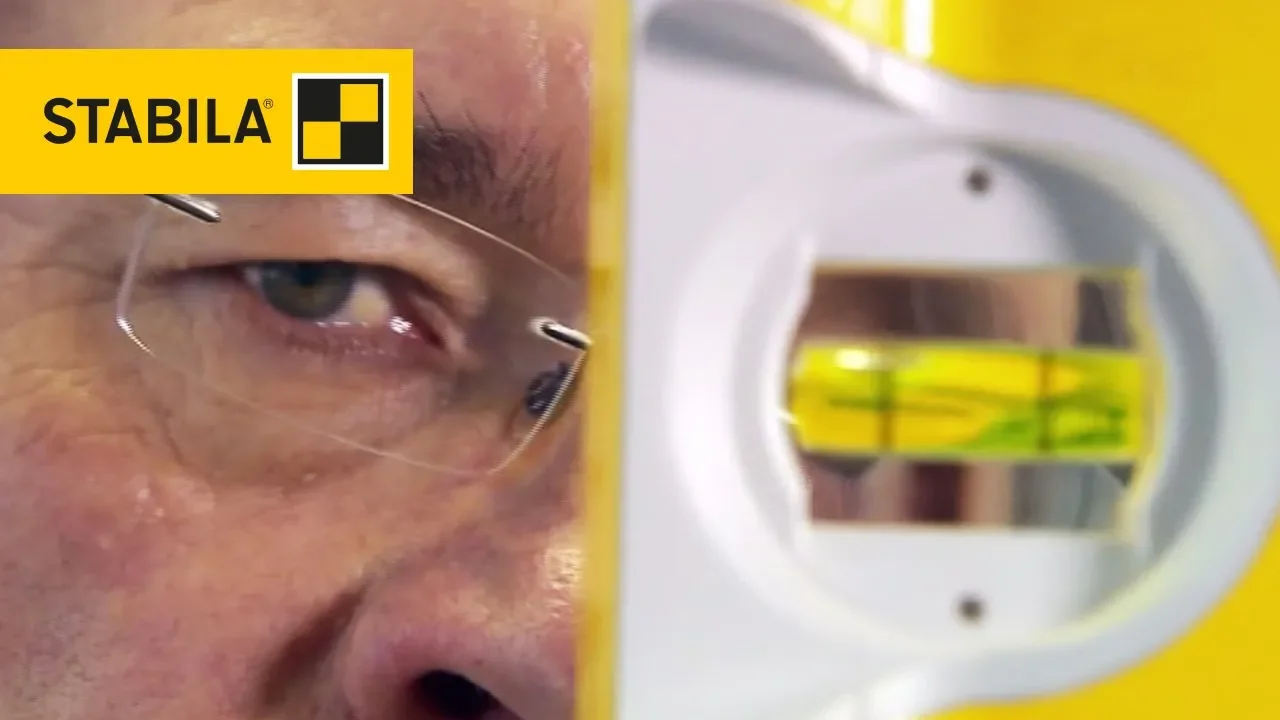
The electronic era: lasers and distance meters since 1994
The move into electronic measurement
In 1993, STABILA built a folding rule factory in Haluzice, Czech Republic. The following year, in 1994, it began developing and manufacturing laser measuring instruments in Annweiler. This development gradually expanded its product range.
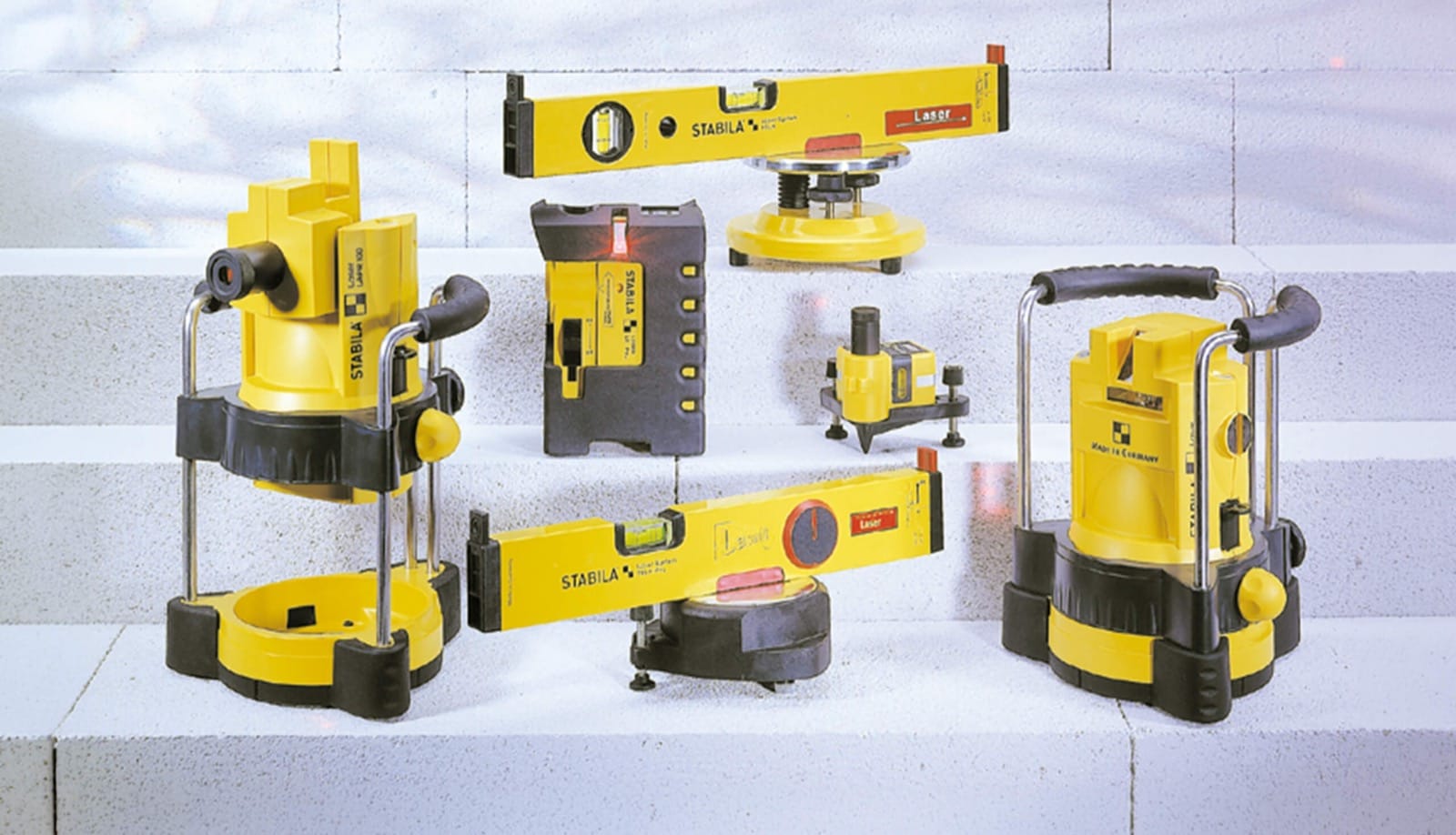
The current laser range and its manufacturing sites
In 2006, the PROTECTOR system was developed to protect the optics of certain rotary lasers; in 2010, the electronic modules gained better protection against dust and water. On site, these are specifications to check on the data sheet of the model you choose, not something to assume across the entire range.
In 2011, STABILA opened a production subsidiary for line lasers in China, as part of a majority-German joint venture. Folding rules are produced in the Czech Republic; spirit levels and some rotary lasers are manufactured in Annweiler, Germany.
STABILA notes that some of the printing operations for folding rules are carried out in Germany: they should not be confused with their manufacture.
In 2017, the MOTION CONTROL function allows certain rotary lasers to be adjusted by turning their remote control rather than by repeatedly pressing the buttons.
The catalog now covers spirit and electronic levels, dot and line lasers, rotary lasers, distance meters, folding rules and tape measures, as well as optical levels. Depending on their family, these products do not all come from the same country: “German brand” does not mean “all made in Annweiler”.
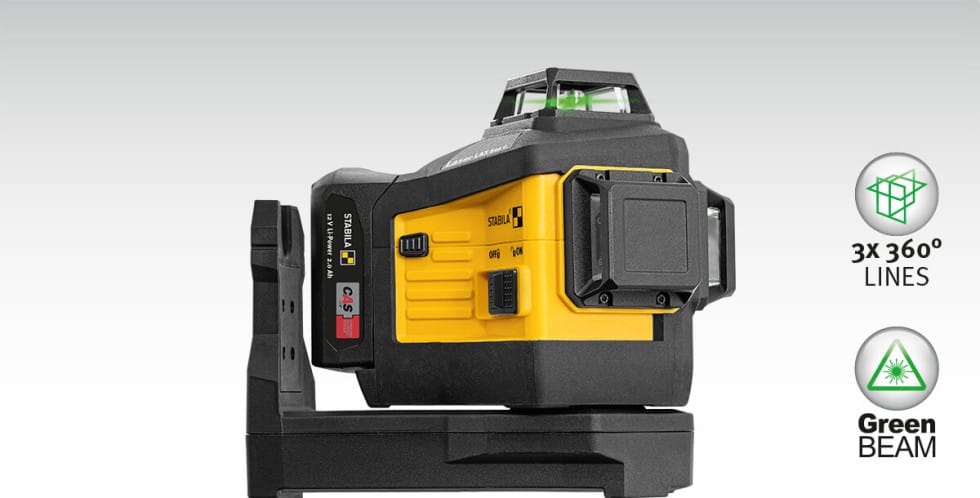
The LAX 600 G, launched in 2022, projects three 360° green lines, with a quoted visible range of up to 40 m. It is rated IP65 without a battery and uses a CAS 12 V battery from the Cordless Alliance System multi-brand platform.
The red-line variant LAX 600 quotes a different runtime and a visible range of 30 m; I tell the two models apart.
The LA 180 L, meanwhile, quotes an accuracy of ± 0.07 mm/m with motorized alignment, under the conditions set out in its documentation.
Recent years have brought the LAX 500 G and LAX 320 G in 2025, the LD 530 BT distance meter with viewfinder and Bluetooth, then the LAX 60 G in 2026, a compact cross-line laser quoted at up to 30 m without a receiver.
The laser does not make the level obsolete
A laser carries a reference over a distance; the bubble level checks the surface it rests on. An electronic level adds a digital slope readout and other functions depending on the model. So I keep several complementary instruments in my toolbox, rather than making a single one carry every function.
What this history changes on a job site
Industrial know-how in use
On a vertical chase, a line laser can mark a wall from top to bottom without me needlessly climbing a stepladder. To fit a DIN rail or a consumer unit (distribution board), the bubble level remains the tool for direct checking: it verifies a surface on contact.
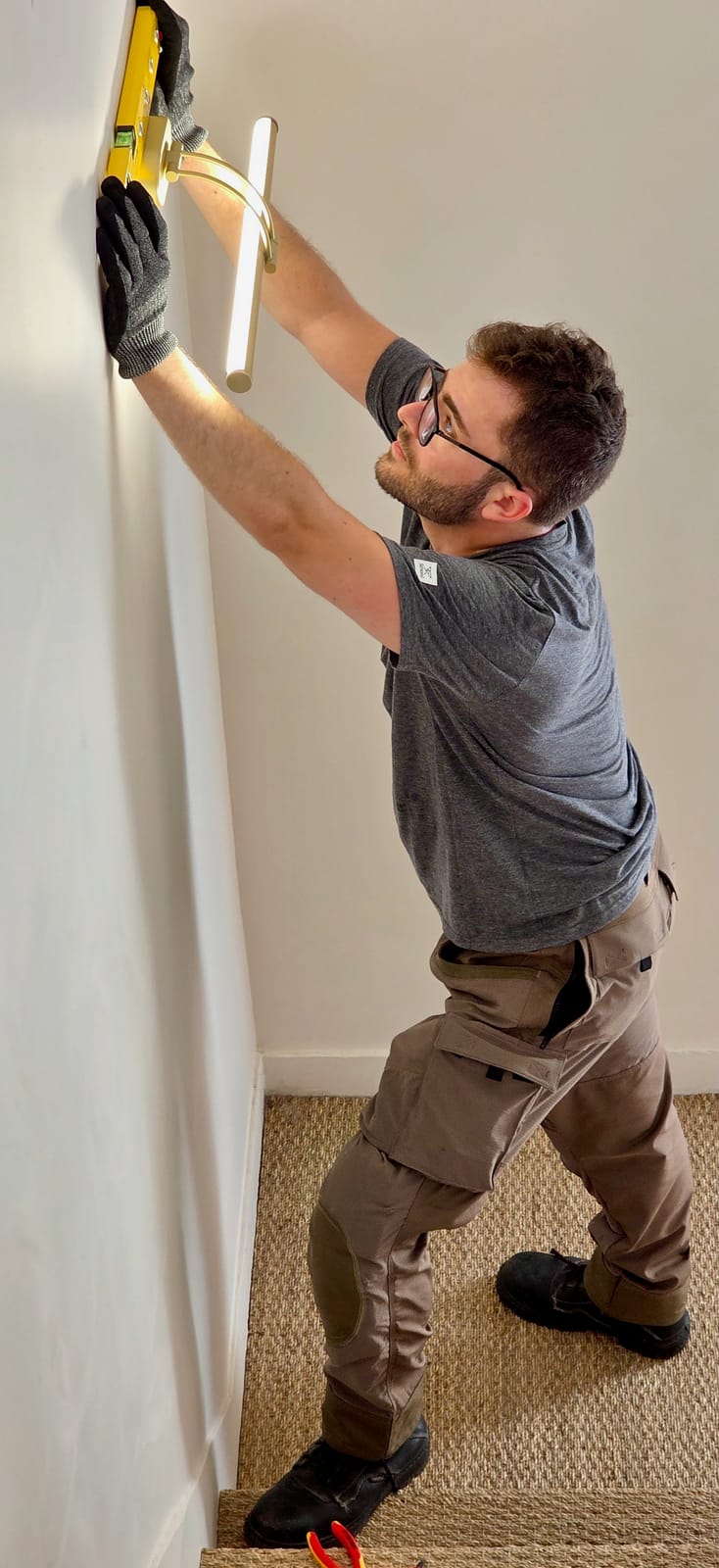
Three technical legacies
The stability of the vial’s alignment traces back to the 1979 sealing patent.
Readability traces back to the work on acrylic glass in 1952. Finally, the current range makes it possible to switch between a manual level, an electronic level and a laser, whose development dates back to 1994. History becomes interesting for a tradesperson when it explains a manufacturing decision or a measuring technique.
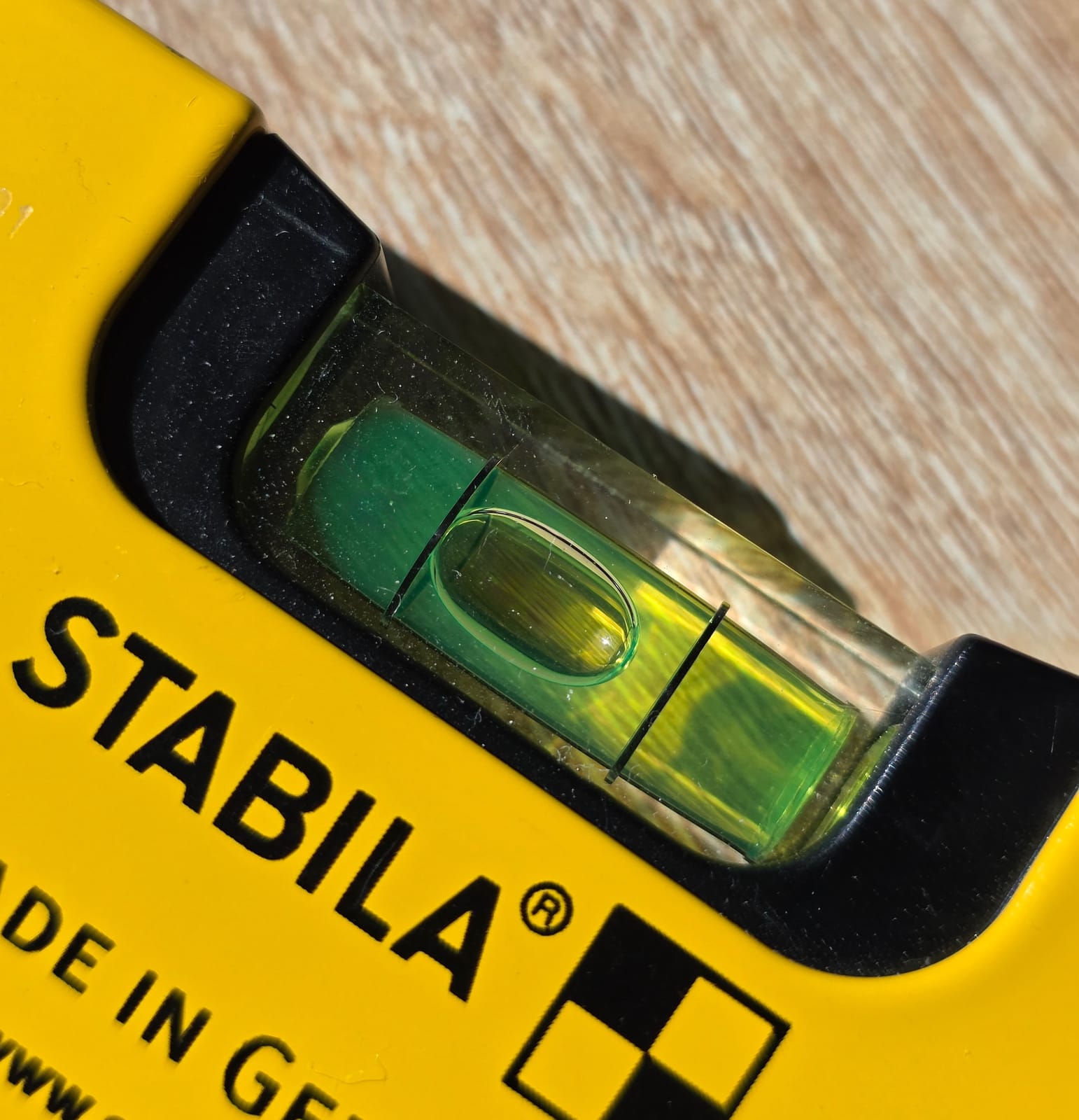
A specialization to place in the right context
STABILA focuses its industrial history on measuring instruments. Other generalist manufacturers cover more tool families. This distinction helps make sense of the catalogs, but on its own it establishes neither a robustness ranking nor a quantified accuracy difference.
For a comparison between models, see my STABILA, Stanley and Bosch guide.
The choice of a fastening tool or a machine comes down to other criteria; my article on Hilti tools for electricians looks at the subject from the point of view of use.
STABILA in France and today
Distribution in France
STABILA’s French website offers a distributor search tool covering trade and DIY retail networks. The company has its own distribution companies in France, North America, the United Kingdom, Italy and Australia, and sells its products in more than 80 countries.
Still a family business
The company remains family-owned. In 2026, it reports more than 600 employees worldwide, including around 350 in Germany, and revenue of around €100 million. Its authorised managing director is Dr Ulrich Dähne.
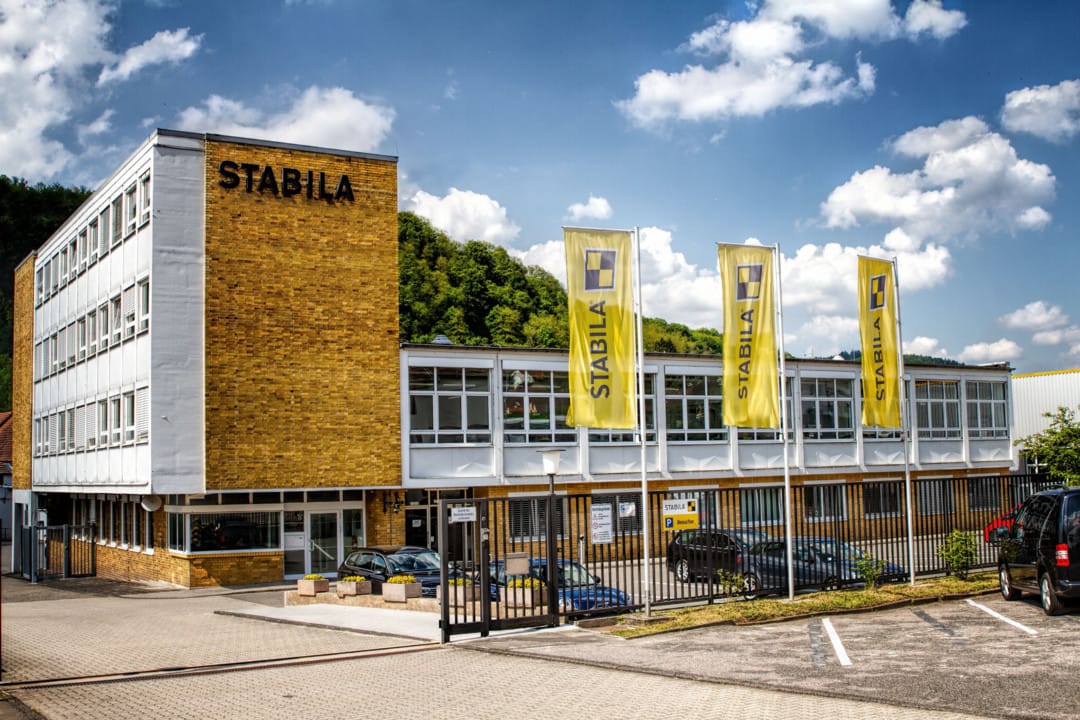
Investments in the sites
In 2020, a new 1,400 m² hall dedicated to spirit-level production opened in Annweiler. The announced investment exceeds 5 million euros, including the building and equipment. The hall includes an area dedicated to making the vials, from filling them to fitting them into the profile.
STABILA reports a maximum capacity that has risen from around 10,000 spirit levels per day in 2019 to 14,000 in 2026, with reported annual production of more than 2 million spirit levels. These figures describe the manufacturer’s capacity and volumes, not counts taken during my visit.
In late June 2024, STABILA opened a logistics centre of around 8,000 m² in Wilgartswiesen-Hauenstein, some 12 km from Annweiler, in an investment announced at around €15 million. The building is described as built to the KfW 55 energy standard and fitted with around 1,200 m² of photovoltaic panels paired with batteries.
In 2026, the company acquired a sawmill in Zdounky, in the Czech Republic, to secure the wood supply for the folding rules made in Haluzice. The German site must not be presented as the factory for these folding rules: STABILA says it carries out printing operations there.
The brand also supports training in the skilled trades, notably through WorldSkills, EuroSkills and programmes for young apprentices.
How I read a measuring instrument designation
When I open a catalogue or a data sheet, I read a designation as a set of clues rather than a single reference. The family comes first, and it tells me the gesture the tool supports.
A spirit level gives a reading on contact with the surface. An electronic level adds a digital readout of the slope, and a line laser carries a reference across the room. Each family changes the way I work, and the designation names the family before anything else.
After the family, the suffix tells me which variant I am looking at: a different beam for a laser, a different battery system, or a receiver supplied with the tool. I read the accessories list before comparing two references, because a designation rarely mentions what comes in the case.
The length and the profile section matter just as much on site: they change the reach and the weight in the hand. I check both before choosing, since a tool that stays in the van does not measure anything.
I also read the designation against my own routine. If I work alone on a ceiling, I need a tool I can set up without help, so a model that requires an extra pair of hands loses its interest, even if its specification looks good on paper.
What the vial patents change in use
The vial patents are not a laboratory detail. A permanently secured vial reduces the risk of internal movement, but it does not rule out a bent profile or damage after a drop. After an impact, I inspect the level and check its accuracy by reversing it on a reference surface, as STABILA recommends.
In practice, that construction limits a source of silent error: a vial that has shifted still shows a bubble, but the reading it gives is wrong. On a level I use for setting out, this is the failure mode I want to rule out before anything else.
Maintenance follows from the same design. I clean the vial window with a soft cloth and a little water, I keep solvents away from it, and I never press on the housing to remove dust from the block.
A cloudy window slows every reading, and a housing I have forced out of place turns a sound instrument into a doubtful one. Cleaning takes less time than re-checking a wall.
On lasers and electronic levels, the same principle applies to the optics and the sensors. I keep the windows clean, I store the instrument in its case, and I treat a quoted protection rating as a specification to check per model, not as a promise that covers every situation.
Used instruments: checks and daily care
On a second-hand level, I start with the vials. I look for an intact bubble, a window without clouding, and a vial that does not move when I press gently around its housing.
Then the measuring face. I run a finger along it and look for burrs, dents or a twist. A level that rocks on a flat surface is a level I leave where it is, whatever the brand on the profile.
The markings come next: scale, printed reference and the origin marked on the tool. If the printing has worn away, I have no way to identify the instrument later, which matters when I keep several levels of the same family.
On a laser, I check the optics window, the battery compartment, the thread of the mount and the accessories supplied. A missing bracket or receiver changes the value of the set, so I list what is in the case before I decide.
I also test the tool before paying: a check against a reference I trust says more than a clean exterior. If the seller cannot show the accessories or the case, I treat the instrument as a spare part, not as a working tool.
In the van, I store levels flat or hung on a bracket, never wedged under a tool bag. A profile that takes a permanent set keeps its error, even when the vial itself is sound.
After a dusty job, I wipe the vials and the measuring faces with a dry cloth, then a barely damp one if the dust has stuck. I keep the instruments away from an open tailgate overnight, because damp air does more damage than a busy week.
For the lasers, I take the batteries out when the tool stays in its case for weeks, and I leave the optics cap on. The tripod thread gets a clean as soon as it feels gritty, before the grit reaches the inside of the mount.
Before each job, I set the level down on a flat surface and look at the bubble. That habit catches a drift early, long before a wall shows it.
Quiz: the STABILA story
3 questions
InteractiveSTABILA history quiz
Three dates to understand the manufacturer
Choose an answer
FAQ
When was STABILA founded?
Gustav Ullrich founded the Meterfabrik in Annweiler in 1889, with a first official mention on 25 October. The STABILA brand was registered in 1929. The founder's name remains in the company name.
Why is STABILA associated with the spirit level?
STABILA developed the acrylic glass vial in 1952 and patented the permanent sealing of the vial in 1979. This design is intended to keep it aligned with the profile and underpins part of the brand's technical documentation.
Does STABILA still manufacture in Germany?
Yes: spirit levels and some rotary lasers are made in Annweiler. Folding rules are made in the Czech Republic and some line lasers in China, as part of a majority-German joint venture opened in 2011. Printing operations for the rules take place in Germany.
Are STABILA lasers useful to an electrician?
Line lasers are used to set out chases, rails, distribution boards and alignments. The LAX 600 G projects three green 360° lines with a stated visible range of up to 40 m, while the LAX 60 G, announced in 2026, handles transfer of levels/points over shorter distances, up to 30 m, without a receiver.
Does STABILA still belong to the founding family?
STABILA is still a family business and reports more than 600 employees worldwide for 2026 and revenue of around €100 million.
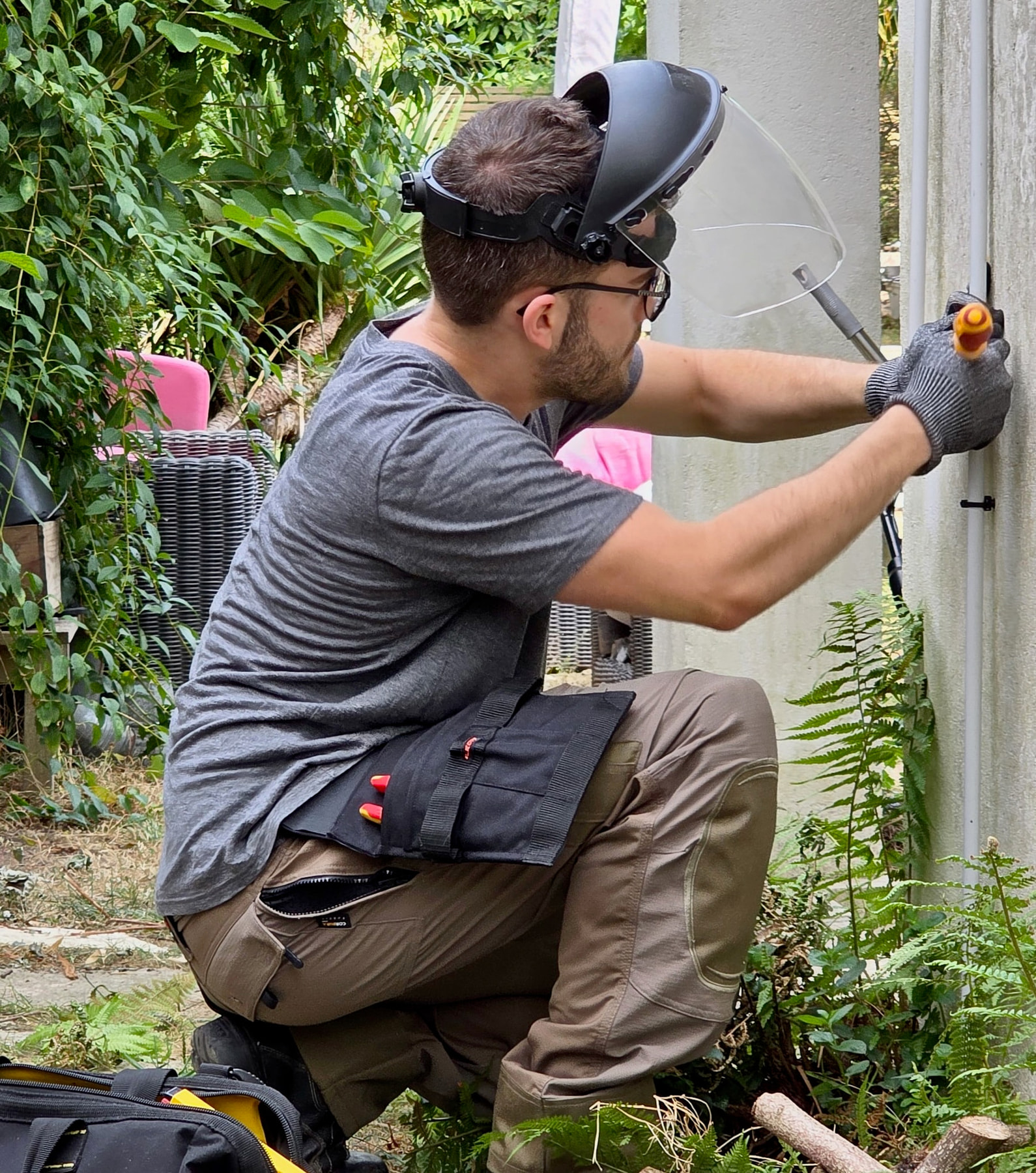
Théo Desrousseaux
Electrician and editor
I work in the field and edit this magazine. Every guide is reviewed for its target country before publication.
Author → Credentials → Editorial method → Report a factual correction →
No email app? Copy the correction details
Email address and prefilled context:
theo@sparx-elec.fr
Article: https://www.sparx-elec.com/gb/stabila-brand-history/
Edition: GB — English
Factual issue: [describe the factual issue]
Passage: [quote or identify the passage]
Source: [optional source URL]
Sources and references
- 1. STABILA — official history
- 2. STABILA — company press release 2026
- 3. STABILA — quality and technology of spirit levels
- 4. STABILA — point and line lasers
- 5. STABILA — new production facility (2020)
- 6. STABILA — logistics centre inaugurated in 2024
- 7. Wikipedia — Stabila (company)
- 8. Wikimedia Commons — File:Stabila um 1926.jpg
- 9. elektro.net — press day at Stabila in Annweiler
More guides
Practical electrical installation guides, diagnostic methods and tool recommendations compared against the technical wiring standards of this national edition.
Wera: brand history
Wera: founded in 1936 in Wuppertal, name taken from Werner and Amtenbrink, Kraftform handle in 1968, Czech production from 1995, Bitburger Holding since 2016.
Read the guide Guide Knipex: the story of the brand Founded in 1882 in Germany, Knipex makes the pliers chosen by professional electricians: history, innovations and a lasting commitment. Read the guide
 Guide Laser levels: Bosch, STABILA or Leica Line laser levels compared: Bosch, STABILA and Leica head to head. Green or red lines, real range, accuracy and how to choose the right one as an electrician. Read the guide
 Guide STABILA, Stanley or Bosch: choosing a spirit level Comparison based on my visit to the STABILA factory, Stanley spec sheets and an electrician's use: vial mounting, accuracy, length and laser. Read the guide