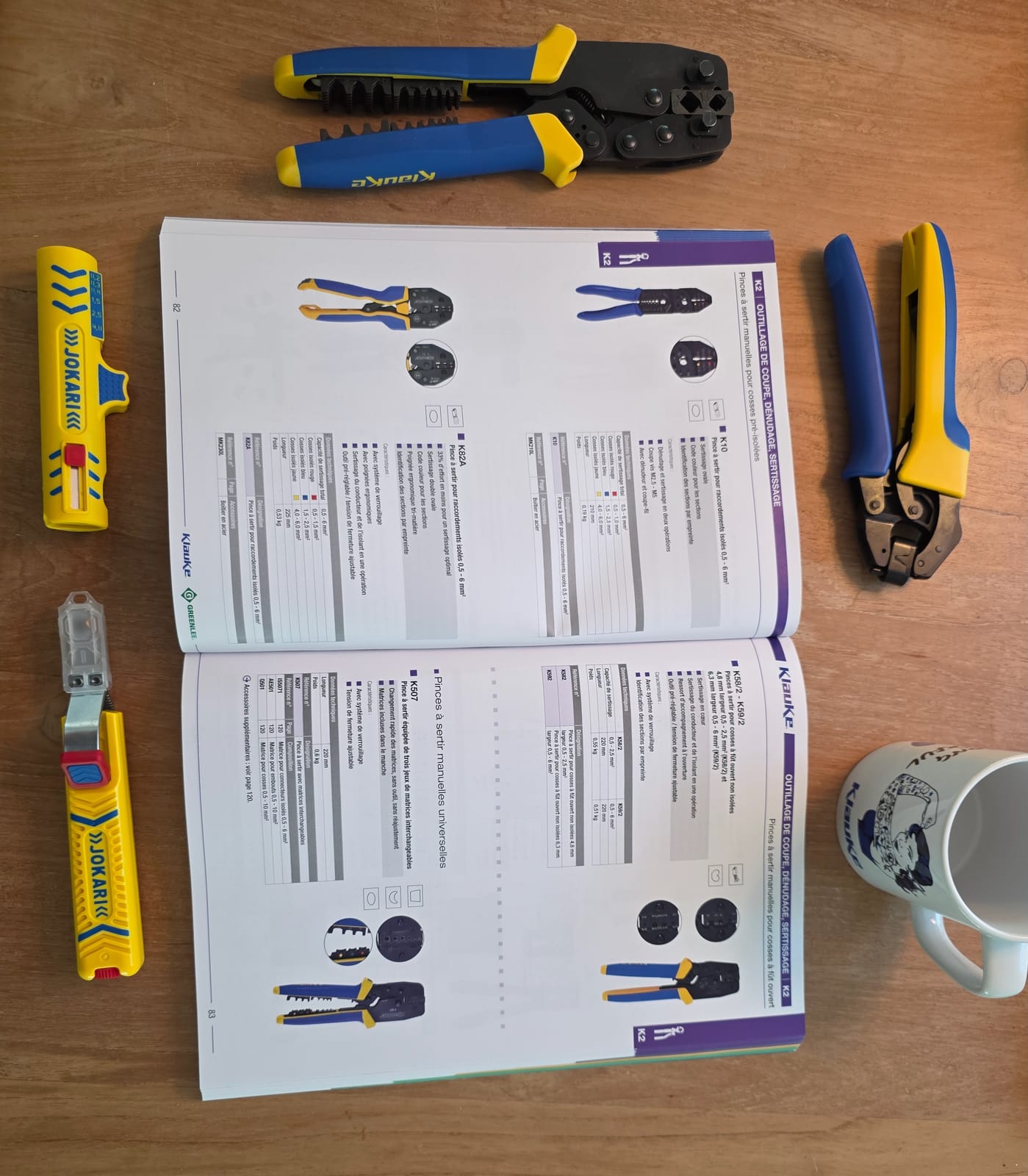
Klauke catalogue
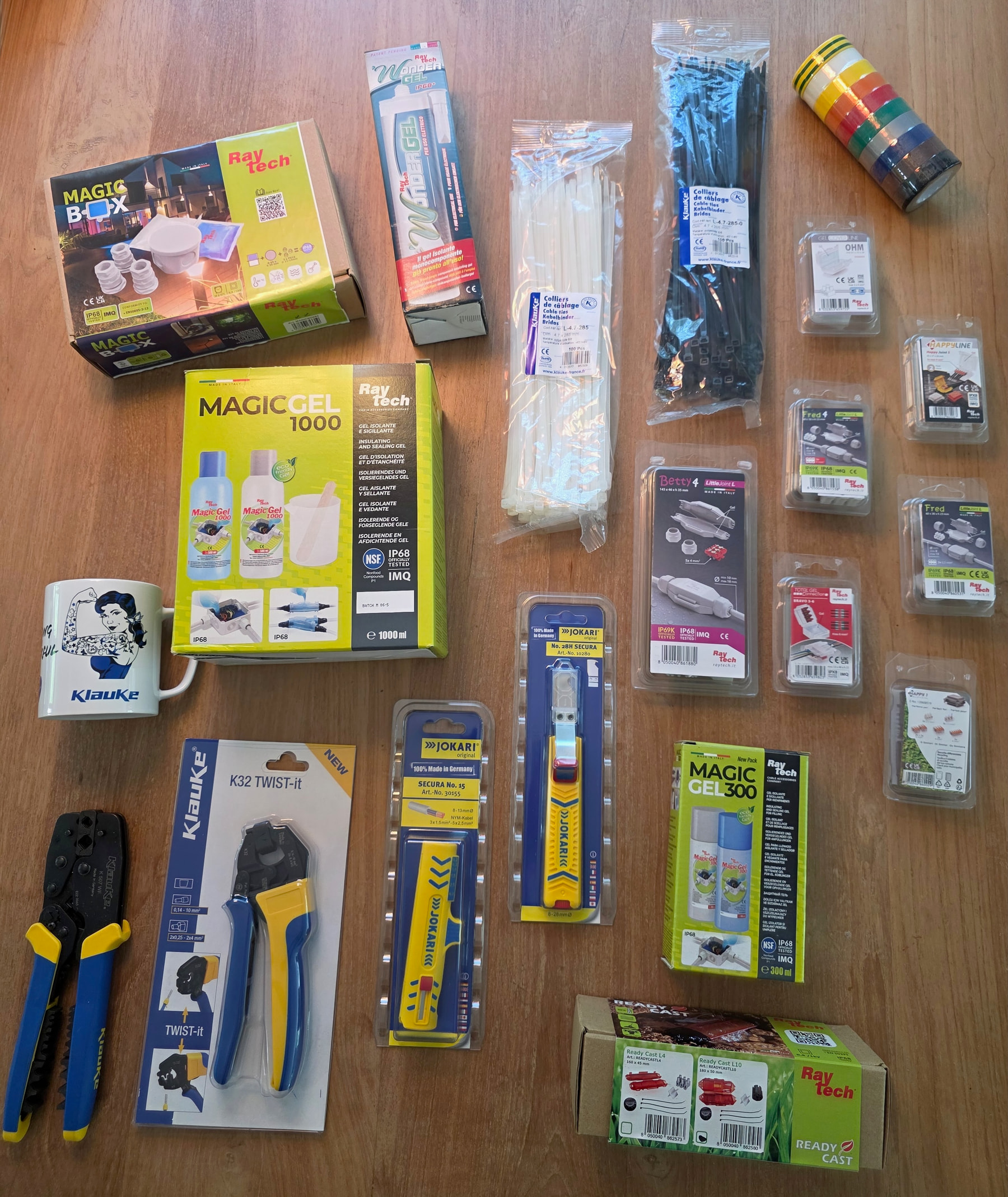
The Klauke range catalogue open on the workbench, among the pliers and the strippers: the range is as much to browse as to put to work.
Published 24 July 2026
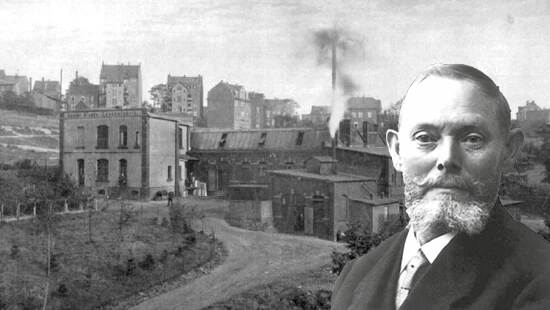 Photo : Klauke
 In brief
When I open an electrician’s toolbox for high-current work, there’s a good chance I’ll come across a crimping tool stamped Klauke. The German brand doesn’t have the mainstream recognition of a drill manufacturer, but in its niche, connection and crimping, it is one of the historic benchmarks.
Klauke is first and foremost a long story: 1879, a forged-pliers workshop in Remscheid, then a shift toward cable lugs and crimping in 1960 that defined its entire current identity.
This article retraces that trajectory, details what the brand really makes, its place within a large global group, and what its range is actually worth for an electrician working in 2026.
1879
Founded in Remscheid, Germany
1960
Shift toward cable lugs and crimping
800
Employees today, approximately
300 mm²
Common cross-sections in hydraulic crimping
The story begins far from electricity. In 1879, Gustav Klauke, 24, founded the company Gustav Klauke with his brother in the Osterbusch district of Remscheid, with five employees. Remscheid was then the German cradle of forged tools, and the workshop produced high-quality pliers and pincers.
These pliers found an immediate outlet, mainly in watchmaking, thanks to very clean hand forging. This was fine precision, the kind used to work on delicate mechanisms, not yet electrical cable.
The company grew on this know-how. In 1906, it was entered in the commercial register as a general trading company, the factory floor area reached 1 200 m² and the workforce approached around sixty people. The brand took an international turn early on.
As early as 1925 the first pliers catalogue appeared in English, followed in 1930 by French and Spanish versions. Klauke targeted export markets long before that was a given for a regional German workshop.
Succession took place within the family. In 1948, after the death of Gustav Klauke II, the company became a limited liability company, run by his son-in-law Gustav Diederichs alongside Max Klauke. This family continuity shaped the firm for a long time.
The decisive turning point was 1960. The growing electrification of post-war Germany pushed management to decide to produce cable lugs and the corresponding tools. This was the moment when Klauke stopped being a mere pliers manufacturer to become a connection specialist.
The switch was clear-cut on the production side. In 1968, traditional pliers manufacturing was stopped, while the production of lugs and crimping tools was expanded. The brand abandoned its original trade to bet everything on crimping.
That choice fixed its identity. Even today, Klauke presents itself first and foremost as a manufacturer of connection systems: the lug and the tool that crimps it are conceived as a pair, not as two separate products.
Crimping is not a detail. A badly crimped lug heats up, works loose and ends up creating a hot spot, exactly the mechanism that explains a sizzling power outlet on a failing clamp. On large cross-sections, this defect costs dearly.
That is why a manufacturer that masters both the geometry of the lug and the crimping force has a real argument. Crimping creates a cold, sealed and mechanically stable joint, where a simple screw can loosen over time.
In 1979, Gustav Klauke GmbH celebrates its centenary in Remscheid, by then firmly established in its role as a specialist. The founder’s name has remained, but the product has nothing in common with the original watchmaker’s pliers.
The current range is easier to understand if you break it down into families.
Electrical connection technology brings together the consumables: copper lugs and sleeves, aluminium or Al/Cu bimetal, crimped lugs to the DIN standard, wire end ferrules, connectors and insulated or uninsulated joints.
These consumables account for a major share of the business. According to the trade press, Klauke’s revenue is split in roughly equal shares between connection consumables and tools. The brand lives as much from the lug as from the crimping tool.
Klauke catalogue
The Klauke range catalogue open on the workbench, among the pliers and the strippers: the range is as much to browse as to put to work.
When it comes to tooling, the structure is logical. Crimping tools range from the mechanical pliers to the battery-powered electro-hydraulic crimper, including the interchangeable hydraulic heads and die systems.
| Family | Role | Usage type |
|---|---|---|
| Family Lugs and splices | Role Connection consumable | Usage type Connect a conductor to a terminal block or busbar |
| Family Dies / inserts | Role Crimp shape | Usage type Give the hexagonal or punch imprint |
| Family Mechanical pliers | Role Manual crimping | Usage type Small and medium workshop cross-sections |
| Family Hydraulic crimpers | Role Power crimping | Usage type Large cross-sections up to 300 mm² and above |
| Family Cutting tools | Role Cut the cable | Usage type Cut copper and aluminium cleanly |
The main families of the Klauke range, from consumables to power tools.
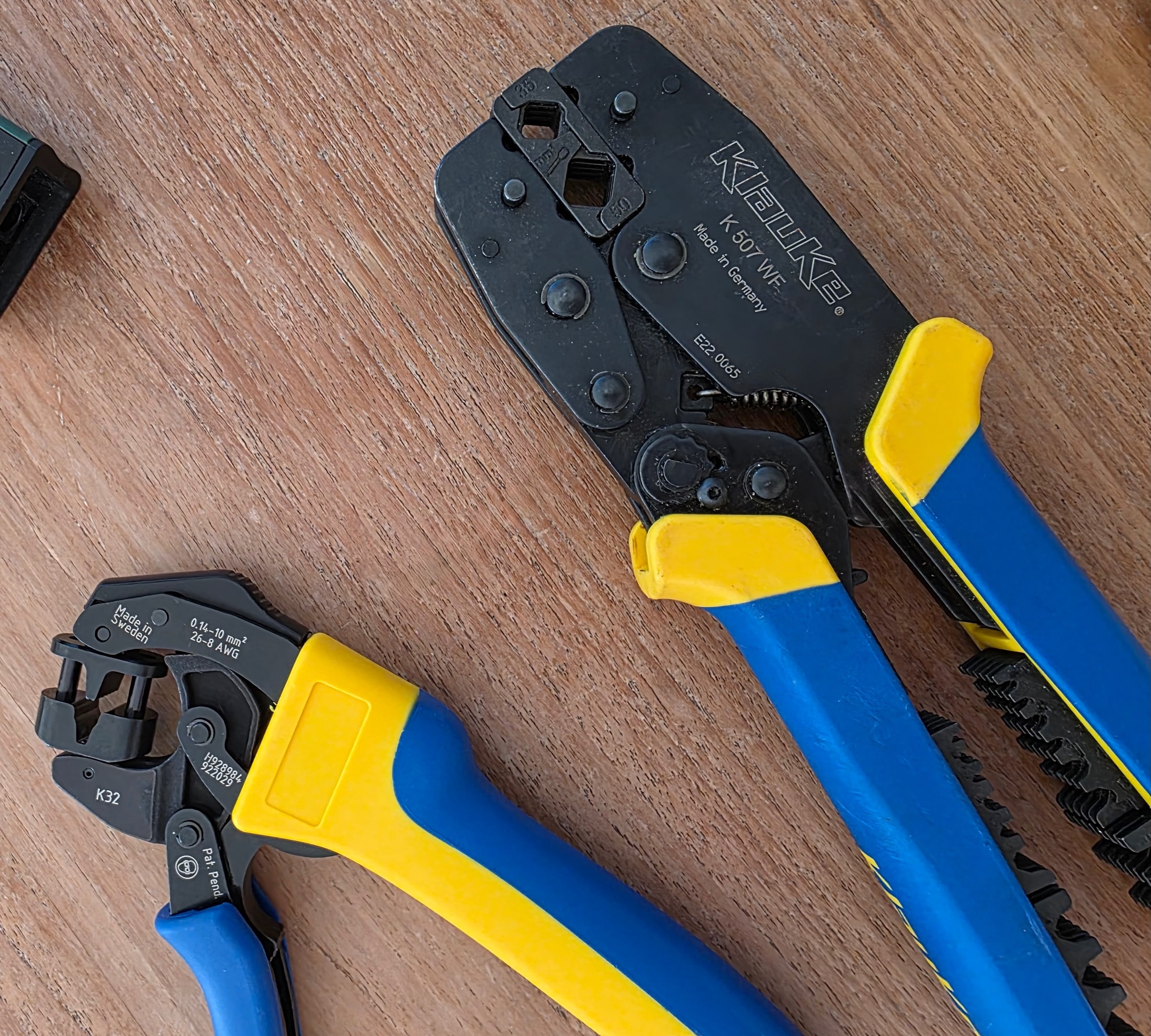
The die, or insert, is an element that the uninitiated underestimate. It is what gives the crimp its shape: a hexagonal imprint distributes the pressure over the entire circumference of the lug, which guarantees a homogeneous contact and reproducible mechanical strength.
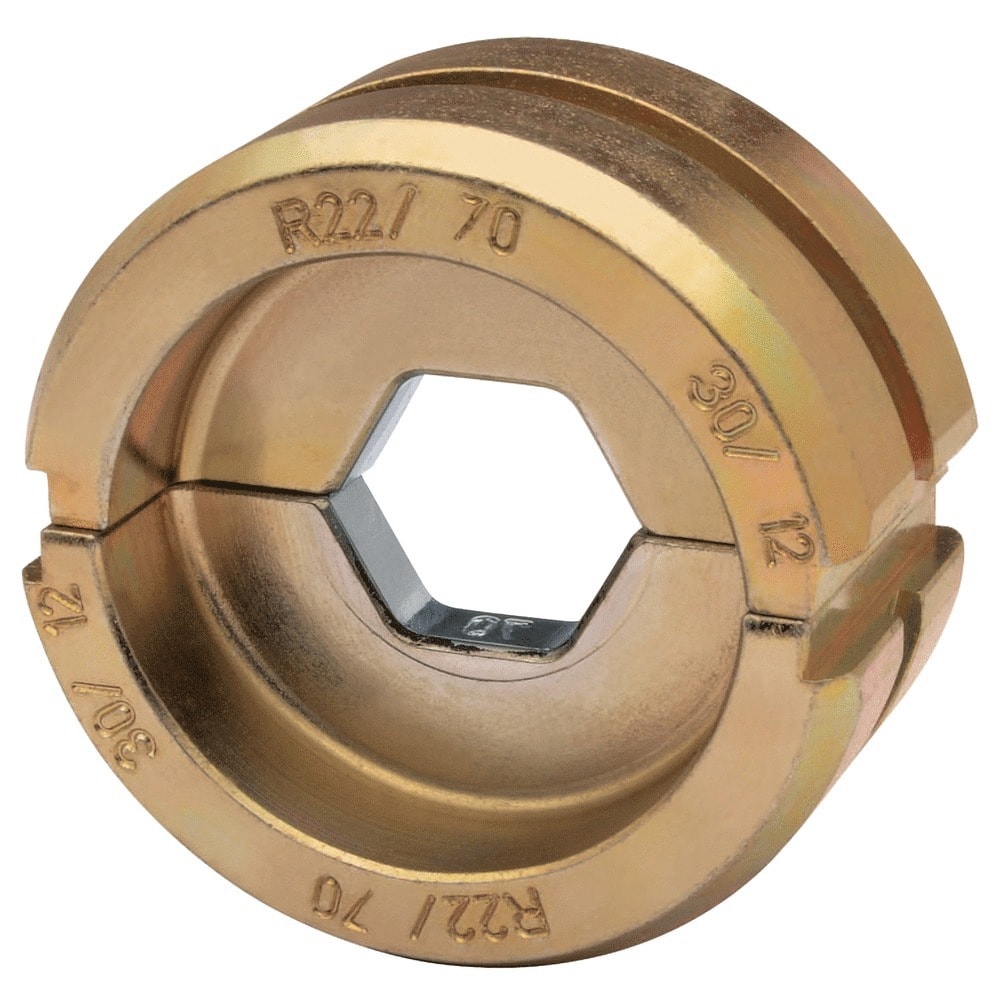
Each cable cross-section and each type of lug calls for a specific die. It is this system logic, lug plus die plus tool, that distinguishes a crimping specialist from a general-purpose tool manufacturer. A mismatched die gives an out-of-spec crimp, even with a good tool.
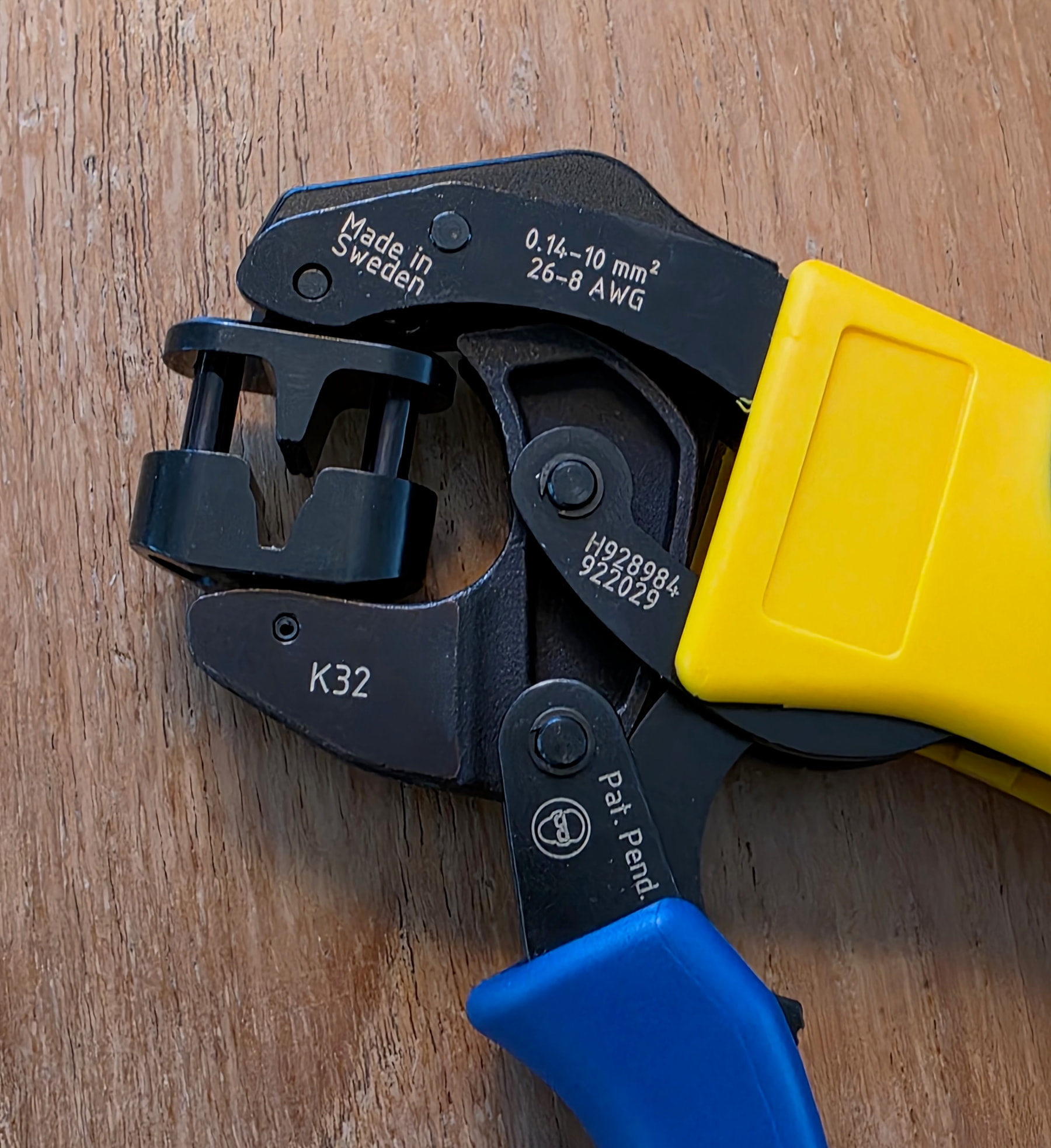
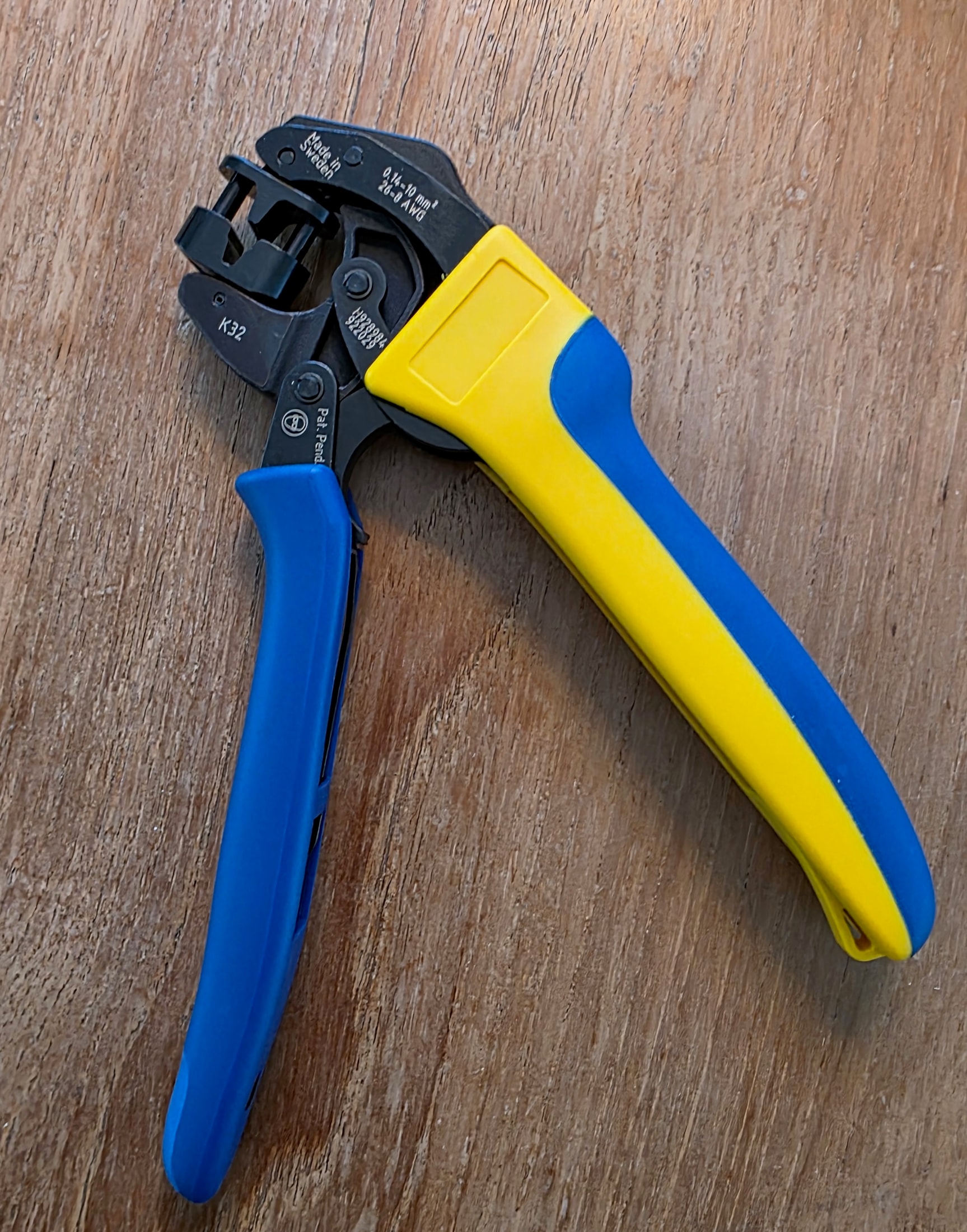
The big technical evolution at Klauke is the move to electro-hydraulics. On a small cross-section, a mechanical crimping tool is enough, like the Klauke K32 TWIST-it and K507 WF manual crimping tools that I have handled.
Once you go up in cross-section, the required force exceeds what an arm can provide cleanly and repeatably.
Battery-powered crimpers solve this problem. A model like the EK 60 develops a crimping force of several tens of kilonewtons and covers cross-sections from 6 to 300 mm², with a crimping time of a few seconds and automatic return of the head after the cycle.
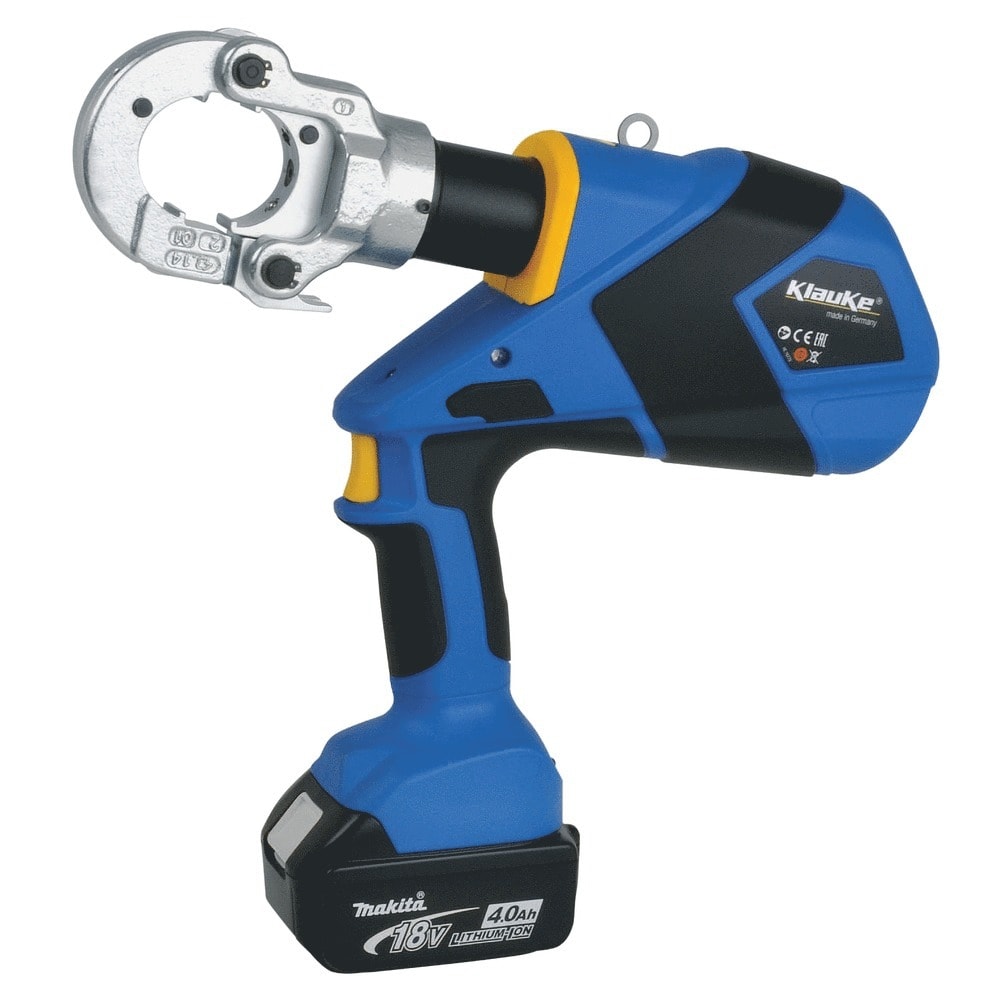
These tools run on lithium-ion battery packs, including batteries from third-party platforms such as Bosch or Makita depending on the model. This choice to open up to shared battery packs echoes the compatibility logic found among cordless tool manufacturers described in the history of Makita.
Power crimping concerns large feeders directly. When sizing a supply with a 400 V three-phase cable cross-section, you quickly end up with conductors of 25, 35 or 50 mm² that do not connect properly to the hand crimper.
Here, the hydraulic crimping tool becomes the mandatory tool.
Connecting heavy equipment follows the same logic. On a heat pump or a large panel feeder, large-section lugs require certified crimping, not an approximate tightening that will loosen over time.
Klauke also maintains a range of manual hydraulic crimping tools, with an integrated lever pump. They offer hydraulic force with no electronics and no battery, which remains appreciated for occasional use or in environments where you do not want to depend on a battery pack.
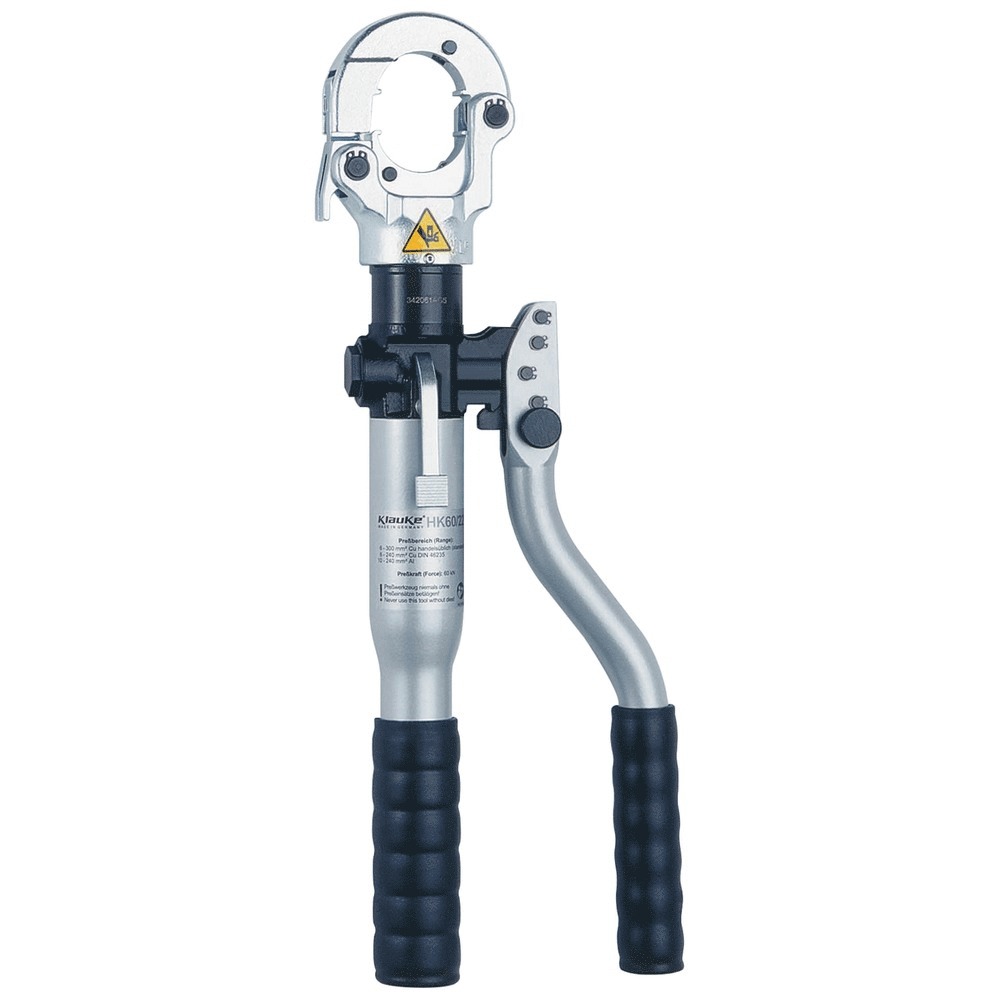
Manual hydraulic crimping tool
Two levers drive the hydraulic cylinder: hydraulic force with no electronics and no battery.
Klauke — Manual hydraulic crimping toolsThis coexistence of manual and cordless is a hallmark of the brand. Klauke does not seek to impose a single technology: it covers the task from the wire end ferrule to the power cable, with the tool suited to each level of effort.
Crimping is not enough: you first have to cut the cable cleanly. A clean shear avoids crushing the conductor and a sloppy crimp start. Klauke therefore offers a range of cutting tools: mechanical ratchet, electromechanical and hydraulic.
Ratchet cable cutter
The classic of the cutting range: the blade goes around the cable instead of flattening it.
The ratchet cable cutter is a classic of the trade. The mechanism multiplies force and lets you cut through copper or large-cross-section aluminium without harsh effort, with a blade that goes around the cable instead of flattening it.
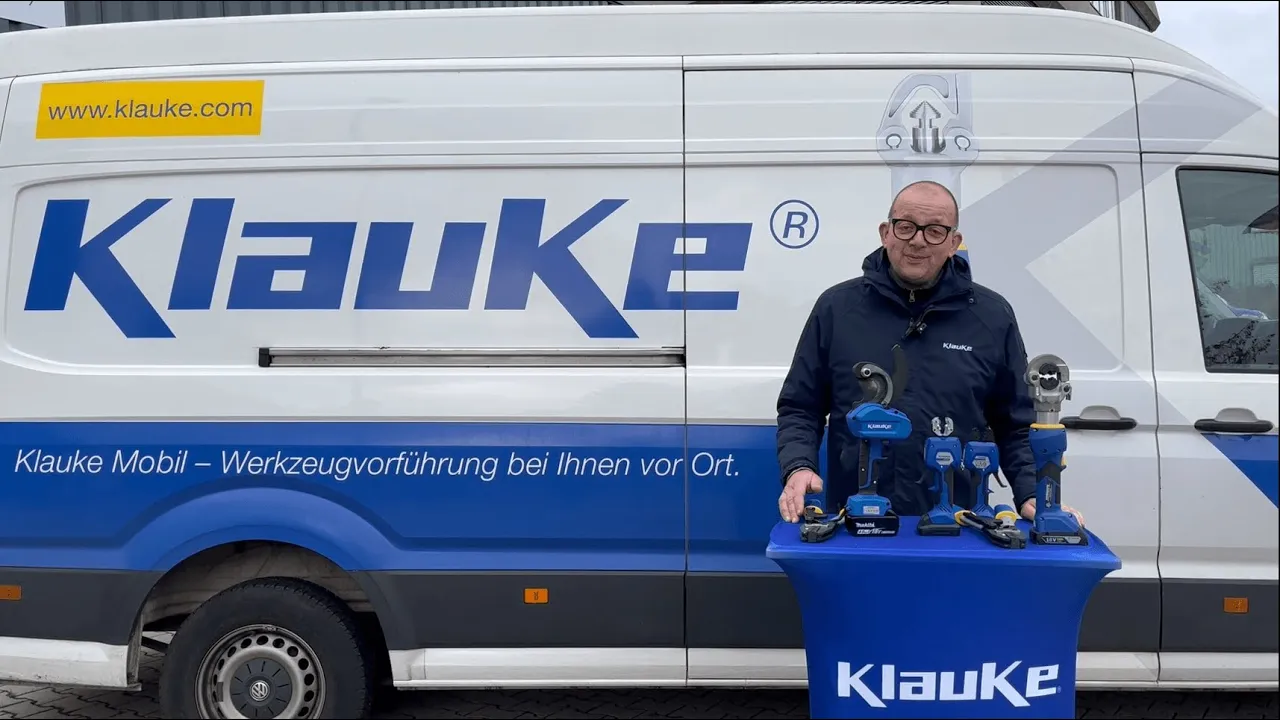
Klauke claims a notable innovation in this field: the first battery-powered hydraulic cutting and crimping tools incorporating protection against voltage up to 1 000 V. This is a safety argument aimed directly at work on or near live voltage.
This safety dimension makes sense for a professional. On an installation whose real condition is unknown, for example a house with old electrical wires from the 1970s, the certainty that the tool is insulated changes the way you approach the job.
The insulation of a tool never replaces lockout. It constitutes a complementary protection, not an authorization to work live: disconnection and the verification of absence of voltage remain the rule.
Klauke is no longer an independent family business. The brand now belongs to the American group Emerson, within its Professional Tools division, alongside Greenlee in particular. The brand’s official page is in fact hosted within the Emerson ecosystem.
This ownership explains several things. The depth of the range, the presence of Greenlee drilling and punching tools in the Klauke catalog, and a structured international distribution stem from this group logic.
In concrete terms, the historic Remscheid factory still produces cable lugs and electro-hydraulic tools, with workshops dedicated to connection, component machining and assembly. A specific workshop even manufactures cable lugs for subcontractors in the automotive industry.
The company today has around 800 employees, with revenue of around 139 million euros, split equally between consumables and tools. It is a long way from the five-person workshop of 1879, but the core business, connection, has not changed since 1960.
In 2026, an electrician buying battery-powered crimping mainly sees generalist platforms pushing their own crimpers. So the question of Klauke’s positioning against a player like Milwaukee comes up often, and it deserves a dedicated article rather than a shortcut.
The heart of the matter comes down to one sentence: Klauke is a connection specialist that also makes tools, whereas a battery platform is a tool manufacturer that adds crimping to its catalogue. The details of this logic are covered in my review of the Klauke EK 50 ML crimper.
This difference in DNA shows in the system logic. At Klauke, the lug, the die and the tool are designed together, with crimping traceability designed for standards requirements.
The debate between long-standing specialists also comes up in the history of Cembre, two houses of pure crimping.
On the other side, the platforms’ advantage lies elsewhere: a single battery ecosystem for the drill, the screwdriver and the crimper. This trade-off between specialist and platform is the same as the one described in the Dewalt, Makita and Milwaukee comparison, transposed to crimping.
3 questions
InteractiveQuiz: Klauke, the German crimping specialist
3 questions to check the essential points
Choose an answer
A good crimp comes down first and foremost to preparation. Several points count when starting the cycle: the stripped length, the insertion of the lug and matching with the die.
If any of these points is approximate, no tool will save the connection. Durability over time is decided upstream.
The order I follow at the bench and on site comes down to a few simple gestures.
The final check is visual and mechanical: a regular impression, a terminal with no split, a conductor that does not move under moderate stress. That is what I check before putting the tool away.
Most of the failed crimps I see do not come from the tool, but from a detail upstream. Once the cycle has started, recovery is no longer possible.
None of these errors is visible on the tool. It shows up on the connection, sometimes long afterwards, when a hot spot develops on a poorly checked crimp.
A crimping tool lives a long time if it is given a minimum of attention. In a site tool case, dust and copper shavings build up quickly.
This maintenance takes little time and avoids a breakdown at the wrong moment, inside a cabinet or at the top of a stepladder. A tool that is looked after stays predictable at the moment of the cycle.
The choice of a crimping tool comes down to the cross-section to be handled, how often it is used and access to the connection point, not on the rest of the catalogue.
The right tool is the one that covers my usual cross-sections, with the matching dies and a power supply that suits me. The rest is secondary.
Crimping is not the answer to every connection. I reserve it for cases where the connection has to last, with a lug as the interface between the cable and the terminal block.
These limits come down to technique, not to the brand. A successful crimp is prepared upstream, and it is that preparation that makes the difference over time.
For a typical residential installer, most crimping comes down to wire end ferrules and small lugs.
In that area, the gap with a good general-purpose crimper is small, and many connections are now made without crimping, with automatic connectors like those mentioned in the choice between Wago 221 and 2273.
The real value of Klauke shows up as you move up in cross-section and in requirements.
As soon as you connect high-power feeders, run a new line as in a project for running a cable from the electrical panel, or need to guarantee a certified connection, the brand’s system logic makes complete sense.
Choosing within the range mainly comes down to the connector, cross-section, die and tool family. Some models use interchangeable dies, others are die-free; on battery-powered tools, the compatible battery platform depends on the exact model.
In my work, that system logic matters most when a power connection must be made repeatably with the intended lug, matching die and matching tool.
Retour de chantier
Crimping does not forgive approximation on large cross-sections. The lug and die pairing must be exact: an out-of-spec die produces a non-compliant crimp, even with a high-end tool.
Klauke is a German brand, founded in 1879 in Remscheid, whose historic factory still produces the lugs and the tools. For several years it has belonged to the American group Emerson, in its Professional Tools division, alongside Greenlee. The expertise and the production remain rooted in Germany.
The turning point dates back to 1960, when electrification pushed the company to produce lugs and the corresponding tools. In 1968, the historic manufacture of watchmaker's pliers was stopped to focus entirely on crimping and connection, which remain its core business.
For light residential work, no: most connections are made on small cross-sections or with automatic terminals, as when you have to mix stranded and solid wire on a Wago connector. A Klauke tool becomes relevant as soon as you regularly crimp large cross-section lugs.
No, but several models accept batteries from third-party platforms such as Bosch or Makita, depending on the reference. That is an advantage when you already own one of these ecosystems, because it avoids buying a battery fleet dedicated solely to the crimper.
The mechanical crimper is suitable for small and medium cross-sections with manual effort. The hydraulic crimper, manual or battery-powered, develops several tens of kilonewtons and covers large cross-sections up to 300 mm², with a repeatable force that the arm cannot provide on its own.
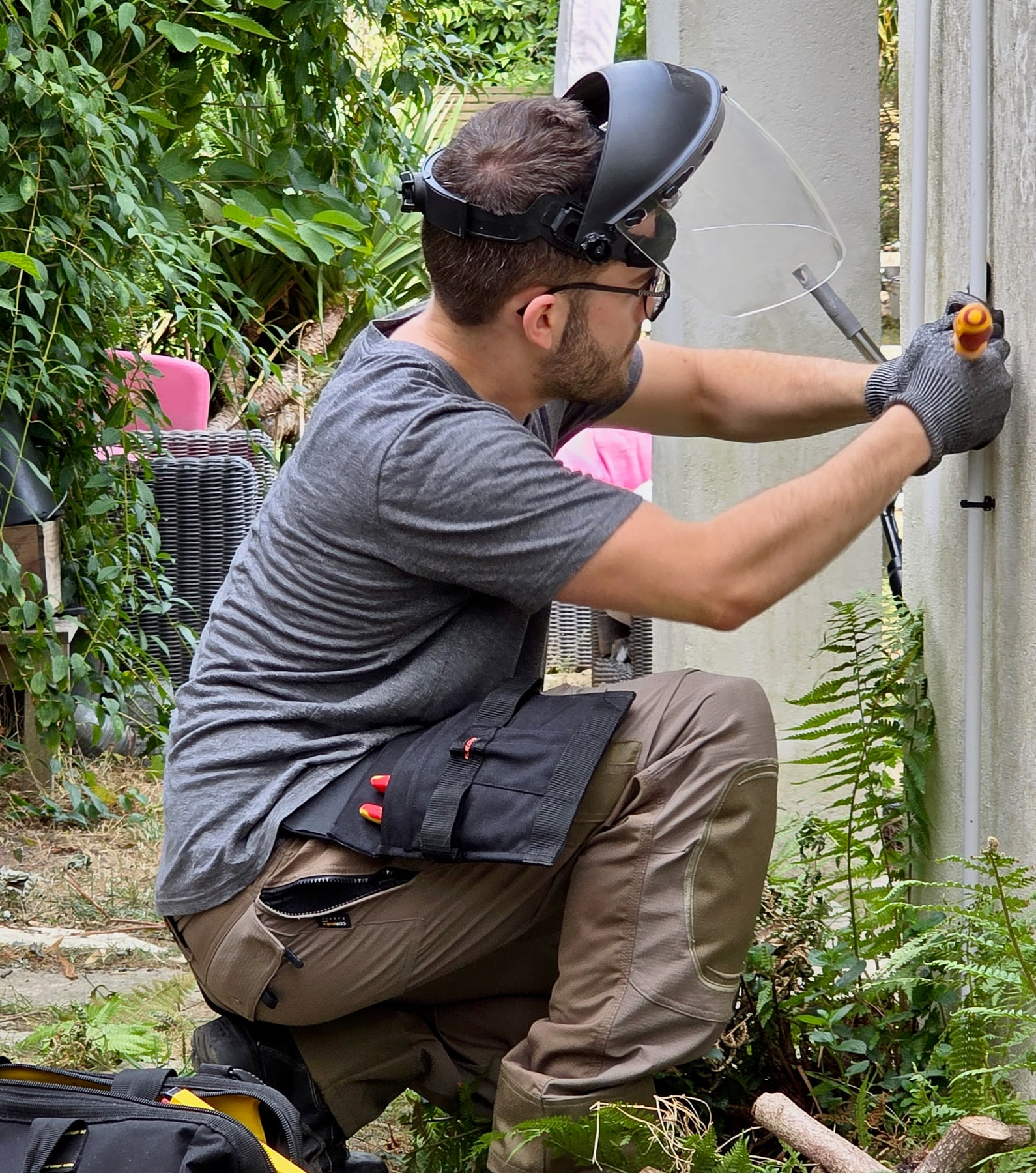
Théo Desrousseaux
Electrician and editor
I work in the field and edit this magazine. Every guide is reviewed for its target country before publication.
Sources and references
Practical electrical installation guides, diagnostic methods and tool recommendations compared against the technical wiring standards of this national edition.
Review of the Klauke EK30IDML: die-free hydraulic crimping from 6 to 120 mm², 30 kN of force, connector scope and documented specifications.
Read the guide Guide Wera: brand history Wera: founded in 1936 in Wuppertal, name taken from Werner and Amtenbrink, Kraftform handle in 1968, Czech production from 1995, Bitburger Holding since 2016. Read the guide
  Guide Klauke EK 50 ML: characteristics and limitations Klauke EK 50 ML: verified specifications, compatible dies, the contents of the case and the limits for wiring and crimping before buying. Read the guide
 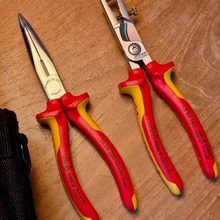 Guide Knipex: the story of the brand Founded in 1882 in Germany, Knipex makes the pliers chosen by professional electricians: history, innovations and a lasting commitment. Read the guide