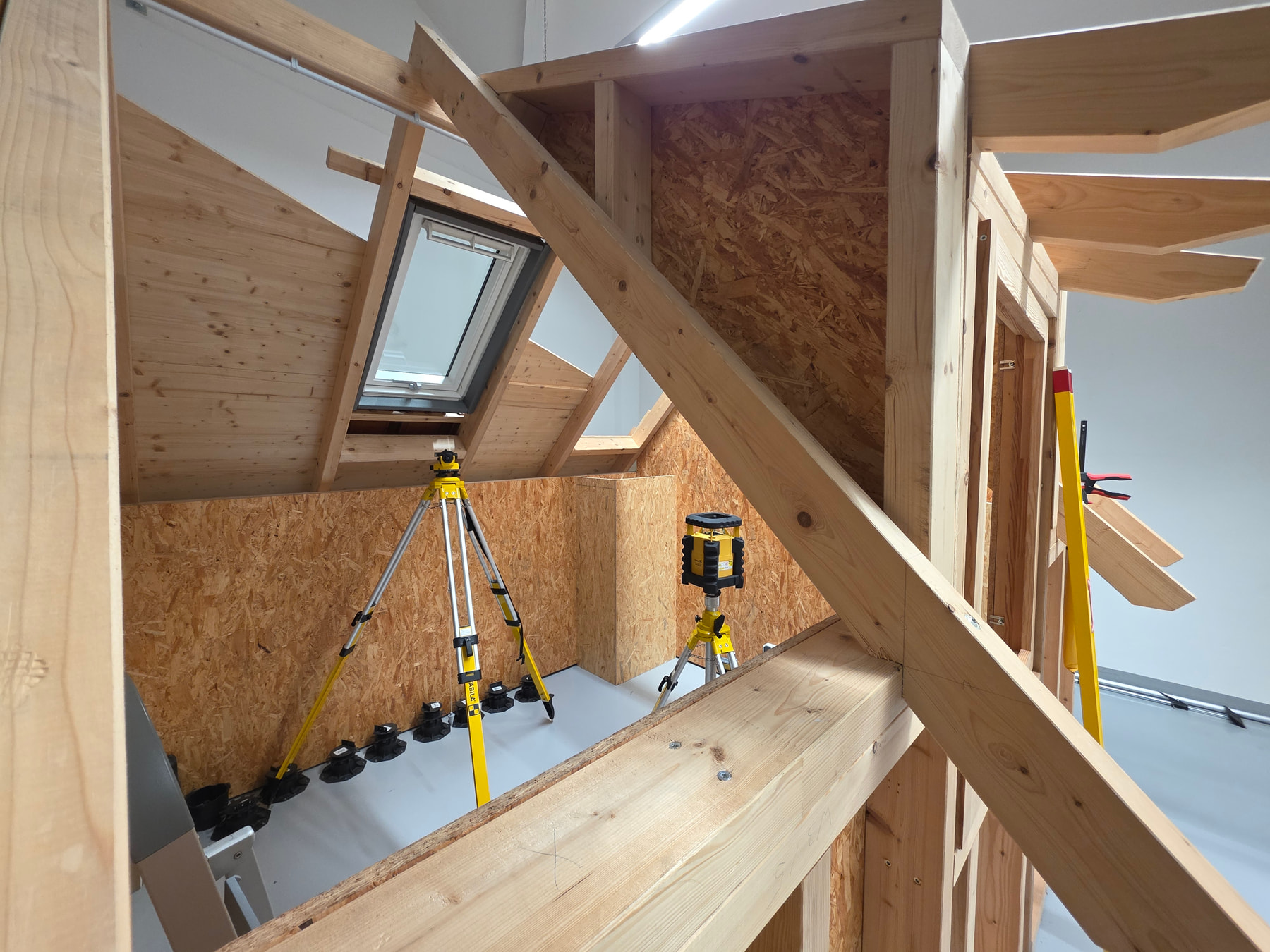
Receiver being demonstrated
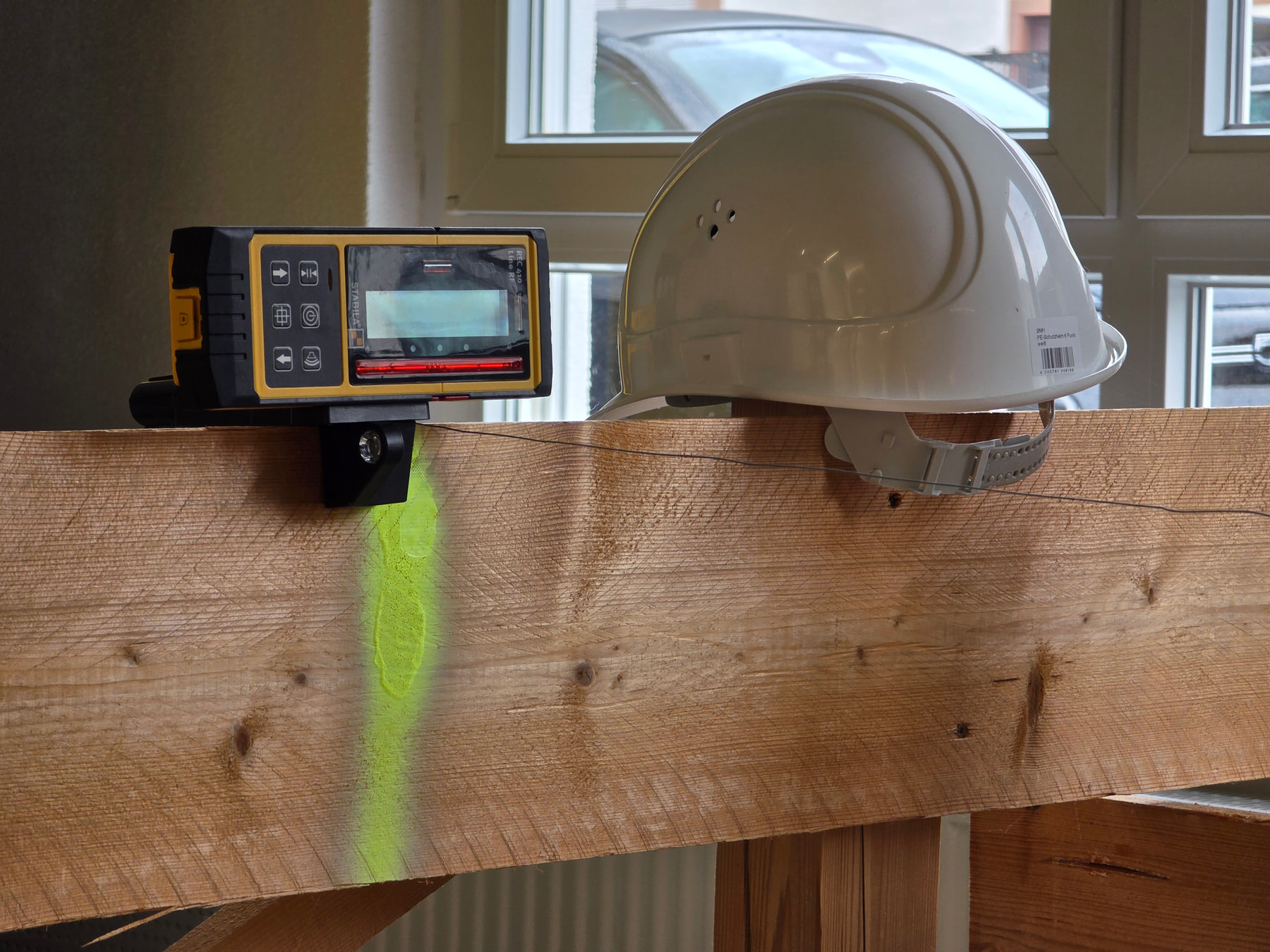
Clipped onto the structure, the receiver picks up the green beam where the eye can no longer make it out: it is the receiver that handles the long ranges.
In brief
To choose between a Bosch, STABILA or Leica laser level, the decision comes down to four points: the beam colour, the number of lines, the real-world range and the IP rating.
Among current models, the Bosch GLL 3-80 projects three red lines at 360° with an accuracy of ± 0.3 mm/m, the STABILA LAX 600 G three green lines at 360° with an IP65 rating specified without its battery, and the Leica Lino L2P5G two lines and four green points with a levelling accuracy of ± 0.2 mm/m.
Here I compare three instruments that I can check against the official spec sheets, along with the list prices the manufacturers advertise when they give them.
The goal is simple: to know which one will actually be used to mark out a chase, fit a rail or set out a row of back boxes, without paying for a range you’ll never need on site.
± 0.3 mm/m
quoted levelling accuracy of the Bosch GLL 3-80
40 m
quoted range of the STABILA LAX 600 G with a green beam
± 0.2 mm/m
quoted levelling accuracy of the Leica Lino L2P5G
£338.18
Bosch UK price incl. VAT, 15 October 2026, GLL 3-80 ref. 0601063S00
A line laser level spec sheet always lists the same values, and they don’t all weigh the same when choosing. Levelling accuracy is given in mm per metre: it tells you how far the line can deviate from true horizontal over one metre of distance.
The three brands quote comparable figures, between ± 0.2 and ± 0.3 mm/m, which is typical of professional line laser levels.
Important clarification: the performance of ordinary site levels and lasers is not governed by any mandatory harmonised standard — the French standard NF E11-301 exists for spirit levels, but it does not impose the advertised commercial figures, and only the rigour of manufacturer quality control backs them up.
On this front, STABILA publicly documents its process and its checks in detail.
The range is the most misleading figure on the spec sheet. It is measured under ideal conditions, in the dark, with a receiver for the maximum ranges.
The Bosch GLL 3-80, for example, advertises a working range of 30 m (without receiver) and 120 m with the LR 6 or LR 7 receiver: on a bathroom wall you are renovating, the line remains readable at a few metres, and that is what counts.
Self-levelling is also worth a look. The self-levelling range indicates how far the device can be tilted before it levels itself automatically: ± 4° on the GLL 3-80 and on the Lino L2P5G. Beyond that, the laser flashes or switches off, and you have to reposition the device.
Finally, the IP rating helps determine suitable exposure, but it applies only to the tested configuration: IP54 indicates limited dust ingress and splash protection; IP65 indicates dust-tight and protection against water jets. STABILA specifies its LAX 600 G IP65 rating without the battery fitted, so I do not transfer that rating to the complete battery-powered setup.
This is the first choice to make, and it is simple: the green beam is more visible than the red one in full daylight, while red costs less.
Manufacturers use diodes with different wavelengths: Bosch emits red between 630 and 650 nm on the GLL 3-80, Leica emits green at 525 nm on the Lino L2P5G, and STABILA in green with its GREENBEAM technology on the LAX 600 G.
Human eye sensitivity peaks around 550 nm: green at 525 to 532 nm therefore stands out far more clearly on a pale wall in window light. In practice, in a very bright room, a red line stays visible over 3 to 5 m, while a green line often holds all the way across a whole room.
This is not a comfort argument; it is a direct time saving when I am marking out a chase on my own at the other end of a room.
The extra cost of green is justified in two cases: regular use for lit indoor renovation work, or jobs in daylight. For occasional use in an enclosed room, red is enough, and the price difference can pay for a tripod.
Choosing between a spirit level and a laser is another matter altogether, which I covered in my STABILA, Stanley and Bosch comparison.

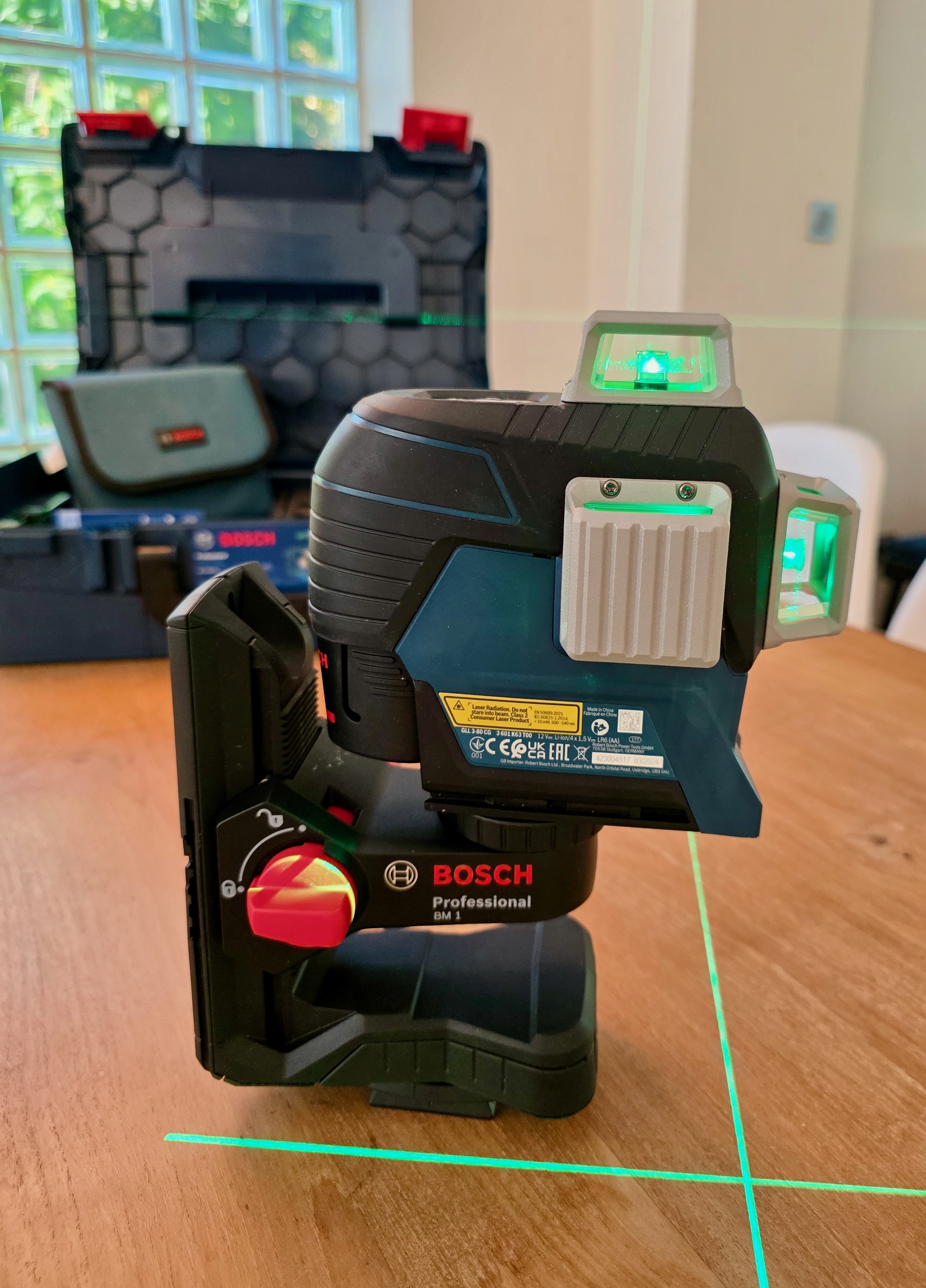
The GLL 3-80 Professional, reference 0 601 063 S00, is widely used on construction sites. Its three 360° lines cover an entire room from a single point: one horizontal and two vertical, which is enough to set out both the socket height and the plumb of a partition at the same time.
The stated accuracy is ± 0.3 mm/m, the levelling time is 4 seconds, and the device runs on 4 AA batteries with a stated battery life of 4 hours in three-line mode.
Its strength on an electrician’s job site is versatility at a traceable UK price: Bosch UK displayed £338.18 incl. VAT for reference 0601063S00 on 15 October 2026. Check the precise bundle and the current price before ordering. The IP54 rating and the weight of 0.82 kg make it a van tool, not a laboratory instrument.
On the accessories side, Bosch UK showed the BM 1 universal mount at £58.99 incl. VAT and the BT 250 tripod at £103.47 incl. VAT, checked on 15 October 2026. Prices vary and these are separate items; confirm your kit contents before ordering. The laser offers 1/4” and 5/8” mounting threads.

The weak point of this model is its red colour: in a very bright room, the lines fade. To stay with Bosch and get a green beam, you need to move up to the higher-tier models, which changes the budget. That’s exactly the kind of trade-off I detail in my STABILA, Stanley and Bosch comparison.
The LAX 600 G from STABILA directly addresses that limitation: three 360° green lines, with the GREENBEAM technology the brand claims gives visibility up to 40 m. The manufacturer quotes a levelling accuracy of ± 0.3 mm/m and a self-levelling range of around ± 4°.
The unit runs on the multi-brand CAS 12 V battery platform, with a claimed runtime of up to 15 hours and a full charge in a maximum of 45 minutes with the fast charger, and STABILA states IP65 protection without the battery fitted. The Bosch GLL 3-80 and Leica Lino L2P5G are specified as IP54; the IP figures do not compare complete powered setups on identical terms.
On a renovation site, that choice makes sense: plasterboard dust and water splashes are not uncommon, and a sealed instrument avoids the nasty surprise of a sensor that refuses to self-level.
The self-levelling pendulum is designed for site conditions, and the brand also offers the LAX 600 in red (claimed range of 30 m, up to 28 hours of runtime) for those who want to stay with a red beam.
For interior fit-out work, the LAX 60 G launched in 2026 rounds out the range: compact cross lines claimed up to 30 m without a receiver and 80 m with a receiver in pulsed mode, running on three AA batteries.
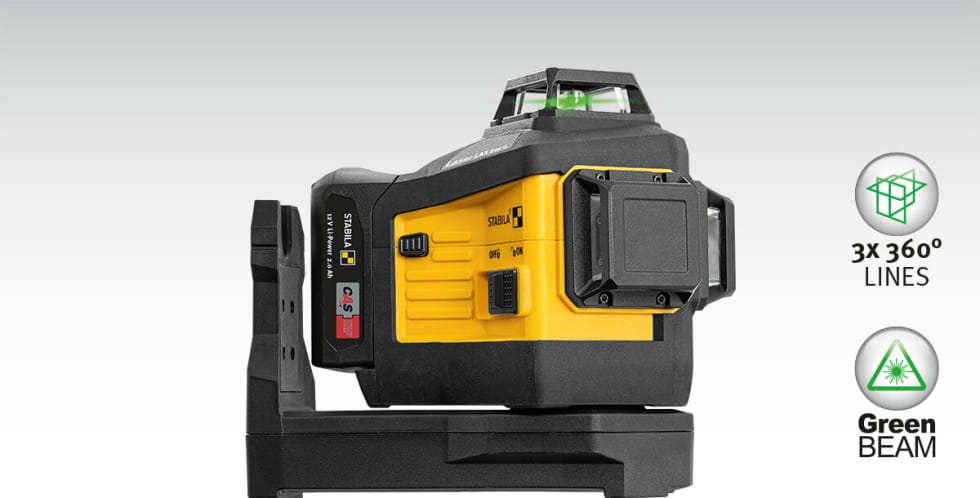
STABILA’s logic is that of a measuring ecosystem: the line laser joins the brand’s electronic levels and distance meters, which I discuss in my piece on the usefulness of the electronic level.
The LAX 600 G doesn’t list a retail price on the manufacturer’s website: it’s sold through distributors, and you should expect to pay more than the red GLL 3-80, though I can’t give a verified figure.
Receiver being demonstrated
Clipped onto the structure, the receiver picks up the green beam where the eye can no longer make it out: it is the receiver that handles the long ranges.
It’s this transmitter-receiver pair that delivers the real working range on a job site, far more than the figure on the spec sheet.
For the LAX 600 G, STABILA lists the REC 500 RG receiver, quoted with a working range of up to 200 m diameter — the photo above shows a rotary laser receiver as demonstrated at the training centre, not the original setup for the LAX 600 G.
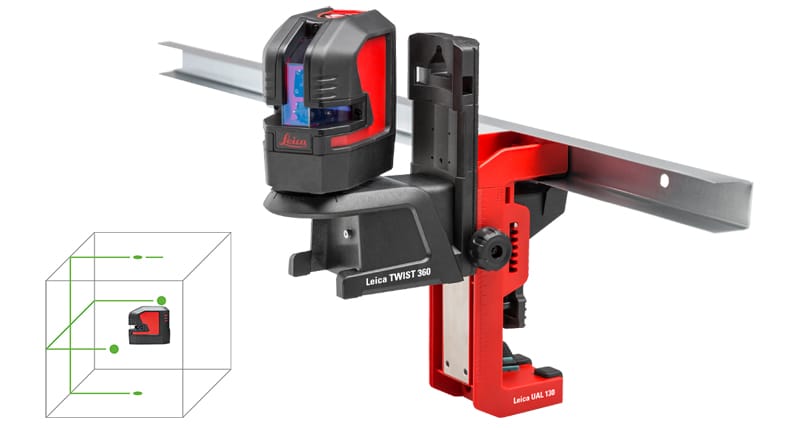
Leica Geosystems has long been the precision measurement specialist, and the Lino L2P5G brings that heritage to the line laser. What sets it apart: two lines (one horizontal, one vertical) and four points (plumb up and down, plus left and right), all in a 525 nm green beam, laser class 2.
The official technical brochure quotes a levelling accuracy of ± 0.2 mm/m, lines at ± 0.3 mm/m, a range of 35 m (80 m with receiver) and a runtime of up to 28 hours on a Li-Ion battery.
It’s not the most spectacular tool in the line-up: two lines versus three from Bosch and STABILA. But the four plumb points make all the difference when transferring a vertical position from ceiling to floor, for example for a suspended light fitting or a conduit that has to line up.
The IP 54 rating, the 1/4” thread and the 530 g weight make it a complete indoor site tool.
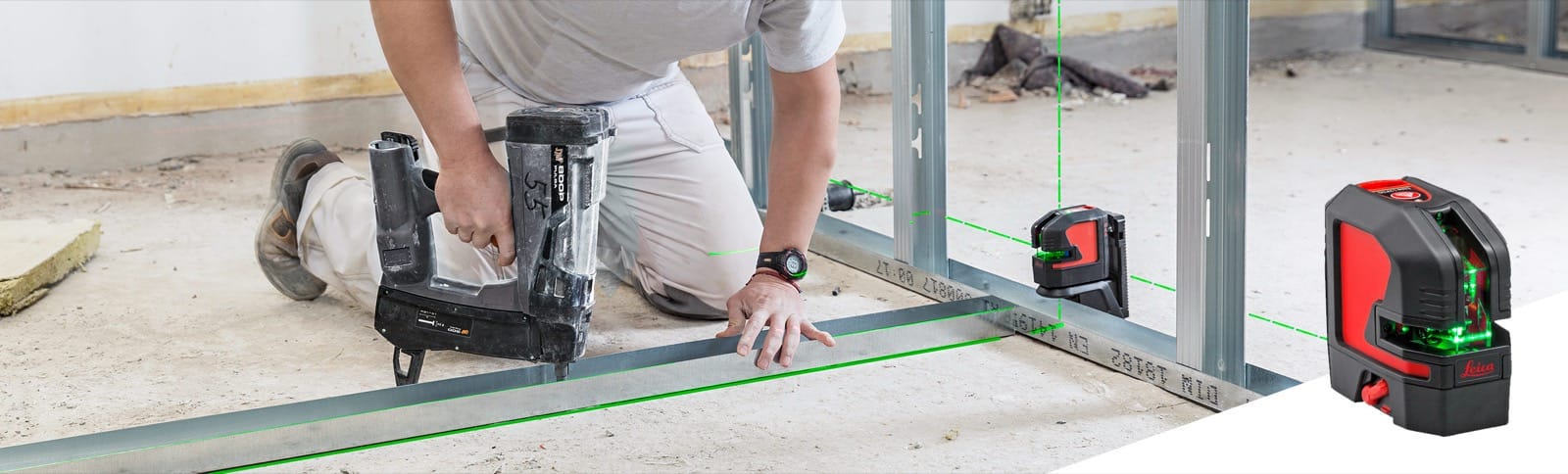
The L2P5G in use for a vertical transfer: the line and the points work together.
Source: Leica Geosystems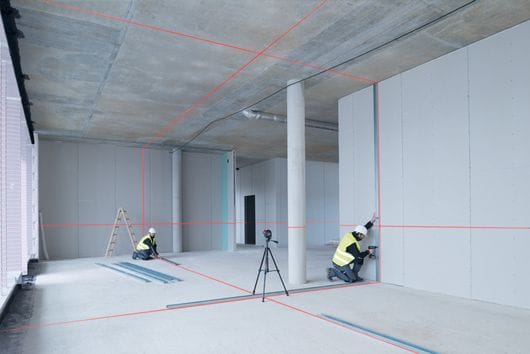
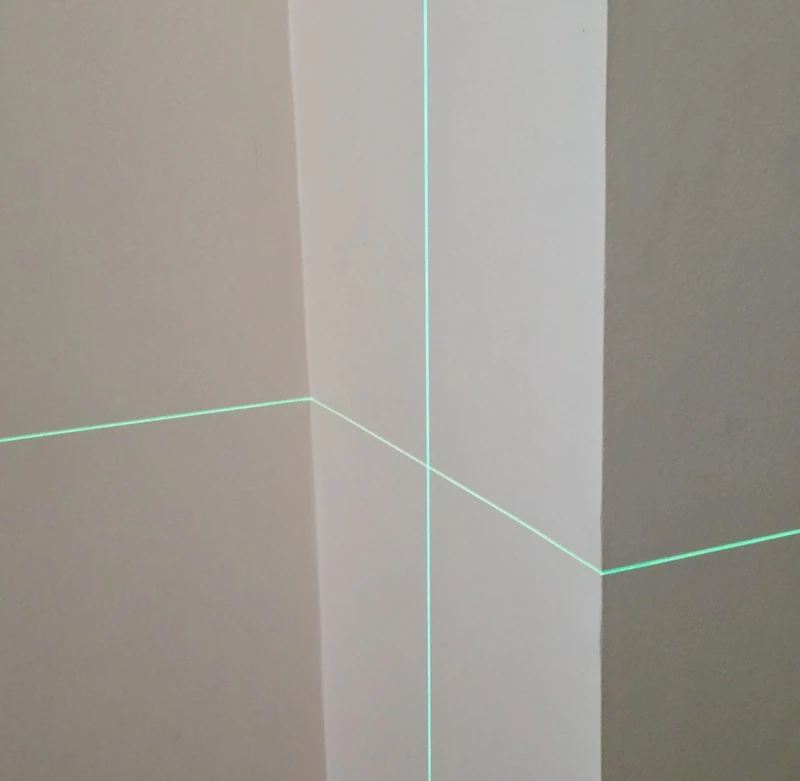
Typical use of a line laser: aligning framing, a rail or a row of back boxes.
Source: Bosch ProfessionalLeica positions the Lino L2P5G as a precision model. The French-market €624 figure is not a verified UK selling price; obtain a current British quote for the exact kit and confirm whether VAT is included. The extra levelling accuracy may matter on precision finishing work, but compare the complete bundle and the type of measurement being quoted.
Here is the comparison table, using only the figures quoted by the manufacturers and verified on their official spec sheets.
| Feature | Bosch GLL 3-80 | STABILA LAX 600 G | Leica Lino L2P5G |
|---|---|---|---|
| Feature Lines | Bosch GLL 3-80 3 360° lines | STABILA LAX 600 G 3 360° lines | Leica Lino L2P5G 2 lines + 4 points |
| Feature Colour | Bosch GLL 3-80 Red, 630-650 nm | STABILA LAX 600 G Green, GREENBEAM | Leica Lino L2P5G Green, 525 nm |
| Feature Accuracy | Bosch GLL 3-80 ± 0.3 mm/m | STABILA LAX 600 G ± 0.3 mm/m | Leica Lino L2P5G Levelling ± 0.2 mm/m, lines ± 0.3 mm/m |
| Feature Quoted range | Bosch GLL 3-80 30 m, 120 m with receiver | STABILA LAX 600 G Up to 40 m | Leica Lino L2P5G 35 m, 80 m with receiver |
| Feature Self-levelling | Bosch GLL 3-80 ± 4° | STABILA LAX 600 G ± 4° | Leica Lino L2P5G ± 4° |
| Feature IP rating | Bosch GLL 3-80 IP54 | STABILA LAX 600 G IP65 (without battery) | Leica Lino L2P5G IP54 |
| Feature Battery life | Bosch GLL 3-80 4 h, 4 AA batteries | STABILA LAX 600 G Up to 15 h, CAS 12 V battery | Leica Lino L2P5G Up to 28 h, Li-Ion |
| Feature UK price | Bosch GLL 3-80 £338.18 incl. VAT (Bosch UK, 15 Oct 2026) | STABILA LAX 600 G Distributor quote required | Leica Lino L2P5G UK quote and VAT status required |
Comparison of the three line lasers based on the manufacturers’ official spec sheets
Reading this table comes down to three checks. The GLL 3-80 has a dated UK Bosch price; the LAX 600 G has bright green lines but its quoted IP65 applies without the battery fitted; the L2P5G has the tighter specified levelling tolerance and additional plumb points. Compare the exact configurations rather than treating the IP or price columns as like-for-like.
None of them is a poor choice: all three are professional instruments, and the decision comes down to colour, the site environment and the budget.
On a renovation, I set the line laser on its tripod or mount, and I mark the horizontal reference line first at accessory height.
Then each vertical chase follows the projected line: no need to hold a spirit level against the wall. The line marks the same height from one end of the room to the other.
To fit a row of back boxes, I set the horizontal line on the first box already in place, then I set out the next ones along the line. The same principle applies to a row of luminaires or to installing trunking.
When the wall is hard to drill, as with stone, accurate marking saves all the back and forth: I cover it in my guide to fitting a socket on a stone wall.
The laser does not replace everything: a spot check with a spirit level is still needed on the back boxes, and the question of the measuring electronics, which I look at in my review of how useful an electronic level is, is worth raising before buying.
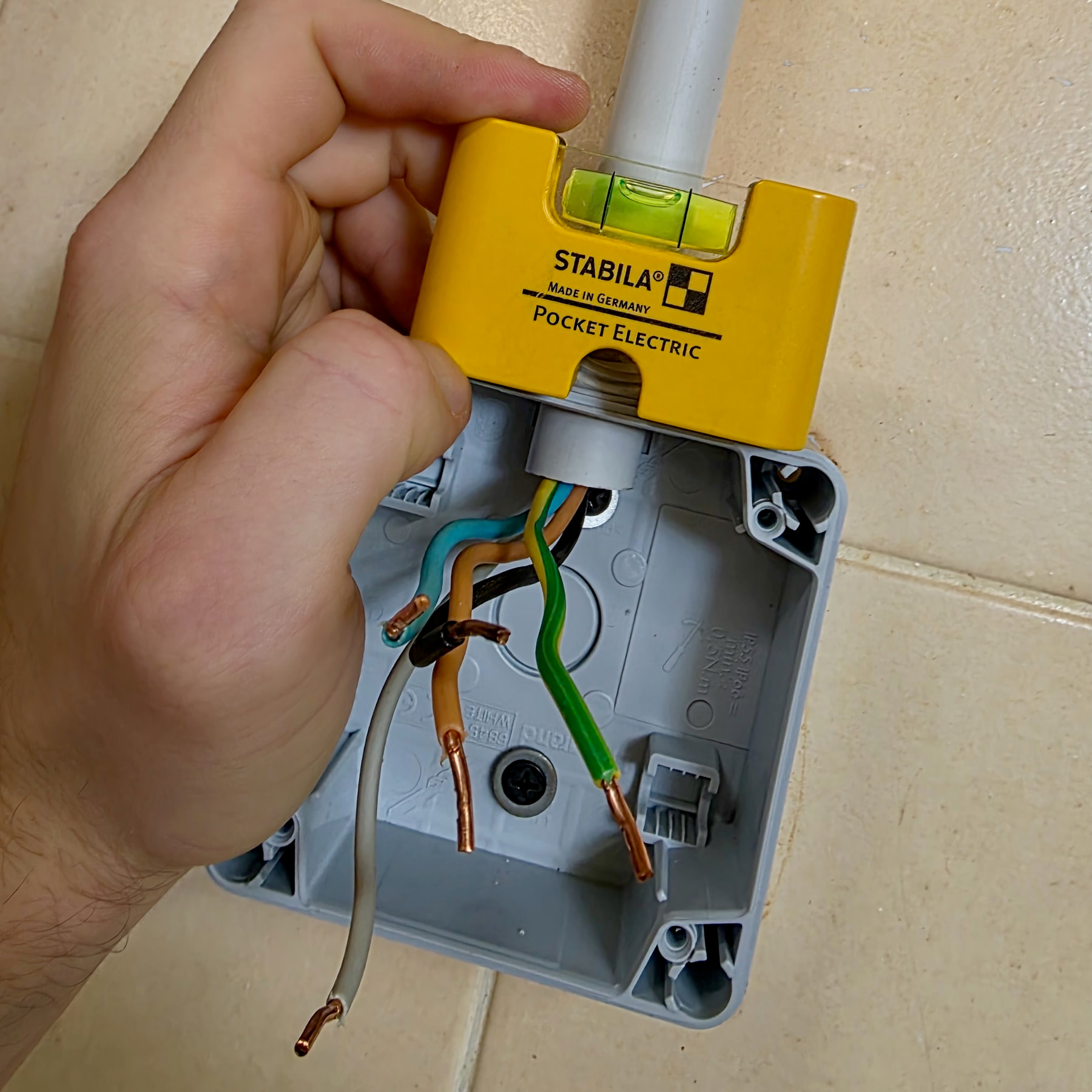
Checking the box is level
The step that follows laser marking: the bubble must stay centred on the box before the box is fixed in place, even if the laser line has already set the height.
If you’re kitting out a whole van, the reasoning is different from that of the savvy DIYer: I compared the professional tool ranges in my article on Hilti tools for electricians.
A line laser without a tripod loses half its point: it is the tripod that sets the reference height. Bosch UK listed the BM 1 at £58.99 incl. VAT and the BT 250 at £103.47 incl. VAT on 15 October 2026. Check current prices, accessories included and compatibility for your exact Bosch model.
At STABILA, the lasers run on the battery from the multi-brand CAS 12 V platform, so they slot into your existing tool kit; at Leica, the L2P5G accepts alkaline batteries as a backup to the Li-Ion battery.
Wall mounts are the second accessory worth having: a magnetic plate or a wall bracket frees up the tripod and lets you work at the height of the mount without taking up floor space.
Finally, the receiver is only useful over long distances outdoors: on an indoor electrical job, it stays at the bottom of the case.
3 questions
InteractiveQuiz on line lasers
3 questions to help you remember the key figures
Choose an answer
Bosch GLL 3-80 vs STABILA LAX 600 G
Advantages
Drawbacks
Hidden benefits
Hidden costs
On site I never stand the instrument straight on the floor: it goes on the mount, the wall bracket or the tripod, which fixes the reference height and keeps the beam clear of the tools lying around.
I set the line at the height where the back boxes will sit, wait for the self-levelling to settle, and only then start marking. If the laser flashes instead of holding still, the housing is tilted too far and the line cannot be trusted.
The check I run before marking is to slide the instrument along the wall, keeping the same setup height, and see whether the mark falls back on the same point. A line that drifts when the setup moves tells me the mount is loose or the support is moving.
For vertical work I cross-check the line with a plumb bob before anything is fixed, since a chase slightly out of plumb is the mistake I want to catch early.
A dusty aperture also dulls the line, so I clean the window with a dry cloth before the first pass of the day.
The first mistake is a support that moves: a tripod on a floorboard that flexes underfoot, a mount clipped to a partition still being fixed, or a case used as a shim.
The next one is treating the room as the reference. The line is level or plumb, while a sloped floor or a partition out of plumb is not, and the mark has to follow the line.
A beam that is partly hidden is another classic: a tool, a door leaf or a coil of cable in the way has me marking where the line is clipped, and the mark moves as soon as the obstacle is cleared.
A wide marker on a fine line widens the doubt, so I mark the centre of the line with a sharp pencil and stand on the same side of the wall each time.
Running a drill or a breaker on the same structure as the tripod makes the line creep, so I mark first and cut afterwards.
Moving the setup in the middle of the job is the last trap: once the instrument has been shifted, every earlier mark has to be checked again against the new position.
Once the day is under way I re-check the first mark of the morning, since a tripod on a wooden floor can settle after the setup has been walked past a few times.
A line laser is not a torch: I never aim the beam at anyone’s face, and I set it so that the line passes below or above head height when other trades are working in the room.
While I am marking, I keep the instrument as close to the work as the line allows, so that the beam falls on the surfaces I am marking rather than across a corridor where someone is walking in.
Between two marking passes I switch the instrument off: a laser left running on the floor is exactly how someone crouching down catches the beam at close range.
Glazing, mirrors and polished panels are covered or avoided, because a reflection can send the beam back in a direction I cannot see.
Ordinary sunglasses cut the ambient light without protecting the eye from a direct beam, so they are not the answer.
The rule I give to everyone on a shared site is simple: nobody looks into the aperture, whatever the angle.
On a short run, the laser takes longer to set up than the marking itself, so for two adjacent back boxes on the same wall the spirit level wins.
In a stairwell or on a scaffold there is often no flat place for a tripod, and a level held against the structure is quicker than an instrument balanced on an edge.
In full sun on a facade the eye loses the line very quickly, so I fall back on the spirit level, which needs no visible beam.
On a finished wall I avoid the mount as well: a magnetic plate can mark paint, whereas a spirit level laid flat leaves nothing behind.
When the question is the fall of a pipe or the slope of a run, I need a reading along the pipe itself, and a projected line does not give it.
The laser earns its place when several walls have to share the same height; the spirit level earns its place when the reference is the surface under my hand.
The two tools work together on the same job, and switching between them costs nothing once both are in the van.
Green is more visible in daylight: the eye is more sensitive around 550 nm, and manufacturers emit green at 525 nm. Red costs less and is good enough in an enclosed room. The Bosch GLL 3-80 is red; the STABILA LAX 600 G and the Leica Lino L2P5G are green.
Accuracy is model- and measurement-specific, not one compulsory tolerance. Bosch states ±0.3 mm/m for the GLL 3-80 and STABILA ±0.3 mm/m for the LAX 600 G. Leica specifies ±0.2 mm/m levelling accuracy but ±0.3 mm/m line accuracy for the L2P5G. Compare the right figure and the application.
No. A laser projects a reference at a distance, whereas a spirit level checks the surface beneath it. On an enclosure or a rail, spot-checking with a spirit level remains essential. I covered the difference and the crossover point in my review of the STABILA electronic level.
A mount or a wall bracket sets the reference height and keeps the beam clear of the floor, which matters when the tripod would stand in the way. It also makes the setup easier to repeat from one room to the next.
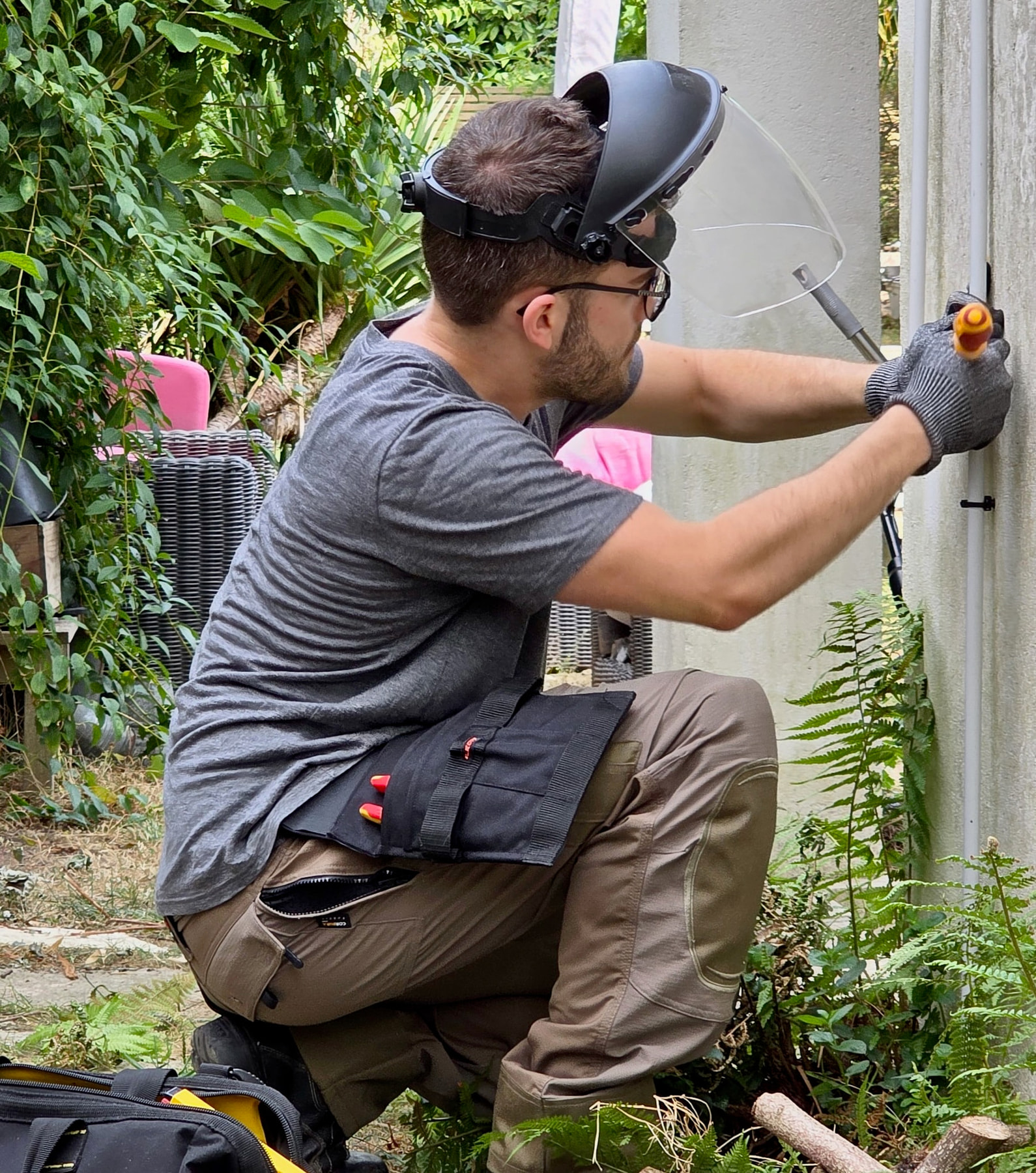
Théo Desrousseaux
Electrician and editor
I work in the field and edit this magazine. Every guide is reviewed for its target country before publication.
Author → Credentials → Editorial method → Report a factual correction →
Email address and prefilled context:
theo@sparx-elec.fr
Article: https://www.sparx-elec.com/gb/laser-level-brand-comparison/
Edition: GB — English
Factual issue: [describe the factual issue]
Passage: [quote or identify the passage]
Source: [optional source URL]
Sources and references
Practical electrical installation guides, diagnostic methods and tool recommendations compared against the technical wiring standards of this national edition.
Wiha or Wera: VDE 1000 V screwdrivers and pliers, storage systems and a method for a tool set suited to real electrical work in the home.
Read the guide Guide STABILA, Stanley or Bosch: choosing a spirit level Comparison based on my visit to the STABILA factory, Stanley spec sheets and an electrician's use: vial mounting, accuracy, length and laser. Read the guide
 Guide STABILA: the history of the brand STABILA, a German manufacturer founded in 1889: the 1886 joint patent, the Meterfabrik in Annweiler, lasers and the brand's standing in France. Read the guide
 Guide Stabila electronic level: worth it in 2026? The Stabila electronic level measures angles and slopes. I detail its uses, its limits and the users for whom it is worth the money. Read the guide