HellermannTyton cable ties: review and guide
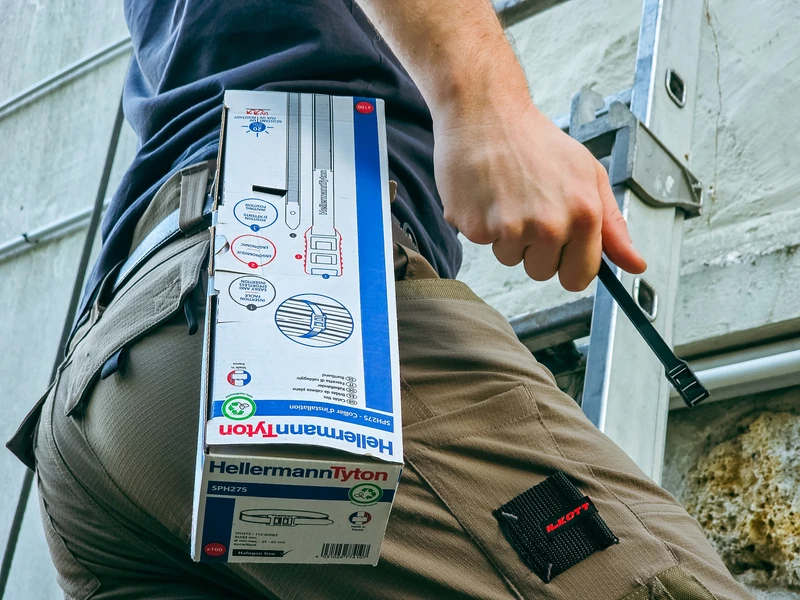 Photo : Sparx Elec
In brief
- HellermannTyton specialises in professional cable management. At Trappes in September 2026, I saw demonstrations of SPH275 and Fast'N'Tube, not independent site tests.
- For SPH275, the manufacturer states 800 N tensile strength and UV resistance for up to 20 years. The manufacturer also describes recycled, halogen-free polyamide and French production for this range.
- HelaGuard corrugated conduit sits alongside 1,155 heat-shrink products listed on the French website, with shrink ratios from 2:1 to 6:1.
- A HelaGuard product must not be assumed to comply with the French ICTA conduit standard. Check the exact product specification and the rules applicable to your installation.
- The manufacturer lists French distributors, including Rexel and Sonepar, but does not display retail prices. Availability and prices in other countries need separate checks.
Cable ties, fixing systems and protective conduit are everyday consumables in electrical work, but there is a substantial difference between a general hardware supplier and a company whose core business is cable management. HellermannTyton belongs to the second group.
My assessment combines the manufacturer’s product documentation with a visit to its premises in Trappes on 28 September 2026. I watched demonstrations of the SPH275 cable ties and Fast’N’Tube fixings. Those demonstrations help explain the design; they do not establish durability or installation speed under real site conditions.
What interests me is the depth of the range. A domestic electrician may need a straightforward cable tie one day, then a particular chemical resistance, minimum bend radius, identification system or protective conduit for a different job. Choosing the correct product matters more than choosing the largest catalogue.
What HellermannTyton makes
The manufacturer describes its business through six operations: fasten, bundle, connect, insulate, protect and identify cables. It is primarily a cable-management specialist rather than a manufacturer of sockets, distribution boards and circuit breakers.
Its product pages address industrial applications such as rail, aerospace, automotive, nuclear and solar energy, alongside building services. That explains the attention given to operating temperature, vibration, chemicals, UV exposure and specific materials.
This distinction is important for a domestic installation. An industrial-looking component does not automatically meet the requirements of a building wiring system. I check the application and the individual product datasheet instead of relying on the reputation of the brand.

The company’s French operation is based at 2 rue des Hêtres, Trappes, in the Paris region. The official company history traces the original Paul Hellermann GmbH business to Hamburg in 1935 and records the opening of the Trappes production site in 1992.
It is also incorrect to say that the manufacturer does not document its quality certifications. Its ISO standards page discusses ISO 9001, IATF 16949 and EN/AS 9100, for the activities to which each applies. Management-system certification is not, by itself, evidence that any one conduit or cable tie is suitable for every installation.
- Fasten cables with ties, mounting bases and dedicated fixing systems.
- Bundle conductors and cable runs using cable ties or protective sleeves.
- Connect cables using joining and sealing products.
- Insulate and protect with corrugated conduit, heat-shrink tubing and tapes.
- Identify circuits with markers, labels and printing equipment.
SPH cable ties: the range aimed at electricians
The manufacturer’s cable-tie portfolio includes internally serrated ties, externally serrated ties, ties without serrations, reusable models, stainless-steel versions and fixing straps.
For conventional electrical work, the SPH family is particularly relevant. It includes SPH175, SPH275 and SPH350, with different lengths to suit the bundle or fixing point.
800 N
manufacturer's tensile-strength figure for SPH275
Up to 20 years
manufacturer's stated outdoor UV resistance for SPH275
3
SPH175, SPH275 and SPH350 sizes
2:1 to 6:1
heat-shrink ratios listed across the range
1,155
heat-shrink items listed on the French website when reviewed
The external serration is an important design feature. It avoids presenting the toothed side of the tie directly against the cable insulation. The SPH design also includes a pre-lock position, allowing the tie to be placed without immediately completing the final tightening.
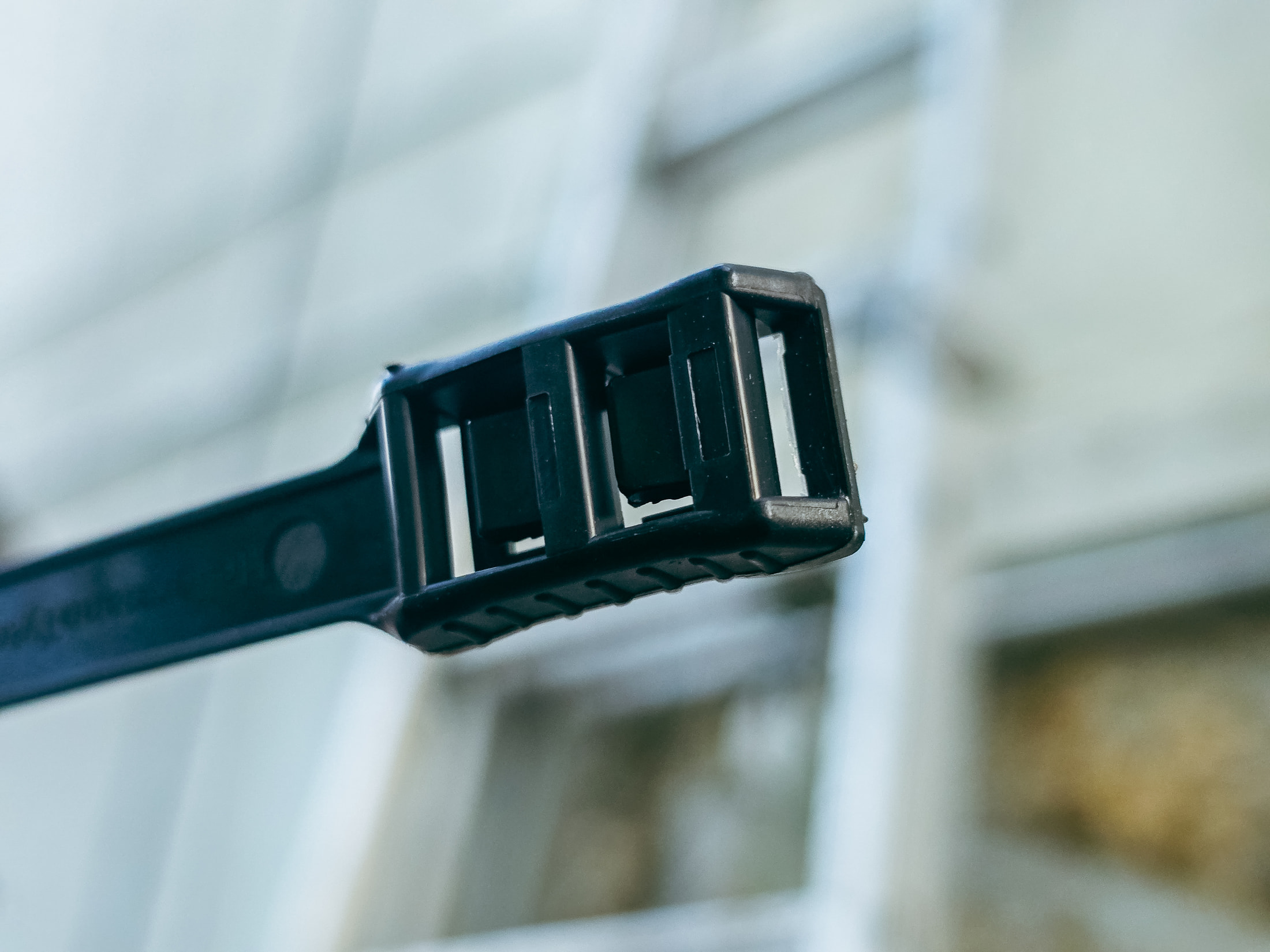
For SPH275 reference 112-00083, HellermannTyton publishes 800 N tensile strength and outdoor UV resistance of up to 20 years. These figures come from its specification, not from a tensile test I have performed.
The manufacturer also states that the SPH ties are made in France from recycled, halogen-free polyamide. Their cardboard packaging is presented as recycled and resealable. Material selection is a useful factor, although it does not replace checking temperature, environment and installation load.
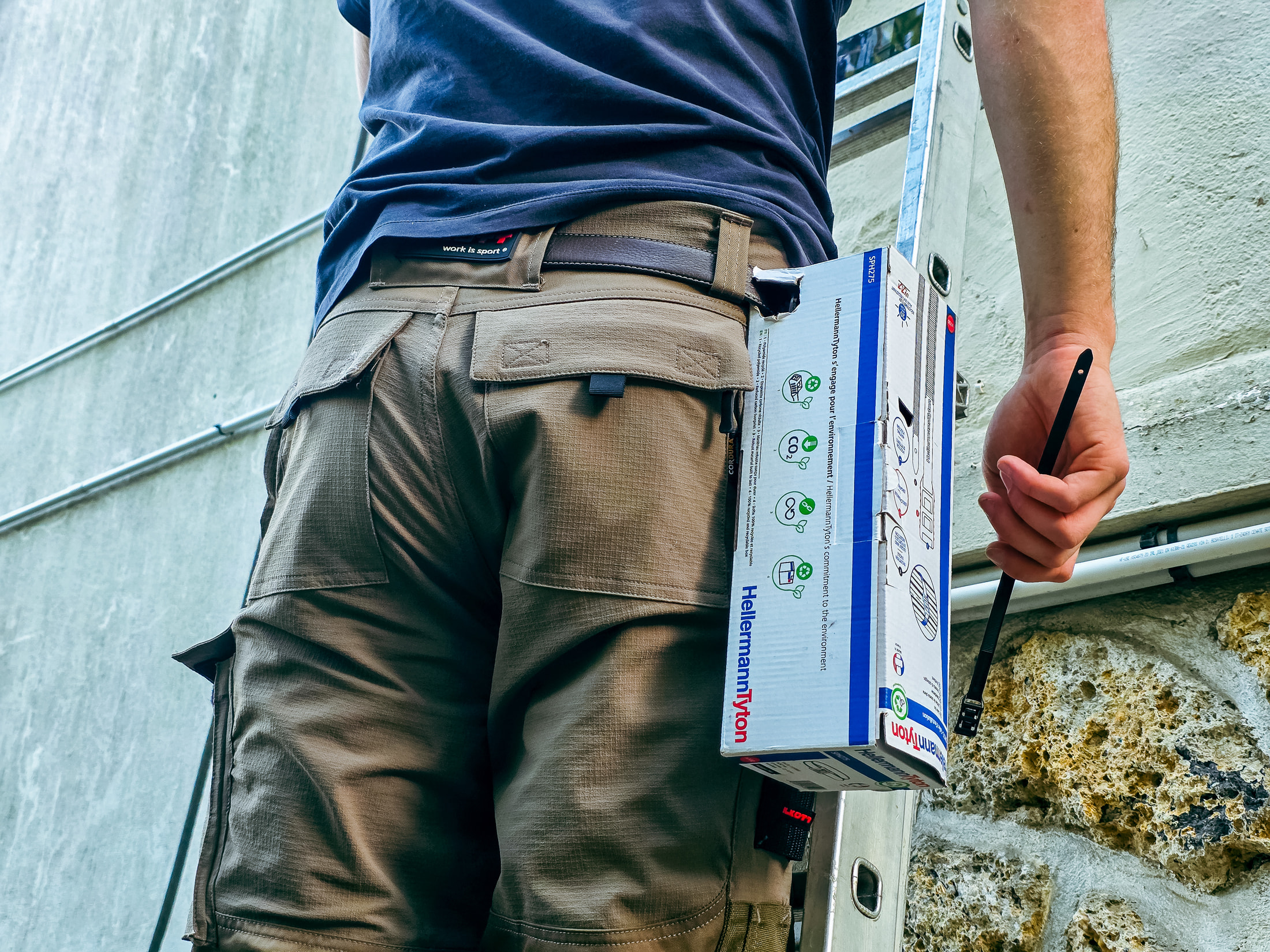
At Trappes, I was shown the SPH275’s pre-lock position, rounded head and the openings through which ties can be dispensed without opening the whole box.
The packaging can also be worn at the waist. I like the idea of keeping ties accessible when working at height or making repeated fixings. I have not measured whether it makes an installation quicker.
I was also shown Fast’N’Tube, but only SPH275 cable ties were supplied for me to examine. Neither receiving the ties nor watching the Fast’N’Tube demonstration establishes performance on a customer’s installation.
- External serration helps keep the toothed surface away from cable insulation.
- Pre-lock position allows positioning before final tightening.
- Three SPH lengths let you select a tie for the bundle rather than overtighten an unsuitable size.
- Recycled polyamide and halogen-free construction are stated by the manufacturer.
- Resealable dispensing box is designed for repeated access at work.
Other ties are designed for much more specific conditions. PEEK cable ties are offered for high temperatures, with published figures extending from -55 °C to +240 °C on the products described. The polymer is selected for demanding chemical and radiation environments.
MCT metal-detectable ties incorporate metal particles in the plastic. They are intended for applications where detecting a stray tie matters, including food processing and pharmaceutical production under HACCP processes.
| Family | Distinguishing feature | Documented characteristic or use |
|---|---|---|
| Family SPH | Distinguishing feature External serration, halogen-free recycled polyamide | Documented characteristic or use Electrical installation, indoors and outdoors |
| Family PEEK | Distinguishing feature High-temperature polymer | Documented characteristic or use -55 °C to +240 °C, chemicals and radiation |
| Family MCT | Distinguishing feature Metal-detectable particles | Documented characteristic or use Food and pharmaceutical environments, HACCP procedures |
| Family Reusable | Distinguishing feature Release and refasten | Documented characteristic or use Regular maintenance and changes to cable runs |
| Family Stainless steel | Distinguishing feature Metal cable ties | Documented characteristic or use Aggressive environments, subject to the exact specification |
| Family Fixing straps | Distinguishing feature Wider fastening surfaces | Documented characteristic or use Applications defined by the individual fixing system |
Main cable-tie families described by HellermannTyton
The position of the serrations is the first choice I make for a cable tie that will contact an insulated cable. Internal, external and non-serrated products are not interchangeable merely because they have similar dimensions.
I also check the bundle diameter, the declared tensile strength, operating temperatures, material and any restrictions on the installation method. The best-performing industrial polymer may offer no benefit on an ordinary cable run, while the wrong material can fail in a harsher environment.
Among the reusable products, the manufacturer describes the SpeedyTie RTT750HR: 752 × 13 mm, a stated bundle diameter of 40 to 210 mm and 888 N tensile strength. TEXTIE S and L use hook-and-loop fastening, at 150 × 12.5 mm and 330 × 12.5 mm respectively.
Softfix M is a flexible TPU product aimed at sensitive cables, including optical fibre. A gentler contact surface and controlled tightening can be more relevant to delicate cables than a high breaking-load figure.
The portfolio includes versions designed for flame resistance, UV exposure, metal detectability and impact resistance. Each feature belongs to particular product references. I would not describe the whole range as having every one of these properties.
For general work, polyamide ties may be sufficient. Where a cable is sensitive, I examine the softer TPU alternatives. For temperature or chemical exposure beyond common installation conditions, the specialist materials deserve closer attention.
The advantage of a specialist range is choosing a fastening material for a specific technical requirement, rather than selecting general-purpose ties without checking their operating conditions.
Fast’N’Tube: a conduit fixing demonstrated at Trappes
Fast’N’Tube was the other product demonstrated during my visit. It combines a fixing for rigid conduit with a finned anchoring feature. The team showed how the system is positioned and how a suitable alternative screw may be chosen for the substrate and fixing method.
The manufacturer’s FNT1635LOK01SET datasheet describes a fixing for 16 to 35 mm conduit, with an 8 mm fixing hole for the supplied anchor. That reference is listed in grey recycled polyamide, UV-stabilised and packaged in sets of 100.
Those details refer to the identified product. They should not be read as specifications for every colour, variant or mounting substrate in the Fast’N’Tube family.
I can see the attraction of managing the conduit clip and fixing operation with fewer separate pieces. It is especially interesting when there are many repeated fixing points. But the presentation was a demonstration, not a comparative installation trial or a test of pull-out strength in a wall.
I would still check the wall material, required fixing method, conduit outside diameter and the installation instructions before selecting it for a particular job.
Julien also suggested a further discussion about cable identification, alongside a factory visit of approximately one hour. No date has been agreed.
I would like to examine outdoor cable labels, the precise conditions behind any water and UV resistance claims, and tools intended to provide repeatable cable-tie tension. These are topics for a future visit, not product tests that have already taken place.
HelaGuard corrugated conduit and building applications
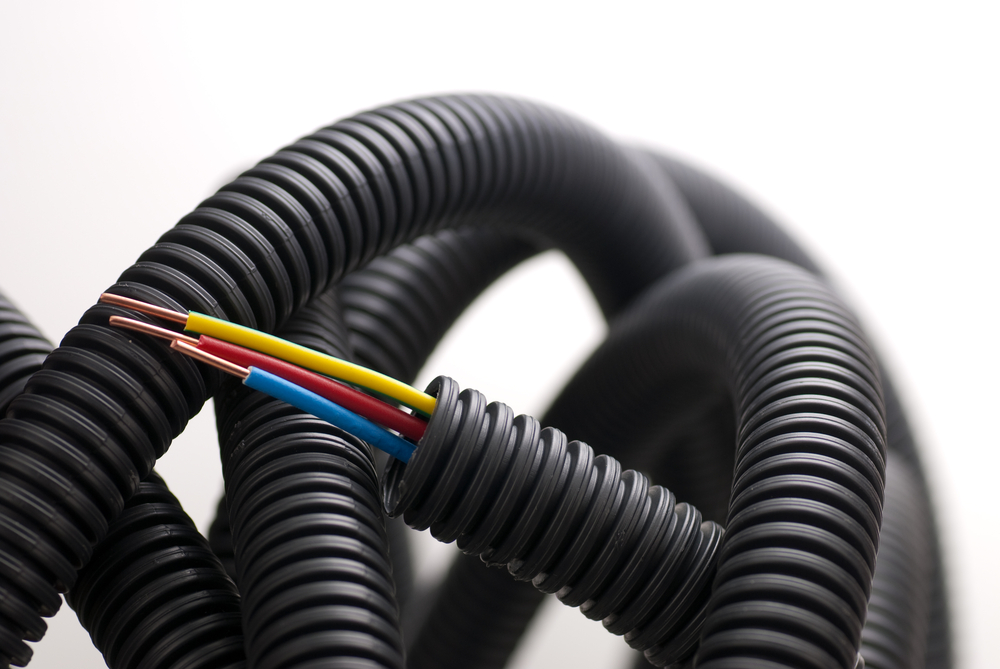
The HelaGuard range is a family of corrugated protective conduits. The manufacturer lists materials such as PA6, PA12, PP and PE, with slit and unslit options and different wall thicknesses.
These distinctions are useful in industrial cable routing, where oils, vibration, impact, movement or exposure may determine which protective system will last.
| Range | Main feature | Documented application |
|---|---|---|
| Range HG-DC | Main feature Double slit, PA6, self-extinguishing, halogen-free | Documented application Retrofit work, supplied in 25 and 50 m coils |
| Range HG-ELWS | Main feature Slit, thin wall | Documented application Light-duty cable protection |
| Range HG-LW | Main feature Lightweight wall construction | Documented application Control cabinets and terminals |
| Range HG-SW | Main feature Standard wall, UL94 V2 self-extinguishing grade | Documented application Applications including public buildings |
| Range HG-HI | Main feature Designed for movement | Documented application Continuously moving cable routes |
| Range HG-PP | Main feature Polypropylene construction | Documented application Applications described for concrete and plaster |
| Range HG-FR | Main feature Flame-retardant version | Documented application Environments with particular fire-performance requirements |
| Range HG-HW | Main feature Heavy wall construction | Documented application More demanding mechanical environments |
Examples of HelaGuard conduit families and the applications described by the manufacturer
For building work, HG-PP stands out because the manufacturer describes applications involving concrete or plaster. HG-SW, with a stated UL94 V2 classification, addresses a different selection criterion.
Those facts cannot establish compliance with every national building-wiring standard. The intended use, applicable tests and the precise product reference still need to match the installation.
HelaGuard fittings are available in straight, 45° and 90° forms. The range includes protection ratings such as IP66, IP67, IP68 and IP69K where specified, with reference to IEC 60529.
The manufacturer also describes reusable fittings that can be released using a screwdriver. That could help when maintaining or modifying machinery, but the stated reusability needs to be checked for the precise product. Repeated reuse is not a guarantee that a sealing system will remain unchanged in every condition.
What matters to me in maintenance is access. A fitting that can be removed and refitted without damaging the conduit can make changes easier. I would assess the sealing components before deciding that a refitted assembly retains its original IP rating.
The FlexiGuard family is another example, using spiral protective conduit for machinery and automation where resistance to oils, some chemicals, UV and ozone is relevant.
Is HelaGuard equivalent to French ICTA conduit?
ICTA is a designation used for corrugated conduit in French building wiring. To select a comparable product, I check its own test documents and the requirements of the installation market.
The general HelaGuard product pages do not establish a universal equivalence between their industrial conduits and French ICTA. A visually similar shape is not evidence of the same test standard.
Attention
For any country, check the conformity documents of the specific conduit reference against the rules and standards applicable to that installation. The French ICTA classification is not a substitute for local requirements in the United Kingdom or elsewhere.
Heat-shrink tubing: materials, wall thickness and shrink ratios
The French manufacturer’s catalogue listed 1,155 heat-shrink products when the article was checked. This is a catalogue count, not an independently verified number of variants in every market.
The listed materials include polyolefin, elastomers, fluoropolymers, PVDF and PTFE. Their temperature ranges and chemical resistance differ substantially. A generic reference to heat-shrink tubing is not enough when the job involves unusual heat, movement or chemical exposure.
The shrink ratio, listed across products from 2:1 to 6:1, matters when a sleeve must pass over a connection before contracting around a smaller cable. A 2:1 sleeve can reduce its diameter to half the starting value under its specified conditions. Higher ratios may accommodate a larger change in diameter.
The range includes thin-wall and heavy-wall constructions, plus adhesive-lined dual-wall products for applications requiring sealing. Correct heating and material compatibility determine whether the adhesive achieves the intended seal.
The manufacturer’s French pages also describe examples such as TA37, TCN20 and HFT-A or HFT-B in various colours and roll formats. Product availability and packaging should be checked in the catalogue serving your market.
These products help with cable identification, protective finishes and insulation work when they are suitable for the intended application. They do not automatically make a damaged installation safe, and they do not replace checking the integrity of conductors or the relevant installation requirements.
- 2:1 to 6:1 ratios address different starting and final diameters.
- Adhesive-lined tubing can provide additional sealing when correctly selected and installed.
- Different wall thicknesses suit different protection needs.
- Material choice governs heat, chemical and environmental performance.
- TA37, TCN20 and HFT are examples to check in the current product catalogue.
The CHG900 cordless hot-air tool is another product shown in the manufacturer’s building range. Battery operation can be useful where a suitable mains supply is not immediately available.
I would choose the heating tool according to the sleeve’s specified installation temperature and the surroundings. Even heating is important, but the manufacturer’s procedure remains the reference.
Corrugated conduit or heat-shrink tubing?
These are not competing solutions for the same job. Corrugated conduit protects and routes a length of cable, while heat-shrink tubing is applied locally to a suitable cable or connection to insulate, identify or protect it.
I start by asking which surface needs protection, whether the protection must remain removable, and what mechanical or environmental conditions it will encounter. Those three questions normally clarify which product family is relevant.
Building products: RELICON, WIC and cable identification
HellermannTyton’s building portfolio goes beyond conduit and cable ties. It includes VarioPlate cable-entry systems, cable-pulling accessories, RELICON cable joints, WIC markers, thermal-transfer labelling equipment, HelaTape insulating tape and the CHG900 heat gun.
These items solve different problems. A cable-entry system organises a penetration; a sealed joint is selected for an appropriate connection; a marker improves identification. One does not replace the other.
RELICON belongs to the family of cable joints using gel or cast resin, with a manufacturer’s selection system. Where a watertight joint is required, the cable type, installation position, environmental exposure and relevant product approval are as important as the brand.
For a comparison of a particular sealed connection product, I have separately reviewed Raytech Betty 4. That is a different manufacturer’s product, so the evidence for one cannot be transferred to RELICON.
WIC markers and label-printing systems are particularly relevant when circuits have to be maintained or altered later. Clear conductor identification can reduce the time spent tracing a circuit, though labels must suit their temperature and operating environment.
For outdoor identification I want to establish which label materials and printing methods the manufacturer recommends for UV, water and cleaning exposure. Those questions are part of the proposed follow-up discussion, rather than properties I have tested.
Cable-pulling accessories complete the range. I regard them as a separate tool category from cable ties and conduit, even though all three can be involved in the same routing job.
- VarioPlate: cable-entry and passage management.
- Cable-pulling tools: routing conductors into suitable conduit.
- RELICON: cable-jointing products using gel or cast resin.
- WIC markers: conductor identification.
- CHG900: cordless hot-air tool for compatible heat-shrink work.
- HelaTape: insulating tape for specified applications.
The manufacturer’s online training material also covers subjects such as cable-tie installation, materials and storage. It is a useful resource for understanding the product categories, although training information does not remove the need to read the exact product instructions.
Info
For repeatable installation practice, start with the manufacturer’s product-specific instructions. Information about materials, tightening and storage can help prevent the wrong consumable being selected for an otherwise straightforward job.
Buying HellermannTyton products: check the market
The French website lists distributors including Rexel, Sonepar, RS Components and Leroy Merlin, alongside specialist suppliers. That demonstrates a presence across French professional wholesalers, industrial suppliers and some retail channels.
It does not establish that every reference is stocked at the same retailers in the United Kingdom, nor does it establish local stock levels or a standard trade price.
The company’s French operation at Trappes is relevant to its history and production footprint. Manufacturing in France can be useful background, but it does not by itself prove shorter delivery times for a given order.
I would choose the product reference first, then check stock, pack quantity, delivery date and trade pricing with a supplier serving the actual installation location.
The manufacturer’s own site does not present one universal retail price for the entire range. Availability and pricing are therefore questions for a distributor, not reasons to judge the technical quality of the products.
What I still need to establish through practical use
Product specifications, an on-site presentation and a long-term field trial are three different levels of evidence.
The SPH275 pre-lock position and dispensing box were demonstrated to me, and I received SPH275 cable ties for examination. Fast’N’Tube was demonstrated but not supplied or field-tested.
I have not performed a controlled comparison of installation time, pull-out strength, ageing under outdoor exposure or the longevity of a particular conduit connection. Any numerical performance claimed here is attributed to the manufacturer, not presented as my measured result.
- Pricing depends on the distributor, reference, pack size and market.
- Long-term site performance is not established by the manufacturer's presentation.
- Market share and worldwide sales volumes are not independently evaluated here.
- Local conformity must be checked against the relevant product documents and installation requirements.
The most useful evidence available now is the manufacturer documentation, the product details I actually saw at Trappes, and the identity of the references being discussed. That is enough to narrow a shortlist, not to promise a universal result.
My verdict on HellermannTyton for electrical work
After looking at the catalogue and meeting the team at Trappes, I see HellermannTyton as a credible specialist supplier of cable-management consumables.
- Specialist range: fixing, protection, identification and joining are central products rather than peripheral accessories.
- SPH ties: externally serrated design, a useful pre-lock position and published material specifications.
- Fast'N'Tube: a practical-looking conduit fixing demonstrated in person, with site results still to establish.
- Material selection: different polymers, constructions and fittings for different environments.
- Technical documentation: product details, company history and certifications are publicly available.
- Industrial focus: not every product in the catalogue is intended for ordinary domestic wiring.
- Conduit compatibility: an industrial specification is not automatic approval for a country's building-wiring application.
- Trade availability: prices, pack sizes and local stock require confirmation with a distributor.
I am particularly interested in SPH275 and Fast’N’Tube, along with the company’s identification systems. Their design deserves a closer look, but I will not call either fixing field-tested on the basis of a manufacturer demonstration.
Conseil
Before buying in quantity, obtain the datasheet for the exact reference. Check the cable or conduit dimensions, substrate, material, environment and applicable installation standard. A familiar brand name is not a substitute for those checks.
Frequently asked questions about HellermannTyton
3 questions
InteractiveHellermannTyton: ties and conduit
Three quick questions about the product specifications
Choose an answer
Is HellermannTyton a good brand of cable ties?
HellermannTyton is a specialist cable-management manufacturer with a wide range of materials and products. At Trappes I saw its SPH275 pre-lock design demonstrated. The manufacturer's 800 N specification is not a tensile measurement I have performed.
Which HellermannTyton cable ties should an electrician choose?
The SPH175, SPH275 and SPH350 range is relevant for electrical installation. I would select by bundle diameter, material, temperature, exposure and the exact product datasheet, rather than assume one tie suits every job.
Is HelaGuard conduit the same as French ICTA?
No equivalence should be assumed. French ICTA refers to a particular installation context and standard. Check the precise HelaGuard reference and the requirements applicable in the country where it will be installed.
What are SPH275 and Fast'N'Tube like in practice?
I saw demonstrations at Trappes and received SPH275 cable ties, not Fast'N'Tube fixings. I liked the SPH275 dispensing box and pre-lock function, but have not carried out a comparative site test of either system.
Where can I buy HellermannTyton and how much does it cost?
The manufacturer lists French distributors such as Rexel, Sonepar and RS Components. For UK stock and pricing, check the exact reference with a supplier serving your area; the French distributor list is not evidence of UK availability.
Disclosure HellermannTyton : SPH275 cable ties supplied; Fast'N'Tube demonstrated only.
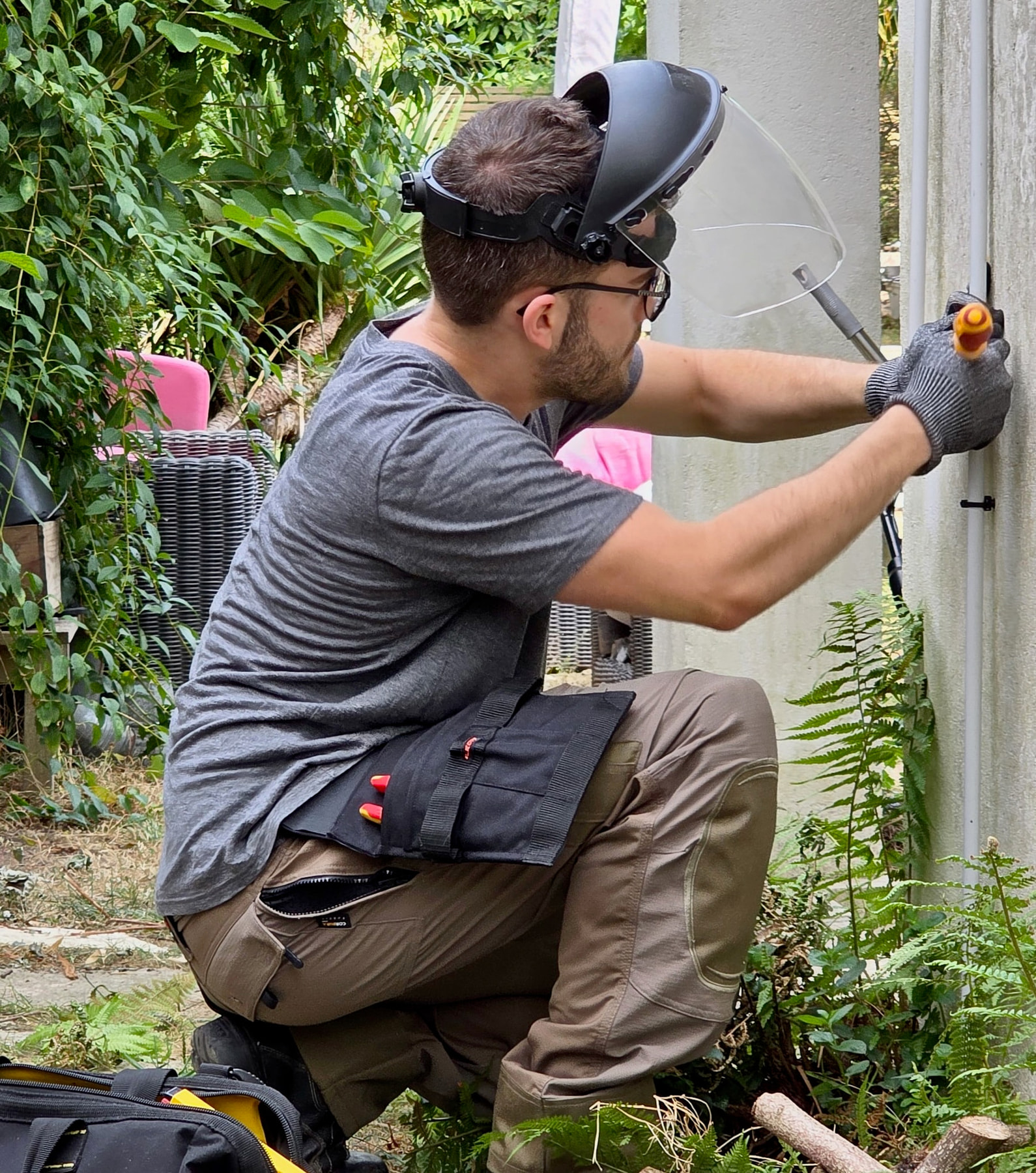
Théo Desrousseaux
Electrician and editor
I work in the field and edit this magazine. Every guide is reviewed for its target country before publication.
Author → Credentials → Editorial method → Report a factual correction →
No email app? Copy the correction details
Email address and prefilled context:
theo@sparx-elec.fr
Article: https://www.sparx-elec.com/gb/hellermanntyton-cable-ties-review/
Edition: GB — English
Factual issue: [describe the factual issue]
Passage: [quote or identify the passage]
Source: [optional source URL]
Sources and references
- 1. HellermannTyton — company history
- 2. HellermannTyton — ISO standards and certifications
- 3. HellermannTyton — downloadable certificates
- 4. HellermannTyton — French website
- 5. HellermannTyton — French sitemap
- 6. HellermannTyton — SPH275 product reference 112-00083
- 7. HellermannTyton — cable ties and fixing systems
- 8. HellermannTyton — HelaGuard corrugated conduit
- 9. HellermannTyton — heat-shrink products
- 10. HellermannTyton — building products
- 11. HellermannTyton — distributors in France
- 12. HellermannTyton — Fast'N'Tube FNT1635LOK01SET
More guides
Practical electrical installation guides, diagnostic methods and tool recommendations compared against the technical wiring standards of this national edition.
KNIPEX 86 03 180: pliers wrench review
KNIPEX 86 03 180 pliers wrench: 35 mm capacity, 13 positions, variants, smooth jaws, verified uses and maintenance for electricians.
Read the guide Guide C.K Tools pliers review: RedLine VDE What the C.K Tools RedLine VDE T3973-160 and T3910-210 pliers are worth: shear cutting, stripping, LOOP eyelet, and 1 000 V insulation, after testing. Read the guide
 Guide Knipex, Wiha or Wera: comparison for electricians Knipex, Wiha or Wera: compare equivalent VDE pliers and screwdrivers by ergonomics, certification and field use for professional electricians. Read the guide
 Guide Laser levels: Bosch, STABILA or Leica Line laser levels compared: Bosch, STABILA and Leica head to head. Green or red lines, real range, accuracy and how to choose the right one as an electrician. Read the guide