Switch off and verify
Switch off the circuit at the consumer unit, lock off to prevent re-energisation, then prove the circuit is dead with a two-pole voltage indicator.
In brief
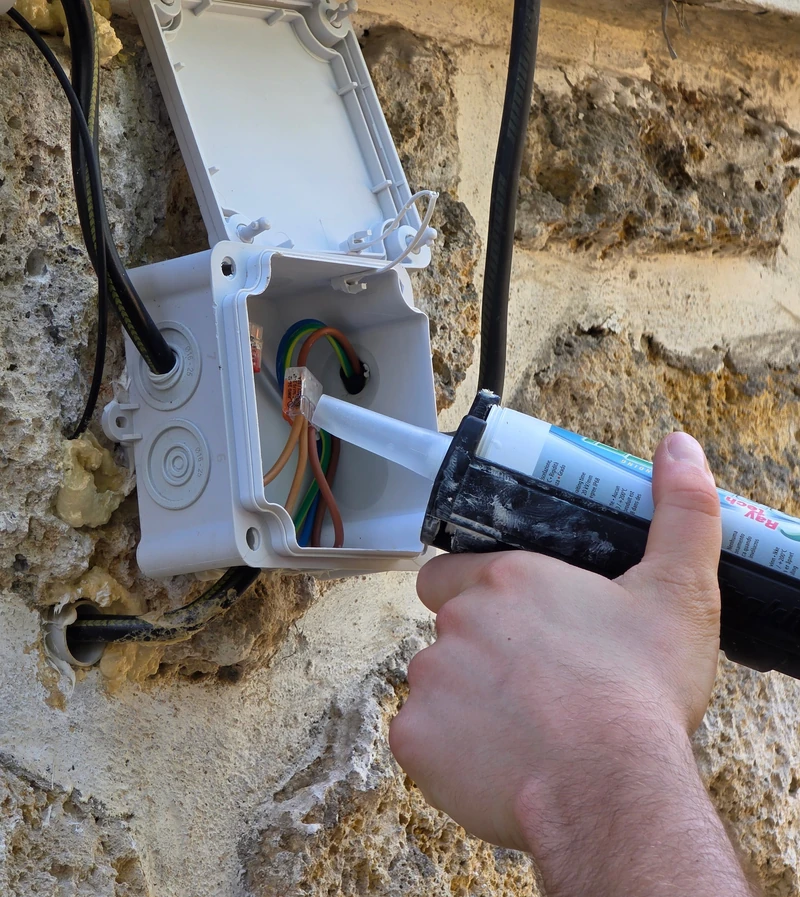
Raytech sent me two sealing gels for electrical connections: the Magic Gel, two-component, and the Wonder Gel, single-component.
I used them on Wago 2273 connections in an outdoor junction box, the most common case for a joint that needs protecting from moisture.
The choice comes down to the use case: Magic Gel is mixed and then cures in around ten minutes to permanently encapsulate a connection, while Wonder Gel is already cured and is applied straight away with a cartridge gun.
In the same shipment I received the Magic Gel 300, the 1000 size and a 280 ml cartridge of Wonder Gel, from the Italian brand.
In what follows I flag what I find questionable, starting with an inconsistency in the stated cure times, then a complete failure with the Wonder Gel cartridge — I’ll come back to that in detail in the wrap-up.
2 figures
cure at 23 °C: under 10 min in the description, around 15 min in the Raytech technical table
> 20 kV/mm
stated dielectric strength for both gels
−60/+200 °C
stated service temperature for both gels
2 × 150 ml
contents of the Magic Gel 300
A bare terminal in a junction box is not acceptable if accessible or improperly terminated: moisture is only one of the installation risks. Outdoors, condensation forms inside the enclosure as soon as temperatures fluctuate, and the water eventually reaches the conductors.
It’s the classic scenario of the 30 mA RCD tripping when it rains, with no appliance to blame: the leakage comes from a wet connection.
Sealing gel answers this specific problem. It encapsulates the terminal, blocks moisture ingress and protects the contact from oxidation and corrosion, two causes of poor connections that overheat. The Wonder Gel data sheet also mentions insects getting in, a classic in garden junction boxes.
The most common case in renovation work is a box already in place whose lid never gets closed again. Water builds up inside through condensation on the walls, the terminals age, and the fault only shows when the protective device trips.
In that situation, the gel acts preventively: it removes the path water takes to the contact, without replacing either the box or its cable gland.
Before using gel, I check how the enclosure is intended to manage condensation. In my field work in France I have made drainage openings, including on new boxes. That describes the work I carried out, not a general installation instruction or proof that the boxes retained their rated protection.
For a British installation, follow the enclosure manufacturer’s approved drainage or ventilation arrangements and the required ingress protection. Do not drill an IP-rated enclosure merely to drain condensation: an unapproved opening can defeat its protection.
On a buried box, that’s impossible: that’s where the gel really comes into its own, and the same goes for transformers and ground-mounted outdoor lights, which always end up giving out.
Unlike a casting resin, the gel stays re-enterable: you cut into it, pull the terminal out, replace it. That’s the main argument against traditional re-boxing, which is irreversible, and it’s what interested me on a job site where waiting connections often change.
A spare circuit is one not yet connected to its device: a lighting point waiting for its luminaire, a terrace feed waiting for its distribution board.
Unused conductors must be safely terminated and enclosed in equipment suited to their exposure and intended use. Gel does not replace safe termination or a suitable enclosure.
That’s exactly where a gel makes sense: the box is closed up for months, condensation is at work, and the connection stays bare as long as the gel isn’t protecting it.
Here are the two packs as they arrive on site: the Magic Gel 300 box shows its two bottles, the Wonder Gel carton a single tube. The IP68 marking appears on both; what sets them apart is whether or not any mixing is required.
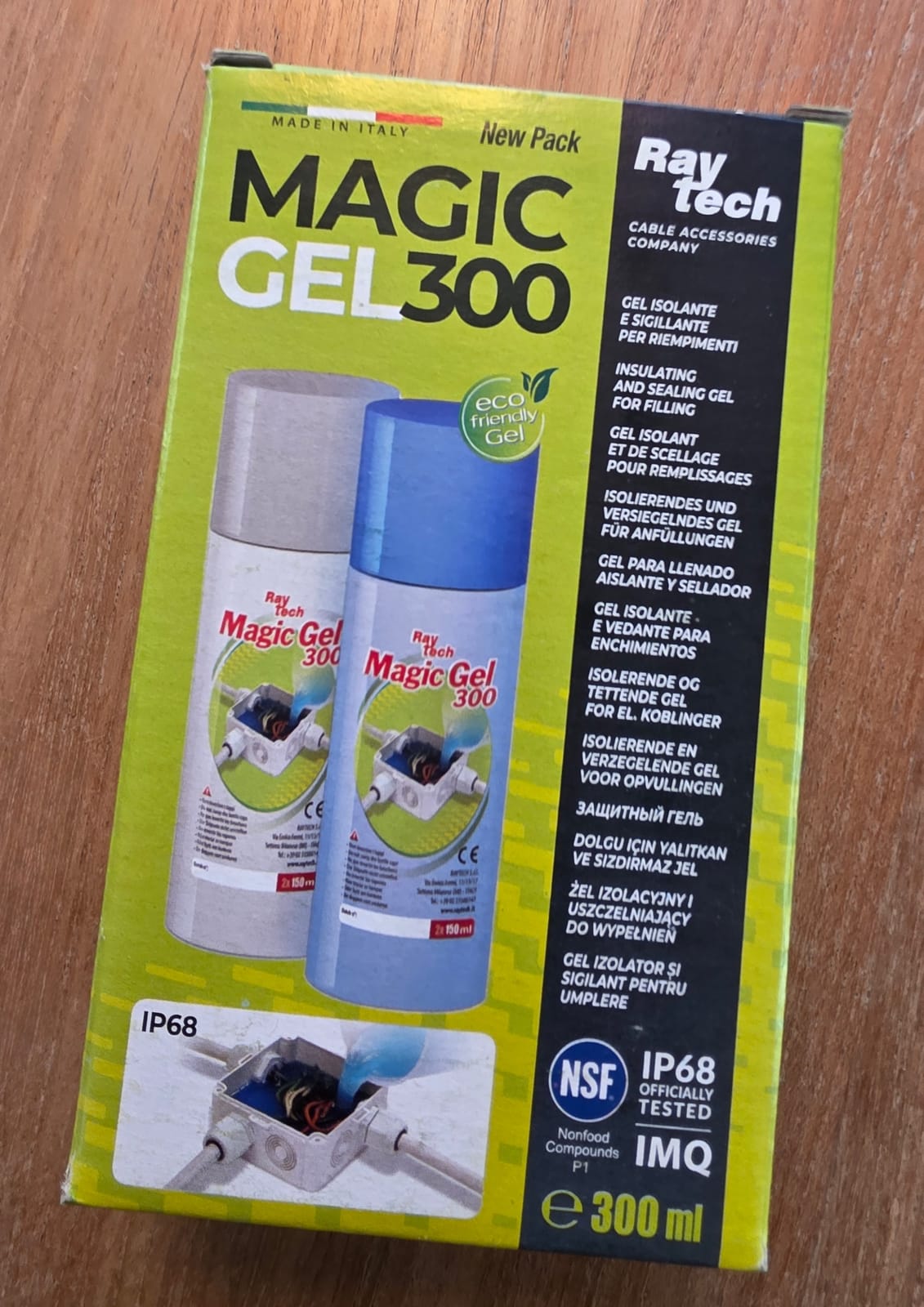
You can tell the two-component version by the mixing instructions printed on the front of the box.
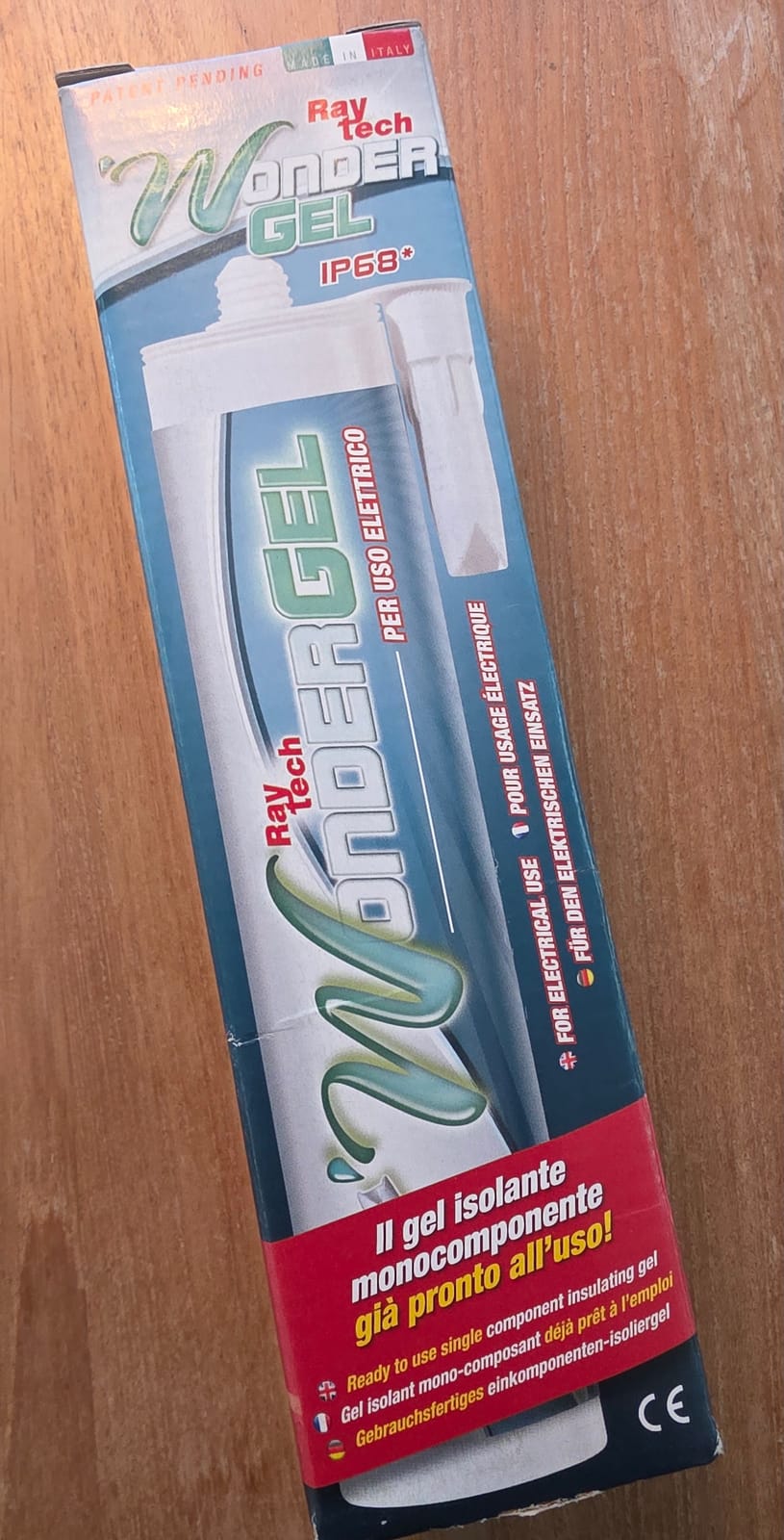
The one-component version, though, shows only a single tube: nothing to prepare before injection.
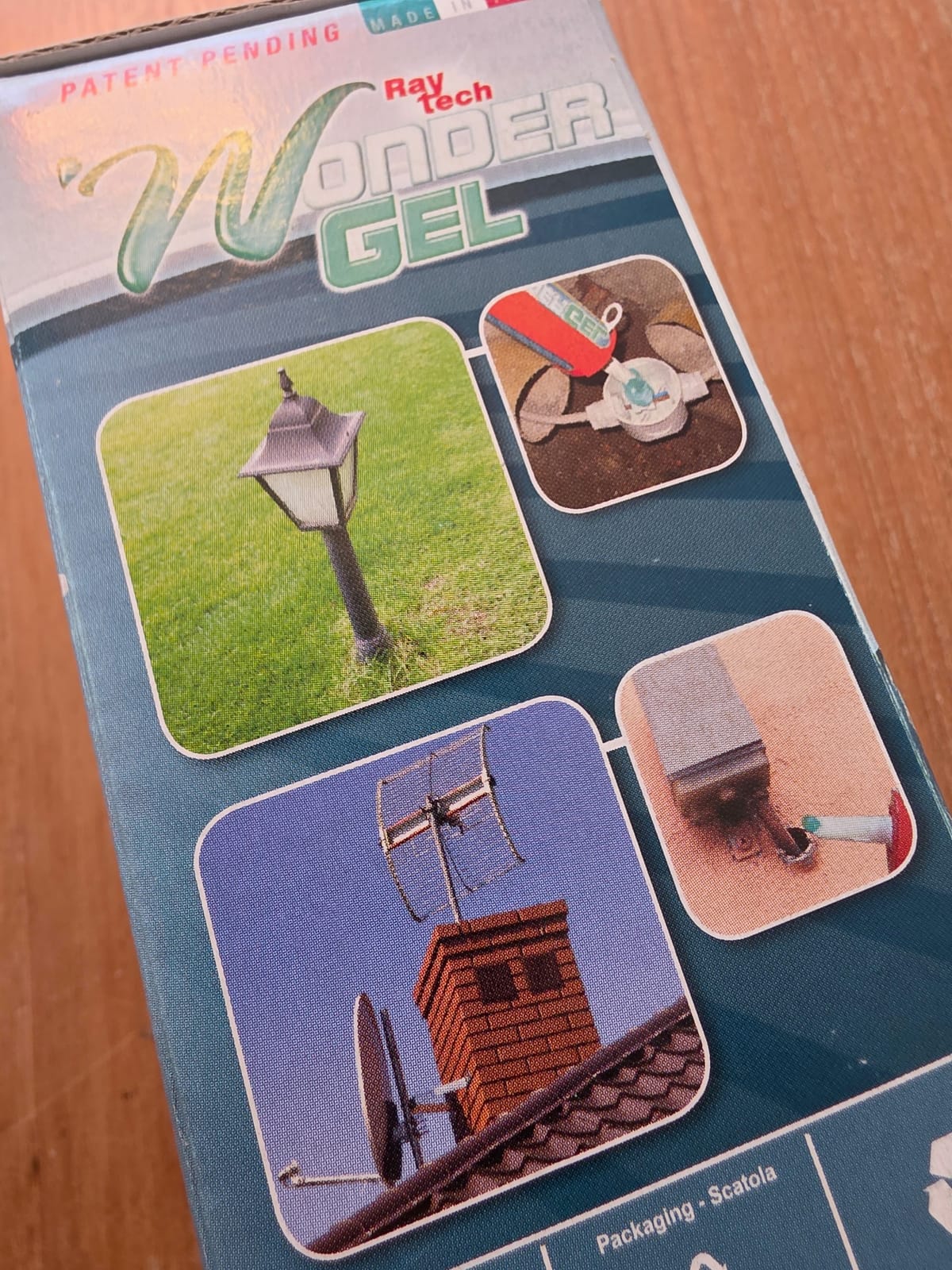
The side panel lists the uses of the one-component version: street light, antenna, outdoor enclosures.
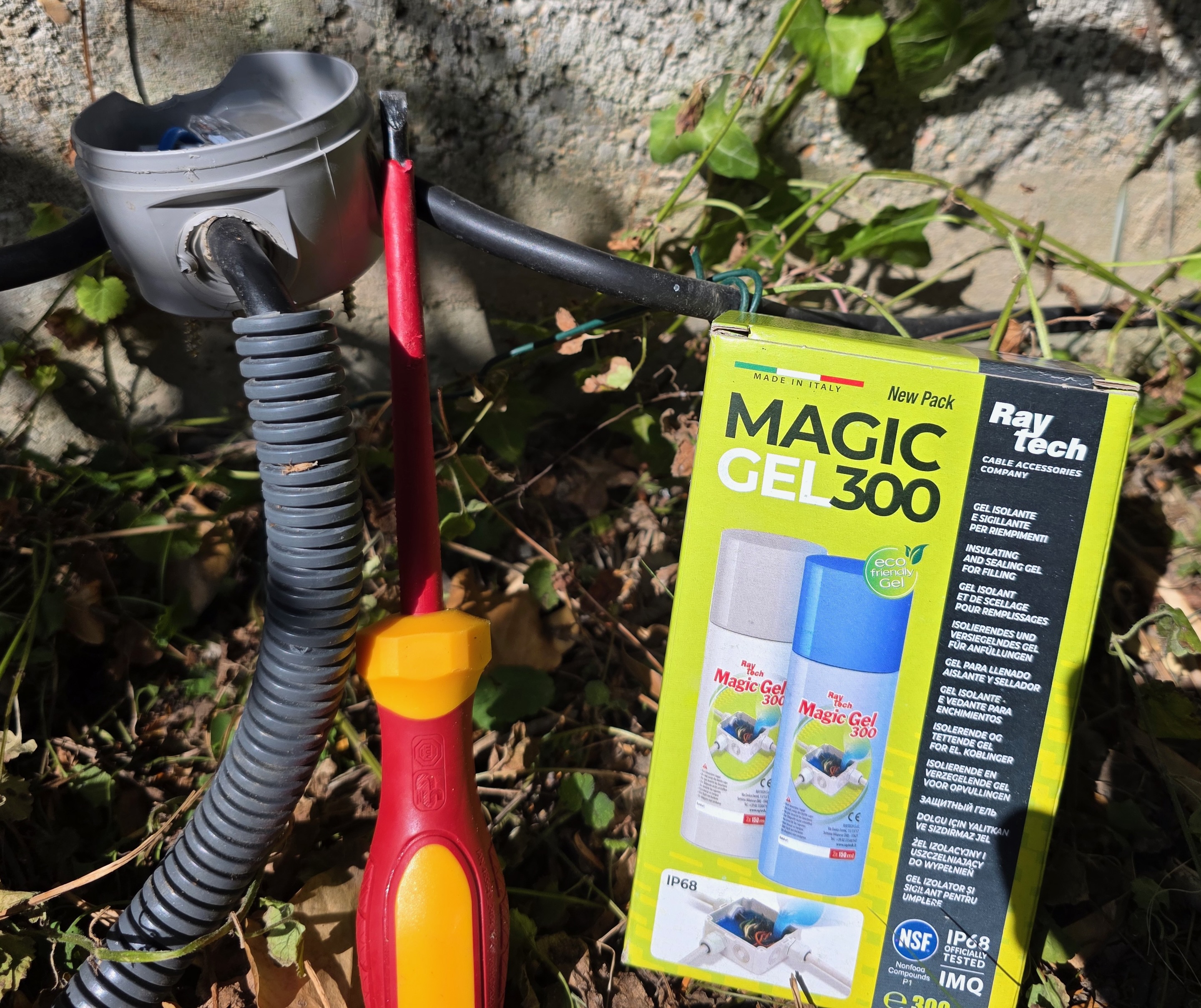
The 300 box sitting next to the junction box and the screwdriver: everything is ready before mixing.
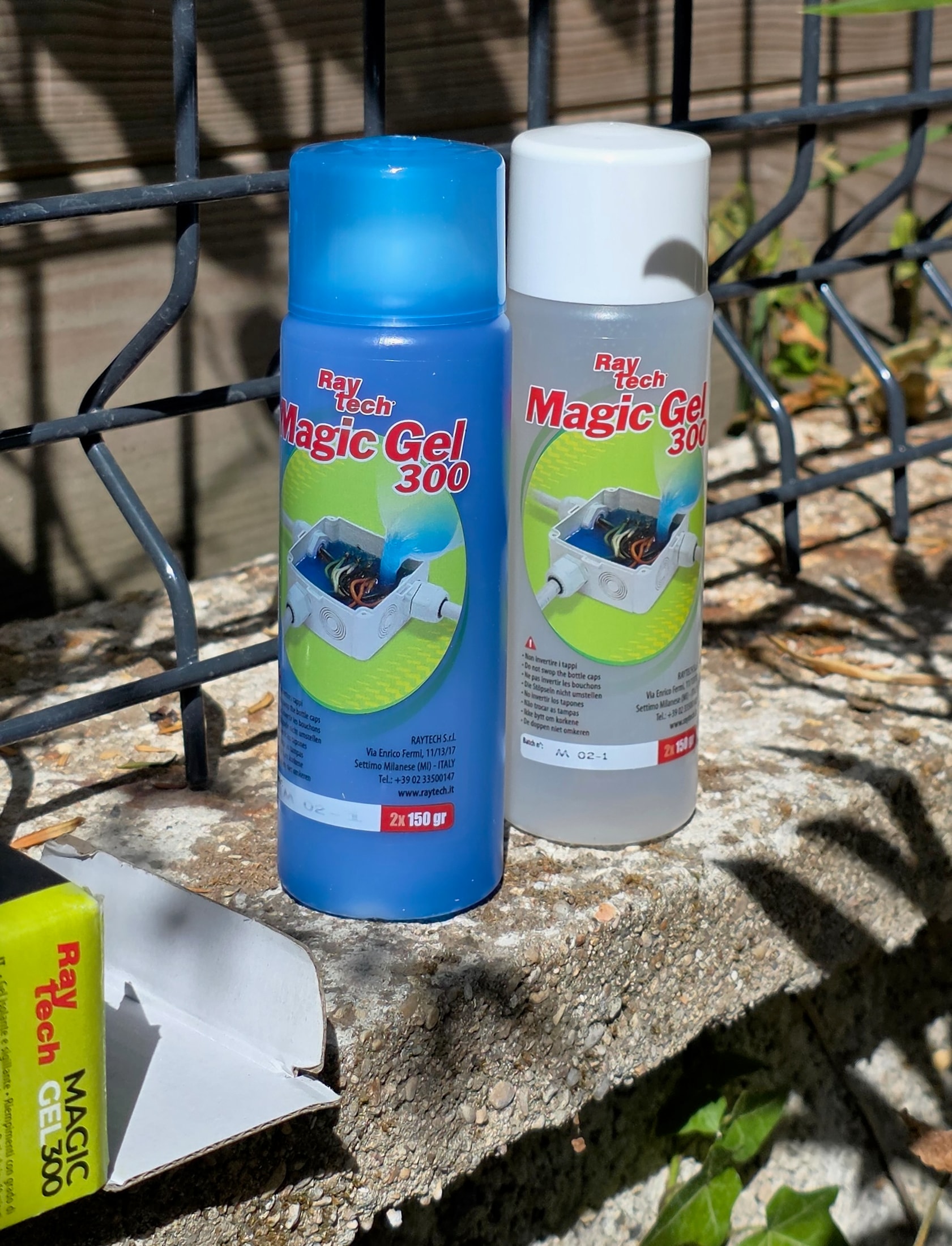
Magic Gel 300 and Magic Gel 1000 each have two component bottles (2 × 150 ml or 2 × 500 ml).
The catalogue’s single-dose sachets refer to other products such as Magic Fluid, not Magic Gel 1000. The datasheet describes it as a very low-viscosity gel: once poured, it spreads and coats any shape, including tightly packed terminals inside an already-wired box.
Curing takes place cold, with no heating of the materials in contact.
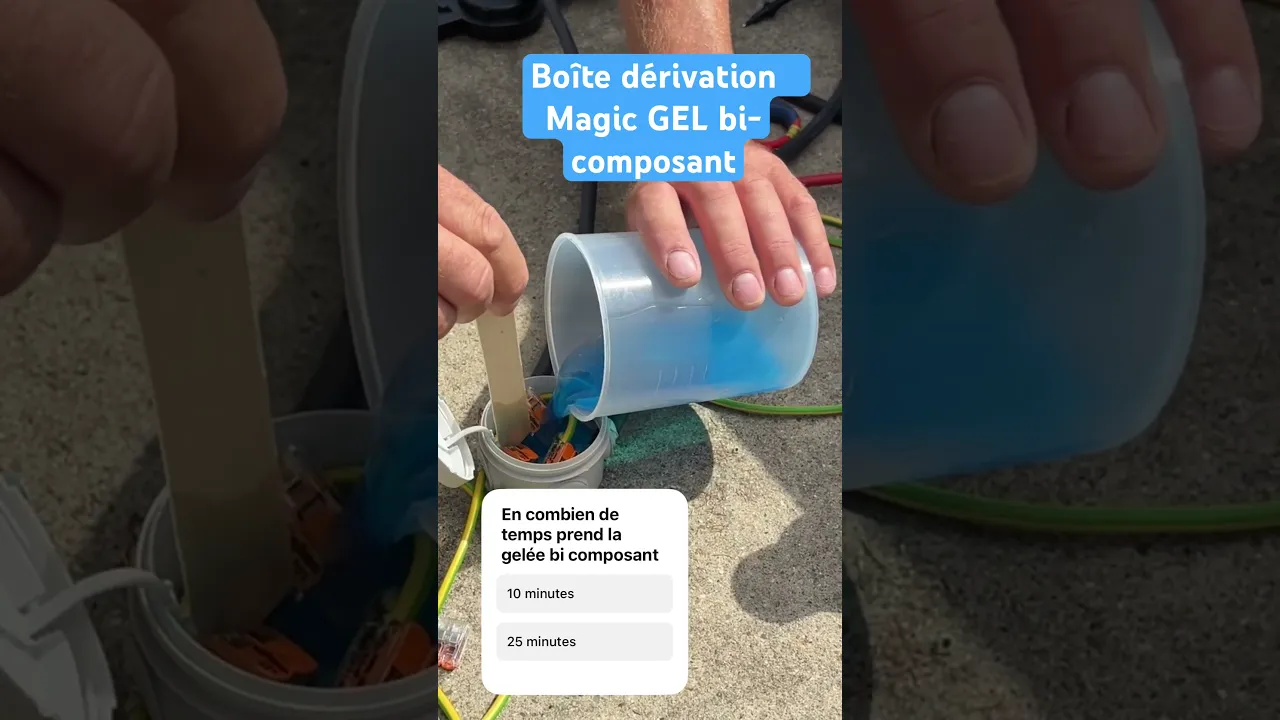
Mixing is done in equal parts, just before application: once the two components are combined, the gel starts to set and it has to be poured straight away. So I prepare the whole box before opening the bottles.
Temperature has a marked effect on the pot life. During my test in high summer, about ten seconds of mixing was already enough, and the material then started to thicken very quickly. In cold weather, the window gets longer; I’m not looking for a universal stopwatch — I mix it briefly until uniform, then pour immediately.
The current Raytech datasheet itself gives two figures at 23 °C: the description mentions curing in under 10 minutes, while the technical table shows around 15 minutes. These are curing times, not an instruction to mix for ten or fifteen minutes.
The benefit over a resin is precisely the cold cure: the datasheet quotes a very low isothermal peak, with no significant thermal stress on the materials in contact.
Info
Mixing and curing are two different things. In summer, my mix was ready after about 10 seconds; I pour right away. The 10 to 15 minutes published by Raytech refer to curing at 23 °C, with two different official values on the same datasheet.
Wonder Gel comes in a 280 ml cartridge, with no mixing at all. The brand describes it as already cross-linked: “no mixing, no waiting”. You load it into a standard sealant gun, inject, and the protection is in place immediately.
That’s what the datasheet promises; in the field, it didn’t work for me — I’ll come back to that in my experience report.
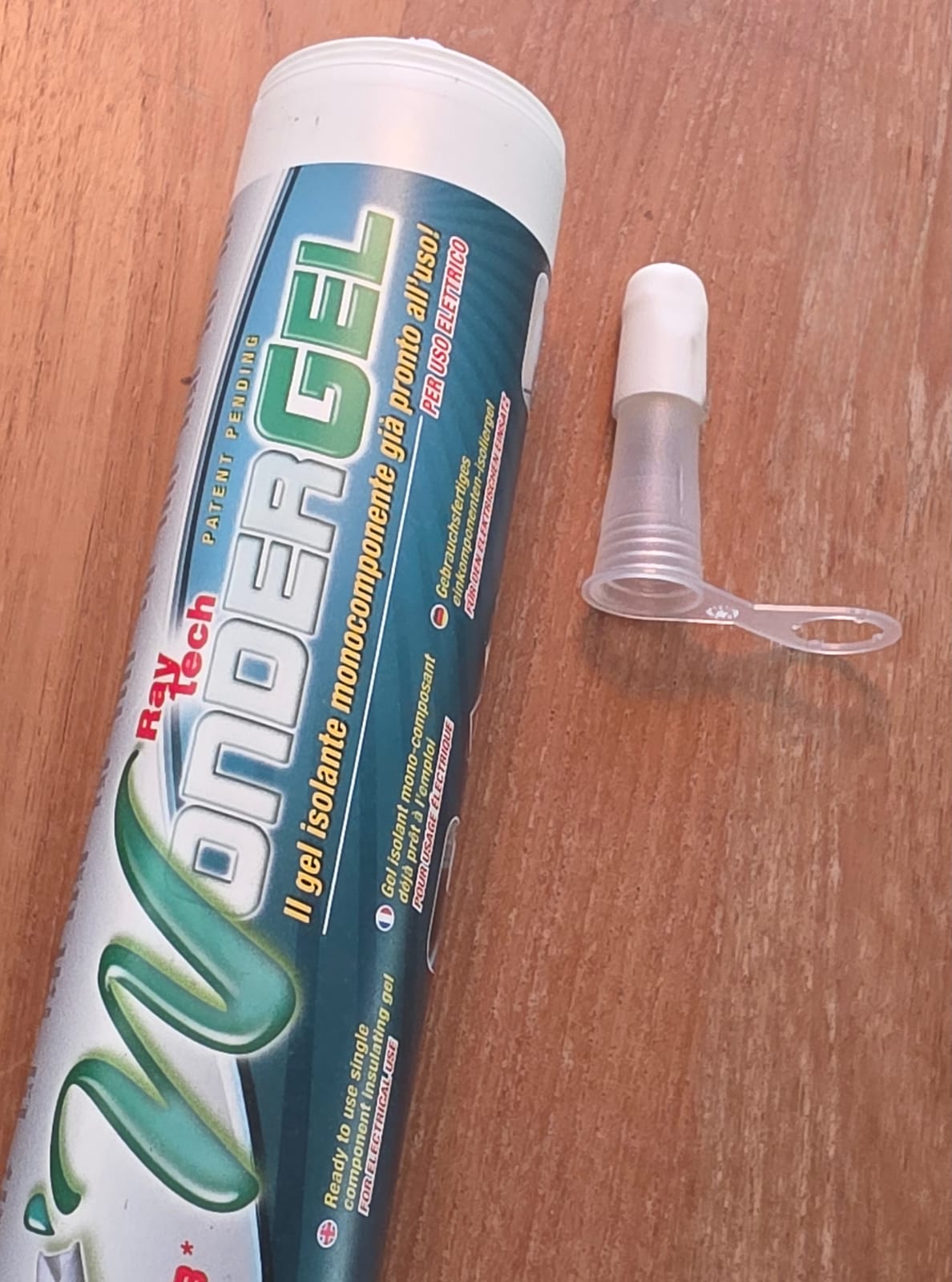
Its key point: it does not harden. The gel stays flexible, and you can rework it later by cutting into it. The datasheet also states that it can be applied in all weather conditions, including in the rain, and that it does not degrade over time.
The theory sounds nice; in practice, it didn’t hold true for me: partial encapsulation, terminals still on the surface, sticky gel — see my experience report below.
Raytech describes Wonder Gel as already cross-linked and states that it can be stored without an expiry date in its sealed cartridge. That does not by itself establish a regulatory labelling exemption: the product-specific label and safety data sheet govern.
You take it out of the box, use it, put it back; nothing dries out, nothing expires.
That’s the behaviour of a quality sealant, not a demanding on-site chemistry.
It also comes in a Wonder Gel Invisible variant, a transparent gel for cases where visual inspection of the connection matters: you can see the contact through the gel without having to cut it open. The cartridge I received is the classic blue version; the principle is the same, only the tint changes.
The side panel of the packaging also shows the intended applications: garden lamp post, roof aerial, enclosures. The gel is used as much to salvage a poorly insulated connection as to protect a new joint, including in hard-to-reach places.
Despite their opposite application methods, both gels are reported to have the same electrical performance. The table below reproduces the values published by Raytech in the product sheets and data sheets.
| Criterion | Reported value |
|---|---|
| Criterion Dielectric strength | Reported value More than 20 kV/mm |
| Criterion Volume resistivity | Reported value More than 2 × 10¹⁵ Ω·cm |
| Criterion Fire behaviour | Reported value Gel UL 94-HB |
| Criterion Service temperature | Reported value −60 °C to +200 °C |
| Criterion Short-term overload | Reported value Up to 250 °C |
| Criterion Protection | Reported value IP68 in a suitable enclosure (manufacturer claim) |
| Criterion Re-enterable | Reported value Yes, the gel can be cut and removed |
| Criterion CLP classification | Reported value Check the exact product label and safety data sheet |
| Criterion Shelf life | Reported value Unlimited (no shelf-life limit) |
Specifications reported by Raytech for the Magic Gel and the Wonder Gel (product sheets and data sheets).
Raytech states IP68 in a suitable enclosure for its gels. Its Italian Wonder Gel product page also cites IMQ-tested IPX8, likewise requiring a suitable casing. Neither statement proves the ingress rating of my round IP55 box or of the Wonder Gel assembly: I did not carry out an IP ingress test.
The gel does not make just any box watertight; it protects the connection inside an enclosure that itself provides resistance to solid objects and holds the gel in place.
The temperature range also deserves a look: −60 to +200 °C is the gel itself, not the installation. A power cable rarely heats up beyond 90 °C, so there is plenty of margin.
The UL 94-HB rating (slow horizontal burning) covers the fire behaviour of the product alone. Both datasheets also mention stabilization against UV and mold, a detail that matters for a box in direct sunlight.
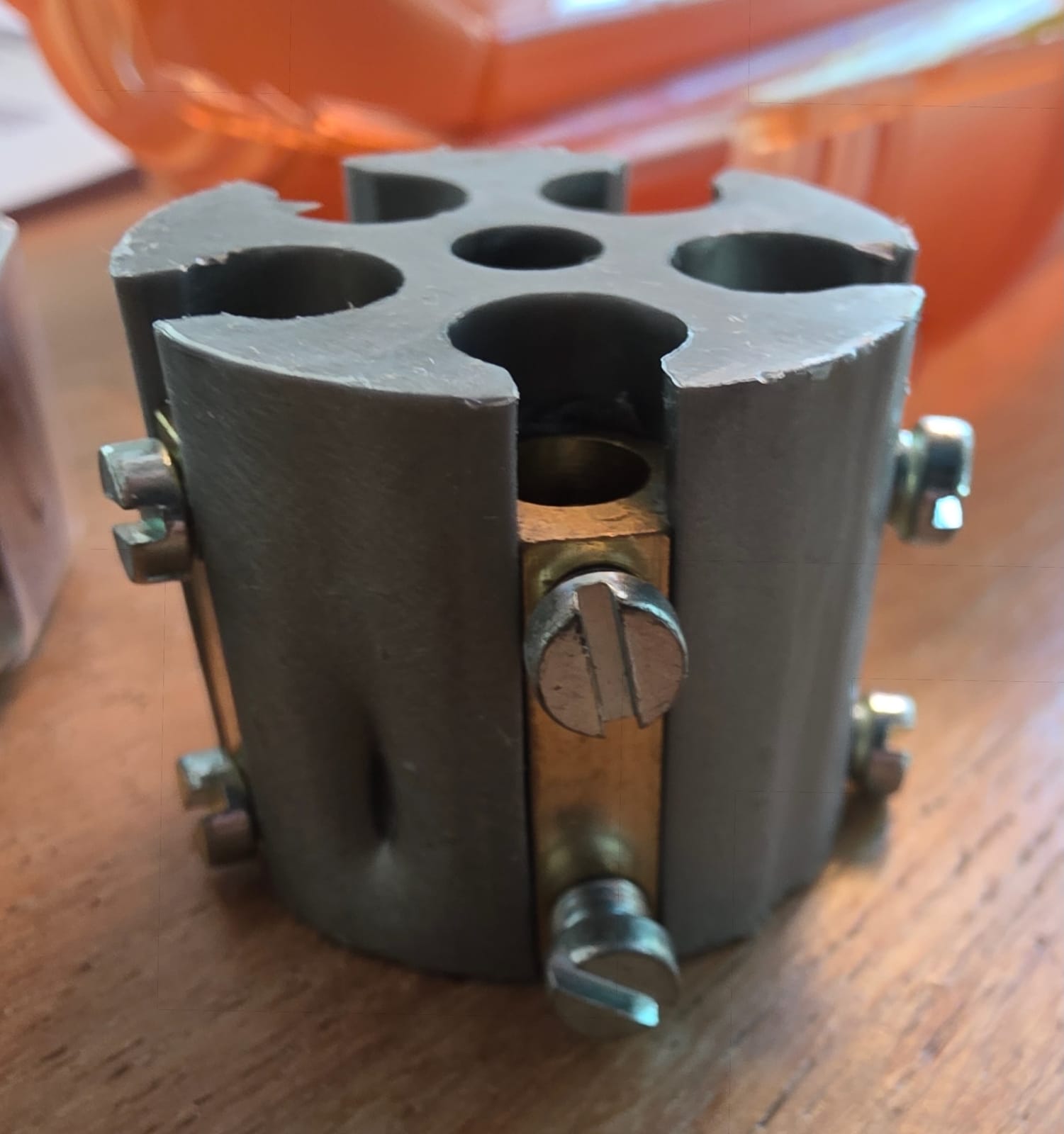
I also tried the gel on screw connectors. That observation does not establish compatibility with every clamping technology: suitability depends on the connection and the manufacturer’s instructions. The cylindrical connector with a copper bar pictured below is shown without gel; that photograph does not document its encapsulation.
A word on the IP rating itself, since both boxes display it prominently. The first digit (6) covers protection against dust, the second (8) continuous immersion: an IP68 rating is not to be read as a quality mark, but as a promise of water resistance tested in a laboratory.
Raytech’s wording for its gel is “in suitable enclosures”, which puts the responsibility for overall sealing on the box and how it is installed, not just on the product poured inside.
The Magic Gel test took place in a round IP55 junction box outdoors on a low concrete wall, with WAGO connectors inside. The cable entries shown are part of that field setup; the test does not establish the cable’s UK designation or the installation’s compliance with BS 7671.
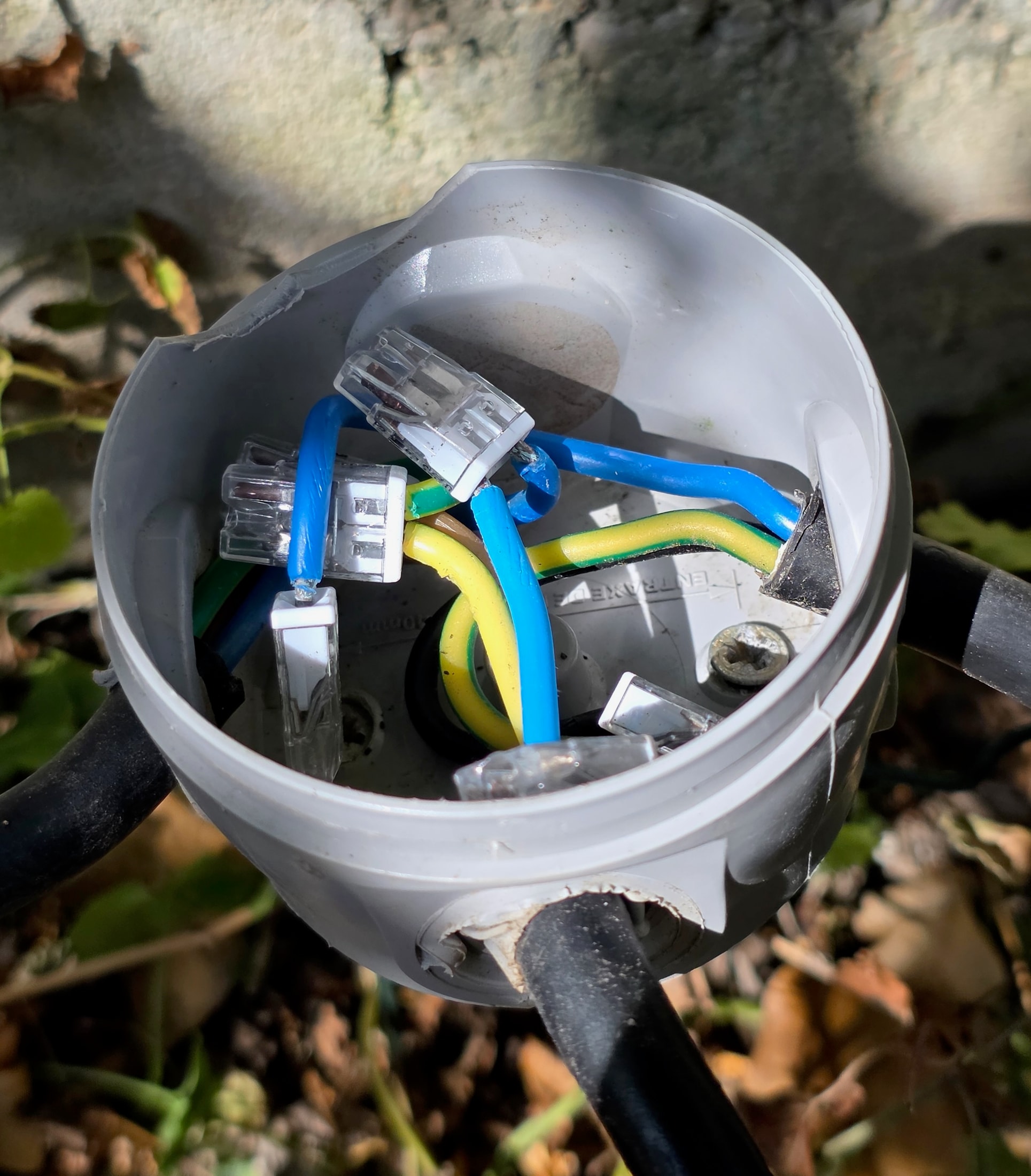
The test pack is the Magic Gel 300: two 150 ml bottles to mix before pouring. The two component bottles on the low wall, the gel box next to the junction box and a screwdriver: setting up is simple, nothing to heat, nothing to load into a sealant gun.
In my test, the critical point was not long mixing, but pouring early enough. At the height of summer, about 10 seconds of stirring was enough before the gel started to thicken; in colder weather, that window gets wider.
The mix is made in a simple container — a glass, a plastic cup or a measuring jug. The gel takes on its translucent blue tint, then I pour immediately.
For curing at 23 °C, Raytech gives two figures on its current data sheet: under 10 minutes in the description and about 15 minutes in the technical table.
The first component is poured into the glass, followed by the second: the two bottles are emptied in quick succession, and the gel starts to set as soon as they meet.
The second component, darker, follows into the same glass: this is the equal parts mix stated in the instructions.
Stirring is done with a clean object suited to the mix. In my summer test, around ten seconds were enough to blend it evenly; waiting any longer quickly made it thicken. So I prepare the connections, the pour path and the container before combining the two components.
The gel is poured from a simple container — a glass, a plastic cup, or a measuring jug — rather than an applicator gun. In my test, it flowed into the box and covered the Wago connectors, with no air pockets visible at the surface during the pour.
That’s the main difference from the Wonder Gel: here, there’s no need to push the material in by hand; it spreads on its own and flows down between the conductors.
The pouring continues into the round box sitting on the low wall: the gel flows in, surrounds the Wago connectors, and flows down between the conductors.
I then poured in the same way, with a steady motion, into the round box placed near the concrete wall: the gel flows smoothly, without stopping, without forming a dome.
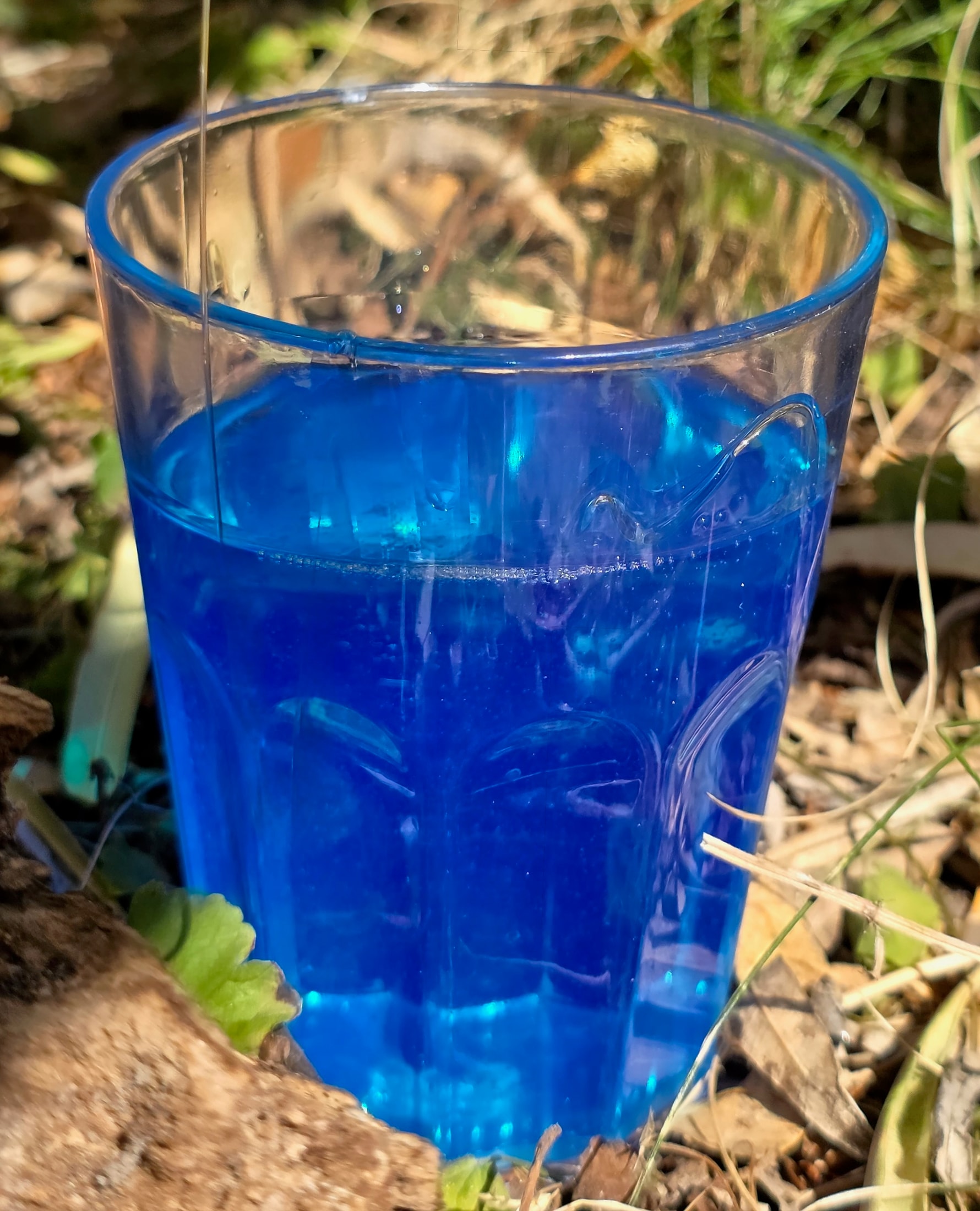
The two components meet in the glass: about ten seconds of stirring, and the gel takes on its translucent blue tint.
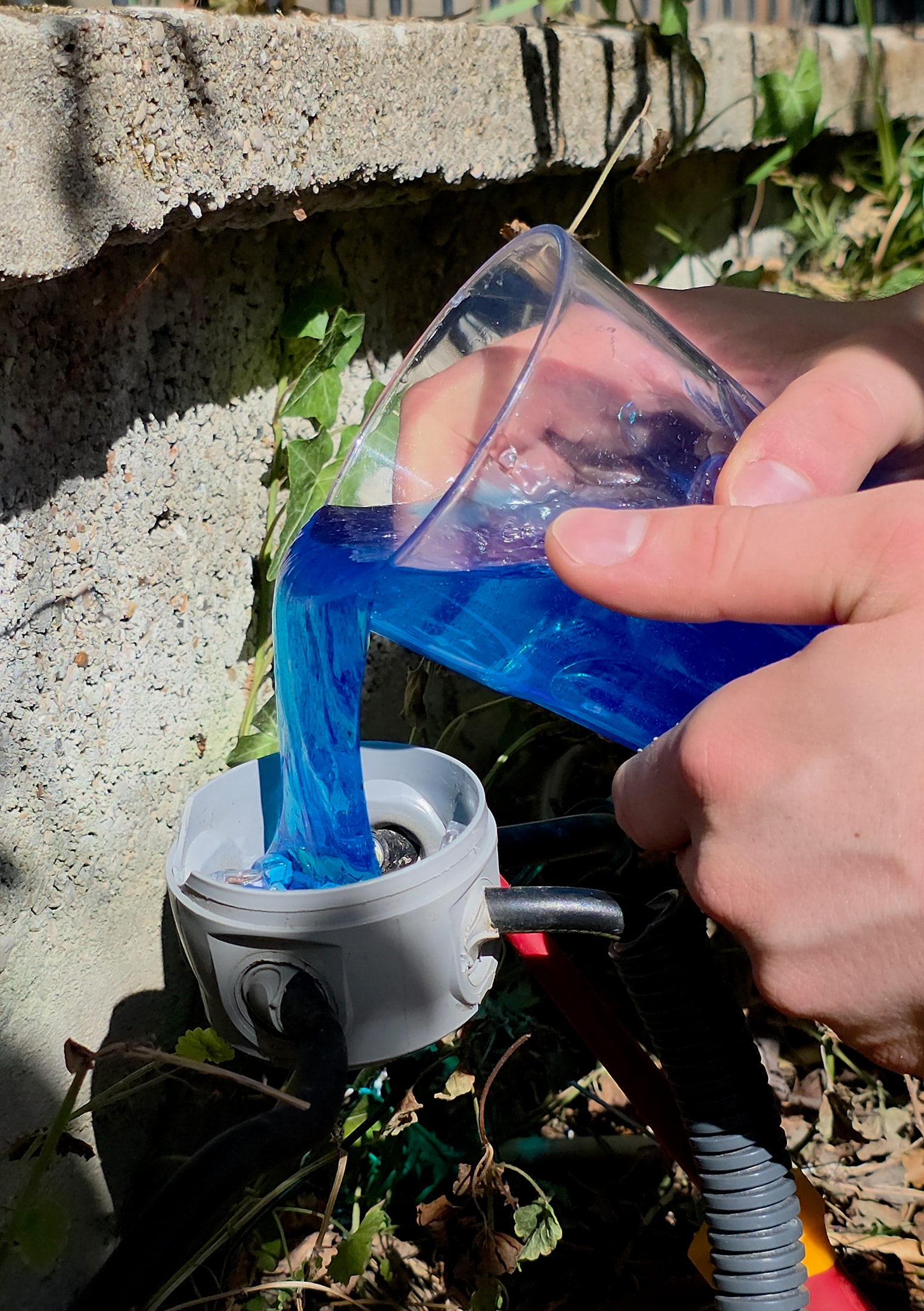
Magic Gel poured from a glass into the round box; no air pockets are visible at the surface while pouring.
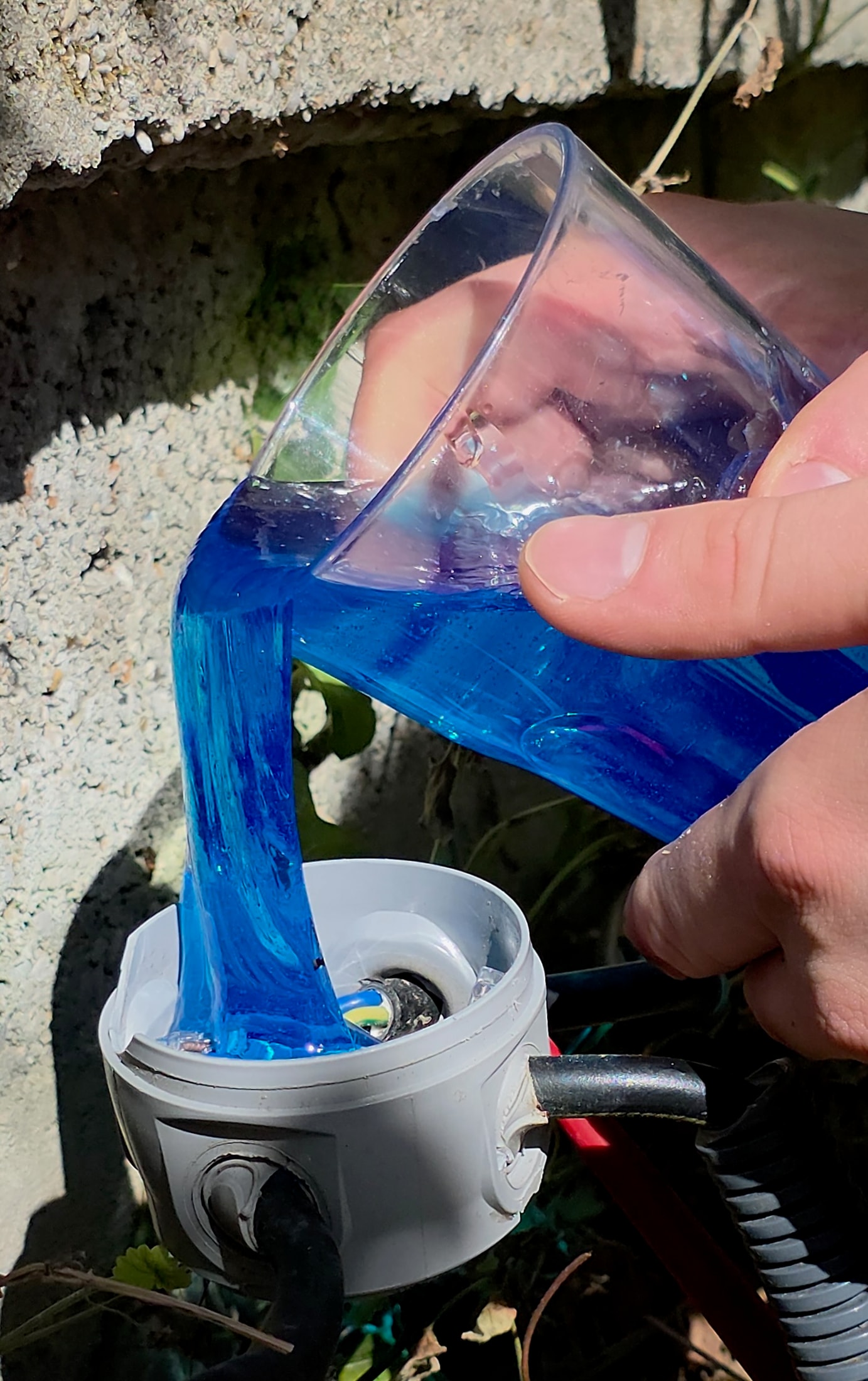
With a steady motion into the round box placed near the wall: the gel flows on, without stopping, without forming a dome.
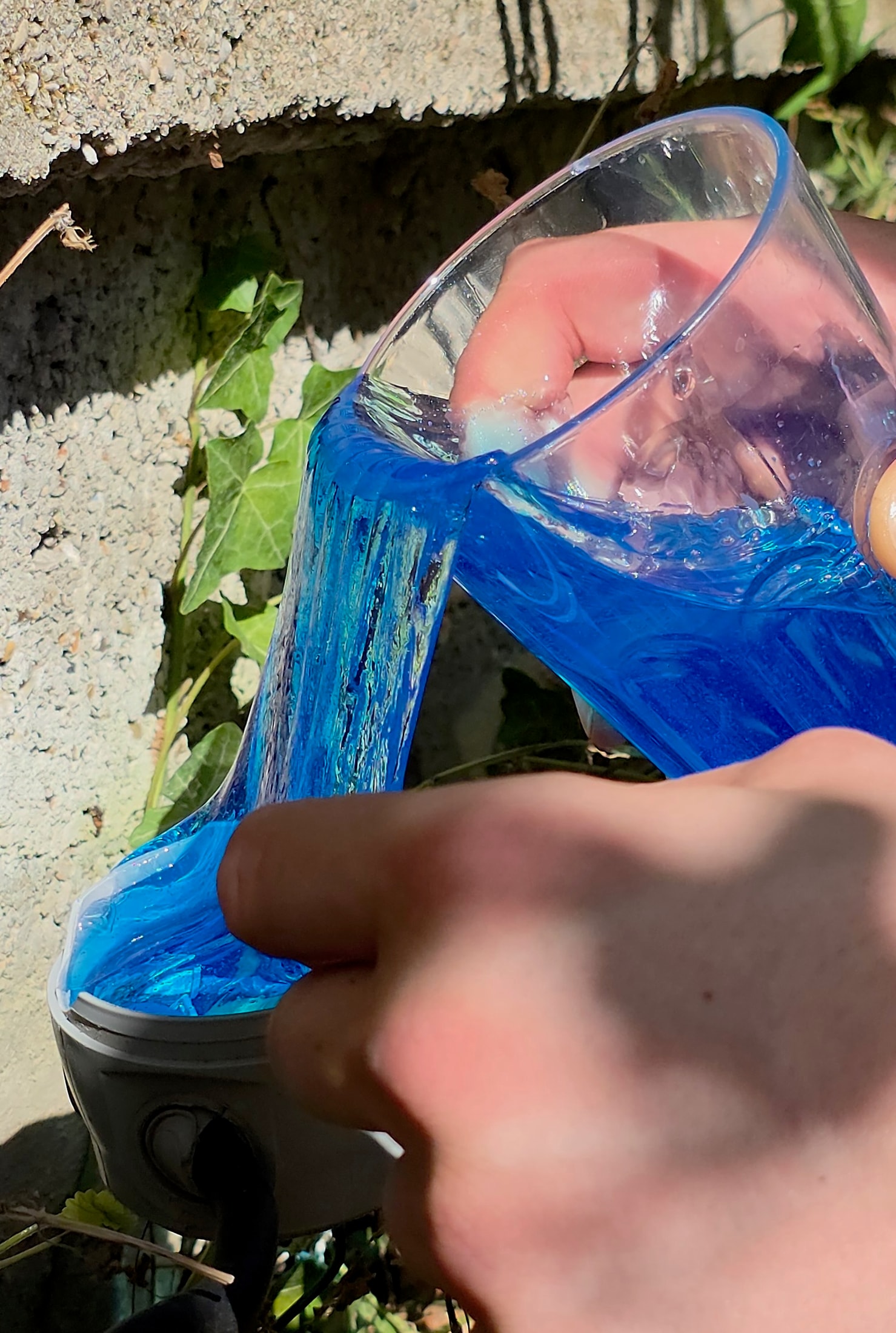
Sticky to the touch, yet fluid enough to hug every shape: the fill is checked by touch.
The result surprised me on one specific point: the gel did not run out through the unglanded cable entries in this test. The WAGO connectors were submerged and the lid could close. That observation does not verify the assembly’s ingress protection, identify a British cable designation or demonstrate conformity to BS 7671.
The finger touching the gel during filling confirms the consistency: sticky like Wonder Gel, but fluid enough to conform to every shape.
In front of the concrete wall, the hand holds a mass of blue gel that stretches without tearing: the viscous texture is that of a product that sticks to everything — hence the importance of working with gloves.
Seen from above, the round box is completely filled: the connectors disappear beneath a uniform mass of blue gel, with no dry spots or cavities.
Three practical remarks to wrap up. The first concerns estimating quantities: with Magic Gel 300, I had enough to handle two good-sized junction boxes in my case, whereas I initially thought I would empty the pack much faster.
The second concerns duration: I deliberately left a Magic Gel sample outside in the garden for about a month. When I checked on it, it had changed very little.
This field observation is consistent with the UV stabilisation Raytech claims, without turning just any box into an IP68 system: the brand itself makes IP68 conditional on a suitable enclosure.
The third concerns installation geometry. As long as the box is open with the lid facing up, pouring is very simple.
On a box already fixed vertically, use a fill method permitted for that enclosure. Do not drill a new opening just to make pouring easier unless the manufacturer specifically allows it and the required protection of the assembled box is maintained.
The hotter it is, or the longer I wait after mixing, the more of a problem this becomes, because the gel thickens.
To get back into a box, though, I don’t need to drill: I open the lid and remove the gel, which peels off by hand in a few seconds, very evenly and with very little residue in my test. The material therefore remains far easier to access again than a hard resin.
The idea of using a Raytech gel somewhere other than a simple cable joint is not far-fetched. Raytech explicitly designs Magic Gel Sprint for electronic circuits, and its Ray Gel for telephone installations, intercoms and the protection of LEDs and displays.
This makes the gel a credible way to protect connections or small electronic assemblies from moisture in a vehicle, a camper van, a scooter or an outdoor light fitting.
The condition remains the same: the whole assembly must be placed in a housing and wired correctly.
This is exactly the kind of test I find interesting for LED accessories exposed to splashes or condensation.
The important limit is heat. Raytech’s datasheets mention temperature resistance and thermal characteristics, but the Ray Gel designed for LEDs shows a thermal conductivity below 0.2 W/m·K.
So I do not treat these gels as thermal paste or as a heat sink. I avoid flooding a driver, transformer or LED without a thermal assessment when it relies on its housing to dissipate heat.
Same logic for the IP rating: the gel protects what it encapsulates, but it does not let you relabel an indoor luminaire as an outdoor one. Raytech specifies that IP68 is achieved in suitable enclosures.
In practice, I mainly see value in making a suitable connection or electronic enclosure more reliable, not in circumventing the product’s thermal and mechanical design.
The second part of the test is Raytech’s IP68 Betty 4 connector: a Little Joint L measuring 145 × 46 × 35 mm, for up to 5 × 4 mm² and cables from 10 to 16 mm in diameter.
The packaging advertises IP68 officially tested by IMQ, IP69K officially tested (the test body is not named) and electrical performance to CEI EN 50393 as applicable.
The housing is pre-filled with gel and comes with its Betty/4 terminal connector, which is distinct from the photographed Fred IP68: no preparation needed, you just connect it and close it up.
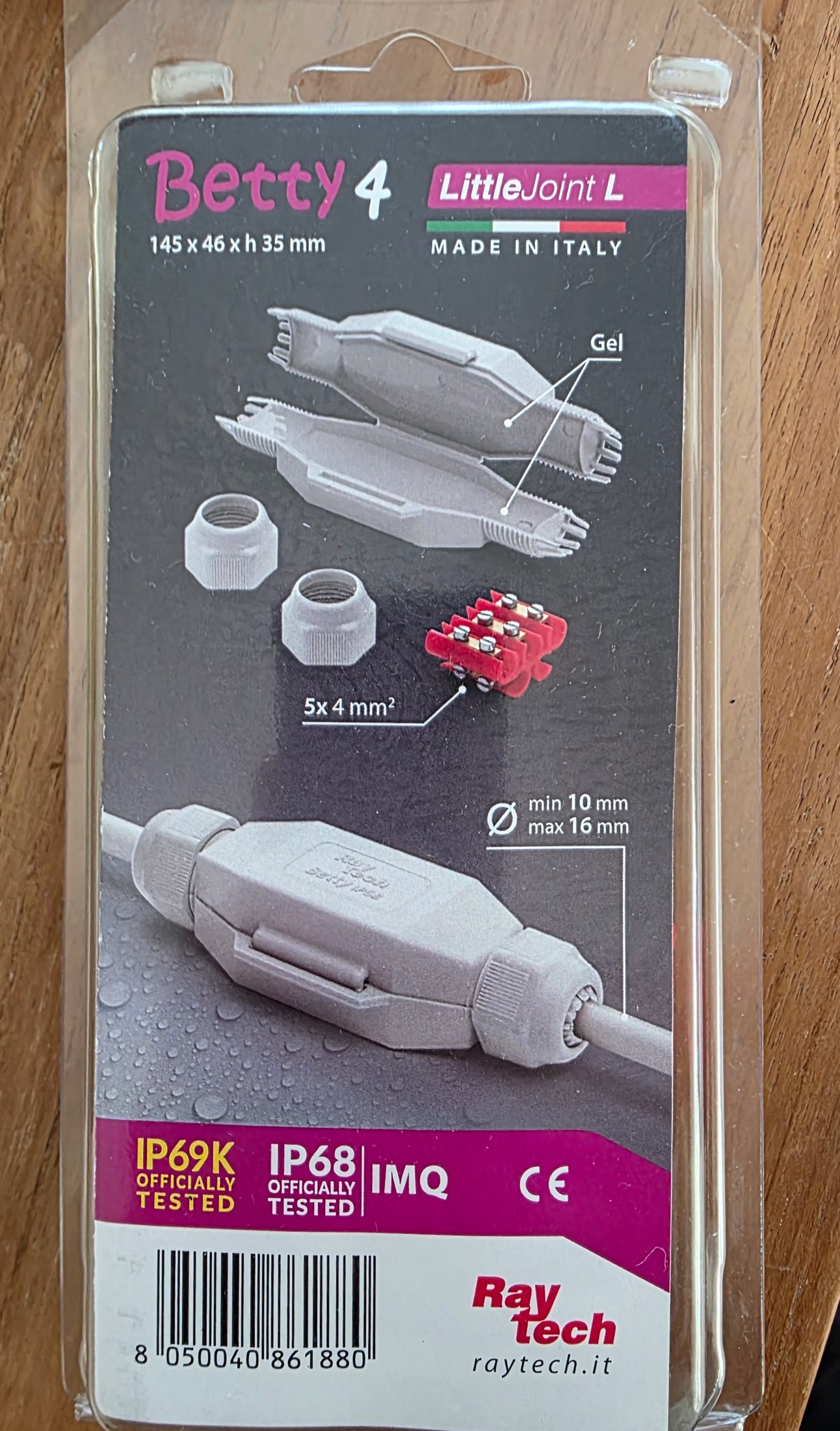
The Betty 4 is a product with IP68 officially tested by IMQ, IP69K officially tested and electrical performance to CEI EN 50393 as applicable, pre-filled with gel and supplied with its specified connector; the Betty/4 data and the Fred workshop photos relate to different models: no preparation needed, you just connect it and close it back up.
It is sized for 5 × 4 mm² max and cables from 10 to 16 mm, so check the range before buying.
Raytech lists Betty/4 for underground use under its stated conditions. Neither its IP rating nor loose gel poured into another enclosure establishes a measured resistance to crushing; mechanical protection depends on the installation.
The workshop photos show the smaller Fred IP68, including its screw terminals and screwdriver tightening. I explain the handling in my Little Joint L and Betty/4 article, while keeping the photographed Fred separate from the Betty/4 specifications.
I set up the test in a waterproof junction box mounted on a stone wall, with Wago 2273-203 connectors wired with 1.5 mm² solid conductors.
These are the everyday connectors for an outdoor spur: push-in connection, 450 V, 24 A, solid 0.5 to 2.5 mm², strip length of 11 mm.
When choosing between the series, I refer you to the comparison Wago 221 or 2273: the 2273 is for solid conductors only, and mixing stranded and solid requires the 221.
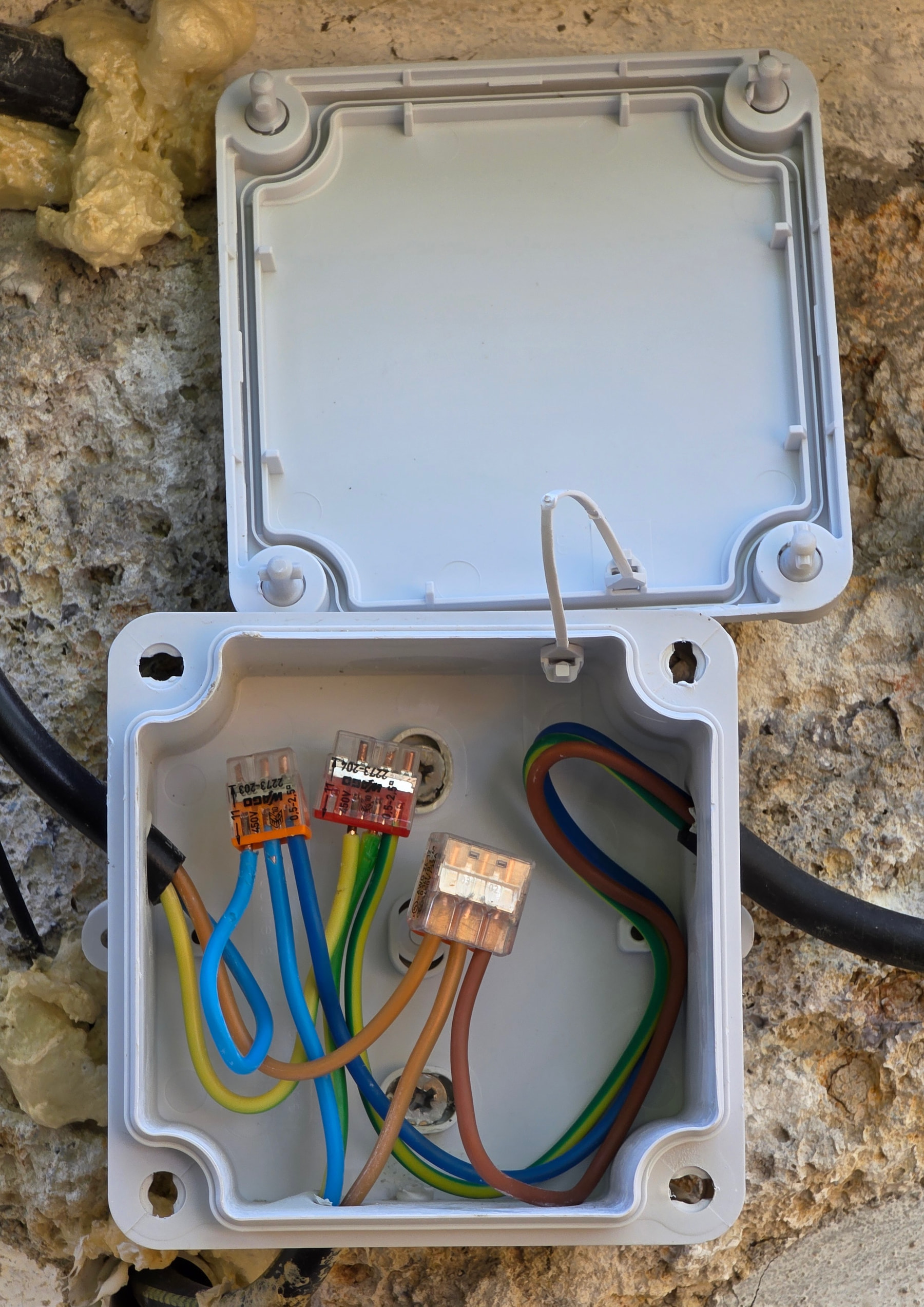
The box takes three connectors on its cable entries: it’s a typical arrangement for a façade, the kind of arrangement you find for the supply to a spotlight or a wall light.
The cables pass through suitable entries in the enclosure. I then insert the stripped solid conductors fully into the WAGO 2273-203 connectors inside the box. The designated test openings are for suitable electrical probes, not adjustable tabs.
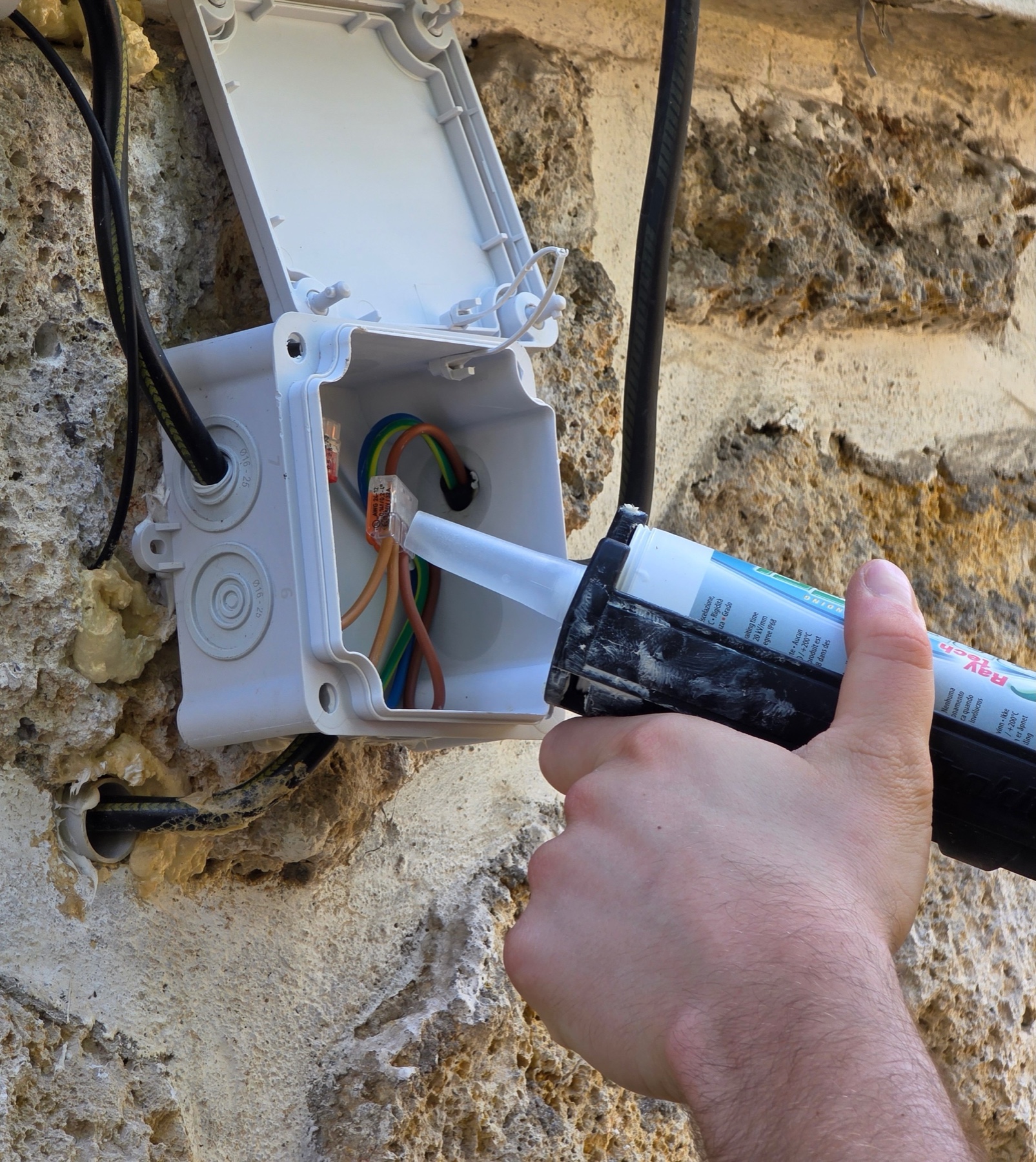
Before opening the junction box
An outdoor box should only be handled once the circuit has been identified and isolated. Switch off the relevant circuit at the consumer unit, prevent it from being re-energised, then verify that there is no voltage before touching the conductors.
Switch off and verify
Switch off the circuit at the consumer unit, lock off to prevent re-energisation, then prove the circuit is dead with a two-pole voltage indicator.
Prepare the connections
Strip the solid conductors to 11 mm and push them fully home into each port of the 2273 connectors.
Mix or load
Mix the two bottles of Magic Gel, or fit the Wonder Gel cartridge into a standard sealant gun.
Flood the connectors
Pour the gel over the connectors until they are completely covered, tilting the box if necessary.
Let it set or close up
Wait for the two-part gel to cure, or close the box immediately for the one-part gel.
Check
With the circuit isolated, check the lid, cable entries and terminations; after safe re-energisation, perform the required RCD operation test using the applicable procedure and suitable equipment.
When it comes to pouring, the reality is less forgiving than the datasheet suggests: the gel is very gelatinous, it does not flow between the conductors and does not level out on its own.
It is applied with a sealant gun, on the surface around the connectors, and the Wago connectors remain visible above the mass.
You can check removal on the same box: the 2273 connector emerges without resistance, and the black cable comes out with it. I remove it without any tool, the block peels off with one hand.
The white box filled with gel, with its black cable and a finger pressing on it, confirms the texture: sticky, but the block can be cut and removed easily.
I applied Wonder Gel with a sealant gun: the 280 ml cartridge screws in like a standard sealant. In the filmed test, a Makita caulking gun: the gel sticks poorly to the tube, and I finish pushing by hand with no success around the Wago connectors: the Wago connectors do not go into the gel.
The operation, however, is more technical than it looks, and that is where my opinion changed — I’ll come back to it in the next section.
Nothing special on the cartridge side: white nozzle, no preparation before injecting.
The gallery below shows the connectors after removing the gel: I slit the block and removed the bulk; only very light residue remains around the connectors, with the markings and conductors entirely clear.
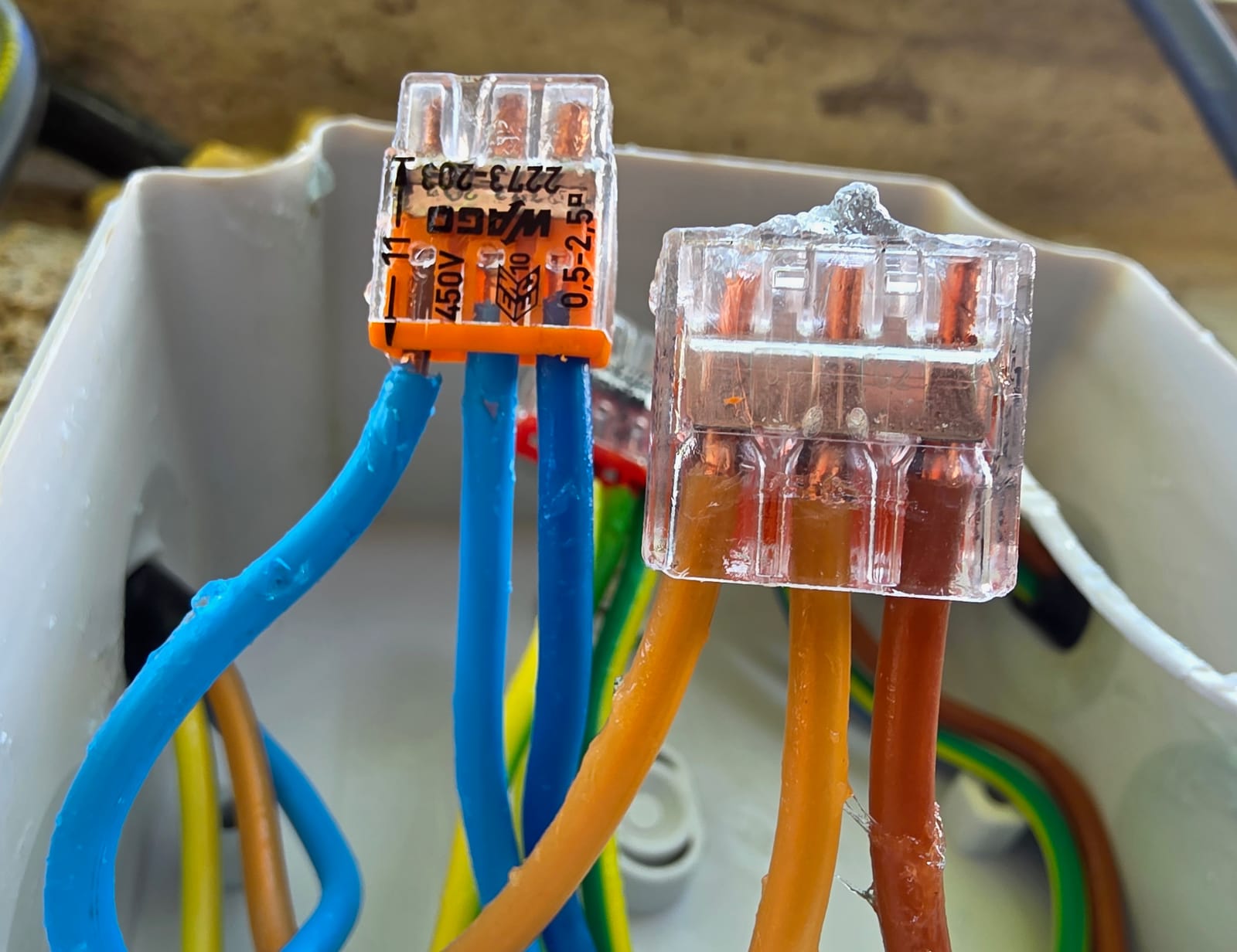
Close-up of two Wago 2273-203 connectors (one orange, one transparent) in the junction box after removing the gel: only light residue remains, and the markings and conductors are fully visible.
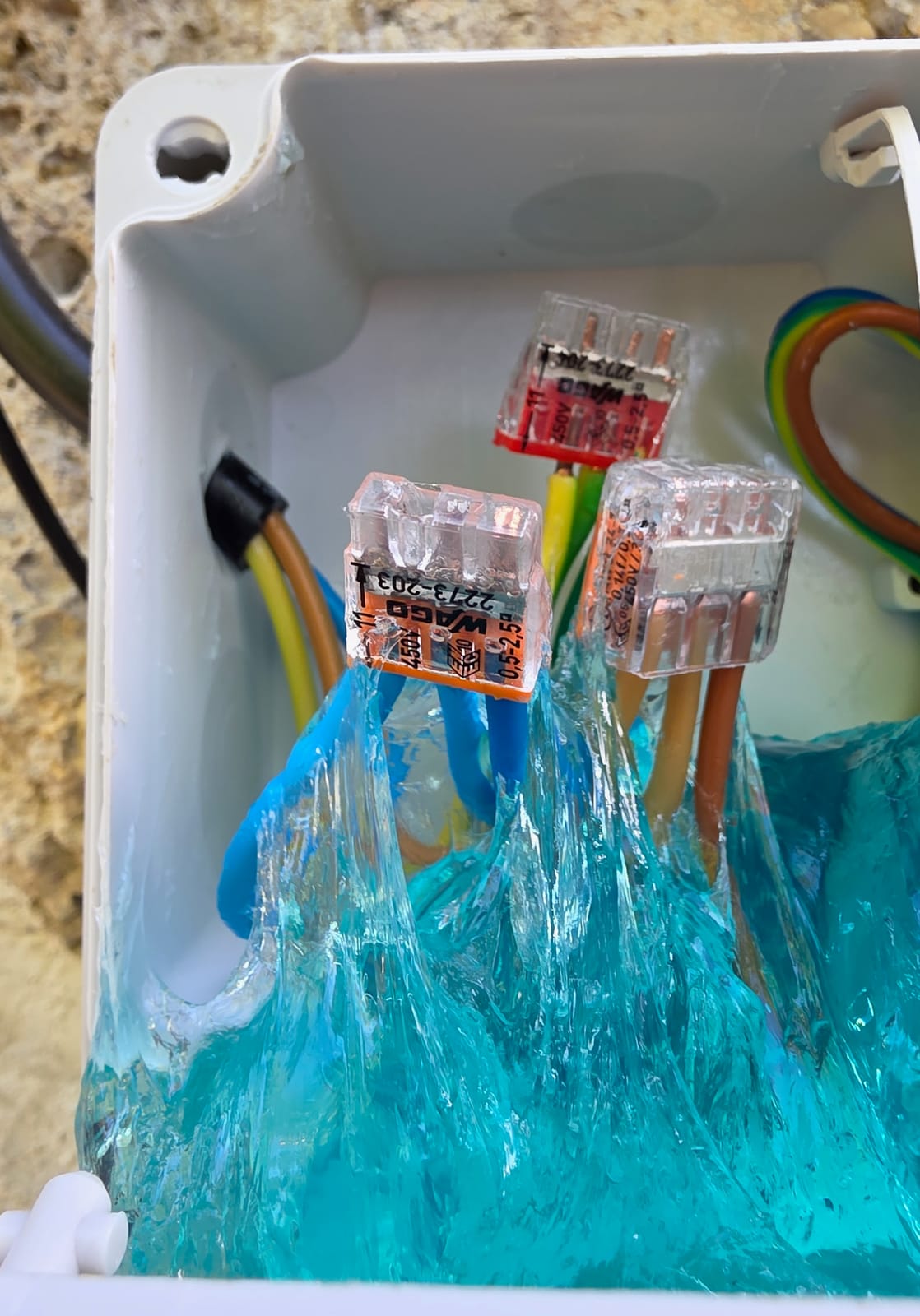
Three 2273 connectors in the box: the blue gel fills the bottom, but the connectors stay visible at the surface — the coating is not even.
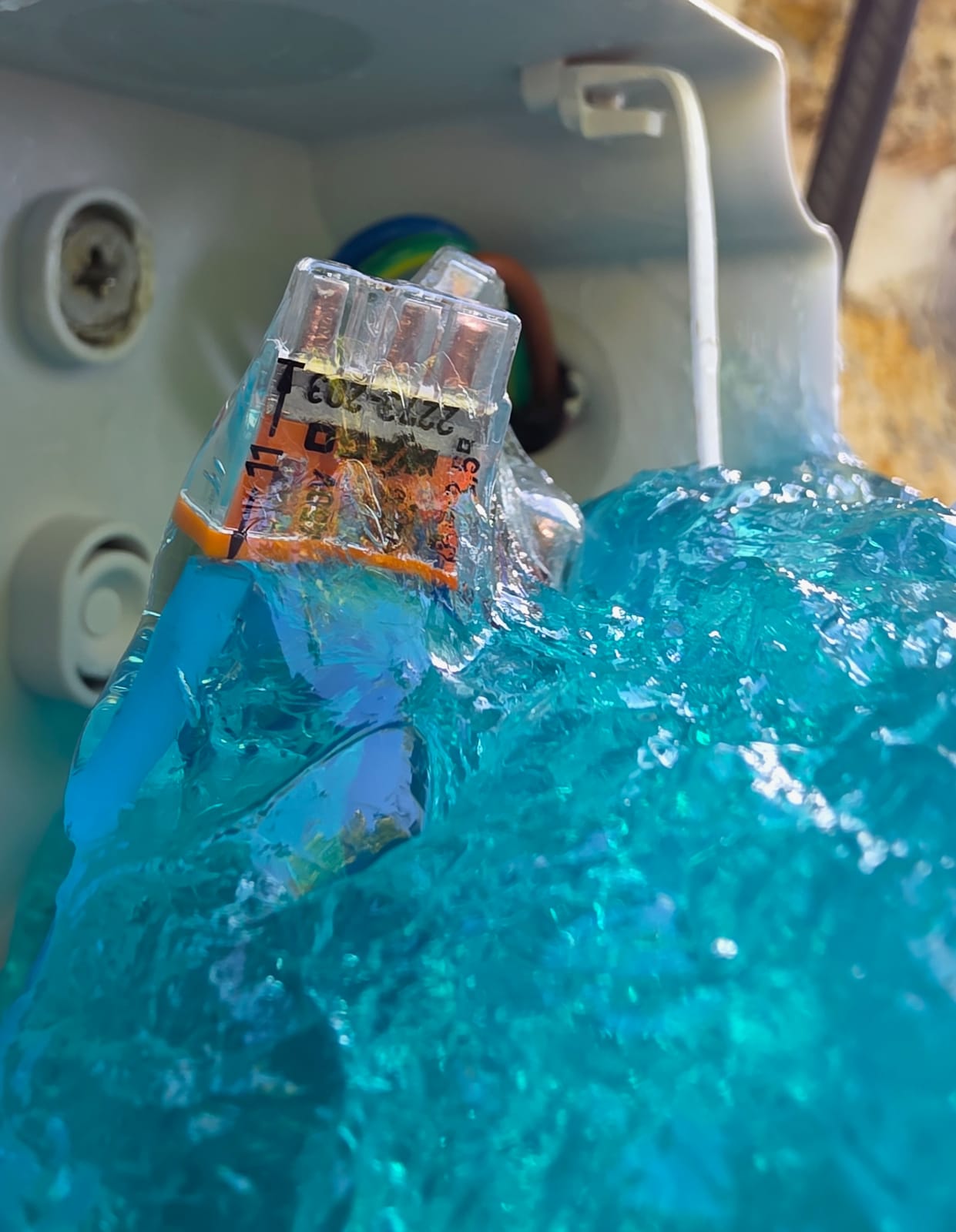
One 2273 connector partially submerged in the thick gel: the base is covered, while the top of the connector and its markings stay visible.
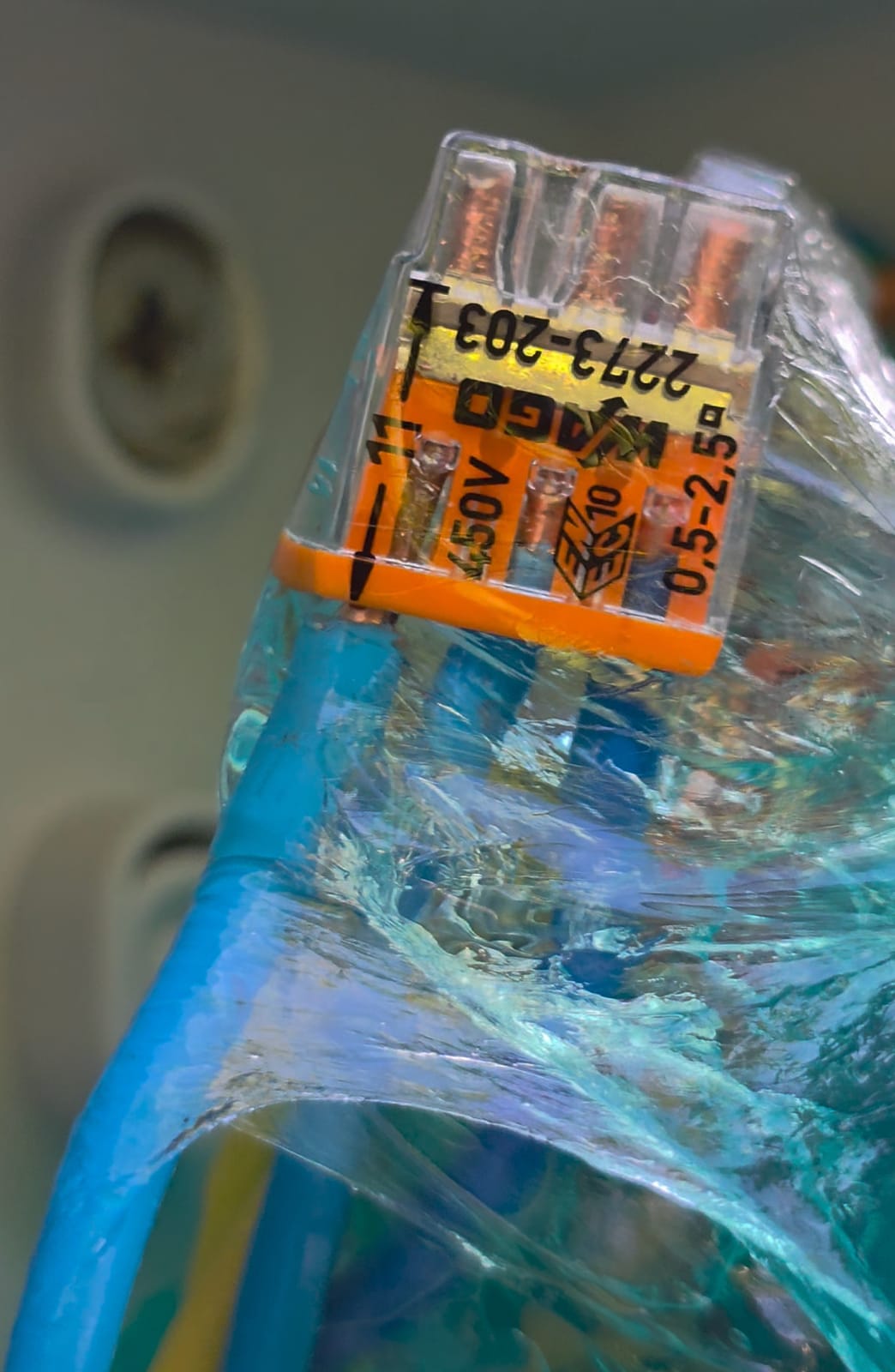
Macro shot of a 2273-203 connector: the 450 V marking stays legible under a thin layer of gel.
I’ll be upfront about one point: pouring gel into a waterproof junction box is a pragmatic field practice, but it isn’t certified by anyone. A 2273 connector on its own is not waterproof.
Ingress protection depends on a suitable enclosure, including its cable entries and closure, assembled according to the instructions; I did not test the IP rating of my assembly. The gel protects the connection it covers.
It’s a pragmatic combination, but pouring into a box remains an uncertified practice: no VDE test certifies it as it stands.
With Magic Gel in the round IP55 box, my pour visibly covered the Wago connectors and no gel leaked at the cable entries; I did not achieve the same result with Wonder Gel. Neither observation verifies the assembled enclosure’s ingress protection.
For compatible WAGO connectors, the WAGO Gelbox is a manufacturer-tested pre-filled product. The Betty 4, meanwhile, is a distinct joint with IP68 tested by IMQ, IP69K officially tested and electrical performance to CEI EN 50393 as applicable. Neither certification covers a separate box filled with loose gel.
The limits of my own test deserve a mention too. First, this was my first attempt at pouring this gel, and I don’t have a test bench — I didn’t time the cure to the nearest tenth of a second or check the dielectric strength after curing.
My observation is visual and practical: partial coating, a very thick, jelly-like gel, resealable box, no gel creeping up into the cable glands. The viscosity problem I ran into is confirmed by online reviews, which describe the same sticky gel that won’t flow.
For measured validation, the values published by Raytech remain the only reference.
The gel doesn’t replace the waterproof box: it does what the box can’t — protect the connection itself.
The real-world test gave a more mixed picture than the bench pour. The two-part Magic Gel poured first time, without any trouble, into the round IP55 box, as detailed above; the 280 ml cartridge of Wonder Gel gave me two setbacks, one about the quantity, the other about the technique.
With Wonder Gel, removal is quick: you score it, peel the material away and the terminal comes free. On the other hand, in my test, putting that Wonder Gel back in place after opening did not restore a uniform coating: it stuck to my fingers and tools instead of returning to its original shape.
I reopened the Wonder Gel box the day before to try to put the material back and then top it up: in my test, the self-bonding Raytech advertises did not allow the original coating to re-form properly.
This observation concerns the Wonder Gel cartridge tested here. It doesn’t contradict my test of the two-part Magic Gel: once cured, it comes out very cleanly in one piece and leaves very little residue, but I still don’t consider a removed gel to be a seal that can be reused as is.
After going back in, three options present themselves. The WAGO FAQ calls for replacing the connectors and the Gelbox: it’s the only option guaranteed by the manufacturer. The Betty 4, on the other hand, can be reopened and closed repeatedly—Raytech still claims it’s re-enterable (“always re-enterable”).
The Wonder Gel in this box comes out quickly, but putting it back doesn’t restore a seal I would consider reliable.
Retour de chantier
In my test, Magic Gel peeled away within seconds, leaving very little residue. My failed attempt to re-form a uniform seal involved Wonder Gel, which stuck to fingers instead of enveloping the terminals again. Raytech describes the Betty 4 as re-enterable, but reopening it does not by itself prove that a reused seal retains its original protection. The Gelbox, replaced with its terminals as WAGO specifies, provides a documented servicing route.
The first letdown was how much gel it took: a square outdoor junction box IP55 with eight entries couldn’t be filled entirely with a 280 ml cartridge. A Wonder Gel cartridge runs out very fast as soon as you drown connectors in a medium-size enclosure.
Raytech doesn’t publish any usage figures for its gels; the documented ballpark figures mention 400 ml per box for a competing two-part gel, 370 ml for a nine-entry resin box and 80 ml for a mini box.
In my eight-entry IP55 outdoor box, one 280 ml Wonder Gel cartridge was not enough to cover the connections fully. I did not measure the box’s free volume; the amount needed depends on its dimensions and wiring.
The second setback is more troublesome: applying Wonder Gel from its cartridge for full encapsulation requires, I think, real technique.
In this particular box, Wonder Gel did not spread beneath the Wago connectors as I applied it, although Raytech describes it as self-levelling: you have to control the pressure on the gun, keep the nozzle at the right angle and work the gel down between the terminals so that the gel gets under the conductors instead of piling up on the surface.
I wasted my first cartridge on a box I thought was full: the surface was covered, the underside of the terminals was not.
In the field, I therefore always check the finished application by looking at the surface. A full encapsulation leaves no terminal visible, whereas a partial encapsulation leaves the connectors at the surface.
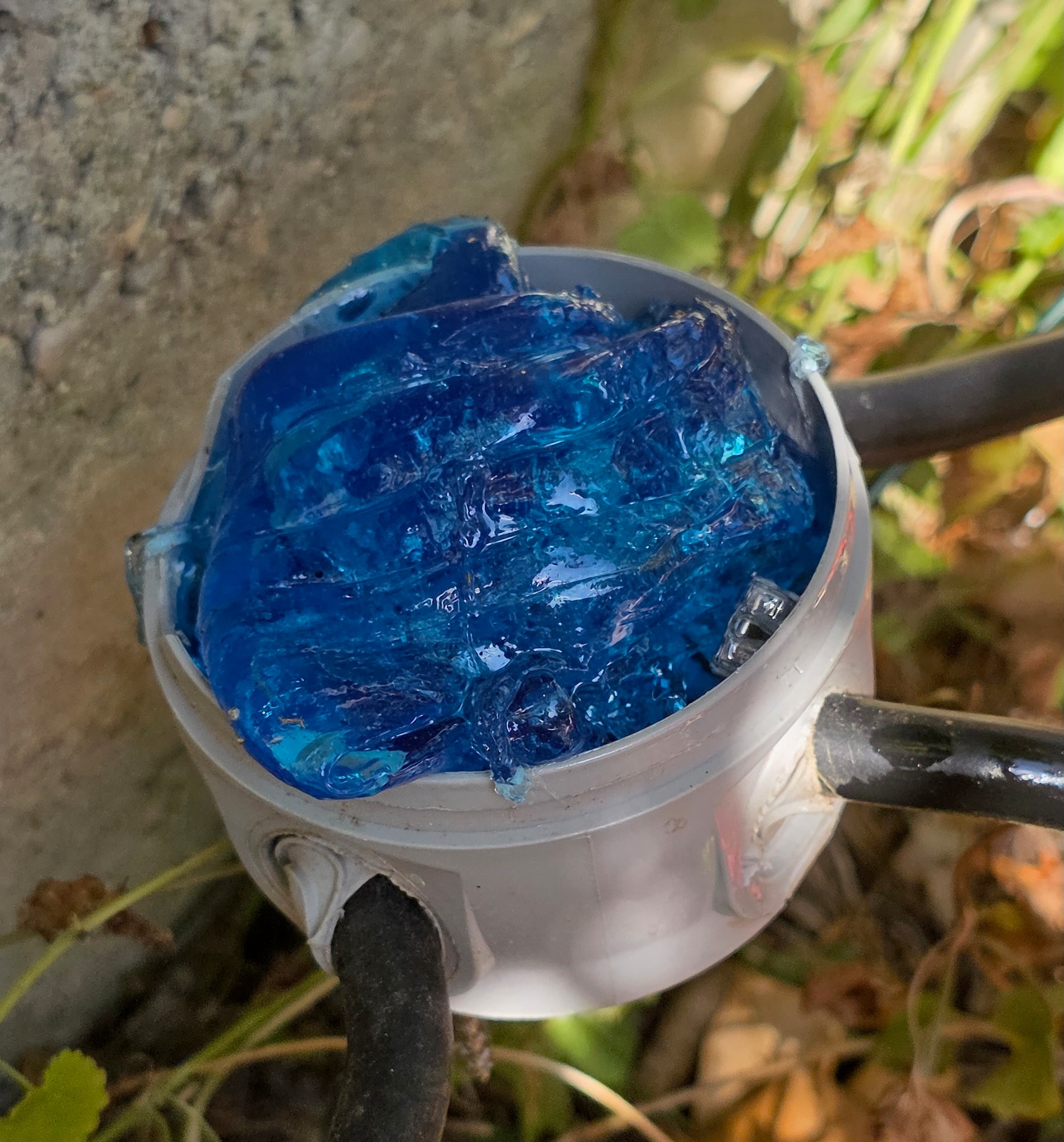
The gel covers the terminals across the whole surface; no air pockets were visible at the surface during this pour.
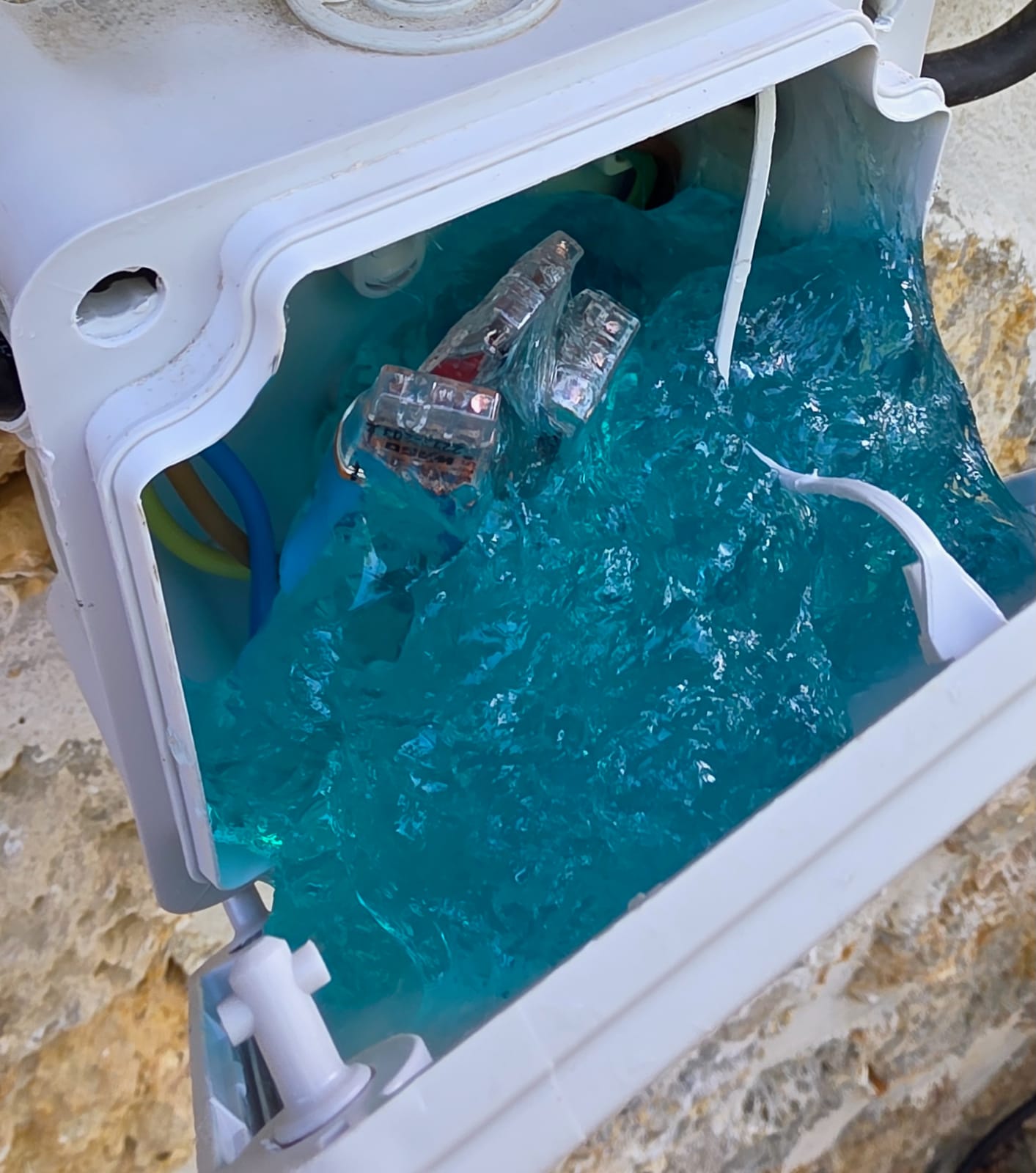
Here the gel hasn't flowed between the terminals: they stay at the surface, the encapsulation is incomplete.
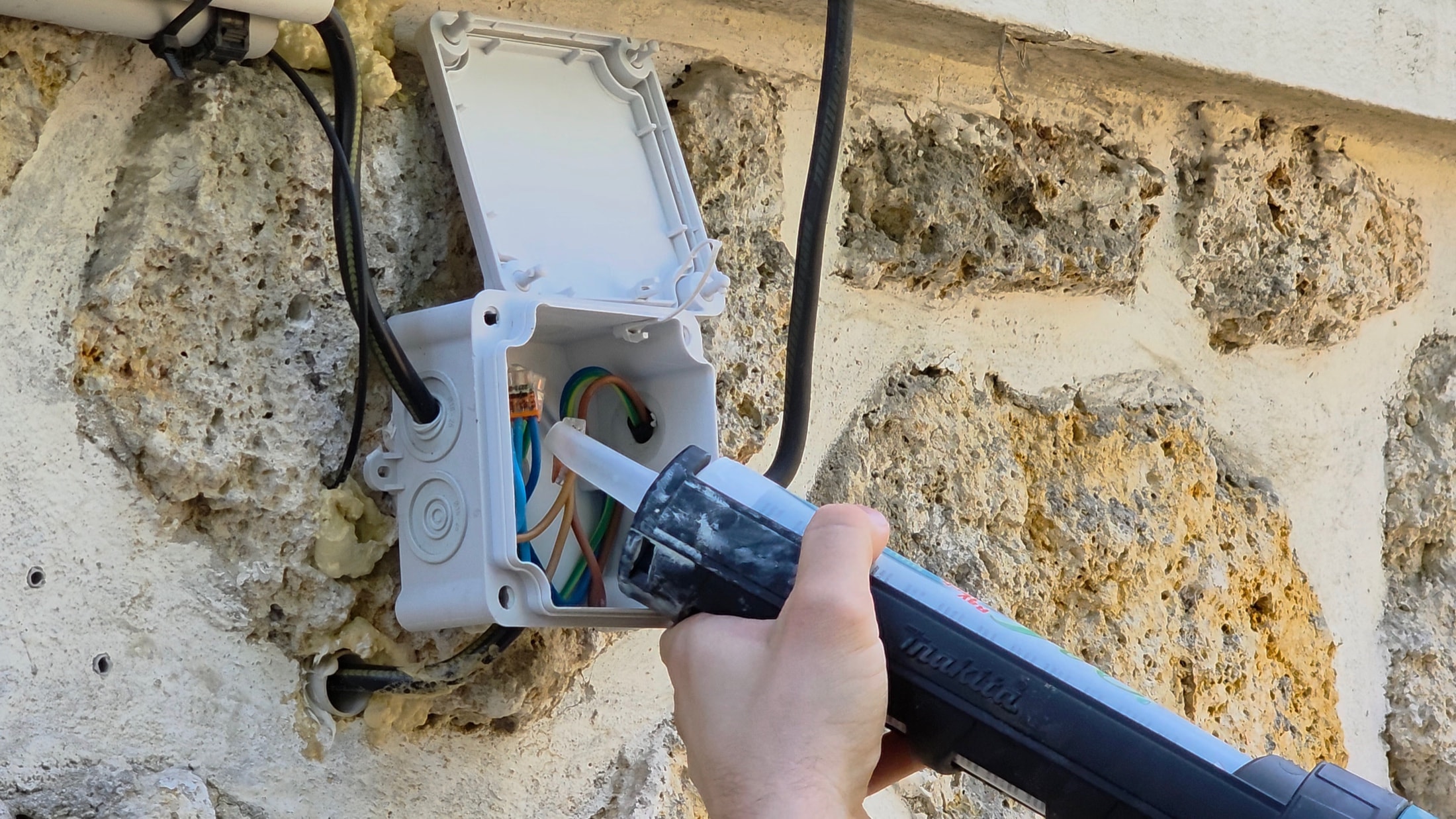
With a gun, the gel gets pushed along the surface: the terminals sit at the top of the gel, the encapsulation stays partial.
And honestly, I didn’t manage it: the Wago connectors refuse to go into the gel, it really sticks to fingers and tools as soon as you try to touch up a missed area, and every attempt fails.
In that particular box, I could not fully cover the WAGO connectors with the 280 ml Wonder Gel cartridge; I did not test the enclosure’s ingress protection. One of my test boxes ended up emptied out and cleaned.
I’m not the only one struggling: a 123elec customer (“Coco”, March 2024) writes that “you have to get the hang of applying it, because it’s a gel that never dries and doesn’t run”. Another one (“Nico.P”, September 2025) finds it easy with a standard caulking gun but would have liked it to firm up slightly.
Italian reviews online describe a very sticky gel that is awkward to use at first. Magic Gel in bottles, on the other hand, can be measured out and poured: it’s the format I strongly recommend — and not just for a first use.
When it comes to handling, the gel clings to fingers and tools: I plan to wear gloves for any handling, and even then, the coating never comes away cleanly once the connector is pulled free.
For compatible WAGO connectors, the WAGO Gelbox is a manufacturer-tested pre-filled option. At 230 V, WAGO requires the Gelbox and terminals to be installed inside a suitable junction box for double insulation; the no-extra-enclosure exception concerns SELV. These tests do not certify a separately chosen box filled with loose gel.
Raytech plays the same card with the Happy Joint 5: a mini box with three cable entries pre-filled with gel, tested IPX8 by IMQ (IEC EN 50393), with connectors included, ready to use and re-enterable — the direct equivalent of the Gelbox, without VDE certification.
I compare it all to pre-filled boxes and cable gland kits in my test of Raytech waterproof junction boxes.
For work in Great Britain, consult Obligation BS 7671:2018+A4:2026 and assess the specific conditions at the point of installation.
Attention
Gel is not a substitute for the enclosure or wiring system. Unapproved drainage holes and unglanded entries can defeat the complete assembly’s IP protection even where the gel stays inside. Verify the actual installation and protective devices, not merely whether gel leaks.
A buried joint is then made in a suitable box or a pre-filled enclosure, never by simply pouring gel into a surface box: the gel protects against moisture, not against crushing.
For the rest of the installation, the guide on installing an outdoor garden socket goes through the location, the circuit and the tests before commissioning, point by point.
Raytech does not publish list prices for its gels: pricing comes from an electrical wholesaler or on quotation. The available sizes range from the Magic Gel 300 (2 × 150 ml) to the Magic Gel 1000 (2 × 500 ml), made to fill several boxes or deep boxes, right up to the 2000 and 10000 formats for industrial runs.
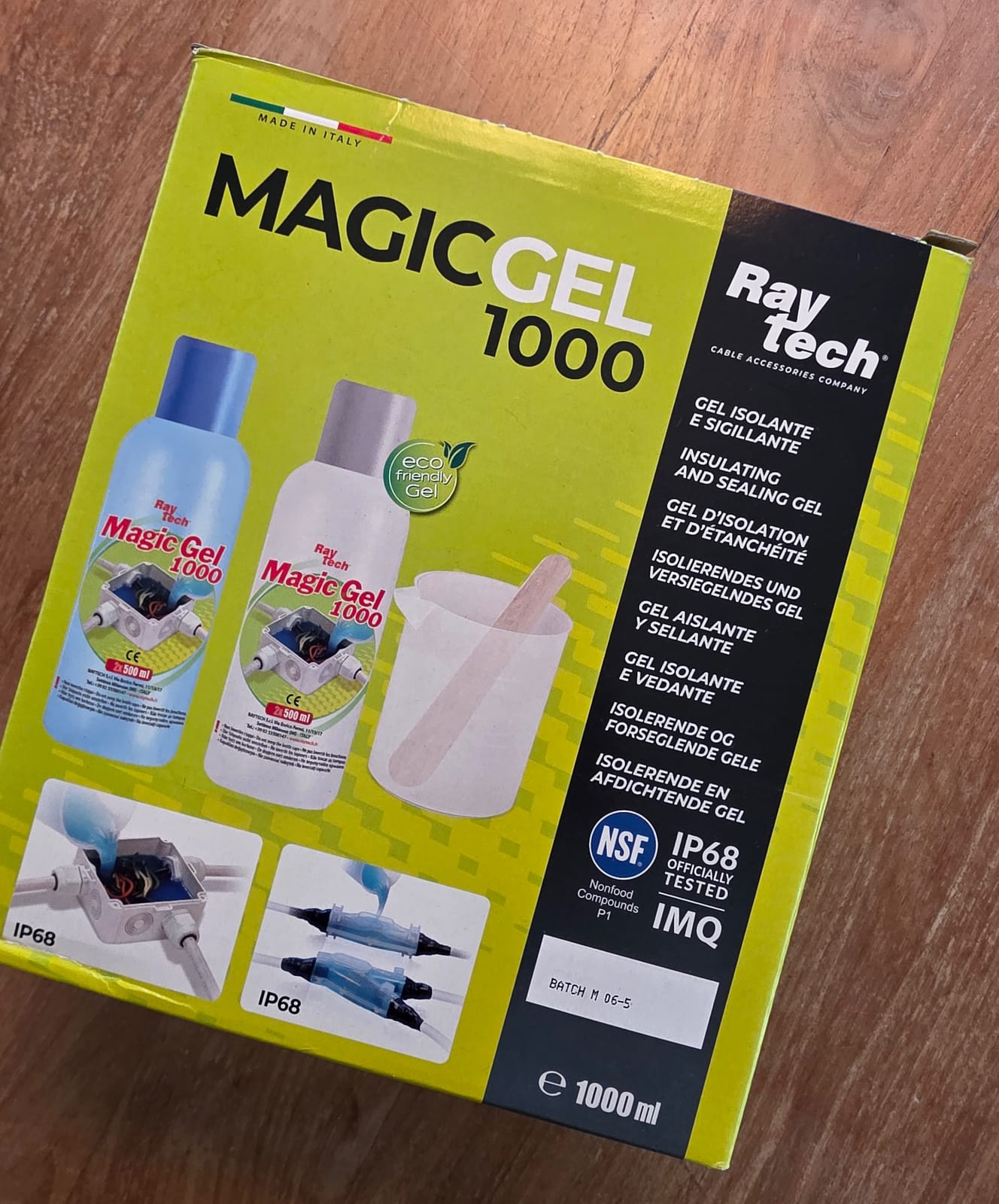
Magic Gel 1000 contains two 500 ml bottles, compared with two 150 ml bottles for Magic Gel 300. For several boxes, the larger pack is practical; any saving per litre depends on actual supplier quotes.
The test helped me compare two application methods. With Magic Gel in bottles, I could prepare the mix, pour it and inspect the result.
In the round IP55 box, the Wago connectors were covered on the first attempt, with no air pockets visible at the surface during the pour. Gel did not leak through the unglanded cable entries during this trial. That observation does not establish the enclosure’s IP rating or the installation’s compliance.
With the Betty 4, the pre-filled gel envelops the terminals when the enclosure is closed, with a little material visible at the seals. This is a manufacturer-tested assembly, distinct from my Magic Gel poured into a standard box.
The Wonder Gel cartridge was another story: I used up the first 280 ml cartridge on an eight-entry box without getting the Wago connectors fully enveloped. The gel stuck to fingers and tools. I could not obtain the continuous coverage I was trying to achieve.
The Wago connectors refuse to go in, the gel sticks to your fingers, and every attempt to put things right makes it worse.
The shared limitations remain the same: manufacturer-stated IP68 in suitable enclosures, IMQ-tested IPX8 cited for Wonder Gel in suitable enclosures, but no IP test of either of my assemblies, cure time quoted as two different figures (10 and 15 minutes) and uncertified pouring into a box.
For compatible WAGO terminals, the WAGO Gelbox is a tested pre-filled option (EN 60998, IPX8), with components to replace according to WAGO’s instructions after rework. Raytech’s Happy Joint 5 is a different pre-filled joint tested IPX8 by IMQ and supplied with terminals.
Neither rating transfers to loose gel poured into another enclosure.
As for the Betty 4, it is a product with IP68 officially tested by IMQ, IP69K officially tested and electrical performance to CEI EN 50393 as applicable, with integrated cable glands and pre-filled gel: a ready-to-install solution, whereas pouring into a separately chosen box remains an assembly carried out on site.
The two gels behave differently when reopening a box: Magic Gel peeled away cleanly in my test, while I could not achieve a uniform seal again with Wonder Gel after removing it. I do not extend that result to every Raytech gel.
If I had to sum up who buys what: the Magic Gel 300 to test or flood a box, the Magic Gel 1000 as soon as you have several, the Betty 4 for a ready-to-install watertight junction, the Gelbox for anything that needs to be certified. As for the Wonder Gel, I found no use for it in the field.
Verdict on the Magic Gel
The Magic Gel in two-component bottles is an excellent product: simple pouring, Wago connectors well covered, with no air pockets visible at the surface while pouring in the round IP55 box, no gel leakage through the unglanded cable entries during this one test, which does not establish the enclosure’s IP rating, and the removal is extremely easy and quick. In the height of summer, around ten seconds of mixing was already enough in my test before rapid thickening; in colder weather, the working window lengthens, with no universal working time to quote. Two genuine reservations: the IP68 rating advertised by Raytech assumes a suitable enclosure, and the data sheet lists two curing times at 23 °C (under 10 minutes in the description, around 15 minutes in the table): 4.5/5.
Verdict on the Wonder Gel
The Wonder Gel in a cartridge did not work in my test: the terminals stayed on the surface, the gel stuck to fingers and tools, and I could not achieve the continuous encapsulation I was after in this box.
Removal is quick, but that does not make up for the failed application on my setup. For this specific use, I would not choose it: 1.5/5.
3 questions
InteractiveQuiz: Raytech sealing gels
3 questions to check the essentials
Choose an answer
The Magic Gel is a two-component product: two bottles to mix, cold curing in around 10 minutes at 23 °C according to the data sheet, to permanently encapsulate a connection. It is poured from a simple container (a glass, a cup, a measuring jug), visibly coats the Wago connectors with no air pockets visible at the surface during my pour, and did not leak through the unglanded entries of the round IP55 box in my test. That observation did not verify the enclosure’s IP rating. The Wonder Gel is single-component, already cured, applied with a standard silicone gun: it does not harden and protects immediately — on paper. In my test, the Wonder Gel was a failure: the terminals will not go in, it sticks to your fingers, and I could not obtain full coverage of the terminals in my box; I did not test its IP rating.
Raytech Betty/4 is a gel-prefilled Little Joint L micro-joint specified at 145 × 46 × 35 mm, for 5 × 4 mm² conductors and 10–16 mm cables. Raytech documents the system’s IP68/IP69K tests and describes the enclosure as re-enterable; this is not proof of watertightness after reuse. The workshop photos show the smaller Fred IP68, a different model, not an independent waterproofing test of Betty/4.
Raytech states IP68 in a suitable enclosure ("in proper casings"), a manufacturer specification conditional on a suitable enclosure; the Italian Wonder Gel page separately cites IMQ-tested IPX8 in a suitable casing, without certifying either of my assemblies. The gel does not make just any box watertight: it protects the connection inside an enclosure that itself provides the protection against solid objects. By contrast, the Betty 4 connector is a product with IP68 officially tested by IMQ, IP69K officially tested and electrical performance to CEI EN 50393 as applicable. The WAGO Gelbox offers a tested pre-filled assembly for specified compatible WAGO connectors (IPX8, EN 60998). This rating must not be transferred to another box simply filled with gel; the separate Raytech junction-box article concerns different products.
It’s a pragmatic on-site practice, but no test certifies it: the 2273 connector alone isn’t waterproof, and pouring gel into a standard box is based on nothing more than common sense. In my test on an IP55 round box, the Magic Gel covered the WAGO connectors with no air pockets visible at the surface during my pour and didn’t run out through the unglanded cable entries. This is one field observation, not proof of the assembled enclosure’s IP rating, cable classification or compliance with BS 7671. The certified route is the WAGO Gelbox, VDE-tested to the EN 60998 standard and certified IPX8, which accepts the 221 and 2273 series up to 4 mm². The choice of connector upstream remains the same: the 2273 for solid wire only, the 221 as soon as a stranded conductor enters the box, as the guide on mixing stranded and solid wires explains.
The Magic Gel 300 (2 × 150 ml) generously filled a round IP55 box with four cable entries: I emptied both bottles, thinking I would get through it quickly, as with Wonder Gel—not at all, I could have done two boxes with the same pack. It goes a long way. In my eight-entry IP55 box, 280 ml of Wonder Gel was insufficient; the quantity for another enclosure depends on its free volume and wiring, not entry count alone. When buying, the 1000 size remains the most economical as soon as you are filling several boxes.
Raytech does not publish list prices: you need to ask a distributor or request a quote. The 300 (2 × 150 ml) and 1000 (2 × 500 ml) sizes cover everyday applications; beyond that, the 2000 and 10000 sizes target industrial runs.
Raytech describes these gels as storable without a stated expiry date under the specified conditions; check the product-specific label and safety data sheet for their current hazard classification. Once applied, they remain re-accessible: the gel can be cut open, the terminal can be pulled out and replaced — Magic Gel comes out extremely easily and quickly. However, in my test, the layers of new gel did not re-bond to the old gel with Wonder Gel: putting it back sticks to your fingers and does not re-form a reliable seal. In a box, once the gel has been poured, revisiting it remains possible without drilling: you open the lid and remove the gel, which peels off in a few seconds — in my Wonder Gel trial, putting the removed material back did not re-form an even encapsulation. This result should not be attributed to Magic Gel. The Gelbox, replaced along with its terminals as described by WAGO, offers a documented approach to servicing.
No. For a British outdoor circuit, apply the relevant BS 7671 requirements to the site, including an enclosure with suitable ingress protection, correct cable entries, and the protective devices appropriate to that circuit. A gel filler does not certify an enclosure or replace electrical shock protection.
Disclosure Raytech : Magic Gel 300 and Wonder Gel gels, Betty 4 connector.
Théo Desrousseaux
Electrician and editor
I work in the field and edit this magazine. Every guide is reviewed for its target country before publication.
Author → Credentials → Editorial method → Report a factual correction →
Email address and prefilled context:
theo@sparx-elec.fr
Article: https://www.sparx-elec.com/gb/ip68-insulating-gel-raytech-review/
Edition: GB — English
Factual issue: [describe the factual issue]
Passage: [quote or identify the passage]
Source: [optional source URL]
Sources and references
Practical electrical installation guides, diagnostic methods and tool recommendations compared against the technical wiring standards of this national edition.
Raytech Betty 4 (Little Joint L) waterproof connector: IP68 tested by IMQ, IP69K officially tested, 5 × 4 mm² capacity, workshop assembly and limits.
Read the guide Guide Outdoor waterproof junction box Outdoor waterproof junction boxes: field test of the gel-filled Ready Cast and the Magic Box 65 with cable glands, per local wiring regulations. Read the guide
 Guide Best multimeter for electricians UK What is the best multimeter for electricians in the UK? Compare the Fluke 87V, Fluke 117, Klein MM700 and Brymen BM235, with prices, CAT ratings and True RMS. Read the guide
 Guide RCBO vs RCD difference UK consumer unit What is the difference between an RCBO and an RCD? Learn what each device protects, why RCBOs trip less, the cost in the UK, and which to choose. Read the guide