Mount the box on the wall
The box is screwed in place, and the screws are covered with the supplied caps before pouring the gel.
In brief
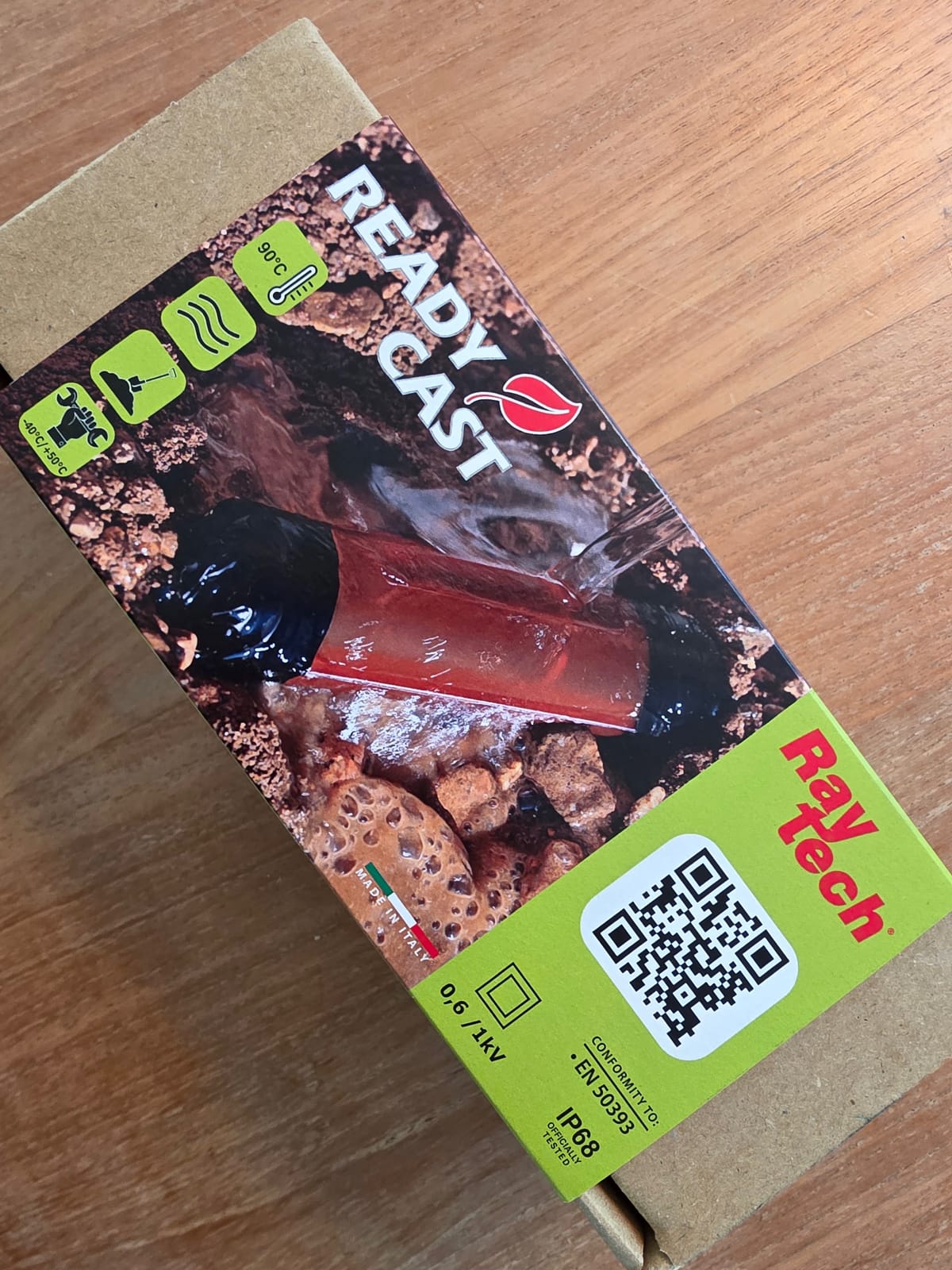
Raytech sent me its waterproof jointing solutions: the pre-filled gel and resin Ready Cast boxes (L4, L10, L16/25 and the Y6, Y16/25 branch joints) and the Magic Box 65 cable gland kit.
I fitted them, opened them, closed them again and compared them with what I normally do on an outdoor electrical installation.
The answer comes down to two strategies. First: a pre-filled box such as the Ready Cast, with no cable glands, for a buried or submerged joint that should never be opened again.
Second: a cable gland and gel kit such as the Magic Box, for a re-accessible enclosure on a wall or a facade, when a connection has to be reopened later.
1 kV
operating voltage of the cables the Ready Cast accepts
30 days
prolonged immersion in the BS EN 50393 test claimed by Raytech
25,80 €
starting price for the Magic Box at Bricozor in France (incl. VAT)
90 °C
operating temperature of both ranges
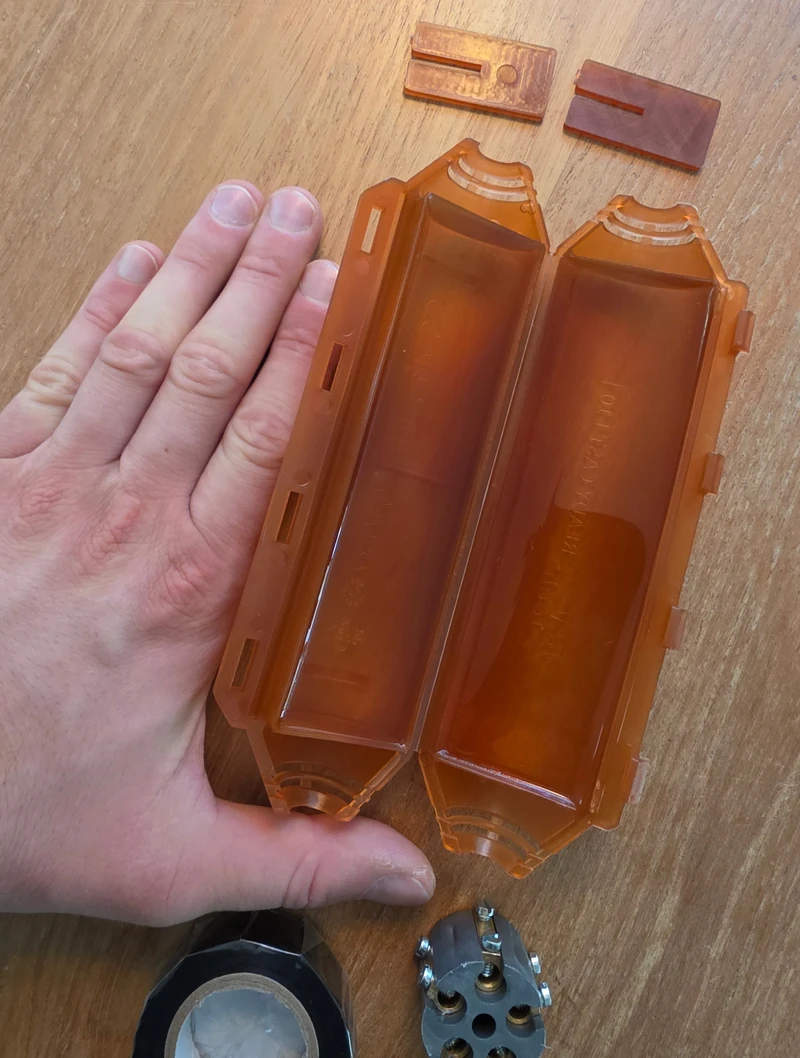
The Ready Cast is a rigid shell pre-filled at the factory with insulating gel or resin.
The cable goes in through pre-scored entries: you cut the membrane to the size of the cable, push it through, make the connection, and the resin or gel flows over the conductors when you close the shell.
The datasheet sums up the installation with a phrase I’ve verified in the field: “Scissors and nothing more!”.
The box is designed for cables insulated up to 1 kV, which covers all domestic work and much of the commercial sector. The material is halogen-free and UV-resistant, two things I always check on outdoor equipment: unstabilized plastic cracks within two or three seasons.
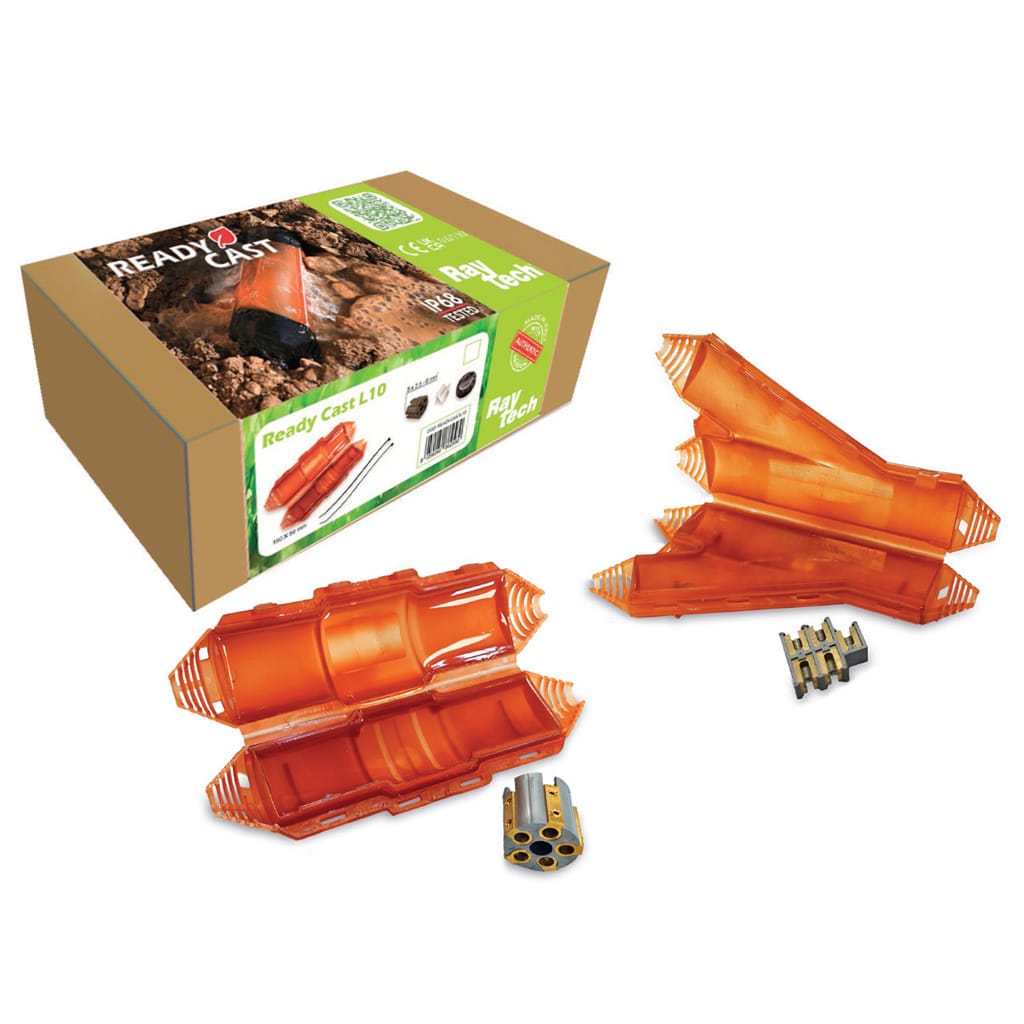
Unlike a typical empty box, everything comes in the one box. Raytech states in its datasheet: the pre-filled enclosure, a screw terminal block, a 4 x separator, strain relief clamps and black electrical tape to finish the cable entries.
The terminal block is what surprised me most for a box of this type: you don’t have to hunt for a connector in your pocket — it’s in the kit.
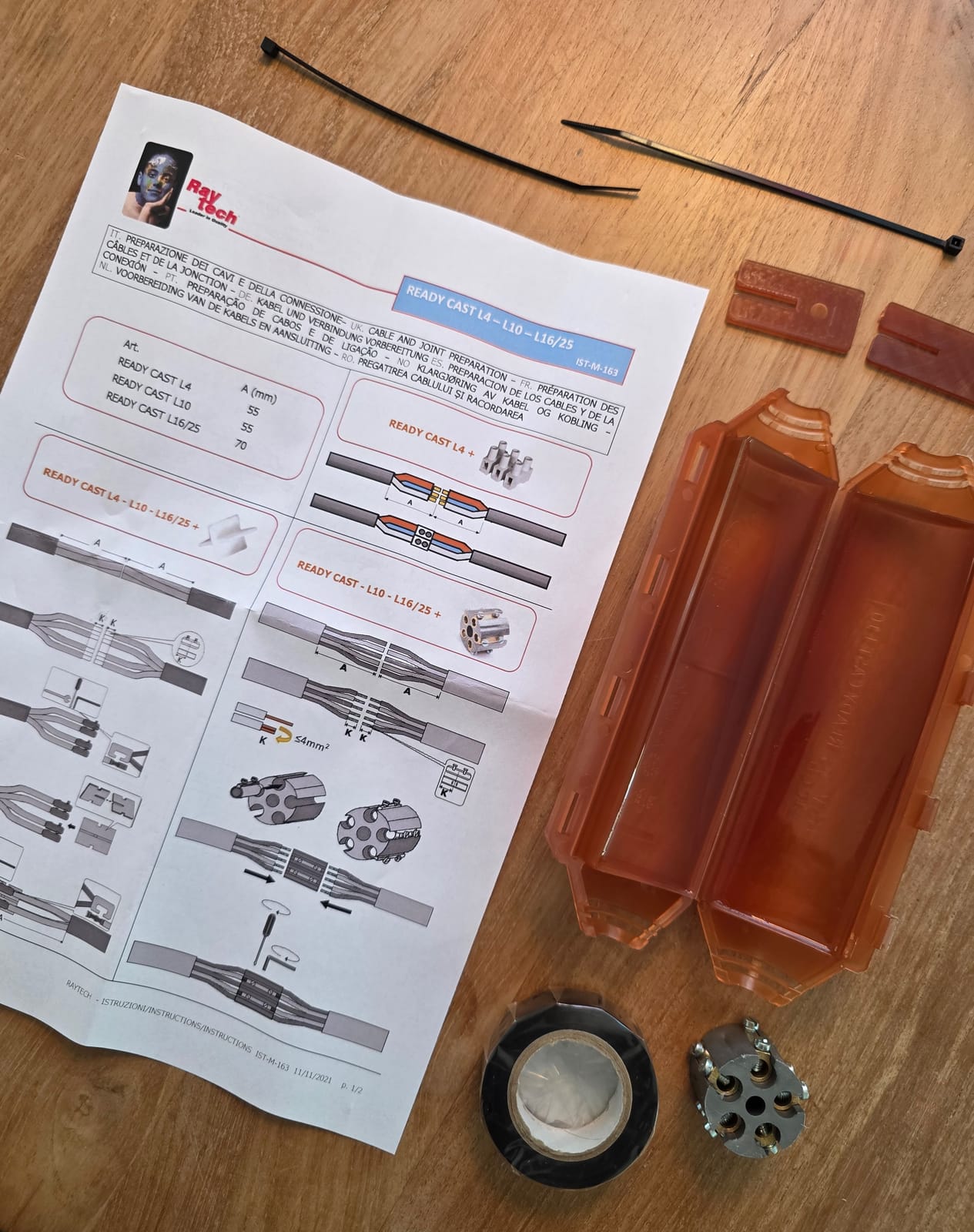
The strain relief clamps earn their place: the cable is secured to the shell before closing, which keeps any later pull from tugging on the connection itself. On a buried joint, no one will see the box again for years: that mechanical anchoring is what prevents unpleasant surprises.
The supplied screw terminal block is enough for a standard junction, and the 4 x separator built into the shell accommodates an off-the-shelf connector if the connection requires it.
I appreciate that Raytech supplies both: it removes a variable at install time, and it saves you from reopening a box you have already closed because the wrong connector was in your hand.
For a single junction that doesn’t need a box, I tried the Betty 4 IP68 waterproof connector route, pre-filled with gel and ready to install.
On a connection where the conductor sizes differ between the incoming and outgoing cables, the screw terminal block makes up the difference more easily than a calibrated spring terminal block.
The straight range comes in three sizes, plus two Y-branch models. Outer cable diameter (mm) and individual conductor cross-section (mm²) are different measures. The Raytech datasheet specifies which N × mm² cable formations each model accepts; check both that matrix and the outside diameter before choosing:
| Model | Dimensions | Cable diameter | Conductor cross-sectional area |
|---|---|---|---|
| Model Ready Cast L4 | Dimensions 160 × 48 mm | Cable diameter Ø 8–18 mm | Conductor cross-sectional area Depends on number and size of cores; check the Raytech N × mm² matrix |
| Model Ready Cast L10 | Dimensions 180 × 50 mm | Cable diameter Ø 8–23 mm | Conductor cross-sectional area Depends on number and size of cores; check the Raytech N × mm² matrix |
| Model Ready Cast L16/25 | Dimensions 215 × 55 mm | Cable diameter Ø 8–30 mm | Conductor cross-sectional area Depends on number and size of cores; check the Raytech N × mm² matrix |
| Model Ready Cast Y6 | Dimensions 180 × 100 mm | Cable diameter Ø 8–20 mm, each leg | Conductor cross-sectional area Check trunk, branch and core formation against the datasheet |
| Model Ready Cast Y16/25 | Dimensions 220 × 105 mm | Cable diameter Ø 8–30 mm, each leg | Conductor cross-sectional area Check trunk, branch and core formation against the datasheet |
Ready Cast range based on the Raytech datasheet: the straight L models for in-line splices, the Y models for branch connections.
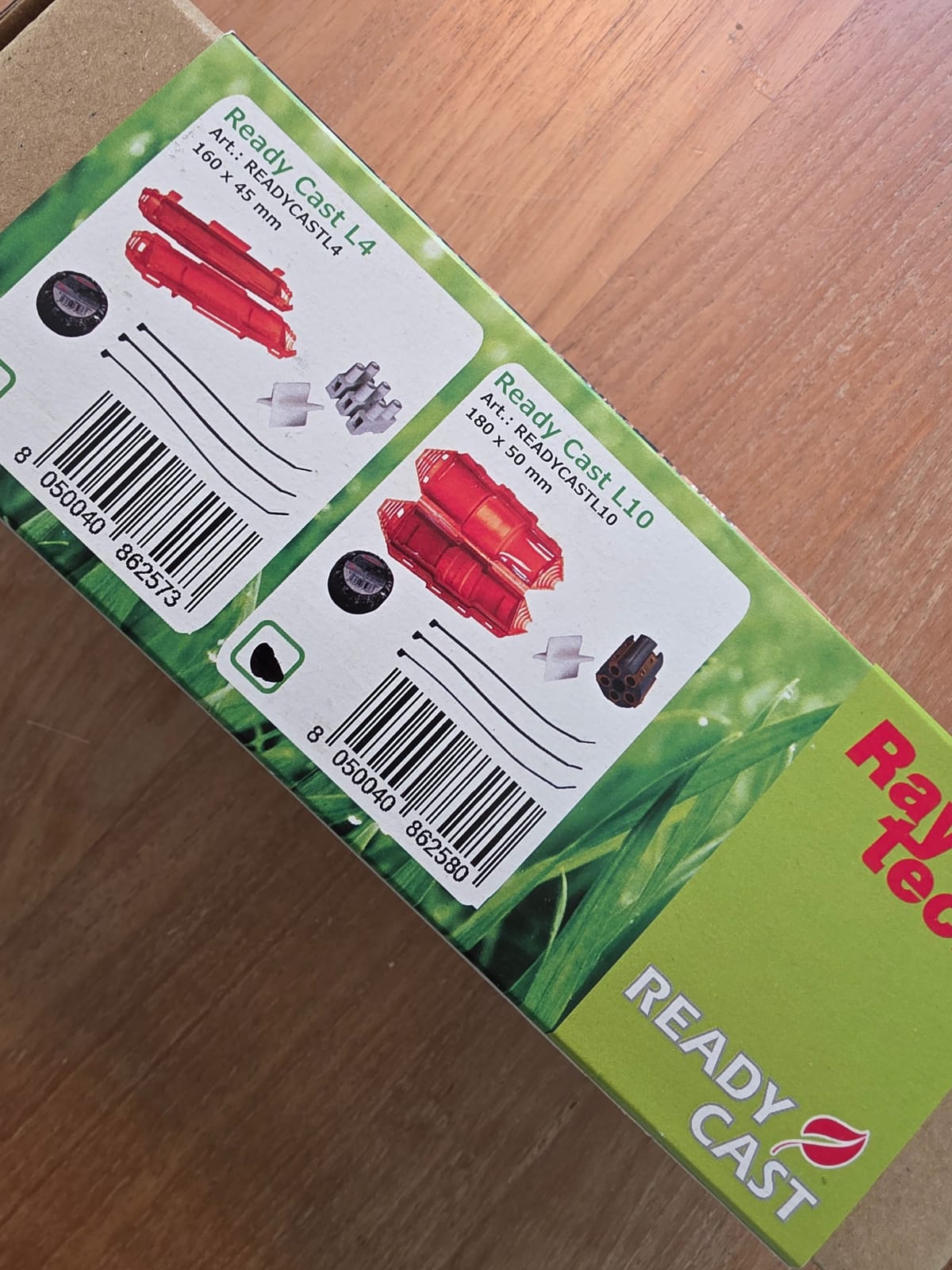
The key thing to watch is the sizing rule: an L4 accepts cables from 2.5 to 4 mm², an L10 goes up to 10 mm², an L16/25 up to 25 mm².
The cable diameter is not the conductor cross-section: a three-phase PVC/PVC cable 5 G 6 mm² can reach 20 mm in diameter, which means you have to check both ranges before buying.
In the field, I start from the cable already pulled, not from the model I would like to use. I measure the actual diameter with a calliper instead of trusting the label, because the sheath varies from one manufacturer to another for the same cross-section.
I then check the box’s two ranges with a margin: an L4 fitted at the maximum of its range leaves less gel around the conductors, and therefore less material to conform to the irregularities.
The technical datasheet lists the electrical performance.
The key point is IEC EN 50393, the standard for low-voltage cable joints: Raytech describes a test that combines air testing and prolonged immersion of around 30 days, with repeated thermal cycles and deliberate removal of the sheath at the entry points, with water then seeping directly between the conductors.
That is exactly the scenario of a buried box that takes in water where a cable passes through.
Added to these are Class II per IEC 64-8 (double insulation), a resin rated UL 94-HB, a service temperature of 90 °C, installation possible at temperatures from -40 °C to +50 °C, and the immersible and direct-burial claims.
The product datasheet rates the joint as IP68 and IP69K, the latter rating covering high-pressure jet washdowns.
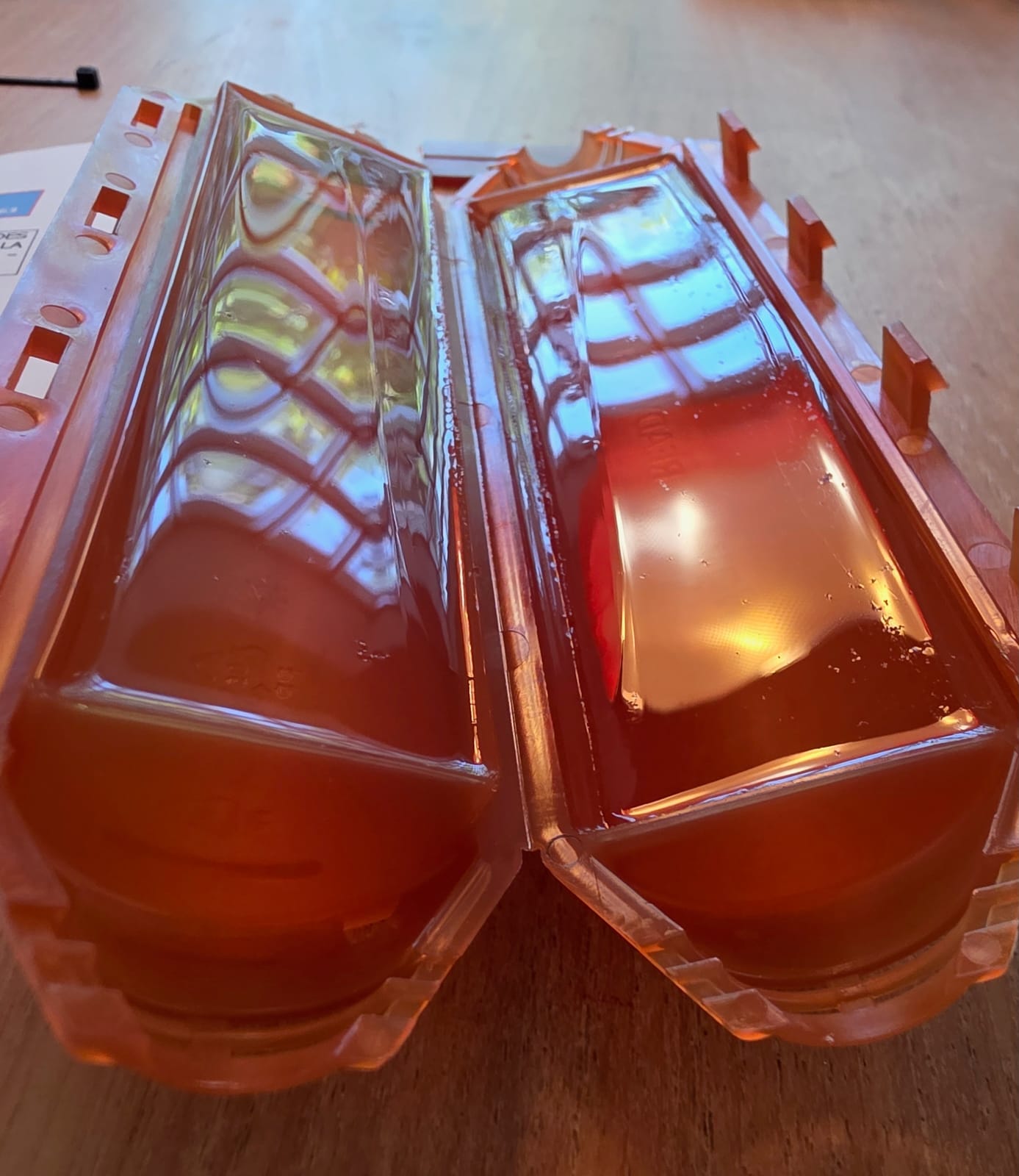
The filling material is checked by feel before the first installation: it must be flexible and conform to the shape of the conductors without breaking up. That is what ensures continuity of the insulation around each strand, even where the incoming and outgoing conductor cross-sectional areas (csa) differ.
The datasheet includes a caveat that I find honest: CEI EN 50393 is cited “where applicable” and Class II “according to CEI 64-8”. In other words, compliance is verified model by model and configuration by configuration, not on a blanket statement.
I read these references as a design framework: the immersion test validates a closed box wired according to the instructions, not a half-open shell or a badly cut membrane. Installation accounts for half of the watertightness.
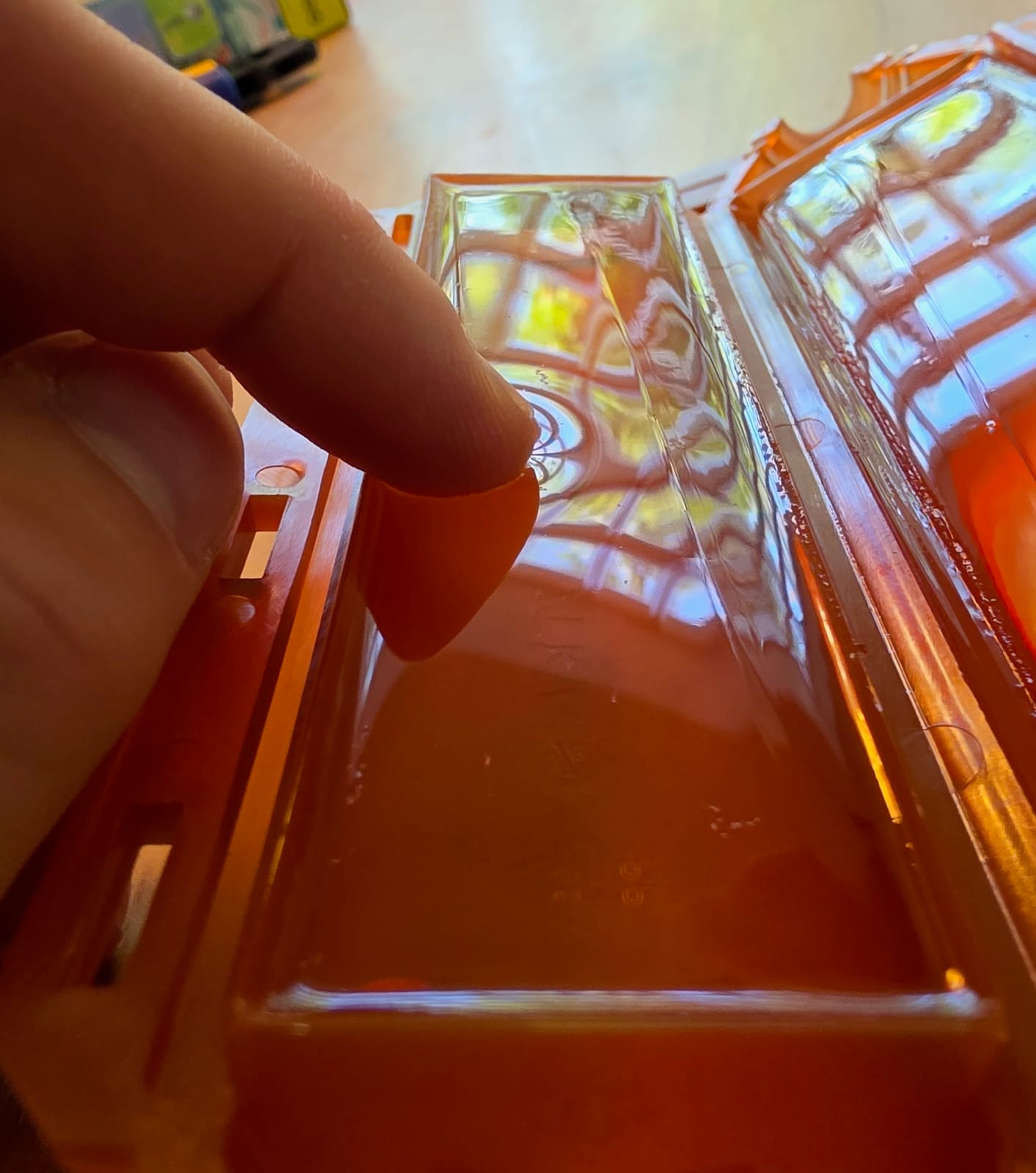
Raytech publishes a demonstration photo on its product page that I found telling: the joint buried in the ground, sprayed with a hose. This is the exact use case for which I recommend this type of box, far from slabs and inspection chambers.
What this demonstration tells me is that watertightness is won or lost at the entries: the pre-scored membrane must hug the cable without pinching it, and a cut that is too wide leaves water a direct path to the connection.
On a buried joint, no one will ever come back to check anything: so I take the time to check every entry before closing it back up, and I make sure each cable is properly secured to the shell. That’s what separates a watertight box from a box that has simply been closed.
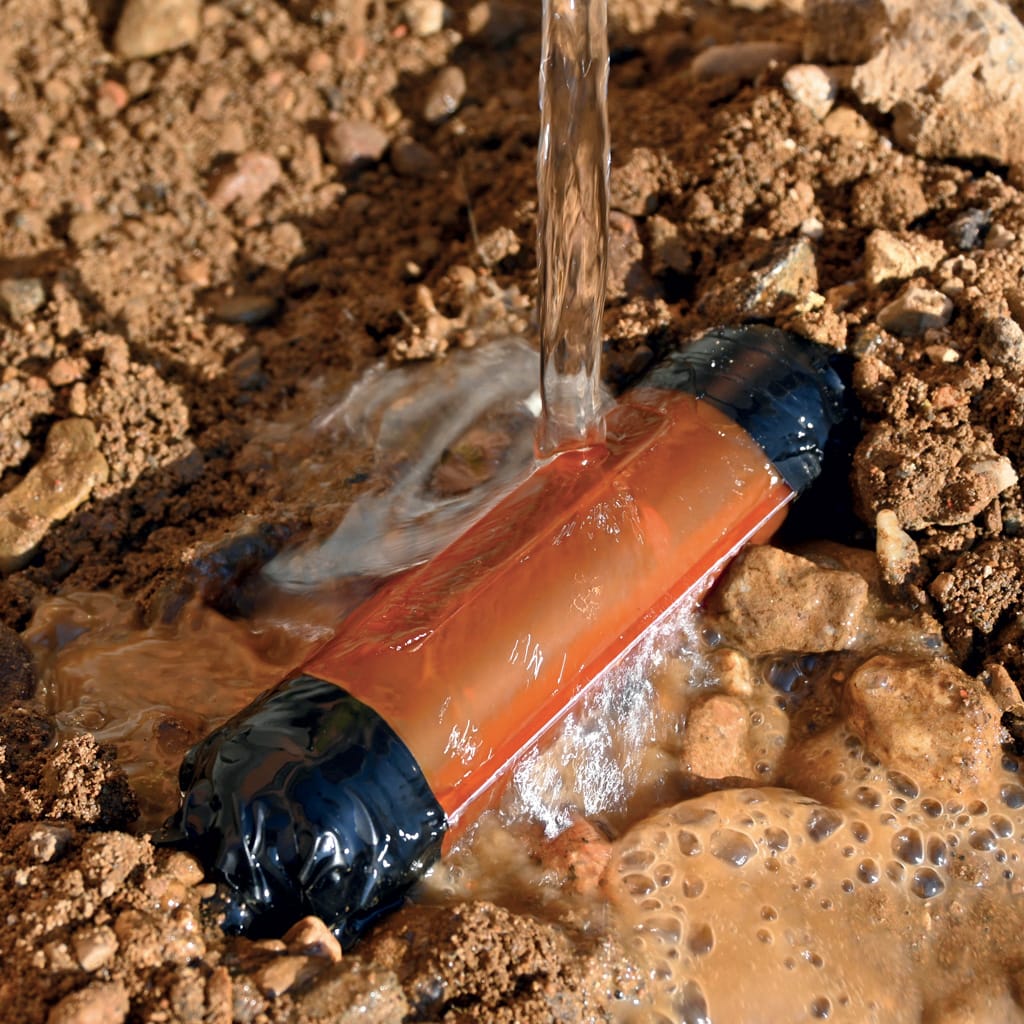
The Magic Box addresses the opposite need.
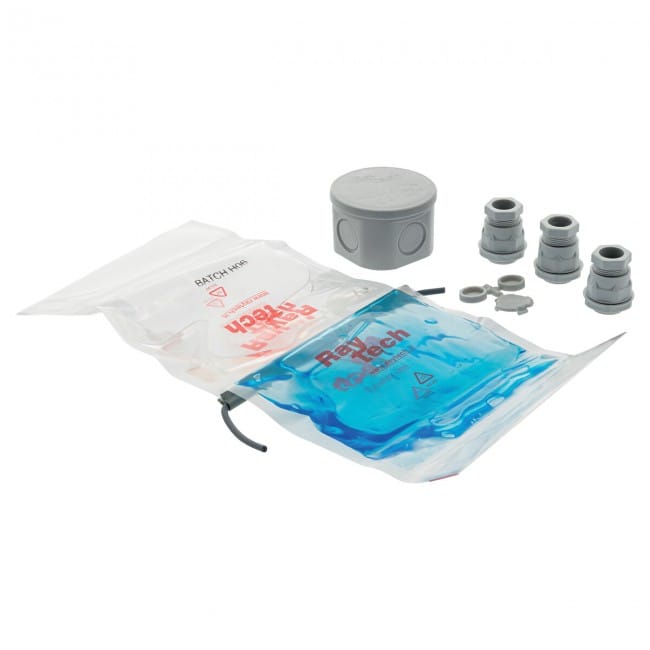
The French datasheet describes it as a complete IP68 insulated connection kit with Magic Fluid: the enclosure, its lid, three PG16 cable glands, a set of blanking plugs and the insulating gel for a complete fill. Everything is supplied, down to the sachet of gel.
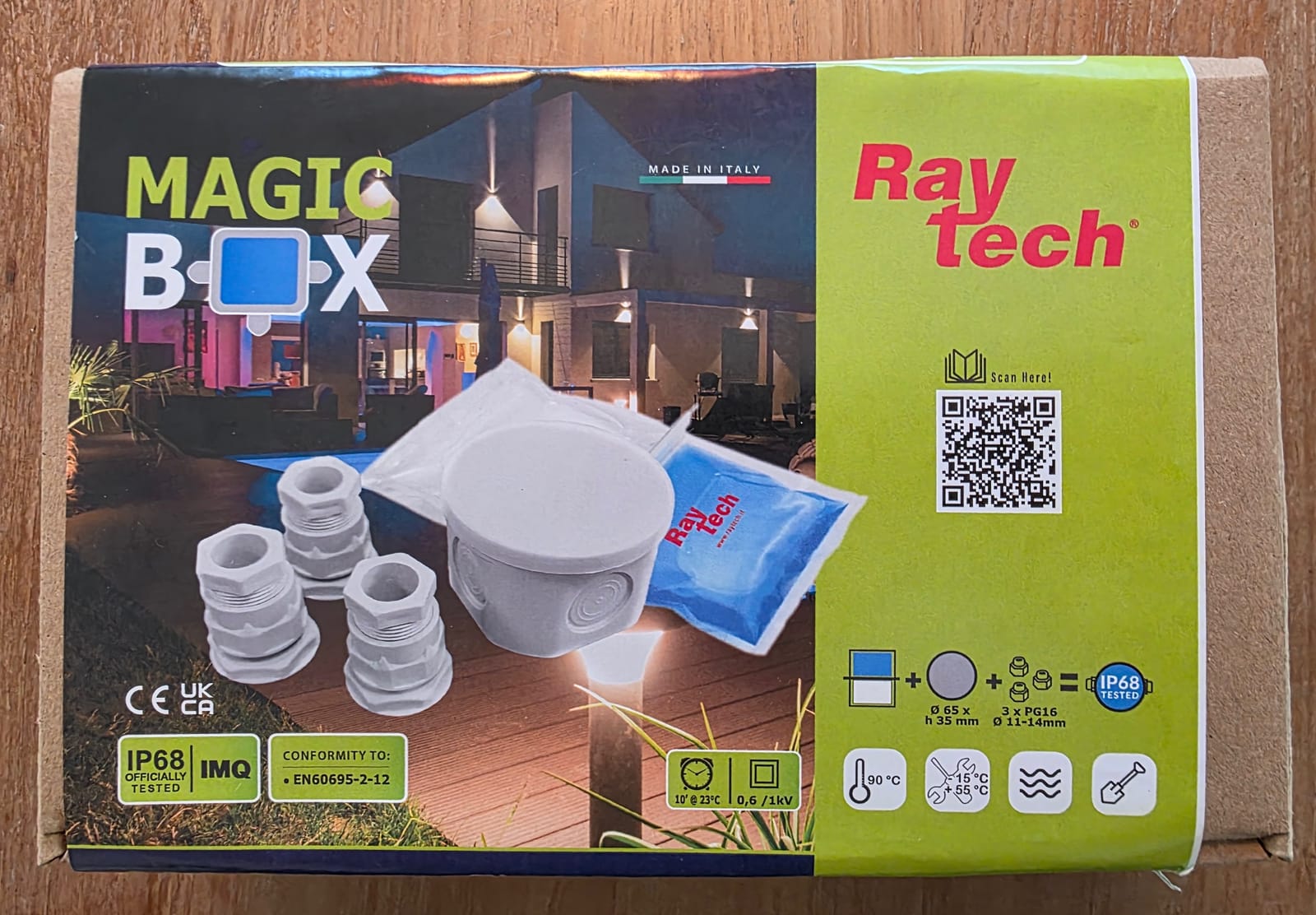
The difference from the Ready Cast comes down to one word: re-enterable. The box reopens, the cable glands unscrew, the gel comes out.
The datasheet stresses that the box can be reopened even after long periods of use, that the gel does not expire, and that it is non-toxic. The gel is not classified as hazardous under the CLP regulation, which matters for storage in a van or a stockroom.
Raytech lists the Magic Box 65 with a maximum 22 mm external cable diameter in its product table, a Ø 65 × 35 mm enclosure and three PG16 cable glands. These are separate specifications: PG16 describes the gland thread, not a 22 mm cable clamping capacity. The clamping range of the three glands supplied with this exact kit is not specified in that table; check the included glands’ manufacturer instructions and the actual cable outside diameter before fitting or claiming a sealed entry. Larger Magic Box models use M25 glands.
The housing has prepared entry positions. Open only the knockouts specified by the Magic Box instructions and seal each used or unused entry with the supplied glands or blanking plugs; do not drill arbitrary holes in the housing.
The M25 cable glands on the larger models make little difference to installation: the same screw-on principle, with a larger opening for large cross-section cables.
On site, I first look at the number of cables to bring in: the Magic Box 65 has only three cable glands, so you have to move up to the next model as soon as more cables meet at the junction, or keep an entry free for a future connection.
The Magic Box datasheet cites CEI EN 50393, Class 2 according to CEI 64-8 (the Italian wiring rules), UL 94-HB gel usable from -60 °C to +200 °C, and a glow-wire test at over 960 °C according to EN 60695-2-12. This is not a certification that every installation complies with British BS 7671.
The applications listed speak for themselves: street lighting, the marine sector, gardens and electric gates.
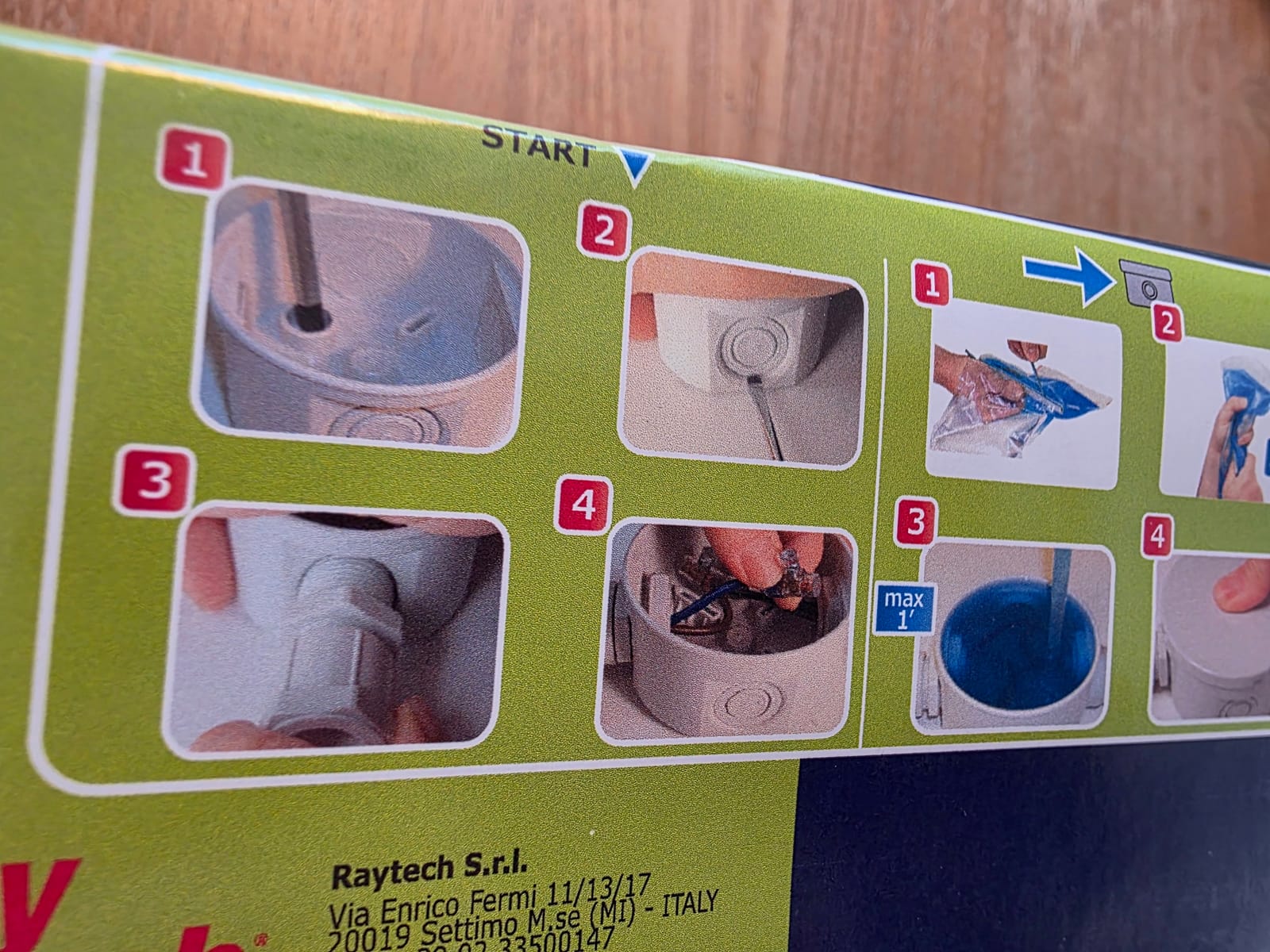
The instructions printed on the back of the box set out the sequence, and I followed them to the letter:
Mount the box on the wall
The box is screwed in place, and the screws are covered with the supplied caps before pouring the gel.
Open the prepared entries
Open the manufacturer-prepared knockouts needed for the cables, then fit the specified glands and blanking plugs.
Fit the cable glands
The three PG16 cable glands screw into the drilled holes, with or without a cable fitted.
Insert and connect the cables
The cables pass through the cable glands, and the connection is made inside the box.
Pour the gel and close up
The Magic Fluid covers the connections, the lid closes and the box stays accessible.
The cable gland is still the electrician’s classic approach: a box with cable glands is a box you can reopen without a knife. The gel provides what the gland cannot: immersed in gel, each conductor is insulated and protected from condensation, even if the box takes on water.
The two approaches complement each other rather than compete.
After closing, I carry out two systematic checks. First: every cable gland is screwed down tight, with the nut tightened firmly but not forced, so as not to crush the sheath. Second: the gel has properly covered every terminal before the lid is closed, because a corner left dry is the first point of corrosion.
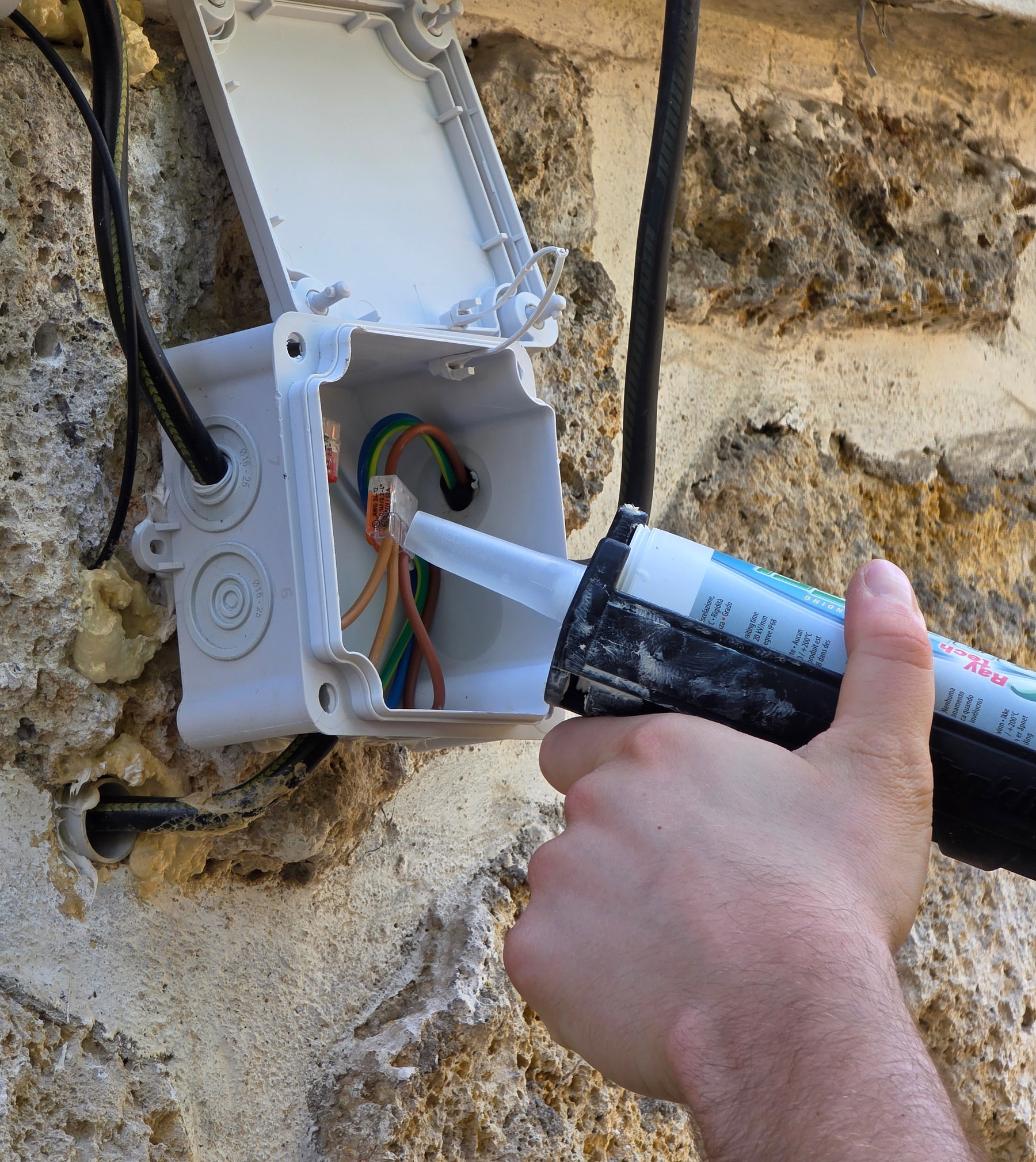
The gel is poured in one go, without filling it to the rim, so the lid engages squarely.

The lid of the Magic Box 65 carries two engraved ratings: IP56 and IP68. When choosing and installing the product, I associate IP68 with the complete gel-filled kit — the immersion configuration described by Raytech.
I do not apply that rating to a box that is only partly filled, or used without its gel filling. In submerged use, I follow the configuration and depth specified for the exact model; in wall-mounted use, the priority remains fitting the cable glands correctly and closing the enclosure.
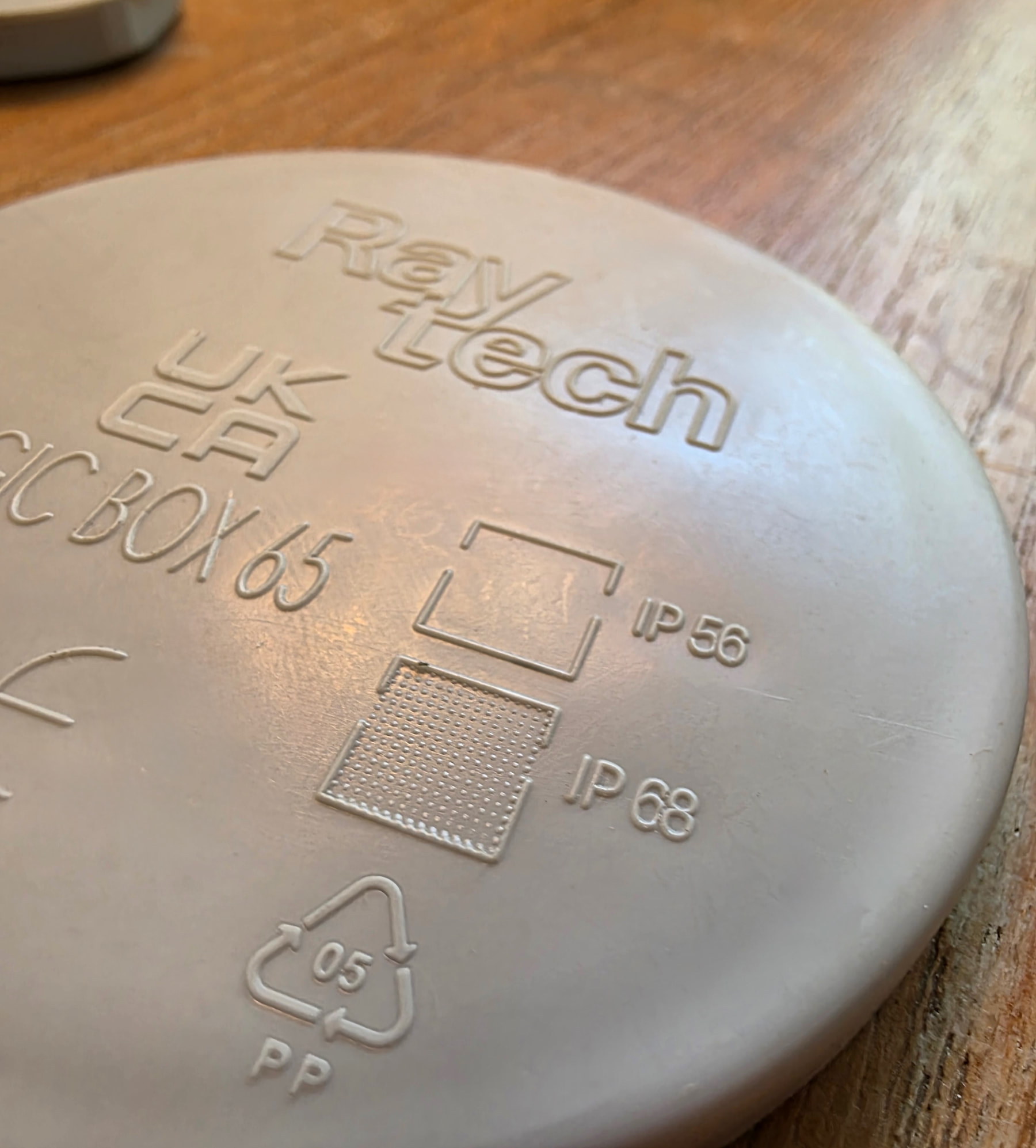
A waterproof joint is only one part of an installation. In Great Britain, Obligation BS 7671:2018+A4:2026 guides the selection and installation of the complete wiring system. The external influences at the location matter more than an advertised IP number taken in isolation.
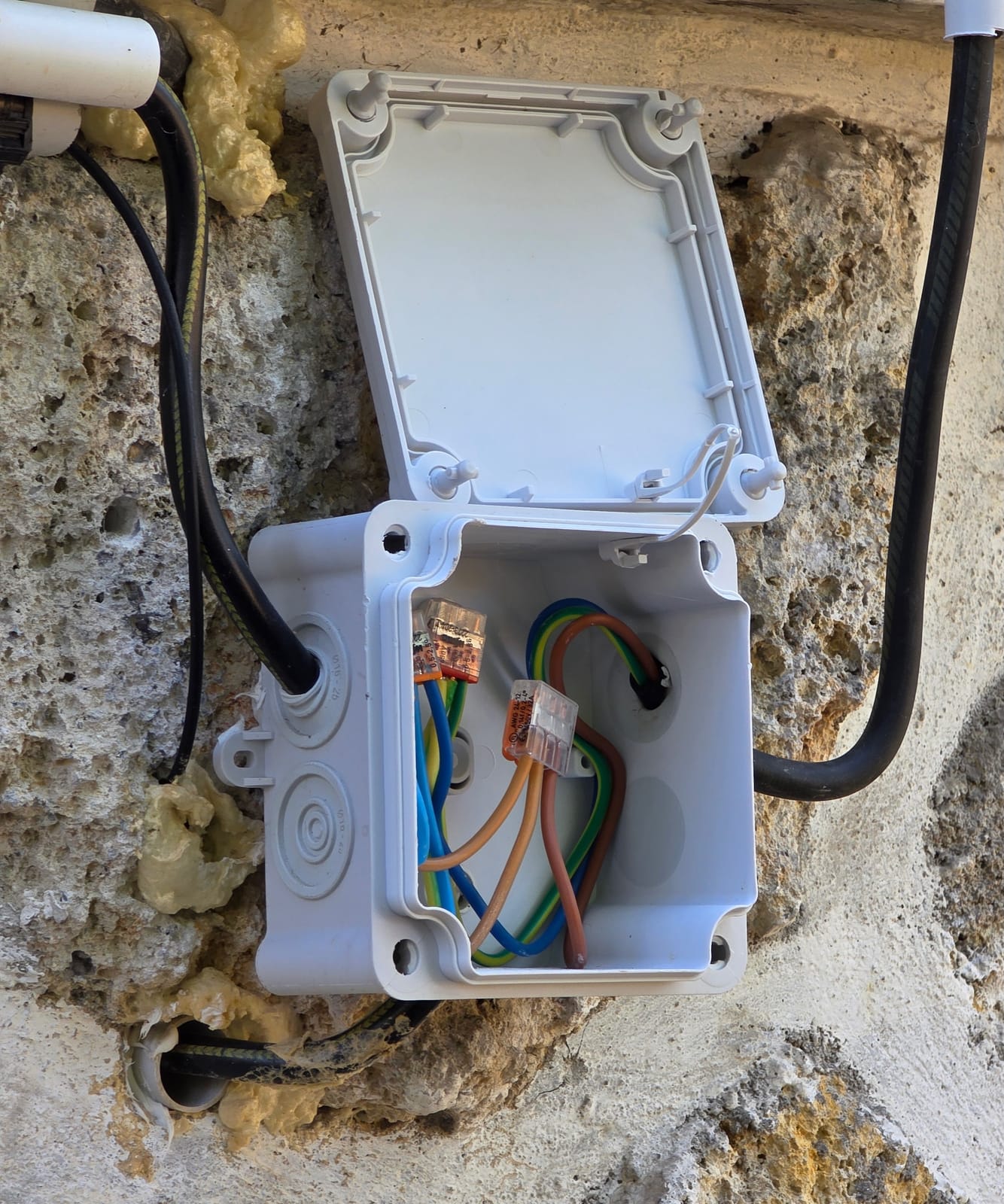
The photograph shows an outdoor box requiring assessment; it is not evidence that the pictured arrangement complies with UK wiring rules.
I measure the cable outside diameter and check its cores before matching a Ready Cast model. On a wall, I also consider the cable-entry orientation, water tracking and a drip loop where appropriate. For a buried connection, I document the joint location and route before backfilling so a future fault can be found without guesswork.
Do not drill drainage holes into an IP-rated enclosure unless the manufacturer explicitly provides for that method and rating. If condensation is a concern, select a suitable enclosure and a manufacturer-approved drainage or ventilation arrangement: an arbitrary hole can invalidate ingress protection. An IP68 designation is conditional on the assembled, correctly fitted product and its specified test conditions.
Before any joint work, I isolate the supply and prove the circuit dead. For a long outdoor run, I check cable sizing and voltage drop against the actual load and route. These checks do not replace the installation’s required inspection and testing.
On a standard outdoor garden socket, I keep a watertight box with cable glands that can be reopened: you open it up, measure, make a change.
On a buried cable joint between two buildings, or on a pool circuit, the pre-filled box offers protection that a mechanical assembly cannot match: the resin conforms to every conductor right up to the entries.
It is worth seeing how the Magic Box reopens before you buy: the gel comes away in one piece or can be cut at the incision, the connection can be changed, and the refill sachet goes back over the top.
Raytech describes the box as re-accessible even after long periods of use, which makes it the go-to tool for repairs: you protect it quickly and come back to it cleanly.
It’s the exact opposite of the Ready Cast, where the decision is made before installation.
Pre-filled Ready Cast box vs Magic Box 65 cable gland kit
Advantages
Drawbacks
Hidden benefits
Hidden costs
The choice of connector is still open in both cases: the supplied screw terminal block does the job, but a slim Wago connector that fits the recess.
The rule for mixing stranded and solid conductors is the same as indoors, covered in detail in my guide to connecting stranded and solid wires.
In the field, I ask about reopening before I ask about sealing: a box inspected every year does not need the same degree of protection as a joint that nobody will ever reopen.
The Ready Cast handles permanent cases, the Magic Box joints that get reopened, and a standard waterproof box with cable glands covers everyday facade work. The choice is made at the estimating stage, not on site.
The WAGO Gelbox is the certified answer to the same problem: a small box pre-filled with silicone-free polyurethane gel, supplied by Cellpack, in six sizes, that takes the terminals from the 221 and 2273 series up to 4 mm².
The Gelbox and terminal set is tested to BS EN 60998 and certified IPX8, meaning it withstands continuous immersion.
Installation is simple: you drop the connected terminal into the Gelbox, close it up, and the gel immediately surrounds the connection, with no mixing and no waiting time. Two things worth knowing.
At 230 V, the Gelbox must stay inside a junction box, the only way to ensure double insulation of the cable, since only the wires are immersed in the gel. And if you reopen a Gelbox to change the wiring, the WAGO FAQ requires the terminals and the Gelbox to be replaced, the only way for the brand to guarantee the protection.
The gel is a silicone-free polyurethane: this is no trivial detail, because a silicone gel releases vapours that interfere with surrounding lacquers and paints in a workshop. Here, the absence of silicone and a fully cured product allow unrestricted use alongside neighbouring materials.
Compared with the Ready Cast, the Gelbox stands out on reopening: a buried Ready Cast is never reopened, whereas the Gelbox remains a junction box that can be reopened but must be renewed after any work on it.
On price, the Gelbox works out at €6.90 to €11.25 per unit (€27.59 for a four-pack of the Small size, as of August 2026): the budget stays below that of a pre-filled box, but the certification is paid for in replacements.
| Criterion | Magic Box 65 | WAGO Gelbox | Ready Cast |
|---|---|---|---|
| Criterion Reopening | Magic Box 65 Yes, gel can be removed and repositioned | WAGO Gelbox No, not without renewing the connectors and the Gelbox | Ready Cast No, never |
| Criterion Preparation | Magic Box 65 Screw-in cable glands + poured gel | WAGO Gelbox Connector inserted, box closed | Ready Cast Cable entries cut with scissors |
| Criterion Certification | Magic Box 65 IEC EN 50393 (Raytech datasheet) | WAGO Gelbox VDE, EN 60998, IPX8 | Ready Cast IEC EN 50393 (Raytech datasheet) |
| Criterion Usage | Magic Box 65 Facade, re-accessible connection | WAGO Gelbox Reopenable joint to be renewed | Ready Cast Buried, submerged, permanent |
| Criterion 230 V outdoor box | Magic Box 65 The housing itself | WAGO Gelbox A junction box required | Ready Cast The enclosure itself |
Trade-off between the three families for an outdoor or buried joint.
To embed a 2273 connector in gel, the Gelbox is the only certified option; the details of the DIY pour into a standard box are in my test of the Raytech gels.
The only firm price I have verified online is the one for the Magic Box: from €25.80 incl. VAT (€21.50 excl. VAT) at the French retailer Bricozor, available in 65 and 100 mm diameters.
The price of the Ready Cast in France is not confirmed on the pages I checked: no price is published for this range. On a job site, this item is a minor part of the cost compared with repairing a buried joint.
At that price, the waterproof box remains a minor line item on site: the cost of repairing a wet joint — digging the box out, replacing the terminals, backfilling — often ends up exceeding the cost of the hardware installed the first time.
I would not advise cutting costs here: the difference between a proper waterproof box and a makeshift splice is measured in years of exposure to moisture.
Retour de chantier
In the field, I pull out these boxes for specific jobs: a garden lighting circuit spur to be buried between the wall and the patio, a pump connection in an inspection chamber, or reworking a box left in for a future connection on a stone facade. The orange shell of the Ready Cast and the white kit of the Magic Box quickly earn their place in the van.
The Ready Cast keeps its promise of a buried joint without special tools, with a complete kit and a rigorous prolonged immersion test. The Magic Box 65 meets the opposite need with a re-enterable box whose gel protects the connections.
I recommend them for outdoor or buried use when the model is chosen according to the actual cable diameter and conductor cross-section. Ready Cast is aimed at permanent joints; the Magic Box 65 has the edge when the joint has to remain re-enterable.
3 questions
InteractiveQuiz: Raytech waterproof junction boxes
3 questions to check the key points
Choose an answer
The Ready Cast is a box pre-filled with gel or resin, with no cable glands: you cut out the pre-scored entries, connect and close it up. The Magic Box 65 is a kit with three PG16 cable glands and gel: the box can be reopened. The first is designed for a permanent buried joint, the second for a connection that remains accessible.
I associate IP68 with the complete gel-filled kit, which is the immersion configuration described by Raytech. I do not carry that rating over to a box used without its filling; for mounting on an exterior wall, I mainly check the cable glands and the closure of the enclosure.
Raytech specifies outside cable diameters of Ø 8–18 mm (L4), Ø 8–23 mm (L10), Ø 8–30 mm (L16/25), Ø 8–20 mm per leg (Y6) and Ø 8–30 mm per leg (Y16/25). The permitted N × mm² conductor formation depends on the number of cores and the model. Check the manufacturer's full matrix; a conductor cross-section is not a cable outside diameter.
The Ready Cast is factory pre-filled and is intended as a permanent joint rather than a serviceable enclosure; you do not pour resin into it on site. The Magic Box is designed for re-entry with its specified Magic Fluid system. Follow the manufacturer's instructions for any reopening or replacement.
No. A waterproof box or insulating gel does not replace electrical fault protection. For a British installation, assess the earthing, automatic disconnection and 30 mA RCD requirements of the particular circuit, equipment and location under BS 7671; do not infer protection from the IP rating.
No. A joint enclosure protects cable connections; a luminaire mounting and termination arrangement must also safely support the light fitting and meet its installation instructions and applicable British wiring requirements. A French DCL box is not a general UK requirement.
Disclosure Raytech : Ready Cast and Magic Box 65 boxes.
Théo Desrousseaux
Electrician and editor
I work in the field and edit this magazine. Every guide is reviewed for its target country before publication.
Author → Credentials → Editorial method → Report a factual correction →
Email address and prefilled context:
theo@sparx-elec.fr
Article: https://www.sparx-elec.com/gb/junction-box-waterproof-outdoor-ready-cast-magic-box-65/
Edition: GB — English
Factual issue: [describe the factual issue]
Passage: [quote or identify the passage]
Source: [optional source URL]
Sources and references
Practical electrical installation guides, diagnostic methods and tool recommendations compared against the technical wiring standards of this national edition.
Raytech Magic Gel and Wonder Gel sealing gels tested on an IP55 junction box with Wago connectors: two-part or one-part, IP68 and WAGO Gelbox.
Read the guide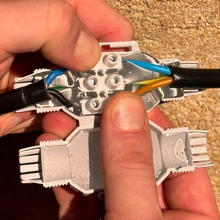 Guide IP68 waterproof connector Raytech Betty 4 Raytech Betty 4 (Little Joint L) waterproof connector: IP68 tested by IMQ, IP69K officially tested, 5 × 4 mm² capacity, workshop assembly and limits. Read the guide
 Guide Best multimeter for electricians UK What is the best multimeter for electricians in the UK? Compare the Fluke 87V, Fluke 117, Klein MM700 and Brymen BM235, with prices, CAT ratings and True RMS. Read the guide
 Guide RCD keeps tripping causes Why does an RCD keep tripping? Learn the common causes, the 30 mA threshold, the six-month test rule, and how to diagnose the fault safely. Read the guide