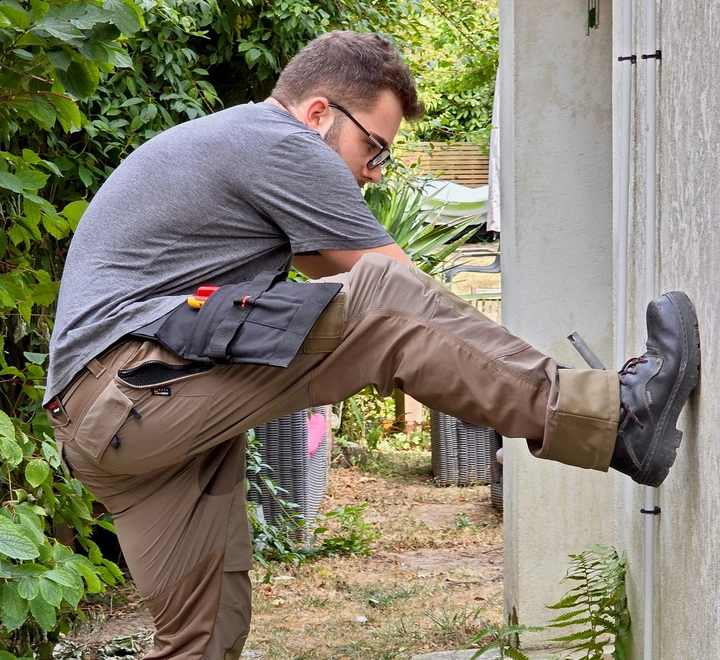
Best multimeter for electricians UK
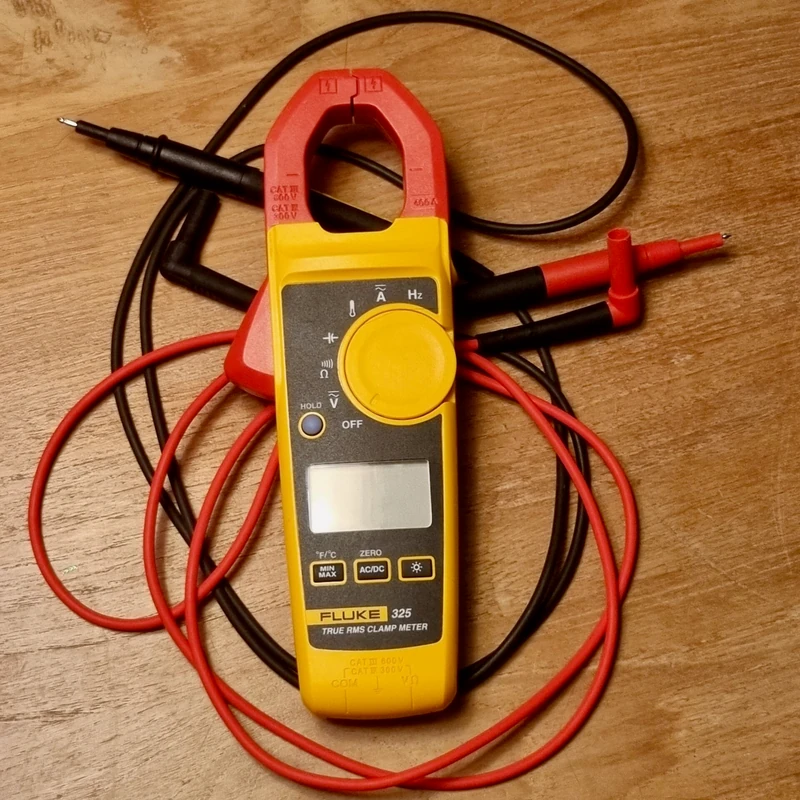 Photo : Sparx Elec image library
 In brief
- The Fluke 87V is the reference instrument for industrial maintenance at 420 to 540 £, with CAT IV 600 V and ±0.05 % DC accuracy.
- The Fluke 117 is the electrician daily driver at 220 to 280 £, with auto-ranging and a non-contact voltage detector.
- The Klein MM700 offers CAT IV 600 V at 100 to 140 £, about half the price of a Fluke.
- CAT III 600 V is the minimum safety rating for an electrician, and True RMS matters on modern loads.
- A 30 £ meter on a 415 V supply that arcs internally can injure you: the safety rating is the real cost.
A multimeter is the most used tool in an electrician’s bag, and the choice matters more than the price tag suggests. A 20 £ meter from a high-street DIY rack reads voltage to within 5 %, has no fuse, and lasts about a year. The Fluke 87V on the next bench is the industry reference instrument, and it costs twenty times as much for reasons that matter when you are measuring an industrial inverter.
On site, your meter is your primary safety check before touching any copper. In the UK, selecting the right multimeter comes down to your daily work environment: the Fluke 87V for industrial switchgear, the Fluke 117 as an everyday trade driver, the Klein MM700 for CAT IV safety at an accessible price, and the Brymen BM235 for electronics bench work. The baseline across all four remains CAT III 600 V certified safety and True RMS measurement.
CAT III 600 V
minimum safety rating for an electrician
±0.05 %
DC accuracy of the Fluke 87V
420-540 £
price of the Fluke 87V reference meter
100-140 £
price of the Klein MM700 trade meter
Why the safety rating matters most
The CAT rating of a multimeter categorises the environment it is safe to use in. CAT I is for electronics, CAT II for plug-connected equipment, CAT III for distribution circuits and fixed installations, and CAT IV for the origin of the installation. A meter marked CAT III 600 V is safe for CAT III environments up to 600 V.
For an electrician, CAT III 600 V is the minimum. The meter and its test leads must both have the rating, because a fault in either can expose the user to an arc. A meter with a lower rating is not safe on a distribution board, no matter how accurate it is.
The safety rating is the real cost difference. A 30 £ meter on a 415 V supply that arcs internally can injure you. The Fluke price reflects CAT IV 600 V certified safety, HRC fuses, internal arc protection and certified test leads. The meter is insurance as much as instrumentation.
| Model | Price | Safety | Accuracy | Best for |
|---|---|---|---|---|
| Model Fluke 87V | Price 420-540 £ | Safety CAT IV 600 V | Accuracy ±0.05 % DC | Best for Industrial maintenance |
| Model Fluke 117 | Price 220-280 £ | Safety CAT III 600 V | Accuracy ±0.5 % DC | Best for Electrician daily driver |
| Model Klein MM700 | Price 100-140 £ | Safety CAT IV 600 V | Accuracy ±0.5 % DC | Best for Trade at lower price |
| Model Brymen BM235 | Price 130-180 £ | Safety CAT III 600 V | Accuracy ±0.5 % DC | Best for Electronics engineer |
| Model Keysight U1241C | Price 330-430 £ | Safety CAT III 600 V | Accuracy ±0.09 % DC | Best for Field and lab |
| Model Aneng AN8008 | Price 25-40 £ | Safety CAT III 600 V (claimed) | Accuracy ±0.5 % DC | Best for Maker and hobbyist |
Multimeter comparison for the UK market (MLC UK).
True RMS: why it matters on modern loads
True RMS is essential for modern electrical systems. A basic meter measures the average of a waveform and assumes it is a clean sine wave. Modern loads, such as variable-speed drives, LED drivers and switched-mode power supplies, produce non-sinusoidal waveforms that a basic meter reads incorrectly.
A True RMS meter measures the actual heating value of the waveform, which is what matters for real work. On a circuit with electronic loads, a non-RMS meter can read significantly low or high, leading to a wrong diagnosis.
For an electrician working on modern installations, True RMS is not a luxury, it is a requirement. Every meter in the comparison above is True RMS, which is the baseline for trade use.
The Fluke 87V: the reference instrument
The Fluke 87V is a stalwart in industrial maintenance, priced at 420 to 540 £. It is the reference instrument for professionals dealing with motor drives and switchgear. It offers CAT IV 600 V safety, twenty-year build quality, 20 000 counts, ±0.05 % DC accuracy and True RMS.
The 87V is the meter to choose when the work is industrial: motor drives, switchgear, and complex diagnostics where accuracy and durability matter. Its premium price makes it overkill for hobbyist electronics, but for the professional it is the benchmark.
The 87V also has a digital and analogue bargraph display, which is useful for observing changing signals. It is the meter that other meters are compared against.
The Fluke 117: the electrician daily driver
The Fluke 117 is a reliable choice for UK electricians at 220 to 280 £. It is the daily driver for domestic and commercial electrical work. It offers auto-ranging, which eliminates the AC/DC switching, and a non-contact voltage detector.
The 117 has 6 000 counts, CAT III 600 V safety, ±0.5 % DC accuracy and True RMS. Its resolution may fall short for precise bench work, and it only meets CAT III, not the higher CAT IV. But for the daily work of an electrician, it is the balance of price and function that most professionals choose.
The non-contact voltage detector is a practical feature: it checks whether a cable is live without touching it, which is the first check before opening any circuit.
The Klein MM700: CAT IV at a lower price
The Klein Tools MM700 is a robust multimeter priced between 100 and 140 £. It offers CAT IV 600 V safety at about half the cost of Fluke models. It features True RMS readings, a drop-tested durability to 10 feet, and a silicone holster.
The MM700 is the choice for an electrician who wants CAT IV safety without the Fluke price. Its drawbacks are a less extensive UK service network than Fluke and a lower resale value. But for the price, it is a strong trade meter.
The MM700 has 6 000 counts, ±0.5 % DC accuracy and a backlit display. It is the US-brand alternative that has found a place in UK workshops.
The Brymen BM235: the engineer favourite
The Brymen BM235 is a solid choice for electronics engineers, favoured by EEVblog for its precise 6 000-count readings and low burden voltage of just 1 mV per microamp. At 130 to 180 £, it offers robust build quality.
The BM235 is CAT III 600 V compliant, with ±0.5 % DC accuracy and a backlit display with bargraph. Its caveat is being a lesser-known Taiwanese brand in UK workshops, but its performance has earned it a strong following among engineers.
The low burden voltage matters for electronics work, because it means the meter disturbs the circuit being measured less. For an engineer working on sensitive circuits, this is a real advantage.
The budget end: what you give up
At the budget end, the Aneng AN8008 costs 25 to 40 £ and offers 9 999 counts and True RMS. It is handy for makers and hobbyists on a budget. But its safety rating has not been independently verified, and the cheap fuses should be swapped out before tackling mains work. It is not suitable for trade certification tasks.
The budget meter is fine for bench work and hobby projects, but it is not a trade tool. The difference is not the counts or the True RMS, it is the safety: the fuses, the arc protection and the certified test leads. For work on mains, the safety rating is the deciding factor.
How to choose for your work
The choice of multimeter follows the work. For industrial maintenance, motor drives and switchgear, the Fluke 87V is the reference. For daily domestic and commercial electrical work, the Fluke 117 is the balance of price and function. For CAT IV safety at a lower price, the Klein MM700. For electronics engineering, the Brymen BM235.
The common requirements are CAT III 600 V minimum and True RMS. Within that, the choice is about accuracy, durability and price. A meter that meets the safety rating and True RMS requirement, and that fits the work, is the right choice.
The meter is a long-term investment. A quality meter lasts for decades, and its safety rating protects you every time you use it. The price difference between a budget meter and a trade meter is small compared with the value of the safety and the accuracy.
What the counts and accuracy figures mean
The counts of a multimeter describe the resolution of the display. A 6 000-count meter reads up to 6 000 on the highest range, which gives a resolution of 0.001 V on the 6 V range. A 20 000-count meter reads up to 20 000, giving finer resolution.
The accuracy figure describes how close the reading is to the true value. The Fluke 87V at ±0.05 % DC is significantly more accurate than a ±0.5 % meter. For most electrical work, ±0.5 % is more than adequate. For precise diagnostics and calibration, the higher accuracy matters.
The counts and accuracy are part of the price. A meter with 20 000 counts and ±0.05 % accuracy costs more because the components and the calibration are better. The choice depends on whether the work needs that precision.
The role of the test leads
The test leads are as important as the meter. A meter with a high CAT rating is only as safe as its leads, because a fault in a lead can expose the user to an arc. The leads must carry the same CAT rating as the meter.
Quality leads have better insulation, better connectors and better strain relief. They last longer and they are safer. The Fluke price includes certified test leads, which is part of the safety story.
The leads are also a wear item. They get damaged, the tips wear, and the insulation cracks. Replacing worn leads is a safety measure, not just a convenience. A damaged lead on a live circuit is a real hazard.
The difference between a multimeter and a clamp meter
A multimeter measures voltage, resistance and continuity through its test leads. A clamp meter adds a clamp that measures current without opening the circuit. The clamp is useful for measuring the current drawn by a motor or an appliance without disconnecting it.
For an electrician, a clamp meter is a valuable addition. Measuring current is a common diagnostic, and the clamp makes it safe and quick. Some meters, like the Fluke 325, combine the multimeter and the clamp in one instrument.
The choice between a multimeter and a clamp meter depends on the work. For voltage and continuity testing, a multimeter is essential. For current measurement, a clamp is the practical tool. Many electricians carry both.
How to verify a meter before buying
Before buying a multimeter, check the CAT rating on the meter and the leads. Confirm that it is True RMS. Check the counts and the accuracy. And consider the build quality and the warranty.
The CAT rating is the first check, because it is a safety issue. A meter without a clear CAT rating should be treated with suspicion. The True RMS is the second check, because it affects the accuracy on modern loads.
The build quality matters for a tool that is used daily. A meter that survives drops and rough handling lasts longer and stays accurate. The warranty and the service network are part of the value, which is one reason Fluke meters hold their value.
The cost of ownership
The price of a multimeter is only part of the cost of ownership. A quality meter lasts for decades, while a budget meter may last a year. The cost per year of a Fluke is lower than it appears, because the meter is still accurate and safe after twenty years.
The cost of ownership also includes the leads, which are a wear item, and the calibration, which may be needed for precision work. A meter that holds its calibration and its accuracy is worth more over its life.
The resale value is another factor. A Fluke meter holds its value, while a budget meter has little resale value. For a professional, the meter is an investment, and the total cost of ownership is what matters.
Common mistakes when buying a multimeter
The first mistake is buying on price alone. A budget meter may lack the safety rating needed for mains work, and it may read modern loads incorrectly. The price is not the measure of the tool.
The second mistake is ignoring the CAT rating. A meter with a low CAT rating is not safe on a distribution board, no matter how accurate it is. The rating must match the environment.
The third mistake is forgetting the leads. A meter with a high CAT rating and cheap leads is not safe, because the leads are part of the safety chain. The leads must carry the same rating as the meter.
When to upgrade your multimeter
Upgrade your multimeter when the work changes or when the meter no longer meets the requirements. If you move from domestic to industrial work, you may need a higher CAT rating. If you start working on modern electronic loads, you need True RMS.
Upgrade also when the meter is damaged or its accuracy has drifted. A meter that has been dropped or exposed to a fault may no longer be safe or accurate. The cost of a new meter is small compared with the risk of a wrong reading or an unsafe tool.
The upgrade path is often the one described in the trade: start with a budget meter, move to a Klein or a Brymen, and eventually to a Fluke. Each step buys more safety, accuracy and durability.
The Keysight U1241C: field and lab crossover
The Keysight U1241C is a solid choice for field engineers and lab techs needing precision in their work. With an OLED display visible even in bright sunlight and Bluetooth data logging, it stands out. At 330 to 430 £, it offers good value but can be tricky to navigate compared with more common UK trade models.
The U1241C has 10 000 counts, CAT III 600 V safety, ±0.09 % DC accuracy and True RMS. The OLED display is a real advantage outdoors, and the Bluetooth logging is useful for recording measurements over time.
The U1241C sits between the trade meters and the lab instruments. It is the choice for someone who needs precision and logging without moving to a bench instrument.
The role of the non-contact voltage detector
A non-contact voltage detector, or NCV, is a feature that checks whether a conductor is live without touching it. The meter senses the electric field around the conductor and signals the presence of voltage. It is the first check before opening any circuit.
The NCV is a safety feature as much as a convenience. It lets the electrician confirm that a cable is dead before touching it, which is the first step of any safe isolation. The Fluke 117 includes this feature, and it is one of the reasons the 117 is popular.
The NCV is not a substitute for proper testing. It is a quick check, not a measurement. But as a first line of verification, it saves time and adds safety.
How the meters are tested and certified
A multimeter is tested and certified to its CAT rating before it leaves the factory. The certification covers the meter and its test leads, and it is the evidence that the meter is safe in the rated environment.
The certification is part of the price. A meter with a verified CAT IV rating has been tested against the standards, including the arc tests that simulate a fault. A meter without verified certification may not have been tested to the same level.
For the user, the certification is the guarantee. A meter marked CAT III 600 V has been tested to that level, and it is safe to use in that environment. The marking is not decorative, it is a safety claim backed by testing.
The importance of the fuse in a multimeter
The fuse in a multimeter protects the current ranges. If a meter is connected across a live circuit on a current range, the fuse blows and protects the meter and the user. A meter without a proper fuse, or with a cheap fuse, is a safety risk.
The Fluke meters use HRC, high rupturing capacity, fuses that are designed to clear a fault safely. The budget meters often use cheap fuses that may not protect properly. Swapping the cheap fuses for quality ones is a recommended upgrade for budget meters.
The fuse is part of the safety chain. A meter that cannot clear a fault safely is not a safe meter, no matter how accurate it is. The fuse quality is one of the hidden differences between a budget meter and a trade meter.
The ergonomics of a daily-use meter
For a tool used every day, ergonomics matter. The size, the weight, the position of the rotary dial, the readability of the display and the quality of the holster all affect how the meter feels in use. A meter that is comfortable to hold and easy to read is used more and used better.
The backlit display is important for work in dark spaces, such as under a board or in a loft. The bargraph is useful for observing changing signals. The holster protects the meter and provides a grip.
The ergonomics are part of the price. A meter that is well designed and well built feels better in the hand and lasts longer. For a daily-use tool, the feel of the meter is a real consideration.
The warranty and service network
The warranty and the service network are part of the value of a meter. A meter with a long warranty and a local service network is easier to repair or replace if something goes wrong. Fluke has an extensive UK service network, which is one reason its meters hold their value.
The budget meters often have a shorter warranty and no local service. If a budget meter fails, it is usually replaced rather than repaired. The cost of replacement is part of the total cost of ownership.
For a professional, the service network matters. A meter that can be calibrated and repaired locally is a better long-term investment than one that must be replaced. The service network is one of the hidden differences between the brands.
What is the best multimeter for an electrician in the UK?
For daily electrical work, the Fluke 117 at 220 to 280 £ is the balance of price and function. For industrial maintenance, the Fluke 87V at 420 to 540 £ is the reference instrument. The Klein MM700 offers CAT IV at about half the price.
What CAT rating does an electrician need?
CAT III 600 V is the minimum for an electrician working on distribution circuits and fixed installations. CAT IV is recommended for industrial environments and at the origin of the installation. The meter and its test leads must both carry the rating.
Why is True RMS important in a multimeter?
Modern loads such as variable-speed drives and LED drivers produce non-sinusoidal waveforms. A basic meter reads these incorrectly, while a True RMS meter measures the actual heating value of the waveform, which is what matters for real work.
Is a cheap multimeter safe for mains work?
A meter without a verified CAT rating is not safe for mains work. A 30 £ meter on a 415 V supply that arcs internally can injure you. The safety rating, the fuses and the arc protection are what make a meter safe, not the price of the functions.
What is the difference between the Fluke 87V and the Fluke 117?
The 87V is the industrial reference: CAT IV 600 V, ±0.05 % accuracy, 20 000 counts, at 420 to 540 £. The 117 is the daily driver: CAT III 600 V, ±0.5 % accuracy, 6 000 counts, with auto-ranging and a non-contact voltage detector, at 220 to 280 £.
Théo Desrousseaux
Electrician and editor
I work in the field and edit this magazine. Every guide is reviewed for its target country before publication.
Author → Credentials → Editorial method → Report a factual correction →
No email app? Copy the correction details
Email address and prefilled context:
theo@sparx-elec.fr
Article: https://www.sparx-elec.com/gb/best-multimeter-uk/
Edition: GB — English
Factual issue: [describe the factual issue]
Passage: [quote or identify the passage]
Source: [optional source URL]
More guides
Practical electrical installation guides, diagnostic methods and tool recommendations compared against the technical wiring standards of this national edition.
RCBO vs RCD difference UK consumer unit
What is the difference between an RCBO and an RCD? Learn what each device protects, why RCBOs trip less, the cost in the UK, and which to choose.
Read the guide Guide UK 13 amp socket types BS 1363 explained What are the UK 13 amp socket types? Learn the BS 1363 plug, the fuse in the plug, safety shutters, the Type G standard, and how the system works. Read the guide
  Guide Outdoor waterproof junction box Outdoor waterproof junction boxes: field test of the gel-filled Ready Cast and the Magic Box 65 with cable glands, per local wiring regulations. Read the guide
  Guide Ring main circuit wiring UK BS 7671 How does a UK ring main circuit work? Learn the BS 7671 433.1.204 rule, the 100 m² limit, the 32 A protection, spurs, and how the circuit is wired. Read the guide