Jokari Secura wire strippers: review
In brief
- On French R2V installation cable, the Secura No. 15 gave me a clean sheath cut; I also appreciated the longitudinal cut and the small built-in cutter.
- The Super 4 Plus is the one I use most often: it's fast on small conductors, including a very thin flex on a light fitting I came across at a customer's.
- The No. 28H is better suited to large cables, and its built-in spare blade is handy on site.
- On the No. 28H, I carefully set the blade depth so as not to nick the inner insulation: that's the tool's normal setting.
- So I distinguish three uses: stripping the R2V sheath I tested, preparing larger compatible round cables, and quickly stripping small conductors.
Jokari sent me several stripping tools that I’ve integrated into my own routine: the Secura No. 15 (Art. 30155), the No. 28H (Art. 10280) and the Super 4 Plus (Art. 20050).
The two Secura tools work mainly on the outer sheath of cables; the Super 4 Plus prepares the conductors themselves. The latter is the one I use most often day to day.
The answer fits in three sentences. The Secura No. 15 is the pocket stripper for round cables 8-13 mm and wires 0.2 to 4 mm²: four self-adjusting blades, no adjustment, 43 grams.
The No. 28H takes over on thick cables 8-28 mm (German types: NYM-J, NYY-J, NHXMH-J), with an adjustable depth and a spare blade housed in the handle.
44 €
recommended retail price of the Secura No. 15 (Art. 30155), jokari.de
24 €
recommended retail price of the No. 28H SECURA (Art. 10280), jokari.de
43 g
weight of the No. 15 as stated in the Jokari spec sheet
8-28 mm
stripping range of the No. 28H
Safety before working on an installation: I identify and isolate the circuit, secure it against re-energisation and prove it dead using a suitable, verified voltage indicator before touching the cable. I never use the No. 15 or No. 28H on or near live electrical parts.
Two sheath strippers received for testing
First I should say what these tools really are, so I don’t confuse them with a wire stripper.
The Secura No. 15 and the No. 28H are round-cable strippers: they remove the outer sheath of round multicore cables. The No. 15 can also strip individual conductors in six specified sizes; the No. 28H cannot.
In my French R2V installation cable test, I removed the outer sheath before stripping the individual conductors. Jokari’s NYM cable types are manufacturer examples, not an additional test I carried out.
The No. 15 covers the everyday work on installation cables; the No. 28H takes over beyond 13 mm, up to 28 mm: supply cables in commercial buildings, distribution board (DB) / consumer unit entries, large NYY in trenches or risers.
I’ll say it up front because that’s what drives the choice: nobody replaces the No. 28H with an automatic wire stripper.
In this three-tool comparison, the two Secura tools open the outer sheath of round cables; the Super 4 Plus strips individual conductors.
On a job site, I reach for the No. 15 or the No. 28H for the sheath, then an automatic wire stripper for the conductors.
This automatic conductor stripper is the Jokari Super 4 Plus (Art. 20050): range of 0.2 to 6.0 mm² on rigid and flexible conductors with PVC insulation, adjustable length stop from 6 to 15 mm and side cutting up to 2.5 mm².
The brand states that the tool is tested to TÜV/GS and publishes a recommended retail price of 34,00 €. The values above are those published by Jokari on the model’s official datasheet.
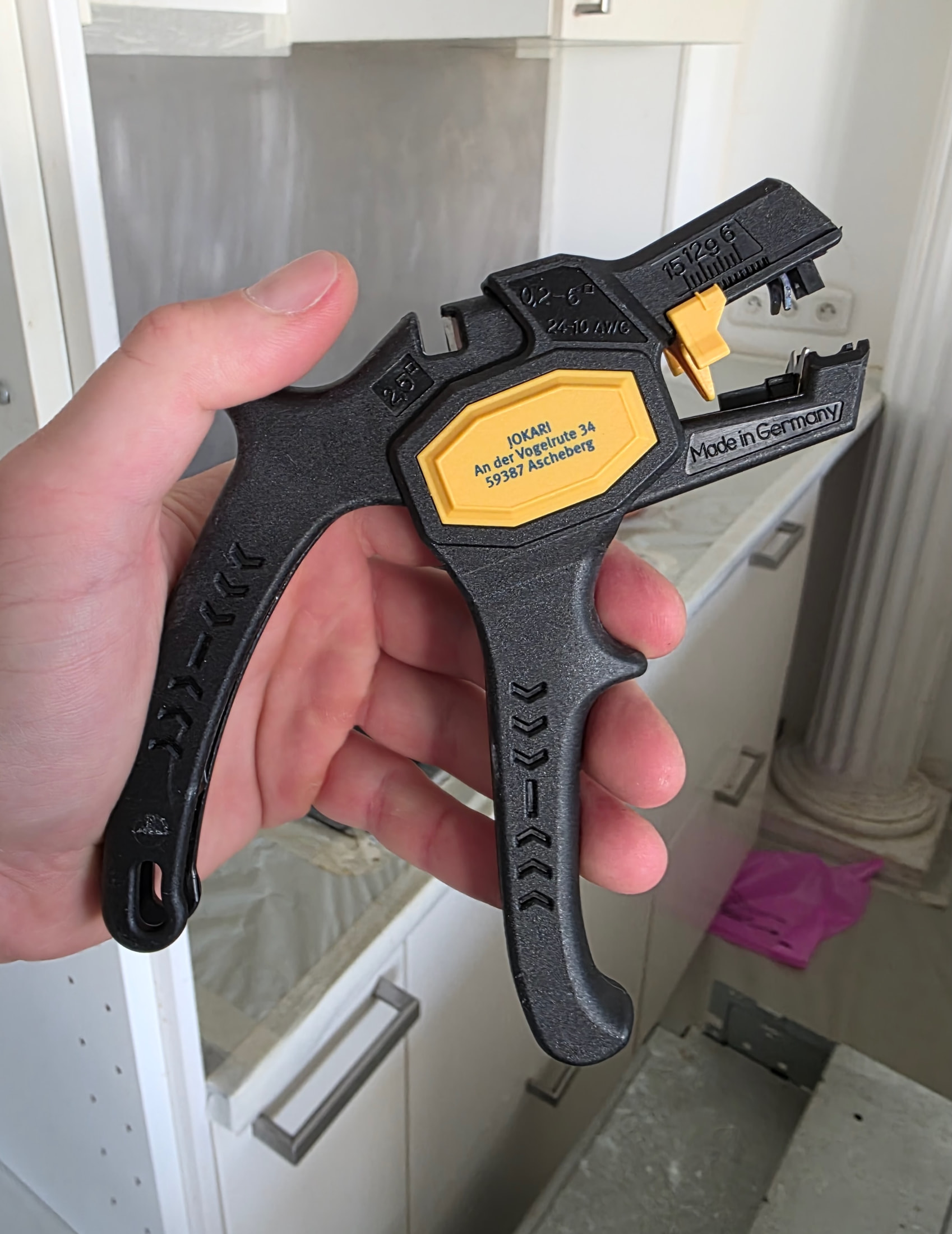
The division of roles remains clear: the sheath to the two Securas, the conductors to the Super 4 Plus.
Super 4 Plus: the one I use all the time
The Super 4 Plus has become one of my most useful tools for wire preparation. The adjustable stop from 6 to 15 mm lets me strip a series of conductors to exactly the same length, without having to eyeball it every time.
I especially notice the difference on small flexible conductors. By hand, it’s easy to tear off a few strands once the cross-section gets small; with this stripper, I can cleanly prepare flexible wires for electronics, automotive wiring or lighting without mangling the core.
I once had a customer with a light fitting bought online whose wires were extremely thin. The Super 4 Plus stripped them cleanly, whereas a standard manual stripper would have required much more care. That’s exactly the kind of situation where I’m glad to have it in my bag.
The integrated wire cutter, rated up to 2.5 mm², also saves me from reaching for a second tool for small conductors. That detail seems minor until the tool is already in my hand and all you have to do is cut and strip in one motion.
The blades remain a wear item, not a reason to throw the tool away: Jokari sells the replacement blade set 29050 for the Super 4 Plus. Given how often I use it, it’s a tool I replace or re-equip without hesitation when the cutting edge eventually dulls.
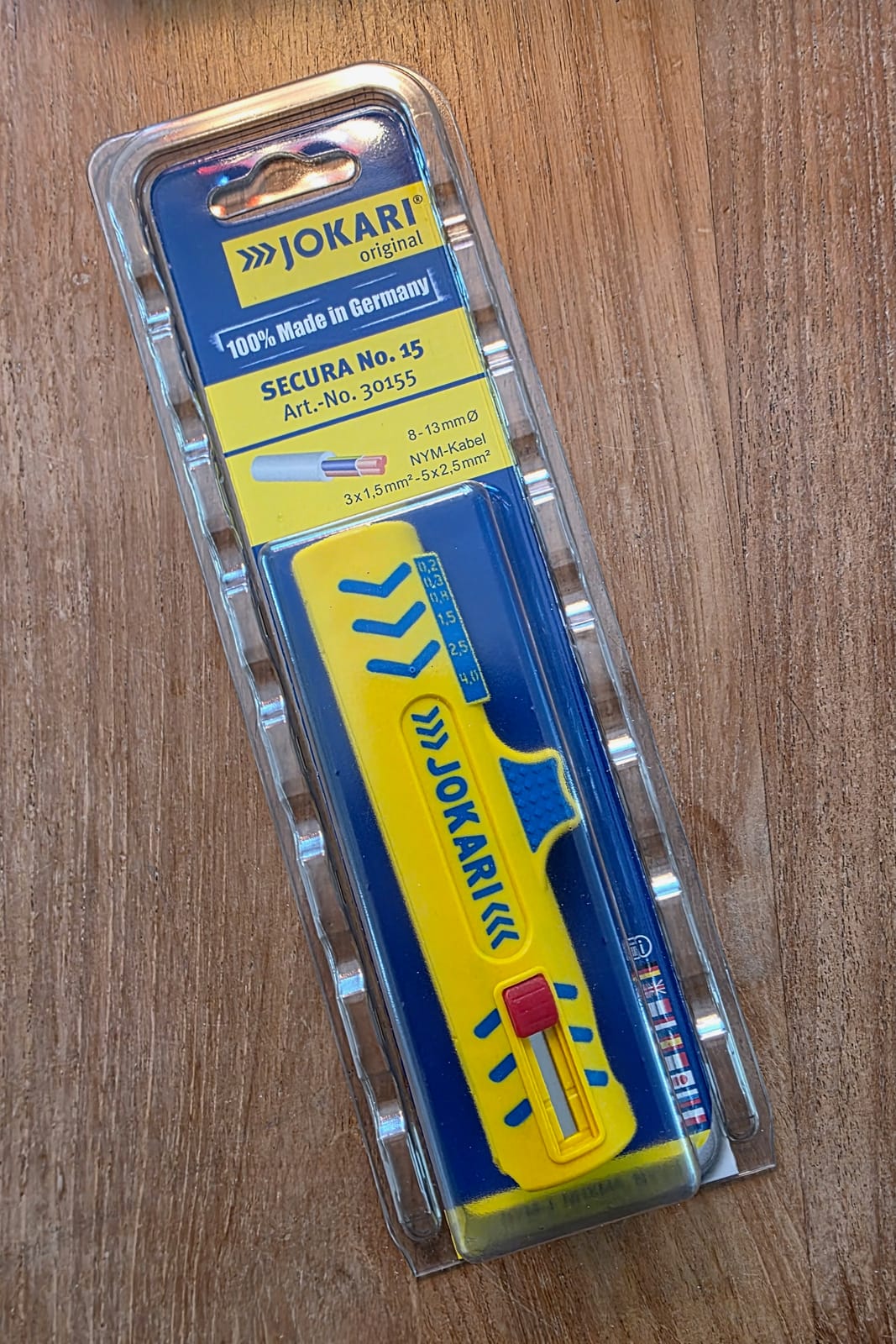
The Secura No. 15: round cables 8-13 mm and wires 0.2 to 4 mm²
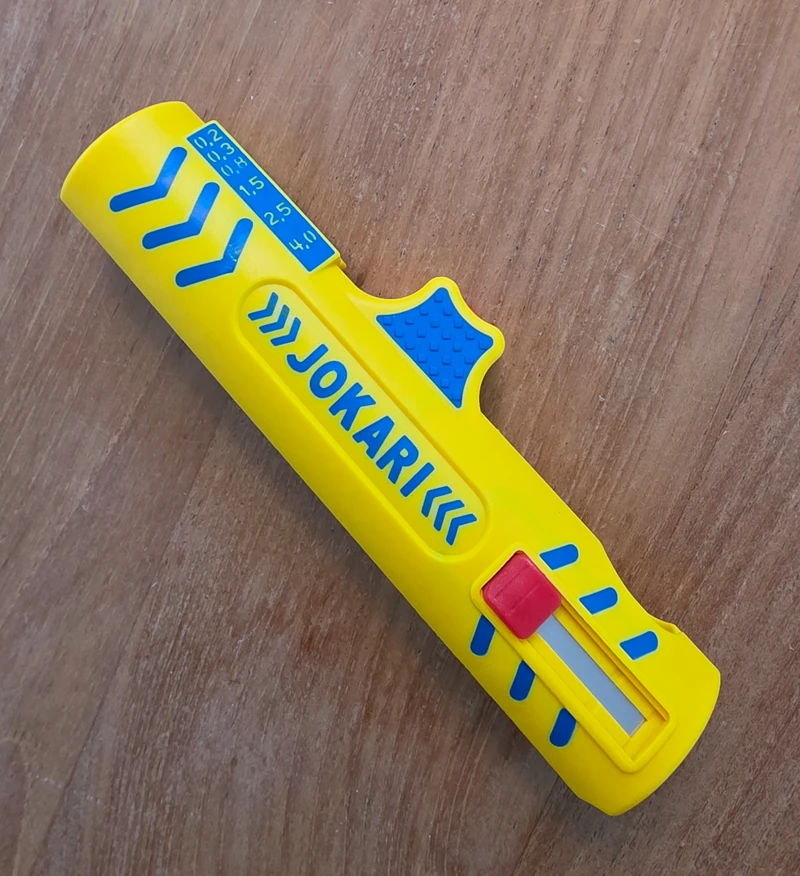
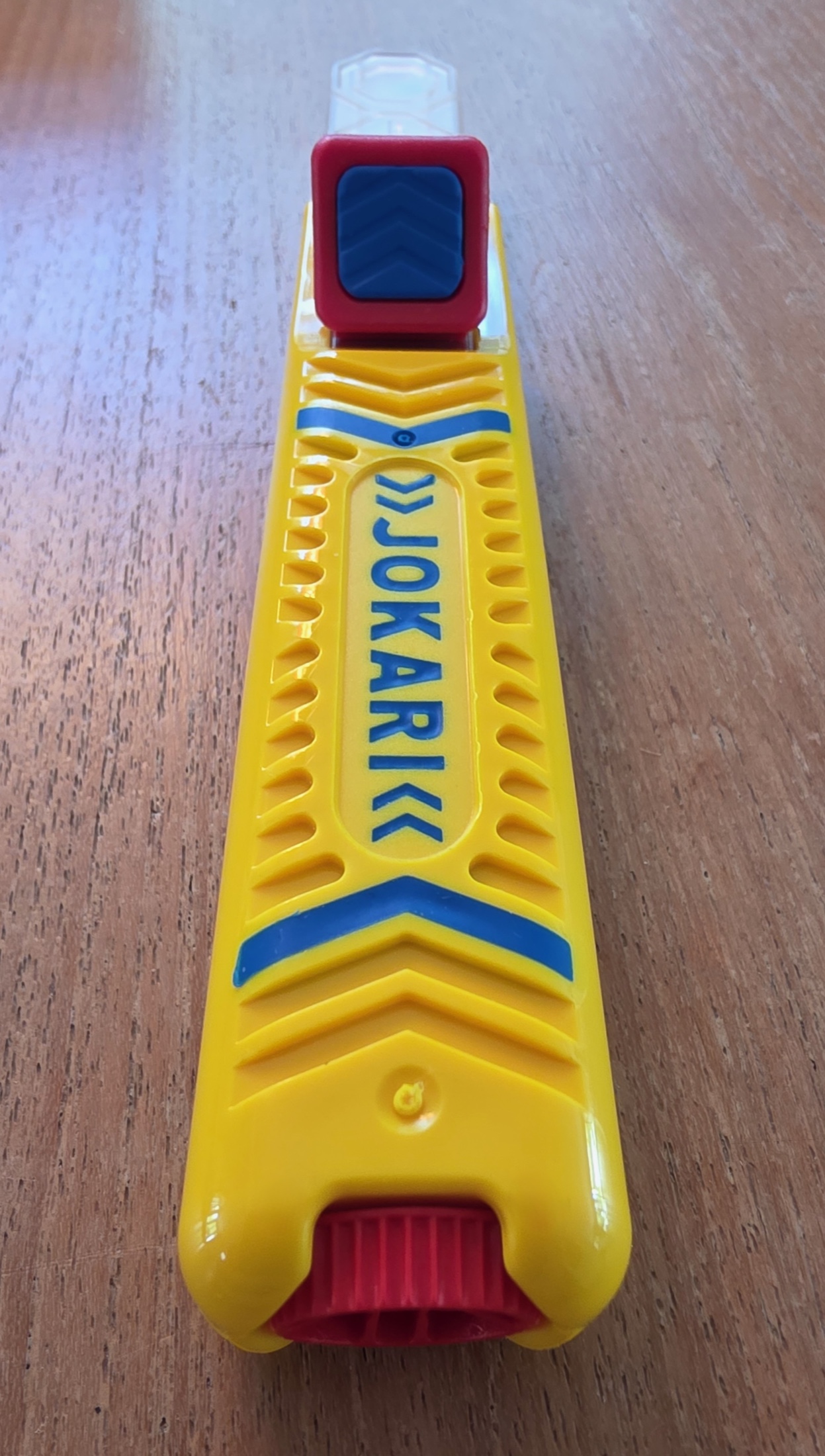
The No. 15 looks like a chunky yellow and blue pair of flat pliers, with no visible jaws at first glance.
Inside, the brand fits what it calls “4 Klingen Technologie”: four profiled blades that adapt themselves to the cable diameter, with no adjustment needed.
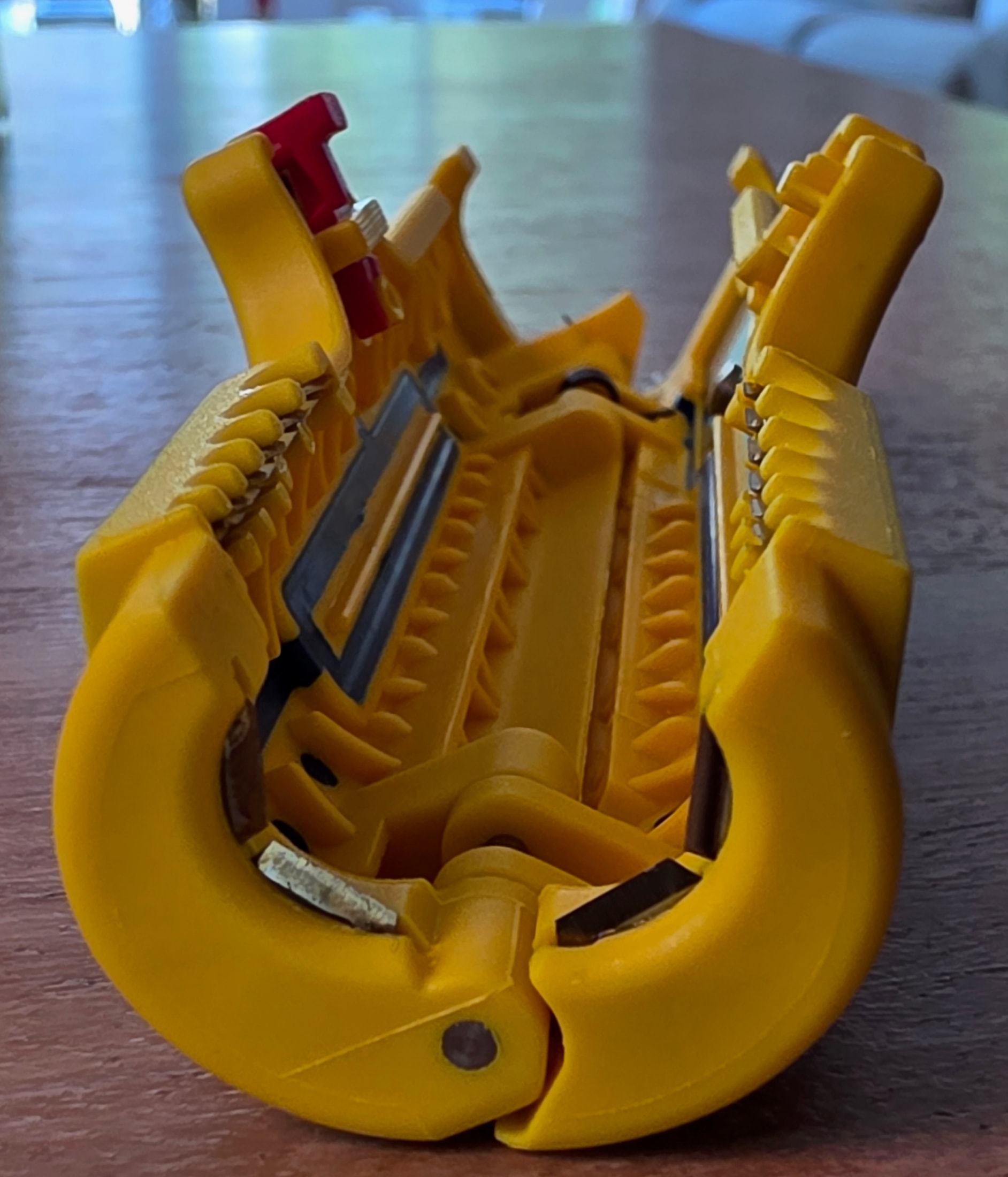
Jokari specifies round sheathed cables with an outside diameter of 8–13 mm for the No. 15, citing NYM-J, NYY-J and NHXMH-J. This manufacturer specification does not establish suitability for flat UK twin-and-earth cable to BS 6004; the actual cable shape and dimensions need separate checking.
Jokari specifies titanium nitride (TiN) on the blades to reduce cutting effort and wear. The packaging documents that feature; the coating’s colour cannot be reliably identified from my close-up photograph.
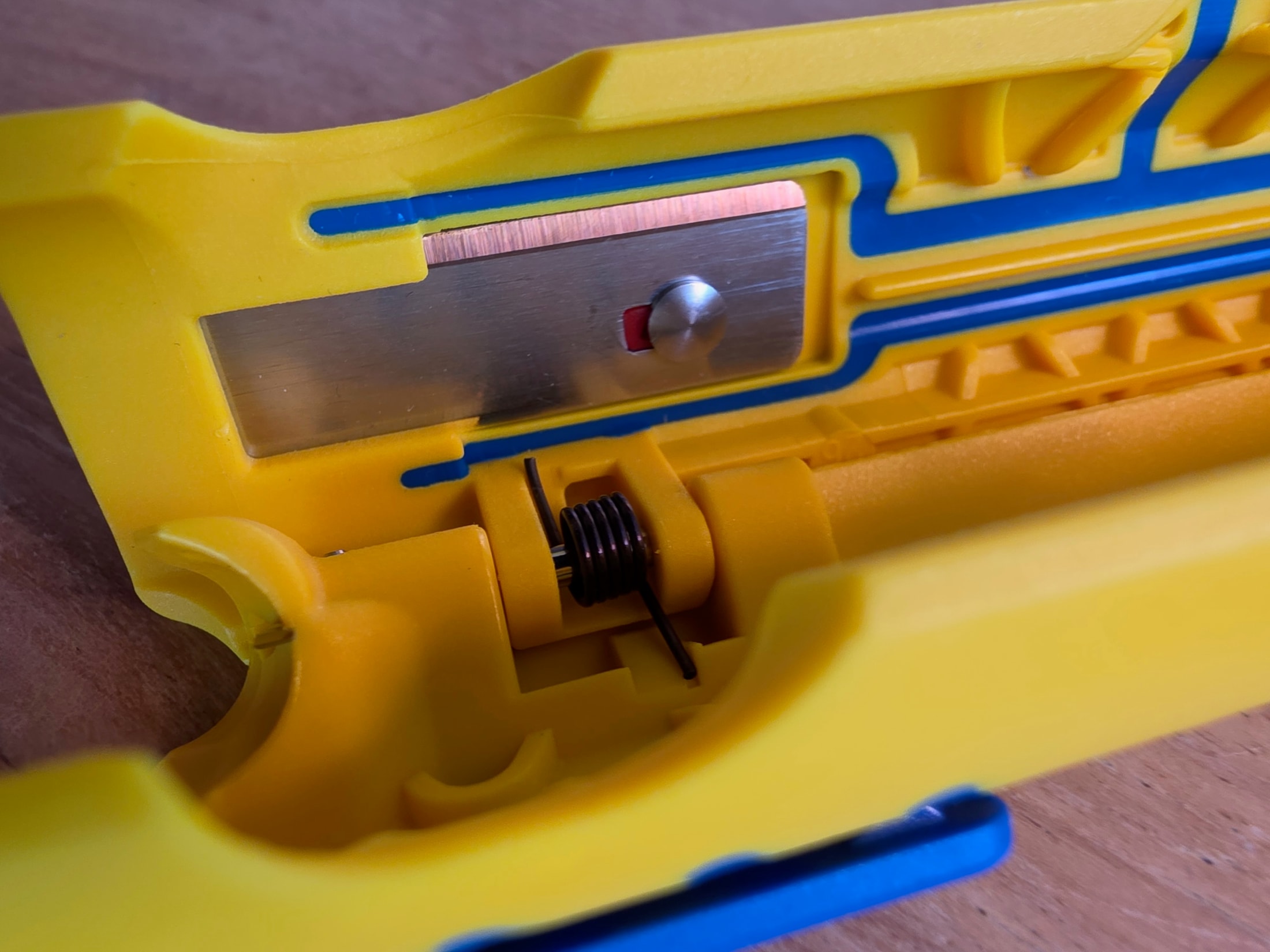
The Jokari data sheet also notes that the way the four blades are arranged stops them clogging up with bits of sheath, a classic problem with cheap cable strippers.
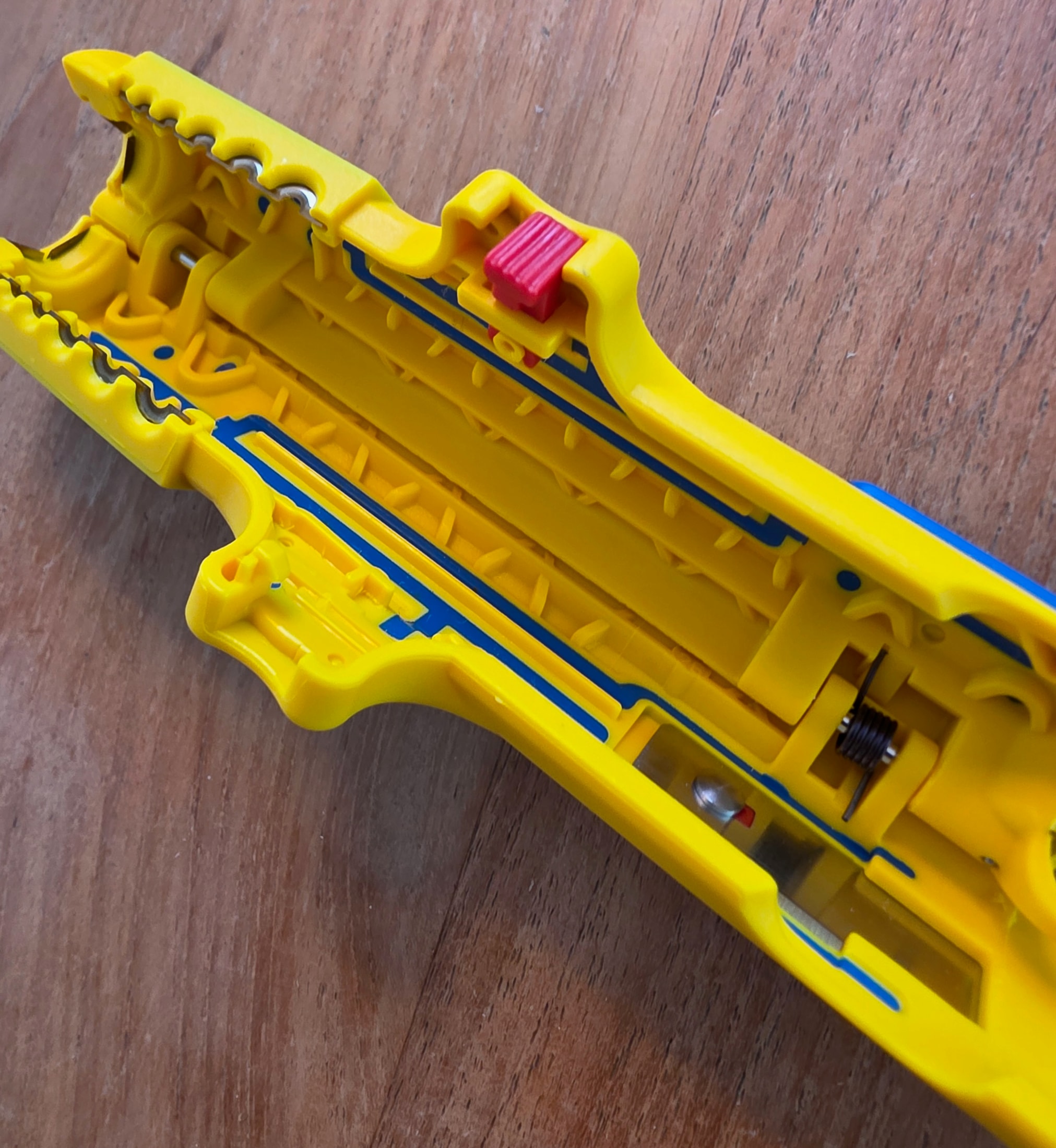
In hand, my first impression comes down to four words: the grip is immediate.
The two-component plastic body is very sturdy, the closing action is crisp, and the pocket clip keeps the tool from slipping down to the bottom of a pair of work trousers. Day to day, I tuck it into the pocket of my Ilkott pants, which I wear on service calls.
The Jokari spec sheet lists 43 g for 124 × 35 × 25 mm: you forget it in a tool bag pocket, and that is exactly what it is for.
In the field, I find it reliable on common round cables, with one caveat I verified first-hand: its flat shape gives me a little less grip on stiff French R2V installation cable than I would like when the cable is stiff.
Two points to note before buying: coax is a job for the SECURA Coaxi No. 1 (Art. 30600, 4.8-7.5 mm, €26 list price) in the Jokari range, and the longitudinal cut runs through the internal guide, with no outer side blade.
On long runs of R2V, this longitudinal cut is just what you need: instead of trying to pull the whole sheath off in one go, I slit it lengthwise and then separate the jacket. It’s cleaner and takes less effort over a long stretch.
The second use is less well known. The tool also has precision blades for individual conductors, with conductor sizes of 0.2 / 0.3 / 0.8 / 1.5 / 2.5 / 4.0 mm².
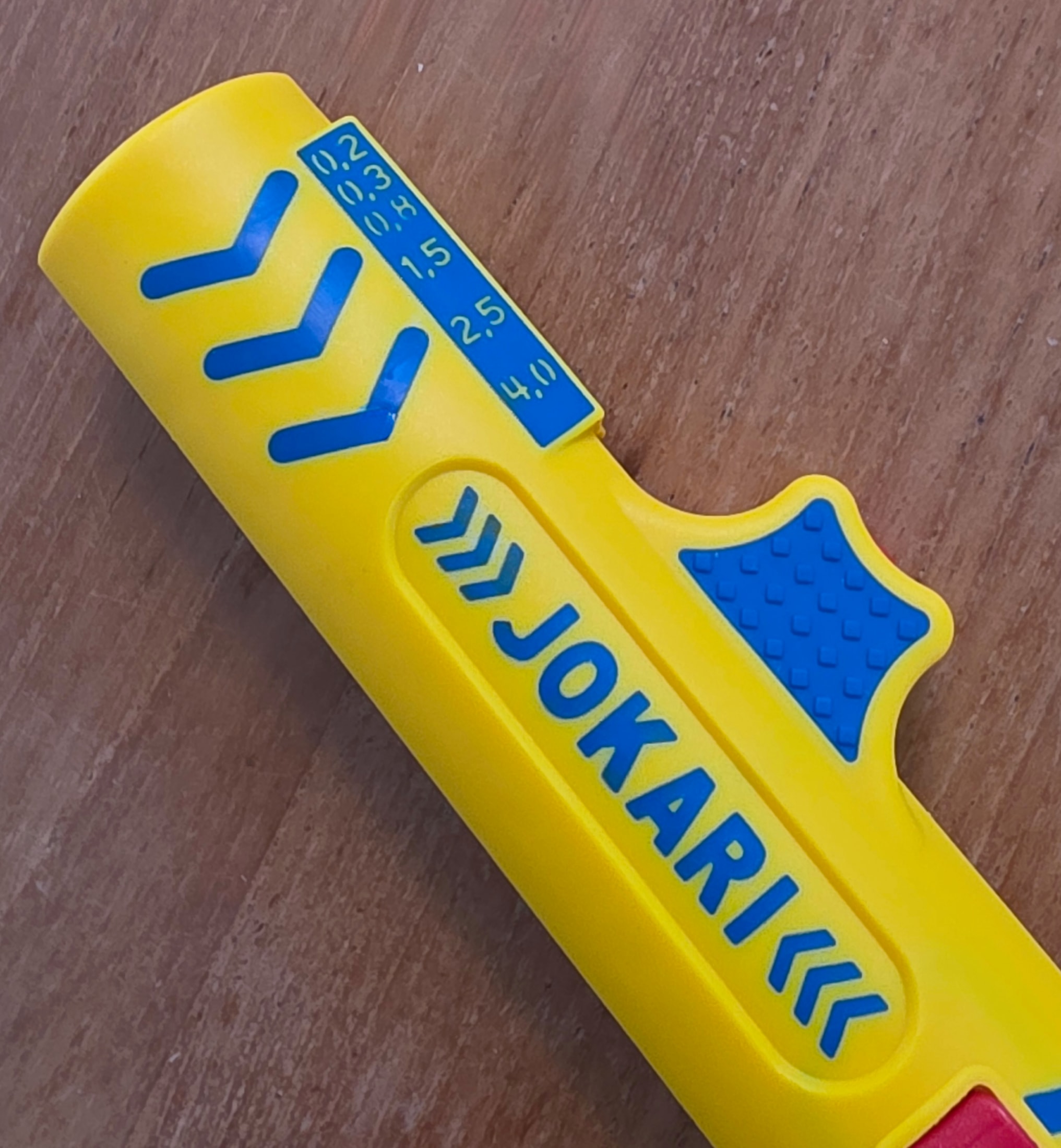
You slide the wire into the slot for its cross-section, close the tool, and pull: the cable stripper becomes a wire preparation tool.
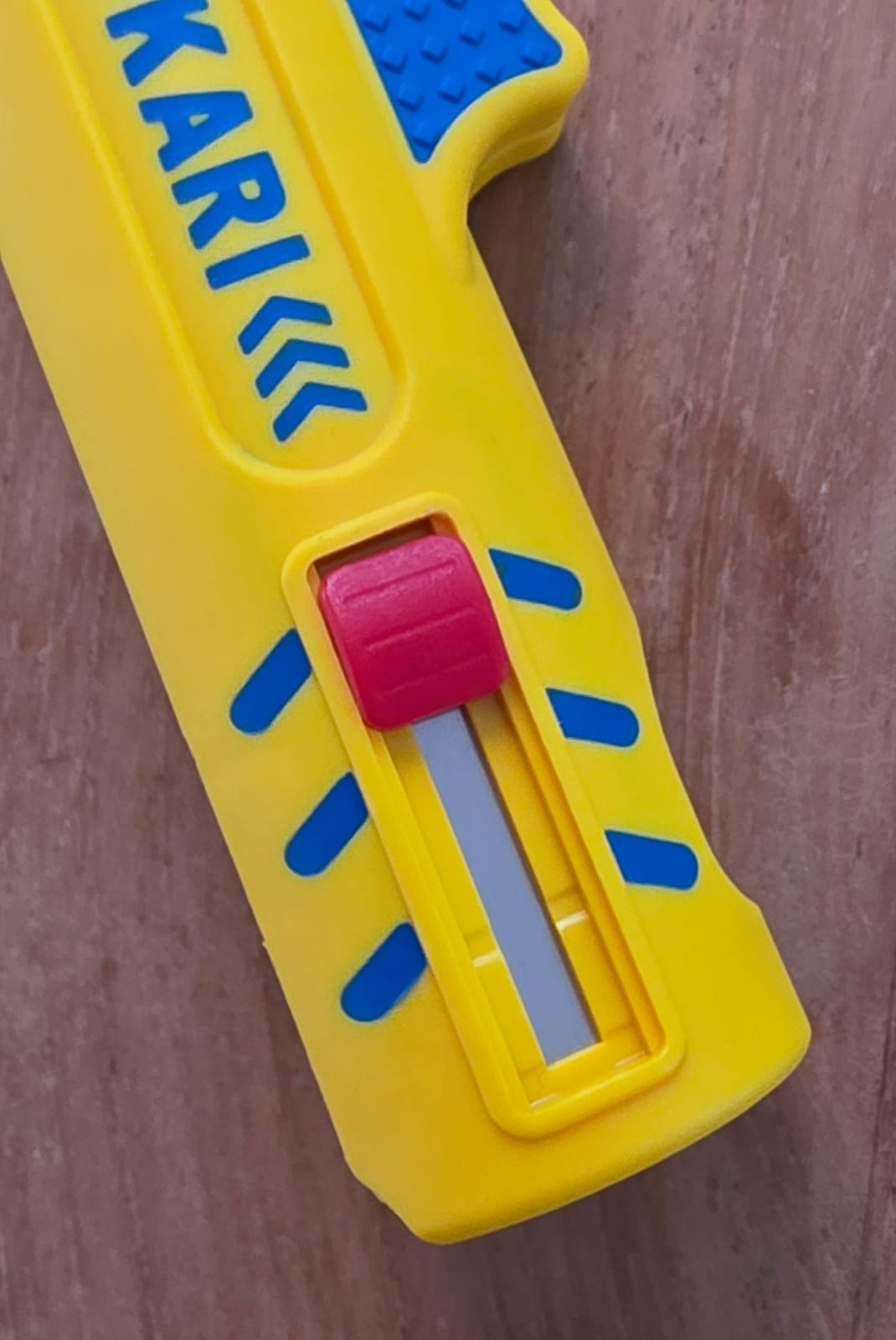
It’s this dual function that makes it a complete pocket tool, even though for hundreds of wires a day, an automatic wire stripper remains faster.
The motion breaks down into three steps: you push the cable all the way into the slot, close the tool, then pull the sheath off with a steady motion.
The longitudinal section runs through an internal guide built into the cable channel: no exposed blade, and the motion stays the same from 3×1.5 to 5×2.5.
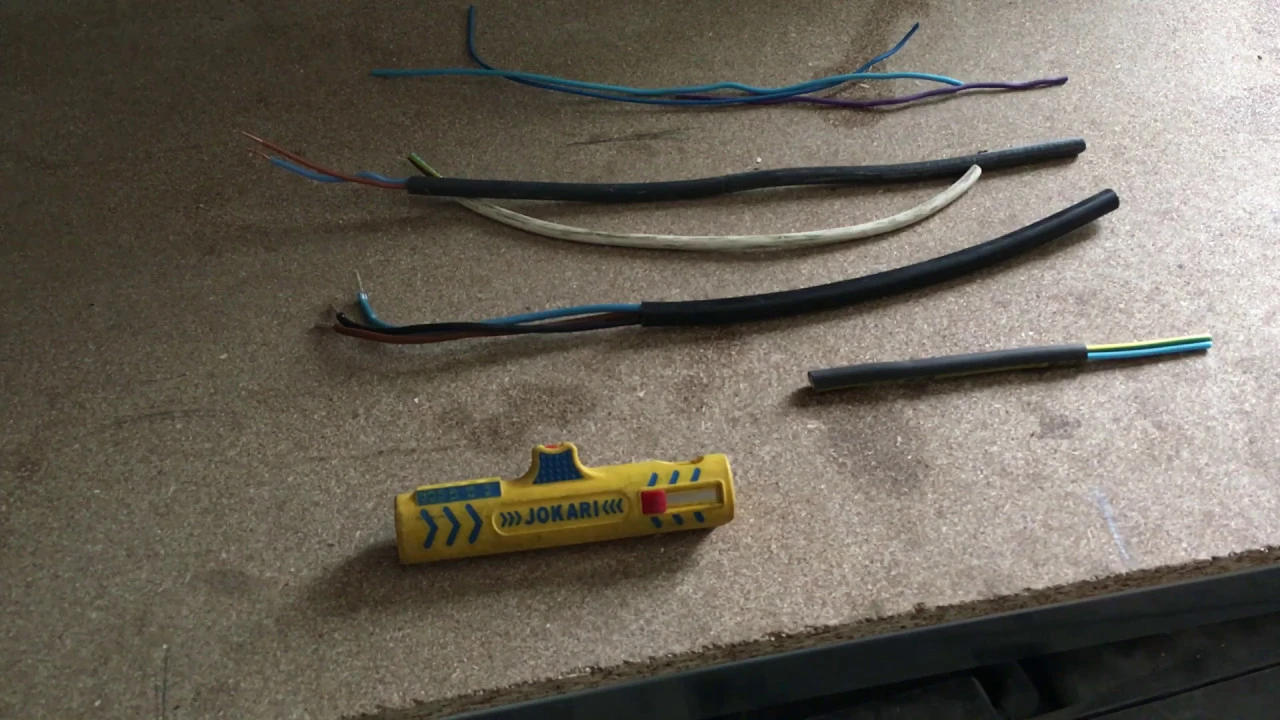
This is the sequence the two videos below show on a French-designation R2V installation cable: stripping the sheath, then stripping the conductors.
The detail I really like is the very handy little cutter that slides out at the front: released by the red button, it opens packaging and coils of cable (cable reels), an everyday task.
Jokari’s spec sheet documents it officially (“sliding blade: suitable for opening packaging or cable rings”), but nobody would guess it until the tool is in their hand.
The tool as a whole is TÜV/GS certified and suits right-handed and left-handed users alike.
In my own use, the outer sheath opened with a controlled motion, without nicking the conductors, and the blades did not clog.
The No. 28H: up to 28 mm, depth-stop screw and integrated spare blade
The No. 28H is a different animal: a cable stripping knife with a pistol grip, designed for round cables 8 to 28 mm in diameter.
Jokari’s spec sheet lists NYM-J, NYY-J and NHXMH-J, for example in 3×1.5 and 5×2.5, up to 5×16 mm².
It’s the tool for panel entries, risers and construction site supply cables, where the cable no longer fits into a 13 mm stripper.
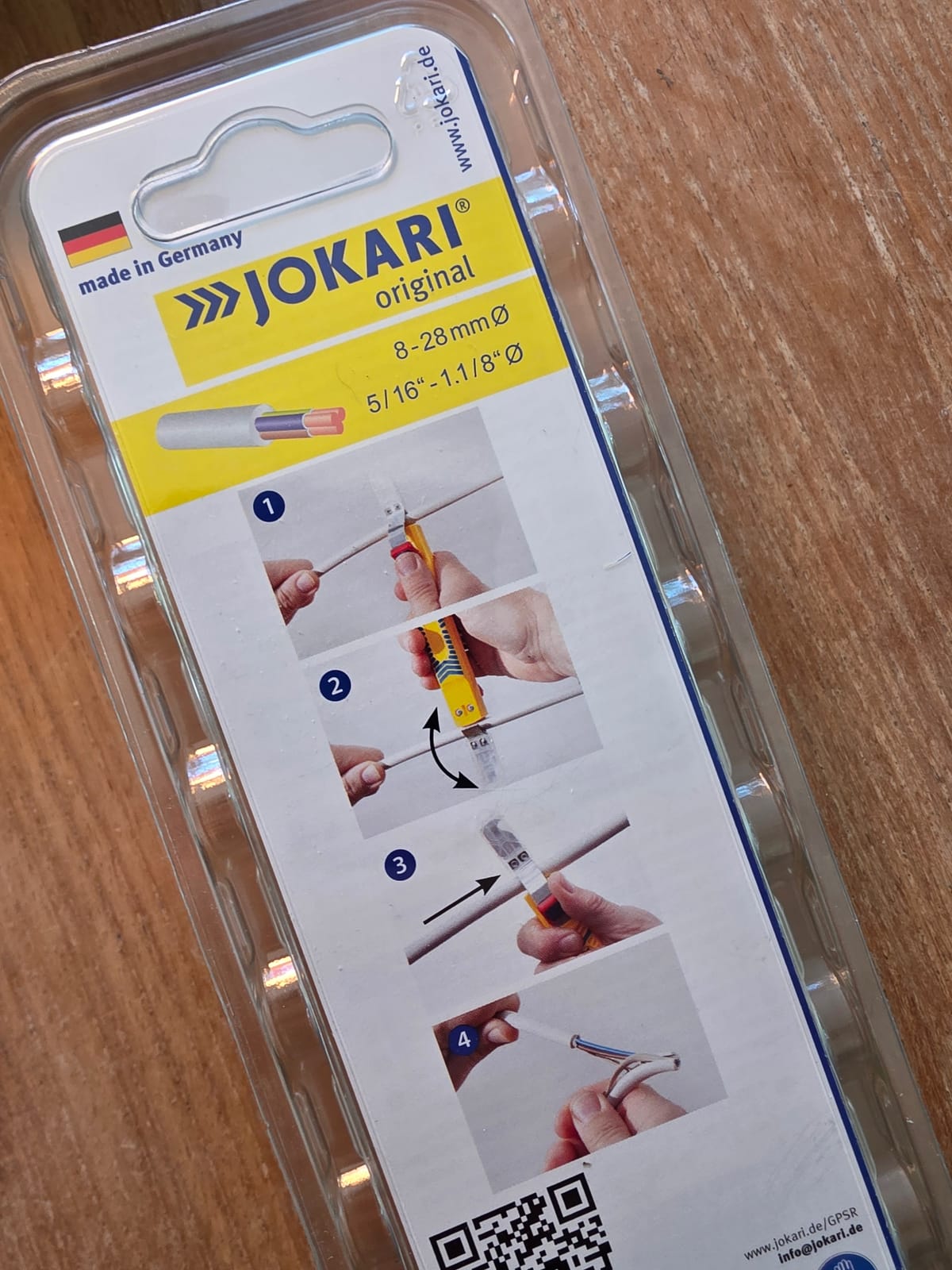
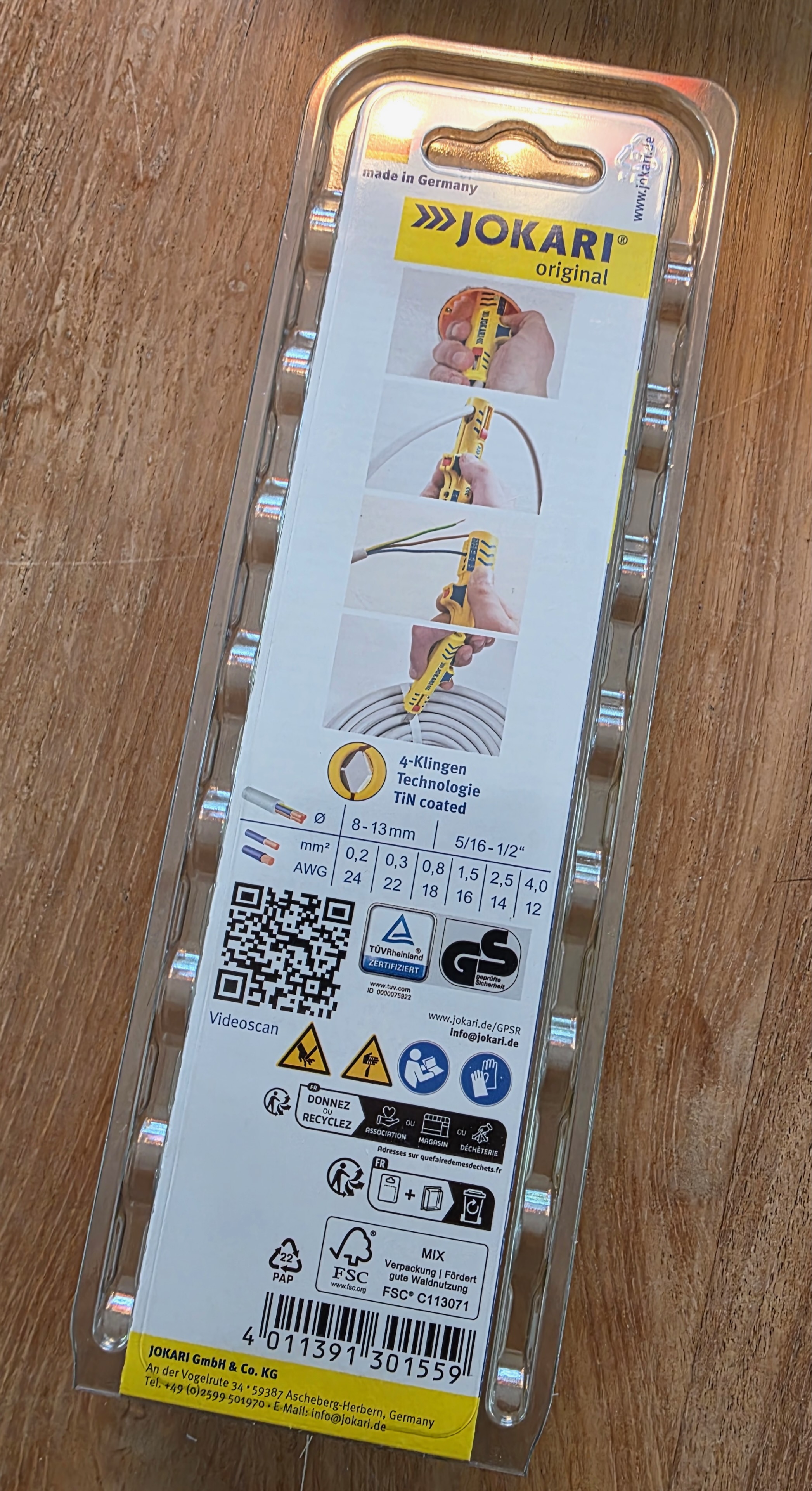
The back of the packaging shows the usage sequence and the 8-28 mm range.
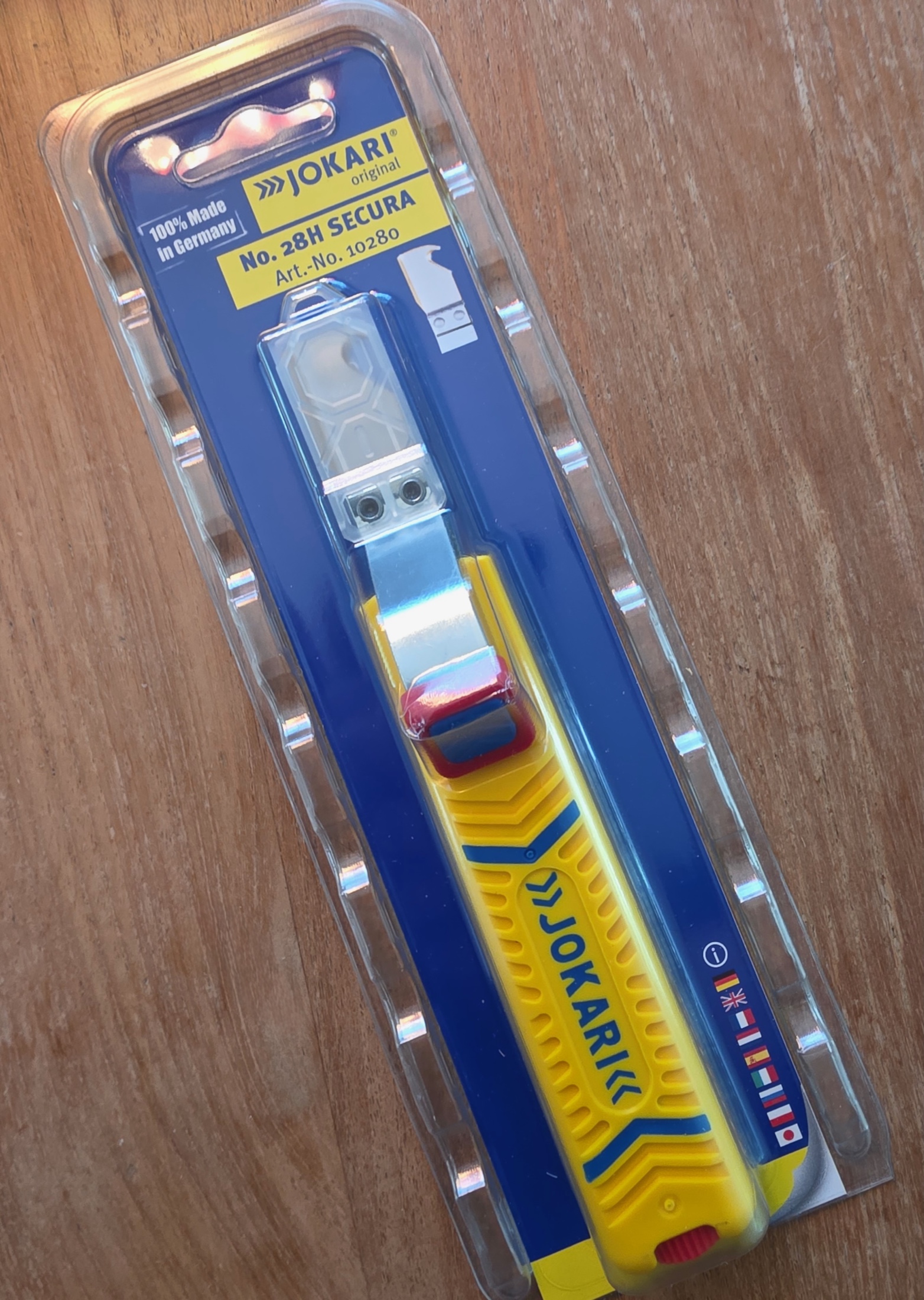
The blister pack identifies the No. 28H Secura and its reference number 10280.
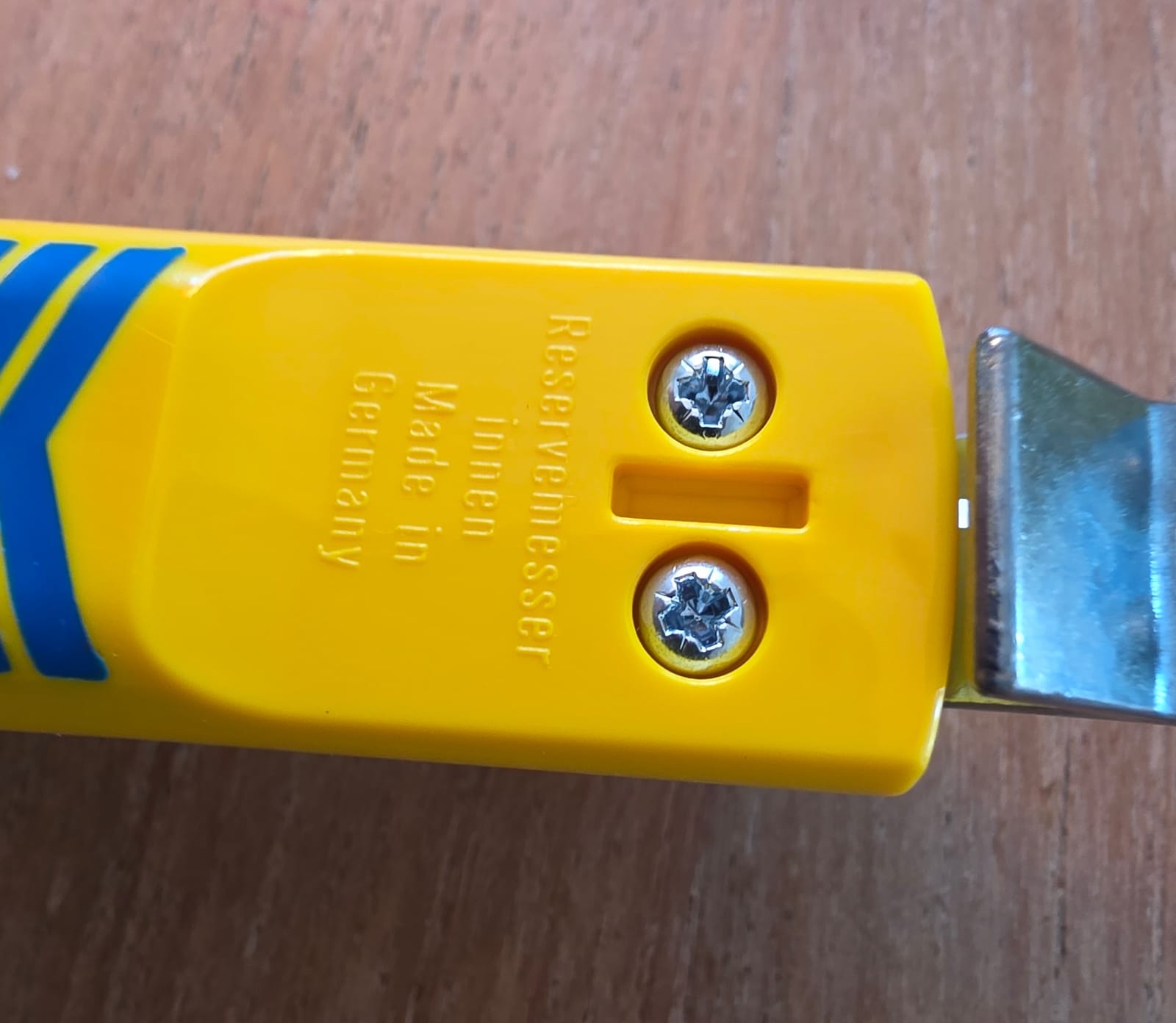
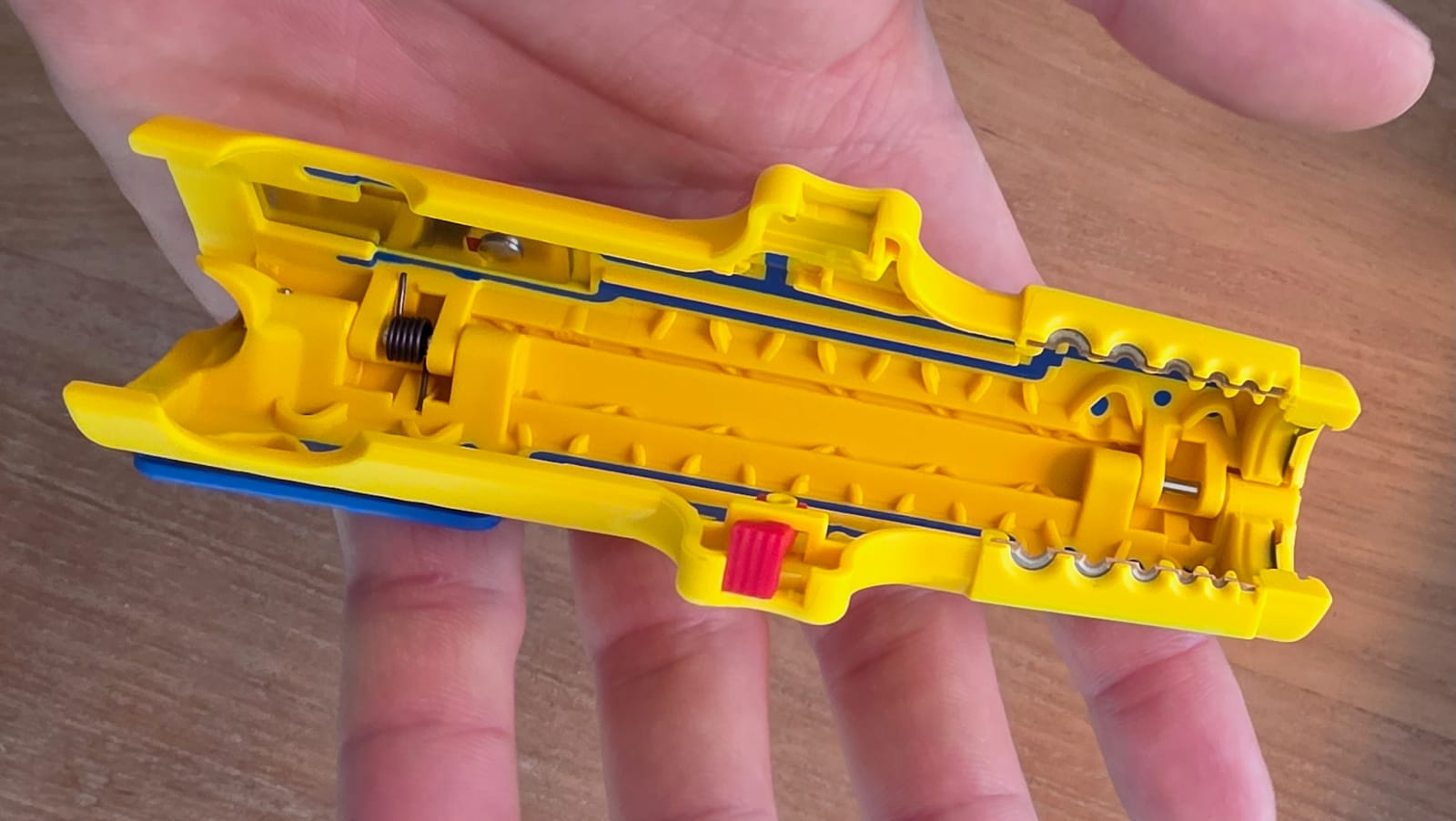
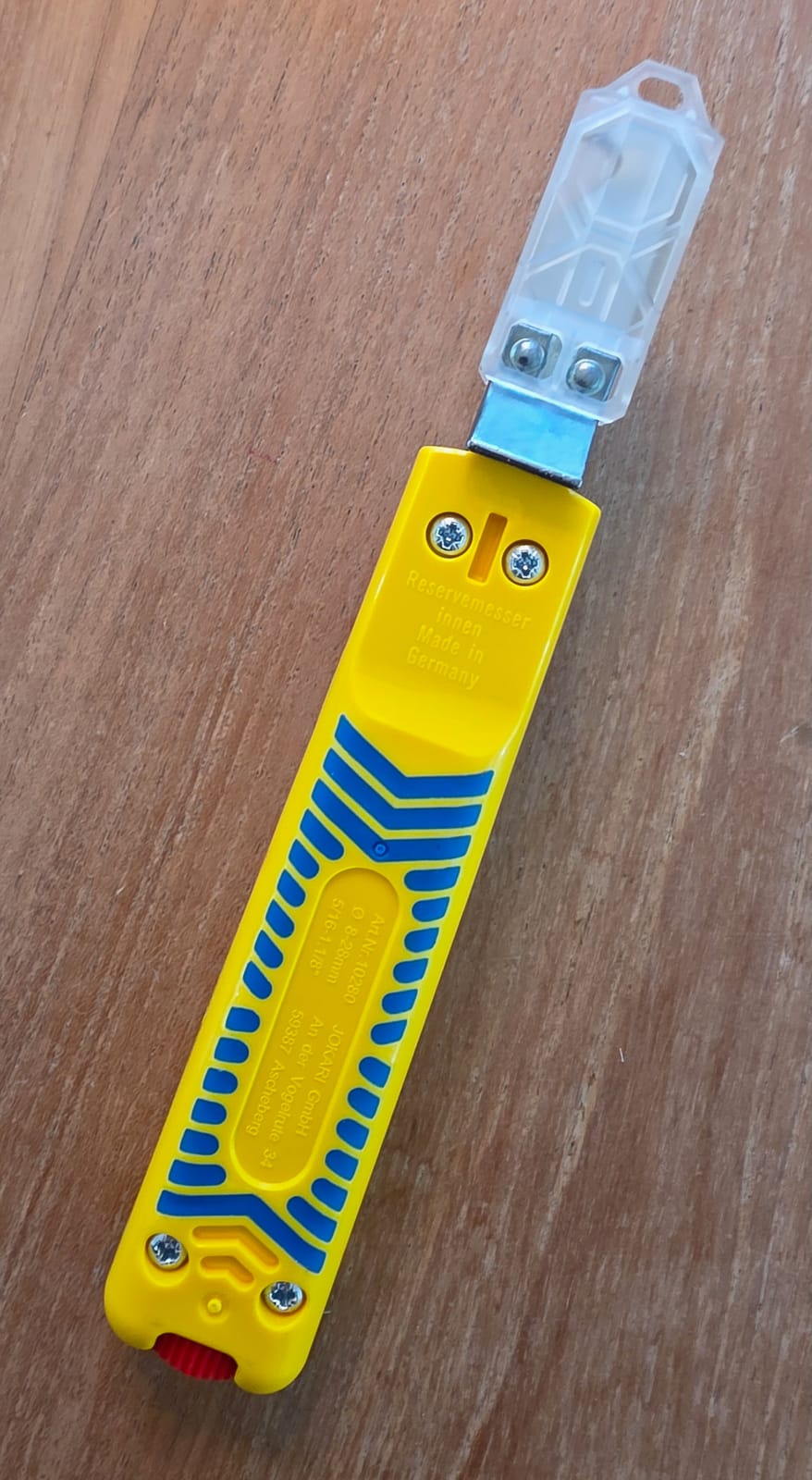
Two screws are visible on this side of the handle. Jokari's blade replacement procedure calls for opening all four handle screws with a PZ1 screwdriver.
The principle is that of a knife whose cutting depth is set by a screw at the end of the handle, the thumbwheel.
You open the cable by pulling the tool along the sheath, with the blade following the curve of the cable, then close it again and strip in two steps.
Jokari claims it automatically adjusts between round and lengthways cuts, which saves you from changing the setting for each action.
Before going any further, a clarification: "Jokari normal" is not a separate model. My packaging says “JOKARI original No. 28H SECURA”, Art. 10280. The No. 28H Standard Art. 10282 is a different model; “Jokari normal” is informal shop talk, not a catalogue name.
The first thing I check on a stripping knife is the spare blade.
Here, the handle is marked "Reservemesser innen", the spare blade sits inside the handle: replacing it requires a PZ1 cross-head screwdriver and removal of the four handle screws, following Jokari’s replacement instructions.
The manufacturer also sells the replacement set separately (art. no. 19000, 13 € on jokari.de).
The body is made of wear-resistant polyamide, with soft components on the handle and the bracket, and the TiN hook blade also opens packaging or scrapes plaster out of back boxes, a detail that comes in handy on renovation jobs.
The 83 g weight and 176 × 29 × 35 mm dimensions point to a tool that lives in the toolbox, not in a pocket.
In use, the No. 28H is an excellent tool for an electrician, very handy for opening and removing long sections of outer cable sheath, not cutting cable to length.
The thumbwheel adjustment takes a bit of careful setting at first. If the depth is set too aggressively, you can cut past the outer sheath and start scoring the insulation on the inner conductors.
That’s why I tend to reserve the No. 28H for large-diameter cables, where its fine adjustment really comes into its own.
After setting the blade depth, the No. 28H is intended for round sheathed cables within its 8–28 mm outside-diameter range. Jokari cites NYM-J, NYY-J and NHXMH-J; this specification does not establish suitability for flat 6242Y/6243Y twin-and-earth or individual 6491X conductors.
The thing that stands out most for me is still the spare blade included, hidden inside the tool: it’s a shame nobody knows about it — a really nice touch from Jokari, and it lets you fit a fresh blade.
On site, the top hook blade is handy for opening packaging. Its cap protects the hook blade; the red screw at the handle end separately sets the internal blade’s cutting depth, as specified in Jokari’s instructions.
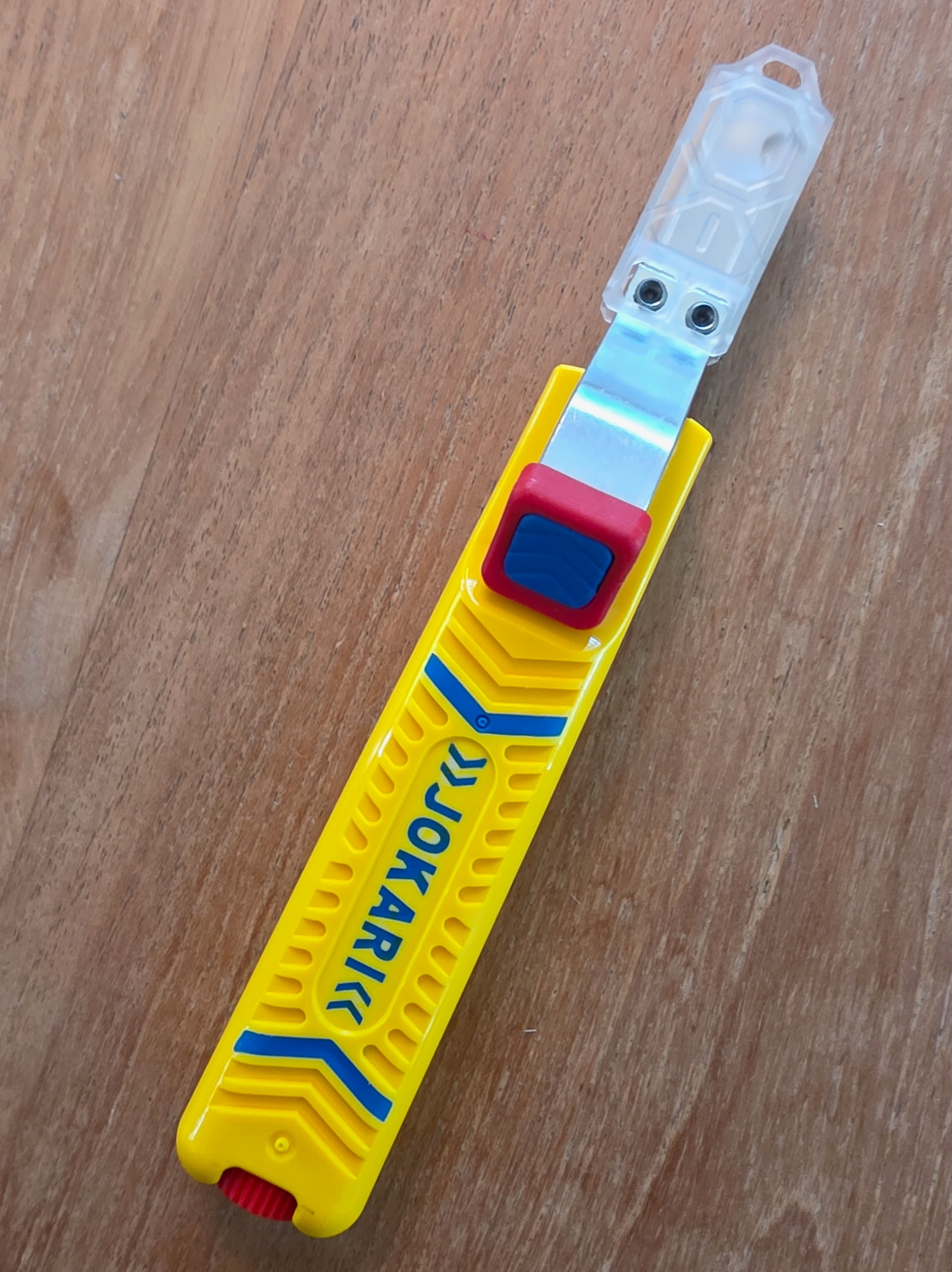
Jokari No. 28H SECURA
Advantages
- Excellent electrician’s tool for opening long sections of outer sheath on compatible round cables
- Spare blade stored in the handle; replacement requires a PZ1 screwdriver and removal of the four handle screws
- Large top hook blade with a protective cap; red adjustment screw at the end of the handle
- Strips the outer sheath of compatible round cables measuring 8–28 mm outside diameter; the 5×16 mm² figures are manufacturer cable-family examples, not an additional personal test
Drawbacks
- The depth adjustment requires precision: set too deep, it can score the insulation of the inner conductors
Points to watch
- Don’t strip individual conductors: it’s a cable sheath cutter, not a wire stripper
- 83 g and 176 mm: it lives in the toolbox, not in your pocket
What you discover after purchase
Hidden benefits
- The spare blade stored inside the handle is marked ‘Reservemesser innen’; replacement requires PZ1 and four handle screws
- The red screw at the handle end controls cutting depth; the hook-blade cap is for protection only
Recommended prices published by Jokari
The recommended prices shown on jokari.de are €44.00 inc. VAT for the No. 15 (and €24.00 for the No. 28H).
Jokari publishes euro recommended retail prices on its official site; these are not verified UK shop prices. I check a UK seller’s current price, VAT and delivery before buying.
Jokari also lists the SECURA Coaxi No. 1 (Art. 30600) and replacement blades for its cable knives. Jokari lists replacement blades under Art. 19000 with a €13 manufacturer RRP; that is not a verified UK retail price.


The full product pages remain useful before buying: the Secura No. 15 page and the No. 28H SECURA page on the brand’s website.
What I take away from the field test
There’s a clear logic to the Jokari duo.
So my choice comes down to the task: the No. 15 for routine cable stripping, the No. 28H for thick cables, and the Super 4 Plus for small conductors.
The No. 15 lives in my pocket: I estimate that it covers 90% of the round cable sheaths I come across on renovation jobs, with wire stripping as a bonus thanks to its six slots.
The No. 28H SECURA (Art. 10280) stays in my toolbox and comes out for thick cables, incoming supplies and commercial projects; at a recommended price of €24, it pays for itself from the first big incoming feed.
The limitations are worth knowing.
Neither of the two tools is a VDE-insulated tool: stripping a live cable is out of the question, and the guide to 1,000 V insulated tools reminds you what the marking really means.
The No. 28H does not strip conductors: it’s a sheath knife, not a cable-preparation tool.
The blades wear out and can be replaced, and it’s better to buy a spare set at the same time as the tool, as with any automatic wire stripper in our dedicated comparison where Jokari features prominently.
The rest of the preparation process doesn’t change: once the wires are stripped, the length of insulation to strip is determined by the terminal, as the guide to crimping terminals points out.
Connectors have their own rules, whether it’s mixing stranded and solid wire or crimp ferrules with a dedicated crimping tool.
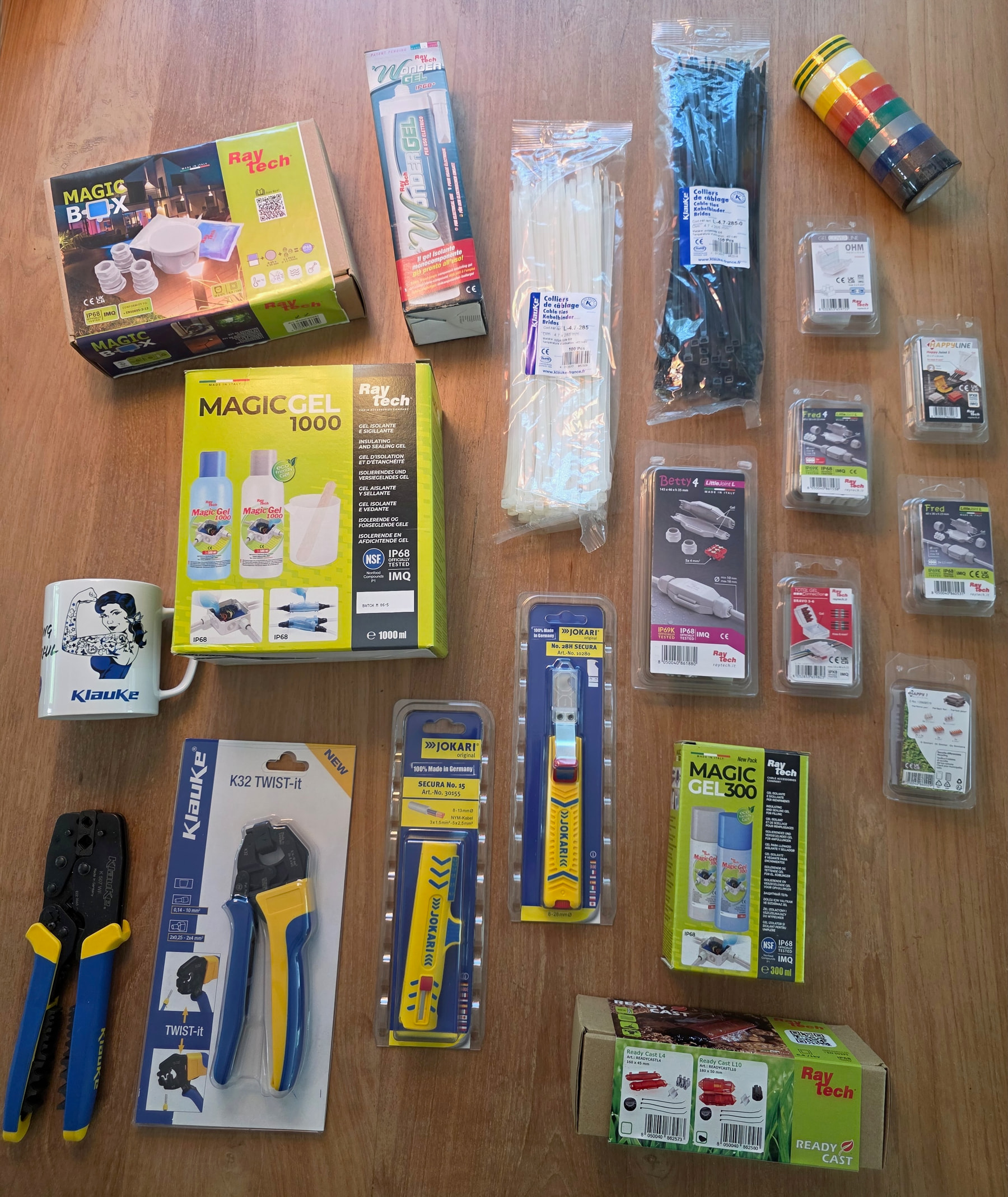
For connections exposed to moisture, the IP68 insulating gel takes over.
And as with any branded tooling, you still need to watch out for fakes: the signs of a counterfeit are detailed in the guide to counterfeit tools.
For a first toolkit, the budget logic is simple: the No. 15 covers everyday stripping and wires, and the guide to kitting out a beginner electrician puts it in the buying order, ahead of the multimeter.
For large cables, the No. 28H, at a recommended price of €24, remains a reasonable outlay.
Verdict — Secura No. 15
The Secura No. 15 is a very good tool: stripping round 8-13 mm cables needs no adjustment, it’s very sturdy and reliable, and I really like the retractable sliding cutter. Three limitations to name: slightly less grip on R2V, no coax (the SECURA Coaxi No. 1 is sold separately), and no exposed side blade; its internal guide still allows lengthwise sheath cuts.
It’s a very good tool, with a few specific points to be aware of: 4/5.
Verdict — No. 28H SECURA
The No. 28H is an excellent electrician’s tool for opening and removing longer sections of outer sheath on compatible round cables of 8–28 mm outside diameter. Jokari lists 5×16 mm² as a cable-family example; I did not perform a separate R2V 5×16 mm² trial.
The spare blade hidden in the handle is very handy, and the large hook blade on top complements the tool well. Its real limitation is the depth adjustment: it takes more skill than a self-adjusting stripper, because set too deep it can reach the insulation of the inner conductors. Once you have mastered that, I would buy it again: 4.5/5.
Quiz: the key points
3 questions
InteractiveQuiz: Jokari Secura strippers, the key points
3 questions to check the essentials
Choose an answer
Frequently asked questions about Jokari Secura cable strippers
What is the difference between the Jokari Secura No. 15 and the No. 28H?
The No. 15 (Art. 30155) strips round cables from 8 to 13 mm (four self-adjusting TiN blades) and strips wires from 0.2 to 4 mm²: a pocket tool weighing 43 g. The No. 28H (Art. 10280) strips cables from 8 to 28 mm, with screw-adjustable depth and a spare blade in the handle.
Is the Jokari Secura No. 15 insulated for working on live cables?
No. Neither the No. 15 nor the No. 28H carries insulated-tool markings: they are not VDE tools. Never use these strippers on or near live parts. I safely isolate the circuit, prevent re-energisation and prove it dead with a suitable, verified voltage indicator before stripping. An insulated-tool marking on another tool does not authorise live stripping.
How much do the Jokari Secura strippers cost?
The recommended price is €44.00 for the No. 15 and €24.00 for the No. 28H, published on jokari.de. Jokari publishes its recommended retail prices (RRP) on its official website; these euro RRPs are not verified UK retail prices. I compare current UK seller quotes, VAT and delivery.
How do you replace the blade on the Jokari No. 28H?
The handle is marked “Reservemesser innen”: the spare blade is built into the handle but replacing it requires a PZ1 screwdriver and removal of the four handle screws, following Jokari's instructions. I check the current replacement-blade reference and price before ordering. A blunt blade tears the jacket instead of cutting through it: I replace it as soon as cutting starts to require more effort.
Can the No. 28H strip the inner wires of a cable?
No, the No. 28H is a jacket stripper: it opens and removes the outer jacket of the cable, not the insulation on the conductors. To prepare the wires once the jacket is removed, you need a wire stripper, either an automatic model or one with stripping notches, like those in our wire stripper comparison.
Disclosure Jokari : Secura No. 15, No. 28H and Super 4 Plus.
Théo Desrousseaux
Electrician and editor
I work in the field and edit this magazine. Every guide is reviewed for its target country before publication.
Author → Credentials → Editorial method → Report a factual correction →
No email app? Copy the correction details
Email address and prefilled context:
theo@sparx-elec.fr
Article: https://www.sparx-elec.com/gb/secura-cable-stripping-pliers-review/
Edition: GB — English
Factual issue: [describe the factual issue]
Passage: [quote or identify the passage]
Source: [optional source URL]
Sources and references
- 1. Jokari — Cable Stripper Secura No. 15 product page (Art. 30155)
- 2. Jokari — Cable Knife No. 28H SECURA product page (Art. 10280)
- 3. Jokari — Automatic Wire Stripper Super 4 Plus product page (Art. 20050)
- 4. Jokari — spare blades for Super 4 Pro / Super 4 Plus (Art. 29050)
- 5. Jokari — Cable Stripper SECURA Coaxi No. 1 product page (Art. 30600)
- 6. Jokari — replacement blades for cable knives
- 7. Jokari — the history of the brand
More guides
Practical electrical installation guides, diagnostic methods and tool recommendations compared against the technical wiring standards of this national edition.
Klauke K32 TWIST-it and K507 WF: electrician review
Field test of the Klauke K32 TWIST-it and K 507 WF manual crimping tools, supplied by the brand: 0.14-10 and 0.5-50 mm² ranges and verdicts.
Read the guide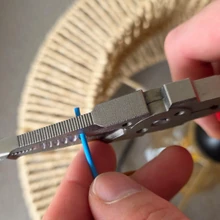 Guide C.K Tools pliers review: RedLine VDE What the C.K Tools RedLine VDE T3973-160 and T3910-210 pliers are worth: shear cutting, stripping, LOOP eyelet, and 1 000 V insulation, after testing. Read the guide
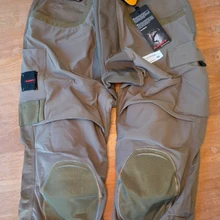 Guide Ilkott trousers: PY55 field review, PY56 photos First-hand review of Ilkott PY55 trousers and AA61 pouch. The cropped PY56 is photographed only; no long-wear test or knee-pad certification is claimed. Read the guide
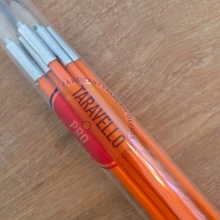 Guide Taravello Pro review: cable rods (drawing rods) Review of the Taravello Pro cable pulling needles: grip, stiffness, accessories, a quote from the manufacturer, and the pulling, rodding and detection range. Read the guide