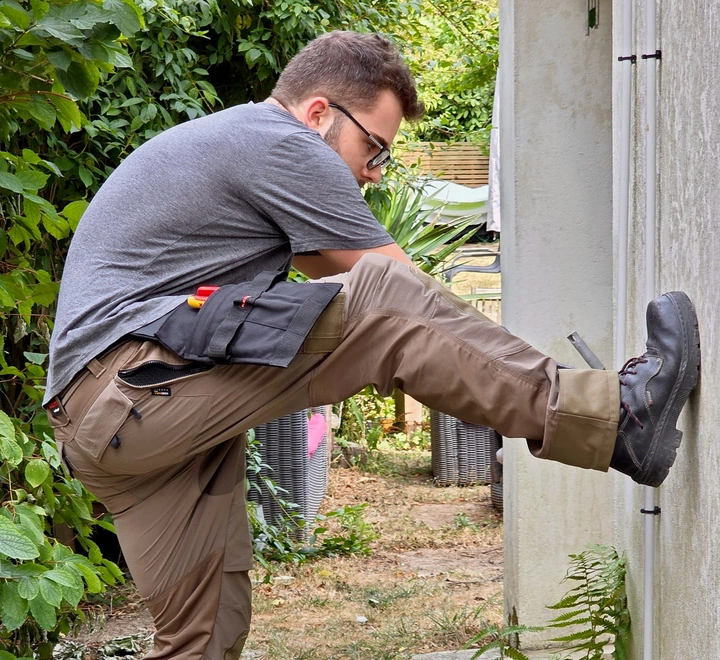
Check the exterior first
Do not test or use a damaged, wet inside, scorched or loose outlet. Leave the enclosure closed and arrange inspection.
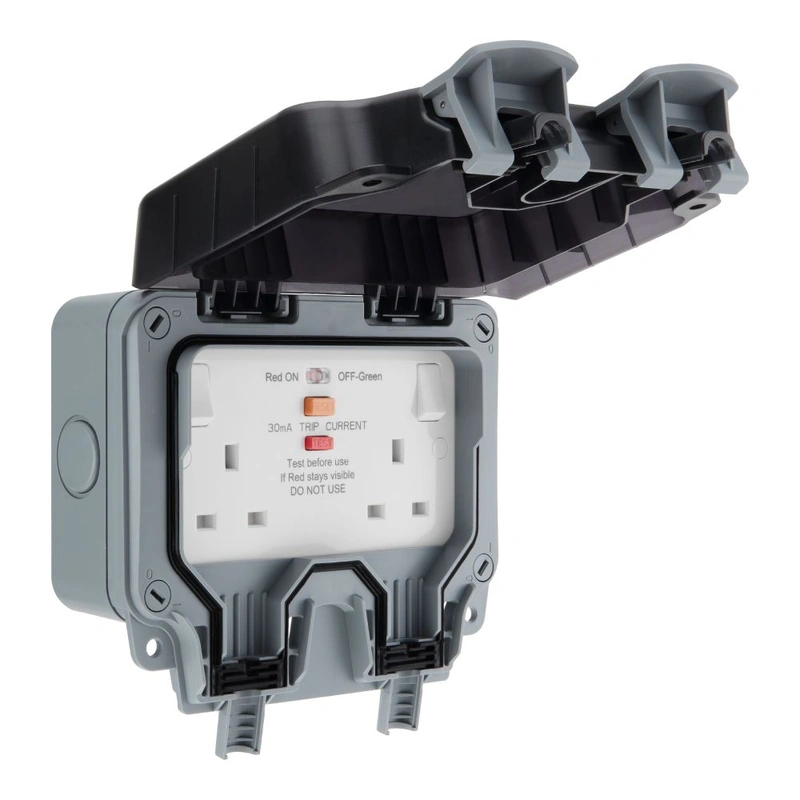 Photo : BG Electrical — WP22RCD
In brief
A mower lead or a hedge-trimmer cable can be damaged outdoors. A 30 mA RCD reduces the risk of a serious electric shock, but it does not make a cut cable safe or guarantee survival. The circuit, its earthing and the weatherproof enclosure matter as well.
I separate three questions when choosing an outside socket: what needs additional protection, what provides fault protection, and which part of the wiring the device actually covers. A test button on the faceplate does not answer all three.
For a new garden supply, a dedicated circuit with an RCBO at the consumer unit is often a straightforward choice. A socket incorporating an RCD can also provide additional protection, subject to the product and installation requirements.
It cannot protect wiring on its supply side. Nor should an SRCD be substituted for a device needed to provide fault protection, particularly where a TT design relies on upstream RCDs. That distinction is more useful than a blanket rule that every socket RCD is either sufficient or forbidden.
30 mA
maximum rated residual current for additional protection
32 A
socket rating up to which 411.3.3 applies
IP66
usual rating for an exposed UK outdoor socket
13 A
rating of the BS 1363 socket shown
Regulation 411.3.3 is the one that governs an outside socket. In AC systems, additional protection by an RCD rated at no more than 30 mA must be provided for socket-outlets rated up to 32 A, and for mobile equipment up to 32 A used outdoors.
The escape route that let a socket go unprotected because skilled people supervised it was removed back in 2015, when the 17th Edition amendment required protection for all socket-outlets up to 20 A rather than only those in general use by ordinary persons.
The IET set out the three indents plainly in its Mythbusters column. Protection is required for sockets up to 32 A where ordinary people, children or disabled people may use them, for sockets up to 32 A in other locations, and for mobile equipment up to 32 A used outdoors.
Only the second indent carries an exception, and that exception needs a documented risk assessment produced with a skilled person and handed over with the certificate.
That structure matters for a garden socket because of the third indent. A lawnmower, a pressure washer or a hedge trimmer plugged in outside is mobile equipment used outdoors, so 411.3.3 bites twice: once through the socket and once through the appliance.
There is no risk-assessment escape from the mobile-equipment indent, only from the second one.
A 13 A BS 1363 outdoor socket sits comfortably under the 32 A ceiling, so it is squarely inside the requirement, and it is the same connector family described in the UK 13 amp socket types guide.
The same is true of the older blue BS EN 60309 industrial outlets that appear on larger garden and workshop installations, as long as they stay at or below 32 A.
Info
Electrical Safety First’s Wiring Regulations guidance, question Q1.132, accepts SRCDs and FCURCDs manufactured to BS 7288 for additional protection in AC installations. The answer cites Regulation 531.3.4.1.
An older IET webinar answer based on the original 2018 text gives a different position; it should not be used as a blanket current prohibition.
The product’s type, edition and instructions still matter. Older devices can be Type AC; a Type A marking is not implied merely by the words RCD socket. Selection must suit the expected loads and residual-current waveforms.
A socket RCD sees faults downstream of its sensing circuit. It cannot disconnect an earth fault in the fixed cable feeding the socket before that device. If the upstream cable needs RCD protection, for example because of its installation method, the local socket device does not satisfy that separate need.
Likewise, additional protection and fault protection are different functions. A TT installation normally relies on an appropriately selected upstream RCD for automatic disconnection. Fitting an SRCD at the end does not repair a missing earthing arrangement or replace that fault-protection design.
| Device | Possible role | Important limit |
|---|---|---|
| Device RCCB to BS EN 61008 | Possible role Residual-current fault or additional protection, as designed | Important limit Requires coordinated overcurrent protection |
| Device RCBO to BS EN 61009 | Possible role Residual-current and overcurrent protection for its circuit | Important limit Type, rating and assembly compatibility must be correct |
| Device SRCD / FCURCD to BS 7288 | Possible role Additional protection under the current guidance | Important limit Does not protect its supply cable or replace required fault protection |
| Device Portable RCD adaptor | Possible role Additional safety for connected equipment | Important limit Not a repair for unsafe fixed wiring |
Choose the device by the protection required and the wiring it covers, not by the position of its test button.
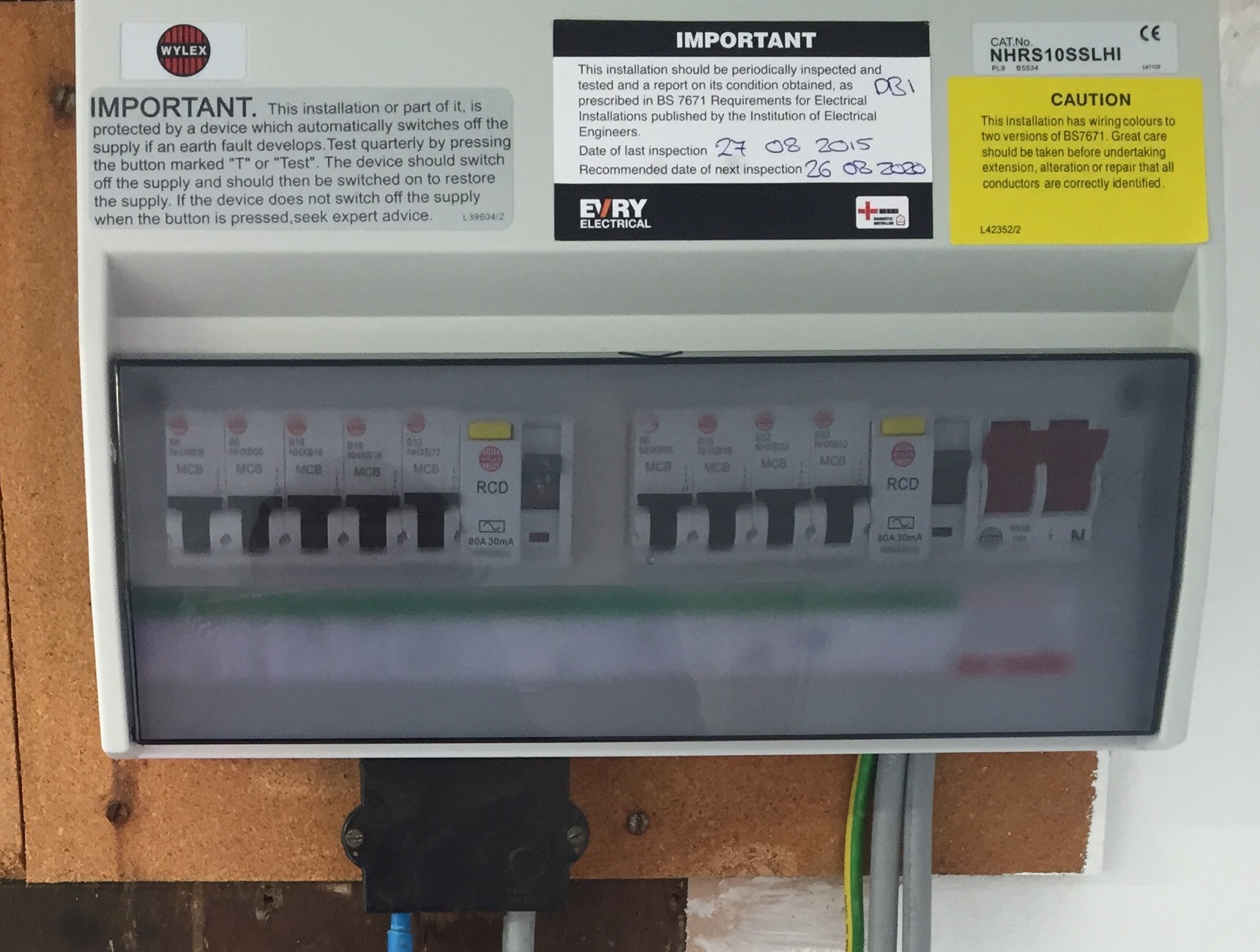
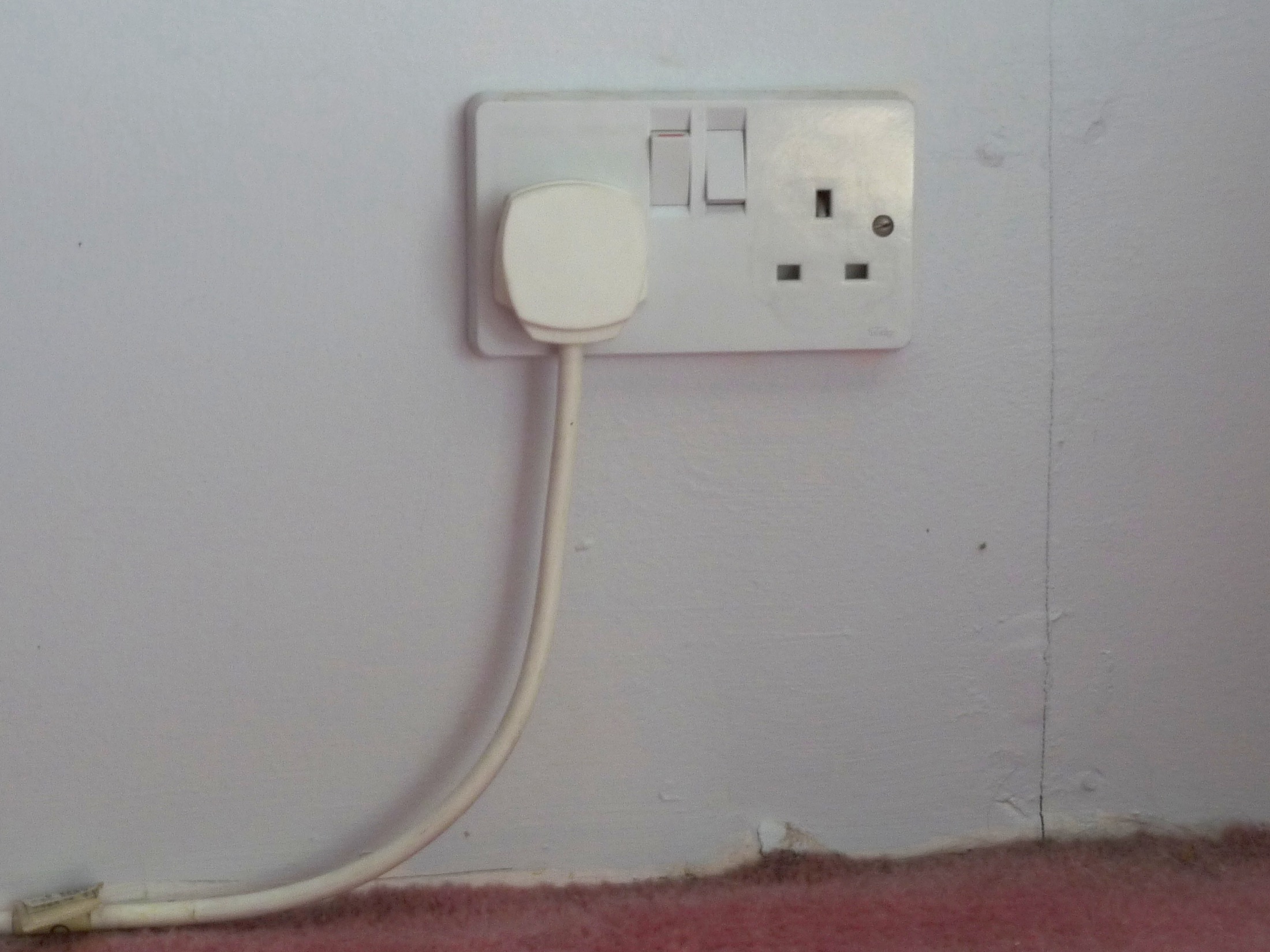
A local RCD socket puts a test and reset control at the point of use. That can be convenient, provided the circuit’s other protection requirements have already been assessed. It is not a way to certify an otherwise unsuitable garden circuit without inspection.
On an existing installation, I first establish whether upstream protection is present, what protects the fixed cable, and whether the device maker permits the proposed arrangement. The price of a board alteration comes after those checks, not before them.
A local reset can save a walk back to the consumer unit only when the local device alone operates. With two instantaneous 30 mA RCDs in series, either or both may trip. There is no guaranteed local-only reset advantage.
The test button checks the mechanism under its internal test conditions. Instrument testing and inspection establish other aspects of the installation; a successful button test does not prove complete protection.
There is also the question of what happens after a power cut. Passive, or mechanically latching, devices stay latched and restore the supply when the power returns, which suits a freezer in a garage. Active devices drop out and wait to be reset by hand, which is the safer behaviour for a socket feeding a power tool.
Timeguard describes the difference in exactly those terms, and it is worth deciding deliberately rather than discovering it at the wrong moment.
BS 7671 does not name an IP rating for a garden socket. The requirement is the general one: equipment must suit the external influences at its location. In practice, UK guidance converges on a number.
NICEIC notes that most outdoor sockets sold here are IP66, meaning dust-tight and protected against powerful water jets, and Knightsbridge’s technical guidance calls IP66 “a prudent minimum” for sockets and switches outdoors.
IP44 covers splashing water; IP65 and IP66 cover progressively more demanding jet tests. Those numbers describe particular test conditions, not how many years an enclosure will survive outdoors.
For an exposed garden wall, IP66 is a useful specification, but it is not a universal minimum written into BS 7671. Check the actual exposure, UV resistance, drainage, mounting orientation and instructions, including the rating with a plug inserted.
The second number is only half the specification. Impact resistance matters more than most buyers expect, because a garden socket sits at the height of a wheelbarrow handle, a strimmer head and a boot.
Products quoting IK06 or better are describing resistance to a modest mechanical blow, and a polycarbonate enclosure is doing real work there. An enclosure that cracks in year three has lost its IP rating entirely.
Attention
The most common shortcut is to run standard twin and earth through a wall to the garden. That cable is not intended for permanent outdoor use. Its PVC sheath has limited resistance to UV, and Knightsbridge’s guidance is explicit that it is not designed for installation in direct sunlight or outdoors.
Where the cable is buried it also needs protection from a spade, which means armoured cable or a robust duct, laid deep enough that garden tools cannot reach it.
Armoured SWA cable is the usual answer for a buried run: the steel wire armour provides the mechanical protection and, with the correct gland and banjo arrangement, a reliable earth path. Where a duct is used instead, oversizing it costs little at the digging stage and makes a later cable pull possible without reopening the trench.
A TT system changes the picture again. Where the installation uses its own earth electrode instead of a distributor-provided protective earth, the installation depends on RCDs for fault protection, not just additional protection.
Disconnection times then have to be met by the RCDs themselves, and the earth electrode resistance becomes a design figure rather than an afterthought. That is a job for someone with the test equipment to measure it, not a decision made at the counter of a DIY shed.
There are two ways to get power to the garden, and the choice affects cost, nuisance tripping and paperwork.
| Approach | What protects the garden | Typical cost picture |
|---|---|---|
| Approach New dedicated circuit with its own RCBO | What protects the garden Additional protection on the new circuit only, so a garden fault stays in the garden | Typical cost picture Highest: cable run, trench, RCBO, notification |
| Approach Spur from an RCD-protected ring | What protects the garden The ring's existing 30 mA device, so a garden fault can drop that whole ring | Typical cost picture Lowest: socket, cable, labour |
| Approach Spur plus RCD socket | What protects the garden Board device plus a local supplementary device, with no guaranteed selectivity | Typical cost picture Middle: the socket costs more |
Knightsbridge’s guidance is clear that taking the garden circuit off an existing circuit through a fused spur is not recommended. The rules that make a ring convenient indoors are also what make it a poor host for a garden load, as the ring final circuit guide sets out.
The reason is discrimination: an independent circuit with its own RCD or RCBO means a fault in the garden does not black out the kitchen. On a ring final protected by a single 30 mA device, a waterlogged joint outdoors can take half the house with it.
An unfused spur from a ring normally supplies one single or double socket, subject to the ring-circuit design. A fused connection unit changes the downstream design: multiple outlets may be possible within the fused load and cable limits.
A spur must not simply be extended without establishing which arrangement exists. The electrician checks the ring, cable route, load, voltage drop and protection before deciding whether the garden needs a separate circuit.
Cost is the honest counterweight. Checkatrade’s 2026 cost guide puts the socket itself at roughly £10 to £60, labour for a single outdoor socket at £130 to £200 or more, and a double at £200 or more.
An RCD socket sits at the top of the material range, but whether a board alteration is necessary depends on the protection design, not the price of the socket.
Part P of Schedule 1 to the Building Regulations applies to electrical installations in dwellings and in a garden or on land associated with a building where the electricity comes from a source within or shared with that dwelling.
The requirement itself is short: reasonable provision must be made in design and installation to protect people from fire or injury.
Notification is a separate question from the requirement, and the 2013 change to Part P in England narrowed it sharply. The IET summarises the notifiable list as the installation of a new circuit, the replacement of a consumer unit, and any addition or alteration to an existing circuit in a special location.
Everything else — additions and alterations outside special locations, maintenance, replacement and repair — is non-notifiable.
Applied to a garden socket, that gives a clean split. Running a new circuit from the consumer unit to an outdoor socket is notifiable, even though the socket is outdoors and even though the circuit is small. Replacing an existing outdoor socket, or adding one to an existing circuit that is not in a special location, is not notifiable.
The notification definition covers specified zones around a bath or shower and rooms containing a swimming pool or sauna heater; a normal garden wall is not one of those locations.
Attention
BS 7671:2018+A4:2026 was published on 15 April 2026 and could be implemented immediately. The IET’s own announcement states that the previous version, BS 7671:2018+A2:2022+A3:2024, would be withdrawn six months later, which puts the end of the transition on 15 October 2026.
New work started from that date uses Amendment 4. NICEIC notes that work started earlier may be certified to the edition against which it was designed.
The headline changes in Amendment 4 are a new chapter on stationary secondary batteries, a new section on functional earthing and functional equipotential bonding for ICT equipment, a new section on Power over Ethernet, and a major revision of Section 710 medical locations.
None of them rewrite Regulation 411.3.3, which is why the 30 mA rule for a garden socket reads the same as it did under Amendment 2.
What does change for an outside socket is the surrounding paperwork. Amendment 4 folds Amendment 3:2024 into the main document, so anyone still working from a brown book plus a free bolt-on PDF is now a version behind.
On a job where the circuit is notifiable, the certificate identifies the applicable design edition; completing an earlier project does not automatically change its original design basis.
A 30 mA device is not a complete specification. The type describes what kind of residual current the device can detect, and the wrong type can stay closed on a fault it cannot see.
Regulation 531.3.3 of BS 7671:2018+A2:2022 requires the RCD to be selected according to the presence of DC components and AC frequencies, and restricts Type AC to fixed equipment whose load is known to contain no DC components.
The IET’s explanation of why is direct: Type AC devices are affected by residual DC components and can become desensitised or “blinded”, to the point of not operating at all. For a garden socket the load is the clue.
A modern mower, a charger, an LED floodlight or a variable-speed pump almost certainly contains electronics, which is why the IET notes that many manufacturers have discontinued Type AC and supply Type A as a minimum.
Type F covers equipment with single-phase frequency inverters, and Type B is reserved for loads that can produce a smooth DC residual current — in a garden that usually means an EV charger rather than a hedge trimmer.
The IET also puts a number on nuisance tripping that most people never hear: standing protective conductor currents should be limited to about 30 per cent of the device rating, which is roughly 9 mA on a 30 mA RCD.
A garden full of outdoor-rated LED fittings, each with a small leakage to earth, can add up to that figure surprisingly quickly. If a circuit trips on a dry day with nothing obviously faulty, accumulated leakage is a genuine cause rather than a mystery.
Conseil
A UK outdoor socket is almost always a 13 A BS 1363 double, because one point that takes two plugs costs little more than one and saves a second installation later. The decisions that actually matter are narrower than the range on the shelf suggests.
| Decision | Plain IP66 socket | RCD socket to BS 7288 |
|---|---|---|
| Decision Provides local additional protection | Plain IP66 socket No | RCD socket to BS 7288 Yes, where the product and design meet the applicable requirements |
| Decision Adds local test and reset | Plain IP66 socket No | RCD socket to BS 7288 Yes |
| Decision Selectivity with board RCD | Plain IP66 socket Not applicable | RCD socket to BS 7288 None guaranteed |
| Decision Protects the supply cable | Plain IP66 socket No | RCD socket to BS 7288 No; upstream requirements remain |
| Decision Typical extra cost | Plain IP66 socket Baseline | RCD socket to BS 7288 Higher unit price |
A local SRCD does not remove any requirement to protect the upstream cable or provide automatic disconnection for faults.
The test button creates an internal electrical imbalance; it is not a mechanical lever that forces the contacts apart. It needs the supply and device position specified by the manufacturer.
Use the applicable test interval and press normally with the enclosure intact. Portable garden RCDs may require a check before use. A button check does not measure trip time or establish effective earthing.
A failed button test requires investigation. Confirming the supply and test conditions is part of that investigation; a dead test circuit caused by missing supply is not proof that the device itself is broken.
Repeated tripping is a different symptom. Moisture, damaged wiring, appliance leakage, accumulated leakage or a device fault can cause it. Do not reset repeatedly without finding the cause; see why an RCD keeps tripping.
With two instantaneous 30 mA RCDs in series, the trip order does not reliably locate the fault. A downstream fault can operate either device or both.
The electrician separates the loads and circuits and uses appropriate tests. The fact that the board tripped while the socket RCD stayed on does not prove the fault lies upstream of the socket.
Check the exterior first
Do not test or use a damaged, wet inside, scorched or loose outlet. Leave the enclosure closed and arrange inspection.
Press the test button
For a normal test with the required supply present, the device should trip. Release the button if it does not and obtain expert advice.
Reset and confirm the flag
Read the actual product’s position markings; colours are not universal. A status flag is not proof of safe isolation for maintenance.
Check the enclosure seal
Look at the lid gasket and the cable entries. A perished seal turns an IP66 socket into an unrated one.
Record the result
A date on the test, even pencilled inside the lid, turns a habit into evidence at the next inspection.
For an outside socket, I check additional protection, fault protection, cable protection and weather resistance separately. An RCBO-fed circuit often brings these requirements together cleanly, but the device still has to suit the installation.
An SRCD can provide local additional protection under current guidance. It does not turn an unsafe supply into a safe one, and it does not protect the cable before the socket. That is the distinction to establish before ordering the equipment.
The recurring questions about garden sockets are rarely about the socket. They are about whether the protection already exists, whether the work needs signing off, and whether the cheap route is a false economy. The answers above cover the reasoning; the FAQ below covers the specific cases that come up most often.
Yes. Regulation 411.3.3 requires 30 mA additional protection for socket-outlets up to 32 A and for mobile equipment up to 32 A used outdoors, which covers a mower or pressure washer plugged in at the end of the garden.
It depends on the function required. Current Electrical Safety First guidance accepts BS 7288 SRCDs for additional protection. A socket device does not protect upstream wiring or replace separately required fault protection. The circuit design and product instructions determine whether an upstream RCD is also necessary.
IP66 is a common choice for an exposed position, not a universal statutory minimum. Select the complete enclosure for the actual water, dust, UV and impact exposure, and check its rating with a plug inserted and with the specified cable entries fitted.
It depends on the circuit. A new circuit is notifiable under Part P, while adding a socket to an existing circuit outside a special location is not notifiable. Wales kept a broader notifiable list, so the nation matters.
Passive stays latched and restores power by itself after a cut, which suits a freezer or a pond pump. Active drops out and waits for a manual reset, which is the safer choice for a socket feeding power tools.
Follow the manufacturer’s instructions for the exact product and use. A portable garden RCD may need testing before use. A failed test needs investigation of the device and supply conditions, not repeated resets or an automatic assumption that replacement alone will fix it.

Théo Desrousseaux
Electrician and editor
I work in the field and edit this magazine. Every guide is reviewed for its target country before publication.
Author → Credentials → Editorial method → Report a factual correction →
Email address and prefilled context:
theo@sparx-elec.fr
Article: https://www.sparx-elec.com/gb/outside-socket-with-rcd/
Edition: GB — English
Factual issue: [describe the factual issue]
Passage: [quote or identify the passage]
Source: [optional source URL]
Sources and references
Practical electrical installation guides, diagnostic methods and tool recommendations compared against the technical wiring standards of this national edition.
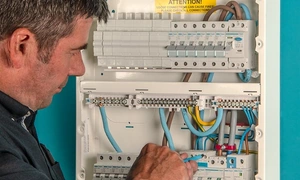
Why does an RCD keep tripping? Learn the common causes, the 30 mA threshold, the six-month test rule, and how to diagnose the fault safely.
Read the guide Guide Best multimeter for electricians UK What is the best multimeter for electricians in the UK? Compare the Fluke 87V, Fluke 117, Klein MM700 and Brymen BM235, with prices, CAT ratings and True RMS. Read the guide
 Guide Ring main circuit wiring UK BS 7671 How does a UK ring main circuit work? Learn the BS 7671 433.1.204 rule, the 100 m² limit, the 32 A protection, spurs, and how the circuit is wired. Read the guide
 Guide Surge protector plug: what a 13 A adaptor does What a UK surge protector plug really does: the 13 A fuse, the joule rating, the clamping voltage, and why it cannot replace a board SPD. Read the guide