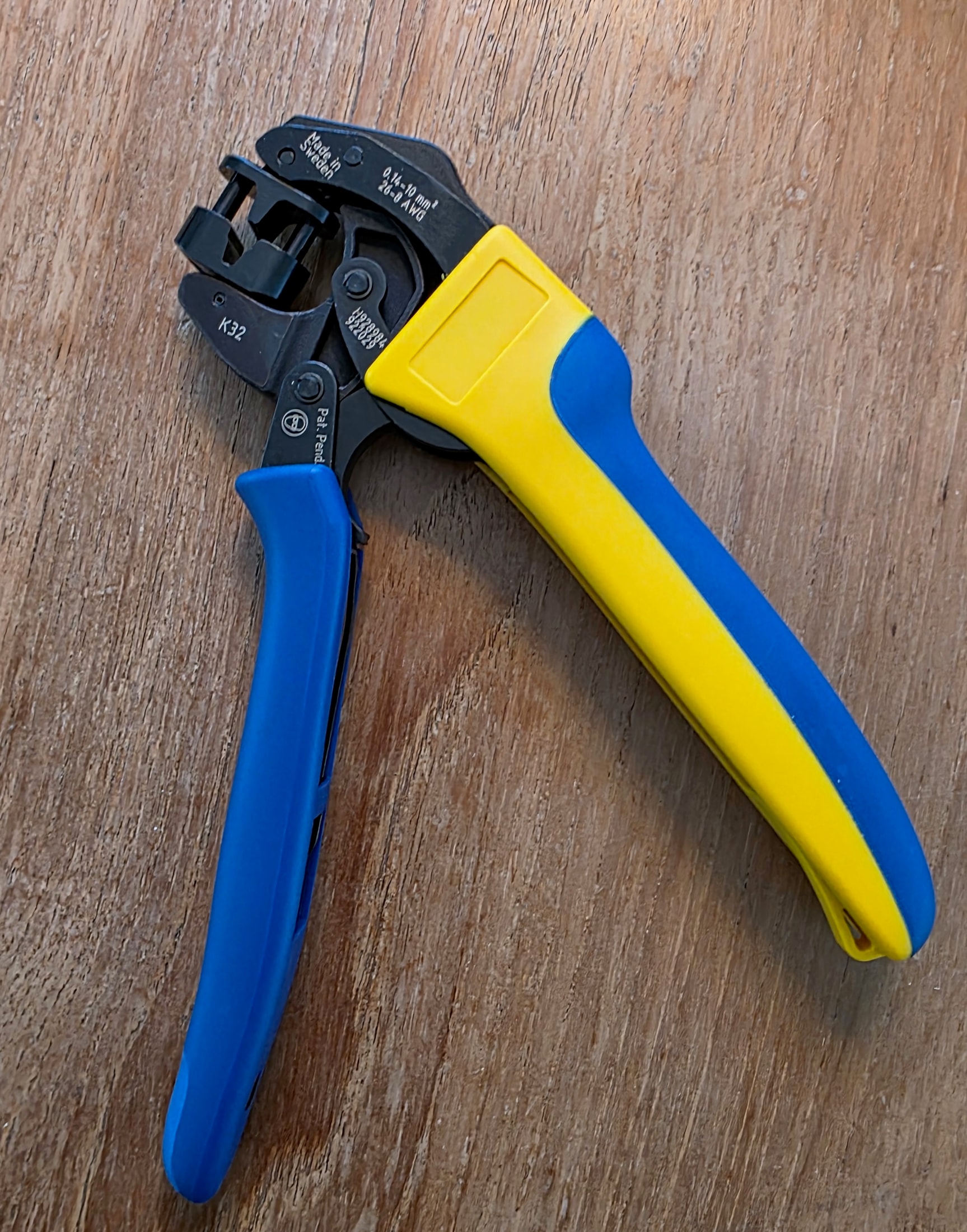
Engravings on the K32
The head and the body carry the model reference, the crimping range and the Made in Sweden marking: these markers can be read on the tool.
Published 11 August 2026
In brief
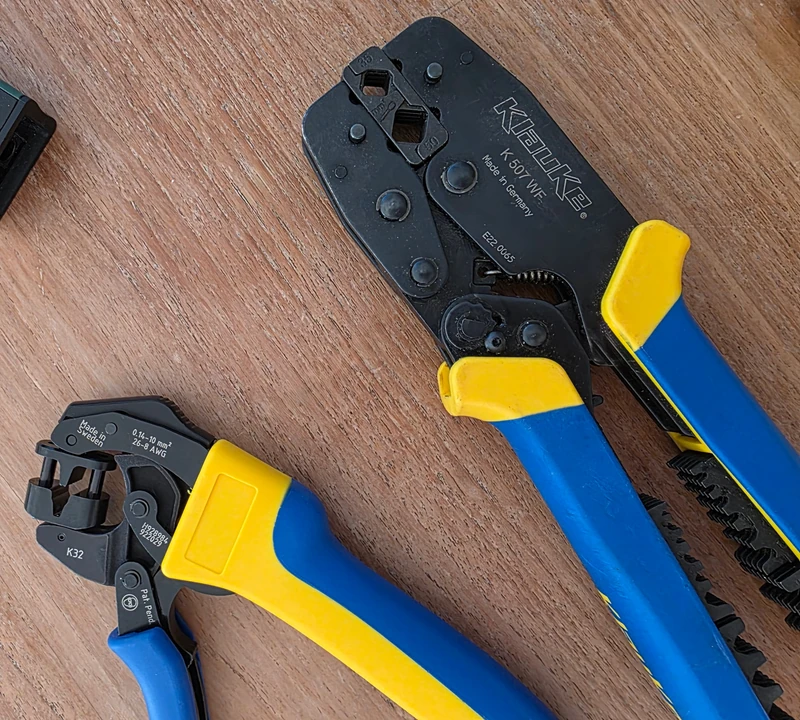
The two manual crimping pliers from Klauke that I have in hand respond to two different concepts: the K32 TWIST-it covers ferrules from 0,14 to 10 mm² in a bag format of 177 mm and 0,298 kg, the K 507 WF covers ferrules from 0,5 to 50 mm² with its dies stored in the handle, at 220 mm and 0,657 kg.
One lives in the bag, the other on the workbench: that is the first conclusion to remember before buying.
These two crimpers were sent to me by Klauke for this test. The photos in this article are test photos taken on my workbench, they are not customer site photos, and no figure comes out of my work documents.
The impressions that follow come from real use over several weeks: common 1,5 mm² ferrules and handling/crimping trials on 35 and 50 mm² samples on my workbench, supplemented by the official datasheets. I do not present these large cross-sections as customer-site experience. No verdict exceeds 4/5 in this article.
177 mm
length of the K32 TWIST-it
220 mm
length of the K 507 WF
0,14-10 mm²
single ferrule range of the K32
0,5-50 mm²
ferrule range of the K 507 WF
Klauke has been building connection tools since 1879, and the German brand is above all known, in the connection trade, for its electromechanical and hydraulic crimpers.
The Klauke story tells of this move upmarket: the manufacturer went from manual crimping pliers to powered tools without abandoning the first level of the range.
The K32 and K 507 WF are precisely what occupy this first tier: no battery, no hydraulics, just the hand, a ratchet and dies.
The difference with the EK 50 ML electromechanical crimper comes down to one sentence: on manual crimpers, the force comes from the handle, the ratchet only guarantees that the cycle runs to the end. The motorised tool delivers 15 kN with no hand effort, but it costs more and requires a battery.
For anyone crimping ferrules a few times a day, the manual crimper remains the simplest and most reliable tool: nothing to charge, nothing to maintain, and the movement stays controlled.
On this ground, the two models target two different audiences:
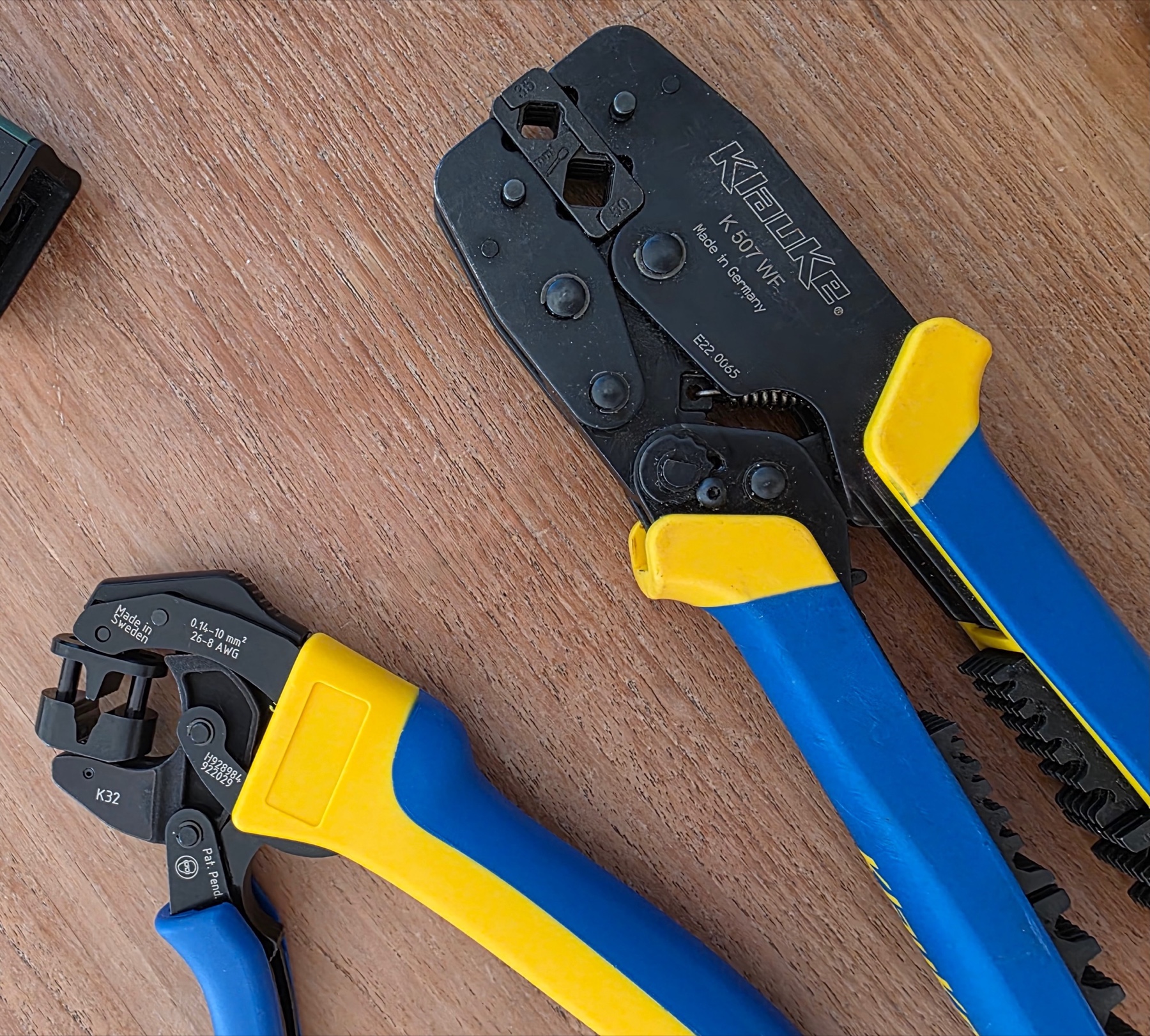
It has to be said clearly, because the name is misleading: the TWIST-it does not twist the sleeve. This mistake appears in trade discussions and is easy to explain: the name suggests a rotation, and the first photo of the crimper makes you believe there is a twisting movement.
In reality, the rotation is that of the crimping die itself.
The official Klauke datasheet mentions a « rapid transition between inserting the sleeve from the front and from the side »: the die, toothed and pivot-mounted, tilts to receive the connector in line with the tool or perpendicular to it, depending on the available access. This is a sleeve crimping tool, not a twisting tool.
This pivot brings two things in the field. First, side insertion: when the connector is already on the conductor and access is awkward, the sleeve is slid into the die laterally instead of being threaded in from the front.
Then, a single crimp profile for all cross-sections: the datasheet states automatic cross-section adjustment, meaning that the die adapts to the inserted connector without any intermediate adjustment.
The resulting profile is trapezoidal, a shape that Klauke deems suitable for the box terminals of cabinets. The toothed die is claimed to give good pull-out values for the connection, and a ratchet locking mechanism ensures uniform results.
The head also carries a die lock to prevent mishandling, and a safety eyelet allows a lanyard to be attached.
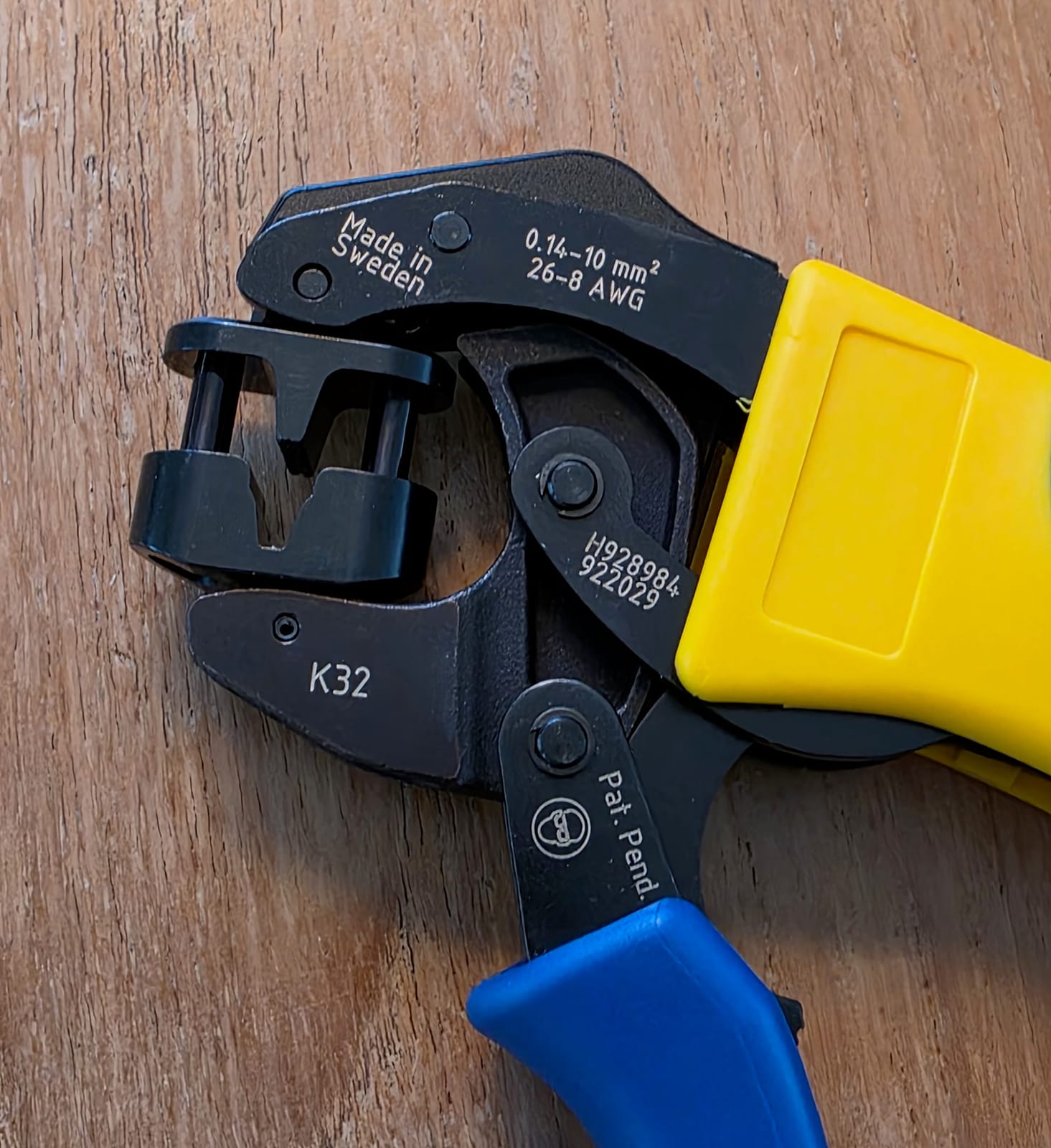
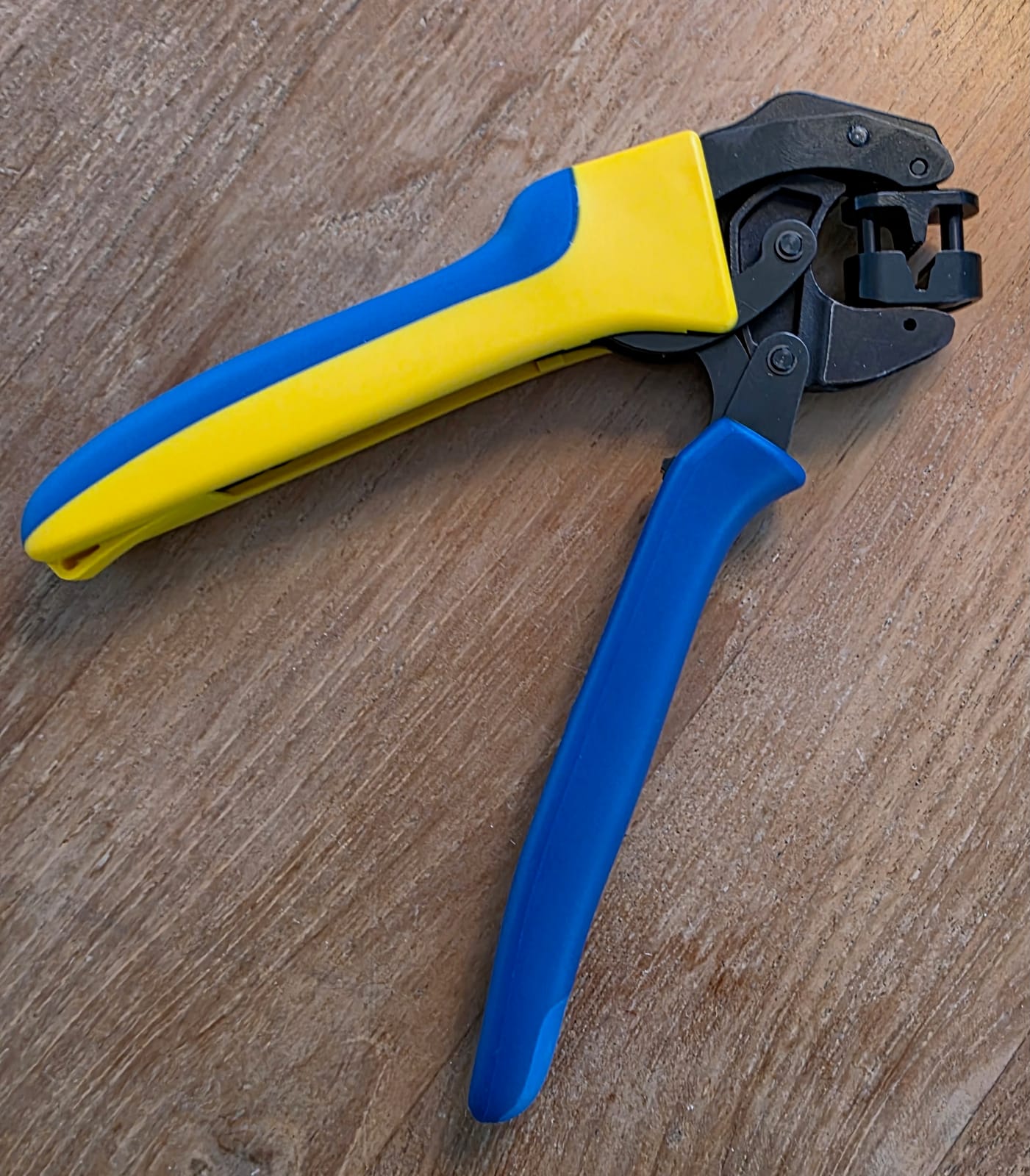
The official datasheet gives 177 mm and 0,298 kg, and a distributor datasheet rounds it to “298 to 350 g, 177 to 210 mm” depending on the version.
In the hand, the difference in size compared with the K 507 WF is striking: the K32 fits in the palm, the blue and yellow non-slip handles are short, and the opening angle in the hand stays small, a point Klauke highlights for comfort of use.
The engraving on the black head is complete: K32, 0.14-10 mm², 26-8 AWG and the “Pat. Pend.” marking, meaning patent pending.
The tool also carries a Made in Sweden engraving, visible on the head: I describe it as it is, because Klauke does not officially document the country of manufacture of this crimper and I am not going to claim it on its behalf.
Engravings on the K32
The head and the body carry the model reference, the crimping range and the Made in Sweden marking: these markers can be read on the tool.
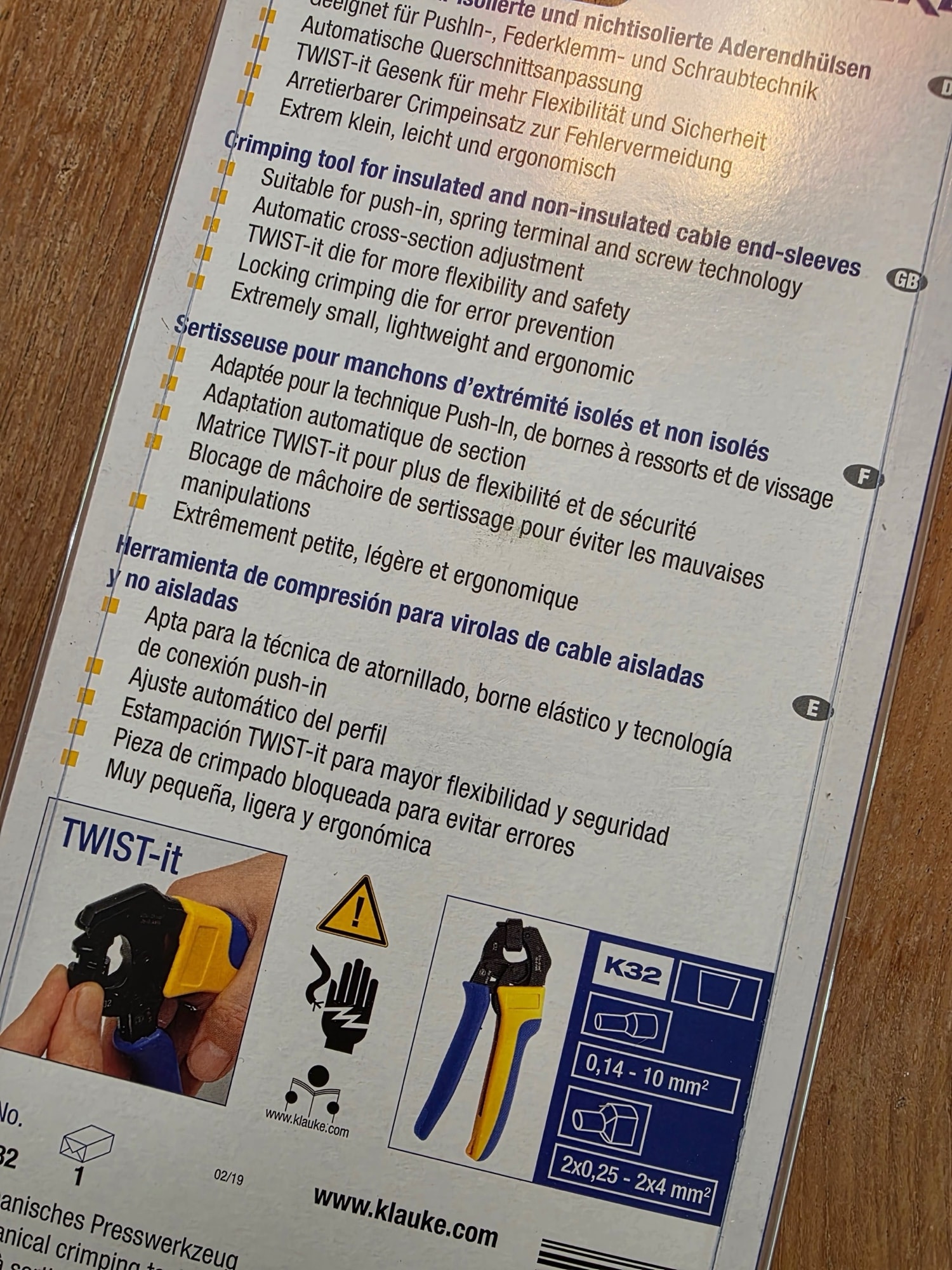
The blister packaging, which I photographed before taking the crimper out, confirms the range and adds the detail of the twin ferrules from 2×0,25 to 2×4 mm². The cardboard box marks “NEW” and illustrates the TWIST-it mechanism: it is packaging designed for sale through the trade, not for the job site.
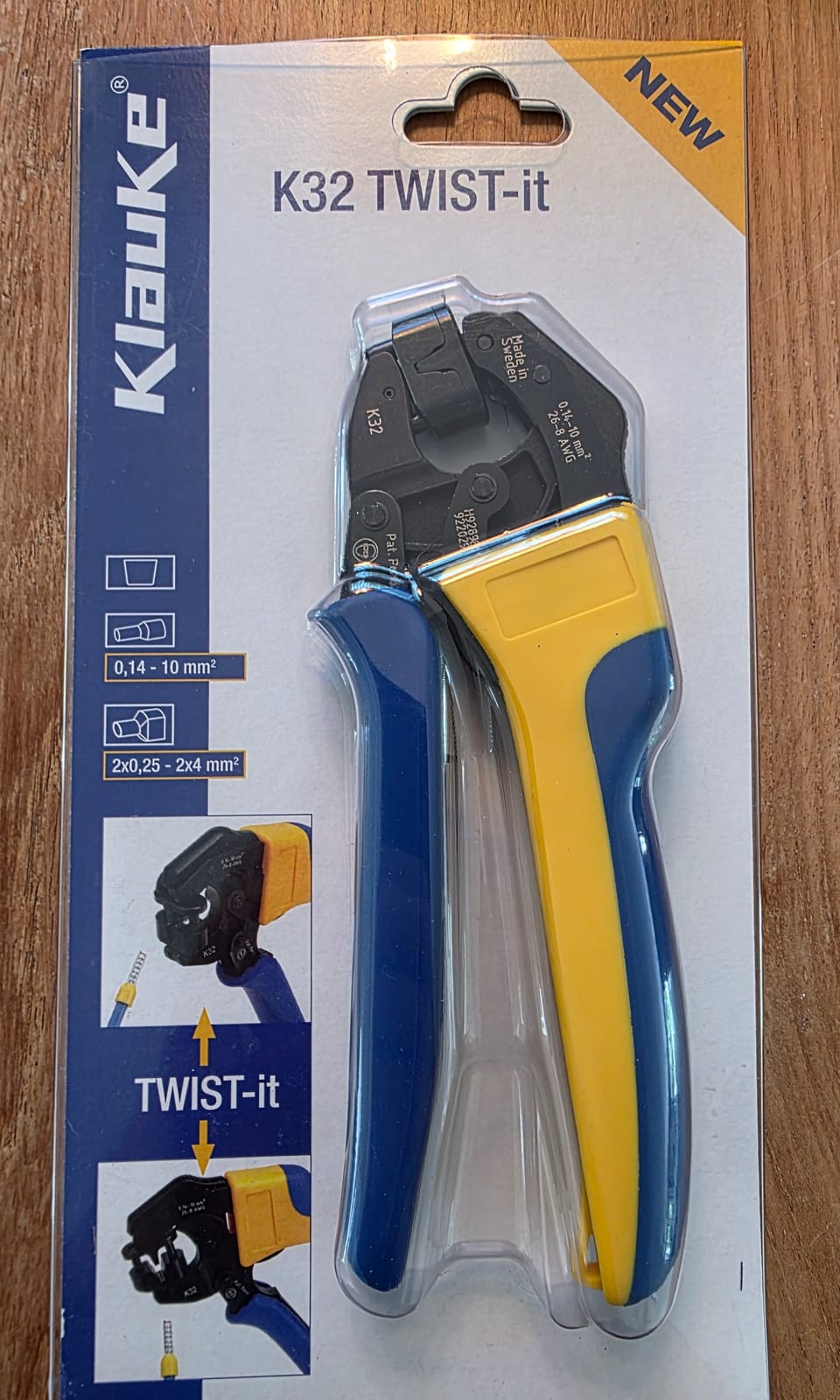
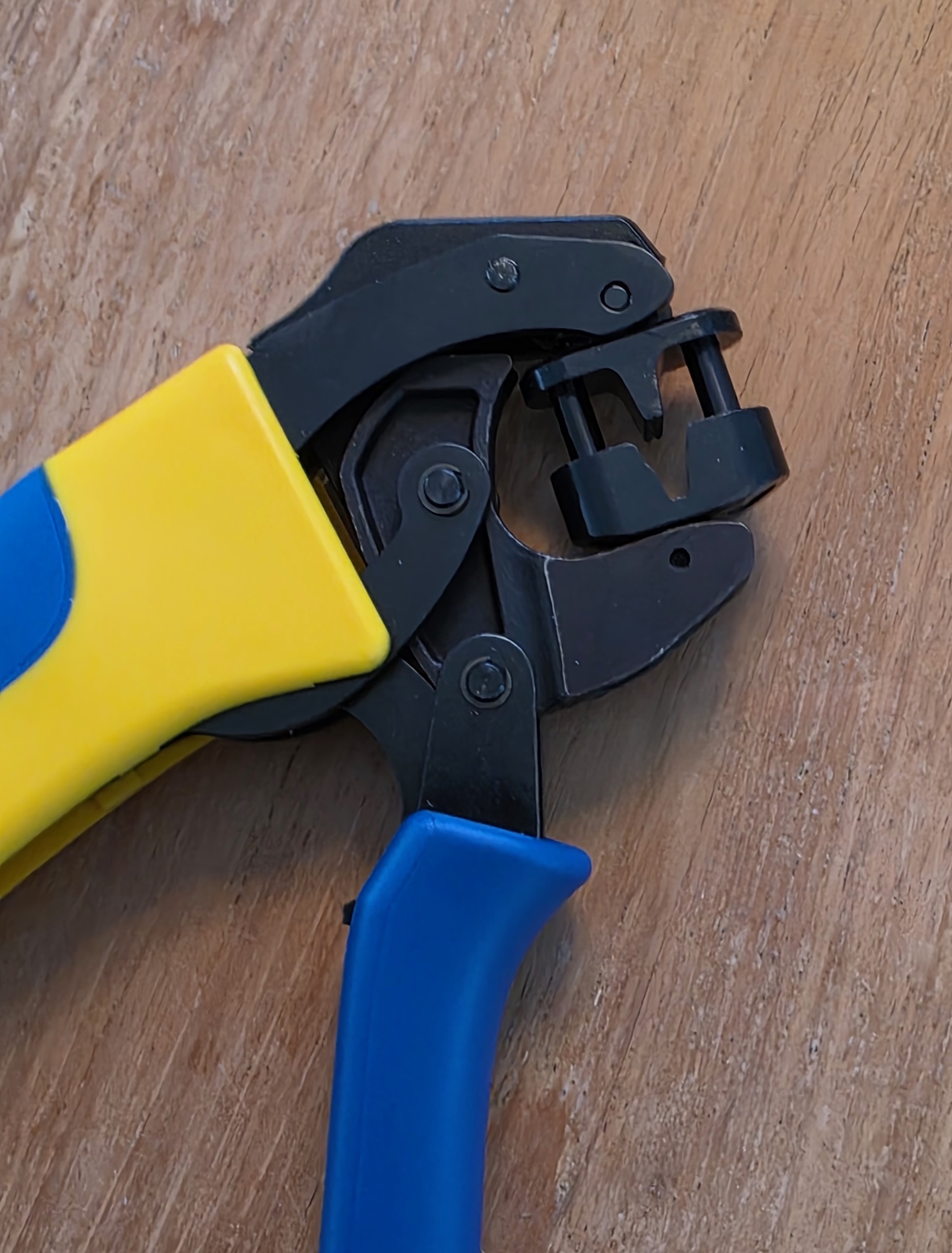
On the workbench, the open tool shows the rotating die and the compact black head. The ratchet is crisp: with each squeeze, the jaw advances one notch and does not move back until the cycle is complete, a behavior I check on manual crimping tools before anything else.
The automatic cross-section adjustment can be felt when going from a 1,5 mm² ferrule to a 6 mm² ferrule: no adjustment, no die change, you insert the sleeve and crimp.
Head and die of the K32
The open tool reveals the rotating die at the end of the head and the ratchet that advances notch by notch.
Where does it fit in the range? In my comparison of ferrule crimping tools, the K32 sits in the ratcheting rotating-die crimping tool category, one notch above fixed-anvil crimping tools.
The French price is not published by the manufacturer: the price has to be requested from a distributor or via a quote. The K32 is justified by the pivot, the ratchet and the consistency of the profile, not by the maximum cross-section.
Day to day, it’s the crimper I reach for first for wiring: faster than a die-based crimper, versatile on all common cross-sections, light enough to stay in hand for the whole preparation of a cabinet.
| Criterion | K32 TWIST-it |
|---|---|
| Criterion Published range | K32 TWIST-it 0.14–10 mm² single ferrules; 2×0.25–2×4 mm² twin ferrules |
| Criterion Access | K32 TWIST-it Rotating die: front or side entry depending on available space |
| Criterion Format | K32 TWIST-it 177 mm / 0.298 kg |
| Criterion Above the K32 range | K32 TWIST-it Choose the K 507 WF or another tool sized for the required ferrule |
Published scope and selection criteria for the K32 TWIST-it.
The K 507 WF takes the opposite approach: a fixed crimper and interchangeable dies.
The principle is stated in the official datasheet: quick die changes without tools, thanks to a dedicated fixing system, and a single crimping profile for all common conductors.
The range goes from 0,5 to 50 mm², which covers virtually all the wire ferrules found on an installation.
The documented kit includes three sets of dies: the AE5071 for 0,5 to 6 mm² ferrules, the AE5072 for 10 to 25 mm² and the AE5073 for 35 to 50 mm².
The Klauke datasheet for the K 507 states that spare dies are integrated into the handle, and a distributor datasheet for the K 507 WF repeats the same point: on the tool, the sets are therefore stored in the grips, which keeps them from getting lost in a drawer.
An adjustment disc compensates for the natural wear of the tool, a rare detail on a manual crimper.
The process used by this range is a square crimp — « square pressing process » in the Klauke documentation — applied by wide dies: for most ferrules, a single pass is enough to compress the barrel, where other crimpers require two.
Pre-crimping is made easier and the adjustment disc compensates for die wear, not the crimping force.
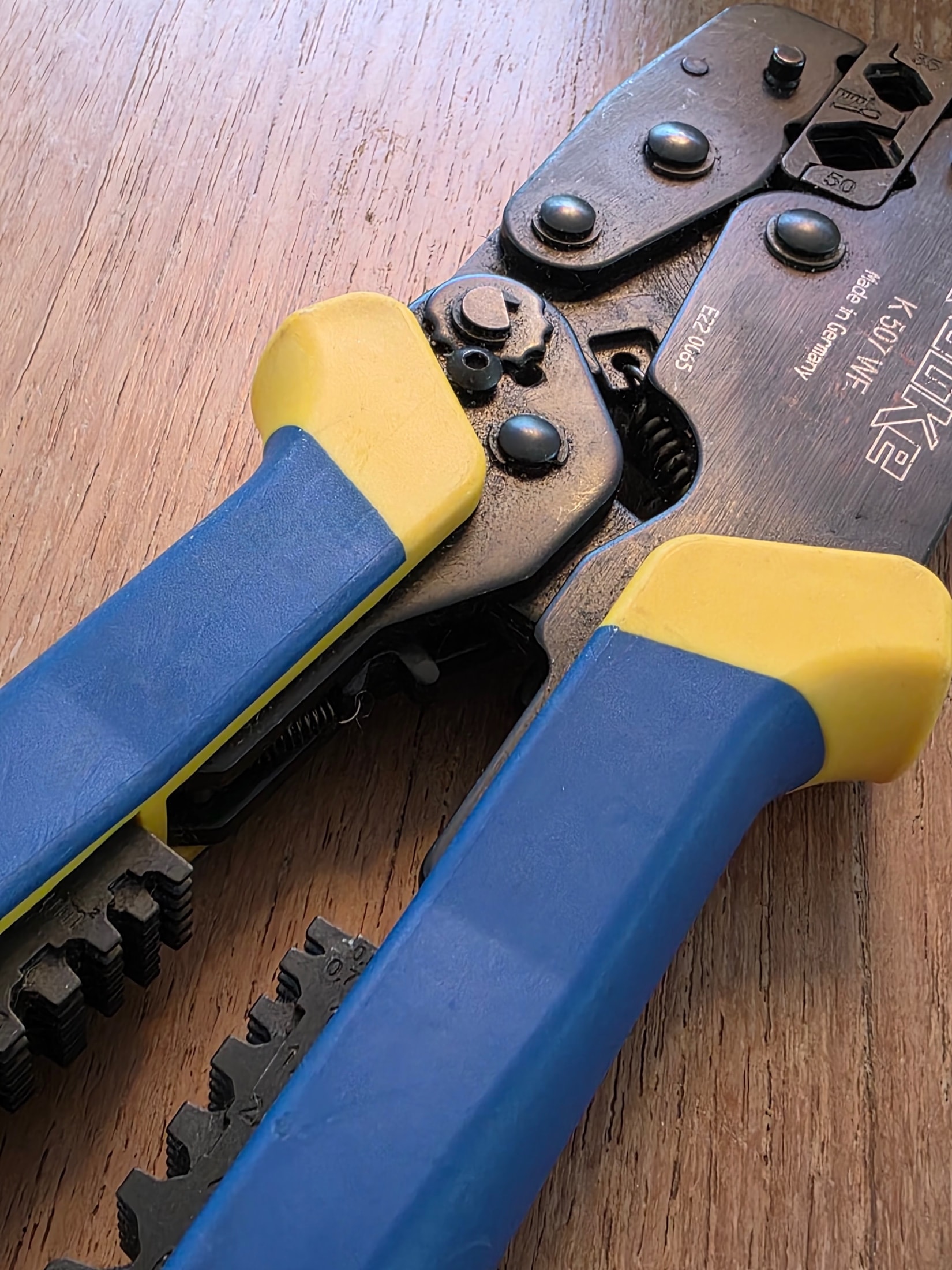
Pivot joint and jaws of the K 507 WF
The riveted mechanism, the model engraving and the toothed jaws can be seen in this detail: this is where the barrel is compressed.
The supplied die sets are also compatible with the Klauke Micro tool: if this little crimper is already lying around in your truck, the same dies work with both tools. The K 507 WF is a recent crimper in the catalogue, launched in summer 2022.
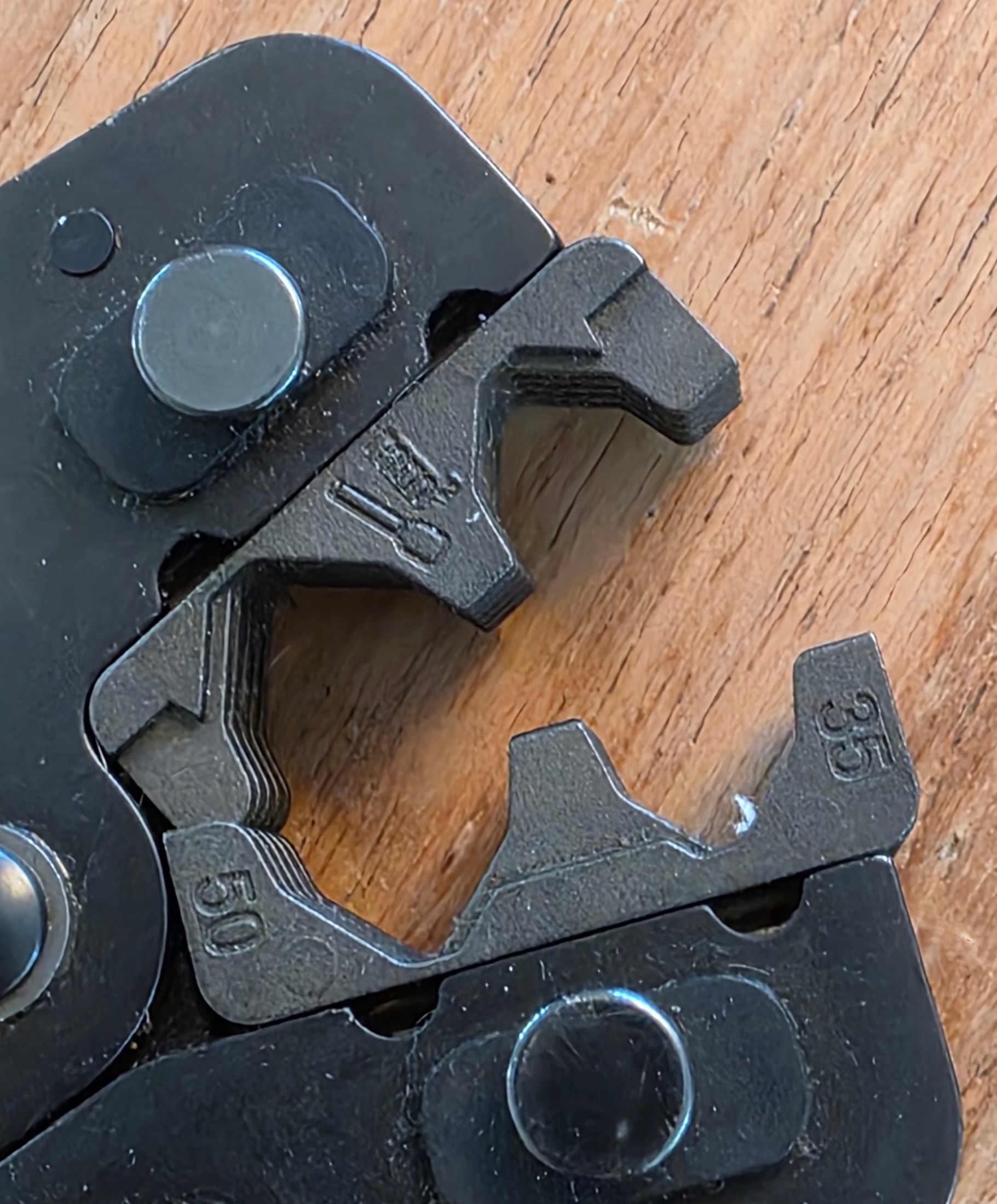
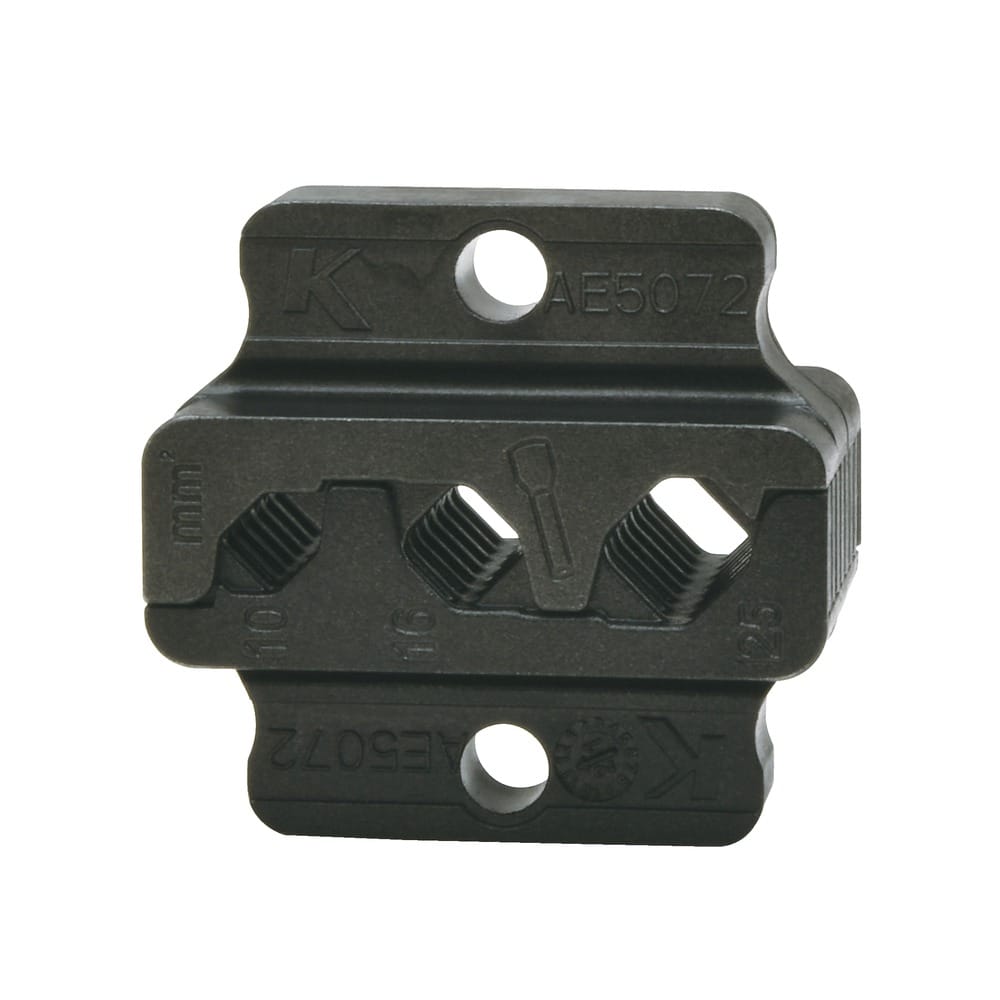
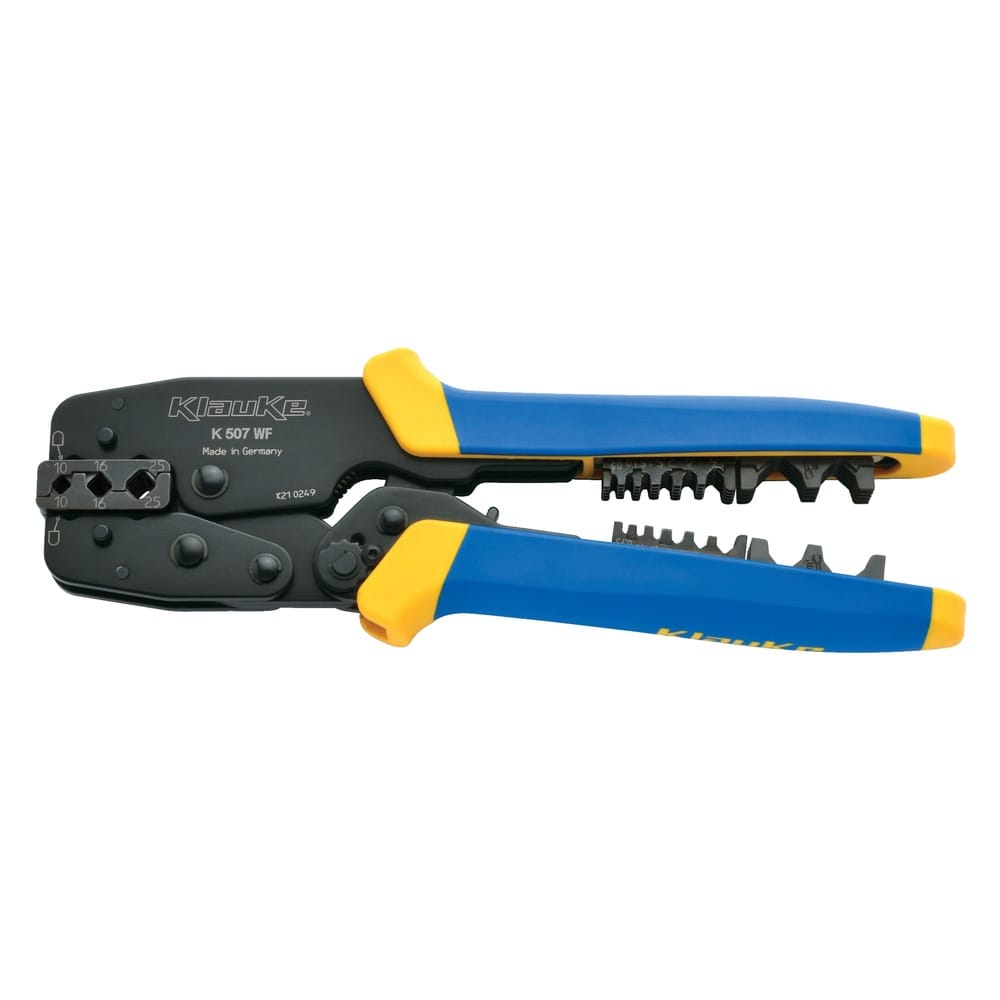
The dies I received bear the reference AE5072 engraved with the 10, 16 and 25 mm² cross-sections under each imprint: three profiles in a single die, which explains the reduced number of crimps advertised by Klauke.
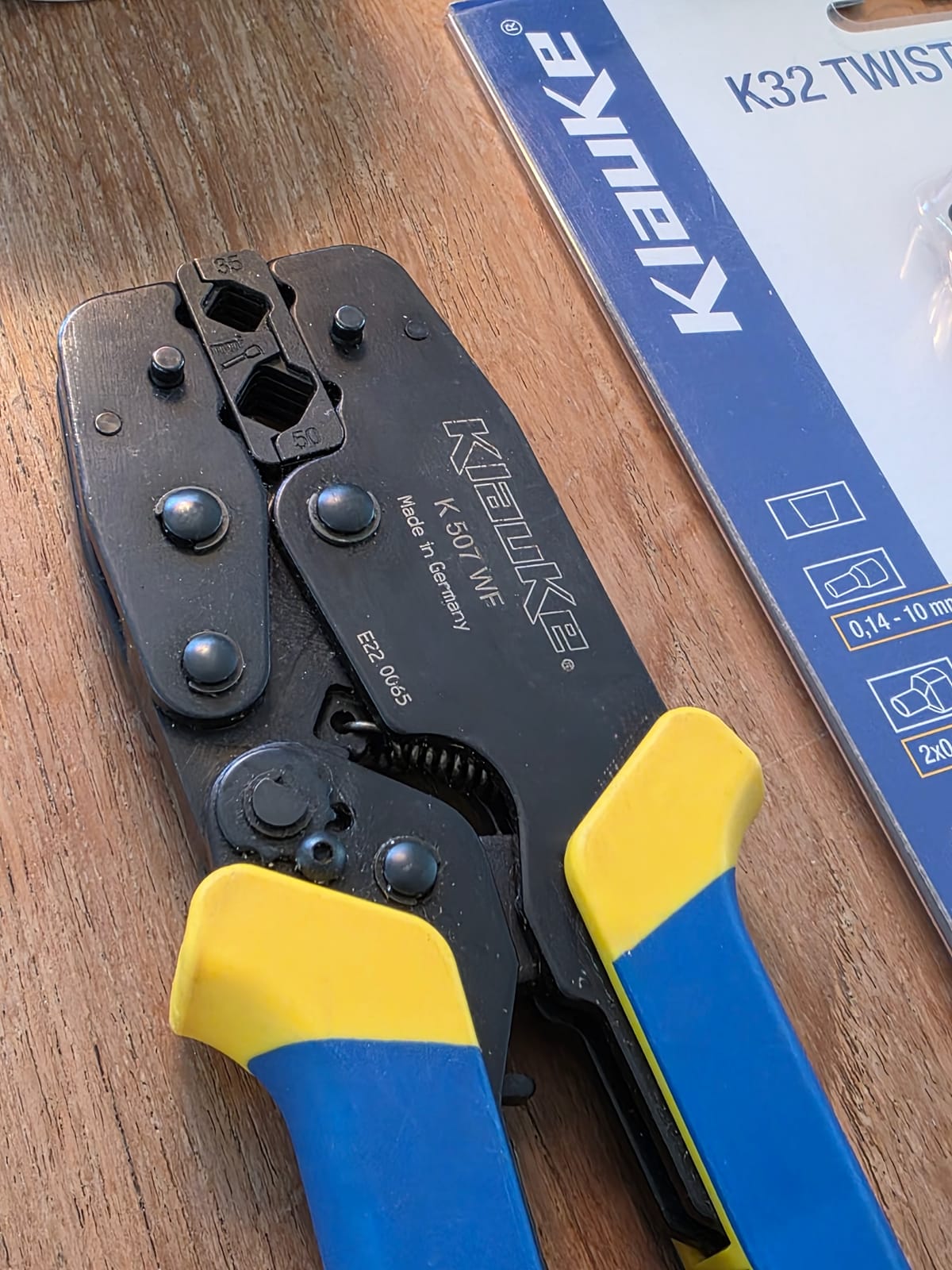
This is the most telling image of the concept: a multiple die, marked imprints, no tool to change it.
The dies are stored in the handle and are removed by the dedicated fixing system; after a few changes, the movement becomes straightforward.
In hand, the verdict is more nuanced than the weight suggests: 220 mm and 0,657 kg is heavy for a manual crimper, but light for its capacity — next to a hydraulic tool on a job site, it carries without any discussion.
The gripping force is significant and the tool is very comfortable in hand despite its length; the jaws are what I like best about this crimper: wide, the ferrule goes in squarely and the square crimp is done in a single pass.
On larger cross-sections, the manual ratchet naturally requires more hand force. For repeated high-section work, motorised crimping mainly changes the physical effort and cycle repetition; INRS notes more generally that force constraints contribute to hand and wrist fatigue.
For common ferrules, I use the K32. I keep the K 507 WF for larger ferrule cross-sections and workbench preparation; for repeated high-section runs, the comparison of battery-powered crimpers shows where motorisation becomes useful.
The full view of the crimper, on the official product sheet, clearly shows the architecture: crimping head at the tip, mechanism between the open handles, and the K 507 WF with Made in Germany marking on the head — this time, the engraving matches the Klauke documents.
One thing to know before buying: the twin ferrules require an optional insert, the ZAE5072 for 2×6 to 2×16 mm². The supplied crimper covers single ferrules across the entire range, but not twin ferrules without this additional part. For anyone who crimps only twin ferrules, it is better to include this insert from the quote stage onward.
On the budget side, the official French price is not published: in the trade, it only appears once the professional account is logged in, and the price must be requested by quote.
The scope is precise: the K 507 WF crimps ferrules and sleeves, not power lugs. For lugs, use a lug crimper or a hydraulic tool designed for that connector family.
These are mechanical crimping tools used during conductor preparation on a de-energized installation. The official K 507 WF documents checked on August 12, 2026 do not state VDE 1000 V insulation.
No mention of VDE marking in the official French spec sheet or in the manufacturer datasheet (reference FLK507WFGB, June 2022): it is a mechanical crimping tool for de-energized work, and no VDE variant exists in the catalog.
The conclusion is the same for the K32: its official spec sheet and its datasheet carry no VDE marking.
In wiring practice, this is almost never a hindrance: a ferrule is crimped before the panel is energised.
The working rule is the same as for mechanical crimping tools generally: isolate the circuit and check for absence of voltage before crimping.
The requirements for insulated tools, detailed in my article on 1 000 V insulated tools, do not apply here: neither of the two tools is marked VDE, and nothing should suggest otherwise.
The answer lies in the actual maximum cross-section of your work, not in the price. Both crimping tools are for wire end ferrules and nothing else: no tubular lugs, no ring terminals, no power sleeves.
Choosing the right crimping tool starts with the right type of connection, as my guide to crimping lugs and ferrules reminds.
| Criterion | K32 TWIST-it | K 507 WF |
|---|---|---|
| Criterion Single ferrule range | K32 TWIST-it 0,14 to 10 mm² | K 507 WF 0,5 to 50 mm² |
| Criterion Twin ferrules | K32 TWIST-it 2×0,25 to 2×4 mm² | K 507 WF ZAE5072 optional (2×6 to 2×16 mm²) |
| Criterion Dies | K32 TWIST-it Integrated rotary die, no change required | K 507 WF 3 sets AE5071 to AE5073 supplied, stored in the handle |
| Criterion Length | K32 TWIST-it 177 mm | K 507 WF 220 mm |
| Criterion Weight | K32 TWIST-it 0,298 kg | K 507 WF 0,657 kg |
| Criterion Crimping profile | K32 TWIST-it Trapezoidal, rotary die | K 507 WF Square, single pass |
Comparison of the two Klauke manual crimping tools based on the data from their official datasheets.
If your wiring doesn’t go beyond 10 mm², which covers the vast majority of cabinets, panels and device connections, the K32 is enough, and it stays in the bag.
If you regularly prepare 16 to 50 mm² ferrules, only the K 507 WF covers them, and its dies stored in the handle save you the bag of spares.
The positioning may be surprising: the K 507 WF covers more cross-sections than the K32 despite a simpler build. The explanation is simple — the K32 includes the patented rotary mechanism and an automatic adjustment, while the K 507 WF is a classic plier accompanied by three sets of dies.
On paper, the TWIST-it technology justifies positioning above the cross-section range.
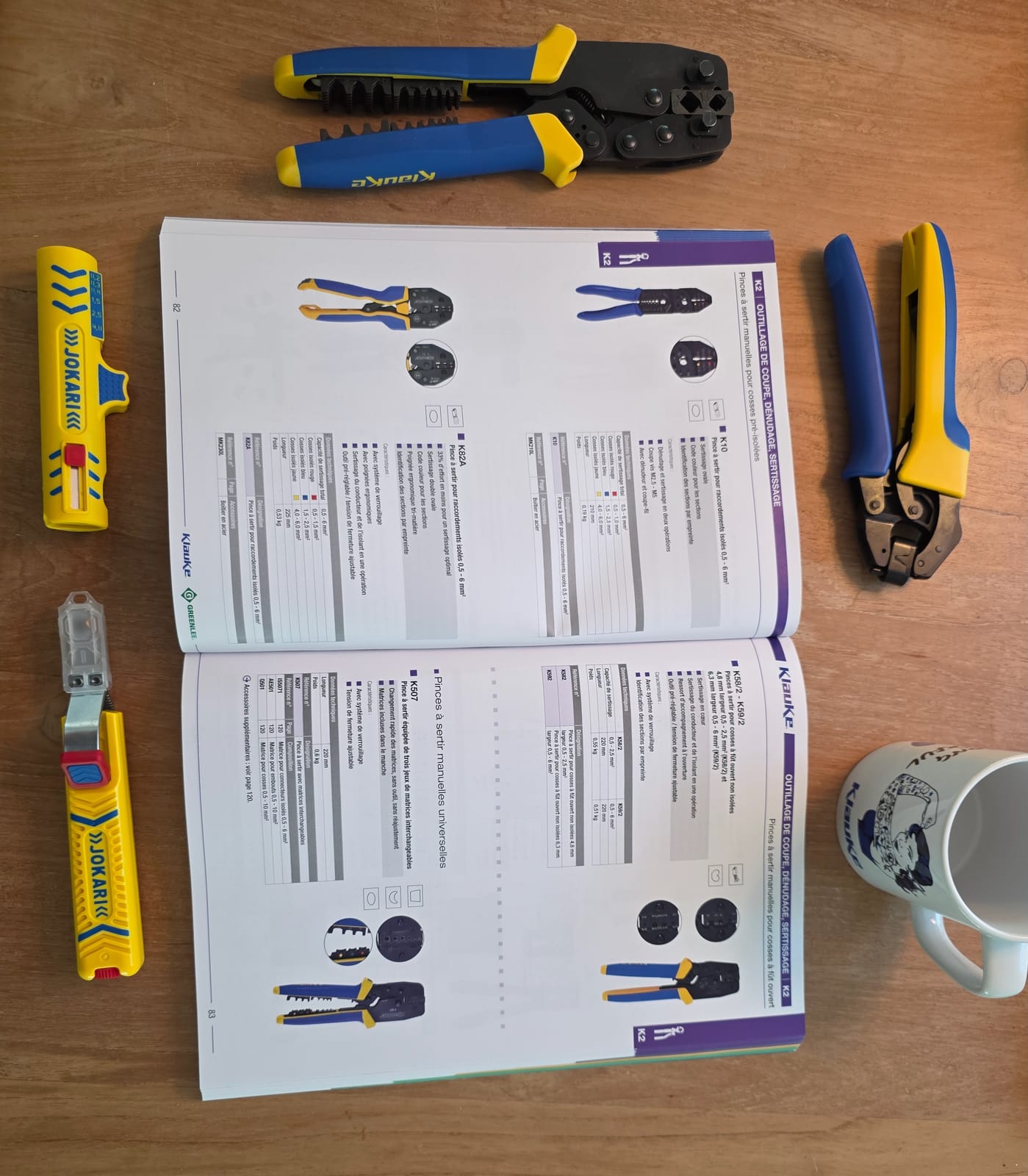
The Klauke catalogue open on the workbench shows the whole family: cutting, stripping and crimping pliers sit side by side in the same chapter, and the K507 family sits alongside the K32 there.
This is useful reading before buying: Klauke doesn’t sell a plier, it sells a connection logic, and the accessories matter as much as the basic tool.
A distributor datasheet for the K32 contradicts itself: its title states “0,14-6 mm²”, while its technical data gives a “crimping range 0,14 to 10 mm²”. The blister packaging also indicates 0,14-10 mm², and the tool itself is engraved 0,14-10 mm² on the head.
Klauke officially states 0.14-10 mm² for single ferrules and 2×0.25-2×4 mm² for twin ferrules.
This kind of title mismatch is a classic of distributor listings fed by several channels: the title comes from an old catalogue, the technical data from another one. The risk for the buyer is wrongly missing out on the 10 mm², or conversely taking the product for another model.
The fix is simple: check the range on the official Klauke page and on the tool itself before buying, not on the distributor’s title alone.
Verdict K32 TWIST-it
The K32 keeps its promise: a single trapezoidal profile for cross-sections from 0.14 to 10 mm², a crisp ratchet, a format of 177 mm for 0.298 kg that still fits in a tool bag, and the TWIST-it pivot that engages the sleeve from the front or from the side. In everyday use, it’s the crimper I pick up first, faster and lighter than my old crimpers on common cross-sections.
Its scope is clear: 0.14 to 10 mm² for single ferrules and up to 2×4 mm² for twin ferrules. The French manufacturer price is not published online and is requested through the professional channel or by quote.
Verdict K 507 WF
The K 507 WF covers ferrules from 0.5 to 50 mm² with three sets of dies included and stored in the handle, a single-pass square crimp and an adjustment disc that compensates for wear. In my use, it complements the K32 for larger ferrule cross-sections and workbench preparation.
The connector scope is also clear: it is a ferrule crimper, not a cable-lug crimper; twin ferrules from 2×6 to 2×16 mm² use the optional ZAE5072 insert. The French manufacturer price is requested through the professional channel or by quote.
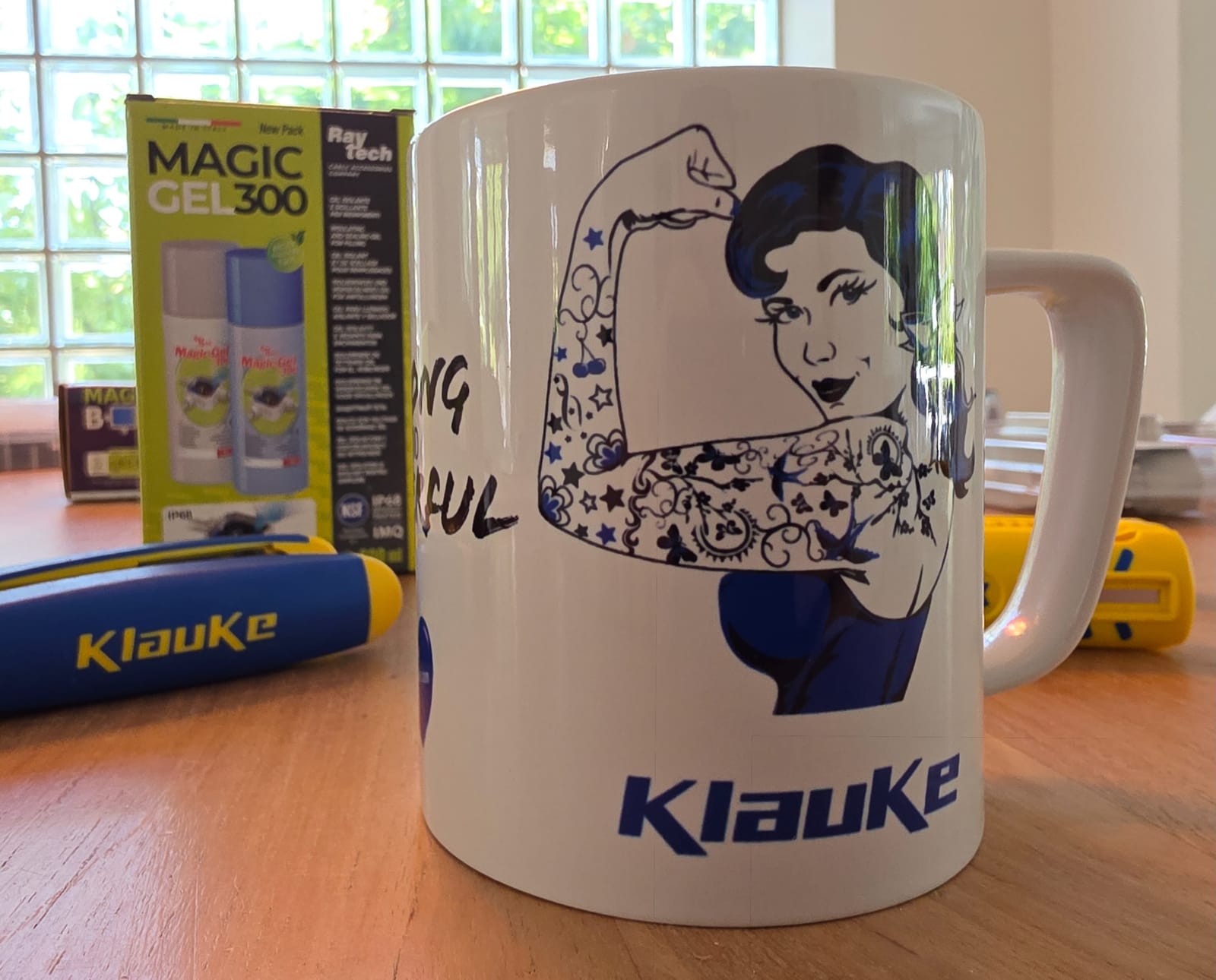
These crimpers were gifted by Klauke. What that changes: I didn’t pay for the tools and I was able to handle them, photograph them and compare them on my workbench before publishing.
What that doesn’t change: if I found the crimpers mediocre, the article would say so. The mug lying around in the photos, sent with the crimpers, remains a mug.
By the same logic, these two manual crimpers don’t cover all crimping: for cable lugs and power connections, electro-hydraulic machines remain the subject, and the history of the Klauke brand recounts that move upmarket.
The manual ferrule crimpers, for their part, have their place at the end of the chain, on wiring connections.
3 questions
InteractiveQuiz: Klauke K32 TWIST-it and K 507 WF
3 questions to check the essential points
Choose an answer
No. The rotating die pivots, it twists nothing: the ferrule is crimped by a single trapezoidal profile, applied by ratchet. The pivot only serves to insert the ferrule from the front or from the side, depending on access.
It all depends on the maximum cross-section. Below 10 mm², the K32 TWIST-it is enough and still fits in a tool bag thanks to its 177 mm and 0.298 kg. Beyond that, up to 50 mm², only the K 507 WF is suitable, with its three sets of dies included.
Yes: the case includes the AE5071 for 0.5 to 6 mm², the AE5072 for 10 to 25 mm² and the AE5073 for 35 to 50 mm², stored in the handle. Only the insert for twin ferrules (ZAE5072, 2×6 to 2×16 mm²) is optional.
The K32 carries the patented rotating mechanism with automatic cross-section adjustment, a technology more costly to produce than the cross-section range; the K 507 WF is a classic ratchet tool, completed by its dies.
No, these are tools for wire end ferrules. Tubular lugs, ring lugs and heavy-duty connectors require different dies and forces, often a hydraulic crimper. The question of compatible jaws is covered in my article on crimping jaw compatibility.
No. No VDE marking appears in the official documentation or in the datasheets — reference FLK507WFGB of June 2022 for the K 507 WF. These are mechanical tools for de-energized work, and no VDE variant exists in the catalogue: every crimp is made with the installation switched off and checked.
No: the rotating die is integrated into the head and adapts by itself to the cross-section engaged. It is the K 507 WF that takes interchangeable dies, three sets included (AE5071 to AE5073) stored in the handle.
The difference is the force: the K32 and K 507 WF are manual, the ratchet only guarantees the end of the cycle, while the EK 50 ML provides 15 kN of motorized force and a short cycle, for a higher cost and weight. For daily runs of ferrules, the manual tool remains relevant; for a high volume, the electromechanical crimper is justified.
Disclosure Klauke : K32 TWIST-it and K 507 WF crimping tools.
Théo Desrousseaux
Electrician and editor
I work in the field and edit this magazine. Every guide is reviewed for its target country before publication.
Practical electrical installation guides, diagnostic methods and tool recommendations compared against the technical wiring standards of this national edition.
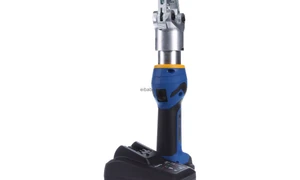
Review of the Klauke EK30IDML: die-free hydraulic crimping from 6 to 120 mm², 30 kN of force, connector scope and documented specifications.
Read the guide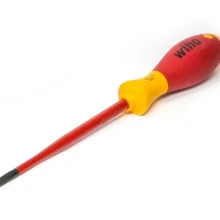 Guide Wiha or Wera: which tool kit for an electrician? Wiha or Wera: VDE 1000 V screwdrivers and pliers, storage systems and a method for a tool set suited to real electrical work in the home. Read the guide
 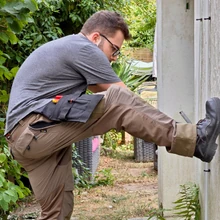 Guide Ilkott pants review: 2026 field test Ilkott review of the Fresh Collection pants and AA61 bag, tested on real jobs: flexibility, freshness, pockets, knee pads, tool bag. Read the guide
  Guide Klauke: brand history Founded in 1879 in Remscheid, Klauke moved from watchmaker's pliers to lugs and crimpers. Its history, range and place in electrical engineering. Read the guide