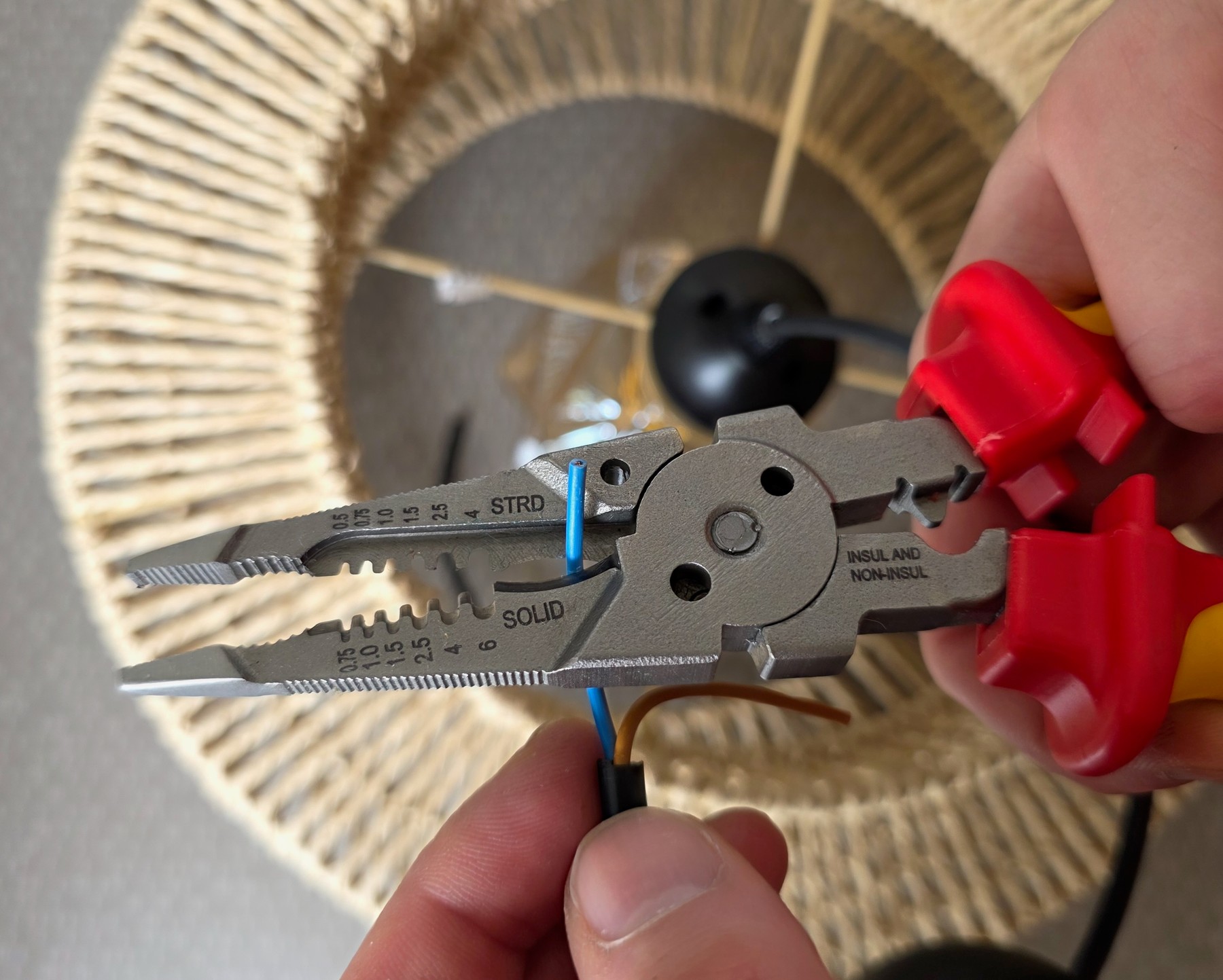
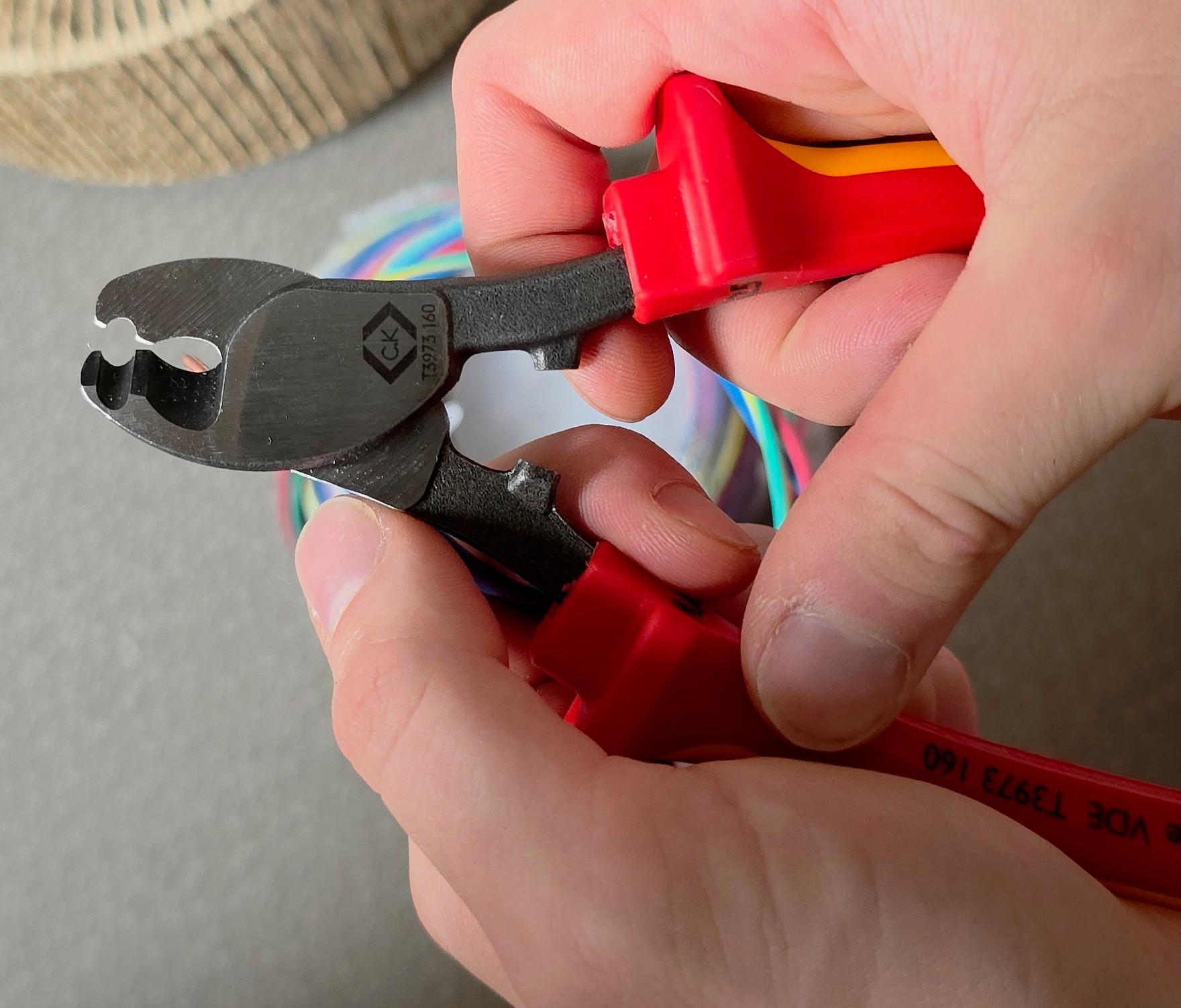
C.K RedLine VDE T3910-210 pliers
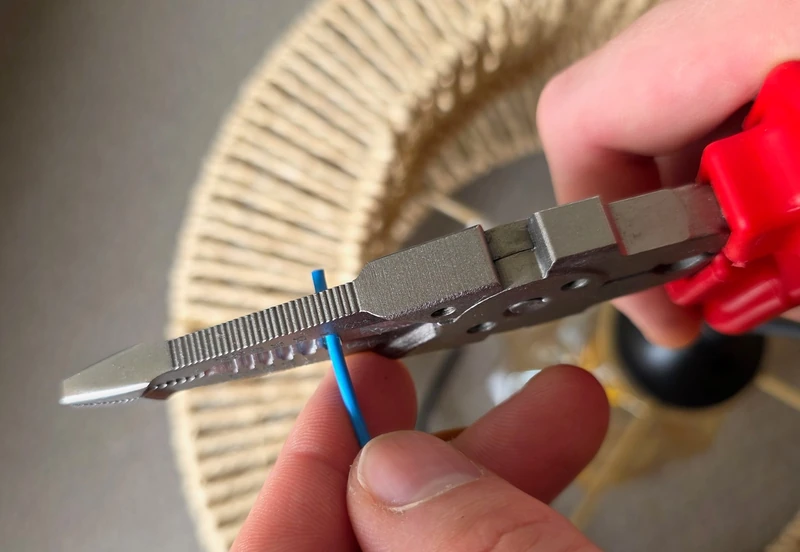
The field photo shows the pliers actually used, their two-tone handles and the working area of the jaws while stripping.
Published 12 August 2026
In brief
C.K Tools is a brand you come across in every insulated tooling comparison, without ever knowing exactly where it comes from. I’m going to clarify that point, because it’s the first thing I check before trusting a brand: its history, its parent company and what it actually claims.
My take: C.K Tools is a long-established brand of German origin, which became Welsh after it set up in Wales, and its VDE story rests on verifiable elements — individual test at 10 000 V, use up to 1 000 V, certification by the German VDE institute, compliance with the IEC 60900 standard.
What I take away in one sentence: a credible professional brand in the VDE segment, with published technical claims and genuine 2025 developments that can be checked directly.
1790
founding of the parent company in Wuppertal, Germany
1904
creation of the C.K brand by Carl Kämmerling
10 000 V
individual test claimed on the VDE screwdrivers
19
products in the RedLine VDE range relaunched in 2025
C.K Tools is a brand of Carl Kammerling International Ltd (CKI), a company registered in England and Wales under number 00764323. Its head office is at C.K House, Glanydon Industrial Estate, Pwllheli LL53 5LH, in the United Kingdom.
The group does not live on C.K Tools alone. It also carries the brands C.K Magma (storage), C.K Classic, Kasp (padlocks and security), Avit (entry-level DIY and pro), Jokari and Clipacore.
This is typically the profile of a group consolidating complementary brands, a topic I cover in detail in my article on tool groups and their brands.
This point matters for a purchase: when you buy a C.K screwdriver, you are buying a product from the CKI group, not a product from an unknown independent company. It is an element of traceability, neither a quality argument nor a flaw.
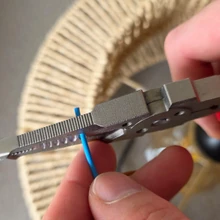
C.K RedLine VDE T3910-210 pliers
The field photo shows the pliers actually used, their two-tone handles and the working area of the jaws while stripping.
The chronology verified on the group’s official “Our History” page gives a clear trajectory, with a German origin:
Two clarifications about this story: the C.K brand was formally born in 1904, but is backed by the parent company Carl Kammerling, whose origins go back to the late 18th century. The company is now based in Wales.
Reading this chronology is not about memorizing dates: it is about understanding how a German business became a Welsh group.
The shift from 6 employees in 1954 to a multi-brand holding company reads as progressive family growth: no spectacular fundraising or takeover by a conglomerate in the official dates, but continuous expansion driven by the same family up to the generation that joined the board in 2002.
The opening of C.K House in 2000 (37 000 sq ft, around 3 400 m²) marks the shift to centralized logistics: warehouse and offices under the same roof in Pwllheli.
For the buyer, these steps matter: a brand established in the same place since 1954 and investing in its own premises offers a traceability that recent brands, born from a simple trademark filing, cannot show.
The brand claims continuous family governance for several generations, with solid distribution among British hardware stores and electricians.
This is the heart of the topic. The C.K VDE range is organized around three verified families: the Dextro screwdrivers, the Dextro Glo VDE Slim screwdrivers, and the RedLine VDE pliers relaunched in 2025.
The VDE acronym refers to the German institute of the same name, which certifies insulated tools for live working.
To understand what a VDE certification is really worth, I’ll point you to my guide on 1000 V insulated tools and the 60900 standard — it’s the technical reference that lets you read C.K spec sheets without getting caught out.
The official spec sheet for reference T49193D describes a set of 7 VDE screwdrivers, flat and Pozidriv, sold under the “Dextro” family. The composition can be verified:
| Tip type | Set sizes |
|---|---|
| Tip type Flat | Set sizes 2.5×75 / 4.0×100 / 5.5×125 / 6.5×150 mm |
| Tip type Pozidriv | Set sizes PZ 0×60 / 1×80 / 2×100 mm |
Composition of the 7-piece VDE Dextro T49193D screwdriver set, according to the official C.K Tools spec sheet.
The manufacturer states a two-component handle molded directly onto the blade, a long neck, grip ridges at the top of the handle, a blade in chrome-vanadium steel and a precision-machined tip.
These elements are manufacturer claims: I report them as they are, and they are consistent with what competing brands offer in this segment.
The decisive point is the stated safety: “VDE approved — individually tested to 10,000 V for safe live working up to 1,000 V”. In other words, each screwdriver is said to be individually tested at 10,000 volts, for live working up to 1,000 volts.
The spec sheet states compliance with the IEC 60900:2004 standard, with independent approval and audit by the German VDE institute.
This is exactly the kind of statement to check when comparing insulated screwdrivers: the market is full of sets stamped 1000 V whose certification is unclear. Here, the name of the institute, the standard and the cited edition are identifiable, which is already a good sign of seriousness.
Why a factor of ten between the test voltage and the working voltage? Because an insulated tool does not stay new: it ages, it takes knocks, scratches and temperature variations.
Testing every unit at 10 000 V for a stated use at 1 000 V is the safety-margin logic described by the manufacturer. The verifiable claims used here are the individual 10 000 V test, the cited IEC 60900:2004 standard and the stated approval by the German VDE institute.
The decisive word in the listing remains “individually tested”: an individual test means that every unit off the production line is checked, whereas a batch check would only verify a sample.
This distinguishes a manufacturer claim of individual testing from batch sampling; it does not by itself establish a price advantage or a hierarchy over other sets.
The reference T49283PD is a set of 5 screwdrivers (slotted 3,5 / 4,0 / 5,5 mm, PZ1 and PZ2) whose distinguishing feature is the phosphorescent handle: it glows for 20 to 30 minutes after exposure to light, which makes it easier to spot in a toolbox or on a poorly lit worksite.
I see it as a smart choice for beginners: when you are just starting out, finding the right screwdriver in a pouch in the dark is better than a standard handle. If you are equipping your first toolbox, my guide to the beginner electrician’s equipment can help you work out your priorities.
The product listing lists standards: EN 60900, VDE 0682/201, ISO 2380-2, ISO 8764. This information comes from the Amazon listing for the set.
The spec sheet also indicates a German origin and a 2-year manufacturer warranty against manufacturing defects.
Here too, the 2-year warranty deserves to be put back into the market context: terms differ widely from one brand to another, and it is an underestimated purchase criterion, as I show in my comparison of tool warranties.
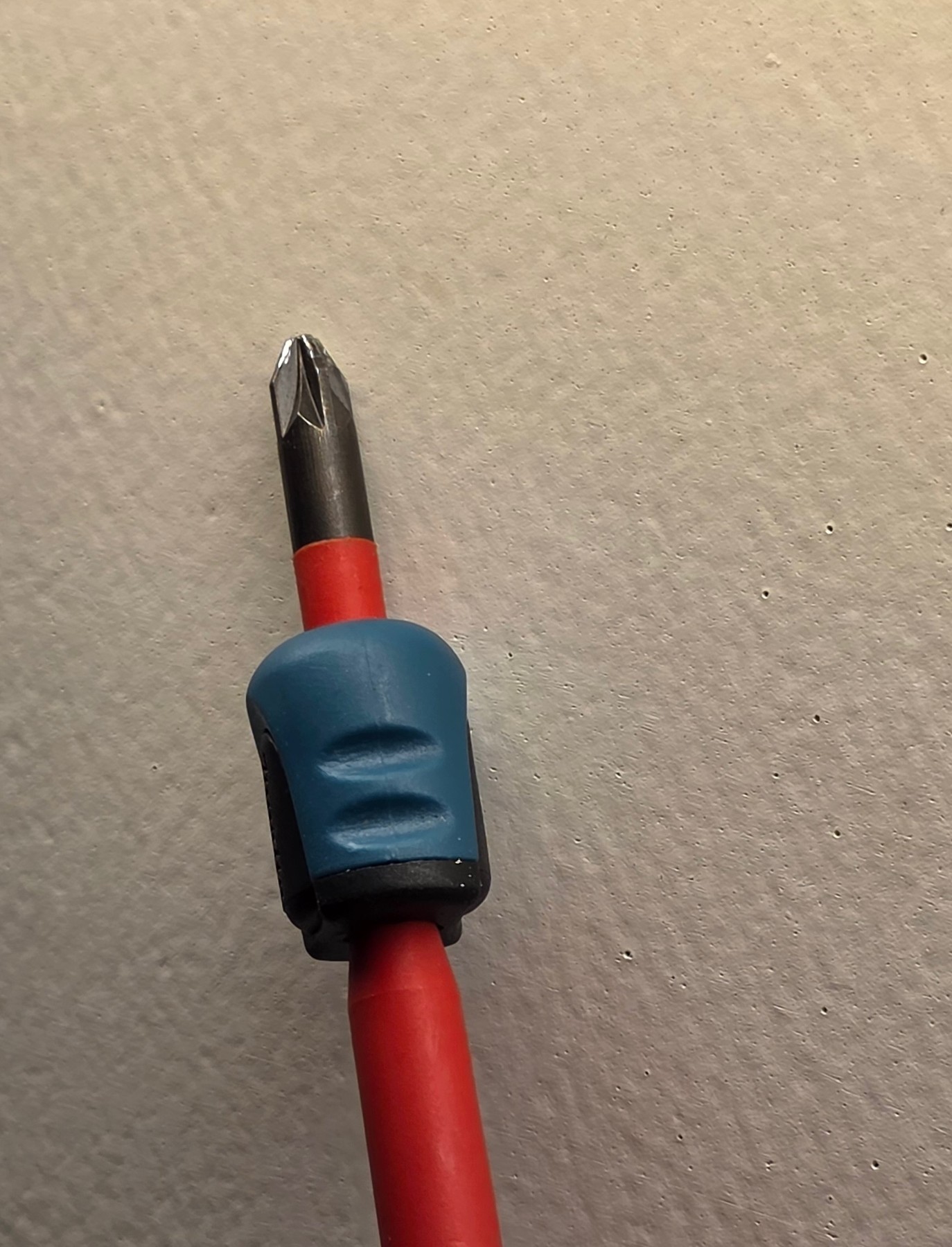
The visuals in this article show another variation of the VDE range: the STUBBY screwdrivers, a short format recognizable by its orange shaft, its thick red handle and its Made in Germany and AC 1000 V markings.
I mention them because they illustrate the brand’s logic: applying the same VDE message (individual testing, use up to 1 000 V) to different usage formats.
A short screwdriver is useful where a standard format will not fit: in a tight electrical panel, behind a recessed mechanism or in a cable duct. The shorter format changes reach and access; I do not infer lower available torque from shaft length alone, because that depends on the exact screwdriver, handle, tip and fastener.
I see it as a complement to a main set rather than a first-time purchase: the Dextro T49193D set covers everyday use, the STUBBY models handle specific cases.
The flagship pliers range has been relaunched: the announcement was made on 2 July 2025 in the trade press (Professional Electrician), with an effective launch on 1 July 2025.
The range includes 19 references (SKUs): side-cutting pliers, cable cutters, half-round nose pliers, combination pliers and the “Combicutter” (cut and strip), in several sizes including 160 and 180 mm found on the official spec sheets.

The announced changes are specific: integrated attachment point (tool tether) for working at height — this is the differentiating argument of this relaunch —, induction-hardened jaws, optimised geometry, a redesigned two-component handle, and claimed German manufacturing (“expert German manufacturing”).
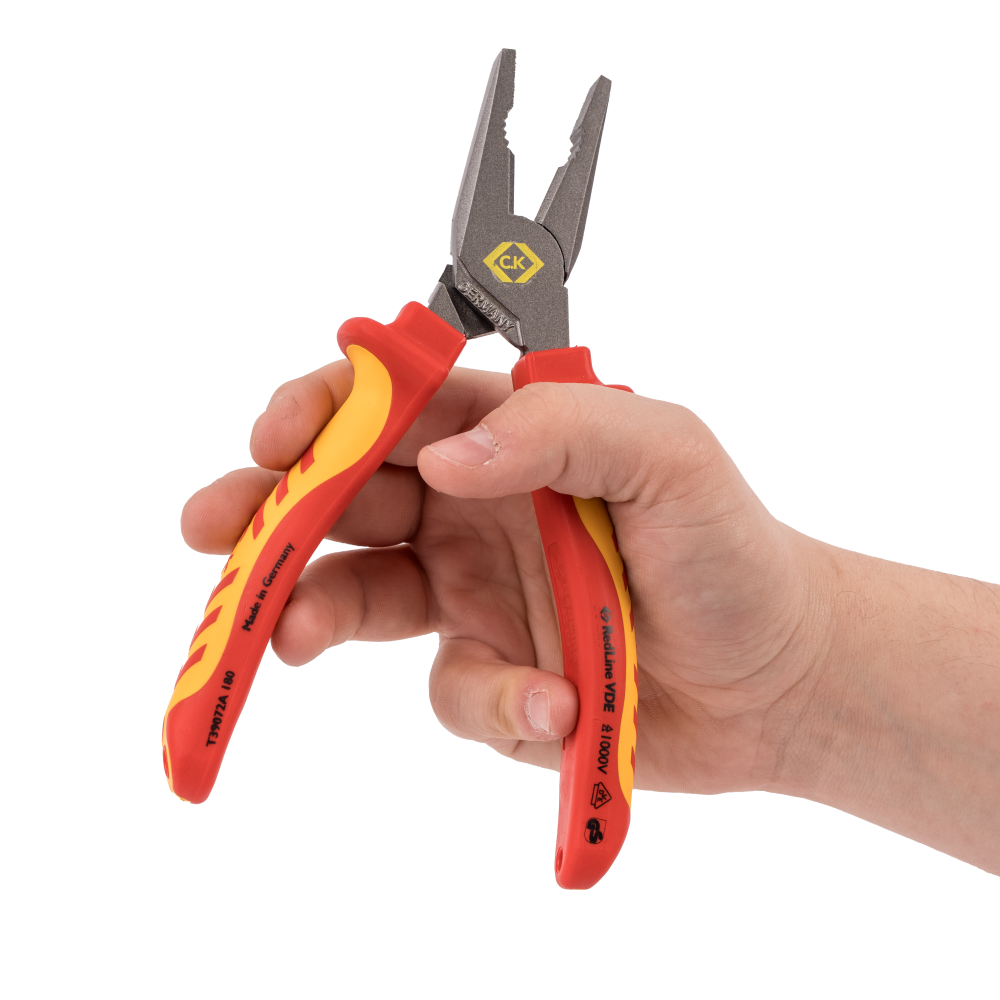
RedLine VDE 180 pliers
Identify the working area of the pliers relaunched in 2025: the hinge and the induction-hardened jaws.
The attachment point deserves a closer look. It addresses a real risk of working at height: falling tools. The manufacturer cites British figures: in 2023/2024 in the United Kingdom, 50 deaths and nearly 5 000 non-fatal injuries linked to work at height, with falling tools contributing to these figures.
I report them as they are, with two caveats: these are UK figures, not to be transposed as-is to France without a source, and here they serve to understand the value of the tether, not to measure a French risk.
It’s a good answer to a genuine practical question: on a job site, a pair of pliers falling from 5 meters is a potential accident down below.
For live work, the subject of electrician’s pliers is well covered in my comparison Knipex vs Wiha, which gives a comparison scale to read C.K.’s promises.
Why an integrated attachment point rather than an add-on attachment? Because a collar or a carabiner added on afterwards can slide along the handle, open under load, or unbalance the pliers in hand.
An attachment point designed in from the outset, however, does not move: it accepts a standard safety lanyard and supports the weight of the tool without hindering grip. It’s the detail that turns a bench pliers into a work-at-height tool: in the event of a drop, the tool stays attached to the wrist or the harness instead of falling.
I see it as the most useful evolution of the relaunch for an electrician who works from a ladder or an aerial platform. For work at height, inspect the attachment point and safety tether before use.
The test bench above covers the slim screwdrivers and the RedLine pliers.
The Redline VDE relaunch is announced by C.K Tools in a trade press article that quotes Brinley Buckley-Roberts, Head of Marketing for the brand.
When I recommend a brand to a colleague, I ask about size first, not price. Each use has its own answer: the Dextro set for the workshop and everyday jobs, the Dextro Glo for dark technical rooms, the STUBBY for tight access.
My first criterion remains size coverage: a set that duplicates one size and forgets another costs me more time than it saves. So I read the list of tip sizes before buying, rather than the number of tools advertised on the packaging.
The phosphorescent handle of the Dextro Glo is useless in a well-lit workshop: I keep it for the cases that live in a technical room or in a van, where finding the right screwdriver really matters.
The STUBBY, on the other hand, is judged on its access. I bring it out when a standard handle hits the wall of a panel or a trunking. The short format changes reach and clearance; tightening torque still depends on the exact reference, handle, tip and fastener.
Before putting a VDE screwdriver away in my case, I inspect it under a lamp: the sleeve along its full length, the tip, then the junction between the blade and the handle. An insulation defect is visible to the eye; it cannot be guessed by hand.
I then check that the shaft stays insulated right up close to the working end and that nothing is chipping. A nicked, pierced or peeled insulation takes the tool out of service, even if the tool still tightens correctly: insulation and tightening are not checked the same way.
Last, I check the tip, because a blunt tip no longer engages properly in the screw head. This check only takes a glance, and I repeat it every time a tool comes back rather than only once at purchase.
My maintenance comes down to a few simple actions: a cloth on the handles, tips protected during storage, and never a case left behind a van window in full sun.
The sensitive point remains the insulation, which is vulnerable to impacts, sharp edges and the rubbing of tools stored loose. I prefer a slotted case or a pouch with loops over a bucket where the handles knock against each other every time you brake.
On the job site, the most common mistake I see: using an insulated screwdriver as a lever or a chisel. Then comes cutting with the tip of a pair of pliers instead of its cutting zone. The tool and the part suffer.
I treat storage as a check: every time a tool returns to the case, I glance at its insulation. That quick glance is worth more than a careful check that is always postponed.
An insulated tool changes nothing about the basic rule: I lock out the installation before working on it; insulation only covers situations that require live work or a hazardous environment. Mixing everything up would be asking the tool for more than it can give.
When live work is justified, I set up the area before opening up: lighting, dry floor, clear access, someone within earshot. A prepared move goes more cleanly.
For cutting, I place the conductor at the back of the jaw, I cut one conductor at a time and I check the state of the core after the cut. A jaw that crushes the copper instead of slicing it is something you feel in your hand.
For screwdriving, I choose the exact tip size for the recess and I keep my fingers behind the handle: too small, the tip slips in the recess; too large, it marks the screw head.
In use, I find that an insulated tool wears less from the work than from impacts. The signs that make me take a tool out of service: insulation nicked or gone shiny from being rubbed, a handle that turns on its blade, a rounded tip that no longer engages.
I don’t try to fix these defects. A handle that turns can’t be re-glued, and damaged insulation can’t be repaired cleanly: safety can’t be patched up with makeshift fixes. The tool leaves the electrician’s crate for good.
The cited manufacturer sources do not publish a public recommended price for these references. I therefore do not use one-off marketplace readings as a benchmark here; the useful buying checks are the exact reference and the VDE / IEC 60900 marking.
A word on secondary resellers: one French reseller presents itself as being on the French market for “25 years”, and a major component distributor lists the brand. The figure of 25 years is a self-presentation by the reseller, to be taken as such.
The cited sources show online availability and distributor listings in France. That is useful purchasing-channel context, not a product-quality criterion.
So, what is C.K Tools worth to a French electrician? My reading, after this research:
The brand starts with a solid foundation. A German origin documented since 1904, an identifiable parent company, official data sheets that name the VDE institute, the IEC 60900 standard and the 2004 edition — that is more than many brands in the same segment do.
The messaging around the individual 10 000 V test for use at 1 000 V is precise, consistent with the real use of an insulated tool, and in line with the spirit of the standard.
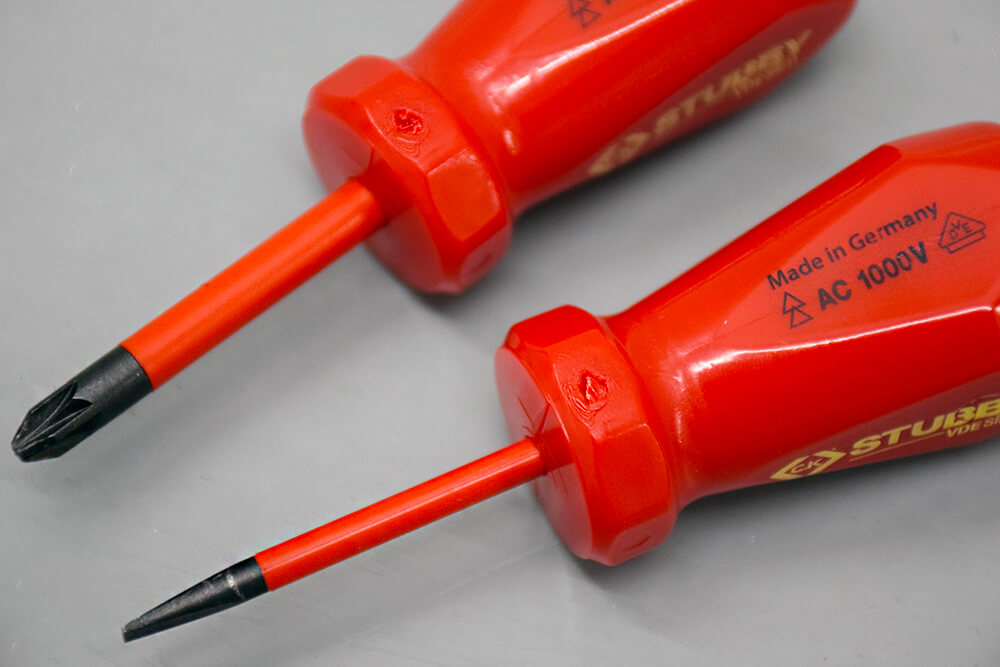
STUBBY VDE screwdriver
Spot the markings on the handles indicating German origin and the STUBBY short range.
The 2025 RedLine VDE relaunch shows a brand investing in its core business: 19 renewed references, an attachment point designed for safety at height, induction-hardened jaws, claimed German manufacturing. This is dated and verifiable news, not a vague promise.
For a professional comparison, I stick to the exact references, their VDE markings, the tip and size coverage, the published manufacturing information and the warranty terms. Those points are verifiable and useful for choosing a tool; the amount of French commentary available online is not a product characteristic.
One last point of reference: C.K Dextro handles compete directly with the German references in the same segment, and my comparison of Wera Kraftform vs Wiha SoftFinish handles gives a useful basis for reading C.K’s grip promises in light of what already exists.
3 questions
InteractiveC.K Tools, review and VDE range
3 questions to check the essential benchmarks
Choose an answer
The brand is of German origin: created by Carl Kämmerling in 1904, following on from the P.L.S. company founded in Wuppertal in 1790. The company has been based in Wales since 1954, and the company behind it, Carl Kammerling International, is registered in England and Wales.
This is the manufacturer's official claim on the datasheet for reference T49193D: individual testing at 10 000 V for use under voltage up to 1 000 V, compliant with standard IEC 60900:2004 and independently audited by the German VDE institute. This is a manufacturer's claim, consistent with the logic of the standard — how this standard actually works is explained in my guide on 1000 V insulated tools.
The Dextro range focuses on grip: a two-component handle overmoulded onto the blade, a long neck, grip ridges, a chrome-vanadium steel blade. The Dextro Glo VDE Slim range adds a phosphorescent handle that glows for 20 to 30 minutes, in a slim format, with standards announced as EN 60900, VDE 0682/201 on the product datasheet.
The range was relaunched on July 1, 2025 with 19 references: cutting pliers, cable cutters, half-round nose pliers, combination pliers and Combicutter. The new features announced: integrated attachment point for working at height, induction-hardened jaws and German manufacturing claimed.
The cited manufacturer sources give no public recommended price for these references. I therefore do not use marketplace readings as a pricing benchmark; the useful checks are the exact reference and the VDE / IEC 60900 marking.
The T49283PD datasheet shows 4,6/5 from 218 reviews, with a badge of 94 % positive ratings. This is a marketplace aggregate, not a field test: it should be read as a signal that there is no major problem, not as proof of durability.

Théo Desrousseaux
Electrician and editor
I work in the field and edit this magazine. Every guide is reviewed for its target country before publication.
Sources and references
Practical electrical installation guides, diagnostic methods and tool recommendations compared against the technical wiring standards of this national edition.
Wiha or Wera: VDE 1000 V screwdrivers and pliers, storage systems and a method for a tool set suited to real electrical work in the home.
Read the guide Guide Wera Kraftform or Wiha SoftFinish: which to choose? Wera Kraftform or Wiha SoftFinish: a handle launched in 1968, blades, VDE references and interchangeable systems to pick the right reference. Read the guide
  Guide C.K Tools screwdriver review: Dextro VDE Slim Review of the C.K Tools Dextro VDE Slim screwdrivers: slim insulated blades, Glow series, Modulo tips, magnetic ring and torque hold on terminal blocks. Read the guide
  Guide C.K Tools pliers review: RedLine VDE What the C.K Tools RedLine VDE T3973-160 and T3910-210 pliers are worth: shear cutting, stripping, LOOP eyelet, and 1 000 V insulation, after testing. Read the guide