Switch off and verify
Switch off the circuit in question at the consumer unit (or distribution board) and verify there is no voltage with a voltage tester before going near a conduit that contains a cable.
In brief
Taravello Pro sent me the 20 m polyester draw wire and a fibreglass draw wire to test. The set of 10 1 m screw-together rods, ref. 203, I had already bought from 123elec before the partnership.
My detailed hands-on feedback covers the polyester draw wire; for the rods, I’m relying here on their published composition and the photos of my own unit.
I have not measured or compared pulling force or time for these two tools in the same conduit. The differences described here concern design and handling, not a measured performance advantage.
The rods meet a different need: gradually building up length inside a partition or a duct where a full draw tape is less comfortable to feed. The manufacturer’s specifications then give weight, dimensions and part numbers.
1925
Taravello Pro's claimed know-how since this date
20 m
length of the cased polyester fish tape handled here
980 g
stated weight of the 20 m cased polyester fish tape
10 × 1 m
what's in the official screw-together rod set
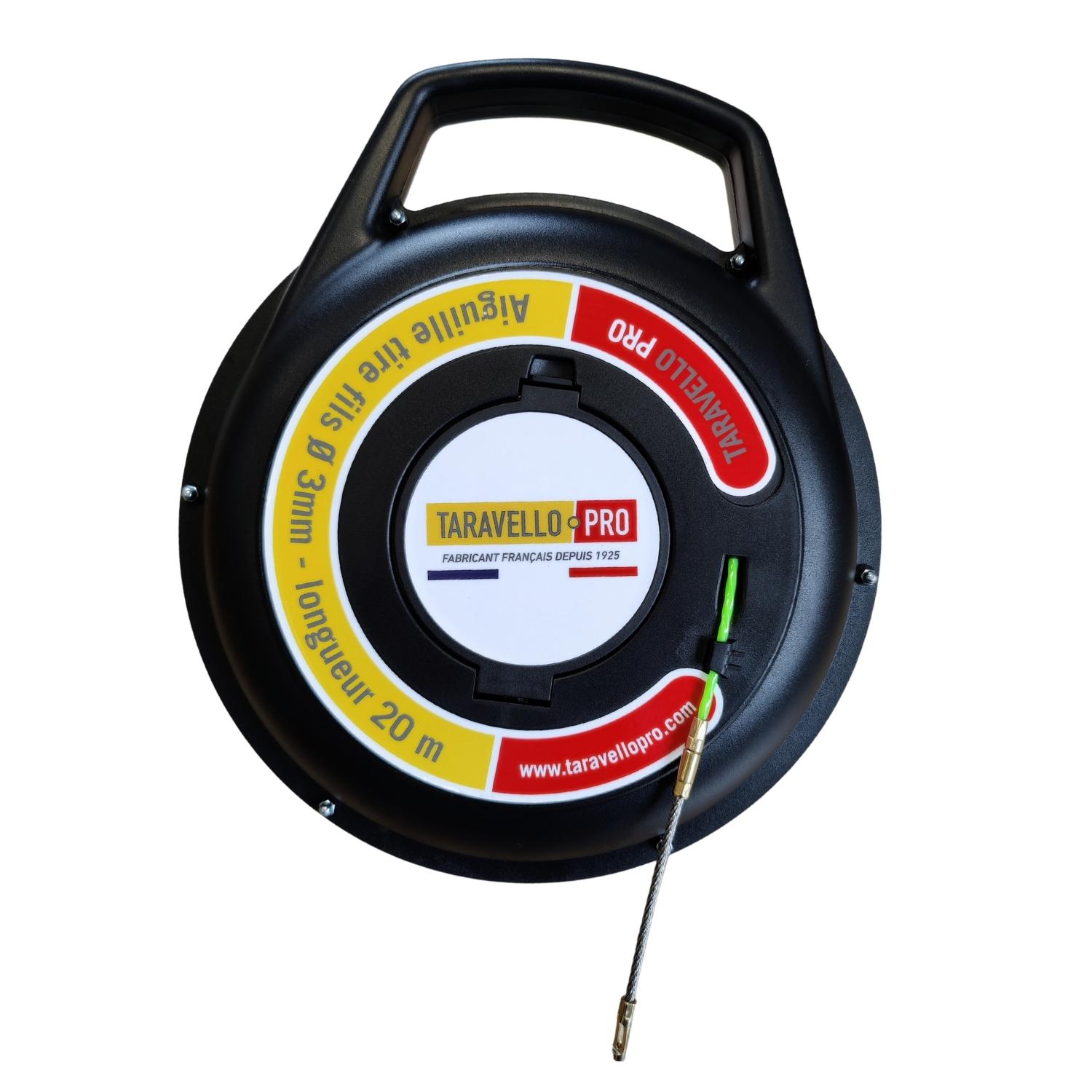
The model I received is a twisted polyester fish tape, Ø 3 mm, 20 m, in a case. That’s the format my hands-on feedback is about.
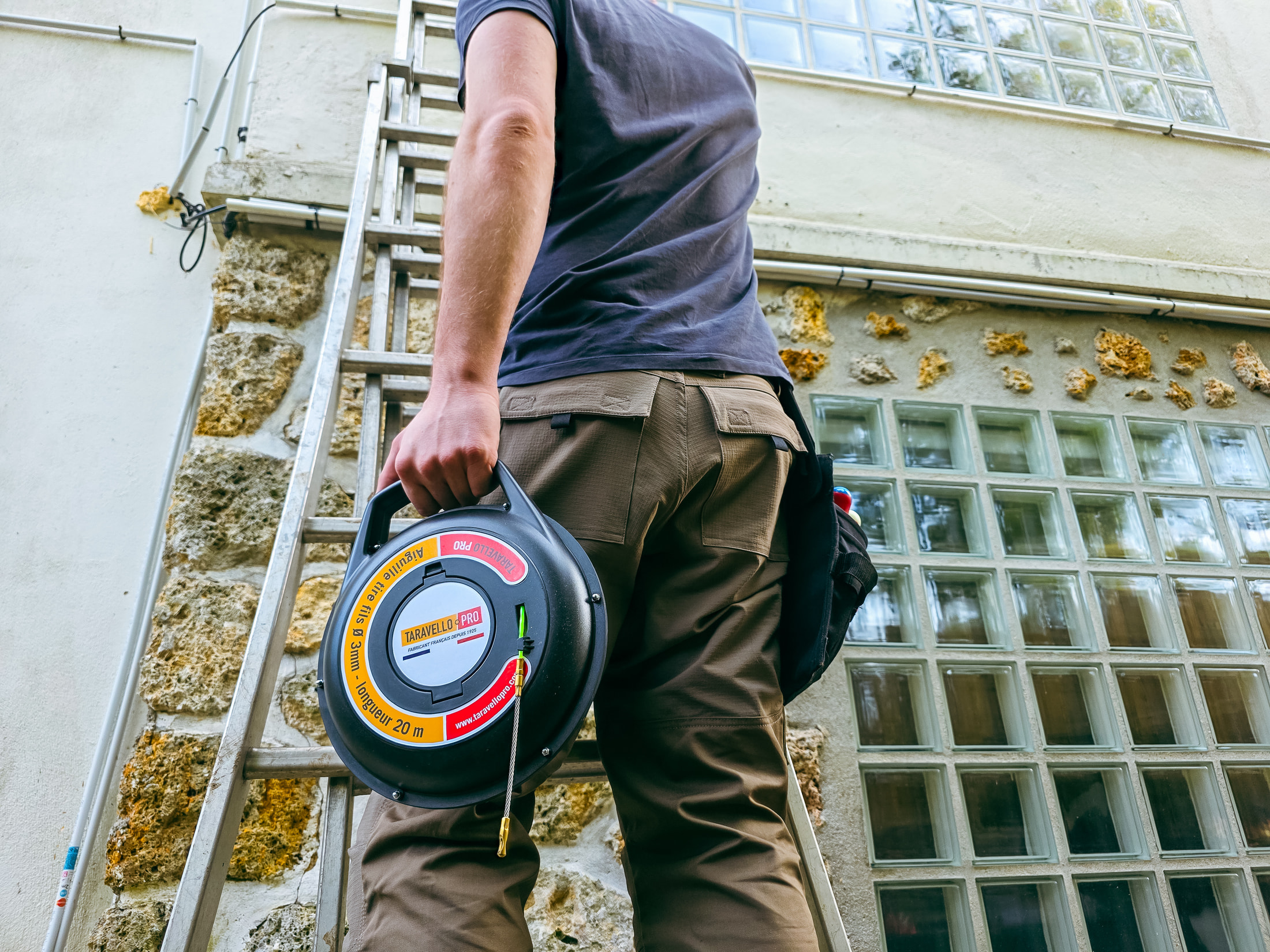
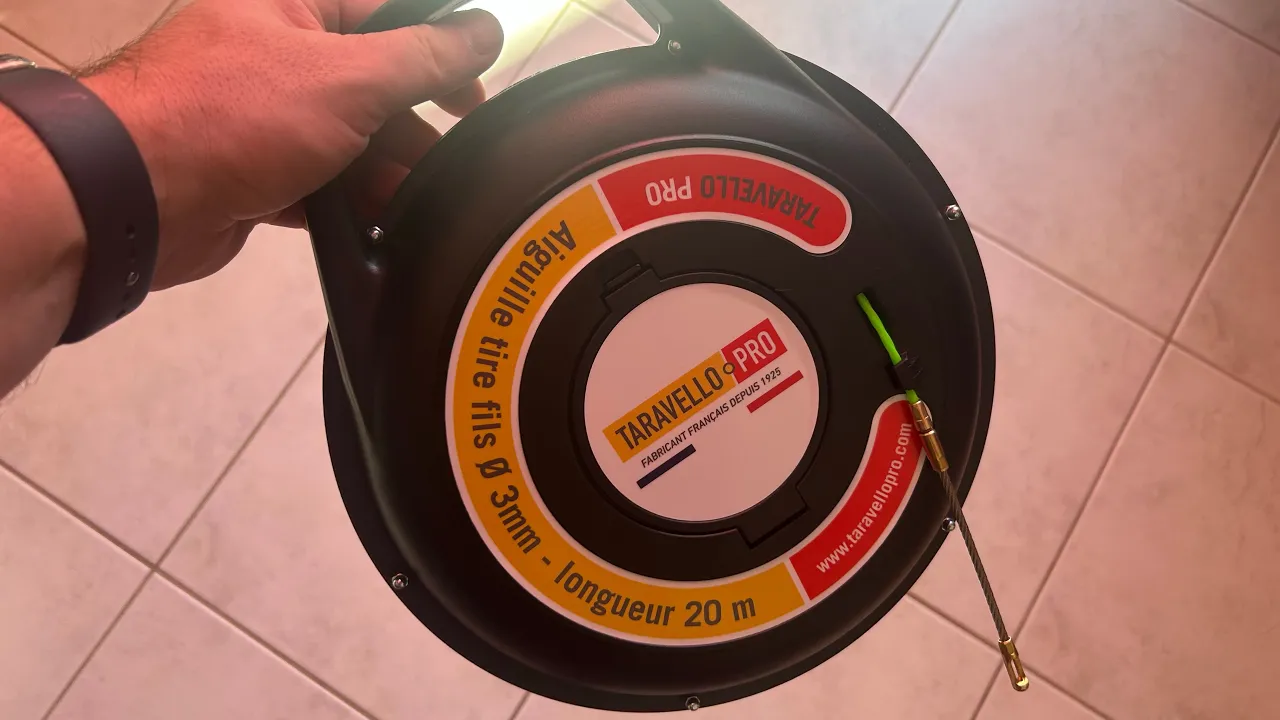
The case is 30.5 cm in diameter and 39 cm tall. It contains a compartment for accessories, and it has a carry handle. The complete set weighs 980 g.
The front element is M3 threaded, with a flexible head and pulling eyelets. This model is intended for pulling and pushing through small and medium-diameter conduit runs.
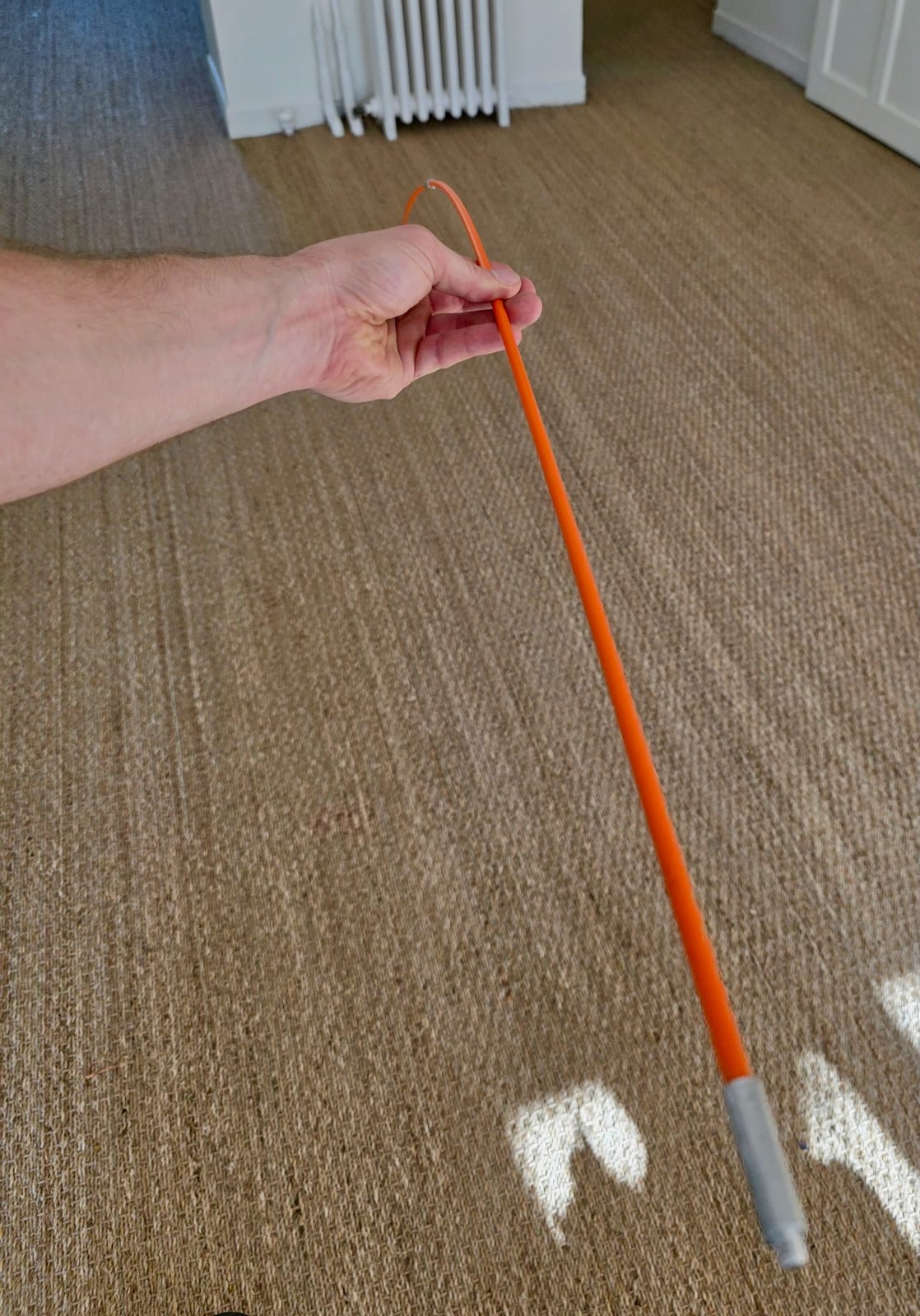
During handling, the polyester draw tape stays stiff enough to remain extended over several metres while still flexing visibly. This observation describes the unit received; it does not predict how it behaves in all conduits.
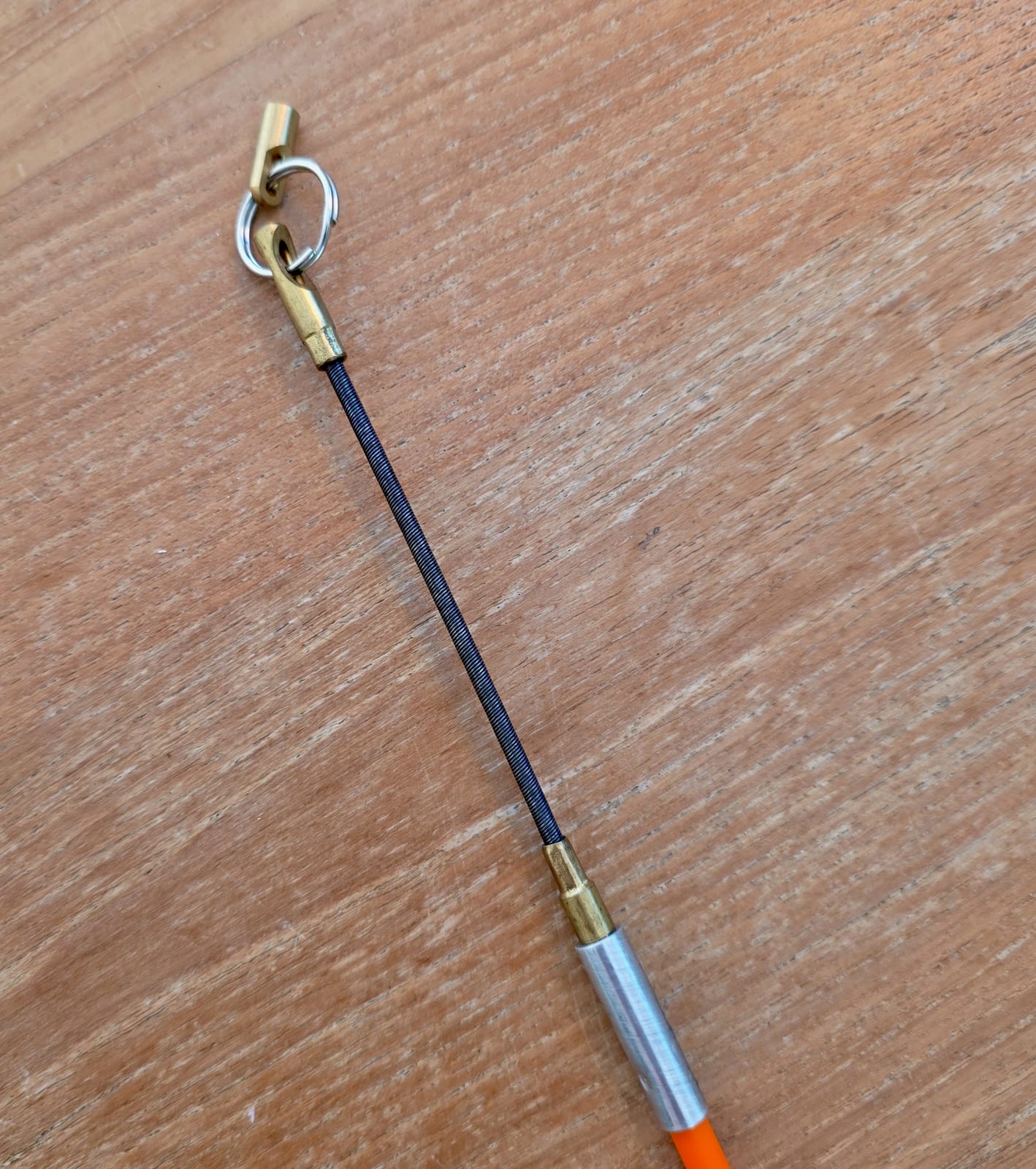
The first useful check is the tip. The threading, the flexible head, and the eyelet determine how the cable is attached and which accessories can actually be used.
My hands-on assessment covers flex and accessories. I do not extend this finding to all partition walls or all types of insulation: behaviour depends on the run, the cross-section, and the number of bends.
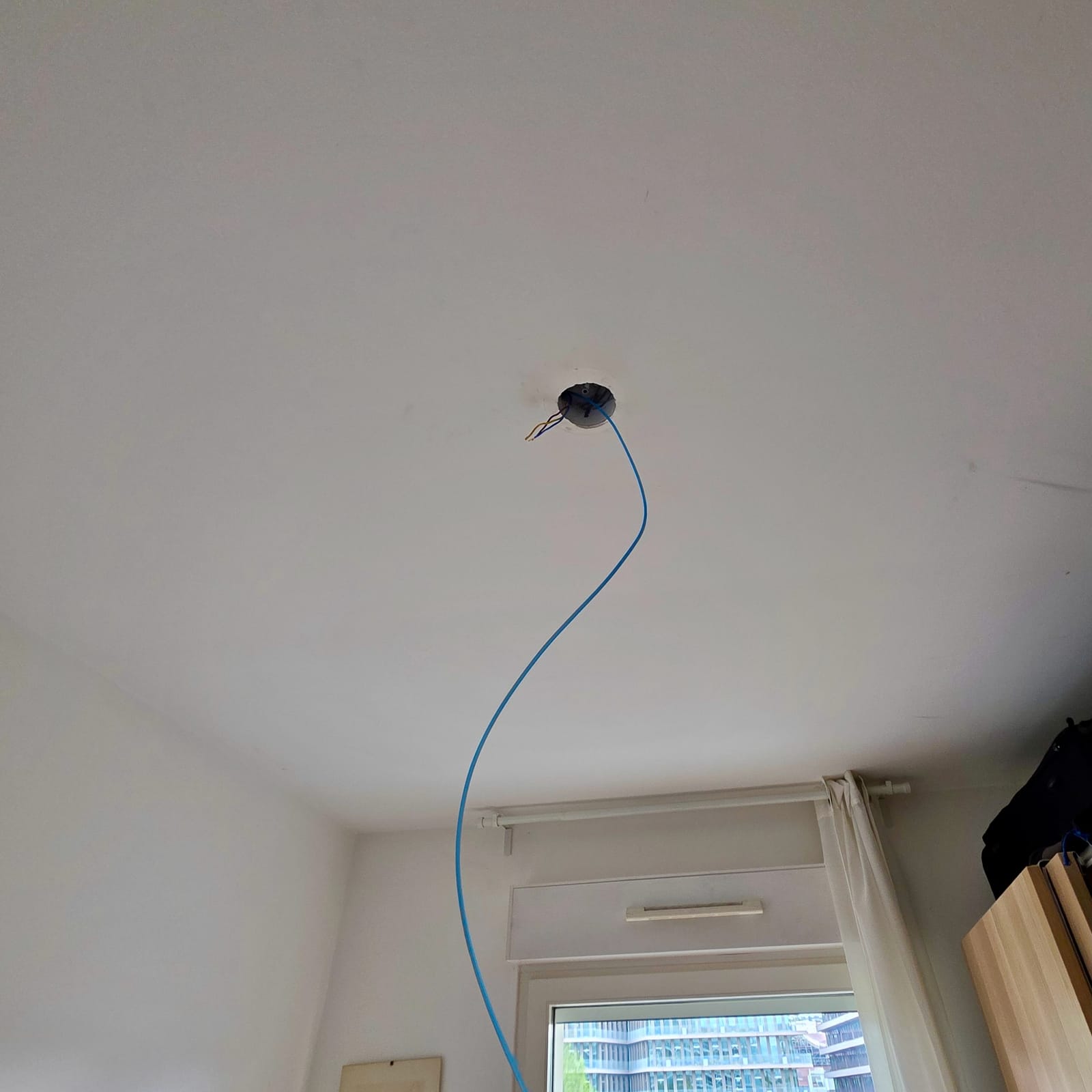
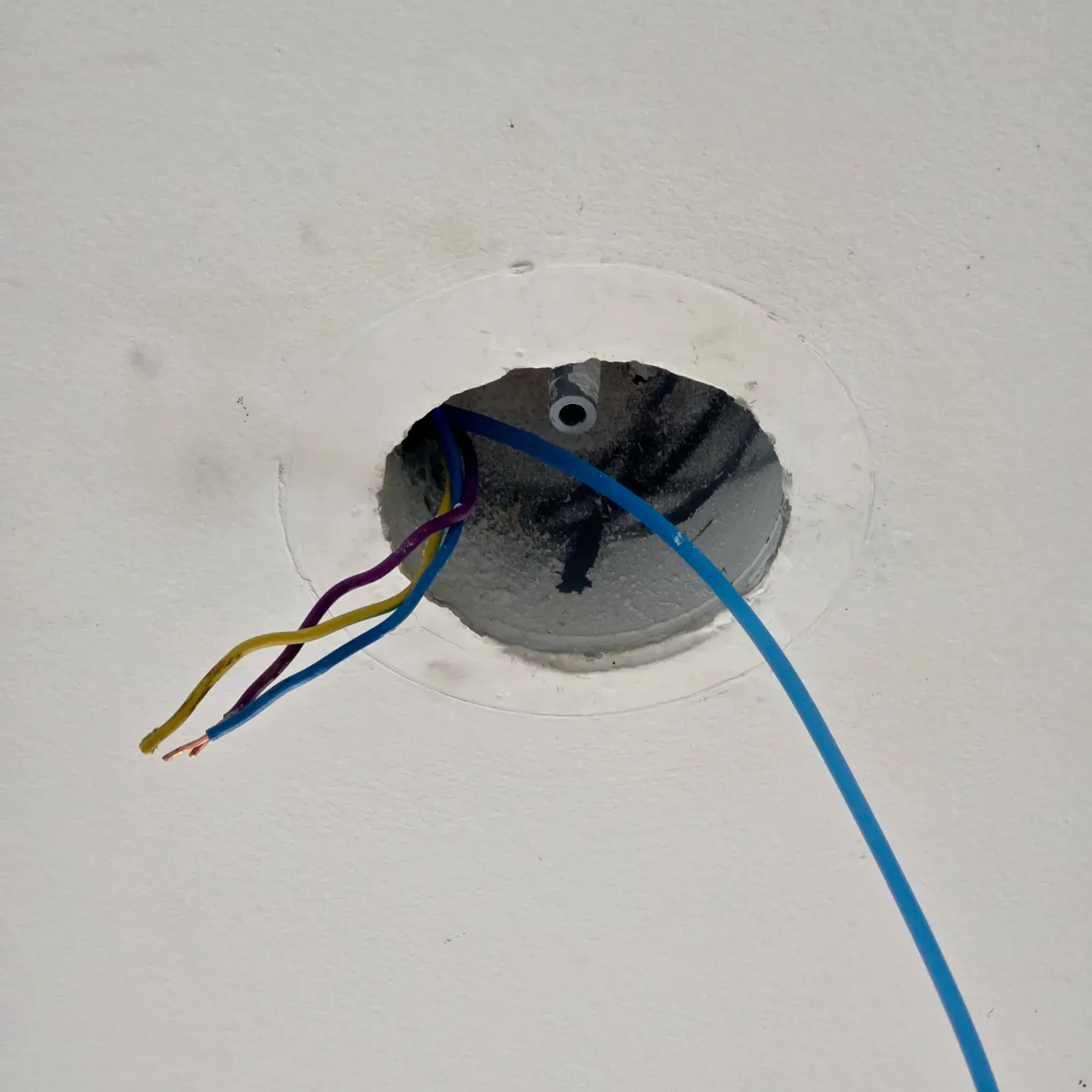
The following photo shows a cable being pulled through a ceiling conduit. It illustrates the type of run, without claiming that this scene was shot with the Taravello sample from the test bench.
This format targets building runs of moderate length. For an Ethernet wall socket, a fibre optic line or a conduit already cast into the wall (cast-in conduit), the choice depends mainly on the length and the conduit.
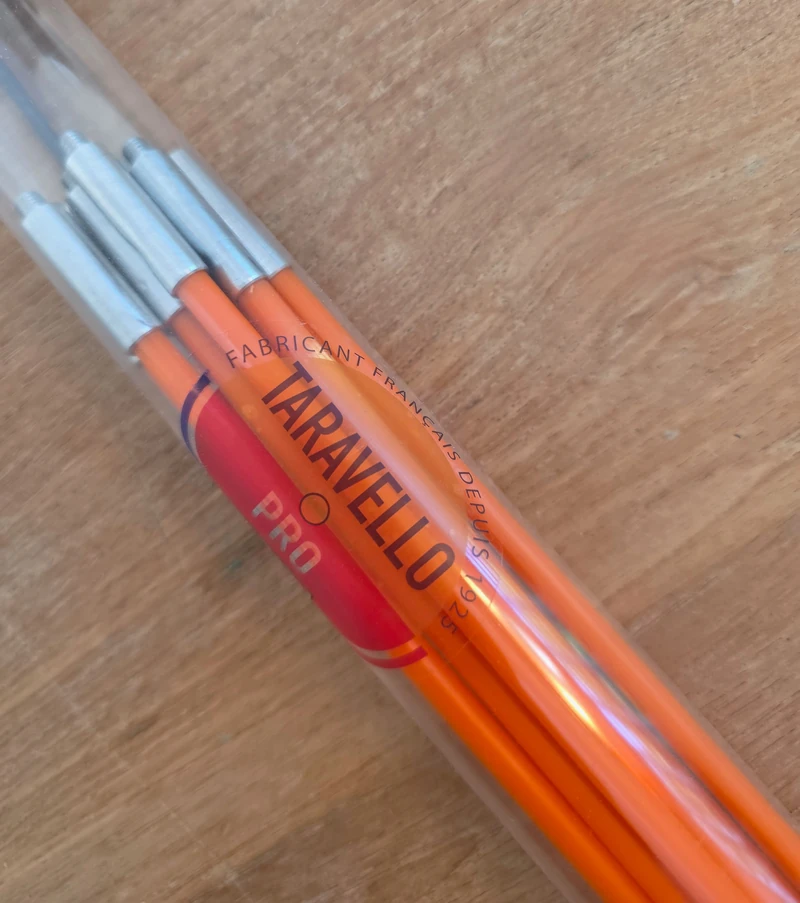
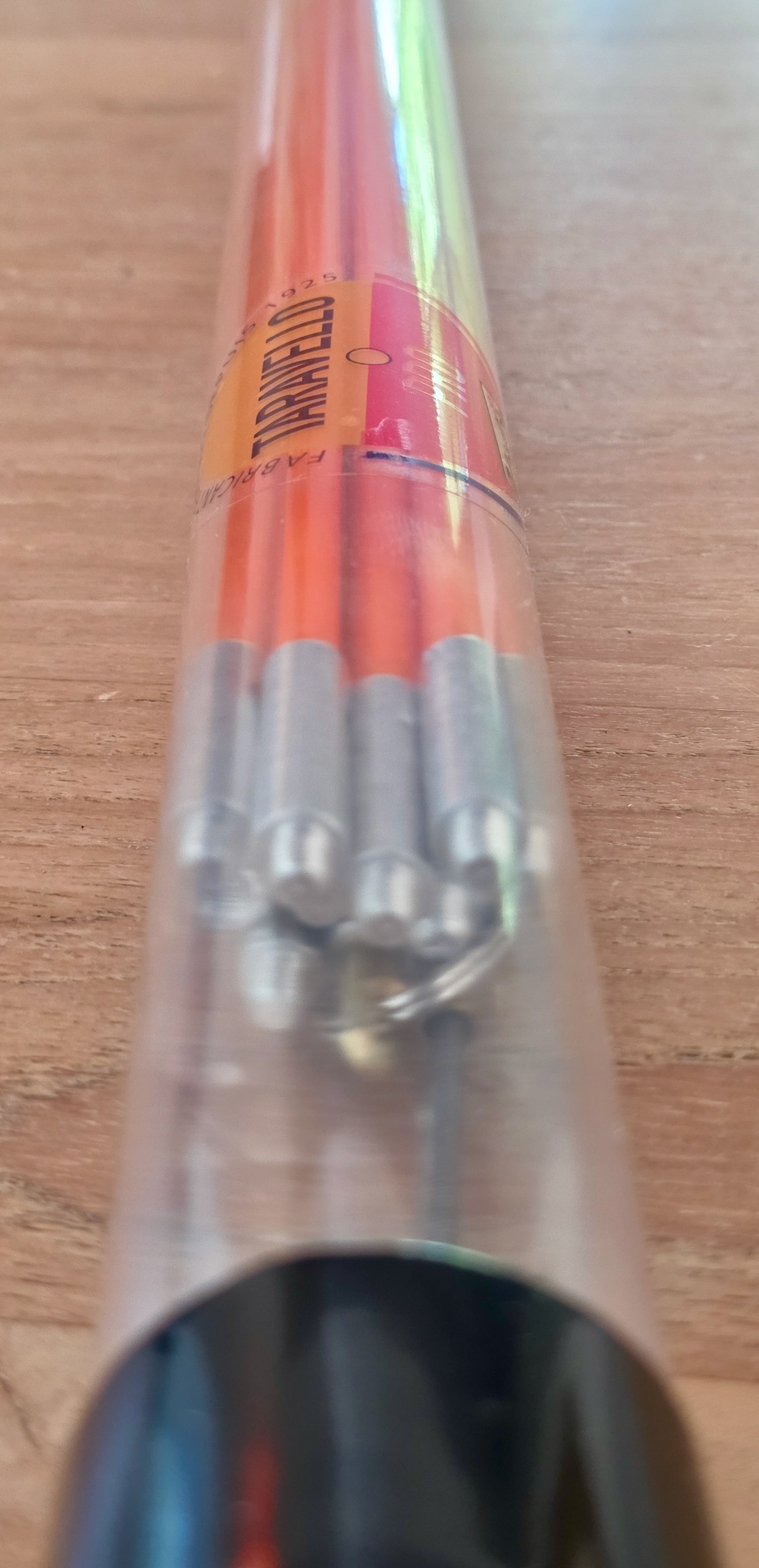
The manufacturer also offers a 10-piece set of 1 m cable rods with accessories. The official datasheet confirms fibreglass and male and female aluminium ends with M5 threads.
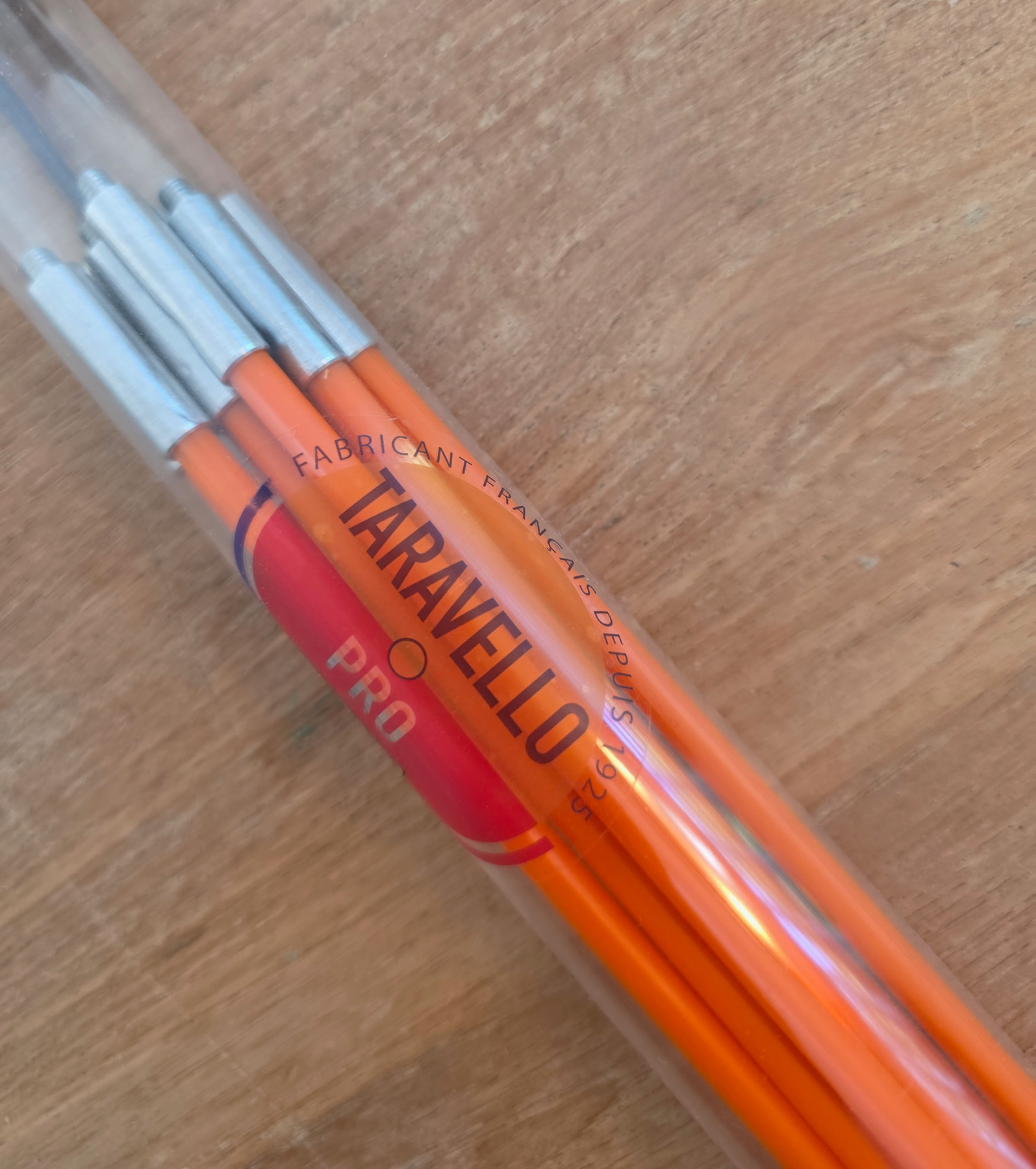
The kit contains ten 1 m rods, a flexible head, a pulling eye with a ring, a second pulling eye and a plastic storage tube. These are the items explicitly published by the manufacturer.
The manufacturer’s 2024 catalogue identifies this as ref. 203, comprising ten 1 m fibreglass rods, Ø 6 mm, with M5 threaded fittings. The separate 3 mm polyester fish tape has an M3 front fitting.
Taravello Pro supplies these rods for pulling cables through conduits, ceilings, trunking, floors and stud/partition walls. The category page adds pipe clearing to the stated uses.
The logic is different from that of a 20 m draw tape (draw wire): the length is built up as the run progresses. Two or three sections are enough for a short crossing; ten sections give 10 m by adding the rods together.
Above all, this modularity makes it possible to stop the assembly at the required length. On its own, it says nothing about the bend radius or the force that can be applied: both of these still depend on the conduit being used.
The M5 thread matters when buying a head or a spare part. It must not be confused with the M3 of the front section on the polyester draw tape in its case.
The benefit compared with a cased fish tape is that the length builds up progressively. In a skirting trunking, a stud wall cavity or a suspended ceiling, you only add the sections you need for the run.
Taravello Pro is a manufacturer, not a white-label brand. The company manufactures in Romans-sur-Isère, at 6 rue Alphonse Gélibert, in a 7,500 m² workshop, and claims 100 % French manufacturing.
The website claims expertise dating back to 1925.
The company supplies cable pulling equipment for telecommunications and equipment for the construction industry. The markets listed are public works, telecoms, electrical and plumbing, detection and agriculture.
The stated distribution covers France and its overseas territories, Europe and Africa. Its family catalogue goes beyond push rods alone: routing, drain cleaning, detection, site protection and tooling.
The made-in-France question in tooling has its nuances, and I cover it in the guide to tool brands made in France.
The Taravello Pro range is not just about length. It comes in several designs (or “versions”) that suit different routes: under cover, on a reel, screw-together rods, drain clearing and detection.
The under-cover draw wire is designed for electrical conduits and ducts. The handle makes handling easier, and the heads store under the cover, which keeps the accessories in the same place as the draw wire.
The under-cover category lists three materials and geometries: fiberglass Ø 3 mm, flat steel Ø 1.5 mm and twisted polyester Ø 3 mm. So the choice also comes down to the material, not just the length.
The polyester I received and handled is 20 m with an M3 front element. The thread size matters here: M3 and M5 both exist in the manufacturer’s range, so I always check the family before ordering a head.
Reel-mounted draw wires are available in longer lengths and larger diameters. The manufacturer lists fiberglass options of 4.5, 6, 9 and 11 mm.
The reel is not just a holder. Taravello Pro lists a brake to control the unwinding and lock the wheel, along with a carry handle.
The 4.5 mm diameter appears in this family; the published lengths are mainly for Ø 6 and Ø 11 mm.
The manufacturer describes guide heads drilled and pinned in its workshops. The built-in eyelet allows both pushing and pulling, with threaded brass end fittings and an aluminium nose cone.
The stated applications cover underground and overhead cables, as well as underground ducts (e.g. telecoms duct). These are more useful selection criteria than a simple “longer”.
At Ø 6 mm, the range goes up to 60, 80 or 100 m. At Ø 11 mm, it reaches 150, 200 or 300 m.
The Ø 9 and 11 mm reels are available with wheels. On the Ø 11 mm version, the manufacturer also lists a central brake, a horizontal or vertical position and stiffness suited to the longest runs.
Switching to a reel is therefore justified when continuity of the run becomes the dominant factor: a longer duct, an outdoor pull or a length beyond what a compact cassette can hold.
The thread is not the same across the range. The polyester rod in a cassette uses M3, while the fibreglass rod in a cassette and the rod kit use M5.
Taravello Pro lists an M5 flexible head among its accessories for fibreglass rods and screw-together rods.
The manufacturer also offers an M5 threaded sleeve and repair parts for fibreglass rods.
The accessories category lists front and rear components, screw-on male and female ends, a repair connector, an M5 sleeve and an M5 flexible head.
This availability changes the purchasing decision: a damaged end piece does not necessarily mean replacing the whole rod.
The manufacturer lists these accessories for rigid screw-together rods and fibreglass rods. This compatibility does not automatically extend to M3 polyester.
Rodding is another part of the range. The official rod is made of extra high-impact PVC, Ø 24 mm, with threaded male and female ends.
Its locking lug is described as patented. The published lengths are 1 m, 1.5 m and 2 m.
This rod is used for clearing ducts but also for cable pulling. The same rod then takes the tool suited to the obstruction encountered.
The official range includes in particular single and double plunger, spearhead, spring hook, coil spring, rigid scraper, turning handle and turning-handle crank.
The choice is therefore not based on rod length alone. You also need to look at the tool fitted at the end and how the coupling stays locked during the job.
This is also what sets the 1 m rod kit apart from the Ø 24 mm rodding equipment. Both are threaded, but they do not meet the same need or fit the same duct diameter.
Taravello Pro separates network tracing from acoustic leak detection. Both families use a rod, but the signal they are looking for is not the same.
The official category lists a detectable rod Ø 7.4 mm × 90 m. It is the only detectable size listed here, because it is the one shown on the manufacturer’s public pages.
Acoustic detection targets something else: locating a water leak by sound. The Acoustic Tracer announced in April 2025 combines a tracing system and a built-in microphone.
The standard model is quoted at 100 m. It has a two-position switch, a built-in microphone and speaker, with no Bluetooth connection to set up.
The manufacturer presents this two-position switch as a way of simplifying handling for technicians. It also describes a one-piece housing, rigid French fibreglass and a brass cable gland.
An M6 thread lets you add an optional probe or camera. The manufacturer also advertises a horizontal steel chassis and a watertight, impact-resistant case on castors. The head has been redesigned to reduce the risk of breakage in complex underground conduits.
Taravello Pro publishes the INPI DSO2025003446 protection for this product.
| Family | Official specs | When to consider it |
|---|---|---|
| Family Cased polyester | Official specs Ø 3 mm, 20 m, 980 g, M3 | When to consider it Traced runs of small and medium cross-section, pulling and pushing. |
| Family Screw-together rods | Official specs 10 × 1 m, fibreglass, M5 aluminium end fittings | When to consider it Conduits, ceilings, trunking, floors and hollow walls. |
| Family Fibre on reel | Official specs Ø 4.5 to 11 mm, brake, handle, up to 300 m depending on the diameter | When to consider it Long continuous runs, ICTA, TPC, underground or overhead cables. |
| Family Rodding | Official specs High-impact PVC rod, Ø 24 mm, 1 to 2 m per section | When to consider it Conduit with a terminal tool suited to the obstruction. |
| Family Detection | Official specs Detectable draw tape or acoustic tracer, 100 m | When to consider it Trace a conduit or locate a leak by sound. |
Taravello Pro families are chosen first and foremost based on the run and the type of work.
To choose between these families, I start with the actual run. A traced conduit of moderate length calls for the draw tape in its case; a short passage through a hollow wall is better suited to rods added as you go. Long continuous runs point to the reel.
If the need shifts to rodding or detection, I switch to a different family rather than trying to adapt the pulling tool. Diameter, thread and the end fitting are then what separate the models.
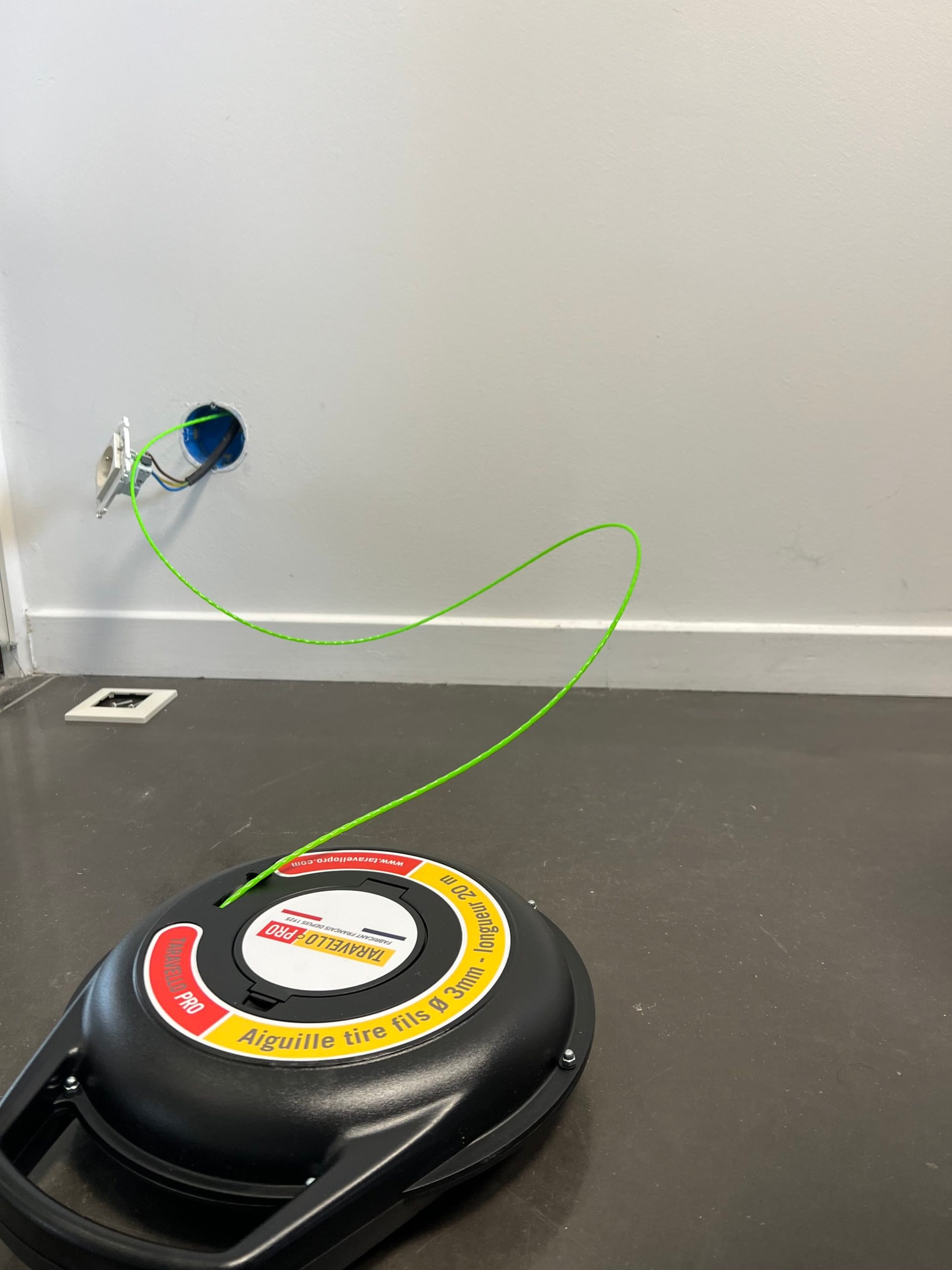
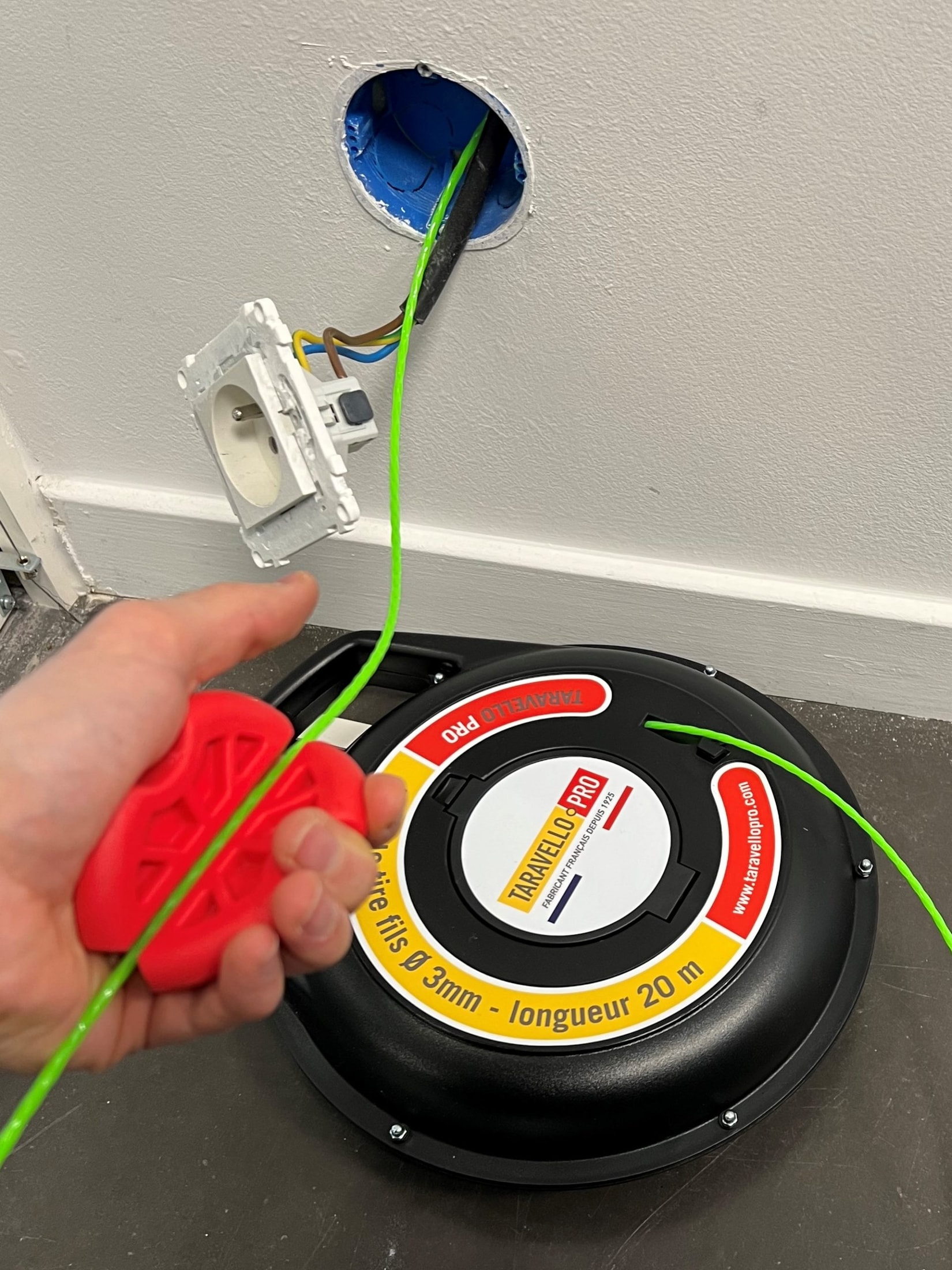
The green draw tape unrolls all the way to the flush-mounting box: the tape guides the cable.
Taravello ProTo trace a cable run before pulling, I often also use a wall cable detector, and to identify a fault, with the methods in the guide to common electrical faults.
Taravello Pro works on a quote basis and promises a reply within 24 hours. Rather than a retail price that goes stale, I start from the model’s specifications and lock down what actually has to arrive.
The manufacturer also advertises custom manufacturing and small, medium or large production runs. So the quote is the right place to set out the exact family, the length, the diameter and the thread required, instead of ordering by trade name alone.
For drain cleaning, I add the rod length and the end tool I want. For detection, I specify whether the need is to trace a pipe run or to pinpoint a leak acoustically: the accessories and the workflow are not the same.
For the polyester rod I tested, the official figures are 20 m, 980 g, a case 30.5 cm in diameter and 39 cm high, with an M3 front element.
For the rods, I check what the kit contains: 10 sections of 1 m, a flexible head, two pulling eyes and a storage tube. The stated thread is M5.
On a reel, I check the diameter, the length, the frame type and whether castors are included. The 4.5 / 6 / 9 / 11 mm ranges do not cover the same lengths.
Finally, I check the accessories at the same time as the rod. The quote must list the exact product range, the thread and the end fittings: that trio is what prevents an unusable order at assembly time.
The method works for the rod in its case just as for the screw-together rods. The steps below are the ones I apply on every job, always starting with safety whenever a circuit may be involved.
Switch off and verify
Switch off the circuit in question at the consumer unit (or distribution board) and verify there is no voltage with a voltage tester before going near a conduit that contains a cable.
Feed the tape without a cable
Feed the tape in on its own to feel the bends, the insulation or a blockage before attaching anything.
Build the pulling head
Form a tapered head with the conductors staggered and the tape smoothed down, without adding bulk where it passes.
Push and twist
Push the tape with small rotations: the twisting gets it through the bends without forcing it straight.
Pull steadily with two people
One person feeds the tape at the entry end while another pulls steadily at the exit end. Stop and check the route if resistance rises.
Lubricate if it drags
Use a pulling lubricant compatible with electrical cable; friction that will not give way signals a problem, not a need for extra effort.
For a difficult conduit, the complete guide to pulling cable through an already-installed PVC conduit (ICTA) details the causes of blockages and the criteria for giving up. The video below shows a demonstration of the fish tape.
The choice depends primarily on length, diameter and conduit type. The Taravello Pro families cover cases different enough to avoid treating all fish tapes as the same tool.
For a building run of moderate length, the polyester tape in a case remains a simple option: 20 m, push and pull, flexible head and accessories stored in the case.
When the length has to be built up gradually, the set of 10 x 1 m rods changes the method. You add rods as you go instead of unrolling a complete fish tape.
On a long conduit run, the fibreglass draw tape (on a reel) provides continuity; the lengths, diameters and frame equipment are detailed in the product range section above.
First question: how many metres do you actually need to cover? A partition-wall penetration, a 20 m run and a 150 m conduit do not require the same setup.
Second question: is the run continuous, or built in stages? Screw-together rods let you add length gradually; the reel gives immediate continuity.
Third question: do you only need to pull a cable, or also clear a duct? The manufacturer offers a Ø 24 mm PVC rod and dedicated tools when the job goes beyond electrical fish tape work.
Fourth question: do you need to trace a network or locate a leak? The traceable fish tape follows a conduit; the Acoustic Tracer works on acoustic detection. These are two different diagnostic approaches.
On the polyester fish tape I received, the main thing I take away is the hands-on feel. For the rods I had already bought, the difference that matters comes down to the format: the 20 m fish tape gives you its full length straight away, while the rods build the run piece by piece.
The end fitting and the accessories are as important as the fibreglass itself. The macro photo of the end shows why: the quality of the joint dictates how the head is presented and how the cable is attached.
The stiffness and the handling describe the polyester fish tape as received. The lengths, diameters, threads and applications across the range are data published by the manufacturer.
Within this scope, what I note above all is a range that is consistent in use: polyester in a case for a moderate-length building run, screw-together rods when the length has to be built up gradually. The availability of accessories and repair parts strengthens the appeal of the whole.
Storage matters as much as handling. A draw tape that goes back into its case dry and clean feeds out smoothly on the next job.
I wipe the tape with a dry cloth before it goes back in, and I check the front element at the same time. A bent tip or a clogged thread is easier to sort out on the bench than up a ladder.
The screw-together rods need the same attention. I keep the threads clean, and I store the sections in their tube rather than loose in the van. Grit on a thread damages the coupling over time.
Common handling mistakes cost time on site. Forcing a tape through a tight bend, pulling before the person feeding it is ready, and leaving a draw tape coiled under tension are the ones I see most.
The manufacturer quotes prices on request and promises an answer within 24 hours. I first set the diameter, the length, the thread and the accessories of the requested model, rather than settling on a one-off market price.
Yes. Taravello Pro manufactures in Romans-sur-Isère in a workshop stated to cover 7,500 m², and claims 100% French manufacturing and expertise in network equipment dating back to 1925.
The cased polyester rod used here is a Ø 3 mm, 20 m model designed for moderate building runs. The reel-mounted fibreglass rods come in several diameters, from 4.5 to 11 mm, with lengths up to 300 m depending on the range.
Yes. The manufacturer lists conduit cleaning among the uses of the rod set. For dedicated work, its range also includes PVC rods Ø 24 mm and several screw-on cleaning tools.
I start with the length and the route: a cased tape for a moderate conduit run, screw-together rods where the length builds up in stages, and a fibreglass reel for longer continuous runs. I then check diameter, thread and accessories.
Disclosure Taravello Pro : polyester draw tape Ø 3 mm, 20 m and fiberglass draw tape.
Théo Desrousseaux
Electrician and editor
I work in the field and edit this magazine. Every guide is reviewed for its target country before publication.
Author → Credentials → Editorial method → Report a factual correction →
Email address and prefilled context:
theo@sparx-elec.fr
Article: https://www.sparx-elec.com/gb/taravello-pro-review-fish-tape-pulling/
Edition: GB — English
Factual issue: [describe the factual issue]
Passage: [quote or identify the passage]
Source: [optional source URL]
Sources and references
Practical electrical installation guides, diagnostic methods and tool recommendations compared against the technical wiring standards of this national edition.
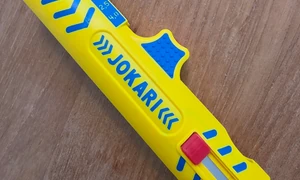
Field test of the Jokari Secura No. 15, No. 28H and Super 4 Plus: real-world use, stripping ranges, limitations and official recommended prices.
Read the guide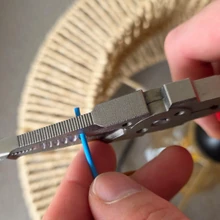 Guide C.K Tools pliers review: RedLine VDE What the C.K Tools RedLine VDE T3973-160 and T3910-210 pliers are worth: shear cutting, stripping, LOOP eyelet, and 1 000 V insulation, after testing. Read the guide
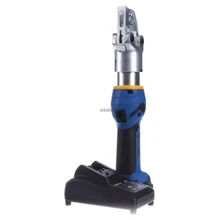 Guide Klauke EK30IDML: review of the electric crimper Review of the Klauke EK30IDML: die-free hydraulic crimping from 6 to 120 mm², 30 kN of force, connector scope and documented specifications. Read the guide
 Guide C.K Tools screwdriver review: Dextro VDE Slim Review of the C.K Tools Dextro VDE Slim screwdrivers: slim insulated blades, Glow series, Modulo tips, magnetic ring and torque hold on terminal blocks. Read the guide