Socket not working but not tripped
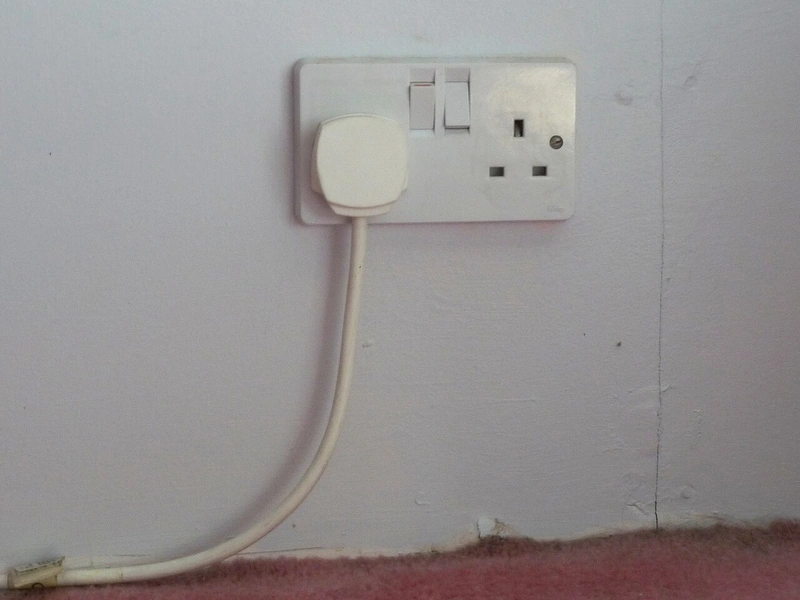 Photo : Thryduulf, Wikimedia Commons, CC BY 3.0
In brief
- A dead socket with nothing tripped usually comes down to the plug fuse, the socket switch, a broken ring final circuit or a device that is off without looking tripped.
- Only where there is no damage, overheating, moisture or shock, try a known-safe small appliance in a known-working outlet. Do not move a suspect damaged appliance to another socket or dismantle fixed wiring.
- A BS 1362 fuse blowing is a symptom, not the fault; replacing it with a higher rating, foil or wire is how socket fires start.
- A ring final circuit keeps working with one leg broken, so sockets can stay live while the circuit is already damaged; only continuity testing proves the ring is intact.
- Burning smells, heat, scorch marks, crackling or a shock mean stop: that is a registered electrician's job, and some of the repair work is notifiable under Part P.
A socket that has stopped working while every switch in the consumer unit still sits where it always did is a particular kind of annoying. Nothing has visibly failed, nothing has been reset, and the lights in the same room are still on. The obvious conclusion is that the socket itself has died.
The symptom alone does not identify the cause. The order of the checks matters more than the checks themselves, because four different faults produce the same symptom from the outside: no power at the outlet and nothing to reset.
A blown fuse in the plug, a socket switch knocked off, a broken connection on a radial circuit or spur, and a residual current device that has tripped without the lever dropping all look identical from an armchair. Working from the appliance end towards the consumer unit finds the cause without opening anything that is live.
30 mA
RCD threshold for socket-outlets up to 32 A
13 A
largest BS 1362 fuse used in a BS 1363 plug
230 V
nominal UK supply voltage
32 A
typical ring final circuit breaker rating
What “not tripped” actually tells you
Very little, on its own. It suggests that the main switch has not visibly moved and that no device has physically moved to a position you noticed. It does not tell you that the circuit is healthy, and it certainly does not tell you that the socket is at fault.
A consumer unit holds three kinds of device, and they fail in different ways. An MCB protects the cable against overload and short circuit, and its trip indication depends on the model; not every MCB has a middle trip position. An RCD compares the current going out with the current coming back and trips on earth leakage.
An RCBO does both jobs in one module, which is the difference explained in RCBO versus RCD. Which of the three protects your socket circuit tells you what kind of fault to expect.
On a dual RCD board, the circuits are split between two residual current devices so that one fault does not plunge the whole house into darkness. That is exactly what regulation 314.1(iv) of BS 7671 asks for when it requires the installation to be divided so that a fault does not take out everything at once.
That division is also why “nothing has tripped” is unreliable as an observation. Half the board can be dead behind one RCD while the other half keeps the kitchen and the lights running, and if you only glanced at the row of levers you may have looked at the wrong half.
Devices also get switched off by hand, by a previous occupant, or during a test and never put back. And some older RCDs trip to a position that looks nearly ON from standing height.
There is a second blind spot. A socket can have no supply because something upstream of it is switched off, and that something is not always in the consumer unit.
A fused connection unit feeding an outside socket, a boiler or a shed is a small accessory with its own fuse, usually at skirting height or beside a back door, and it has no lever to drop. Its fuse blows, the socket beyond it dies, and the consumer unit never moves.
Attention
Do not remove socket or consumer-unit covers for these checks. Unplug an appliance completely before accessing its replaceable plug fuse. Switching off at the socket does not make the terminals safe, because a socket wired with live and neutral reversed will still have live parts behind the plate when the switch is off.
Step one: prove the appliance before blaming the socket
First check for damage, heat, burning smell, noise or a shock. If any is present, stop using the equipment and arrange an electrician; do not move a suspect appliance between outlets to reproduce a fault.
With no warning signs, substitution can help narrow the problem. I use it as a clue, not as proof that either the appliance or the installation is safe.
Unplug the appliance from the dead socket and plug it into a socket you know works, ideally in another room on a different circuit. If it runs, the original outlet or its supply becomes a stronger suspect. An intermittent appliance fault is not excluded.
Then take a table lamp you know works and plug it into the dead socket. If the lamp lights, that confirms it can receive power there at that moment, not full wiring safety. If it stays dark, do not assume the socket is voltage-free: an open neutral or poor connection can leave hazardous voltage present.
Only compare outlets and appliances where neither shows danger signs. A working appliance on another socket narrows the investigation, but does not rule out an intermittent plug or lead fault. Fixed-wiring tests belong to a competent electrician, not a trial with a screwdriver.
Step two: the fuse inside the plug
A BS 1363 plug contains a BS 1362 cartridge fuse, and that fuse is the one protective device in a British installation the occupant is expected to change. Ratings run from 1 A to 13 A.
A 3 A fuse is the usual choice for a lamp, a radio or a small power supply; a 13 A fuse covers a kettle, a heater or a washing machine. The fuse protects the flexible cord and the appliance, not the socket circuit.
A blown fuse is not a fault in itself. It is the fuse doing its job, and the reason it blew is usually inside the appliance or its flex: a failed heating element, a damaged cord, a short in a power supply, or an appliance that draws more than the fuse rating because someone fitted a 3 A where a 13 A belonged.
Replace a user-serviceable fuse only with the specified rating, after unplugging and checking for damage. Do not repeatedly re-energise a suspected faulty appliance.
Replacing it with a higher rating, with foil, or with a piece of wire is how plug fires and socket fires start, because the fuse then passes a current the flex cannot survive and the overheating moves into the plug, the socket and the wall.
If a new fuse of the correct rating blows immediately, stop buying fuses: the appliance has a real fault.
Two smaller checks belong here as well. The fuse carrier must be tight, because a loose one heats up and eventually discolours the plug. And the pins should be clean and bright; tarnished brass increases resistance at the contact, which shows up later as a warm plug.
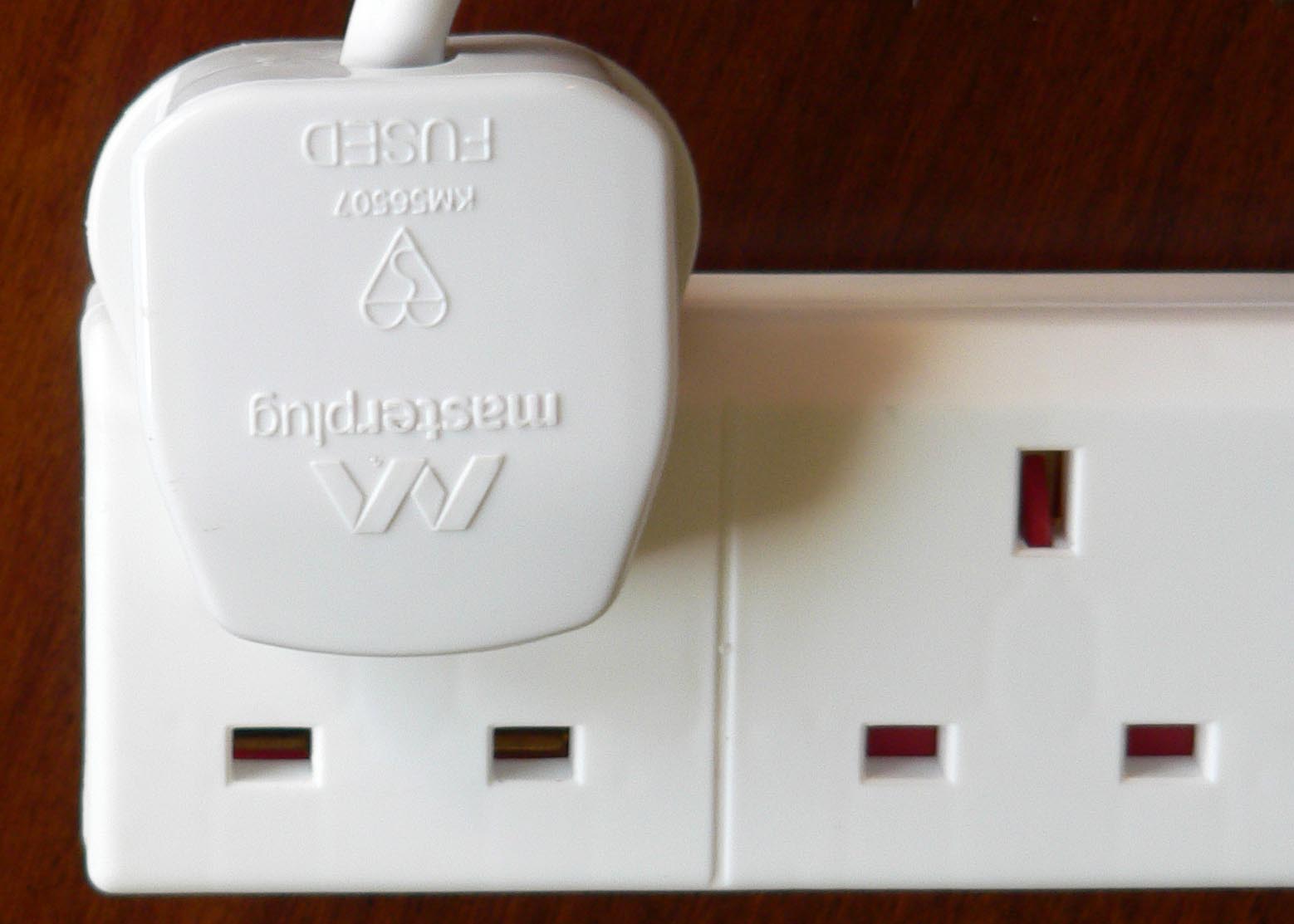
Step three: the switch, the outlet and the other half of a double socket
On a switched double socket, check the corresponding switch once, normally. Unswitched sockets also exist. Do not force or repeatedly work a stiff, damaged or crackling switch.
The more informative case is the double socket where one half works and the other does not. Both outlets share one back box, one set of supply terminals and a link between them.
A single dead half therefore points at the accessory itself rather than the circuit: a burnt contact, a loose link, a failed switch, or a terminal that was never tightened properly. The anatomy of the accessory is covered in UK 13 amp socket types, which is worth reading before deciding the whole thing needs replacing.
That is a stop sign rather than a repair instruction. Internal contact or switch failure is possible, including overheating. That needs inspection; one dead half does not prove that heat is the cause.
Watch for the physical evidence as well. A rocker that is discoloured or soft, a plug that wobbles in the outlet, a socket face gone brown around one hole, or a plug that feels warm after ten minutes of use all describe the same process: a contact with too little surface area, arcing, carbon, more heat.
NICEIC lists exactly these signs, together with a fishy or burning smell and crackling when a plug goes in, as reasons to stop using the socket and call a registered electrician rather than to keep using it carefully.
Step four: when a whole group of sockets is dead
If several sockets in the same room or on the same floor are dead while the lights are fine, the fault is at circuit level and the consumer unit becomes the place to look.
Find the device that protects that circuit. Consumer units are supposed to be labelled, and labels can be inaccurate, so they are a starting point rather than proof of isolation. Check the position of that device rather than the whole row.
If it is an RCBO, it has a test button and a lever, and the lever tells you whether it is closed. If it is an MCB on the RCD-protected side of a dual board, check the RCD as well, because it sits upstream and takes several circuits with it.
If a device has tripped, follow its operating instructions and check for warning signs before any reset. Do not re-energise a damaged, wet or overheating installation.
Where a safe single reset is appropriate, unplugging loads may help narrow the cause. Repeated operation with a particular appliance makes it suspect, but cumulative leakage or a circuit fault can complicate the diagnosis. Do not keep resetting to reproduce the fault.
If it trips immediately with nothing plugged in, fixed wiring, permanently connected equipment or the protective device itself need investigation. Repeated resetting is not a diagnosis.
If nothing has tripped and the circuit is still dead, the possibilities narrow to a device that is switched off, a supply failure upstream, or a break in the circuit the protective device cannot see. That last one is the interesting case, and it is a British speciality.
Info
An RCD test button proves that the device operates. It does not prove that the wiring is sound, that the circuit is complete, or that the socket you are standing at is connected to anything. Pressing it every six months, as the IET’s inspection guidance recommends, is still worth doing, but a failed button test requires investigation of the supply, test circuit and device. It does not by itself identify which part failed.
Step five: the ring final circuit and its hidden break
Most UK socket circuits are ring final circuits. The cable leaves the consumer unit, runs from socket to socket around the floor, and returns to the same terminals. Current can reach any outlet by two routes, which is why a 2.5 mm² cable with a current-carrying capacity of roughly 25 A can sit on a 32 A breaker.
The layout and the testing sequence are set out in ring main circuit wiring, which explains why the loop is drawn the way it is.
Regulation 433.1.204 of BS 7671 permits that specific arrangement, and Appendix 15 explains how unfused spurs hang off it. The arrangement is efficient in copper and unforgiving in fault tolerance.
Break the ring anywhere and every socket usually keeps working. The outlets beyond the break are simply fed from the other side, through the other leg. Nothing trips, nothing looks wrong, and the installation carries on for years.
A broken ring can leave sections operating as radials on protection selected for a ring. The current is no longer shared as the design assumed, and a section may be overloaded depending on the break position and connected loads.
That does not mean every socket inevitably heats up, or that a single break must make sockets dead. It means normal operation is not proof of ring continuity or adequate overload protection.
A damaged cable or an incorrect alteration can interrupt a ring. The defect can remain unnoticed because ordinary use does not test conductor continuity.
That is why “the sockets work, so the ring must be fine” is not a valid conclusion, and why a plug-in tester cannot answer the question. Proving a ring is intact means isolating the circuit and measuring continuity of the line, neutral and circuit protective conductors at the consumer unit.
That is instrument work on a safely isolated circuit by someone competent to interpret the readings. Inspection may reveal some defects, but normal socket operation cannot establish ring continuity.
Step six: what a plug-in socket tester can and cannot prove
A socket tester with three neon lamps is a useful first-line tool and a poor substitute for testing. Martindale, who make both, are candid about the limits: a tester identifies wiring faults at the socket it is plugged into, but it cannot easily detect a swapped earth and neutral.
A basic three-lamp socket tester may miss a reversal at the incoming supply. Some specialised instruments add a separate detection function: Martindale identifies this feature on the EZ365 and BZ701.
The exact tester matters. A limitation of a simple indicator cannot be extended to every product called a socket tester.
If you are buying instruments rather than borrowing them, best multimeter UK covers what a general-purpose meter will and will not measure on a domestic circuit.
The same applies to the RCD test button found on more advanced testers. It performs a basic trip test on the device associated with that socket. It is not the RCD test required by BS 7671, which measures operating time at the rated residual current with a calibrated instrument.
What a tester cannot do is more important than what it can. A basic indicator does not measure insulation resistance or ring continuity. Advanced models may indicate or measure loop impedance; none of this replaces complete installation verification. It will not find a high-resistance joint that is hot but still conducting.
It will not tell you that the circuit is safe.
A normal indication means only that the tester did not detect a fault within its capabilities. That is the beginning of an answer, not the end of one.
Step seven: older boards, rewirable fuses and missing RCDs
A lot of UK housing still has a board with BS 3036 semi-enclosed fuses, where a cartridge holder contains a replaceable fuse wire. These fail visibly, which is one of their few virtues, but they are also easy to abuse: 15 A wire in a 5 A carrier, or a length of copper wire in place of the proper element, both happen.
Do not improvise fuse wire or increase its rating. Have the fault and the correct protective arrangement assessed before re-energising an uncertain older circuit.
There is a second issue with older boards that has nothing to do with the fault in front of you but everything to do with how you interpret it. An installation with no RCD at all, or with a single upfront device, offers less protection than a modern board.
Regulation 411.3.3 requires 30 mA additional protection for socket-outlets up to 32 A in the current edition of BS 7671, which is what a modern board provides on the socket circuits.
If your board has no RCD on the sockets, that is a characteristic of the installation rather than the cause of the dead socket, but it is worth knowing before you plan any work.
Step eight: when the supply itself is the problem
If nothing in the house works, check for a whole-property supply problem or a fault at the consumer unit; the symptom alone does not locate it upstream. Confirm the main switch is closed, look at the meter display, and check whether the neighbours are affected.
A local outage is a call to the network operator’s 24-hour line, which is 105 across Great Britain, and no work inside the house will restore it.
Never break a seal or pull the cut-out fuse. That equipment belongs to the distributor, it is not yours to open, and the terminals on the supply side of the main switch remain live whatever you do to the consumer unit.
Voltage is worth a mention only because it is so often blamed. The declared UK supply is 230 V between line and neutral, and regulation 27 of the Electricity Safety, Quality and Continuity Regulations 2002 sets the permitted variation at 10 per cent above and 6 per cent below, which gives a working range of about 216 V to 253 V.
A supply outside that range usually shows up as flickering lights, dimming or appliances behaving oddly across the whole house, not as one dead socket in a bedroom.
Step nine: the signs that mean stop
Some faults are a maintenance job and some are a warning. The list below is the one NICEIC gives householders, and it is a good place to draw the line.
| What you notice | What it usually means | What to do |
|---|---|---|
| What you notice One half dead | What it usually means Burnt contact or failed switch inside the accessory | What to do Stop using both outlets, have the socket replaced |
| What you notice Warm plug | What it usually means Poor contact between pins and socket contacts | What to do Unplug, do not reuse until inspected |
| What you notice Fishy or burning smell | What it usually means Overheating insulation or arcing behind the plate | What to do Isolate the circuit at the board, call an electrician |
| What you notice Scorch marks | What it usually means Sustained arcing or a loose terminal | What to do Isolate, do not reset, book a visit |
| What you notice Crackling or buzzing | What it usually means Loose connection or failing switch | What to do Isolate the circuit before touching it |
| What you notice A shock, however minor | What it usually means Live part accessible or a wiring fault | What to do Stop, have the installation tested |
| What you notice Repeated fuse blowing | What it usually means Fault inside the appliance or its flex | What to do Stop replacing fuses, have the appliance checked |
Warning signs at a socket-outlet and the response each one calls for
Anything on that list converts a diagnosis into a repair job for someone competent. Replacing the accessory without finding why it failed simply moves the heat to the next weakest terminal.
What the electrician will actually do
The visit is usually more methodical than dramatic. Expect safe isolation first, proved with a tester rather than assumed from a switch position. Then the electrician checks protective-conductor continuity and, for a ring, the separate line, neutral and CPC end-to-end paths and appropriate cross-connected readings.
These are not indiscriminate continuity connections between live conductors.
Insulation resistance between conductors and to earth comes next, then polarity, then earth fault loop impedance at the far end of the circuit. An RCD trip time test with an instrument follows if the circuit is RCD protected.
Alongside the instruments there is a visual inspection of the accessories and their terminals, looking for the heat damage a multimeter cannot see.
The repair that follows depends entirely on what those tests show. A loose terminal is a re-termination. A failed accessory is a replacement.
A broken ring is a repair to the ring, or a decision to split it into two radial circuits with protection to match, which is a design change rather than a repair and needs to be recorded. A damaged cable under a floor is a joint in an accessible enclosure or a new cable run.
None of those decisions can be made from the symptoms alone, which is the whole reason the tests exist.
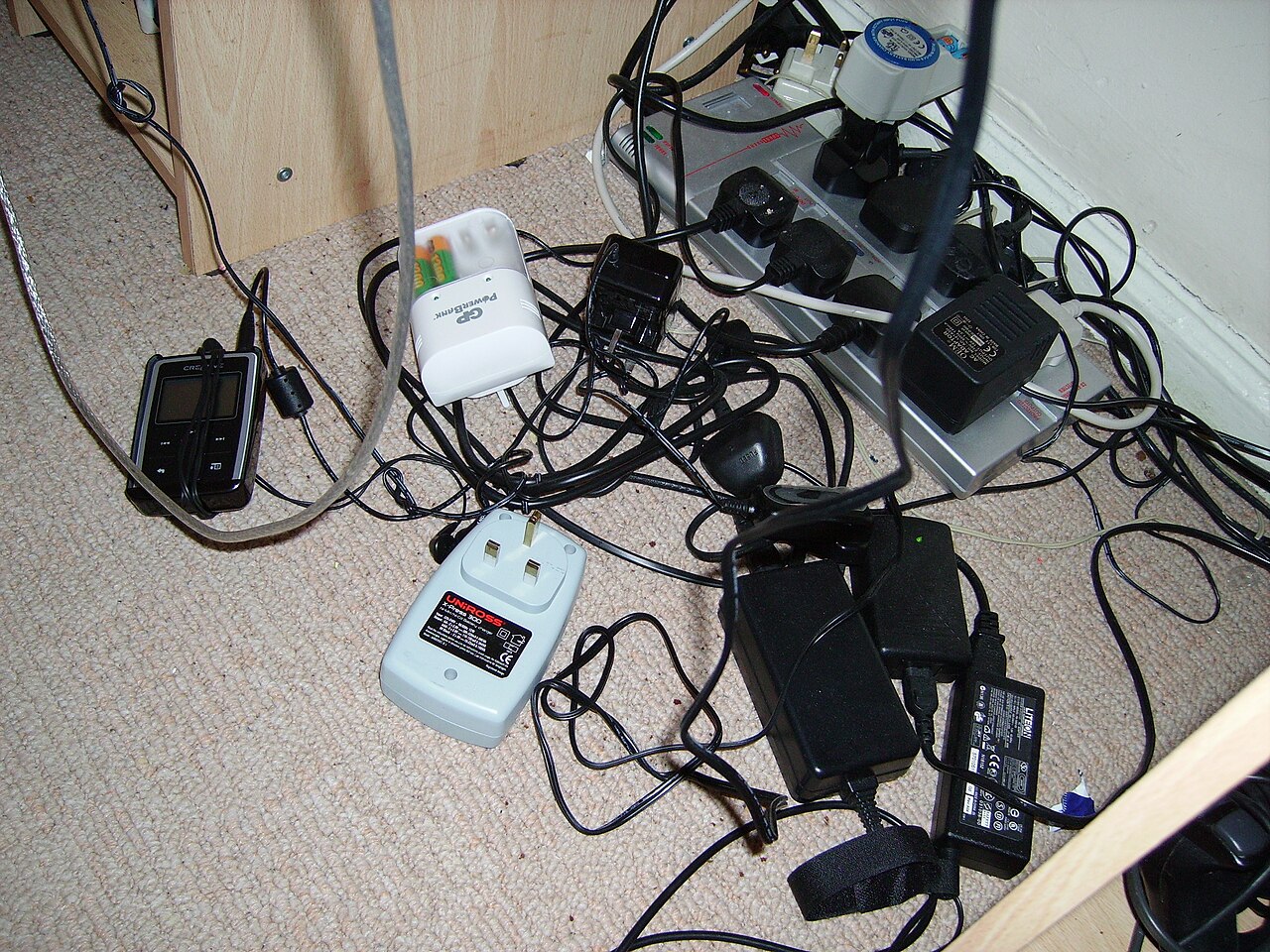
The mistakes that turn a small fault into an expensive one
The first is replacing the socket without finding out why it failed. Age, wear, heat damage and loose connections are possible causes. Replacing the accessory without checking its connections and supply can leave the underlying fault unresolved.
The second is fitting a bigger fuse. A 13 A fuse in a plug that should carry a 3 A one does not make the appliance work better; it removes the protection the flex was designed around. Foil and wire are worse.
The third is adding to a circuit that is already suspect. A spur taken from a socket on a broken ring adds load to the one leg that is still carrying everything, and it is exactly the situation that ends with a burnt joint inside a wall.
The fourth is resetting a device repeatedly. An RCD or RCBO that trips again immediately is reporting a persistent fault. Resetting it ten times does not clear the fault, and it does put the device through unnecessary stress. The pattern of trips and what each one means is covered in RCD keeps tripping.
The fifth is ignoring the pattern. A socket that dies only when the washing machine runs, or only after rain, or only in one room, is telling you where to look. Writing down when it happens is free and it shortens the electrician’s visit.
Part P and what you are allowed to do yourself
In England and Wales, electrical work in dwellings is covered by Part P of the Building Regulations. The requirement itself is short and worth reading in full, because it frames everything else.
Reasonable provision must be made in the design and installation of electrical installations to protect people operating, maintaining or altering them from fire or injury.
The English Approved Document P sets out its notification categories, and the list is narrower than most people assume. It covers the installation of a new circuit, the replacement of a consumer unit, and any addition or alteration to an existing circuit in a special location.
A special location means the zone around a bath or shower and rooms containing a swimming pool or sauna heater. Replacements, repairs and maintenance anywhere are not notifiable.
Changing a socket faceplate is therefore not notifiable. That does not make it a good idea for someone without the knowledge to do it, because notification and competence are different questions, and the work must be completed and verified by someone competent.
Non-notifiable does not mean exempt from testing or from the safety requirements.
If the installation has never been inspected, an EICR is the document that answers the question the socket raised.
Electrical Safety First recommends ten years for owner-occupied homes and five for rentals, with shorter intervals or earlier investigation where condition and the report require them, and a house purchase or a change of tenancy is the usual moment to commission one.
Where the socket feeds an outdoor light, a shed or a garden pump, water ingress is the other common cause of a dead circuit, and waterproof junction boxes explains what a proper outdoor enclosure looks like.
The report records the condition of the installation, the results of the tests, and any observation coded for urgency, which is a far better basis for a decision than replacing accessories one at a time until the problem moves.
Conseil
If a socket dies and you cannot find the cause in ten minutes, write down what you have checked and stop. A note that says “both halves dead, fuse intact, breaker on, lamp dead in that socket, working in the hallway” saves the electrician time and gets you a diagnosis instead of a guess.
Why has one socket stopped working when nothing has tripped?
The most common reasons are a blown fuse in the plug, a switch knocked off on that outlet, a failed accessory where one half of a double socket has died, or an open connection on a radial circuit or spur. A single ring break can instead leave sockets apparently working. Work from the appliance towards the consumer unit, and stop at any sign of heat or smell.
Can a socket be dead if the breaker is still on?
Yes. An open connection, failed accessory or protective device can interrupt the supply without an obvious trip. A single broken ring often leaves sockets working, so it is a different warning rather than a reliable explanation for a dead outlet. A fused connection unit upstream, feeding an outside socket or a shed, can also have blown without anything moving in the consumer unit.
Is it safe to keep using a socket where one half works?
Stop using the faulty accessory and arrange an inspection. A failed contact or switch is possible, including heat damage, but the symptom alone does not prove the cause. Do not keep testing a socket that is hot, scorched, noisy or smells burnt.
Will a plug-in socket tester tell me if the wiring is safe?
Not on its own. Basic indicators have limited fault detection; advanced models can add loop-impedance or supply-polarity functions. None replaces the complete inspection, continuity, insulation, polarity and protective-device verification appropriate to the circuit.
Do I need to notify Building Control to change a socket?
A straightforward like-for-like socket replacement is normally non-notifiable, but must still be safely completed and verified. New circuits and consumer-unit replacements are notifiable. England and Wales have different rules for other alterations, so check the nation and exact scope rather than applying one combined list.
How often should the RCD test button be pressed?
The IET gives six months as the general interval; also follow the device manufacturer’s instructions, including any shorter interval. The button proves that the device operates; it does not prove that the wiring is sound or that your appliances are safe. If the button does not trip the device, or the device will not reset, arrange an electrical inspection.

Théo Desrousseaux
Electrician and editor
I work in the field and edit this magazine. Every guide is reviewed for its target country before publication.
Author → Credentials → Editorial method → Report a factual correction →
No email app? Copy the correction details
Email address and prefilled context:
theo@sparx-elec.fr
Article: https://www.sparx-elec.com/gb/socket-not-working-but-not-tripped/
Edition: GB — English
Factual issue: [describe the factual issue]
Passage: [quote or identify the passage]
Source: [optional source URL]
Sources and references
- 1. IET Wiring Matters — Mythbusters #8: socket-outlets and 30 mA RCD protection Official
- 2. IET Wiring Matters — Changes to RCD testing in BS 7671:2018+A2:2022 Official
- 3. IET Wiring Matters — Mythbuster #11: adapting for change (ring final circuits) Official
- 4. IET — Model forms and guidance for BS 7671 inspection and testing (PDF) Official
- 5. NICEIC — Plug socket not working? These could be the reasons why
- 6. Electrical Safety First — Your questions answered Official
- 7. Martindale Electric — Safely choosing the right socket tester
- 8. legislation.gov.uk — Building Regulations 2010, Schedule 1, Part P Official
- 9. GOV.UK — Electrical safety: Approved Document P Official
- 10. legislation.gov.uk — Electricity Safety, Quality and Continuity Regulations 2002, regulation 27 Official
- 11. Electrical Safety First — Periodic inspection intervals for owner-occupied and rented homes Official
More guides
Practical electrical installation guides, diagnostic methods and tool recommendations compared against the technical wiring standards of this national edition.
RCD test button not tripping
An RCD test button that does not trip means the device failed its own check. What the button proves, the causes, and the checks you can make safely.
Read the guide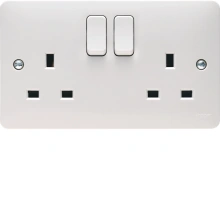 Guide UK 13 amp socket types BS 1363 explained What are the UK 13 amp socket types? Learn the BS 1363 plug, the fuse in the plug, safety shutters, the Type G standard, and how the system works. Read the guide
 Guide Outside socket with RCD: UK rules and choices What does an outside socket with RCD need in the UK? BS 7671 30 mA protection, IP ratings, whether an RCD socket replaces a board RCD, and Part P. Read the guide
 Guide Ring main circuit wiring UK BS 7671 How does a UK ring main circuit work? Learn the BS 7671 433.1.204 rule, the 100 m² limit, the 32 A protection, spurs, and how the circuit is wired. Read the guide