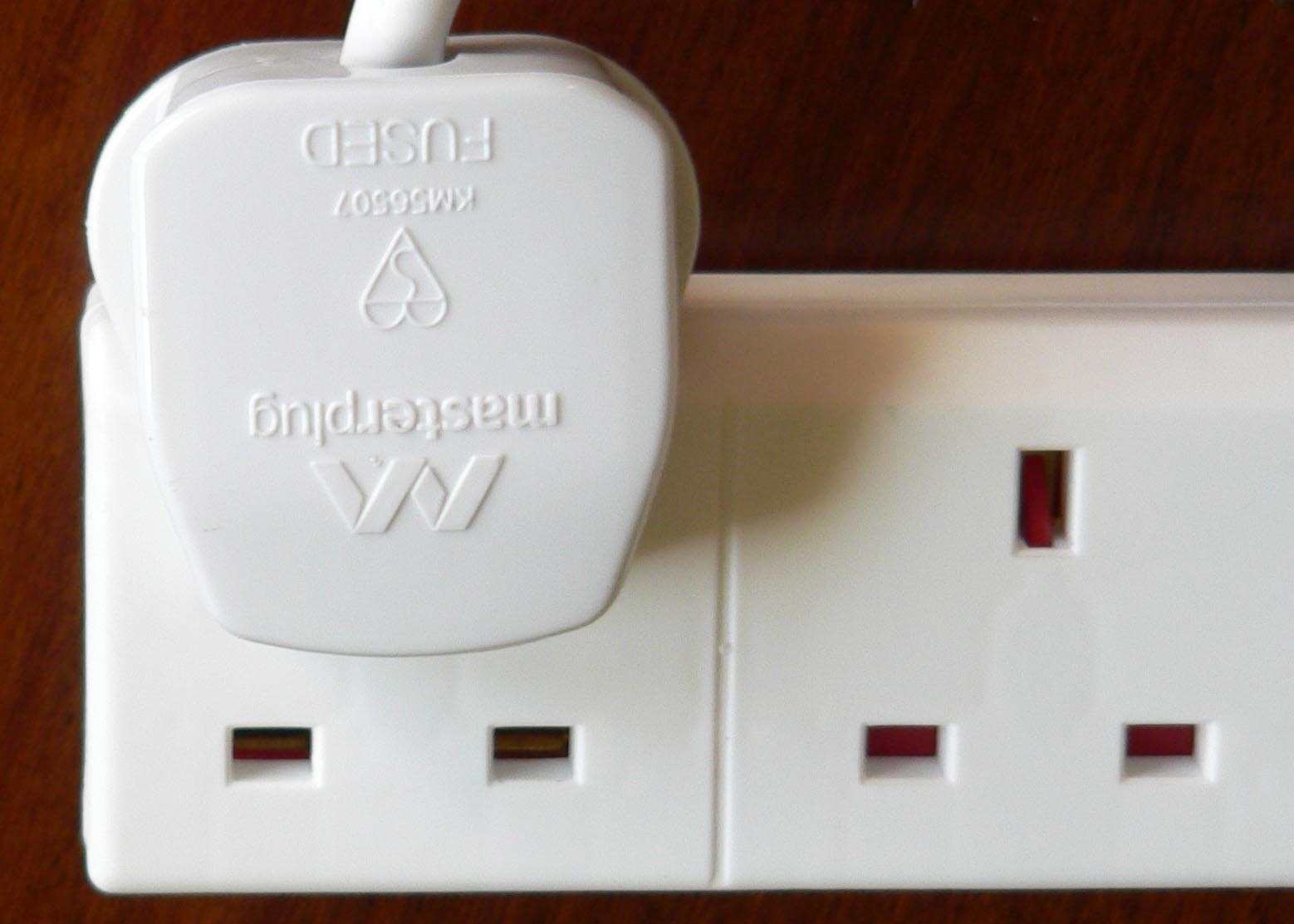
Fuse marking and shutters
The embossed FUSED marking identifies a fused-plug design; it does not prove that a correct fuse is fitted; the empty outlet beside it shows the shuttered contacts; shutter mechanisms vary between socket designs.
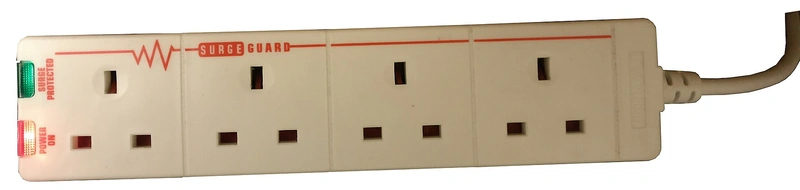 Photo : Dylan Myers, CC BY 4.0, Wikimedia Commons
In brief
A surge protector plug is a 13 A adaptor with a metal-oxide varistor inside and a fuse in front of it. It clips the voltage peak that reaches whatever is plugged into it.
It does nothing at all beyond its own outlets. In a British installation it sits at the far end of a BS 1363 circuit, downstream of the consumer unit, the circuit breaker and the RCD.
That makes it a cheap, useful and genuinely limited device. The mistake that matters is buying one instead of the protection the installation needs, then considering the question closed.
The plug-in unit earns its place in three situations. It is worth fitting in front of one expensive item in a house with no surge protective device at the board. It helps on a socket feeding equipment that generates its own switching noise. And it makes sense as a sacrificial item where a laptop and a bench supply share a trailing lead.
What it is not is a substitute for a Type 2 SPD in the consumer unit, an RCD, an overcurrent device, or a lightning protection system. Those four jobs are separate, and no adaptor the size of a matchbox does any of them.
13 A
fuse in the plug top, shared by every outlet on the adaptor
3,120 W
maximum load at 240 V, across the whole strip
375 J
surge energy rating on a branded three-socket adaptor
775 V
clamping voltage on the same unit
Type 3
position of a plug-in device in the SPD hierarchy
The working part is a varistor, usually a disc of zinc oxide about the size of a coin. Below its threshold voltage it behaves as an insulator.
As the voltage across it rises past that threshold, its resistance collapses and it conducts the surge away. That pulls the peak down before it reaches the appliance.
A second varistor usually sits between neutral and earth, and a third may sit between live and earth, which is what the trade calls three-channel protection. Some units add a gas discharge tube for the largest transients.
Almost all of them add a thermal fuse in series with the varistors. A varistor that fails short circuit then disconnects itself instead of sitting across the supply and overheating.
There is also an indicator lamp wired across the protection circuit, and that lamp is the only diagnostic the device has. It is not a test button. Nothing in a plug-in strip can tell you the residual clamping voltage, and no multimeter will measure it at the socket.
What the adaptor does not contain is any kind of residual current device. Earth leakage, a damaged flex and a shock through a faulty appliance are all outside its scope, unchanged by its presence.
If the circuit has RCD or RCBO protection, that device is still the one that protects people. The adaptor neither adds to it nor interferes with it.
The SPD type describes its tested duty, not just its physical location. Type 1 handles the specified lightning-current impulse; Type 2 deals with the specified surge-current impulse; Type 3 is close-to-equipment protection.
A domestic consumer unit may contain Type 2 or a combined Type 1+2 device, depending on the supply and lightning-protection design. Combined Type 1+2 is not a universal requirement for every house.
A Type 3 device sits close to the load it protects. The same article is explicit that a Type 3 device must only be installed as a supplement to a Type 2 device.
Where several SPDs are used they have to be coordinated under Regulation 534.4.4.5. Devices from different manufacturers need their compatibility confirmed under Regulation 536.4.203.
| Type | Usual position | Test waveform | Typical rating |
|---|---|---|---|
| Type Type 1 | Usual position Origin, main board | Test waveform 10/350 µs | Typical rating Class I |
| Type Type 2 | Usual position Sub-board or consumer unit | Test waveform 8/20 µs | Typical rating Class II |
| Type Type 3 | Usual position Close to the load | Test waveform 1.2/50 µs with 8/20 µs | Typical rating Class III |
The three SPD types as the IET and NICEIC describe them, with the impulse waveforms used to classify them under BS EN 61643-11.
The product standard behind those classes is BS EN 61643-11:2012+A11:2018, and the application guide underneath it is DD CLC/TS 61643-12. A plug-in adaptor sold in the UK is normally a Class III device.
Here is the nuance that gets lost. The Type 3 rule is written for SPDs selected as part of an electrical installation. A plug-in adaptor bought in a shop is not selected that way: it is an accessory, plugged in by whoever owns the appliance.
It is not wrong to use one on its own. It is also not a way of meeting a requirement that applies to the installation.
The IET’s 2023 explanation of BS 7671:2018+A2:2022, Regulation 443.4.1, requires protection against transient overvoltages where the consequence could be serious injury to or loss of human life, failure of a safety service, or significant financial or data loss.
For every other case it still requires protection, unless the owner of the installation declares it is not required because any loss or damage is tolerable and they accept the risk.
The IET’s own commentary notes that the middle indent, failure of a safety service, was deleted by the May 2023 corrigendum. That leaves two grounds that trigger a mandatory SPD and a general default covering everything else.
Regulation 443.4.2 adds the other side of the argument: protection must be considered where equipment likely to produce switching overvoltages is installed, judged against the rated impulse voltage in Table 443.2.
The IET points out that the classic domestic sources are no longer only industrial. Electric vehicle charging, air and ground source heat pumps, and speed-controlled washing machines all make transients more likely inside a house than they were thirty years ago.
None of that is discharged by a £10 strip in a bedroom. The regulation is about the installation, and the decision it forces is a decision about the consumer unit.
One date matters when you read any of this. Amendment 4 (2026) was published by the IET and BSI on 15 April 2026, and the previous edition, BS 7671:2018+A2:2022+A3:2024, was withdrawn six months later.
The amendment adds a chapter on stationary secondary batteries, a section on Power over Ethernet, and changes to the medical locations section. Surge protection is not restructured by it, but the edition a certificate quotes now tells you which text was applied.
A branded three-socket adaptor on sale in the UK quotes 375 joules of maximum surge energy, 13,500 amps of maximum current and a 775 volt clamping voltage. Those three numbers describe three different things.
The clamping figure concerns voltage limitation under specified test conditions. It is not the only relevant selection characteristic. The joule figure is the energy the varistor can absorb before it is damaged, measured in the manufacturer’s own test.
A larger number means a bigger or more numerous varistor stack, which costs more to make and takes more space. It does not mean the device clamps better, and it says nothing about how long it lasts at a given surge level.
The amp figure is a peak current used in a test, usually an 8/20 µs waveform. It is a survivability number, not a let-through number.
Brennenstuhl, who make both types of product, makes the same point in their own technical note: amperes and joules are different quantities and comparing them head to head tells you very little.
Clamping voltage is the one that matters to your equipment. It is the voltage that still appears downstream while the device is conducting.
At 775 V, a surge that would otherwise have arrived at several thousand volts arrives at a few hundred above the normal peak of the mains. A lower declared protection level can be useful when comparing like test conditions. Discharge capability, coordination, installation and the equipment’s withstand voltage must also be considered.
A BS 1363 plug contains a cartridge fuse to BS 1362, and the 13 A version is what a three-socket adaptor carries. Thirteen amps at 240 volts is 3,120 watts, and that is the stated 240 V example for the whole strip. At 230 V, 13 A corresponds to 2,990 W; follow the actual product marking and current limit.
The fuse is a slow device and it is worth knowing how slow. BS 1362 requires the fuse to dissipate no more than one watt at its rated current.
It must carry 1.6 times its rating, which is 20.8 A for a 13 A fuse, for at least thirty minutes without blowing. It must blow within thirty minutes once the current passes 1.9 times the rating, which is 24.7 A.
On a hard fault of a hundred amps it operates in between a hundredth and three tenths of a second. Two practical consequences follow.
The first is that the fuse will not save you from a 15 A load: it will sit there getting warm. Adding up the appliances is the only reliable check, and Electrical Safety First publishes an overload calculator for exactly that reason.
The second is that the fuse protects the adaptor and its flex, not the appliance on the end. An appliance with its own 3 A or 5 A plug fuse is protected by that fuse.
There is a counterfeit problem here too. Twenty amp fuses marked as BS 1362 are sold online and are not compliant with the standard. Fitting one to stop a 13 A fuse blowing defeats the protection and turns a warm plug into a hot one.
It does not protect the fixed wiring. That is the job of the circuit breaker or RCBO, and a plug-in device has no influence on it. A ring final circuit is protected at the board, not at the socket.
It does not protect appliances plugged into other sockets, on the same circuit or anywhere else in the house. Protection is per outlet, and the strip only knows about its own.
It does not protect against a surge arriving on a telephone line, a coaxial cable or an aerial downlead. The IET makes the point that a surge can enter by any incoming service.
It does not protect the building from lightning. Risk management for direct and nearby strokes is BS EN 62305-2, and a plug-in strip is not part of that assessment in any meaningful way.
And it does not repair a bad socket. A loose outlet, a scorched faceplate or a plug that rocks is an installation fault: the heat comes from a poor contact, not from a transient.
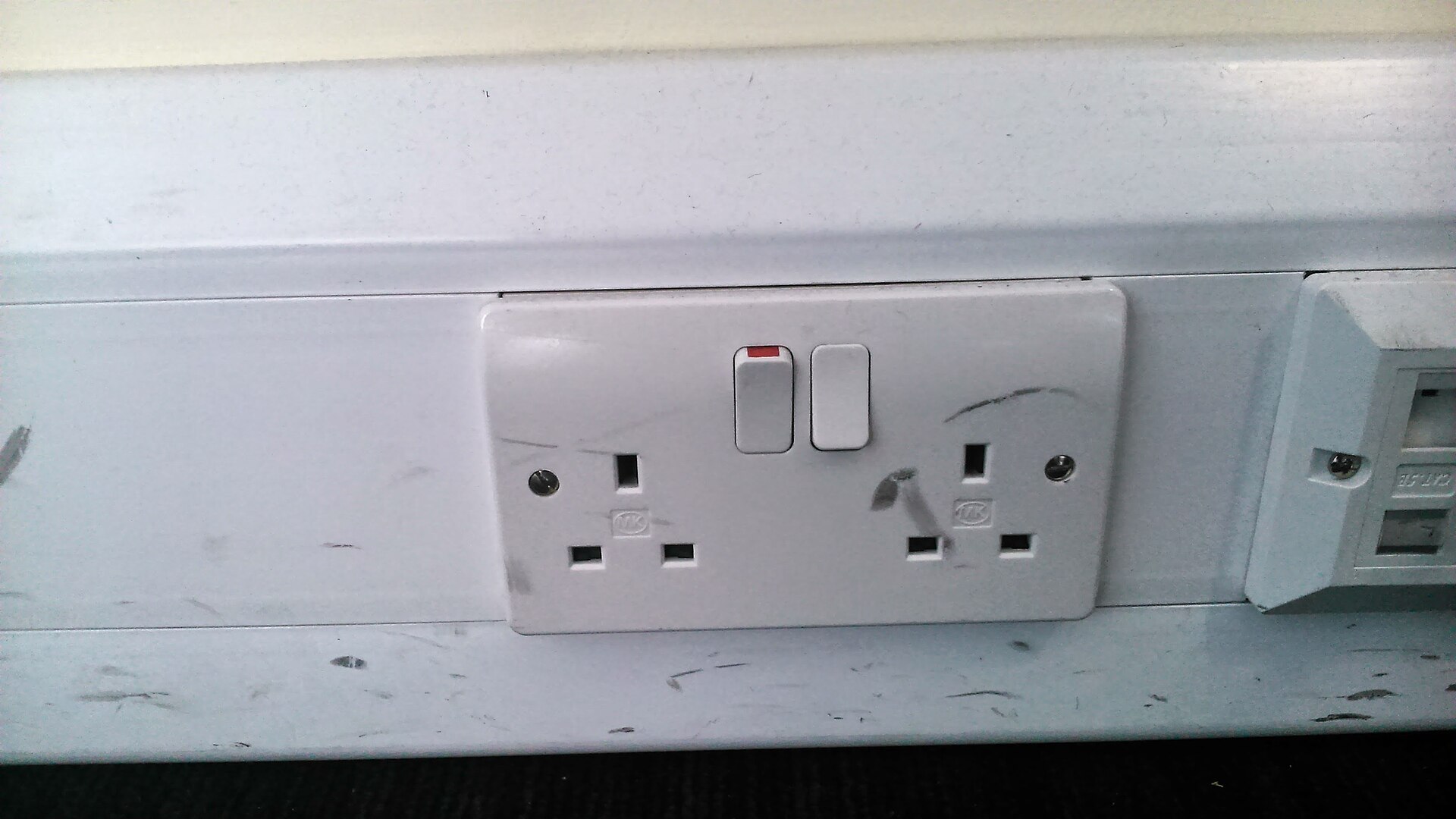
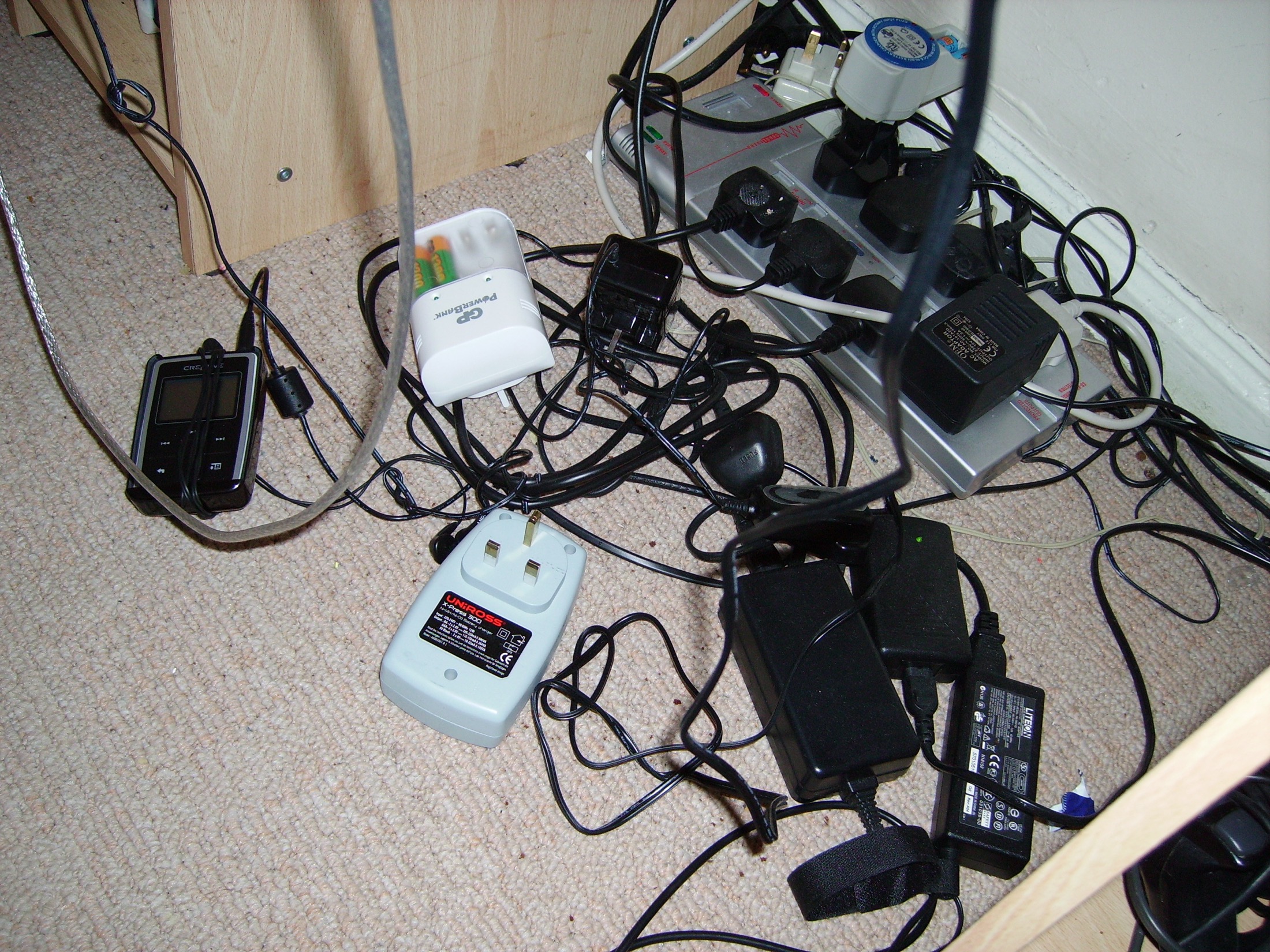
Electrical Safety First is direct about it: use only one socket extension device per socket, and never plug an extension lead into another extension lead. The practice is called daisy chaining and it is described as a serious risk of overloading the wall socket.
The electrical reason is straightforward. The first device’s 13 A fuse protects everything downstream of it, so a second strip plugged into the first shares that same 13 A. The second strip’s own fuse does not raise the limit.
Each additional joint also adds contact resistance in a path already carrying the full load. The mechanical reason is just as real: a three-socket adaptor with three plugs in it puts a lever on the outlet, and the pins take a load they were never designed for.
Cable reels deserve their own line. They are rated according to the cable fitted, they must be fully unwound to achieve that rating, and they should have a thermal cut-out. A reel run coiled at 13 A has nowhere to put the heat.
Varistors wear out. Every surge takes a little of the material with it, and after enough of them, or after one large event, the disc degrades and the thermal fuse takes it out of circuit. That is the designed behaviour, and it happens silently.
Indicator arrangements vary. A power lamp may only show that supply is present; a separate protection-status lamp reports the state defined by the manufacturer.
Some designs keep powering outlets after the protective element disconnects, while others cut the supply. Read the exact instructions instead of assuming every product has two lamps or always becomes an ordinary extension lead.
There is no reset, no test button and no field repair. Some industrial SPDs have replaceable cartridges that restore the device; consumer adaptors almost never do.
Age matters as much as events. A strip that has sat behind a desk for a decade has absorbed years of small transients and is closer to the end of its life than its appearance suggests.
Fuse marking and shutters
The embossed FUSED marking identifies a fused-plug design; it does not prove that a correct fuse is fitted; the empty outlet beside it shows the shuttered contacts; shutter mechanisms vary between socket designs.
The order of operations matters more than the product choice. Check the socket first, count the load second, and only then decide whether the strip is the right answer at all.
Inspect the socket
Look for discolouration, a loose faceplate, a plug that rocks or a warm surface. Any of those is a fault to be fixed, not a reason to add an adaptor.
Add up the load
A kettle at 3 kW already fills a 13 A adaptor on its own. A laptop, a monitor and a lamp together are well under 500 W.
Plug straight into the wall
One device per socket, no daisy chains, and no strip hanging from a cable that is under tension.
Read the status indication
Identify the power and protection indications provided on the actual product, and follow the manufacturer’s explanation of a failed status.
Keep it ventilated
An adaptor behind a sofa or under a rug has no airflow, and the fuse dissipates heat by design.
Act on a failed protection indication
Follow the manufacturer’s replacement instructions. Also stop using a device with damage, overheating or loose contacts, even if its lamp is lit.
A compliant adaptor declares its standards, and the declaration is worth reading rather than assuming. BS 1363-2 covers the socket outlets, BS 5733 covers general accessories, and BS EN 61643-11 covers the surge protection itself. A product that names none of them has nothing to declare.
The fuse should be a 13 A cartridge to BS 1362, replaceable, and marked as such. The load rating should be stated in watts as well as amps, because 3,120 W is easier to check against a row of appliance labels than 13 A.
The 2023 revision of the BS 1363 series tightened several details that matter here. Brass current-carrying parts must now contain at least 58 per cent copper, and the scope runs from 50 Hz to 60 Hz.
Non-rewireable plugs also gained a creepage and clearance requirement between the fuse and the clips. Those are precisely the dimensions a counterfeit plug gets wrong.
Buy from a reputable retailer rather than a third-party marketplace seller, and register the product. Electrical Safety First gives both pieces of advice for the same reason: a product that has not passed the safety checks, and a recall you never hear about.
The three shapes sold in the UK do the same electrical job and differ only in how many outlets they cover. A single plug-top protector is a 13 A plug with a varistor inside and one socket on the front, and it protects one appliance only.
A three-socket adaptor plugs straight into the wall and covers three appliances at once. It is the most common shape, it carries its whole load on the outlet, and it is the version that quotes 375 J.
A four-gang strip on a short lead spreads the load across a desk. It is also the shape that most often ends up daisy chained, because the lead invites a second strip at the far end.
None of the three changes the 13 A ceiling. Three appliances on a three-socket adaptor still share 3,120 W, and a strip with a lead carries exactly the same limit as an adaptor without one.
What changes is the mechanical load. A plug-top unit hangs its weight directly on the wall socket, so the pins and the shutter assembly take the strain. A strip on a lead puts that weight on the floor and leaves the plug in the wall carrying only its own cable.
That is a small engineering point with a real consequence. Heavy adaptors can strain contacts and mounting points. Overloading and poor connections are also possible causes of overheating; appearance alone does not rank their frequency.
A branded three-socket surge-protected adaptor with individually switched outlets is not an expensive item. The Masterplug MSWRG3 is listed at £10.47 by a UK trade retailer, falling to £9.95 each at ten units.
It declares 375 J, 13,500 A, 775 V, a 3,120 W maximum load, a replaceable 13 A fuse and a £1,000 connected equipment warranty.
The warranty is worth reading rather than trusting. It is a commercial promise with conditions attached, usually requiring the device to have been used within its rating and the claim to be supported by evidence. It does not turn a £10 accessory into installation protection.
A Type 2 SPD fitted inside the consumer unit is a different purchase with a different scope. It is bought with the board work, it protects every circuit fed from that board, and it is the device Regulation 443.4.1 is talking about.
If the consumer unit is being replaced or extended, a Type 2 SPD belongs in the conversation. That is true in a new installation, after a home EV charger is added, where a heat pump or a solar inverter has appeared, and in any house with a home office whose data loss would count as significant.
If the board is not being touched, a plug-in strip in front of one expensive item is a reasonable, honest compromise. It is not compliance and it is not coordination, and it costs a tenner.
Part P of the Building Regulations is not engaged by a plug-in adaptor, because the adaptor is not part of the electrical installation. It is engaged when fixed wiring changes.
A new circuit is notifiable in England, and adding a socket to an existing circuit generally is not unless it sits in a special location. The rules for an outside socket set out how that works in practice.
No. It protects only the outlets on the adaptor, and only against transients that arrive through that one socket. Everything else on the circuit, and every surge arriving by another route, is unaffected.
Not by itself. A joule rating describes energy handling under specified conditions; it does not rank all products. Compare voltage protection level, discharge capability, test conditions and installation instructions. Clamping voltage is not a guarantee of the voltage that every connected appliance will experience.
No. Electrical Safety First is clear that you should use one extension device per socket and never daisy chain, because the first device's 13 A fuse covers everything downstream of it and the wall socket can be overloaded.
Use the manufacturer’s status indication. Some models retain power after protection is lost and others disconnect it. Replace a device with a failed protection indication as instructed, and do not infer full protection merely from an illuminated power lamp.
No. Regulation 443.4.1 applies to the installation and is answered at the board by a Type 2 device. A plug-in unit is a Type 3 device and the IET describes those as a supplement, not a substitute.
No. A surge protector limits certain transient overvoltages; it does not solve overloads or appliance faults. Keep within the product’s marked load rating. A fuse that repeatedly operates needs investigation, never substitution with a higher rating or foil.

Théo Desrousseaux
Electrician and editor
I work in the field and edit this magazine. Every guide is reviewed for its target country before publication.
Author → Credentials → Editorial method → Report a factual correction →
Email address and prefilled context:
theo@sparx-elec.fr
Article: https://www.sparx-elec.com/gb/surge-protector-plug/
Edition: GB — English
Factual issue: [describe the factual issue]
Passage: [quote or identify the passage]
Source: [optional source URL]
Sources and references
Practical electrical installation guides, diagnostic methods and tool recommendations compared against the technical wiring standards of this national edition.
What does an outside socket with RCD need in the UK? BS 7671 30 mA protection, IP ratings, whether an RCD socket replaces a board RCD, and Part P.
Read the guide Guide UK 13 amp socket types BS 1363 explained What are the UK 13 amp socket types? Learn the BS 1363 plug, the fuse in the plug, safety shutters, the Type G standard, and how the system works. Read the guide
 Guide RCBO vs RCD difference UK consumer unit What is the difference between an RCBO and an RCD? Learn what each device protects, why RCBOs trip less, the cost in the UK, and which to choose. Read the guide
 Guide RCD keeps tripping causes Why does an RCD keep tripping? Learn the common causes, the 30 mA threshold, the six-month test rule, and how to diagnose the fault safely. Read the guide