UK 13 amp socket types BS 1363 explained
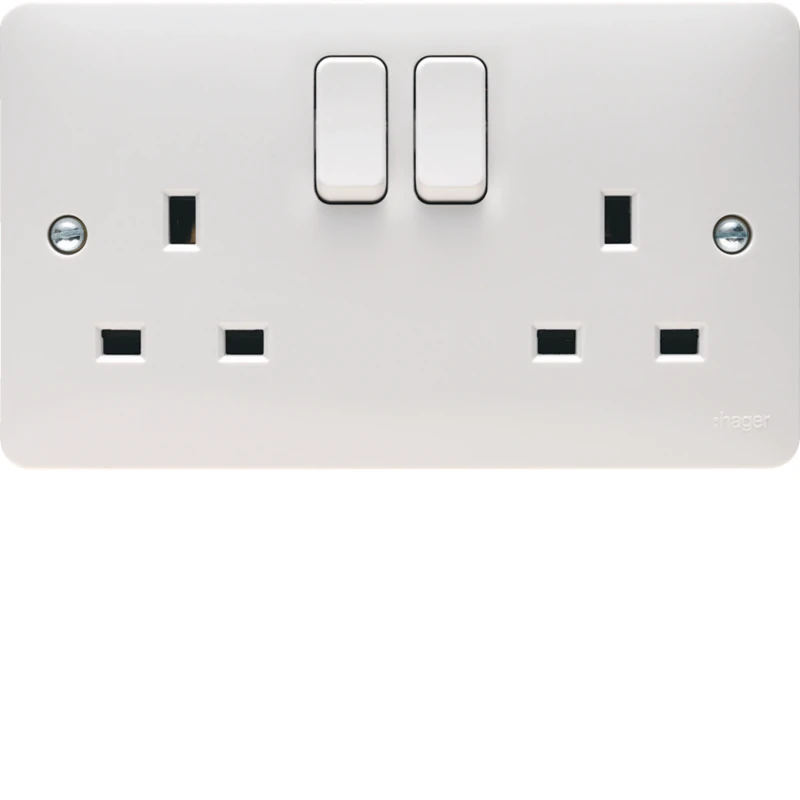 Photo : Hager UK
 In brief
- The BS 1363 13 A plug has two horizontal rectangular pins for live and neutral and a larger vertical earth pin above them.
- A BS 1363 plug carries a user-replaceable fuse from 1 A to 13 A, a distinctive feature compared with the older round-pin BS 546 family.
- BS 1363 sockets have safety shutters behind the holes and often a socket switch; the plug corresponds to Type G in the IEC table.
- The UK mains supply is 230 V, and the BS 1363 system is the dominant single-phase socket system in the country.
- Older BS 546 round-pin sockets and low-power BS 4573 shaver sockets still exist alongside the dominant BS 1363.
The UK 13 amp socket system is built around one standard: BS 1363. A BS 1363 plug has two horizontal rectangular pins for live and neutral, and above them a larger vertical pin for earth. The plug carries a user-replaceable fuse, and the socket has safety shutters behind the holes. This is the dominant single-phase socket system in the United Kingdom, and it corresponds to Type G in the IEC table.
The direct answer to the question in the title is that the UK has one dominant 13 A socket type, BS 1363, with a fuse in the plug and rectangular pins, plus two older families that still exist: the round-pin BS 546 and the low-power BS 4573 shaver socket. Understanding the BS 1363 system explains how most UK sockets work and why they look the way they do.
13 A
maximum rating of the BS 1363 socket
2
horizontal rectangular pins for live and neutral
1 A-13 A
user-replaceable fuse range in the plug
230 V
UK mains supply voltage
The BS 1363 plug
The BS 1363 plug is the heart of the UK system. It has two horizontal, rectangular pins for line and neutral, and above these pins, a larger, vertical pin for an earth connection. Both line and neutral carry current, and the earth pin is the larger and longer pin at the apex of the triangular arrangement.
The rectangular pin shape is a distinctive feature. The older BS 546 family uses round pins, while BS 1363 uses square or rectangular pins. The rectangular shape, combined with the fuse in the plug, is what makes the BS 1363 plug immediately recognisable.
The earth pin is longer than the live and neutral pins. This is deliberate: the earth pin makes contact first when the plug is inserted, and it also opens the safety shutters in the socket before the live and neutral pins reach the contacts.
| Feature | BS 1363 (13 A) | BS 546 (round pin) |
|---|---|---|
| Feature Pin shape | BS 1363 (13 A) Rectangular | BS 546 (round pin) Round |
| Feature Fuse in plug | BS 1363 (13 A) Yes, 1 A to 13 A | BS 546 (round pin) No |
| Feature Safety shutters | BS 1363 (13 A) Yes | BS 546 (round pin) Yes |
| Feature IEC type | BS 1363 (13 A) Type G | BS 546 (round pin) Types D and M |
| Feature Status | BS 1363 (13 A) Dominant | BS 546 (round pin) Older, still present |
The two main British plug families compared (Wikipedia).
The fuse in the plug
A distinctive characteristic of the BS 1363 plug is the user-replaceable fuse, from 1 A to 13 A. The fuse protects the appliance cable, not the socket circuit. Because the socket itself is rated at 13 A, the fuse in the plug is sized to the appliance, so a low-power device uses a 3 A fuse and a high-power device uses a 13 A fuse.
The fuse is a safety feature that the round-pin BS 546 family does not have. It means that a fault in the appliance or its cable blows the fuse in the plug rather than tripping the circuit breaker or damaging the socket. Replacing the fuse is a simple task, but it must be done with the correct rating for the appliance.
Safety shutters and socket switches
A distinctive characteristic of the BS 1363 socket-outlet is the protective safety shutters behind the socket holes. The shutters only open when the earth pin is inserted, which prevents children from pushing objects into the live and neutral holes. This is a key safety feature of the UK system.
BS 1363 sockets often also have a socket switch. The switch isolates the socket from the supply, so an appliance can be unplugged or left connected without drawing power. The combination of shutters and switches makes the UK socket one of the safest domestic socket systems in the world.
The older BS 546 and BS 4573 families
The BS 1363 system is not the only one in the UK. The older BS 546 family uses round pins and comes in several sizes, and it still exists in some older installations and in some former British territories. The BS 4573 shaver plug is a low-power, 0.2 A design used for electric shavers.
Shaver supply units typically accept a variety of 230 V two-pin plug types, including BS 4573, Europlugs and Australian plugs, and are protected by the BS EN 61558-2-5 safety standard to protect against shock in wet areas. These units are common in bathrooms, where the isolation transformer provides additional safety.
The practical point is that while BS 1363 dominates, an electrician working in the UK will still encounter the older families, especially in older properties and in specific applications like shaver sockets.
How the system is regulated
The British plug and socket system is regulated by British Standards. The BS 1363 standard defines the 13 A socket-outlet system and connection units, and it is the dominant type of single-phase socket-outlet system in the UK. The standard specifies the contact dimensions, the fuse, and the safety features.
The BS 1363 system was introduced for post-war reconstruction as a newer alternative to the BS 546 plugs and sockets. It has remained the standard ever since, and its safety features have made it a model for socket systems around the world.
Working on a UK socket safely
Working on a UK socket follows the same safety rules as any electrical work. Cut the circuit at the consumer unit and verify there is no voltage before touching the socket. The BS 1363 socket is wired with the earth, live and neutral conductors, and the connections are checked at the screw terminals.
A poor connection is the most common cause of a socket overheating. Loose strands, an undertightened terminal, or a damaged conductor core all create resistance that heats up under load. The conductors should be inspected before reconnecting, and any damaged core should be repaired.
Choosing the right fuse
The fuse in a BS 1363 plug must match the appliance. A 3 A fuse is typical for low-power devices such as lamps, phone chargers and radios. A 13 A fuse is typical for high-power devices such as kettles, heaters and washing machines. Using a fuse that is too high leaves the appliance cable unprotected.
The fuse rating is printed on the fuse itself, and the appliance instructions usually state the correct rating. When in doubt, a lower fuse rating is safer than a higher one, because it protects the cable more effectively. The fuse is a replaceable part, and it should always be replaced with the correct rating.
How the earth pin opens the shutters
The earth pin in a BS 1363 plug does more than carry the earth connection. Because it is longer than the live and neutral pins, it makes contact first when the plug is inserted, and it also opens the safety shutters in the socket. The shutters only open when the earth pin is present, which is the mechanism that stops children from inserting objects into the live and neutral holes.
This design means the live and neutral contacts are never exposed while the shutters are closed. The earth pin acts as a key that unlocks the socket. It is a simple mechanical solution that has proven extremely effective over decades of use.
The same principle applies to the BS 546 round-pin family, which also has safety shutters behind the socket holes. The shutter mechanism is one of the defining safety features of the British socket system, and it is one of the reasons the system is copied around the world.
The triangular pin arrangement
The pins of both the round-pin and rectangular-pin plugs are arranged in a triangular fashion, with the earth pin being the larger and longer pin at the apex. This arrangement is polarised, meaning the plug can only be inserted one way, which ensures the live and neutral connections are always made correctly.
The polarisation matters for safety. A socket that is wired with the live and neutral in the correct orientation keeps the switched live on the correct side, and it ensures that a single-pole switch or fuse always disconnects the live conductor. The triangular arrangement makes it impossible to insert the plug the wrong way.
The earth pin being longer also means that the earth connection is established before the live and neutral contacts are made. If there is a fault, the earth path is already in place when power is applied, which is a fundamental safety principle of the system.
The history of the British plug system
Plugs and sockets for electrical appliances in the United Kingdom originated in the 1870s and were initially two-pin designs. These early designs were sold as a mating pair, and the system evolved over the following decades as the regulations developed.
The BS 1363 system was introduced for post-war reconstruction as a newer alternative to the BS 546 plugs and sockets. The rectangular-pin design with the fuse in the plug was a deliberate improvement, and it quickly became the dominant system. The BS 546 family remained in use for some applications, and it is still found in some older installations and in former British territories.
The history explains why the UK has more than one socket type. The BS 1363 is the modern standard, but the older families have not completely disappeared. An electrician working in an older property will still encounter them.
The BS 8546 travel adaptor standard
Alongside the domestic standards, the BS 8546 standard covers travel adaptors compatible with the UK plug and socket system. A travel adaptor allows a foreign plug to be used with a UK socket, and the standard ensures that these adaptors meet safety requirements.
The existence of the travel adaptor standard reflects the international use of the UK system. The BS 1363 plug is used not only in the UK but in many former British territories, and travellers need adaptors that are safe and compliant. The standard covers the mechanical and electrical requirements for these adaptors.
How the socket is wired
A BS 1363 socket is wired with three conductors: earth, live and neutral. The earth conductor connects to the earth terminal, the live conductor to the live terminal, and the neutral conductor to the neutral terminal. The connections are made at screw terminals, and the quality of the connection is critical.
A poor connection is the most common cause of a socket overheating. Loose strands, an undertightened terminal, or a damaged conductor core all create resistance that heats up under load. The conductors should be inspected before reconnecting, and any damaged core should be repaired.
The socket mechanism is mounted in a back box in the wall, and the faceplate is fixed over it. The earth connection is often made to the back box as well as to the socket, providing a continuous earth path for the metalwork.
Common problems with UK sockets
The most common problem with a UK socket is a loose connection that causes heat. This usually shows as discolouration or a burning smell around the socket, and it should be treated as urgent. The socket should be isolated and inspected before further use.
The second common problem is a worn or damaged socket that no longer holds the plug firmly. A plug that falls out or wobbles is a sign that the socket contacts are worn, and the socket should be replaced.
The third problem is a socket that has been overloaded. While a single BS 1363 socket is rated at 13 A, using adaptors to run several high-power appliances from one socket can exceed the rating. The socket and its circuit should be checked to ensure the load is within limits.
Why the UK system is considered safe
The UK socket system is widely considered one of the safest in the world, and the reasons are built into the design. The fuse in the plug protects the appliance cable. The safety shutters prevent access to live contacts. The polarised triangular arrangement ensures correct connection. And the longer earth pin makes the earth connection before power is applied.
Each of these features addresses a specific risk, and together they provide a level of protection that many other systems do not match. The system has been refined over decades, and its safety record is the result of that design.
The practical consequence is that a correctly installed and maintained UK socket is a very safe device. The risks come from poor installation, damaged components, or misuse, not from the design of the system itself.
The role of the socket switch
The socket switch on a BS 1363 socket is more than a convenience. It isolates the socket from the supply, so an appliance can be unplugged or left connected without drawing power. This reduces standby power and makes it safe to insert or remove a plug without switching the appliance off first.
The switch also provides a clear visual indication of whether the socket is live. A socket with the switch off is isolated, which is useful when working on an appliance or when leaving the home for a long period. The switch is a simple feature that adds both safety and convenience.
Not all BS 1363 sockets have switches, but they are common in UK homes. The switched socket is the standard choice for most installations, and the switch is wired to disconnect the live conductor.
The difference between a socket and a connection unit
A BS 1363 socket is designed to accept a plug. A connection unit, or FCU, is a related device that provides a fused outlet for a fixed appliance, such as an extractor fan or a cooker hood. The connection unit has a fuse, like the plug, but it does not accept a plug.
The distinction matters because a fixed appliance is wired directly to the connection unit rather than plugged in. The fuse in the connection unit protects the appliance cable, in the same way the fuse in a plug protects a portable appliance cable.
The BS 1363 standard covers both the socket-outlet system and the connection units, which is why the standard is described as covering the 13 A socket-outlet system and connection units.
How to check a socket is working correctly
A quick check of a UK socket can be done without opening it. Insert a plug and confirm it is held firmly, with no wobble. Switch the socket on and confirm the appliance works. Feel the faceplate for any unusual heat after the appliance has been running for a few minutes.
A more thorough check requires the socket to be isolated and opened. The connections should be inspected at the screw terminals, and the conductors checked for damage. Any sign of heat, discolouration or a burning smell means the socket should be replaced.
The socket should also be checked as part of the periodic inspection of the installation. The inspection tests the socket for correct wiring, earth continuity and polarity, and it records the results on the electrical installation condition report.
The importance of correct polarity
Polarity is the correct connection of the live and neutral conductors. In a correctly wired socket, the live conductor is connected to the live terminal and the neutral to the neutral terminal. The polarised design of the BS 1363 plug ensures the appliance is always connected the correct way.
Incorrect polarity is a fault that can leave an appliance live even when it appears to be switched off. It is one of the faults checked during an electrical inspection, and it must be corrected if found. The triangular pin arrangement of the BS 1363 system makes it impossible to insert a plug the wrong way, but the socket itself must still be wired correctly.
The international reach of the UK system
The BS 1363 system is used not only in the United Kingdom but in many former British territories, including parts of the Caribbean, Africa, the Middle East and Asia. The system is also used in some countries that adopted it for historical reasons.
The international reach means that the BS 1363 plug is one of the most widely recognised plug types in the world. It also means that the safety features of the system, the fuse in the plug and the safety shutters, are protecting people in many countries, not just in the UK.
For a traveller, the Type G plug is the one to know when visiting the UK and many other countries that use the system. A travel adaptor is needed for plugs from other systems, and the BS 8546 standard covers the safety of these adaptors.
When to replace a UK socket
A UK socket should be replaced when it shows signs of damage or wear. Cracks in the faceplate, discolouration from heat, a plug that no longer fits firmly, or a switch that feels loose are all reasons to replace the socket.
A socket should also be replaced if it has been exposed to water or if it has been the source of a burning smell. These are signs of a fault that could be dangerous, and the socket should be isolated and replaced rather than repaired.
Replacing a socket is a straightforward job for a competent electrician, but it must be done with the circuit isolated and the correct replacement fitted. The new socket should be a BS 1363 unit that meets the current standard.
What is a UK 13 amp socket called?
The UK 13 amp socket is the BS 1363 socket, and it corresponds to Type G in the IEC table. It has rectangular pins, a fuse in the plug, and safety shutters behind the holes.
Why does a UK plug have a fuse?
The fuse in the plug protects the appliance cable, not the socket circuit. Because the socket is rated at 13 A, the fuse is sized to the appliance, from 1 A to 13 A, so a fault in the appliance blows the fuse rather than damaging the socket.
What voltage is a UK socket?
The UK mains supply is 230 V. The BS 1363 socket is rated at 13 A, which gives a maximum power of about 3 kW for a single socket.
Are UK sockets safe?
Yes. BS 1363 sockets have safety shutters behind the holes that only open when the earth pin is inserted, and often a socket switch. These features make the UK socket one of the safest domestic socket systems in the world.
What fuse should I use in a UK plug?
Use a 3 A fuse for low-power devices such as lamps and chargers, and a 13 A fuse for high-power devices such as kettles and heaters. The rating is printed on the fuse, and the appliance instructions usually state the correct value.
Théo Desrousseaux
Electrician and editor
I work in the field and edit this magazine. Every guide is reviewed for its target country before publication.
Author → Credentials → Editorial method → Report a factual correction →
No email app? Copy the correction details
Email address and prefilled context:
theo@sparx-elec.fr
Article: https://www.sparx-elec.com/gb/uk-socket-types-13a/
Edition: GB — English
Factual issue: [describe the factual issue]
Passage: [quote or identify the passage]
Source: [optional source URL]
More guides
Practical electrical installation guides, diagnostic methods and tool recommendations compared against the technical wiring standards of this national edition.
RCBO vs RCD difference UK consumer unit
What is the difference between an RCBO and an RCD? Learn what each device protects, why RCBOs trip less, the cost in the UK, and which to choose.
Read the guide Guide Ring main circuit wiring UK BS 7671 How does a UK ring main circuit work? Learn the BS 7671 433.1.204 rule, the 100 m² limit, the 32 A protection, spurs, and how the circuit is wired. Read the guide
  Guide RCD keeps tripping causes Why does an RCD keep tripping? Learn the common causes, the 30 mA threshold, the six-month test rule, and how to diagnose the fault safely. Read the guide
  Guide Best multimeter for electricians UK What is the best multimeter for electricians in the UK? Compare the Fluke 87V, Fluke 117, Klein MM700 and Brymen BM235, with prices, CAT ratings and True RMS. Read the guide