Read the device position
Check the ON, OFF or trip indicator. Do not reset an unexplained fault or a damaged installation merely to perform a test.
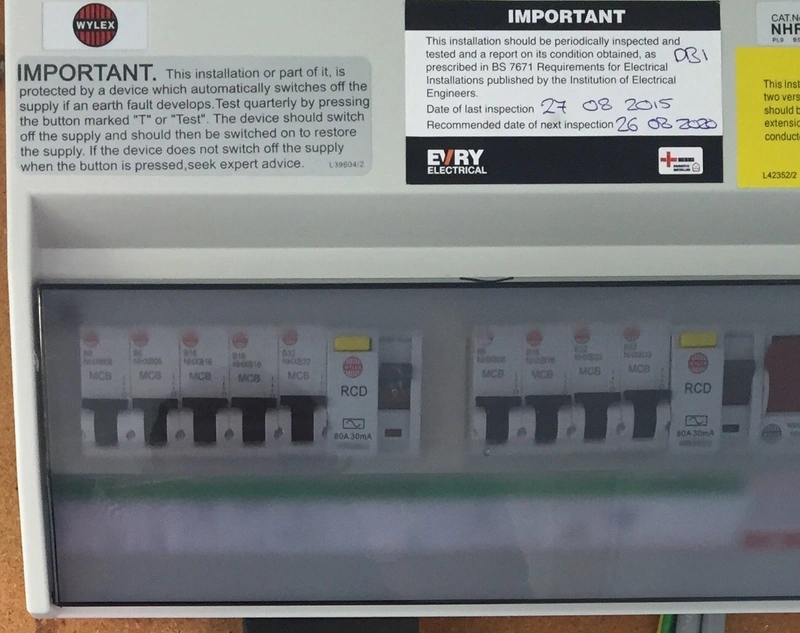 Photo : Wikimedia Commons — Evry Electrical (CC BY 4.0)
In brief
An RCD test button that does not trip is not a cosmetic fault. It is the device telling you that the mechanism which is supposed to disconnect the supply on an earth fault has just failed to operate when it was asked. Until that is investigated, treat the circuit it protects as having no residual current protection at all.
That is a stronger statement than most people expect, because the test button feels like a secondary feature, something you press twice a year to be conscientious. It is not. The button is the manufacturer’s own functional check, and it is the only part of an RCD’s performance a householder can verify without instruments.
This article covers what the button actually does inside the device, why it can stop working while the RCD still looks perfectly normal, which checks are safe for you to make, and where the boundary sits between “press it again” and “call an electrician today”. It deliberately deals with the silent failure.
An RCD that keeps tripping is a different problem with a different diagnosis.
Press the button and you close a small contact inside the RCD that routes a limited current around the sensing coil instead of through it. The coil now sees more current leaving than returning, exactly as it would if someone touched a live conductor, and it trips.
The resistor that sets this test current is inside the device, sized by the manufacturer so the resulting imbalance comfortably exceeds the rated residual operating current.
Two consequences follow, and both matter for diagnosis.
The first is that the button needs a supply to work. It is not a mechanical lever that forces the contacts apart. The test circuit draws its current from the line side of the RCD, so a device sitting in a board with no supply, or with a missing neutral connection on some models, will not trip however hard you press.
That is why a dead board is not evidence of a dead RCD.
The second is that the button proves very little about the rest of your installation. The test current never leaves the device, so it never travels through your protective earthing conductor. An RCD can pass its button test perfectly in a property with no effective earth at all.
It also says nothing about your appliances, your cables, or whether the RCD type is correct for the loads on that circuit.
Attention
A successful button test is not a substitute for an EICR and it does not confirm that your earthing is sound. It confirms one thing only: the device’s sensing and tripping mechanism still operates.
For context on how the device fits alongside your circuit breakers, the difference between an RCD and an RCBO explains why a board may have one residual current device covering several circuits rather than a dedicated device per way.
There are a handful of distinct causes, and they carry very different implications. Some are trivial, one is a genuine safety failure, and one is a supply problem that has nothing to do with the RCD at all.
| Cause | What you observe | Who deals with it |
|---|---|---|
| Cause Device already OFF | What you observe The test conditions may not be present | Who deals with it Check why it is OFF before any reset |
| Cause No supply at the board | What you observe Nothing in the house works, or that section is dead | Who deals with it You, then your supplier or electrician |
| Cause Stiff or obstructed button | What you observe The button barely moves, or feels gritty | Who deals with it Do not force it; arrange an electrician |
| Cause Failed internal test circuit | What you observe Board live, device ON, button does nothing | Who deals with it Electrician — device must be replaced |
| Cause Welded or seized mechanism | What you observe Lever moves sluggishly or not at all | Who deals with it Electrician — device must be replaced |
| Cause Wrong or disturbed wiring | What you observe RCD works on some circuits but not others | Who deals with it Electrician — needs testing |
The observable symptom narrows the cause, but only the first three are within a householder's reach.
A device that is already OFF or tripped may not respond to its test button. The lever can sit down or in an intermediate trip position, depending on the model. Read the indicator and instructions rather than assume every mechanism behaves alike.
For a normal routine test, a safe reset may be needed first. Do not reset a circuit showing heat, moisture, damage or an unexplained recurring fault; the guide to repeated RCD tripping addresses that different situation.
If the whole house is dark, or the section the RCD protects is dead because an upstream device has operated, the test circuit has nothing to work with. Restore the supply first.
This is also why a failed test in a property where the main switch is off tells you nothing at all, and why an electrician will always confirm the supply is present before condemning a device.
The button operates a contact in the internal test circuit. A button that feels stiff or obstructed is not an invitation to press harder. Use the normal operation specified by its manufacturer and release it if the device fails to trip.
Do not keep it held down, work it repeatedly, spray cleaner into the enclosure or lever at the mechanism. The installation needs investigation, not an improvised repair to a sealed protective device.
This is the case the button exists to catch. A broken test contact, a failed resistor or a disturbed internal connection stops the test current flowing, and the device will not trip on test even though it is otherwise sitting there looking healthy.
The important point is that an electrician’s instrument tripping the RCD does not make this acceptable. If the user’s routine check is unavailable, the device has lost the function that lets anyone verify it without dismantling the board.
Contacts can weld closed after a genuine fault, and a mechanism that has sat idle for a decade can seize. Some units also fail because of foreign material or a component that has drifted out of alignment.
An Electrical Safety Council field study of 607 RCDs found over 96% fully functional. It identified several failure mechanisms, including contamination and welded contacts. This is a particular historical study, not a current failure-rate estimate for every household.
The report concluded that using the test button would have identified most or possibly all of the observed failures. That supports regular testing to the manufacturer’s instructions; it does not make the button a substitute for instrument testing.
A test circuit needs the connections the manufacturer specified. Some four-pole devices run their test circuit line-to-neutral, others between two phases.
A neutral that has been borrowed, swapped or left disconnected elsewhere in the board can leave the button inert on a device that is otherwise sound, and an RCD that works on some circuits but not others points at wiring rather than at the device. This is instrument work, not a visual check.
Everything in this section is done with the consumer unit closed. It requires no tools beyond your hands and, at most, a plug-in socket tester.
Work through it in order. Each step eliminates one of the causes above, and the sequence is designed so that you never end up pressing a button on a device with no supply and concluding the worst.
Read the device position
Check the ON, OFF or trip indicator. Do not reset an unexplained fault or a damaged installation merely to perform a test.
Confirm the house has power
Check that lights and sockets on other circuits are working. A dead board cannot trip a device.
Identify the right device
Look for the T or Test button and the 30 mA marking. Not every switch in a consumer unit is an RCD.
Operate the test button normally
Follow the manufacturer’s instructions and release the button if it does not trip. Do not hold it down or force it.
Watch the lever, not just the lights
The RCD should trip and its position indicator should change. Record whether it stayed up or moved part way.
Reset and restore the circuits
After a successful routine test, reset as instructed. Some devices need a full OFF movement first. If it will not remain ON, stop and arrange an electrician.
Two details in that sequence are worth spelling out, because they are where householders most often go wrong.
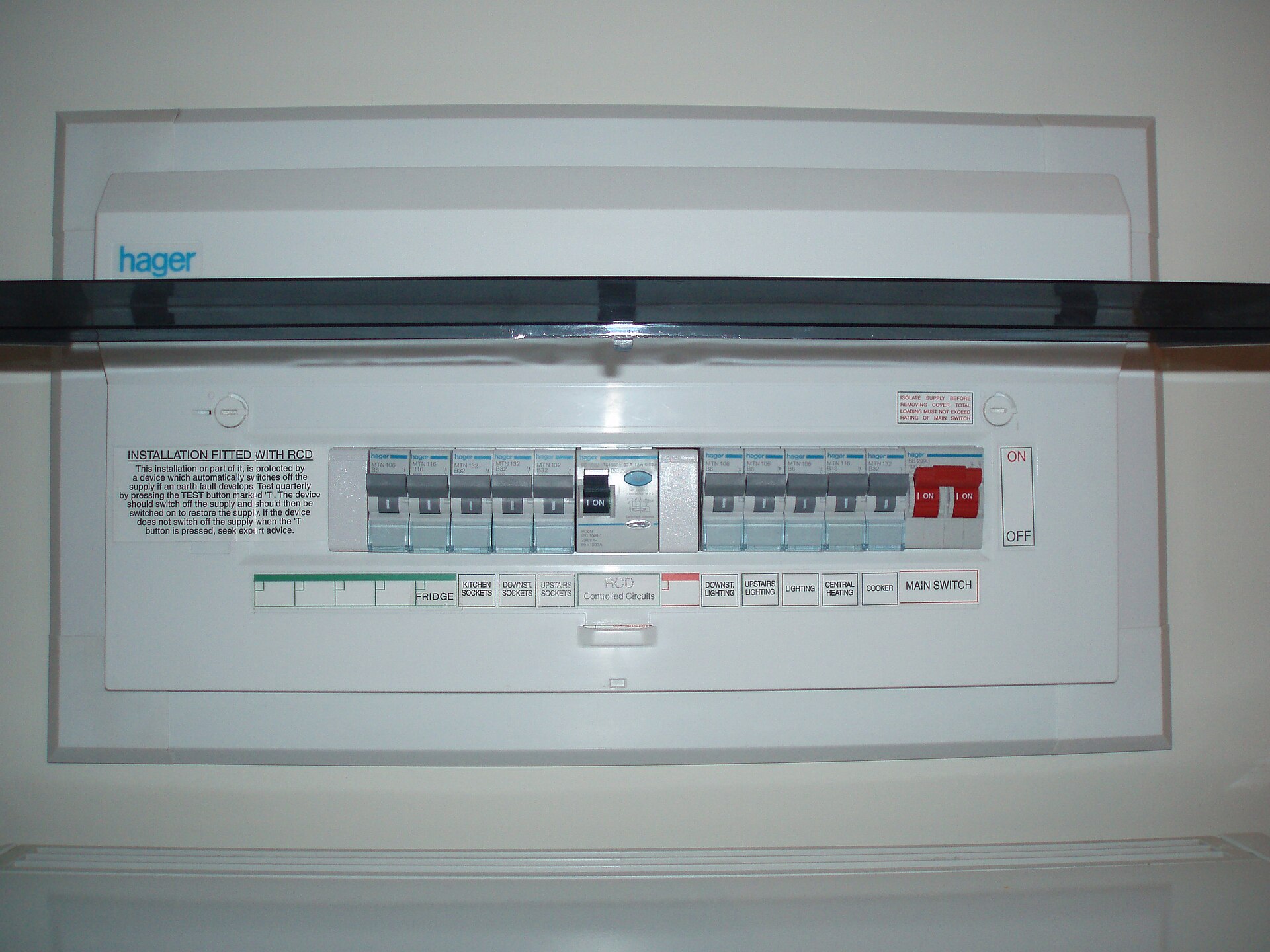
Identify the device properly. A modern board mixes MCBs and RCDs in the same row, and they look alike from a metre away. An MCB has a single rating printed on it, something like B32, and no test button. An RCD carries a residual operating current, marked 30 mA, and a test button marked T or Test.
An RCBO carries both ratings and a test button, because it is both devices in one module. Pressing a button that is not there, or expecting an MCB to trip on a test, is a common source of confusion.
Distinguish “did not trip” from “tripped but nothing went off”. If the lever drops but the sockets stay live, the RCD is operating but something else is supplying those sockets — another circuit, a different board, or an uninterruptible supply. That is a wiring question, not a device failure, and it needs an electrician just the same.
The result table matters more than the pass or fail.
The instinct after a failed test is to assume the whole installation is dangerous. The reality is narrower and, in one direction, more serious than people expect.
| What you observed | What it means | What to do |
|---|---|---|
| What you observed Button does nothing, board dead | What it means No test conditions — not a device verdict | What to do Restore supply and retest |
| What you observed Button does nothing, board live, device ON | What it means Test failed. Protection cannot be relied on | What to do Arrange an electrician |
| What you observed Trips on test, will not reset | What it means Leakage or device fault present now | What to do Arrange an electrician |
| What you observed Trips on test, but sockets stay live | What it means Wrong circuit or a supply you have not found | What to do Arrange an electrician |
| What you observed Trips on test, resets and holds | What it means Device functional — for now | What to do Log the date and follow the applicable test interval |
The observation narrows the verdict. Only the last row deserves a retest rather than a phone call.
The row that deserves attention is the second one. A device that will not respond to its own test button is not “probably fine”. It has failed the only functional check available to you, and the protection it was providing against electric shock on that circuit is no longer something you can assume.
The last row is the one people over-read. A pass proves the mechanism moved. It does not prove the RCD will operate within the required time under a real fault current, and it does not prove the installation is safe. That is what instrument testing during an EICR is for.
These two faults get talked about as if they were the same problem, and they are close to opposites.
An RCD that keeps tripping is operating, but that does not prove its behaviour is correct. Genuine leakage, accumulated leakage from several appliances, wiring faults and transients are possible causes; a defective RCD is also possible.
The diagnosis separates the installation and its loads from the device. Replacing the RCD without testing is guesswork, but declaring it healthy simply because it trips is guesswork too.
An RCD whose test button does nothing has stopped responding. There may be no leakage at all, which is exactly why nobody noticed. The device looks normal, the house works, and the protection has quietly gone. That silence is the whole reason the six-monthly press exists.
If your device trips constantly, the diagnosis belongs in the companion article. If it sits there and ignores you, you are in the right place.
The visit is not a guess. It follows a sequence that separates the supply, the wiring and the device, in that order, because condemning an RCD before checking its supply is how perfectly good devices get replaced for nothing.
First, confirm the supply. An electrician will check that the RCD has the voltage its test circuit needs at the terminals it needs it on. This is where a missing neutral or a dead upstream device shows up, and where a device that “failed” turns out to have been starved of supply.
Second, check the wiring against the manufacturer’s diagram. Line, neutral and earth connections are verified at the device, not assumed from the way the board was left. Improvised links added to force a test button to work are never acceptable, and no competent electrician will fit one.
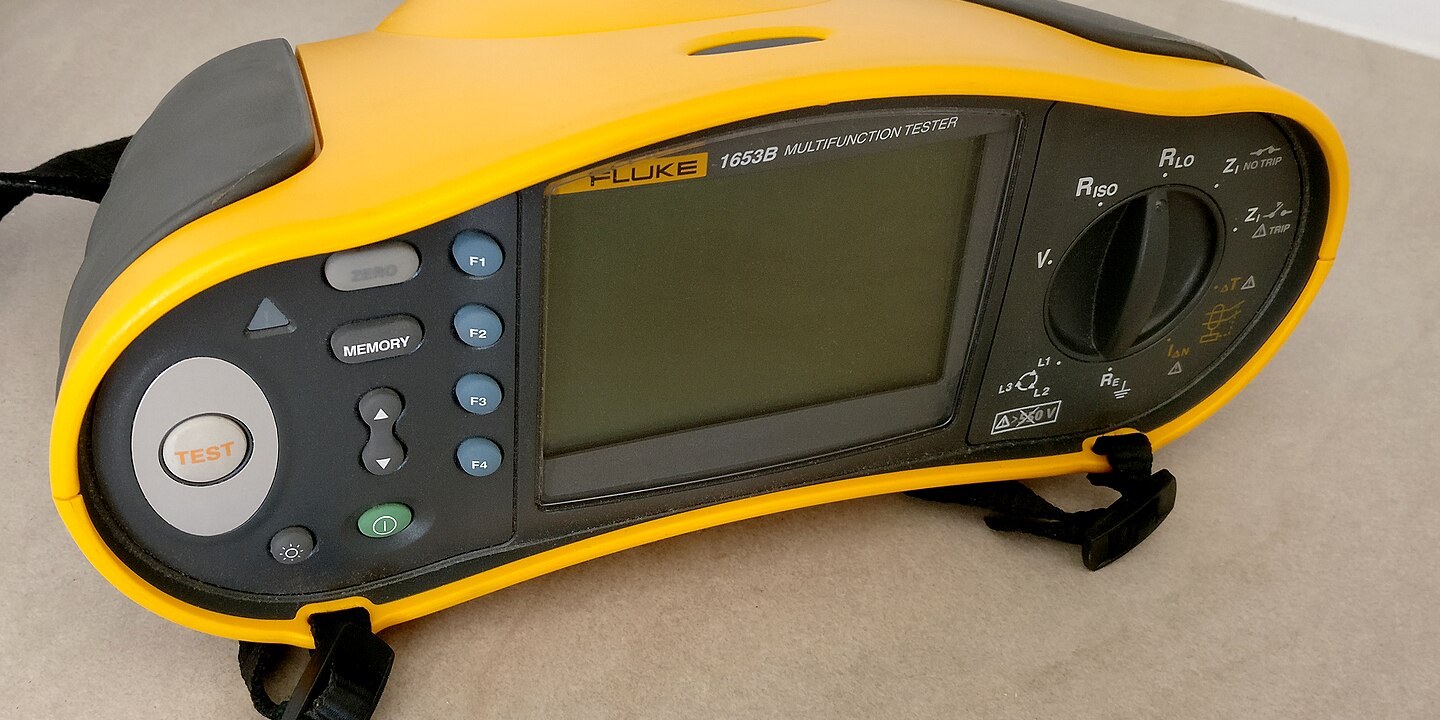
Third, test the device with an instrument. A modern multifunction tester applies a controlled residual current at the rated operating current and measures the disconnection time.
Under BS 7671:2018+A2:2022, an alternating current test at the rated residual operating current is the required check, with a maximum operating time of 300 ms for general non-delay RCDs, and between 130 ms and 500 ms for time-delayed S type devices.
The IET is clear that the earlier requirement to test at five times the rated residual current has gone, and that other tests — half current, ramp, phase angle — are optional fault-finding aids rather than compliance requirements.
Fourth, replace if the device is confirmed faulty. A device with an internal test circuit defect or a seized mechanism is replaced, not repaired. There is no servicing procedure for a domestic RCD, and no safe way to restore confidence in one that has failed its own check.
Info
The instrument test and the button test answer different questions. The button asks “does this device still operate?”. The instrument asks “does it operate fast enough, at the right current?”. A device can pass the first and still need replacing on the second.
The IET’s consumer-unit guidance gives six months as the routine test-button interval associated with Regulation 514.12.2. Older installations may carry a quarterly notice.
The device’s manufacturer instructions also matter. Some products or operating conditions call for shorter intervals; a general six-month reminder should not overwrite those instructions.
The photograph at the top shows an older quarterly test notice on a consumer unit. Its central instruction is still useful: if the test does not disconnect the supply, obtain expert advice.
For the actual installation, follow its applicable instructions and the device maker’s recommendations. Schneider Electric, for example, recommends monthly checks for some voltage-dependent RCBOs and in harsh conditions.
The practical habit matters more than the exact interval. Electrical Safety First has long promoted tying the test to the clock change, precisely because the nuisance of resetting timers is the reason people skip it — their research found 46% of people never test their RCD and a further 24% test only once a year.
Pressing a button twice a year, on a device that protects your family from electric shock, is about as cheap as safety gets.
Conseil
Write the date on the inside of the consumer unit lid, or keep a note in your phone. A device that failed today and a device that has never been tested look identical from the outside.
For an owner-occupied home, the practical action is to arrange investigation of a protective device that fails its test. At work, Regulation 4 of the Electricity at Work Regulations 1989 imposes duties to maintain electrical systems so as to prevent danger.
Rental housing has its own legal framework. Do not apply workplace duties indiscriminately to every domestic situation; the relevant housing rules and the location of the property matter.
For rented homes in England, the installation must be inspected and tested by a qualified person at intervals of no more than five years, or sooner if required by the report.
Required remedial work follows the applicable deadline: 28 days or a shorter period specified in the report, with immediate action for danger. The inspector classifies the observed risk from the actual findings.
A failed button test needs investigation, but is not a complete diagnosis or classification procedure. Supply conditions, the test circuit and the protective function all matter.
Part P is often cited at this point, and usually cited wrongly. Approved Document P makes the replacement of a consumer unit notifiable in England and Wales. A failed RCD inside an existing board is a different case: the guidance is explicit that “replacements, repairs and maintenance anywhere” are not notifiable.
Non-notifiable does not mean exempt from electrical safety requirements, nor does it establish that a homeowner is competent to carry out the work.
What stops you is the testing. A replacement device has to be verified with an instrument at the rated residual operating current, the result recorded, and the work certified — and none of that is available from a screwdriver and a product page. The part is inexpensive and the swap looks like fifteen minutes. The certificate is the job.
A failed test button is a defect to fix, not usually an emergency in itself. It becomes urgent when it is accompanied by anything else on this list.
Those combinations move the situation from “book an electrician” to “stop using the affected circuits and call one now”. A device that has failed mechanically after a real fault may have done so because the fault is still present.
Do not use a plug-in RCD adaptor as permission to keep using a circuit whose fixed protection has failed. It does not repair the board or protect the wiring upstream, and the failed device may be essential to fault protection on a TT supply.
Keep affected equipment out of use pending professional advice. Any temporary supply must itself be established as safe. The waterproof junction box guide explains moisture ingress, a separate cause of repeated tripping.
When the device is confirmed faulty, the replacement should match the installation rather than the price list.
| Decision | What to specify | Why it matters |
|---|---|---|
| Decision Device type | What to specify Type A as the default in a modern board | Why it matters Type AC can be blinded by DC components from electronics |
| Decision Residual current | What to specify 30 mA where additional protection is required | Why it matters Higher ratings may provide fault or fire protection, not 30 mA additional protection |
| Decision Current rating | What to specify Select from the load and overcurrent-protection design | Why it matters Copying an existing rating does not prove adequate overload protection |
| Decision Poles | What to specify Match the existing configuration | Why it matters Test circuit arrangement depends on the pole count |
| Decision Delay | What to specify Non-delay for the required additional protection | Why it matters S type may provide selective fault protection, not this additional-protection role |
The device must also be approved as compatible with the consumer-unit assembly. Matching its width or brand name alone is not enough.
Type A has become the practical default because Type AC devices can be desensitised or blinded by residual direct current from electronic equipment, and the IET has noted that justifying a Type AC device in a modern installation is difficult now that so much equipment introduces DC components. Many manufacturers have discontinued them.
A straight like-for-like swap that reinstates a Type AC device is therefore usually the wrong call in 2026, even though it is the cheapest.
The RCBO comparison sets out the case for splitting a shared RCD into individual RCBO protection, which also limits how much of the house goes dark when one circuit develops a fault. That is a design decision for the electrician doing the work, not a retrofit you can decide from a product page.
There is no substitute. A socket tester with an RCD trip function can apply a test current at a socket and confirm that the device operates, which is useful when the button itself is suspect, but it does not measure disconnection time and it does not replace the instrument test an electrician carries out.
A multimeter cannot test an RCD at all: it has no way to create a controlled imbalance.
What you can do is record. Note the date, what you pressed, what the lever did, and whether the power actually went off where you expected. That record shortens the electrician’s visit and, if the device turns out to be intermittent, it is the only evidence anyone will have.
Yes, potentially. The RCD is there to disconnect the supply on an earth fault, and a device that will not respond to its own test has failed the only functional check available. Treat the circuit as unprotected until an electrician has tested the device, and avoid using portable equipment on it in the meantime.
Replacing a device in an existing board is not the same notification category as replacing the whole consumer unit. That does not remove safety or verification requirements. A competent electrician must select a compatible device, isolate safely, test the work and provide the appropriate record or certificate.
The button checks operation using an internal test current. Trips in use can arise from leakage, wiring, cumulative leakage, disturbances or a device fault. Passing the button check does not diagnose those causes. The RCD keeps tripping guide explains the investigation.
The IET gives six months as the general routine interval. Also follow the manufacturer’s instructions and any shorter interval required for the device or its environment. Older boards can carry quarterly notices; some RCBOs require monthly checks.
It happens, and it is not reassuring. A device that has sat idle for years can seize or develop a failed test circuit without ever showing a symptom, because nothing has asked it to operate. That silent failure is exactly why the six-monthly press exists and why the Electrical Safety Council investigation recommended it so strongly.

Théo Desrousseaux
Electrician and editor
I work in the field and edit this magazine. Every guide is reviewed for its target country before publication.
Author → Credentials → Editorial method → Report a factual correction →
Email address and prefilled context:
theo@sparx-elec.fr
Article: https://www.sparx-elec.com/gb/rcd-test-button-not-tripping/
Edition: GB — English
Factual issue: [describe the factual issue]
Passage: [quote or identify the passage]
Source: [optional source URL]
Sources and references
Practical electrical installation guides, diagnostic methods and tool recommendations compared against the technical wiring standards of this national edition.
Why does an RCD keep tripping? Learn the common causes, the 30 mA threshold, the six-month test rule, and how to diagnose the fault safely.
Read the guide Guide Socket not working but not tripped No power at a socket and nothing has tripped: check the plug fuse, the switch, the ring circuit and the RCD in the right order, and know when to stop. Read the guide
 Guide Outside socket with RCD: UK rules and choices What does an outside socket with RCD need in the UK? BS 7671 30 mA protection, IP ratings, whether an RCD socket replaces a board RCD, and Part P. Read the guide
 Guide RCBO vs RCD difference UK consumer unit What is the difference between an RCBO and an RCD? Learn what each device protects, why RCBOs trip less, the cost in the UK, and which to choose. Read the guide