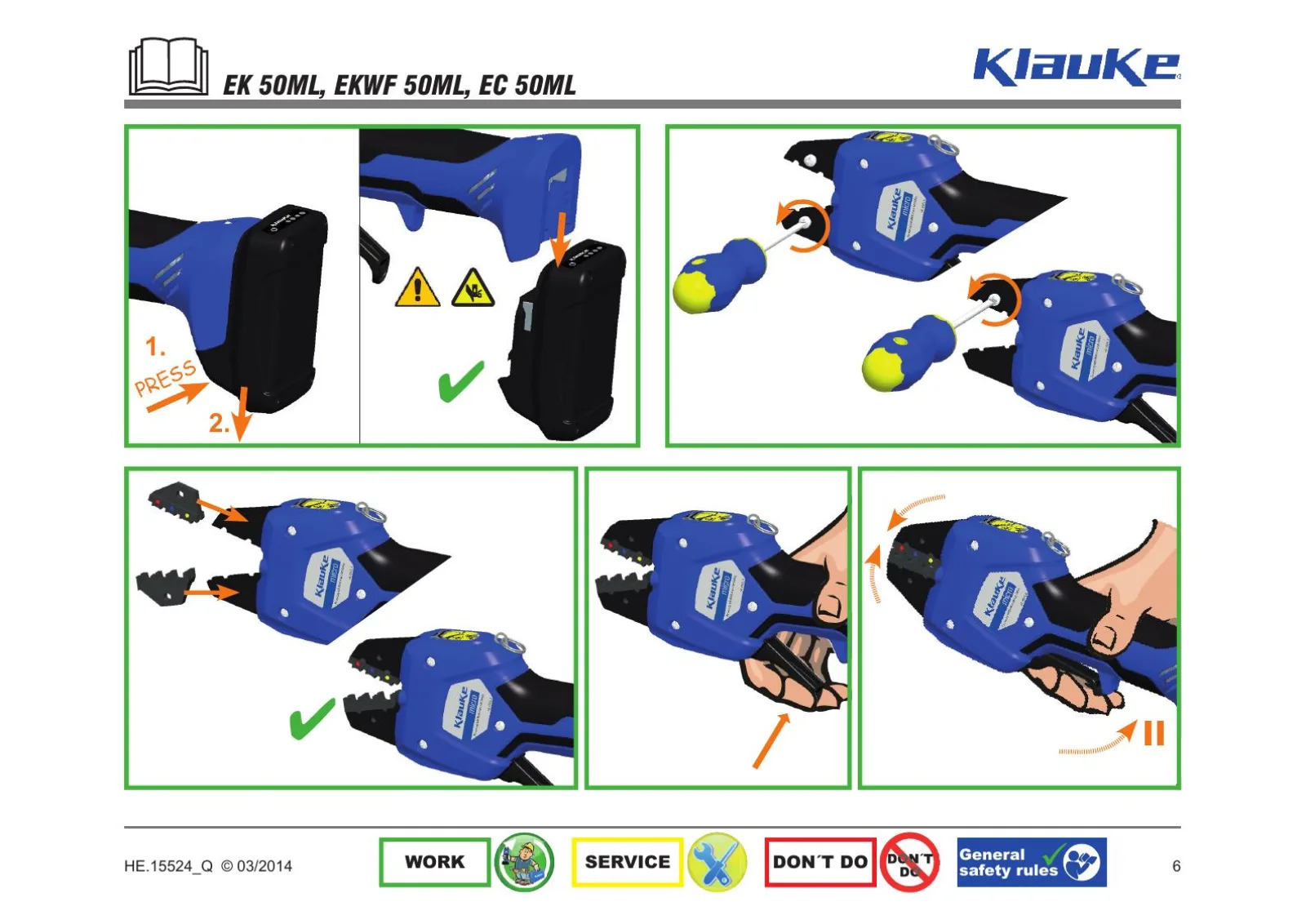
Die and battery of the EK 50 ML
The drawing separates battery removal from the replacement of the half-dies: the die is chosen with the connection, not at random.
Published 26 July 2026
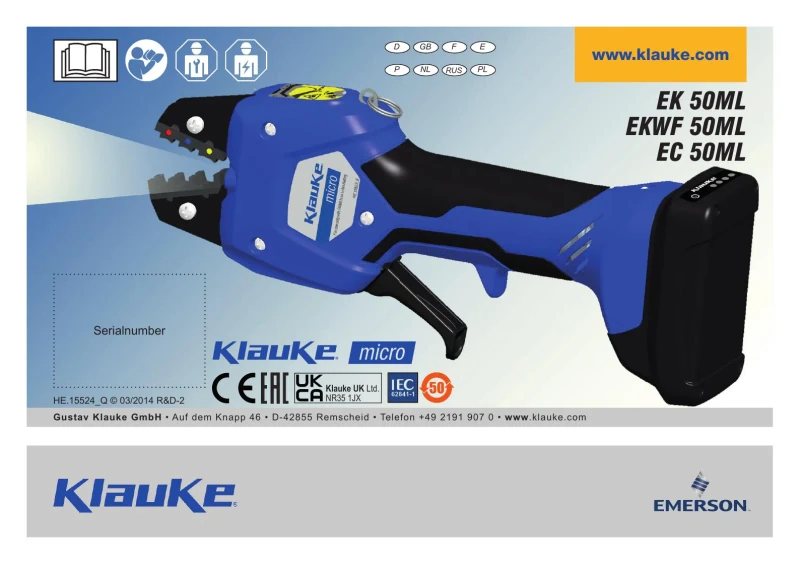 Photo : Klauke
 In brief
This page is not a field test. I have neither received nor used this reference: I therefore cannot publish a personal review or attribute durability, real battery life or user comfort to the EK 50 ML.
I stick to the Klauke documents I have opened and verified, to their explicit limits and to the choices they make possible before purchase.
The reference EK50ML designates an electromechanical crimping tool 10,8 V with interchangeable inserts. The important point is not its apparent range of 0,14 to 50 mm², but the series 50 insert placed in its jaws.
The tool can be used for cabinet wiring, certain copper lugs or insulated connections, but not with a single die and not without identifying the consumable.
15 kN
published maximum force
0,96 kg
stated weight with battery
< 1,5 s
stated cycle depending on the connection
400
stated crimps at 10 mm²
Klauke classifies the EK 50 ML in its micro family, with a 10,8 V 2,5 Ah lithium-ion battery, an LED light and series 50 inserts. The manufacturer publishes 15 kN of maximum force, a weight of 0,96 kg including battery, a charge of about 45 minutes and an operating temperature of -10 to +40 °C.
These figures are product specifications, not proof of a result on every lug on the market.
The term “electromechanical” matters. The EK 50 ML is not an electro-hydraulic crimper for large cross-sections. Its function is to motorize a compact crimping action, with manual pre-clamping then a motor-driven cycle, where a hand crimper would require repeated effort.
For high-power feeders, the cross-section decision is made first with the calculation of the 400 V three-phase cable size, then with the validated lug-tool combination for that cross-section.
The product page states an overall capacity of 0.14 to 50 mm², while specifying the use of interchangeable inserts.
In the compatibility table, the ranges change depending on the connection: 0.5 to 10 mm² for certain DIN crimp lugs, 0.5 to 50 mm² for ferrules with the dedicated inserts, 6 to 25 mm² for DIN copper lugs with hexagonal dies. Reading only “50 mm²” to buy the tool would be a methodological error.
Info
The capacity of the EK 50 ML is that of a tool plus insert plus connection system. A 25 mm² lug may fall under a hexagonal profile, an indentation or another geometry: the cross-section alone does not select the die.
The EK 50 ML is also not a 1 000 V insulated tool advertised for live working. The product data sheet mentions a 10.8 V power supply, a retaining eyelet and cycle safety devices, but not a 1 000 V insulated tool approval for this reference.
The INRS recalls that work must be carried out de-energized as a priority and that operations on or near electrical installations are subject to appropriate prevention and authorization. A motorized crimper does not change this framework.
The origin of the brand is covered in the history of Klauke. Here, the subject is narrower: knowing whether this compact-jaw crimper suits the connection that actually has to be made.
The advertised contents for reference EK50ML are precise: the crimper, the KKEKSD50ML case, the LGML1 charger, a RAML1225 battery of 10,8 V and 2,5 Ah, two knurled screws and the IS5071 insert. The datasheet describes this insert as intended for insulated connections from 0,5 to 6 mm².
That is the scope actually available when opening the documented case.
This detail avoids a common misunderstanding. The crimper can mechanically accept other inserts, but it is not supplied with all the profiles required for wire end ferrules, tubular lugs, DIN lugs, photovoltaic connections or coaxial connectors.
An equipment quote must therefore list the inserts, not just the tool and its charger.
| Connection | Published range | Series 50 insert indicated |
|---|---|---|
| Connection Insulated connections | Published range 0,5 to 6 mm² | Series 50 insert indicated IS5071 supplied with EK50ML |
| Connection Wire end ferrules | Published range 0,5 to 50 mm² | Series 50 insert indicated AE5071, AE5072 or AE5073 depending on the cross-section |
| Connection Twin ferrules | Published range 2 × 6 to 2 × 16 mm² | Series 50 insert indicated ZAE5072 |
| Connection DIN copper lugs | Published range 6 to 25 mm² | Series 50 insert indicated D504 or D505 |
| Connection Standard copper lugs | Published range 0,75 to 25 mm² | Series 50 insert indicated R50, profile depending on the cross-section |
Examples of compatibility published by Klauke for the EK 50 ML. The exact lug reference remains decisive.
For an electrical panel, the supplied insert therefore addresses a targeted need: insulated connections of small cross-section, not the generalized crimping of all the conductors in the case.
A tradesperson who plans to work mainly with ferrules must include the AE die set; a need for DIN copper lugs calls for the D504 or D505 for the published ranges. This accessory logic matters more than the total number of square millimetres shown in a sales datasheet.
A crimped connection is not judged by jaw closure alone. It requires linking the lug reference, the conductor material, its flexibility class, the cross-section and the expected imprint.
Klauke distinguishes in particular R inserts for standard copper lugs, D for DIN copper lugs and splices, Q for certain DIN crimp lugs, AE for ferrules and IS for insulated connections.
This separation is not administrative. A ferrule must keep a shape compatible with the terminal it will enter. A tubular lug must be compressed according to the profile specified by its manufacturer.
Die and battery of the EK 50 ML
The drawing separates battery removal from the replacement of the half-dies: the die is chosen with the connection, not at random.
An unsuitable crimp profile can give a connection that looks tight at first glance, but that has neither the electrical nor the mechanical performance documented for that connection.
The point becomes concrete when preparing a circuit from the distribution board. Choosing a cross-section and a cable, as in running an electrical line from the distribution board, does not complete the job: the type of termination at both ends remains to be planned.
On a flexible conductor, the ferrule and the matching die keep strands from spreading under a terminal. On a power lug, the die must match the lug model and the defined profile.
For conductors in installation cables, the installation context also matters. A buried R2V cable without red conduit first raises a question of installation method and mechanical protection; the EK 50 ML only solves the compatible termination at the end of the cable.
A crimping tool replaces neither the choice of cable nor the circuit protection.
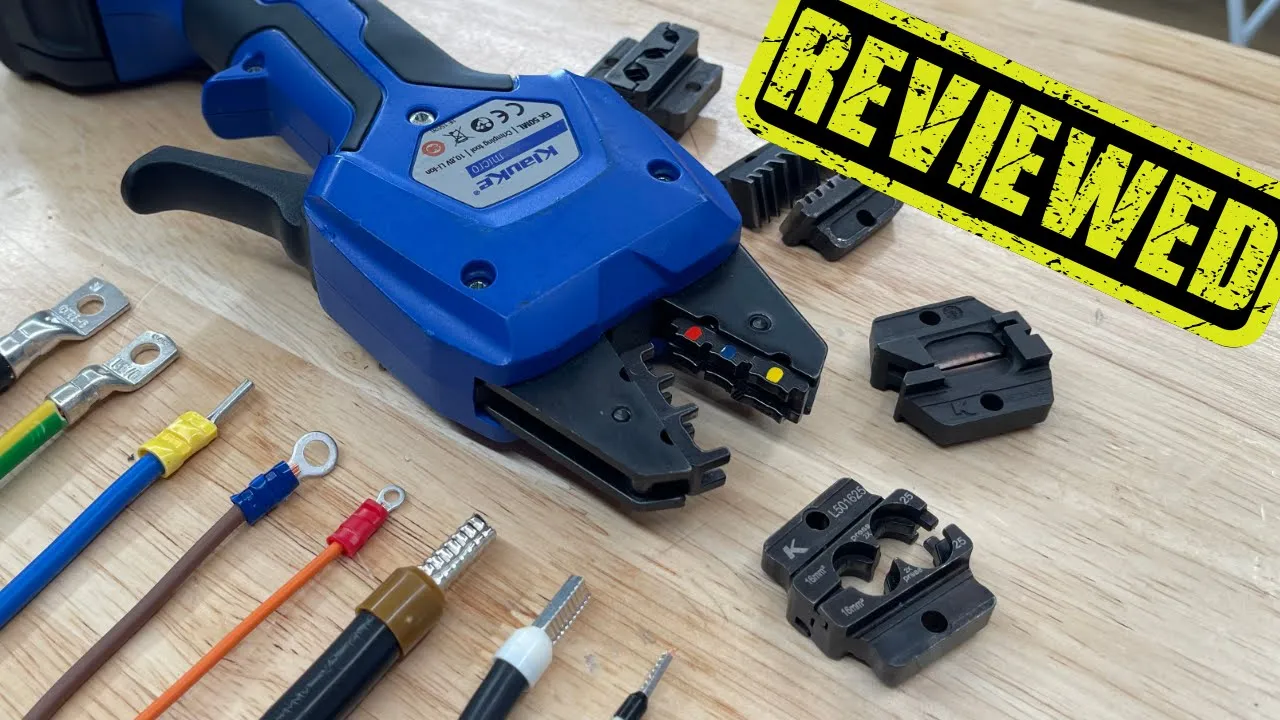
Klauke describes a single-lever control with the PowerSense function: a light press allows pre-crimping, then a full press starts the motorized cycle. The product datasheet adds an electronic control with a locking function that monitors the full closure of the inserts.
The manual also shows an automatic return and a manual return of the head.
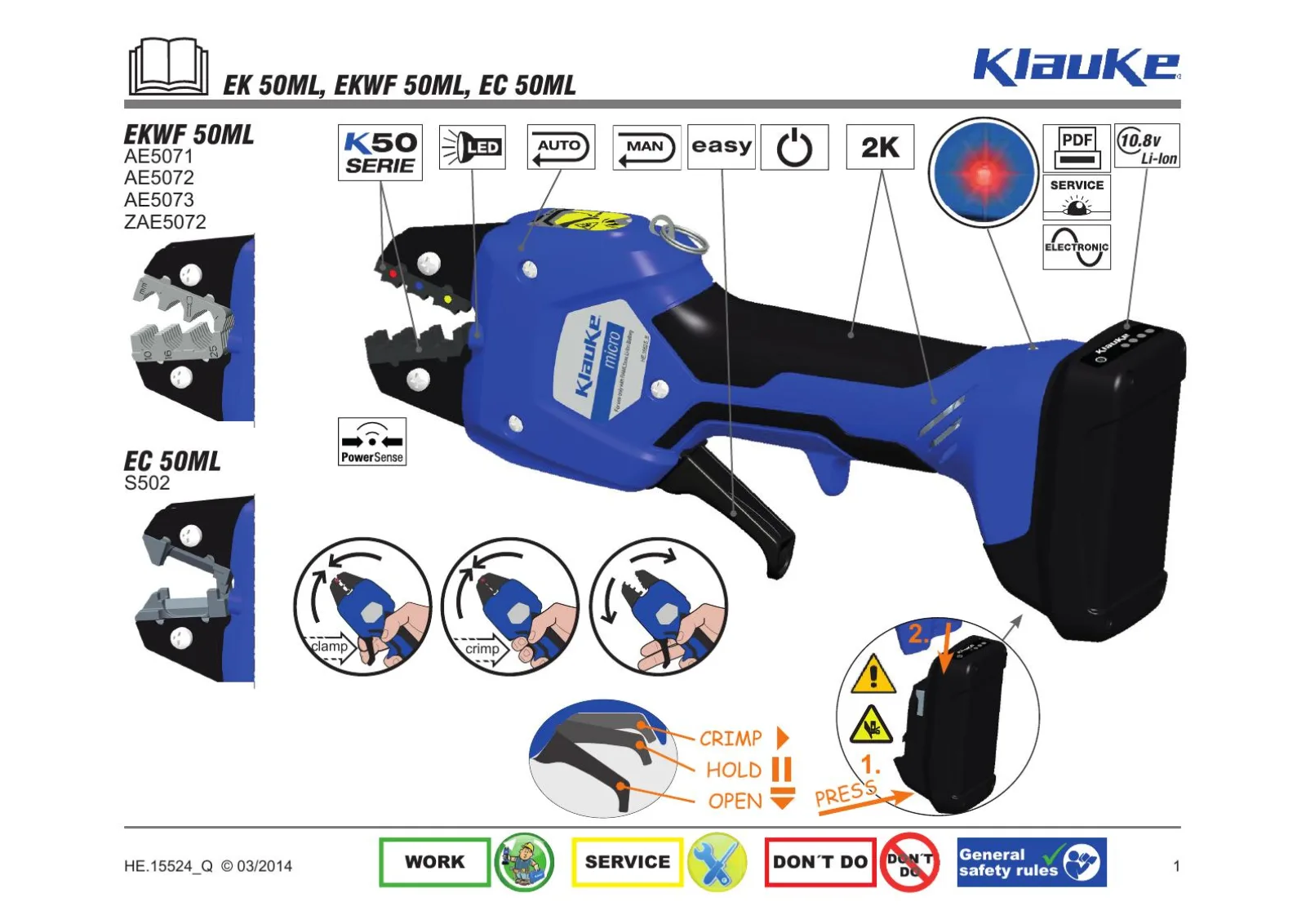
PowerSense control
Manual pre-crimping holds the connection in place; the trigger then starts the motorized cycle until full closure.
Klauke — EK50ML manualThis sequence has a measurable benefit: the connection can be held in place before the cycle, which avoids having to hold it in an open jaw during alignment. The motorized closure then limits the hand effort required for crimping.
INRS points out that the wrist and hand handle both forceful grips and fine movements, and that force demands contribute to muscle fatigue. That justifies looking at a powered tool for repetitive runs, without turning that argument into a promise of medical prevention.
Electronic locking, however, only performs part of the check. It indicates that the cycle has reached its intended closure with the insert fitted.
It cannot see a conductor that is not pushed in far enough, stripping that is too long, an incompatible terminal lug, an undersized cable or a damaged terminal. These checks remain the operator’s responsibility and that of the connection procedure.
The advertised number of cycles calls for the same caution. Klauke states 400 crimps at 10 mm² with the 2,5 Ah battery, and less than 1,5 second per cycle depending on the connection.
The cross-section, the die, the state of charge, the temperature and the time spent preparing each lug all change what a user actually gets over a day. These are sizing benchmarks, not a guaranteed on-site rate.
The documents are not all from the same date or the same role.
The current Klauke product page lists 0,96 kg, 2,5 Ah, about 45 minutes of charging and 400 cycles at 10 mm². The datasheet linked from that page gives the same base, but states a net tool weight with battery of 0,9 kg and dimensions of 253 × 93 × 64 mm without insert.
This difference of 60 grams does not allow concluding an error: the weighing scopes are not specified in the same way. It rules out writing a more precise weight than the documents allow.
The illustrated manual used for the visuals is common to the EK50ML, EKWF50ML and EC50ML. Its diagrams therefore describe a shared platform and control logic, with several heads and several inserts drawn.
The features covered here are those also covered by the EK 50 ML datasheet: lever, pre-clamping, return, battery and insert change. I do not infer from these plates that equipment visible on one variant would be supplied with the EK50ML.
The same caveat applies to performance. The manufacturer states the cycle at less than 1.5 seconds “according to the connection hardware”. This wording rules out turning the figure into a termination time for a cable.
Preparing the stripping length, identifying the lug, fitting the insert, positioning the conductor and checking the result take more time and depend on the connection. The useful information is therefore this: the motor cycle is short; the complete procedure is not necessarily short.
Attention
Product documentation makes it possible to compare references, not to validate a crimp remotely. For a critical connection, the source to follow remains the manufacturer’s specification for the lug, the terminal and the installation concerned.
The supplied RAML1225 battery is rated at 10,8 V and 2,5 Ah, with a charge indicator. The LGML1 charger is specified for a 100 to 240 V, 50 to 60 Hz supply, with an input power of 35 W.
These items are useful at the point of purchase because they define the exact platform, but they do not allow the tool to be equated with a standard battery from a general-purpose power tool brand.
The compatibility to remember is that of the Klauke family cited by the manufacturer, not a compatibility assumed from the voltage marked on the battery alone.
Klauke publishes an ambient working temperature between -10 and +40 °C. It does not give a different runtime for each temperature. In a case left in the cold or in a very hot room, it would therefore be unwise to promise the 400 advertised cycles.
The right decision is to plan for a charged backup battery when a series of connections cannot be interrupted, while remaining within the stated temperature range.
The maintenance interval of 35 000 cycles is a tracking data point, not an authorization to ignore a fault until that deadline. The jaws, their fixing screws, the head return and the battery may require a check before that number.
The maintenance indicator must be treated as information from the tool to be followed up with Klauke service, not as a diagnosis that can be carried out by dismantling the tool yourself.
The presence of an attachment eyelet is also documented for use with a tool balancer or safety lanyard. This feature can be relevant when the tool is used at height, but it describes neither a complete fall-arrest system nor a working method.
A distinction must be drawn between the tool’s ring, intended to tether it, and personal protective equipment.
The EK 50 ML makes sense when the need involves repeated crimps of small or medium cross-sections, with connections already identified and a stable selection of inserts. The 0,96 kg format and the 10,8 V battery favour work in an enclosure or a panel where a power crimper would be disproportionate.
It may suit a workshop that regularly handles ferrules from 0,5 to 50 mm² with the AE5071 to AE5073, double ferrules within the published range with the ZAE5072, or copper lugs and connectors within the specified ranges with the D, R or Q inserts. In that case, the purchase covers a common base and sets of dies ordered for the actual connection flow.
The choice becomes less coherent if the use does not justify the investment in the insert set, if you rarely crimp a single family of small lugs, or if requirements usually go above 25 mm² for DIN copper lugs.
In that situation, the relevant tool depends on the lug and the power involved, not on the mere desire to own a battery crimper.
Another brake is logistical: the inserts are small but they constitute a stock to identify, store and maintain. The datasheet lists more than thirty inserts for crimping, stripping or cutting.
This number does not make the EK 50 ML more versatile by itself; it increases the risk of pulling out a similar but unsuitable insert if the references are not organized by use. For a tradesperson’s vehicle, a label with the connection family, the range and the profile avoids a decision made from memory.
The case of ferrules deserves a clear separation. The tool accepts dedicated AE inserts, whereas a specialized crimper such as the EKWF50ML is designed around ferrules and double ferrules.
If the activity is limited to this family of consumables, comparing the EK 50 ML fitted with several AE inserts with a dedicated reference is more rational than retaining the most general-purpose model. The documentation for the EK50ML itself mentions this reference as a variant of the platform.
The power connection tools in the Klauke range are presented in the brand history. The EK 50 ML occupies a different slot: it has neither the same size, nor the same force, nor the same purpose as an electro-hydraulic head for large cross-sections.
| Situation | Reading the documents | Reasonable decision |
|---|---|---|
| Situation Insulated connections 0.5 to 6 mm² | Reading the documents IS5071 supplied | Reasonable decision The tool is usable in the documented case |
| Situation Ferrules up to 50 mm² | Reading the documents Dedicated AE inserts required | Reasonable decision Quote the three inserts according to the cross-sections used |
| Situation DIN copper lugs 6 to 25 mm² | Reading the documents D504 or D505 inserts published | Reasonable decision Check the lug reference and the profile before ordering |
| Situation Large cross-section run | Reading the documents Outside the EK 50 ML’s compact logic | Reasonable decision Choose a power tool suited to the connection |
| Situation Live circuit | Reading the documents No validation of the tool for this situation | Reasonable decision Lock out and apply the prevention framework |
Decisions based on published compatibility and limits, without extrapolating the tool to another use.
The Klauke manual states scheduled maintenance at 35 000 cycles in the data sheet. That figure does not replace the checks before use: clean jaws, a correctly fitted insert, an engaged battery and a prepared connection remain separate conditions.
A maintenance indicator light or a completed cycle does not remove the need to examine the consumable and the result.
The following procedure does not describe live working. The INRS gives de-energized working priority and recalls the lockout measures. That is the right starting point before touching an existing circuit termination, including when a compact tool gives the impression of making the operation routine.
Lock out before preparing the termination
Identify the circuit, switch off the power, lock out if necessary and verify the absence of voltage before any action on a connected conductor.
Read the connection reference
Note the material, the cross-section and the type of lug or ferrule. An insulation colour is no substitute for a product reference.
Fit the matching insert
Choose the series 50 insert in the Klauke table, fasten it according to the manual and check that it is correctly fitted before inserting the conductor.
Prepare the conductor according to the lug
Strip to the length prescribed by the connection manufacturer and insert the conductor up to the intended position.
Complete the cycle and inspect
Let the cycle close, then check the appearance of the crimp against the connection criteria. Any anomaly means the assembly must be redone with a new consumable.
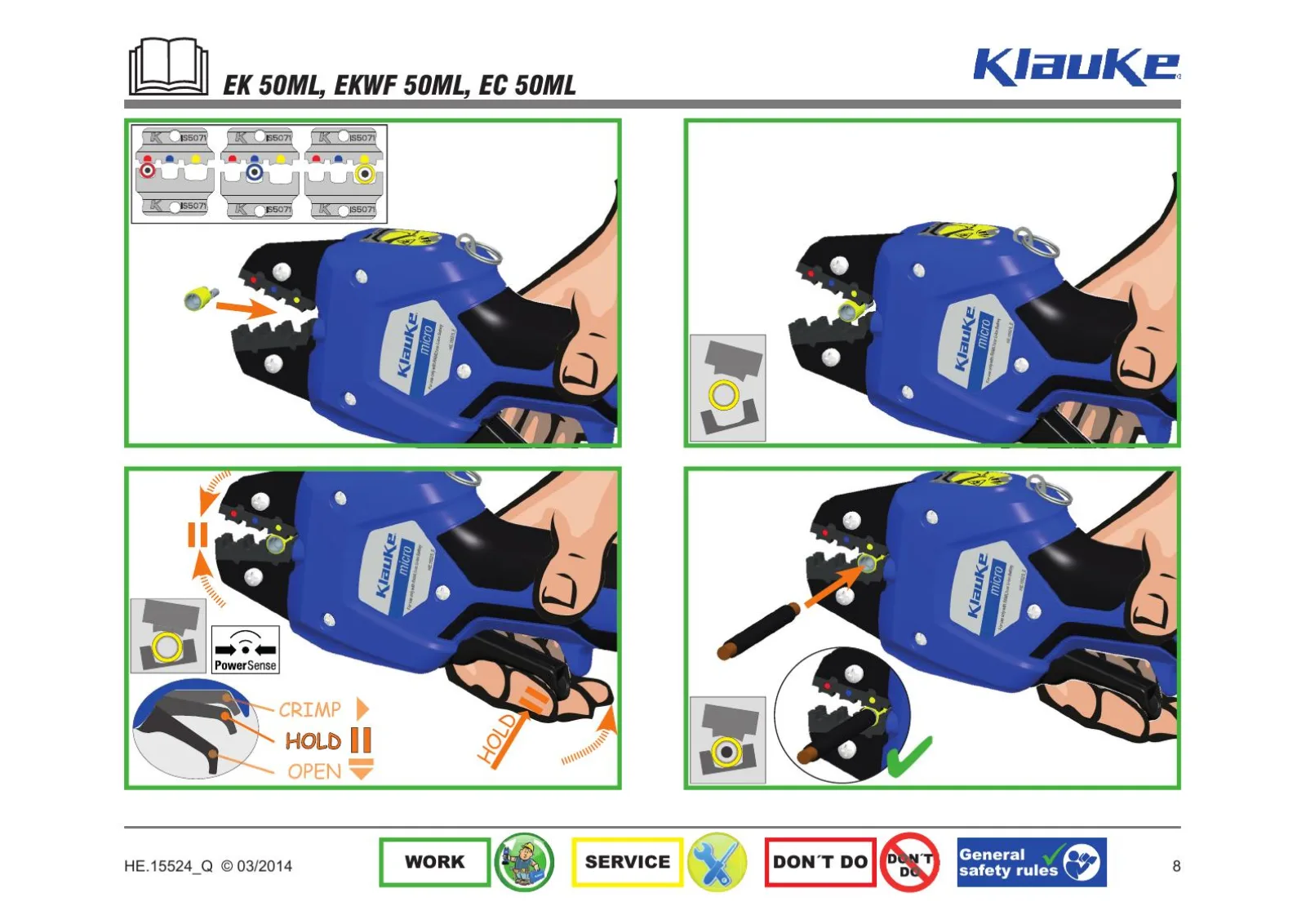
Crimping and inspection
The manual shows the connector in place in the jaws and the check after the cycle; it does not replace the requirements specific to the terminal used.
Klauke — EK50ML manualA termination defect must not be normalized by a second improvised crimp. If a terminal is badly positioned, damaged or crimped with the wrong profile, the safe decision is to replace it and start over with the right assembly.
In a live panel, symptoms such as a burning smell in the electrical panel or a buzzing panel call for switching off the power and a diagnosis: the EK 50 ML is not a troubleshooting tool to be used by guesswork.
The Klauke documents make it possible to establish a clear finding.
The EK 50 ML is a lightweight electromechanical crimper, fast on paper, with a real system logic: 15 kN, 10.8 V battery, PowerSense control, closure check and series 50 inserts. The EK50ML kit immediately targets crimping insulated connectors from 0.5 to 6 mm² thanks to the supplied IS5071.
Its maximum range of 0.14 to 50 mm² should not suggest a universal crimper. The practical limit is always defined by the insert and the documented connection. Before buying, I would therefore keep three lines on the quote: the EK50ML part number, the families of lugs actually used and the corresponding inserts.
Without this list, the tool risks being well designed but unsuitable for the first crimp required.
3 questions
InteractiveQuiz: Klauke EK 50 ML: features and limits
3 questions to check the key points
Choose an answer
No. The EK50ML data sheet lists the IS5071 insert for insulated connections from 0.5 to 6 mm². Inserts for wire end ferrules, DIN lugs, tubular lugs or other connectors are separate part numbers.
The product data sheet states a system range up to 50 mm², but only with the compatible insert and connection. For wire end ferrules, Klauke lists inserts AE5071 to AE5073; a DIN copper lug does not necessarily use the same profile.
It monitors the full closure of the inserts during the cycle. It does not check the lug part number, the stripping, the insertion depth or the condition of the conductor. Checking that the assembly is correct remains essential.
That is not what the EK 50 ML data sheet documents. INRS puts de-energized work first; a crimping tool replaces neither lockout nor a suitable procedure.
The choice starts with the cross-section and the prescribed lug. For supplying equipment such as a heat pump, the suitable cable cross-section comes before choosing the crimper. Beyond the scope published for the EK 50 ML, a power tool compatible with the connection is required.
Théo Desrousseaux
Electrician and editor
I work in the field and edit this magazine. Every guide is reviewed for its target country before publication.
Practical electrical installation guides, diagnostic methods and tool recommendations compared against the technical wiring standards of this national edition.
Review of the Klauke EK30IDML: die-free hydraulic crimping from 6 to 120 mm², 30 kN of force, connector scope and documented specifications.
Read the guide Guide Klauke: brand history Founded in 1879 in Remscheid, Klauke moved from watchmaker's pliers to lugs and crimpers. Its history, range and place in electrical engineering. Read the guide
 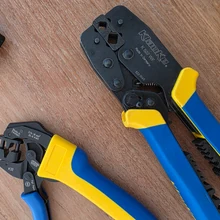 Guide Klauke K32 TWIST-it and K507 WF: electrician review Field test of the Klauke K32 TWIST-it and K 507 WF manual crimping tools, supplied by the brand: 0.14-10 and 0.5-50 mm² ranges and verdicts. Read the guide
  Guide Wiha or Wera: which tool kit for an electrician? Wiha or Wera: VDE 1000 V screwdrivers and pliers, storage systems and a method for a tool set suited to real electrical work in the home. Read the guide