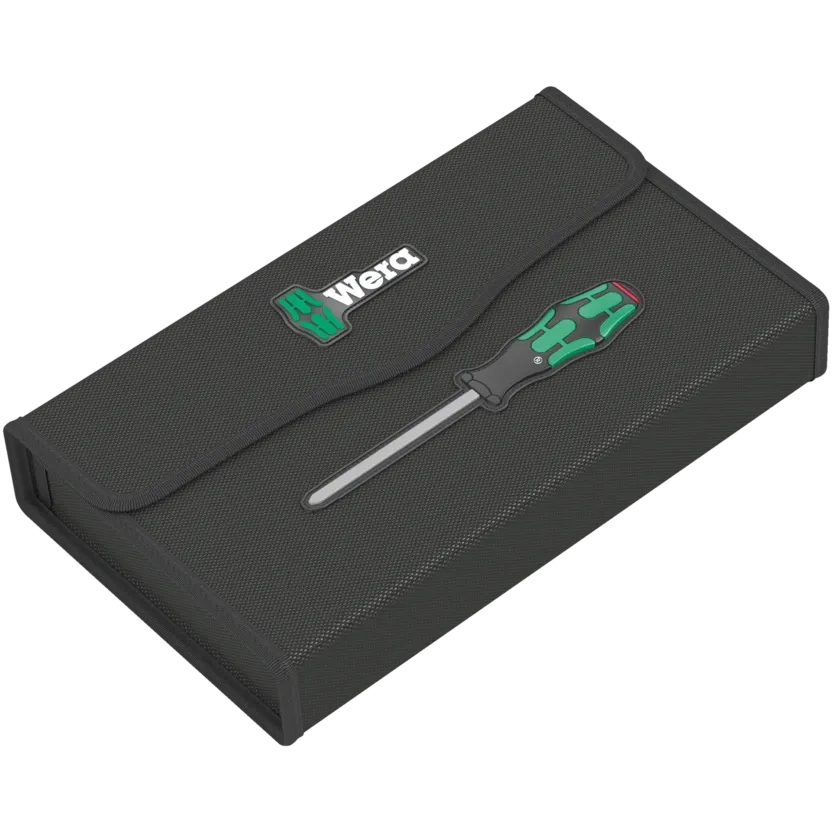
Set Wera Kraftform 1
The Kraftform 1 set brings together seven fixed screwdrivers: the pouch and the number of pieces alone do not say which lengths or profiles suit an installation.
Wera — Screwdriver Kraftform Set 1Published 29 July 2026
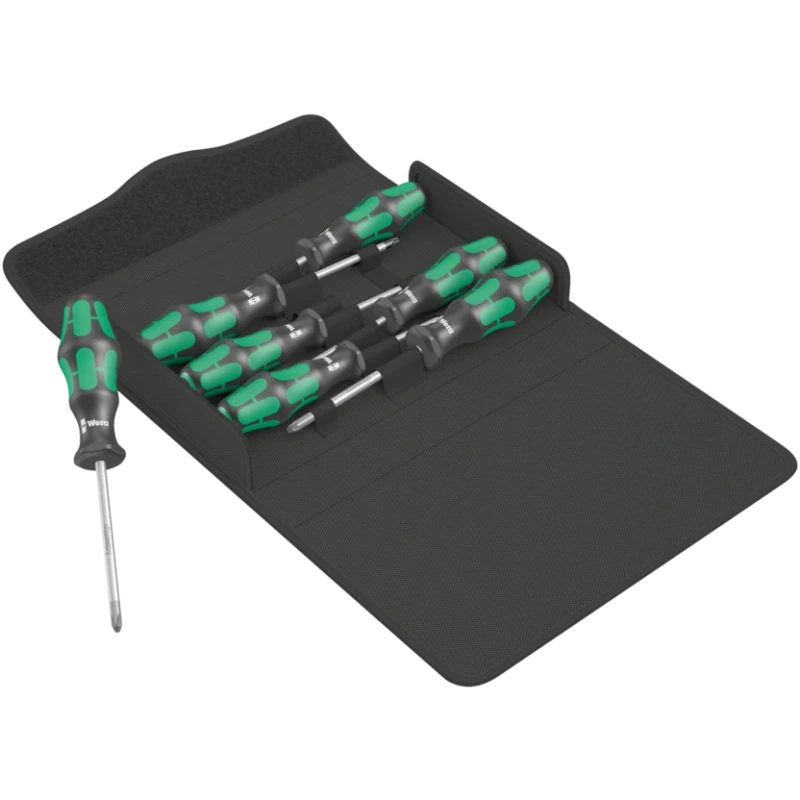 Photo : Wera — Screwdriver Kraftform Set 1
 In brief
I don’t decide “Wera or Wiha” based on the color of the handle. Kraftform at Wera and SoftFinish at Wiha are first and foremost families of handles, each available as fixed screwdrivers, insulated tools and, depending on the reference, systems with interchangeable blades.
Comparing the two names as two single products masks the decision that is useful: which screw needs to be reached, with which profile, at what depth and in what working context?
I don’t decide “Wera or Wiha” based on the color of the handle.
A Kraftform 335 with a fixed blade does not meet the same need as an 817 VDE with interchangeable Wera blades. In the same way, a slotted SoftFinish electric 00820, a SoftFinish SL/PZ1 30700 and a SoftFinish slimVario 43449 handle cannot be compared piece by piece.
So I start from published references and keep the handle, the blade, the tip, the insulation and the working method separate.
1968
market launch of the Kraftform handle according to Wera
3
slimBits included in the Wiha 43449 set mentioned
1 000 V
working voltage stated for the insulated references concerned
For repeated screws, I look first at a fixed screwdriver with the right profile and the right length. Both manufacturers publish slotted series, Phillips, Pozidriv, TORX and, in their electrical ranges, combined profiles.
This solution avoids creating a compatibility to be checked between a handle, a blade, and a locking mechanism.
When profiles and lengths actually change during a single job, a blade system can reduce the volume carried. At Wera, it is the Kraftform Kompakt VDE family; at Wiha, SoftFinish slimVario belongs to the ElectricVario Family.
This modularity is a property of declared references and interfaces, not a permission to mount any insulated blade on any bit holder.
I also avoid inferring the safety level of a handle shape. The useful comparison is that of one marked insulated reference with another insulated reference, then that of their exact content.
The Wiha or Wera comparison remains complementary: it also covers pliers, bits, and the organization of the tool pouch, whereas this guide is limited to Kraftform and SoftFinish screwdrivers.
| Selection question | Wera Kraftform | Wiha SoftFinish | What I check |
|---|---|---|---|
| Selection question A fixed screwdriver | Wera Kraftform Kraftform series, including 1060 i VDE depending on the reference | Wiha SoftFinish SoftFinish electric, including 00820 or 30700 depending on the profile | What I check Tip type, blade, width, length and marking of the reference |
| Selection question A blade system | Wera Kraftform Kraftform Kompakt VDE with blade and handle published as compatible | Wiha SoftFinish SoftFinish slimVario and slimBits specified by Wiha | What I check Interface, length, actual content of the set and missing parts |
| Selection question A combination terminal screw | Wera Kraftform Wera PlusMinus blade explicitly indicated by the reference | Wiha SoftFinish 30700 SL/PZ1 or 30701 SL/PZ2 depending on the screw | What I check Exact head profile, never a visual approximation |
| Selection question An insulated tool | Wera Kraftform VDE reference, individual test and checkable condition | Wiha SoftFinish Relevant SoftFinish electric reference, test and checkable condition | What I check What the manufacturer states for this tool, without extending the property |
Kraftform and SoftFinish are family names. The decision is made at the level of a reference and its documented use.
Wera describes the Kraftform as a multi-component handle with hard zones and soft ones. On its family page, the manufacturer attributes hand repositioning during rotation to the hard zones and torque transmission to the soft zones.
The same page states that the first Kraftform handle was launched in 1968, after work carried out with the Fraunhofer IAO.
These elements describe a grip geometry. They do not say that a Kraftform suits every screw diameter, nor that it delivers a specific torque value.
So I do not turn an ergonomics promise into an absolute ranking of comfort or fatigue: these results depend on the hand, the duration, the screwing axis, the torque required and the condition of the screw.
The simplest function to check on Kraftform screwdrivers is the hexagonal anti-roll feature. It serves to prevent a screwdriver placed on a surface from rolling away. It helps neither to reach a deep screw nor to correct a poorly chosen profile.
It is a usage detail, not a criterion that allows ruling out another handle family.
Set Wera Kraftform 1
The Kraftform 1 set brings together seven fixed screwdrivers: the pouch and the number of pieces alone do not say which lengths or profiles suit an installation.
Wera — Screwdriver Kraftform Set 1The Wera Kraftform 1 set illustrates this method well. Wera advertises seven tools there for slotted, Phillips, Pozidriv and TORX, with the blade references indicated in the composition.
So I retain the stated values, for example PZ2 x 100 mm or PH1 x 80 mm, instead of concluding that a case “covers an electrician’s screws”.
A drive remains the first lock. A PH tip is not a PZ, even when their head looks similar in a poorly lit case. For equipment where the device manufacturer specifies a profile or a torque, I follow those instructions.
The handle never compensates for a tip that does not properly fill the flanks of the screw.
Wiha describes SoftFinish electric handles with hard and soft zones, handle dimensions suited to the type of screwdriving and anti-roll protection.
On the SoftFinish electric 00820, the manufacturer specifies a slotted blade 2,5 mm x 75 mm, as well as an individual test according to IEC 60900 for the insulated screwdrivers of this reference.
I read this spec sheet as a tool description. It allows checking the profile, the length, the width and the stated insulated status.
It does not allow claiming that all SoftFinish have the same blade, the same footprint or the same certification: Wiha also sells non-electric SoftFinish, socket models and bit systems.

The dimensions of the handle are also reference data. Wiha explains that its long, slim handles are intended for small screws, while bulkier handles are aimed at larger screws.
I treat this as a checkpoint, not a working rule: I still need to see whether the handle can turn without hitting a conductor, a cover or an obstacle.
I then look at the visible marking and the condition of the insulation. A blade whose coating is nicked, whose tip is worn or whose identification is illegible does not stay in a selection just because it belonged to a SoftFinish set. This discipline applies in exactly the same way to a Kraftform VDE.
A screwdriver is not judged on how it looks in the pouch. I check the tip, the flats, the handle and the insulation every time I pick the tool back up, because slow wear is hard to spot between two jobs.
I also check that the blade has no play in its handle and that the reference marking is still legible. Any doubt about the condition or the identification is enough to remove the tool from the call-out bag.
I clean the blade and the handle with a cloth, I check that no foreign body remains in the recesses and I let it dry before closing the pouch. A tool stored damp or dusty is checked before being used again.
I take this moment to set aside a screwdriver whose tip is deformed, whose insulation is nicked, whose handle is cracked or whose marking is no longer identifiable. This avoids relying on a doubtful tool mid-job, above a terminal block.
Terminal screwdrivers with a combined profile are a good example of a comparison that must remain precise. Wiha lists the SoftFinish electric 30700 in SL/PZ1 with an 80 mm blade, and the 30701 in SL/PZ2 with a 100 mm blade.
The manufacturer targets PlusMinus Pozidriv terminal screws in enclosures, cabinets and terminal blocks.
I only choose this profile when the head calls for it. A more or less damaged screw can give the impression that a slotted or Phillips tip fits better, whereas the actual recess is different.
The risk is not only slowing the action: an insufficiently engaged tip can mark the head and make the next tightening harder to control.
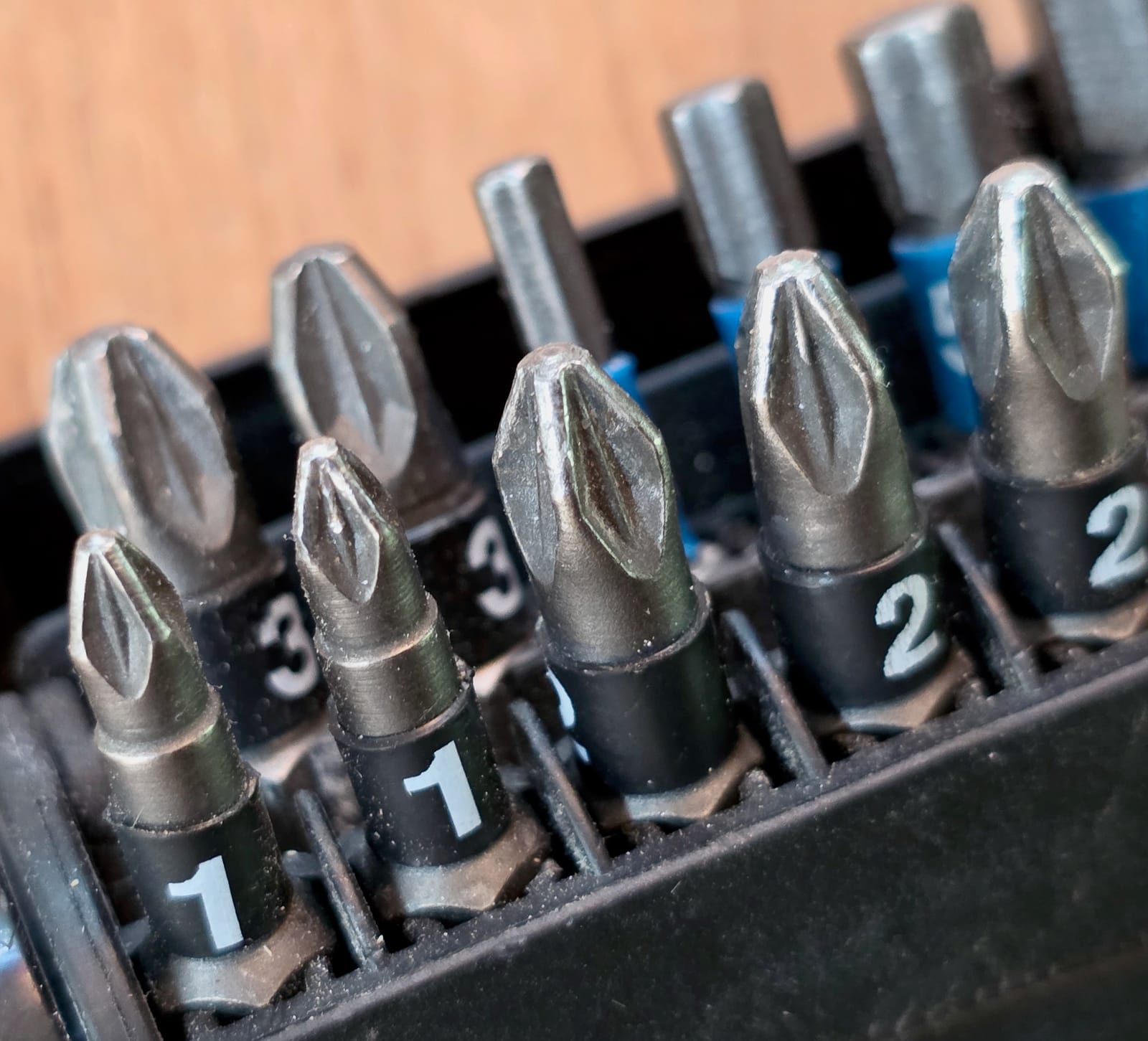
Pozidriv bits from a Wera set
The profile can be read on the bit before choosing: a Pozidriv tip is not a Phillips, even when their heads look similar.

Wera also offers PlusMinus blades and screwdrivers in its VDE range. I do not infer from this any automatic equivalence of a profile or a length between two references. The full name, the tip drawing, the blade and the datasheet must match the actual screw and the access.
This method is more useful than a classification by brand in an electrical panel. In it, devices, terminal blocks and covers mix profiles, depths and available space.
So I prepare the tools from the equipment references and not from a single family of handles.
The Wera Kraftform Kompakt VDE 16 Universal 1 system contains an 817 VDE handle and fourteen VDE blades of 157 mm according to the published composition. Wera states a change via the yellow ring of the handle and individual testing at 10 000 V according to IEC 60900 for the elements concerned.
These data make this kit a system, and not a simple series of fixed screwdrivers.
I note two consequences. First, the announced length of 157 mm provides access different from a fixed blade of 80 or 100 mm. Then, a system is only worthwhile if its available blades match the profiles actually encountered.
Carrying fourteen blades does not remove the need to check which one reaches the screw without creating an angled movement.
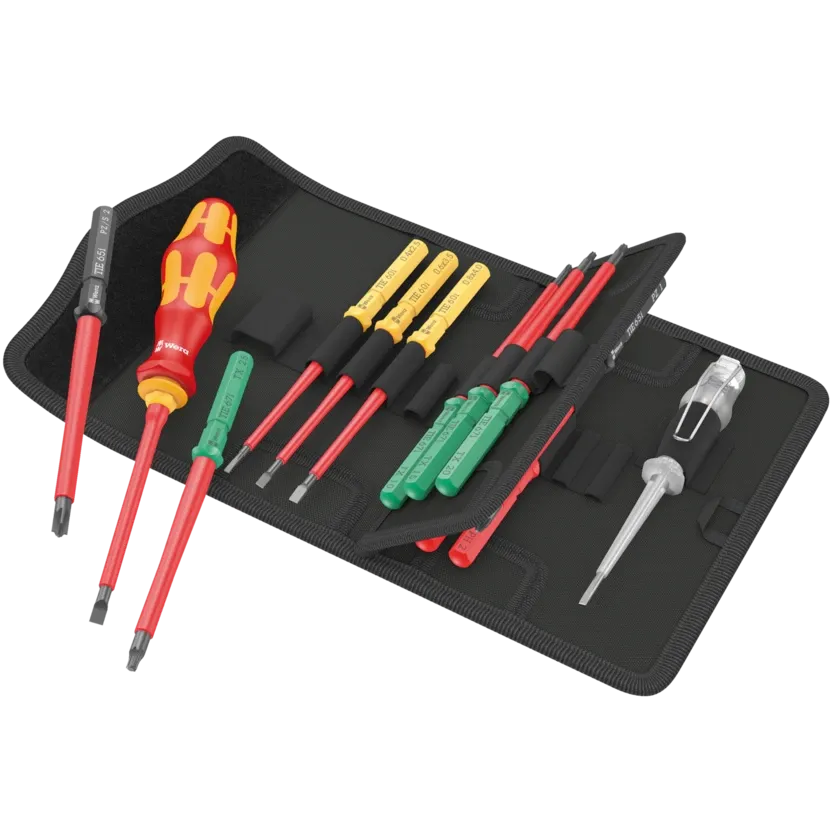
At Wiha, the SoftFinish slimVario 43449 set pairs a handle with three slimBits. Wiha states a blade up to 33 percent thinner for the slimBits concerned, in order to reach deep-set screw or spring elements.
This thinness concerns the clearance around the blade: it settles neither the required profile, nor the space needed around the hand, nor the torque specified by the equipment.
The slimVario and slimBit guide details the compatibility published by Wiha. I consult it specifically to avoid the shortcut “6 mm therefore universal”. An interchangeable blade must remain the one the manufacturer intends for the handle and system in question.
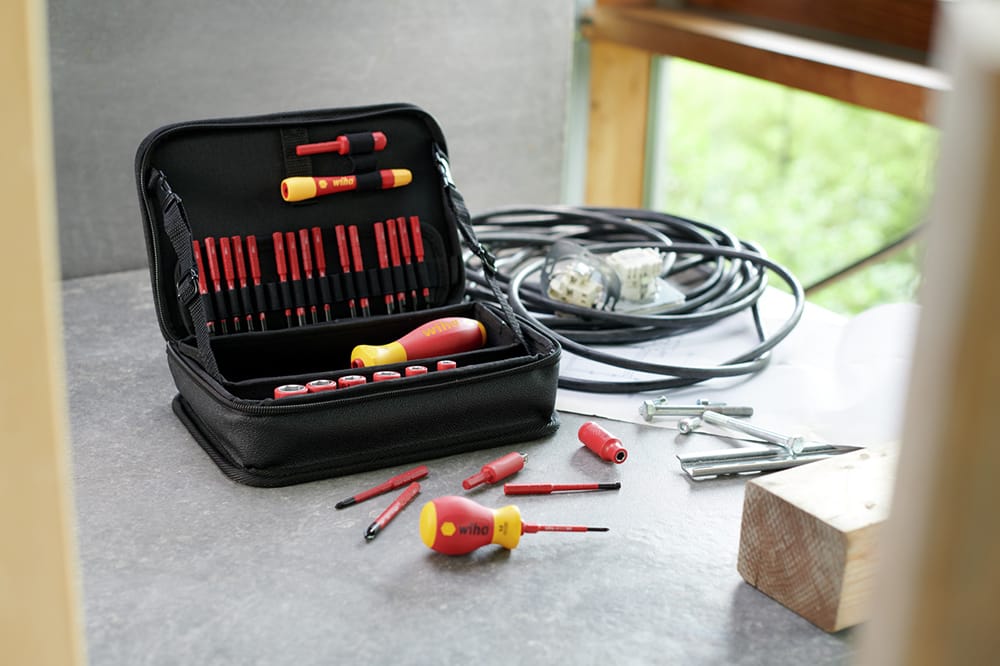
So I keep fixed screwdrivers for the most frequent profiles when speed of identification is the concrete need. I use an interchangeable system when the variety of profiles, lengths or access points justifies it.
This distinction is more solid than an opposition of “Kraftform versus SoftFinish”, because each brand offers fixed lines and modular lines.
Before turning, I seat the tip at the bottom of the recess and align the screwdriver’s axis with that of the screw. A tip engaged at an angle slips, marks the head and damages the flanks even when the profile is correct.
I keep the pressure along the axis and turn without adding lateral force. If the screw resists, I set the tool down, I check the contact and I resume the motion instead of insisting on a wrong position.
First I clear the head, including any dust or paint residue. Next I bring the chosen profile into place without forcing, then I check that the blade no longer moves in the recess. I loosen with a short, controlled movement, and I only continue if the tip stays engaged.
A mistake I see recurring is choosing the tip by eye on a dirty head. A Phillips profile in a Pozidriv recess, or the reverse, gives a false impression of contact and marks the screw at the first effort.
Nor do I continue with a tip whose flats are worn. The tool still seems to enter, but it no longer drives the screw correctly.
A screwdriver is neither a lever nor a punch. I do not hammer on the handle and I do not add an extension to gain torque: I rule out these actions before even starting.
For a stuck screw, I switch methods instead of forcing the tip, and I go back to the equipment with the tool intended for that job.
Wera states for its 1060 i VDE an individual test at 10 000 V according to IEC 60900 and use up to 1 000 V for the tool concerned. Wiha uses equivalent wording for the SoftFinish electric and slimVario mentioned.
This information is important, but it remains tied to the identified reference, to its integrity and to the manufacturer’s conditions.
I never turn them into a live working procedure. Article R4544-9 of the Labor Code states that operations on electrical installations or in their vicinity may only be carried out by authorized workers.
INRS points out that authorization depends on the tasks assigned, the voltage, the type of operation and the conditions, for example de-energized, in the vicinity or live.
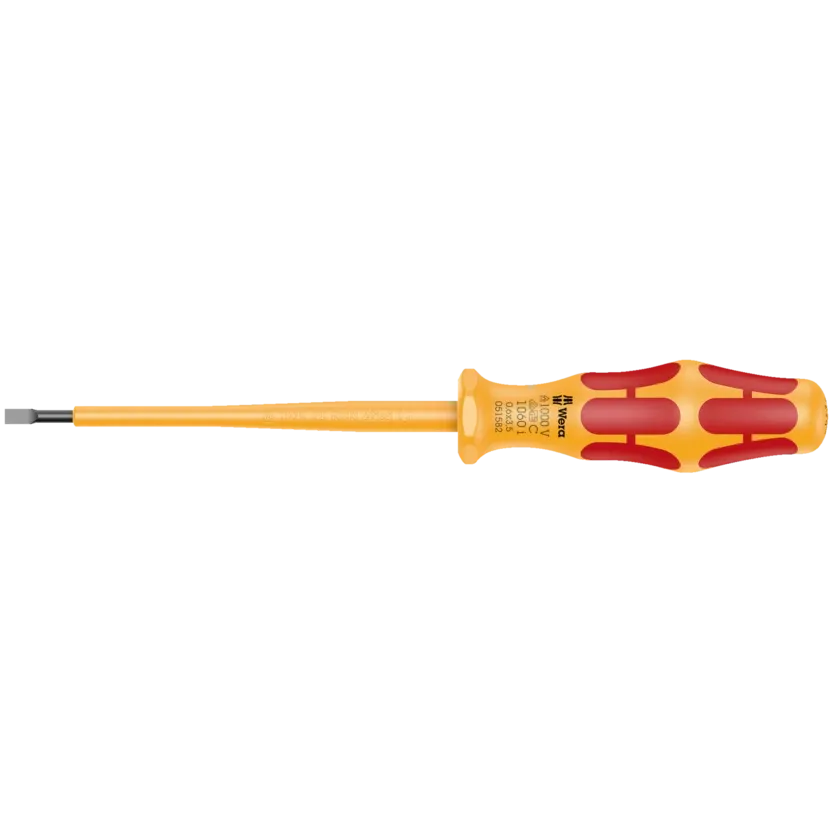
For a job, I favor working with the power off whenever possible, with lockout and the checks suited to the situation. A screwdriver is not a voltage absence tester.
A VAT is a separate device, intended for the verification that precedes working with the power off.
Attention
A VDE marking, an insulated handle or an IEC 60900 blade do not give the right to work live. I remove from the pouch any tool whose insulation, blade, marking or assembly can no longer be checked.
The BR electrical authorization cannot be inferred from the pouch either. It is linked to assigned duties, training and the employer’s decision. The right choice of tooling remains part of a broader prevention effort, not a stand-alone solution.
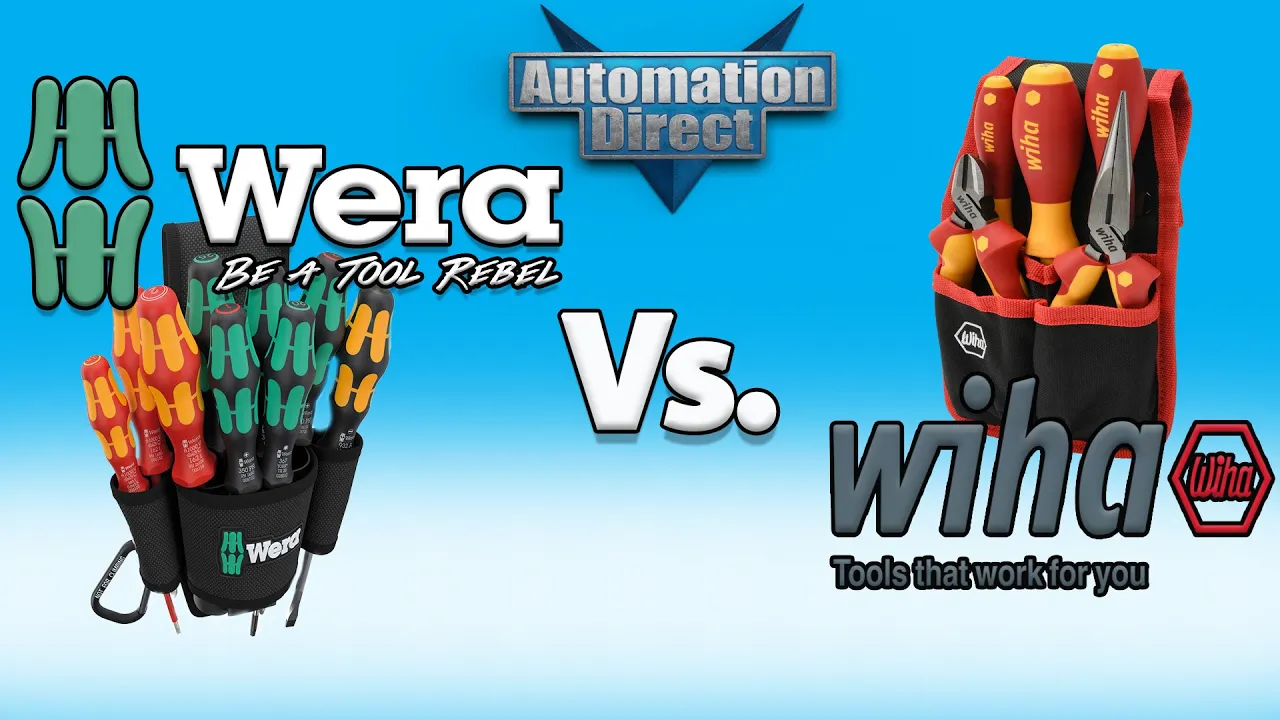
A seven-piece SoftFinish electric set can combine useful profiles with a single-pole tester, depending on the reference. The Kraftform Set 1 includes seven fixed screwdrivers in a textile pouch, for slotted, PH, PZ and TORX.
These two boxes can show the same number of pieces while not matching the same list of screws or the same electrical context.
I read the published contents before buying: profiles, sizes, blade lengths, combined terminal screwdrivers, the presence of a blade-holder handle, the pouch and items that are not screwdrivers. I also make the list of what is missing.
Un set can suit the gear yet leave out a long blade, a PZ size or a PlusMinus tip needed on a given piece of equipment.
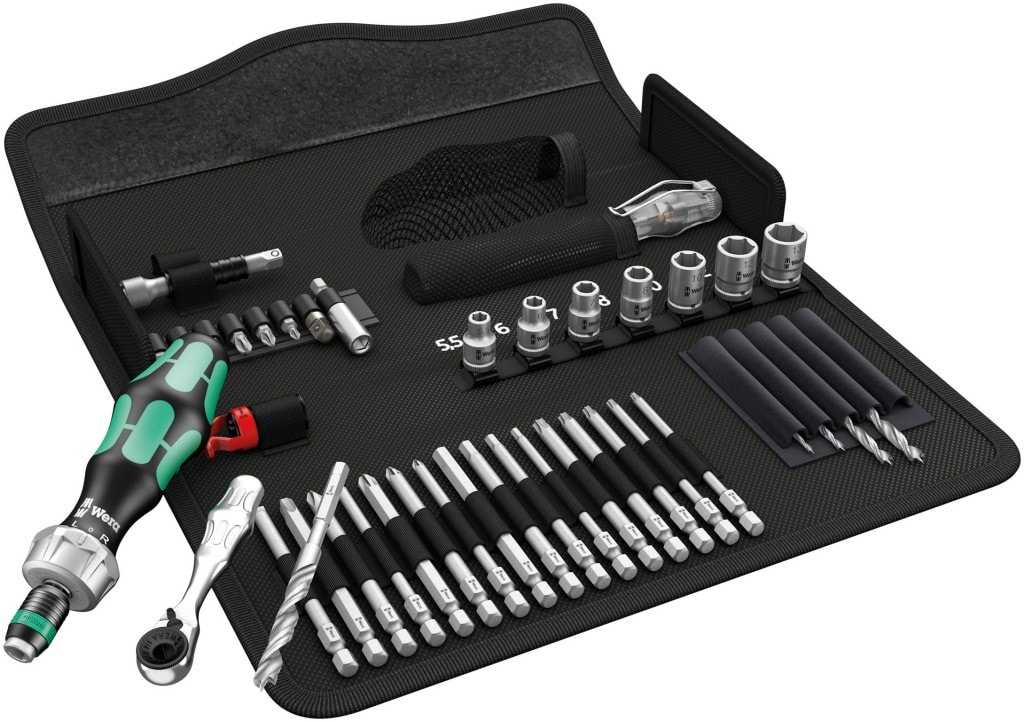
Wera screwdriving set
The handle of the bit holder and the sockets stand out from the screwdrivers: a set's composition is read piece by piece.
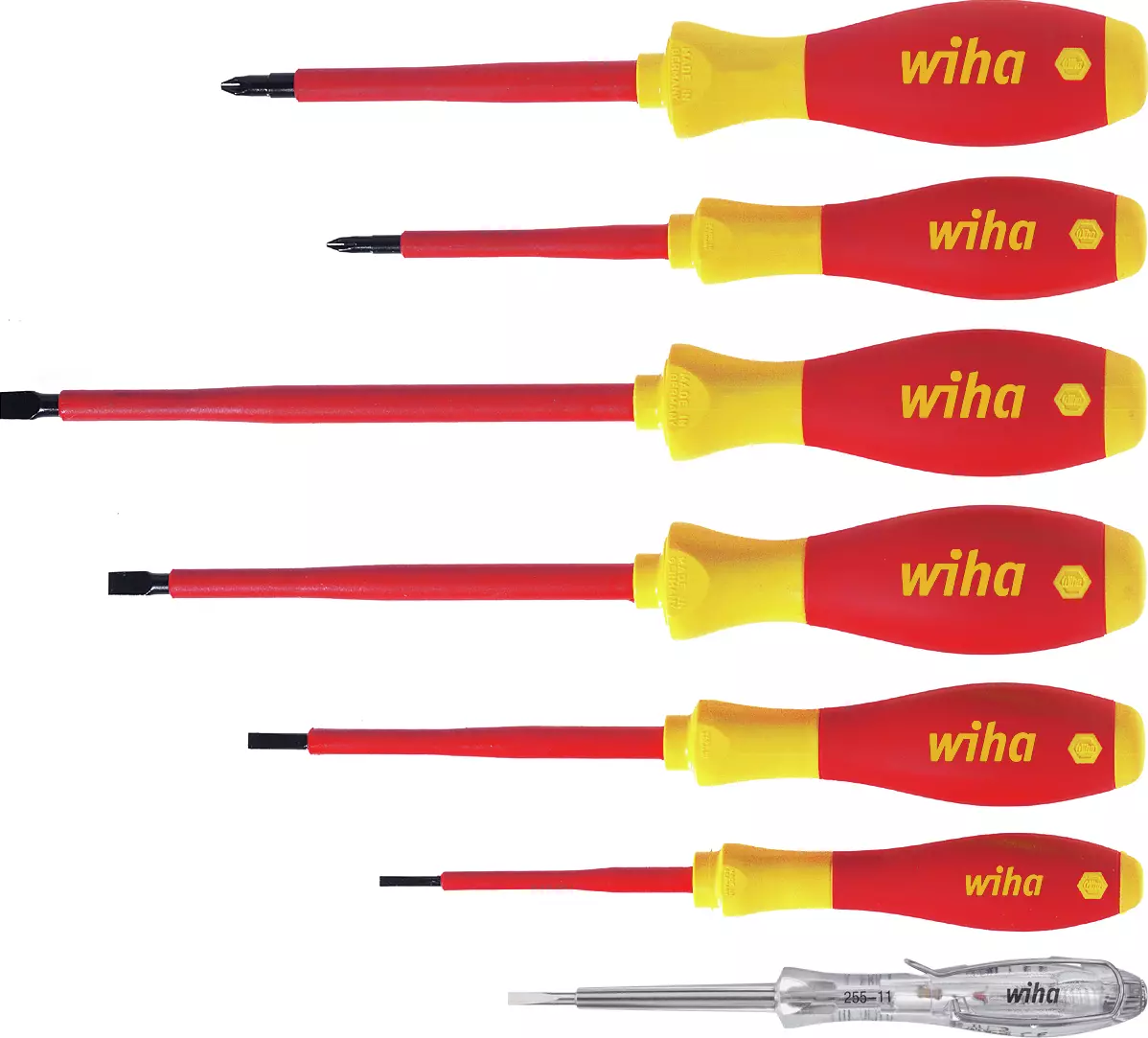
I do not rank a set by the volume of its pouch. The VDE pouch comparison shows why: the presence of an insulated tool, a voltage tester, pliers or a cable cutter depends on the exact reference.
No kit should be presented as complete without having compared its contents with the tasks it is meant for.
Storage matters only after this verification. A compact case helps if every part has a place and remains identifiable. A fixed set sometimes makes handling more immediate. Both choices are valid when they avoid forcing with the wrong tip or looking for a part that was not planned.
I start with the equipment I actually encounter. I note the profiles, the lengths that are missing, deep screws and the areas where the handle cannot make a full turn. This observation avoids replacing tools in working order with a larger case that repeats the same functions.
I then separate the need for fixed blades from the need for an interchangeable system. A fixed screwdriver makes the profile directly visible. A blade system becomes relevant if several profiles or lengths are needed without wanting to carry a handle for each blade.
The right solution therefore depends on the frequency of changes, not on a general promise of modularity.
Identify the screw head and the access
Note the profile, the size, the blade length and the constraints around the handle. A photo of the equipment outside the job can help prepare the bag.
Choose fixed or interchangeable
Keep everyday profiles in fixed screwdrivers if that makes them easier to identify. Choose a blade system only when the published compatibilities and lengths meet the need.
Check the insulated reference
Read the manufacturer’s data sheet, the marking, the condition of the insulation and of the tip. Never infer a certification from a color or a similar handle.
Prepare the operation in its framework
Organize work with the power off and the appropriate verification. Set aside any tool whose blade, insulation or identification no longer allows reliable verification.
Finally, I check what is still missing. If even one length or one regularly used profile is missing, a targeted addition is often more logical than a second complete set.
If a screw requires a defined torque, I consult the equipment documentation and choose the compatible torque tool, rather than assuming that a standard Kraftform or SoftFinish handle is enough.
For an isolated fixed set tracked in real conditions, my review of the C.K Tools Dextro VDE screwdrivers applies the same method: real tip profiles, deep access, torque handling.
I keep a fixed Kraftform or a fixed SoftFinish electric when the profile and the length are known and frequent. I then examine the handle diameter, the anti-roll feature, the marking and the storage as organisational criteria. These are concrete differences, but they do not replace the choice of the tip.
I look at a Kraftform Kompakt VDE or a SoftFinish slimVario when the variety of profiles and accesses really justifies interchangeable blades. In that case, the decisive point becomes the list of compatible blades, their length and their availability.
The Wiha slimBit system can deliver the slim blade profile announced on the intended part numbers; the Wera system brings its own blades and locking. They must not be mixed by analogy.
The comparison therefore has no overall winner. The right question is: “which part number, which blade and which profile make this screw accessible without compromise?” Once that answer is settled, handle preference can break the tie between two genuinely equivalent options.
Fixed-blade screwdrivers vs. interchangeable blade systems
Advantages
Drawbacks
3 questions
InteractiveQuiz: Wera Kraftform or Wiha SoftFinish: which one to choose?
3 concrete reference points cited in this guide
Choose an answer
Both names first refer to families of multi-component handles. You then need to compare a specific reference: fixed screwdriver, VDE model, tip profile, blade length or interchangeable blade system.
No. Kraftform refers to a Wera handle family that also appears on non-insulated screwdrivers. I check the marking and the data sheet of the exact reference, for example the 1060 i VDE series, before selecting an insulated tool.
No. The SoftFinish family covers several uses. For electrical work, I only keep the identified insulated reference, its stated test, its profile and its condition. The red and yellow colour does not replace this check.
I keep a fixed screwdriver for frequently used profiles. A blade system becomes relevant when the recesses or lengths actually change, provided the published compatibilities between handle and blade are checked.
No. An insulated reference and its test concern the identified tool. The Labour Code and INRS govern operations through authorisation and working conditions. I favour de-energised work and the appropriate VAT before any intervention.
No. A PlusMinus profile corresponds to a specific combination screw head. I use the tip that engages that head, then I check the size such as SL/PZ1 or SL/PZ2, instead of choosing a tip that looks close.
Théo Desrousseaux
Electrician and editor
I work in the field and edit this magazine. Every guide is reviewed for its target country before publication.
Sources and references
Practical electrical installation guides, diagnostic methods and tool recommendations compared against the technical wiring standards of this national edition.
Wiha or Wera: VDE 1000 V screwdrivers and pliers, storage systems and a method for a tool set suited to real electrical work in the home.
Read the guide Guide C.K Tools review: VDE tools C.K Tools review: a German-origin brand now Welsh, VDE range of Dextro screwdrivers and RedLine pliers, IEC 60900 standards and published specifications. Read the guide
 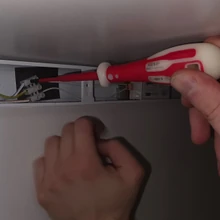 Guide C.K Tools screwdriver review: Dextro VDE Slim Review of the C.K Tools Dextro VDE Slim screwdrivers: slim insulated blades, Glow series, Modulo tips, magnetic ring and torque hold on terminal blocks. Read the guide
  Guide Wera: brand history Wera: founded in 1936 in Wuppertal, name taken from Werner and Amtenbrink, Kraftform handle in 1968, Czech production from 1995, Bitburger Holding since 2016. Read the guide