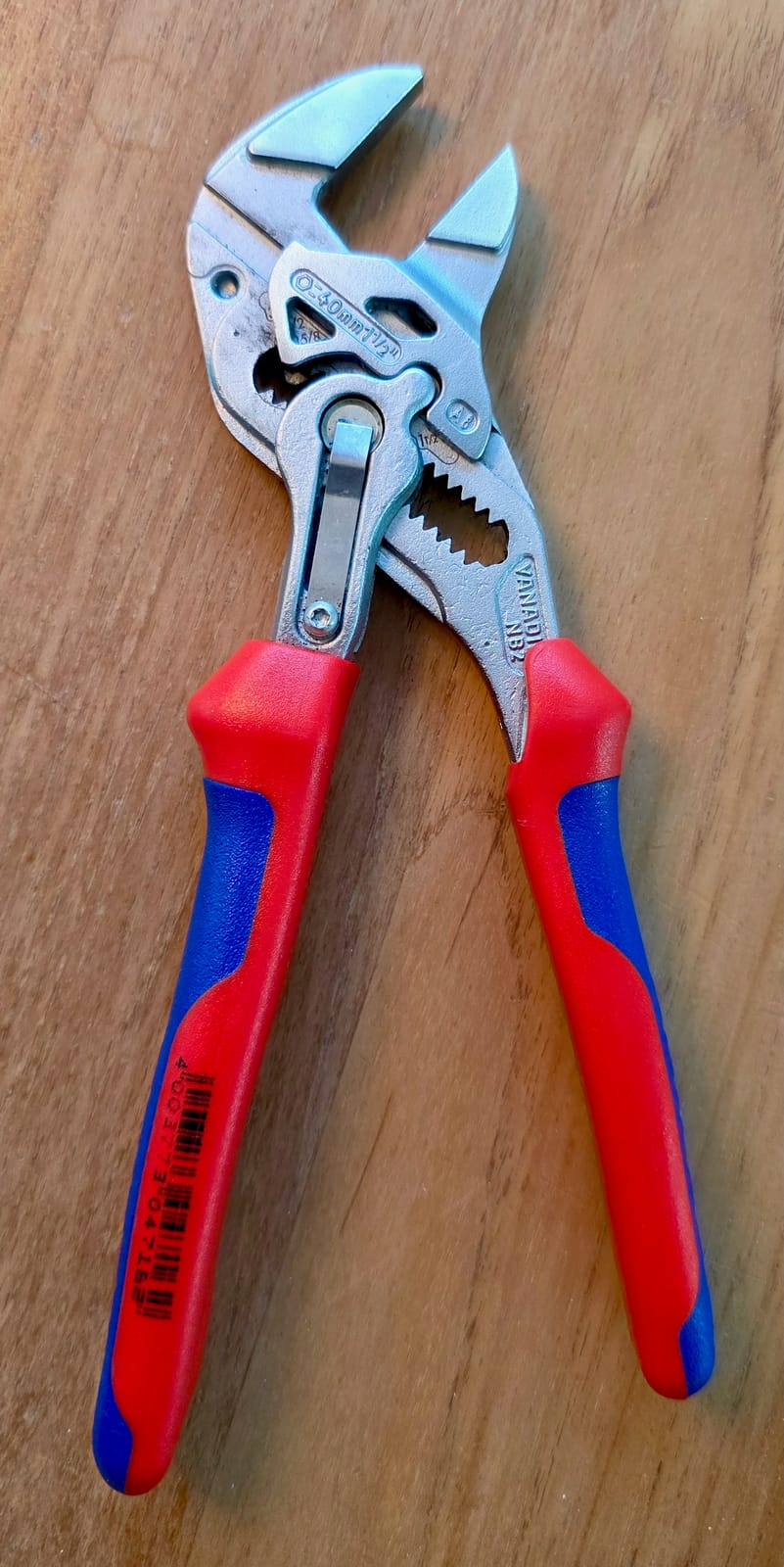
Knipex 180 mm pliers wrench
Smooth jaws avoid marking a delicate finish, unlike the serrations of water pump pliers.
Published 29 July 2026
In brief
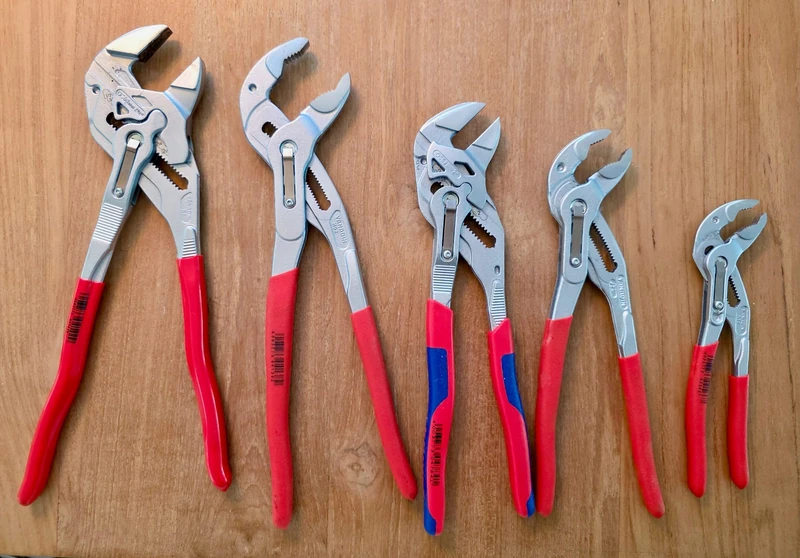
The query “Knipex Cobra or Facom” suggests a duel between two brands. It is not the right thing to compare. A Cobra is a family covering several lengths, finishes and handles. The Facom 181A series also includes variants in 180, 250 and 300 mm.
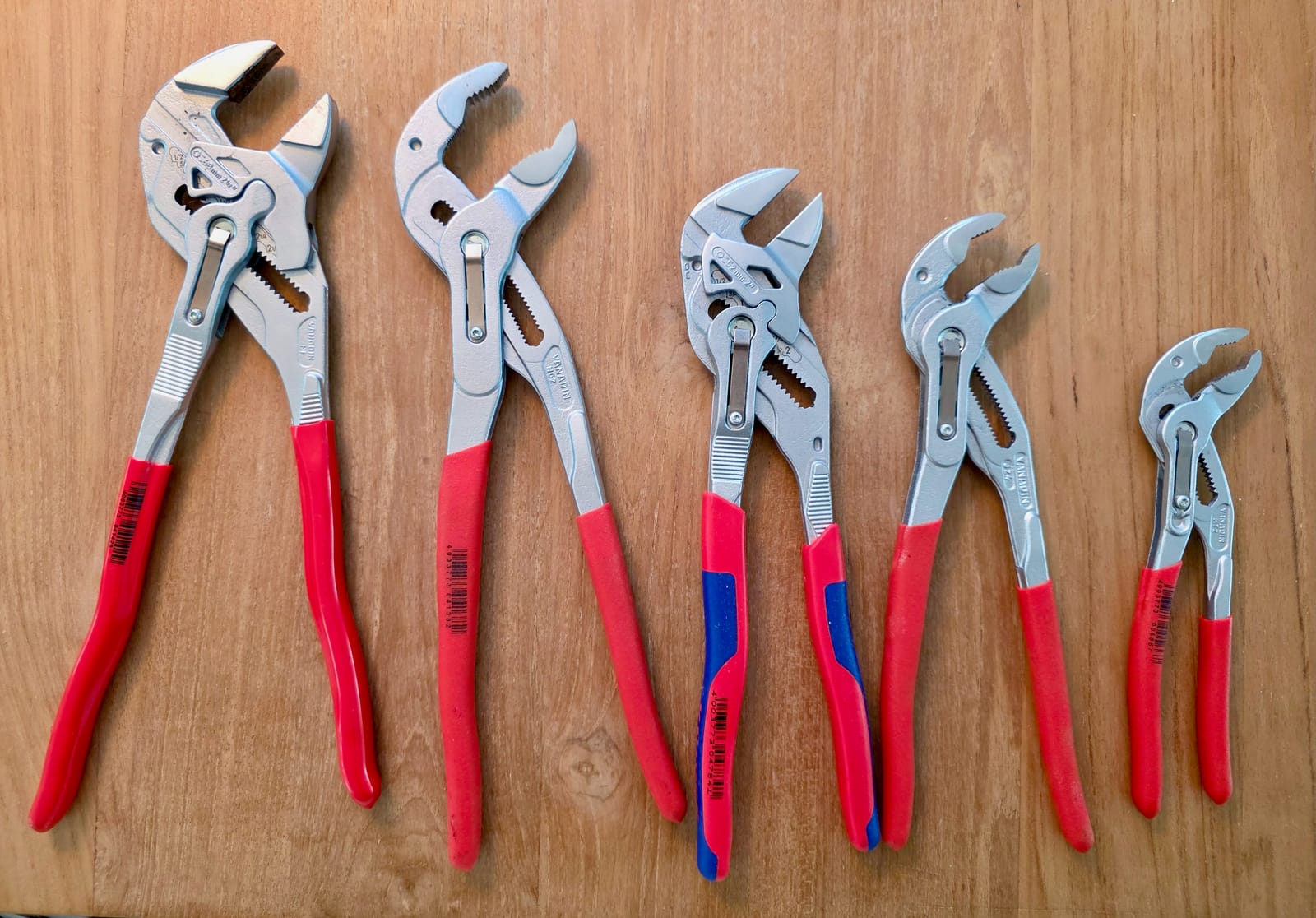
So I set the scope: Knipex Cobra 87 01 250 versus Facom 181A.25G. They are close in length, both with push-button adjustment, and both manufacturers list them as compliant with the ISO 8976 family of standards. They are not, however, interchangeable point by point.
The short conclusion is clear. The Cobra 87 01 250 publishes a more detailed opening and 25 adjustment positions. The Facom 181A.25G publishes 12 positions, a slimmed head with self-locking teeth and a length of 245 mm.
I do not infer from these spec sheets that one plier lasts longer, grips tighter or tires the hand less: that would require a comparable test protocol, which is not published here.
25
positions published for the Cobra 87 01 250
12
positions published for the Facom 181A.25G
46 mm
opening on nut published by Knipex
62 HRC
tooth hardness published for the Facom 181A
A useful comparison starts by eliminating three common confusions: a water pump pliers is not a pliers wrench, a chrome-plated variant is not necessarily an insulated variant, and a brand never sums up every model in its catalog.
The 87 01 250 is the 250 mm Cobra with an atramentized finish, polished head and plastic grips. Knipex gives it 335 g, 25 positions, 46 mm on nuts and 50 mm on pipe. The page also specifies compliance with DIN ISO 8976.
The 181A.25G is the Facom 250 mm with a varnished finish and single-material PVC handles. The international page gives 245 mm, 0,35 kg, 12 positions and the absence of 1 000 V insulation.
The French datasheet for the 181A series distinguishes the 181A.25CPE variant with bi-material handles from the 181A.25G: I therefore do not transfer the handle material from one to the other.
| Verified point | Knipex Cobra 87 01 250 | Facom 181A.25G |
|---|---|---|
| Verified point Published length | Knipex Cobra 87 01 250 250 mm | Facom 181A.25G 245 mm |
| Verified point Published weight | Knipex Cobra 87 01 250 335 g | Facom 181A.25G 0,35 kg |
| Verified point Published adjustment | Knipex Cobra 87 01 250 25 micrometric positions | Facom 181A.25G 12 quick positions |
| Verified point Published opening | Knipex Cobra 87 01 250 46 mm nut, 50 mm pipe | Facom 181A.25G Approximately 42 mm nut, slim profiled jaws |
| Verified point Published teeth | Knipex Cobra 87 01 250 Hardened teeth approx. 61 HRC, self-locking teeth | Facom 181A.25G High-frequency hardened teeth 62 HRC |
| Verified point Manufacturing origin | Knipex Cobra 87 01 250 Wuppertal-Cronenberg (Germany) | Facom 181A.25G Besançon (France) — Origine France Garantie |
| Verified point Manufacturer warranty | Knipex Cobra 87 01 250 Legal warranty against manufacturing defects | Facom 181A.25G Lifetime Warranty with pro counter exchange, Service France Garanti |
| Verified point 1 000 V insulation | Knipex Cobra 87 01 250 Not stated for this non-VDE reference | Facom 181A.25G No |
| Verified point Standards cited | Knipex Cobra 87 01 250 DIN ISO 8976 | Facom 181A.25G ASME B107.500, DIN ISO 8976, ISO 8976, NF ISO 8976 |
Technical comparison of the Knipex Cobra 87 01 250 and the Facom 181A.25G: manufacturer data, origin certification and warranties.
This table does not make it possible to elect a “better” brand. It makes it possible to prepare the decision that matters: can the pliers be adjusted close enough to the workpiece, open wide enough and reach it without making the hand work in a hazardous position?
For insulated tools, I would rather refer to the comparison of VDE 1 000 V tool kits. Non-insulated pliers do not become a live-working tool because their handle is red, blue or coated.
On tongue-and-groove pliers, the number of positions does not indicate a clamping force. It describes the positions of the rack or of the adjustment mechanism. The more there are, the finer the gap between two settings can be, at comparable length.
But the actual spacing and the geometry of each position remain specific to the manufacturer.
Knipex describes the Cobra button as an adjustment made directly on the workpiece. The 87 01 250 has 25 positions. The button pushes the pin into another rack tooth; the user must not try to force the pin when it is loaded against the workpiece.
Facom describes on the 181A series a fast and precise adjustment button with safety locking. The 181A.25G lists 12 positions in its international datasheet. The French family datasheet uses the same rack term at 12 positions.
This is the value I keep, rather than repeating the 24 positions sometimes displayed by resellers without making their counting method explicit.
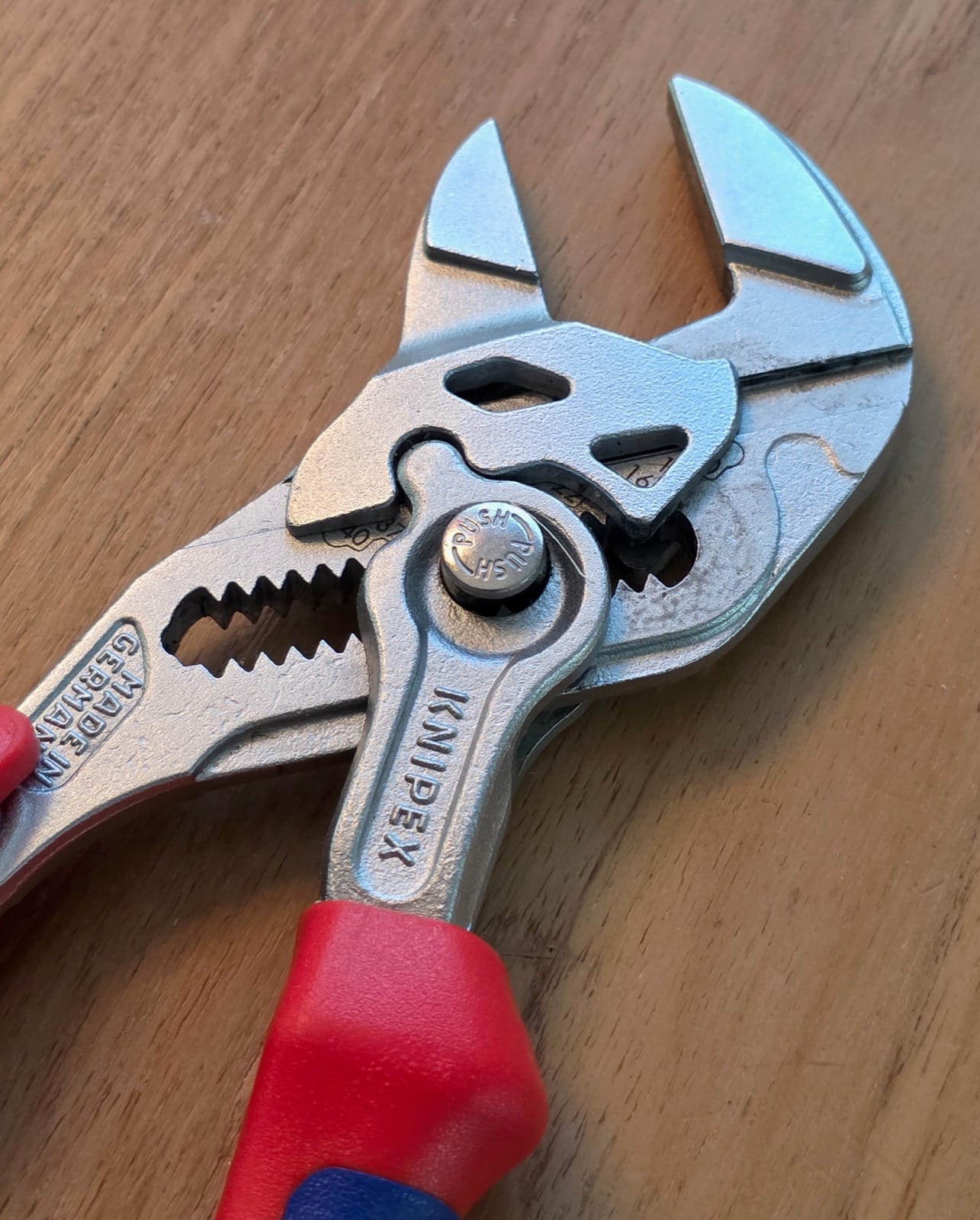
The number of notches is therefore a measure of adjustment precision, not proof that the pliers will never slip. The nature of the workpiece changes everything: painted pipe, greasy nut, brass fitting, rusted steel or plastic part do not offer the same grip.
I prefer to set the pliers as close as possible before loading the handles rather than compensating for a poor notch with more effort.
The locking claimed by both manufacturers limits unintentional movement of the pivot setting. It does not remove the need to visually check that the rack is engaged before tightening. This is a practical difference from an old free-sliding water pump pliers, not permission to put your fingers between the handles.

The Cobra 87 01 250 has serrated jaws. Knipex states a high-frequency treatment at around 61 HRC for the inside of the jaws and a self-locking geometry on pipes and nuts.
The word “self-locking” describes a reaction of the geometry under load; it does not allow you to let go of the pliers or to use a fragile part as a support point.
The Facom 181A.25G is also listed with a slim head with self-gripping teeth. The international datasheet mentions jaws high-frequency treated to 62 HRC.
The two HRC values are very close, but they are not enough to compare tooth depth, the area actually treated or the strength of a complete plier.
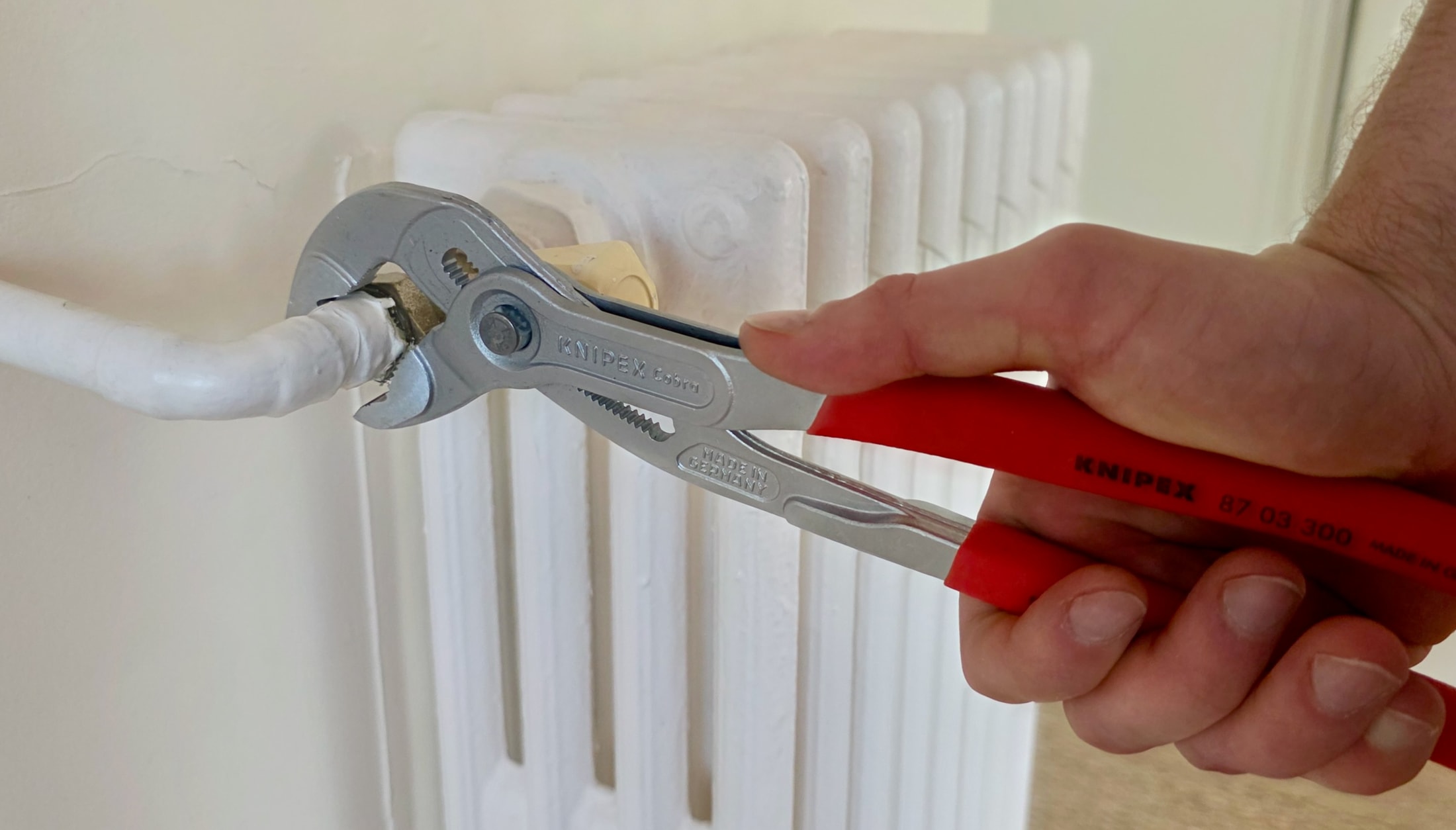
Serrations are fine for holding a metal fitting when marking is not critical. On a visible chrome nut, a plastic nut, a painted-finish fitting or a part that must keep its faces, I’d rather use a suitable wrench or a smooth-jawed pliers wrench.
In the Knipex story, I also distinguish the toothed Cobra from the pliers wrench: they don’t serve the same purpose.
Knipex 180 mm pliers wrench
Smooth jaws avoid marking a delicate finish, unlike the serrations of water pump pliers.
The Facom 181A.25G shown here has a rather slim head, and the Cobra also has a head designed to grip a variety of profiles. I am not turning this visual observation into an accessibility ranking.
Access depends above all on the angle of the pipe, the clearance around the handles and the possible need to use two tools for a lock nut.
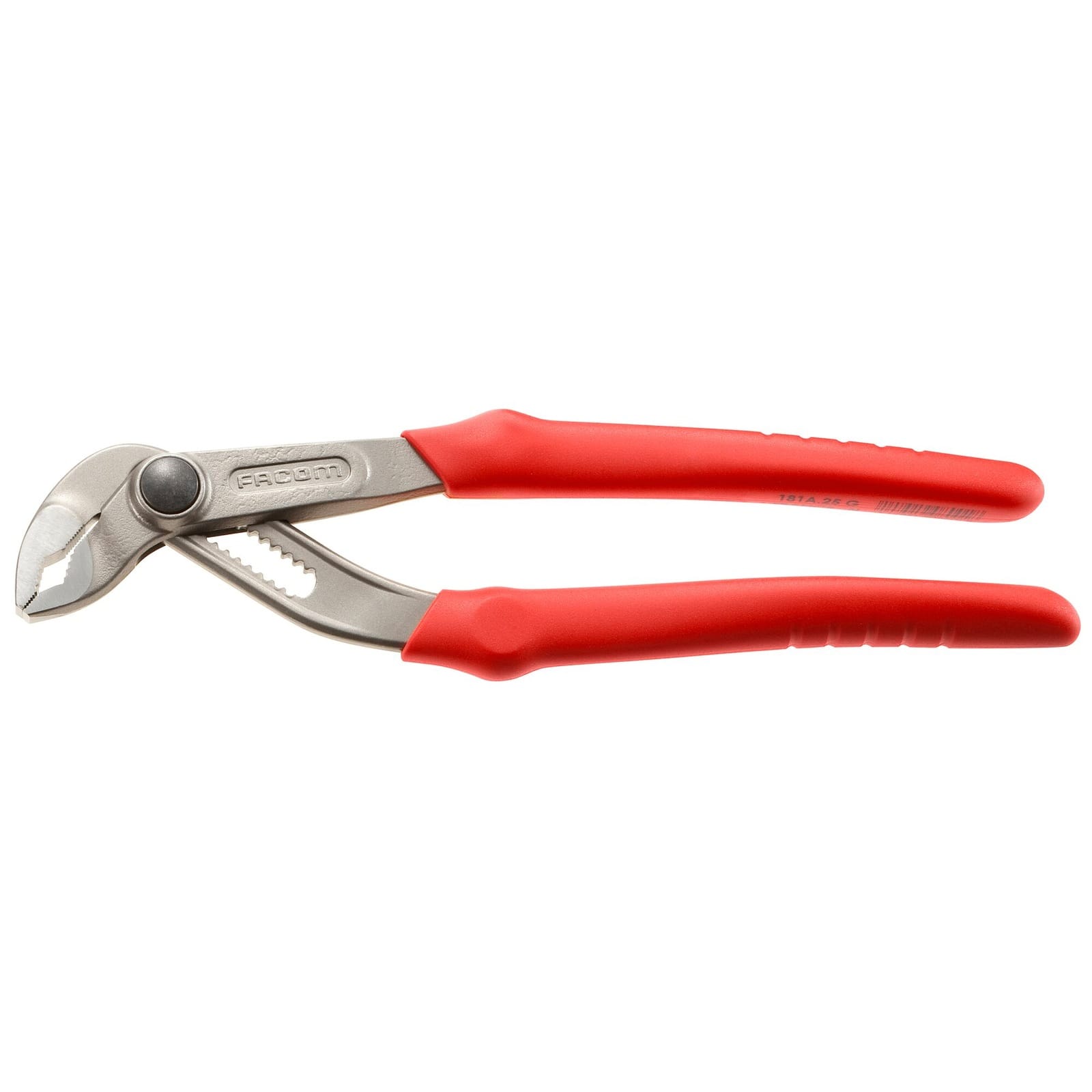
Official profile of the Facom 181A.25G: the button, the serrations and the PVC handles of the G variant are visible.
Source: Facom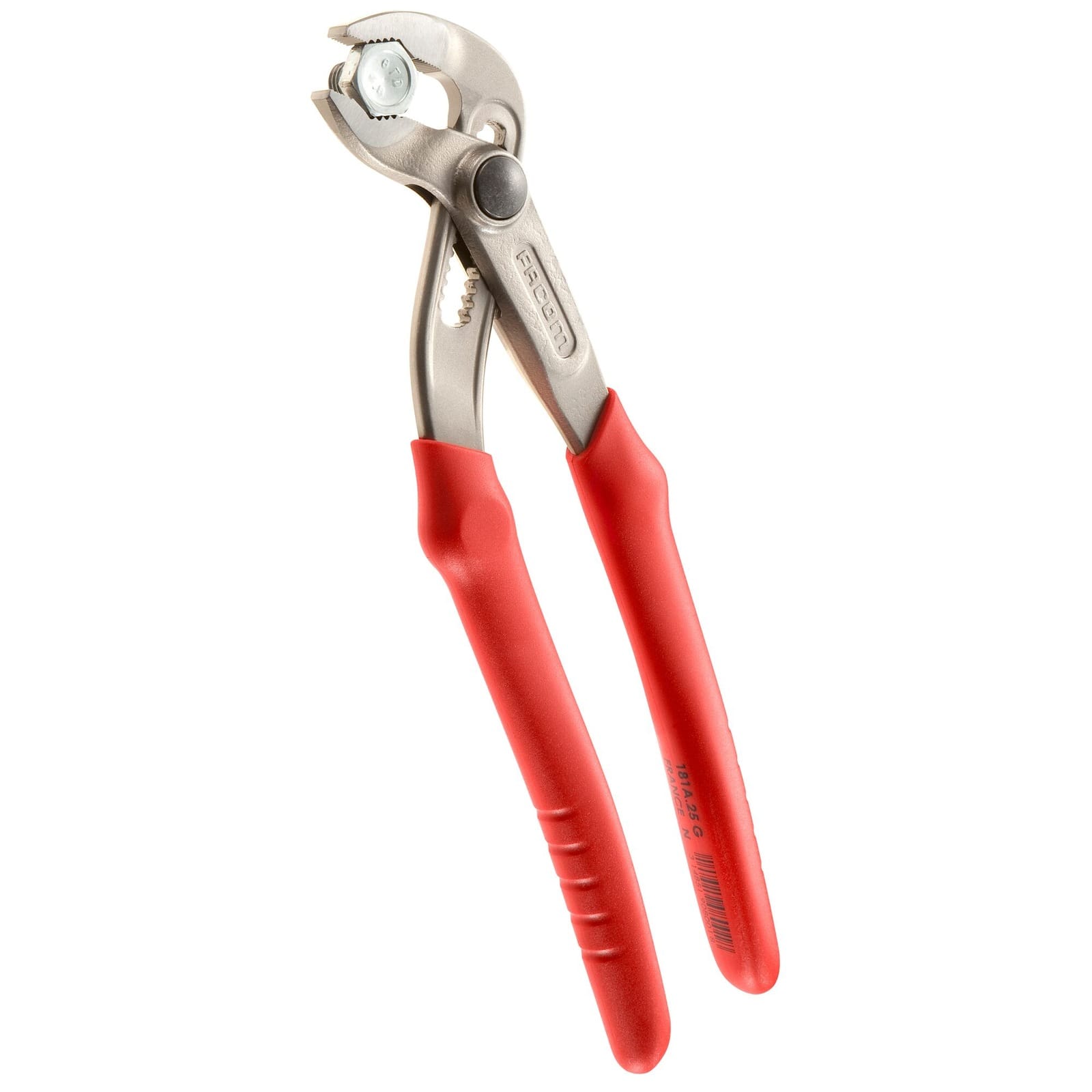
Official view of the 181A.25G open: the rack and the shape of the head can be verified without attributing them to another 181A variant.
Source: Facom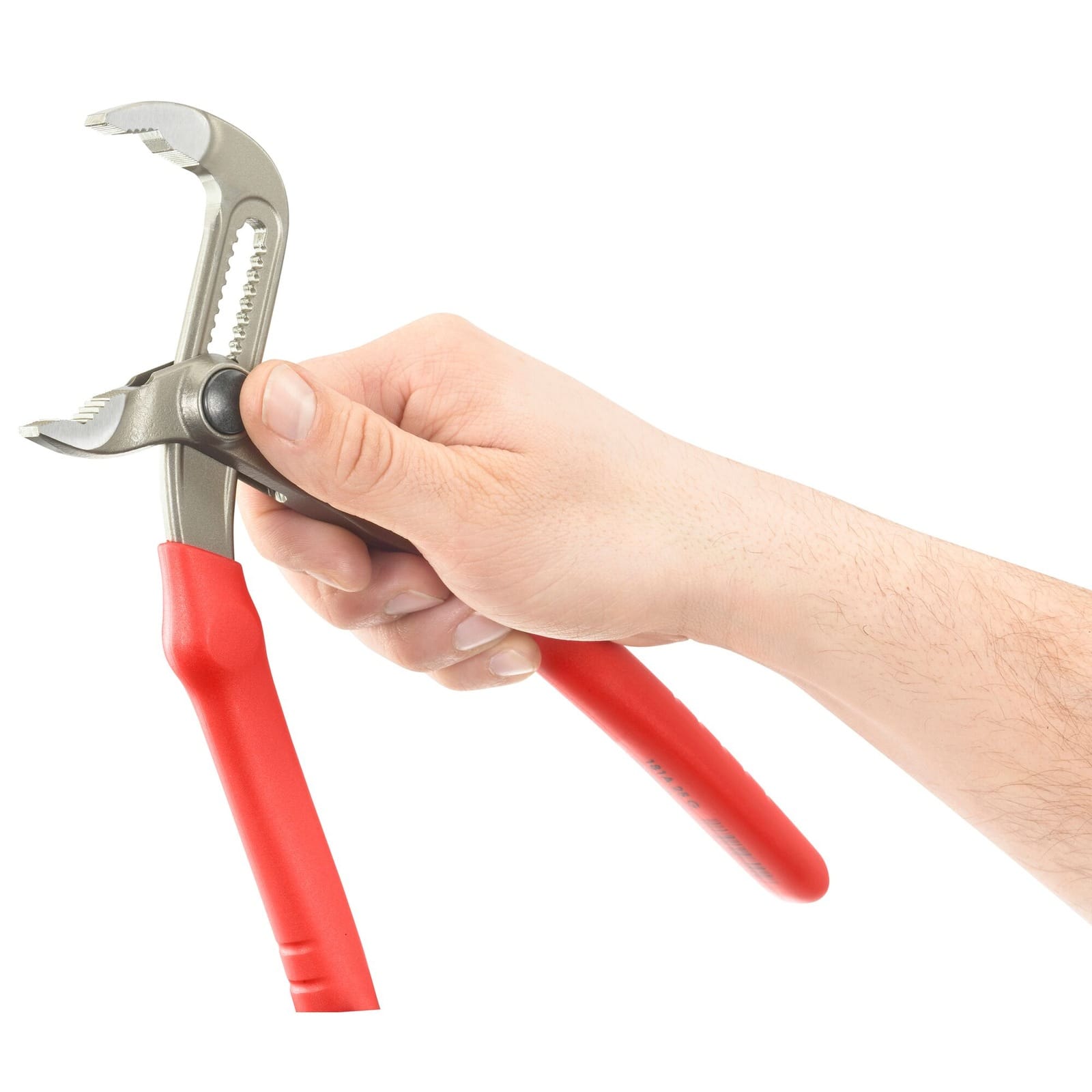
The manufacturer's visual shows the 181A.25G being held, not an ergonomics measurement or a clamping force test.
Source: FacomKnipex publishes two values that answer two part shapes: 46 mm for nuts and 50 mm, or two inches, for the tubes of the Cobra 87 01 250. This distinction is more useful than a plain “large opening”, because a nut is measured across flats while a tube is measured on its outside diameter.
Facom does publish 245 mm for the 181A.25G. Its series datasheet provides a dimensioned drawing with an L1 value of 54 mm for the 250 model, but the drawing legend does not explicitly identify it as jaw capacity. I therefore do not convert it into a “54 mm opening”.
The 181A.25G page does not publish a numerical clamping capacity. For a borderline diameter, I therefore rely only on a datasheet that matches the exact 181A.25G variant or on confirmation from Facom.
This documentation asymmetry is part of the result. If my need is to regularly grip a known diameter between 46 and 50 mm, the Cobra value gives a verifiable limit. If I look at the 181A.25G, I measure my part then I check the pliers in the store or with Facom before deciding.
A 250 mm model does not automatically imply the same opening across all manufacturers.
Conseil
Before choosing water pump pliers, I note three dimensions: outside diameter of the tube, width across flats of the nut and available space to open the handles. The diameter alone does not tell whether the pliers can be engaged.
The difference in nominal length, 250 against 245 mm, is small. It does not support concluding a leverage advantage for either one. The pivot position, the opening chosen and the actual distance between pivot and hand also count.
What I keep in mind above all is that these are two comparable tool-bag formats, not two radically different tool sizes.
Knipex states for the 87 01 250 a chrome-vanadium electrical steel, forged then oil-hardened in several stages. The datasheet mentions an interlocked joint, double guidance and an anti-pinch lug.
Facom states for the 181A.25G a chrome-vanadium steel head, high torsion strength and a slim head. The finish stated on the international page is matte chrome with single-material handles, whereas the French series datasheet pairs the varnished presentation with PVC handles.
This wording difference is not a reason to mix the data of the G and CPE variants.
In both cases, “chrome-vanadium” does not give a detailed chemical composition. The wording also does not allow deducing a service life given in years.
To assess the condition of a plier I am using, I look instead at the play in the joint, the spring of the handles, the condition of the teeth and the absence of cracks or a loose handle.
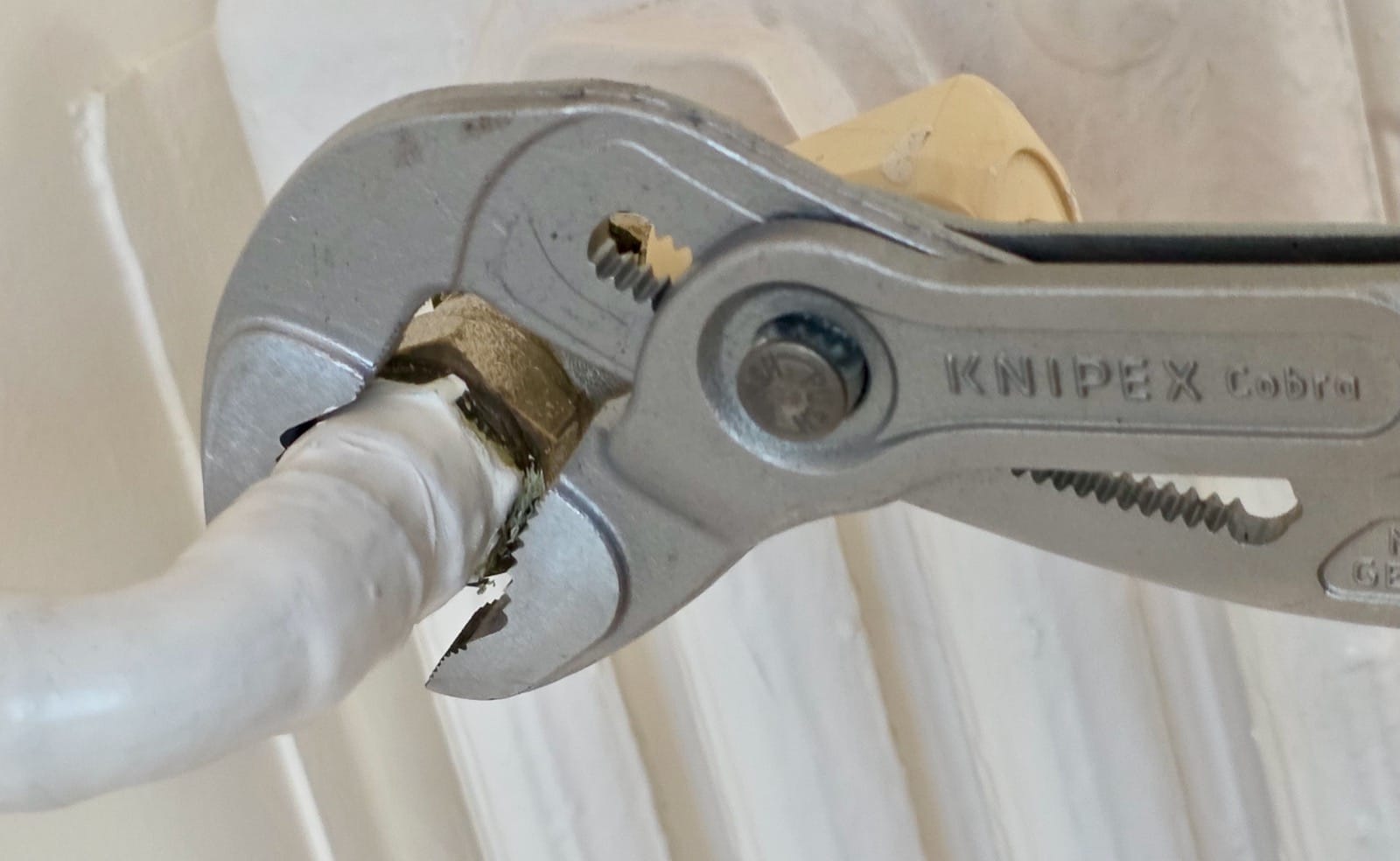
Cobra 87 03 300 jaw
The jaw texture helps with grip, but is not a solution for preserving a delicate finish.
The standard deserves the same caution. AFNOR presents NF ISO 8976:2021 as a standard on the dimensions and test values of multiple slip joint pliers. Knipex cites DIN ISO 8976 for the Cobra 87 01 250; Facom cites ISO 8976 and NF ISO 8976 for the 181A. The announced conformity places the tool within a multiple slip joint pliers standard.
It amounts to neither VDE certification nor electrical protection.
The Facom 181A.25G datasheet explicitly answers “No” to 1 000 V insulation. Knipex offers Cobras with insulated handles in other part numbers, but the 87 01 250 that I compare here is listed with plastic sleeves and no VDE marking in its specifications.
I therefore do not attribute insulation to it by analogy with another Cobra.
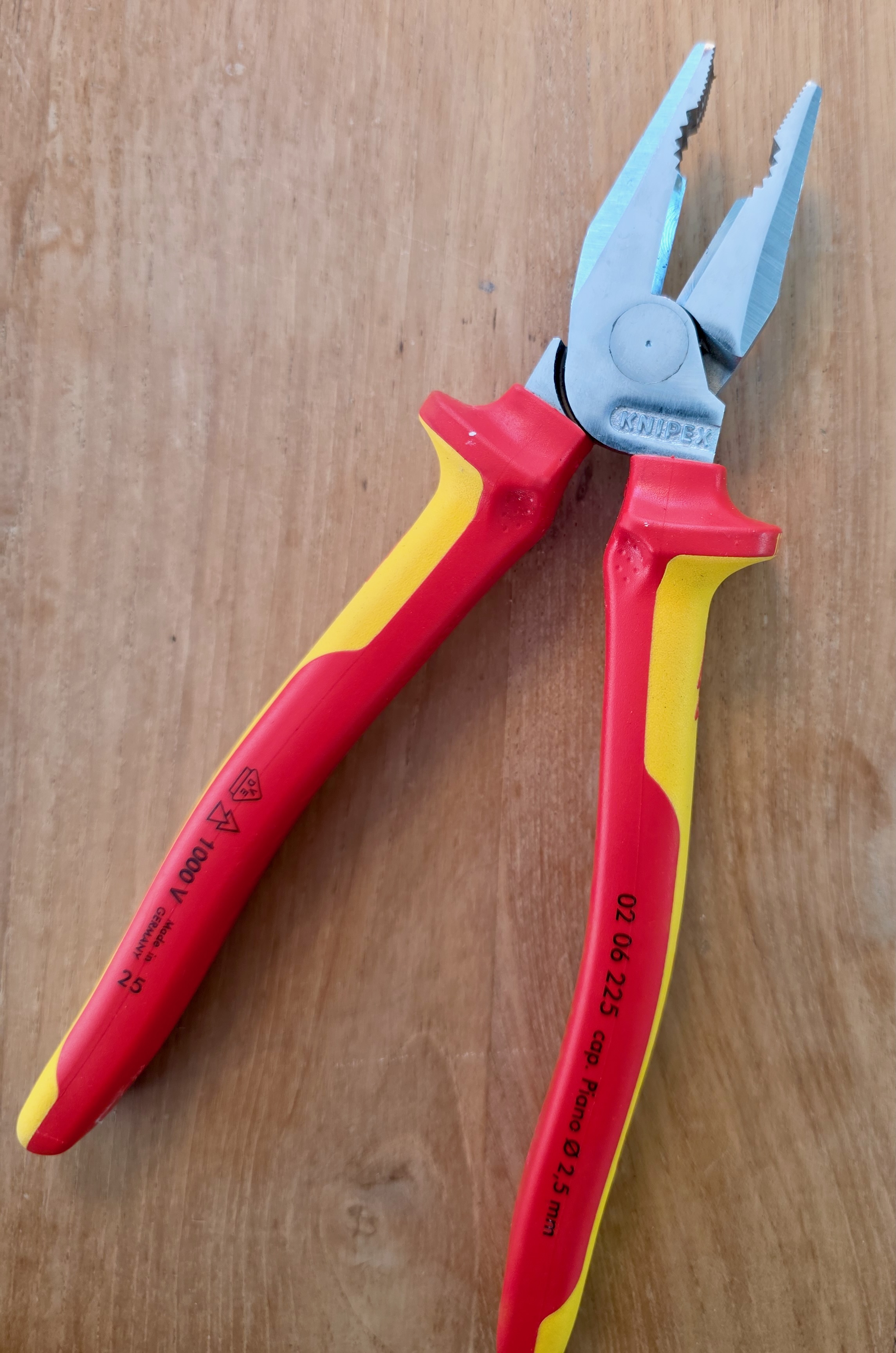
Knipex 02 06 225 VDE combination pliers
The 1 000 V marking is the signature of an insulated tool: neither the 87 01 250 nor the 181A.25G bears it.
On an electrical installation, the multiple slip joint pliers may be used for a mechanical part that is not live: a cable gland nut, holding a non-electrical fitting, or fastening.
It replaces neither the voltage absence tester, nor the lockout procedure, nor the insulated tools required by the situation.
A sheathed handle does not protect against current
Before any work near electrical elements, I switch off the supply, lock it out if necessary and verify the absence of voltage with a suitable voltage absence tester. Pliers not marked for 1 000 V are not used for live working.
The limits of intervention also depend on the electrical authorisation level and the work context. The guides BS electrical authorisation and BR electrical authorisation explain why an authorisation level cannot be reduced to the contents of a tool bag.
I choose the Cobra 87 01 250 when I need a documented opening capacity: 46 mm on a nut or 50 mm on a pipe, and when the 25-position fine adjustment matches the range of parts encountered. It’s a decision drawn from the spec sheet for this reference, not a verdict on all Cobras.
I keep the Facom 181A.25G in the selection if its 12-position adjustment, its 245 mm length and its serration match the part. Before buying for a specific capacity, I ask for the opening dimension of this variant.
If I’m aiming at the 181A.25CPE, I treat it as another reference, with its dual-material handles and its own spec sheet.
I don’t use either of these two pliers to preserve a fragile surface. A pliers wrench, an open-end wrench, a properly adjusted adjustable wrench or a strap wrench can avoid marking a nut or a pipe.
The comparison Knipex, Wiha or Wera covers this logic of complementarity: a good tool bag does not rely on a single family of tools.
The first mistake is comparing a 250 mm Cobra with a 180 mm Facom, then concluding that the manufacturer of the larger plier opens wider. Length changes the clamping range and the available leverage. You need to start by putting similar sizes side by side, then check the figures specific to each reference.
The second mistake is confusing the variants of the same series. At Knipex, 87 01 250, 87 02 250, 87 03 250 or 87 05 250 do not describe the same handles or the same finish. At Facom, the 181A.25G and the 181A.25CPE are two distinct versions. The suffix is technical information, not a color detail.
The third mistake is using a stated capacity as a daily working zone. A plier can reach a maximum opening on a given part without leaving a comfortable handle position or a margin to place it correctly.
When a fitting must be held while a locknut turns, I also check the space needed for the second tool.
The nut deserves particular attention. Slip-joint pliers work through their teeth and through the force transmitted to the pivot. On a hex head in good condition, a wrench of the right size spreads the force across the faces.
Pliers remain useful when the size varies or the profile is round, but they are not the automatic choice for every fitting.
Attention
Teeth on a plastic fitting, a chrome drain, or a decorative nut can leave a mark as soon as load is first applied. I protect the finish by changing tools, not by tightening less with an ill-suited pair of slip-joint pliers.
The absence of a price in this comparison is intentional. Offers change depending on the distributor, the packaging, and the availability. A price on its own says nothing about the opening, the handles, or the reference actually delivered.
I favor the manufacturer’s spec sheet and the label on the pliers rather than a shortened product name.
Before a job, I check the tool unloaded. The button must move without abnormal sticking, the pin must engage in a complete position, and the handles must not show excessive lateral play.
The check does not replace manufacturer maintenance, but it avoids discovering a clogged rack or a split handle at the moment when the fitting is already engaged.
I then look at the teeth. Teeth caked with plaster, dry paint or metal particles reduce the actual contact with the part. I clean the tool away from any electrical zone and I take a pair of pliers out of service if I notice a crack, a deformation or a joint that no longer holds its adjustment.
Prevention is not limited to the condition of the tool. INRS reminds that an unsuitable tool or a slipping hand plays a part in workplace accidents linked to a movement disturbance.
For multigrip pliers, I keep my fingers clear of where the handles close, I direct the force so as not to fall into empty space if the grip gives way and I stabilize the part before applying load.
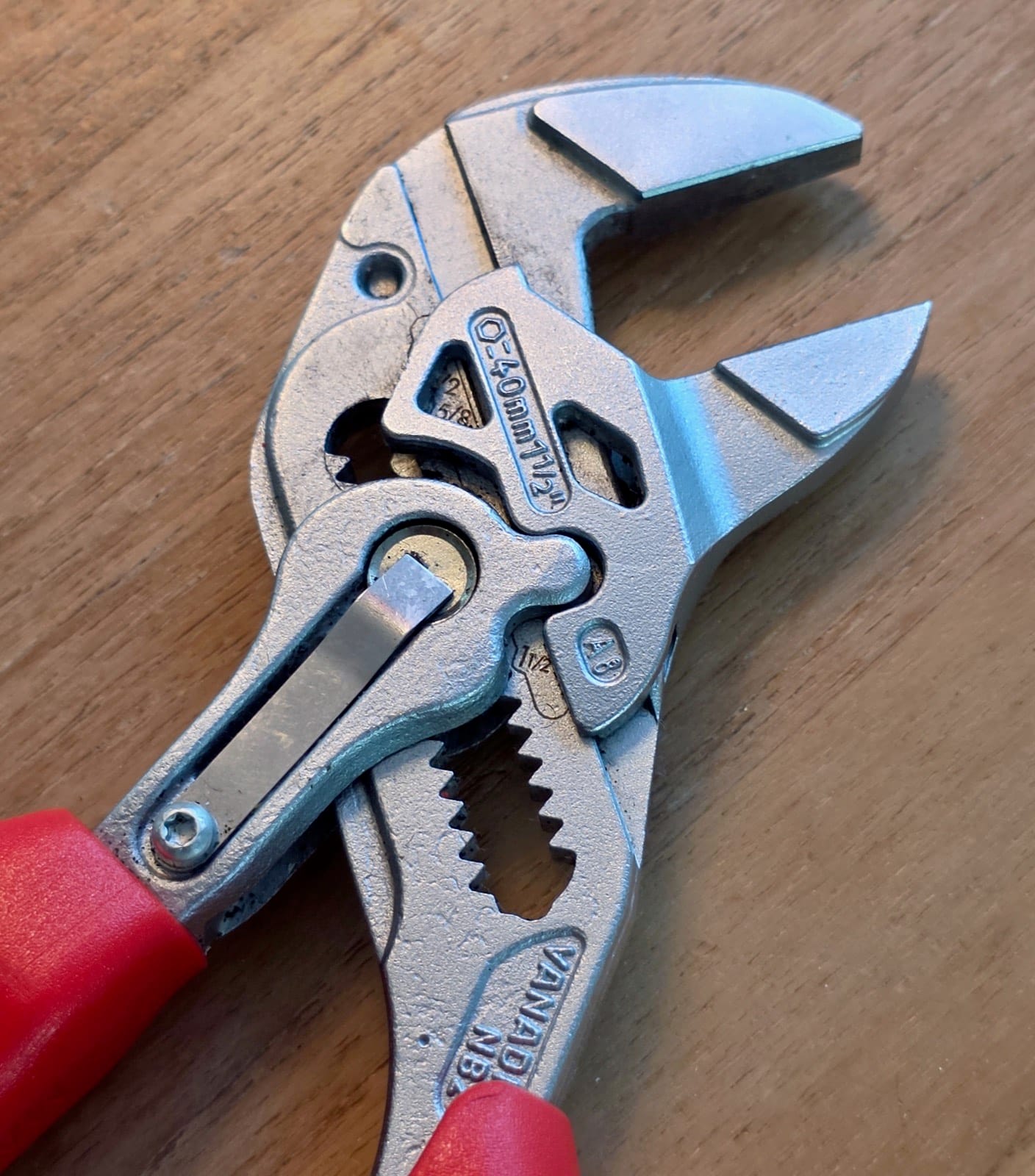
Pivot and rack
The pivot and the adjustment positions are points to keep clean and checkable before any intervention.
This routine applies to both models compared. It does not prove that one brand is stronger: it makes it possible to spot a visible defect before it turns a simple operation into an injury or a damaged connection.
I start by photographing or measuring the most demanding part: the largest nut, the widest tube or the fitting placed in the tightest space. I then note the outside diameter or the width across flats. A screenshot of a spec sheet does not replace this starting dimension.
I then compare the published data. The Cobra 87 01 250 provides explicit limits for nuts and tubes. For the Facom 181A.25G, I confirm the opening from the exact-variant datasheet or directly with Facom before buying it for a borderline diameter.
This approach is less appealing than a ranking, but it reduces the risk of receiving a pair of pliers that closes too tight.
Finally, I check the delivered variant. A photograph may show the CPE while the reference in the cart is G, or vice versa. The engraved marking on the tool and the EAN of the reference must match the selected spec sheet.
It is also the way to avoid attributing insulation, a bi-material handle or a chrome finish to a model that does not have them.
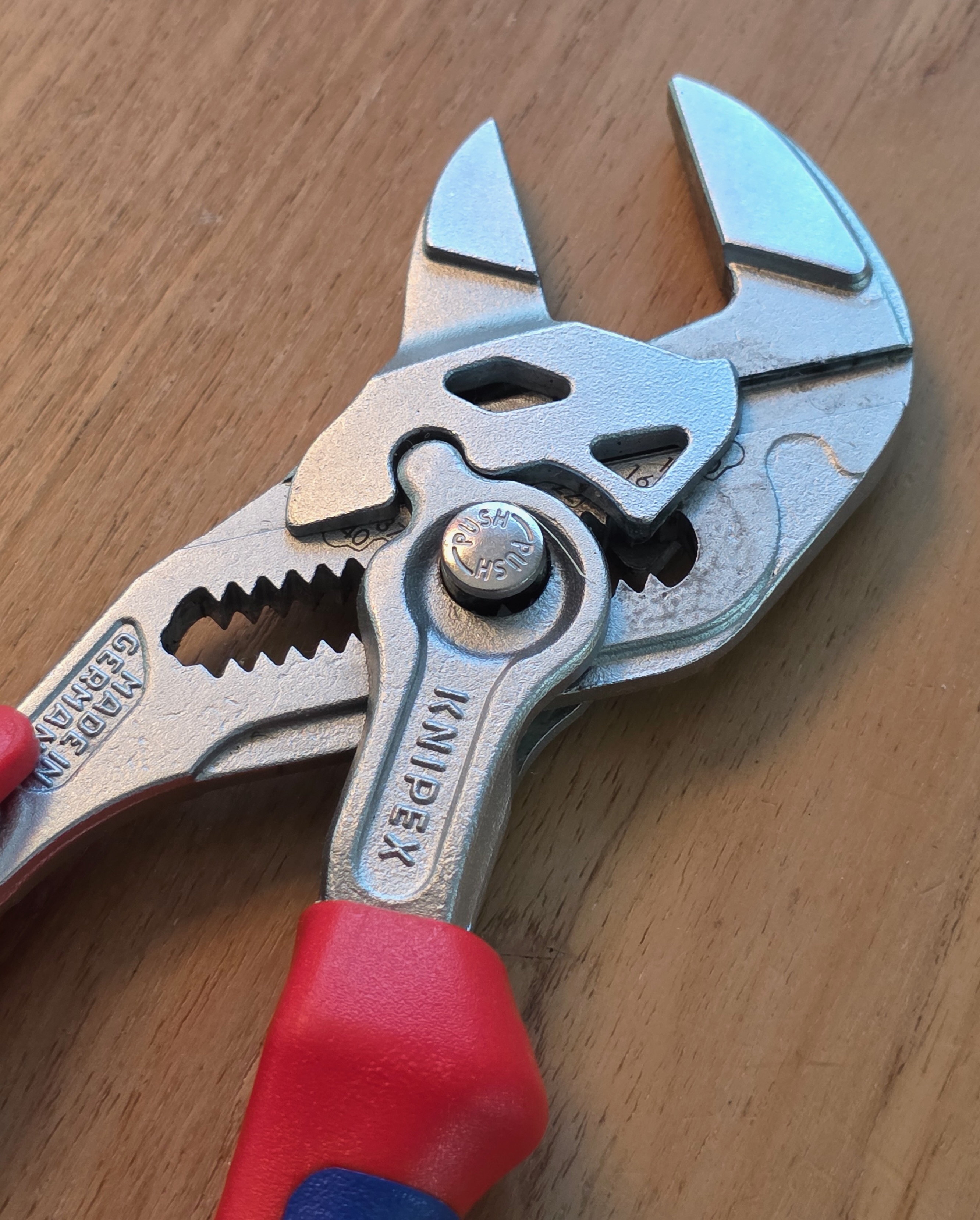
Knipex 180 mm pliers wrench
The engraved marking carries the exact reference of the tool, to be compared with the spec sheet of the delivered model.
The most appropriate pliers are the ones that give a proper grip without reaching their opening limit and without damaging the part.
For the 180 mm or 300 mm pliers, I go back to the full reference: the 46 mm value of the Cobra 87 01 250 does not transpose automatically to the pocket Cobra or to a Facom 181A in another size.
This article compares the published characteristics of the Cobra 87 01 250 and the Facom 181A.25G. I did not compare these two references side by side on a job site, so I do not turn their geometry into claims about which one passes a particular cable gland, grips better in practice or never slips.
The published tooth-hardness values are about 62 HRC for Facom and 61 HRC for Knipex. Those figures describe material treatment; on their own they do not establish a winner for grip, wear or access.
Facom’s cited warranty material presents its Lifetime Warranty under the manufacturer’s applicable terms. Knipex warranty information is treated separately. I do not turn a difference in wording or distribution process into a product defect without equivalent evidence on both sides.
| Published point | Knipex Cobra 87 01 250 | Facom 181A.25G |
|---|---|---|
| Published point Length | Knipex Cobra 87 01 250 250 mm | Facom 181A.25G 245 mm |
| Published point Adjustment positions | Knipex Cobra 87 01 250 25 | Facom 181A.25G 12 |
| Published point Published capacity | Knipex Cobra 87 01 250 46 mm on nuts / 50 mm on pipe | Facom 181A.25G Use the exact Facom datasheet; I do not convert drawing dimension L1 into jaw capacity |
| Published point Jaw description | Knipex Cobra 87 01 250 Serrated, self-locking geometry stated by Knipex | Facom 181A.25G Profiled head and self-locking teeth stated by Facom |
| Published point Origin | Knipex Cobra 87 01 250 Made in Germany | Facom 181A.25G French production information / Besançon in the cited Facom material |
| Published point Warranty | Knipex Cobra 87 01 250 Knipex manufacturer terms | Facom 181A.25G Facom Lifetime Warranty under its published terms |
Documentary comparison only: manufacturer data for the exact references, not a job-site ranking.
Documentary conclusion
The documents establish different adjustment counts, published capacities, geometries, origins and warranty terms. They do not establish that the Facom passes an M25 gland where the Cobra cannot, that the Cobra never slips, or that one reference is the overall winner. I choose from the exact workpiece dimensions, access available and the published terms of the reference.
3 questions
InteractiveQuiz: Knipex Cobra or Facom, which water pump pliers to choose
3 questions to check the essential points
Choose an answer
Knipex publishes 46 mm on nuts and 50 mm on pipe for the 87 01 250. The official Facom 181A.25G datasheet I consulted does not publish an equivalent jaw opening. So I do not compare the numerical capacities without that data.
The manufacturers publish 25 positions for the Cobra 87 01 250 and 12 positions for the 181A.25G. This describes the adjustment of their mechanism, not a universal measure of force or quality. The grip on the actual part still has to be checked.
No. The Facom page for the 181A.25G states the absence of 1,000 V insulation. A PVC handle protects the hand grip, but is not an electrical certification. See the voltage tester comparison to separate absence-of-voltage testing from a tightening tool.
The 87 01 250 reference is published with plastic sleeves and DIN ISO 8976 compliance. It is not presented as a VDE Cobra. Knipex sells distinct insulated variants: I check the marking on the exact tool, never just the Cobra name.
The Facom 181A.25G multigrip plier is 100% made in France at the industrial site in Besançon (Doubs). It holds the certified Origine France Garantie label, attesting that at least 50% of its unit value added and its shaping are carried out in France.
The Facom 181A.25G benefits from the Facom lifetime warranty, with immediate exchange or repair from authorized distributors, handled by the Essonne repair center certified Service France Garanti. Knipex applies a standard manufacturer warranty against manufacturing defects, with no direct over-the-counter exchange service for wear from use.
Serrated jaws can mark the chrome-plated nut. For a visible or soft surface, I prefer a wrench or smooth-jaw pliers. Multigrip pliers are more consistent when the part accepts a toothed grip and its tightening does not have to keep a flawless appearance.
No. NF ISO 8976 covers the dimensions and test values of multigrip pliers. It does not replace an insulation marking, a lockout procedure, or the requirements related to the electrical authorization.
Théo Desrousseaux
Electrician and editor
I work in the field and edit this magazine. Every guide is reviewed for its target country before publication.
Sources and references
Practical electrical installation guides, diagnostic methods and tool recommendations compared against the technical wiring standards of this national edition.
Founded in 1882 in Germany, Knipex makes the pliers chosen by professional electricians: history, innovations and a lasting commitment.
Read the guide Guide KNIPEX 86 03 180: pliers wrench review KNIPEX 86 03 180 pliers wrench: 35 mm capacity, 13 positions, variants, smooth jaws, verified uses and maintenance for electricians. Read the guide
  Guide KNIPEX 87 51 180 pliers: review and electrician uses KNIPEX Cobra ES 87 51 180 water pump pliers: technical specs, hands-on handling, push-button adjustment, 180 mm format and usage framework. Read the guide
 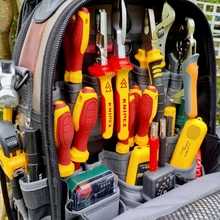 Guide Knipex, Wiha or Wera: comparison for electricians Knipex, Wiha or Wera: compare VDE pliers and screwdrivers by equivalent references, ergonomics, certification and field use for electricians. Read the guide