Home EV charger installation UK requirements
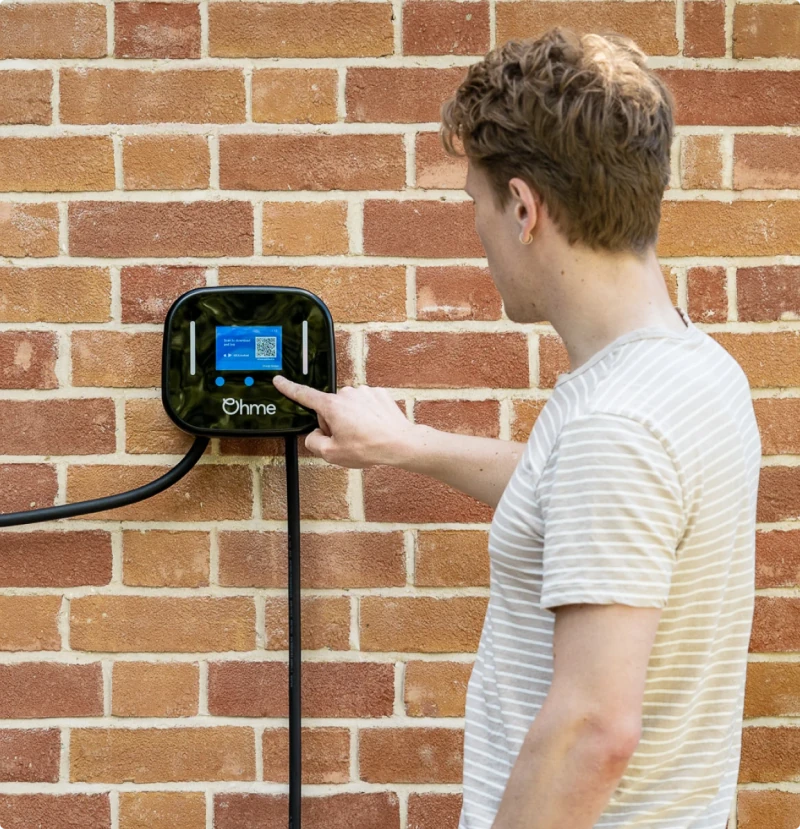 Photo : Ohme
 In brief
- A home EV charger in the UK must be on a dedicated circuit with 30 mA Type A RCD protection under BS 7671 Section 722.
- EV charging is a continuous load: the cable must be sized for 100 % of the charger demand, with no diversity applied.
- On a PME supply, the charger needs a separate earth electrode or built-in PEN fault detection before it can be connected.
- Installation is notifiable under Part P: a registered competent person self-certifies and issues an Electrical Installation Certificate.
- A standard 7 kW charger draws about 32 A, which can push a 60 A or 80 A supply close to its limit without load management.
Installing an electric vehicle charger in the UK is not simply a case of wiring in a new appliance. The work sits at the intersection of several regulatory frameworks, each with specific requirements: BS 7671 Section 722, the IET Code of Practice for EV charging, Part P of the Building Regulations, and Approved Document S. Getting it wrong can result in an unsafe installation, failed inspections, and potential legal liability.
Installing a domestic EV chargepoint requires a dedicated radial circuit straight from the consumer unit, sized for heavy continuous draw (typically 7.4 kW / 32 A). The installation mandates dedicated 30 mA Type A or Type B RCD protection with 6 mA DC fault suppression, an earthing assessment compliant with BS 7671 Section 722, and formal certification under Part P of the building regulations.
722
BS 7671 section covering EV supplies
30 mA
minimum Type A RCD for Mode 3 charging
7 kW
minimum chargepoint for new residential buildings
32 A
typical draw of a 7 kW single-phase charger
BS 7671 Section 722: the foundation
BS 7671, the 18th Edition Wiring Regulations, is the foundation standard for all electrical installation work in the UK. Section 722 deals specifically with supplies for electric vehicles and contains the detailed requirements that apply to every EV charger installation.
The key requirements are clear. Each EV charging point must be supplied by a dedicated circuit. RCD protection is mandatory, with a 30 mA Type A RCD as a minimum for Mode 3 charging. Overcurrent protection must be appropriate for the cable and charger rating. Earthing arrangements must comply with specific provisions for PME supplies. IP ratings must be appropriate for the installation location, indoor or outdoor. And cable selection must account for continuous loading, because EV charging is a sustained load.
Section 722 also addresses the specific risks associated with EV charging: the extended duration of charging sessions, which affects cable sizing for continuous load; the connection between the charger and the vehicle, which introduces additional earthing considerations; and the requirement for load management where multiple chargers share a supply.
Info
EV charging is classified as a continuous load because charging sessions regularly exceed 30 minutes and can last many hours. The cable must be rated for 100 % of the charger maximum demand, with no diversity applied. Undersized cables overheat and present a fire risk, which is why this is one of the most common mistakes in the trade.
PME earthing: the risk specific to EV charging
PME, or Protective Multiple Earthing, is the most common earthing arrangement in UK homes, used in TN-C-S systems. It presents a specific safety concern for EV charging because if the supply neutral, the PEN conductor, is broken or has a high-impedance fault, dangerous voltages can appear on any metalwork connected to the PME earth, including the chassis of a vehicle connected to a charger.
During charging, the vehicle chassis is electrically connected to the installation earth via the charging cable. On a healthy PME system this is safe. But if the PEN conductor fails, the vehicle and anyone touching it while standing on the ground could be exposed to a dangerous touch voltage. This risk is unique to EV charging because of the deliberate galvanic connection between the vehicle and the installation earth.
The protective measures are well established. The most common solution is to install a separate TT earth electrode for the EV charging circuit. Alternatively, use charging equipment with built-in PEN fault detection that disconnects if a fault is detected. In all cases, the earth electrode resistance must be low enough for the RCD to operate within the required time. In some cases, a combination of measures may be required depending on the site conditions.
Determining the earthing arrangement at the property is one of the first things to do during the site survey. If the property has a PME supply, which the majority do, you cannot simply connect the EV charger to the existing earth without additional protective measures. This is a critical safety requirement, not an optional recommendation.
Part P of the Building Regulations
EV charger installation is notifiable work under Part P of the Building Regulations in England and Wales. This means it must either be carried out by a registered competent person who can self-certify the work, or be notified to the local authority building control department before the work begins.
For competent person scheme members, the process is straightforward. If you are registered with NICEIC, NAPIT, or another approved competent person scheme, you can self-certify the EV charger installation. You issue an Electrical Installation Certificate, notify your scheme, and they issue a Building Regulations Compliance Certificate. This is the standard route for professional electricians.
Without scheme membership, the installation must be notified to building control before it begins. Building control will inspect the work, for a fee, and issue the compliance certificate. This adds cost and delay, which is why most professional installers are scheme-registered.
Approved Document S: new buildings
Approved Document S of the Building Regulations came into effect in June 2022 and introduced requirements for EV charging infrastructure in new buildings. This regulation is a major driver of ongoing demand for EV charger installers.
For residential buildings, all new residential buildings with associated parking must have at least one EV chargepoint per dwelling with a parking space. The chargepoint must be at least 7 kW and have a dedicated circuit. Buildings undergoing material change of use must comply if they have more than 10 parking spaces.
For non-residential buildings, new non-residential buildings with more than 10 parking spaces must have at least one EV chargepoint. Cable routes must be installed to at least 20 % of the remaining parking spaces. Buildings undergoing major renovation must install chargepoints if they have more than 10 parking spaces.
Maximum demand and load management
EV chargers draw significant power, and adding one to a property increases the maximum demand on the electrical supply. A standard 7 kW domestic charger draws approximately 32 A on a single-phase supply. Many UK homes have a 60 A or 80 A supply fuse, so the additional load from an EV charger can push the total demand close to or beyond the available capacity.
The solutions are well established. Smart chargers adjust their output based on available supply capacity. Load balancing uses CT clamps to monitor real-time demand and reduce charger output when other loads are high. Scheduled charging shifts demand to off-peak hours, typically overnight. Dynamic load management coordinates multiple chargers in commercial installations. And where the existing capacity is insufficient, a DNO notification or supply upgrade may be required.
The OZEV Minimum Technical Specification requires all grant-funded chargepoints to have smart functionality, including the ability to respond to signals to reduce or shift demand. This is part of the broader strategy to manage the impact of EV charging on the national electricity grid.
The certificates you must get
An EV charger installation requires an Electrical Installation Certificate, not a Minor Works certificate. The EIC is the document that records the design, installation and testing of the new circuit. Alongside the EIC, the installer must handle the Part P notification, document the load assessment, and demonstrate compliance with the IET Code of Practice.
The load assessment is important because it justifies the cable size and the protection. It records the charger rating, the supply capacity, and how the continuous load has been accounted for. Common certification mistakes include issuing a Minor Works certificate instead of an EIC, and failing to document the earthing measures for a PME supply.
Fire safety for enclosed parking
When EV chargers are installed in garages, car parks, or other enclosed spaces, additional fire safety considerations apply. While EV fires are statistically rare, the consequences of a fire in an enclosed space are more severe, and the IET Code of Practice provides specific guidance.
The key considerations include adequate ventilation in enclosed parking areas where charging takes place, fire detection and alarm systems appropriate to the space, positioning of chargers away from building escape routes, cable routing to minimise fire spread risk, emergency isolation provisions accessible to building management, and compliance with any additional requirements from the local fire authority. Installers should consult with the building fire risk assessor and check for any local authority requirements specific to the building type and location.
The IET Code of Practice for EV charging
The IET Code of Practice for Electric Vehicle Charging Equipment Installation provides detailed guidance that goes beyond the minimum requirements of BS 7671 Section 722. It is published by the Institution of Engineering and Technology and is considered essential reading for any EV charger installer. While not legally binding in itself, it represents industry best practice and is referenced by competent person schemes and grant programmes.
The Code of Practice covers detailed site assessment and survey procedures before installation, selection of charging equipment for different scenarios, comprehensive cable sizing calculations specific to EV charging loads, PME earthing arrangements and detailed guidance on when earth electrodes are required, load management strategies and demand-side response, communication protocols between chargers, vehicles and network operators, signage, labelling and user documentation requirements, and maintenance and periodic inspection requirements for installed chargepoints.
The Code of Practice is regularly updated to reflect changes in technology, regulations and industry practice. Installers should ensure they are working from the current edition.
What happens during the site survey
The site survey is where most of the decisions are made. The electrician starts by identifying the earthing arrangement, because that determines whether additional protective measures are needed. They then check the supply capacity, the consumer unit, and the route for the new circuit.
The survey also covers the physical location of the charger. Is it indoor or outdoor? That determines the IP rating required. Is there a parking space close enough for the cable to reach the vehicle? Is the location clear of escape routes and sources of damage? Each answer feeds into the design of the installation.
The load assessment is part of the survey. The electrician records the existing maximum demand, adds the charger demand, and checks the result against the supply fuse. If the total is too high, the design includes load management or a supply upgrade. This documentation becomes part of the Electrical Installation Certificate.
Tethered or untethered: a design choice
The survey also settles a practical question: whether the charger is tethered, with a cable permanently attached, or untethered, with a socket that accepts the vehicle cable. Both are compliant, and the choice depends on how the charger will be used.
A tethered charger is simpler day to day: you plug the attached cable into the car and charge. An untethered charger is more flexible, because it accepts any Type 2 cable and is easier to replace if the cable standard changes. The electrician will confirm that the chosen unit meets the requirements of Section 722 and the charger manufacturer instructions.
The installation process step by step
Once the survey is complete, the installation follows a clear sequence. The electrician isolates the supply, installs the new dedicated circuit from the consumer unit to the charger location, fits the overcurrent protection and the RCD, and connects the charger. The earthing measures for a PME supply are installed at the same time.
After the wiring, the electrician tests the installation: continuity, insulation resistance, polarity, earth fault loop impedance, and the operation of the RCD. The results are recorded on the Electrical Installation Certificate. Only when the tests pass is the charger energised and handed over.
The final step is the paperwork. The EIC is issued, the Part P notification is made through the competent person scheme, and the user is shown how to operate the charger and its app. The whole process, from survey to handover, is designed so that every safety decision is documented and traceable.
Maintenance and periodic inspection
An installed chargepoint is not a fit-and-forget device. The IET Code of Practice includes maintenance and periodic inspection requirements for installed chargepoints. The charger should be visually inspected regularly for damage, and the RCD test button operated at the recommended interval.
Periodic inspection of the charging circuit follows the normal cycle for electrical installations. The interval depends on the type of installation and its use, but a domestic charger circuit is typically inspected as part of the wider installation. Any fault found during inspection is corrected before the charger is used again.
Common mistakes in EV charger installations
The most common mistake is undersizing the cable. Because EV charging is a continuous load, the cable must be rated for 100 % of the charger demand with no diversity. A cable that is fine for a normal circuit can overheat on a charger that runs for hours.
The second mistake is ignoring the earthing arrangement. Connecting a charger to a PME supply without a separate earth electrode or PEN fault detection is a serious safety issue. The earthing check is not optional.
The third mistake is issuing the wrong certificate. An EV charger installation needs an Electrical Installation Certificate, not a Minor Works certificate. The load assessment and the earthing measures must be documented. Getting the paperwork wrong can invalidate the installation in the eyes of building control and insurers.
Choosing the right charger for the property
The choice of charger depends on the supply and the vehicle. A single-phase 7 kW charger is the standard for most UK homes and matches the 32 A draw described earlier. Three-phase chargers are faster but only make sense where a three-phase supply is available and the vehicle supports three-phase charging.
The smart functionality matters as much as the power rating. A smart charger can schedule charging to off-peak hours, respond to signals to reduce demand, and integrate with load management. The OZEV Minimum Technical Specification requires this functionality for grant-funded chargepoints, and it is increasingly the default for all new installations.
The charger should also match the connector standard of the vehicle. Most modern EVs in the UK use a Type 2 connector for AC charging. The electrician will confirm the connector type during the survey so that the installed unit works with the vehicle from day one.
Grants and funding considerations
Several grant schemes have supported home EV charger installations in the UK, and the rules change over time. The key point for the installer is that grant-funded chargepoints must meet the OZEV Minimum Technical Specification, including smart functionality. The installer must also be registered with an approved scheme to carry out grant-funded work.
The practical consequence is that the charger choice and the paperwork are linked. A charger that meets the specification, installed by a registered competent person with the correct certificate, is the combination that satisfies both the regulations and any funding conditions. The installer should confirm the current grant rules at the time of the survey rather than relying on older information.
What the homeowner should check before work starts
Before the installation begins, the homeowner should confirm a few things with the electrician. The first is the earthing arrangement, because a PME supply may require additional work. The second is the supply capacity, because a 7 kW charger may need load management. The third is the route for the new circuit, which affects the cost and the disruption.
The homeowner should also confirm that the electrician is registered with a competent person scheme, because that is what allows self-certification under Part P. A written quote should include the charger, the circuit, the earthing measures, the testing, and the certificate. Anything missing from the quote is a sign that the scope needs to be clarified before work starts.
The role of the DNO
The Distribution Network Operator, or DNO, owns the electricity network that feeds the property. In most cases, a single 7 kW charger does not require DNO approval, because it falls within the capacity of a standard domestic supply. But where the total demand is close to the supply limit, or where a higher-power charger is planned, the DNO may need to be notified.
The DNO notification is part of the load assessment. The electrician calculates the maximum demand, compares it with the supply capacity, and decides whether a notification or a supply upgrade is needed. This is documented on the certificate, so the decision is traceable.
Is EV charger installation notifiable under Part P?
Yes. EV charger installation is notifiable electrical work under Part P of the Building Regulations. It must either be carried out by an electrician registered with a competent person scheme, who can self-certify, or be notified to building control before the work begins.
What RCD does an EV charger need?
BS 7671 Section 722 requires 30 mA Type A RCD protection as a minimum for Mode 3 charging. Many chargers need a Type B RCD or equivalent protection because of the DC fault currents they can produce. Your electrician will confirm the correct device for the charger.
Why does a PME supply matter for an EV charger?
On a PME (TN-C-S) supply, a broken PEN conductor can put dangerous voltages on the vehicle chassis during charging. The charger therefore needs a separate earth electrode or built-in PEN fault detection before it can be connected safely.
How much power does a home EV charger draw?
A standard 7 kW domestic charger draws approximately 32 A on a single-phase supply. Many UK homes have a 60 A or 80 A supply fuse, so the charger can push total demand close to the limit, which is why load management is often recommended.
Do I need planning permission for a home EV charger?
Most home EV chargers are permitted development and do not need planning permission, but the electrical work is notifiable under Part P. Check local rules for listed buildings or conservation areas, and always use a registered competent person for the installation.
Théo Desrousseaux
Electrician and editor
I work in the field and edit this magazine. Every guide is reviewed for its target country before publication.
Author → Credentials → Editorial method → Report a factual correction →
No email app? Copy the correction details
Email address and prefilled context:
theo@sparx-elec.fr
Article: https://www.sparx-elec.com/gb/home-ev-charger-installation-uk/
Edition: GB — English
Factual issue: [describe the factual issue]
Passage: [quote or identify the passage]
Source: [optional source URL]
Sources and references
- 1. Total Skills UK — EV Charger Installation Regulations UK
- 2. Elec-Mate — EV Charger Certificate Requirements UK
- 3. NICEIC — Do I Need Building Regulations for an EV Charger?
- 4. WarmZilla — Planning Permission and Regulations for Home EV
- 5. GOV.UK — Approved Document S: Infrastructure for charging electric vehicles Official