Outdoor lighting cable UK: which cable, how deep
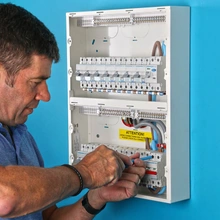
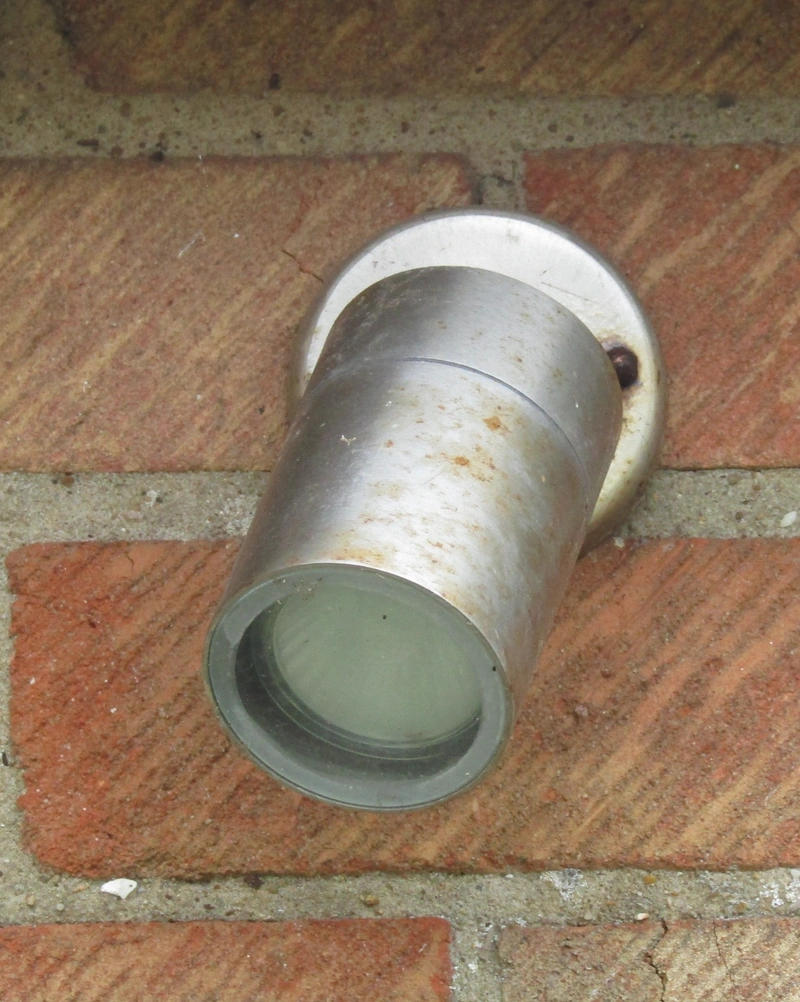 Photo : Kolforn, CC BY-SA 4.0, Wikimedia Commons
In brief
- A buried garden cable needs an earthed armour or an equivalent duct, because Regulation 522.8.10 sets a performance requirement and not a depth.
- Burial depth is site-specific. Guidance commonly uses figures around 500–600 mm, but BS 7671 requires protection against reasonably foreseeable disturbance rather than one universal garden depth.
- Steel wire armoured cable to BS 5467 is the default for anything buried; twin and earth belongs on a wall, never in a trench.
- The gland is where outdoor runs fail: a CW gland seals on the outer sheath at IP66, and its size must match the cable dimensions and armour range, not just the conductor cross-section.
- A 30 mA RCD and, in England and Wales, a Part P decision on notification matter more than the last metre of cable.
A garden lighting circuit is easy to draw and hard to keep working. The fittings are the part everyone chooses carefully, and the cable is the part everyone treats as a delivery mechanism.
Two winters later the joints are full of water, the RCD holds only in dry weather, and the fault is somewhere under forty metres of lawn that has just been re-turfed.
The cable is where the money and the risk actually sit. A buried run has to survive digging, frost heave, water tracking along the sheath and, in some gardens, rodents, and it has to do that for decades without being looked at. That is a different requirement from a light on a wall, and the Regulations treat it differently.
This is a working guide to the cable itself: which family fits which run, how deep it goes, how the armour is terminated so that water cannot follow it into the box, how to check the voltage drop before anyone picks up a spade, and what has to be signed off at the end.
The fitting selection, the socket on the wall and the protection device at the board are separate decisions, and two of them are covered in the outside socket and RCD guide and in the waterproof junction box test.
Site-specific
burial depth must suit foreseeable disturbance
30 mA
additional protection required for outdoor lighting and sockets
IP66
seal a CW gland gives on the cable outer sheath
6.9 V
voltage drop ceiling on a 230 V lighting circuit, 3 per cent
What the Regulations actually ask of a buried cable
Regulation 522.8.10 is the one that governs a cable in the ground, and it is deliberately written as an outcome rather than a number.
A buried cable must either incorporate an earthed armour or metallic sheath, or both, suitable for use as a protective conductor, or it must be an unarmoured cable installed in a conduit or duct that gives equivalent protection against mechanical damage.
The same regulation requires the route to be marked, with cable covers or a suitable marker tape.
That structure matters because it explains why the argument about depth is often the wrong argument. The Regulation does not say six hundred millimetres anywhere.
It says the cable must be protected against any reasonably foreseeable disturbance of the ground, which is an engineering judgement about what happens above the cable: a flower bed, a vegetable patch, a driveway, a patio that will be lifted every few years, or a lawn that will be aerated and edged.
The IET’s own commentary on this is worth reading in full, because it separates the requirement from the guidance that follows it.
The IET points to Regulation 14(2) of the Electricity Safety, Quality and Continuity Regulations 2002, which requires buried cables to be at a sufficient depth or otherwise protected, and then sets out the figures that installers actually use.
Info
The duct route deserves more respect than it usually gets. The note to 522.8.10 points at BS EN 61386-24 for conduit buried underground, and that standard grades impact resistance, with code N for normal resistance and code L for light duty.
A length of grey waste pipe from a builders’ merchant is not automatically an equivalent duct, however well it is glued.
Which cable belongs on which run
Five families turn up on UK garden lighting, and they are not interchangeable. The table is the short version; the paragraphs after it are the ones that decide the job.
| Cable | Where it belongs | Where it must not go |
|---|---|---|
| Cable SWA to BS 5467 (PVC) or BS 6724 (LSZH) | Where it belongs Direct burial, drives, long garden runs, anything a spade can reach | Where it must not go Very tight bends; the armour sets a minimum bend radius |
| Cable Hi-Tuff, a tough PVC sheath with no armour | Where it belongs Clipped to a wall, run in a duct, sheds and outbuildings | Where it must not go Direct burial without a duct that gives equivalent protection |
| Cable NYY-J | Where it belongs Suitable fixed runs; underground in an equivalent protective duct for the design described here | Where it must not go A manufacturer’s burial rating does not remove BS 7671 mechanical-protection requirements |
| Cable Twin and earth to BS 6004 | Where it belongs Indoor fixed wiring, a wall light fed from inside | Where it must not go Any trench, any hose pipe, any buried route |
| Cable H07RN-F rubber cable, BS EN 50525 | Where it belongs Flexible connections and suitable fixed installations under the product specification | Where it must not go Unprotected burial or use beyond the product’s water, support and mechanical ratings |
Nothing in the middle column is a matter of taste. The right-hand column is where most garden faults begin.
Steel wire armoured cable is a common choice for a buried lighting run. The armour provides mechanical protection and must be correctly earthed. Whether it can also serve as the circuit protective conductor requires checking its adequacy.
A typical BS 5467 cable has copper conductors, XLPE insulation, bedding, steel wire armour and a sheath. Its ratings depend on the selected product.
BS 6724 versions use low-smoke, low-halogen materials. Their suitability matters particularly where the route enters buildings or shared spaces; I select the cable for the whole route.
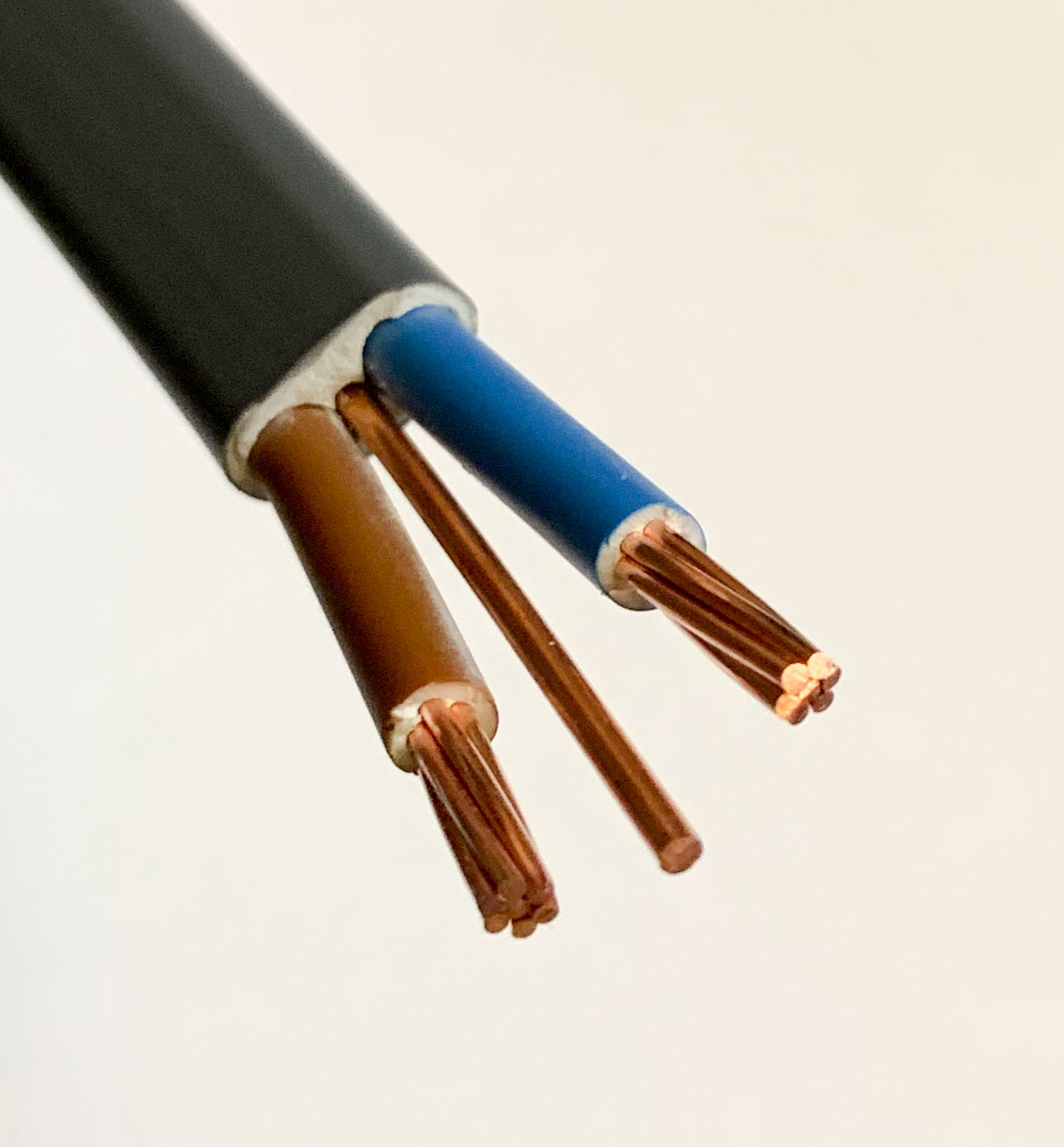
Hi-Tuff and NYY-J are the unarmoured answers. They are tough, they are cheaper, and they are quicker to terminate, but they have no armour, so a buried run needs a duct that provides equivalent mechanical protection.
One UK trade supplier states plainly that Hi-Tuff can only be buried in ducting or with added protection, which is the same conclusion 522.8.10 reaches from the other direction.
Twin and earth is the cable that causes the most damage, because it is the cable already in the van. It is a 300/500 V cable to BS 6004, designed for fixed wiring in a building, with a bare circuit protective conductor that relies on the sheath for its protection.
Run it through a hosepipe and bury it and you have created a cable with no armour, no marker, no impact resistance and a bare earth conductor sitting in whatever water collects in the pipe. NAPIT’s guidance is blunt about the outcome: twin and earth cables often do not fare well in the ground.
H07RN-F is not restricted to a short flexible tail. Suitable products can be used for fixed installations, subject to their ratings and the installation method. The IET’s buried-duct guidance expressly discusses H07RN-F as an unarmoured cable needing appropriate mechanical protection.
Check the actual datasheet for water exposure, support, bend radius and termination. A duct may become waterlogged, so neither the harmonised name nor the presence of a duct proves suitability for prolonged immersion.
Two cores or three
A three-core armoured cable carries a brown, black and grey set of cores as standard, with brown, blue and green-yellow also stocked by the major distributors.
The three-core version is the sensible default for a lighting run because the third core gives you a circuit protective conductor inside the cable, leaving the armour to do the mechanical job and to be earthed as a metallic layer rather than relied on as the only earth path.
A two-core armoured cable can be used, with the armour itself serving as the protective conductor, but only where the armour is genuinely suitable for that duty and is earthed at the supply end. The saving is small and the argument at the end of the job is not, which is why most domestic runs go in as three-core.
How deep, and where the numbers come from
The figures below are the ones that appear in UK guidance, and they only make sense with their context attached.
| Ground | Depth to top of cable or duct | Source of the figure |
|---|---|---|
| Ground General garden, ground not built to highway standard | Depth to top of cable or duct 500 mm | Source of the figure IET Guidance Note 1 |
| Ground Usual garden practice | Depth to top of cable or duct 600 mm | Source of the figure ELECSA guidance, Regulation 522.8.10 |
| Ground Agricultural, general and grazed | Depth to top of cable or duct 600 mm | Source of the figure Regulation 705.522 |
| Ground Agricultural, arable or cultivated | Depth to top of cable or duct 1000 mm | Source of the figure Regulation 705.522 |
| Ground Caravan site | Depth to top of cable or duct 600 mm | Source of the figure Regulation 708.521.7.2 |
| Ground Highway footway, verge or bridleway | Depth to top of cable or duct 500 mm | Source of the figure IET Guidance Note 1, Table 1 |
| Ground Highway carriageway | Depth to top of cable or duct 600 mm | Source of the figure IET Guidance Note 1, Table 1 |
| Ground Soft ground, or ground taking vehicle movement | Depth to top of cable or duct add 400 mm | Source of the figure IET Code of Practice, Appendix K, note 3 |
Depth is measured to the top of the duct, or to the top of the cable where an armoured cable is buried directly. Two classifications at once means the deeper figure wins.
Two things about that table are worth saying out loud. The first is that 500 mm is the general guidance figure and 600 mm is the figure most domestic work uses, and neither is a Regulation.
If a garden is going to be dug over, planted, rotavated or used for a shed base, the honest answer is that no depth is proof against a determined fork, which is exactly why the marker tape above the cable matters as much as the depth.
A separate figure circulates for street works: the Streetworks UK guidance recommends 450 mm for low-voltage services under a two-metre footway.
The IET is explicit that this is a publication aimed at contractors working on public highways and that nothing in BS 7671 requires it for a domestic installation, which is why it does not belong in a garden specification.
The second is that soft ground changes the answer. Where cables or ducts are buried in ground that will compress under vehicles or machinery, or that is subject to frost heave and sinking, the guidance is to add 400 mm to the depth for that classification.
A lawn that a van crosses twice a year is soft ground in this sense, and a run at six hundred millimetres under it is a run at the wrong depth.
Attention
Terminating the armour: the gland is the weak point
Everything upstream of the gland is a cable. Everything downstream of it is an enclosure, and the gland is the boundary where water gets in. This is where outdoor runs fail, and it fails in a way that is invisible until the RCD starts tripping in wet weather.
The gland has to do three jobs at once: grip the cable mechanically, make electrical contact with the armour wires, and seal the cable entry. The standard brass glands split by job:
- BW glands are for indoor use. They give mechanical retention and electrical continuity through the armour termination, with no environmental seal on the sheath.
- CW glands are the indoor and outdoor gland. They give an IP66 seal on the cable outer sheath plus a three-part armour wire termination, which is why they are the default on a garden installation.
- E1W glands go further and seal on both the inner and outer sheath, which provides an additional sealing boundary. Continuous immersion requires an assembly explicitly rated for that condition; the gland code alone does not establish it.
- CW CIEL variants carry a cast integral earth lug for installations needing a heavier fault current path.
The failure mode that kills CW glands is a mismatch between the gland and the cable.
Select the gland for the actual cable construction and dimensions, not just the conductor cross-section. Core count and manufacturing tolerances change the outside diameter.
The gland manufacturer specifies the accepted cable and armour ranges. I compare those with the exact cable datasheet, rather than assume every 1.5 mm² three-core cable takes the same gland.
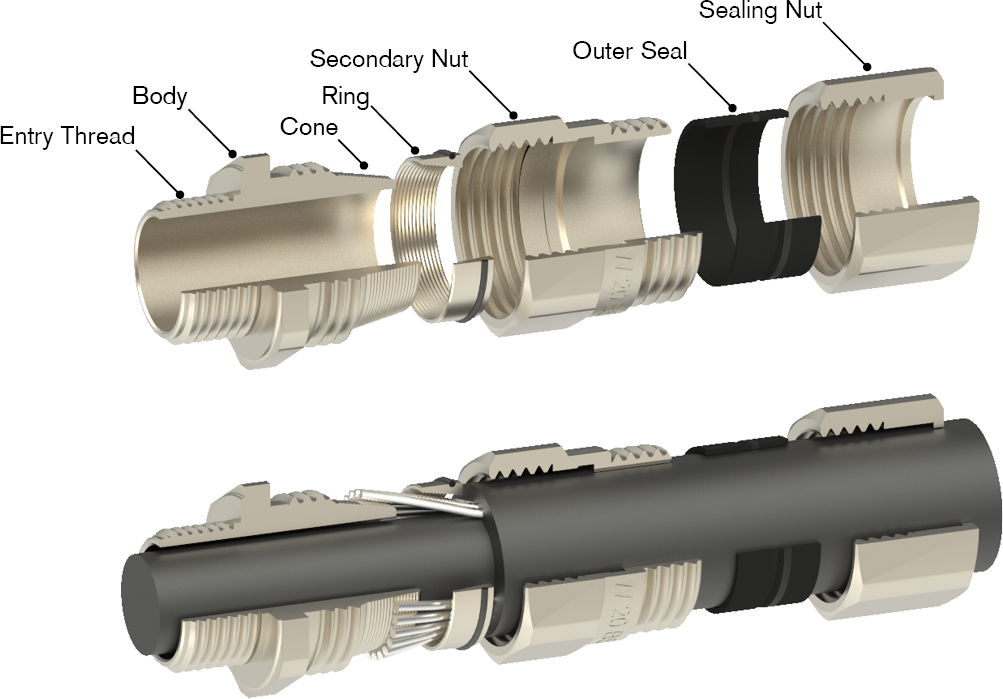
The assembly order explains the sealing logic. The body screws into the enclosure on its entry thread. The cable passes through the sealing nut and the outer seal, which is compressed onto the outer sheath as the nut is tightened. Then the cone, ring and secondary nut clamp the armour wires, and the whole stack is closed up.
Get the order wrong, or leave the seal out because the gland was tight on the sheath, and the gland becomes a funnel.
Two habits are worth keeping. First, cut the armour wires square and evenly, so that the ring clamps all of them rather than three of them and a stray. Second, fit an earth tag or banjo at the enclosure entry and bond it, so that the armour’s earth path does not depend on the tightness of a brass thread into a plastic box.
Conseil
The box at the end of the run
Every lighting run ends in something: a wall light, a bollard, a ground fitting or a joint. Whatever it is, the enclosure is part of the cable system and it has the same two jobs, which are keeping water out and letting condensation out.
A gland seals a cable entry, not every opening in the box. An IP66 enclosure with unused open holes no longer has its declared protection; it does not automatically become IP44. Fit compatible blanking plugs and entry seals as specified.
Inspect the lid gasket and seating surfaces. Dirt, a damaged gasket or incorrect closure can defeat the protection even if every cable gland is correctly fitted.
The same logic applies to the lid gasket: a gasket that has been opened and closed a dozen times, with grit in the groove, is no longer a gasket.
Condensation can occur inside a weatherproof enclosure. Deal with it using the manufacturer’s permitted drainage positions, ventilation accessories or pressure-compensation devices.
Do not drill arbitrary holes as a universal fix: an opening can lower the IP rating or admit water and insects. Hensel, for example, offers membrane glands maintaining IP66/IP67, while other ventilation accessories have lower ratings.
The exception is a buried box, where a drain hole simply lets groundwater in, and where a resin or gel joint is the right answer instead.
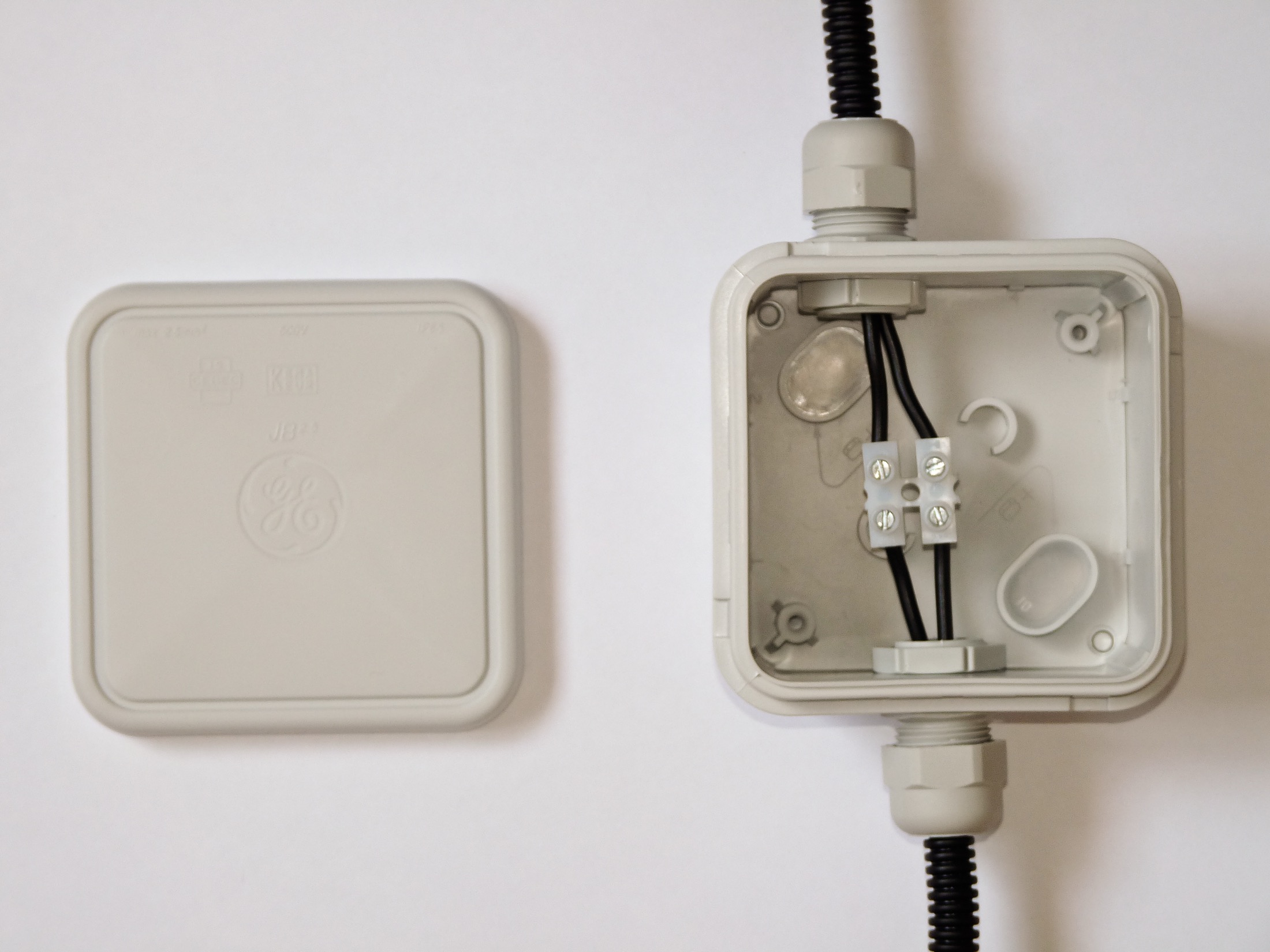
For a joint that cannot be opened, a resin or gel joint is the more reliable choice than a box with a lid, because there is nothing to reassemble wrongly.
For a joint that has to stay accessible, an appropriately rated enclosure with compatible entries, manufacturer-approved condensation control and suitable terminals can provide a maintainable solution.
The gel-filled cast box tested in the waterproof junction box article is the third option, with burial suitability determined by the exact product’s instructions and the completed joint, not by the word gel alone.
Sizing the run: voltage drop before cable size
For a small LED load, voltage drop can become more restrictive than steady load current on a long run. That does not remove the checks for current capacity, fault protection, short-circuit withstand and mechanical suitability.
A published current rating applies only to its stated installation conditions. Clipped-direct values cannot be carried over unchanged to a buried duct, thermal insulation or a grouped run.
What decides the size is voltage drop, and on a long garden run that is where a cheap decision becomes an expensive one.
Section 525 limits the drop between the origin of the installation and the load, and the figures used with a public supply are 3 per cent for lighting, which is 6.9 V on a 230 V single-phase supply, and 5 per cent for other circuits, which is 11.5 V.
The calculation uses the tabulated value for the cable in millivolts per amp per metre, multiplied by the design current and the run length:
Voltage drop in volts = ( mV/A/m × design current in amps × length in metres ) ÷ 1000
The tabulated figures for BS 5467 armoured cable are published by the manufacturers, and the column you use depends on the cable and the phase arrangement.
| Conductor | Two-core, single-phase AC | Three or four-core, three-phase AC |
|---|---|---|
| Conductor 1.5 mm² | Two-core, single-phase AC 31 mV/A/m | Three or four-core, three-phase AC 27 mV/A/m |
| Conductor 2.5 mm² | Two-core, single-phase AC 19 mV/A/m | Three or four-core, three-phase AC 16 mV/A/m |
| Conductor 4 mm² | Two-core, single-phase AC 12 mV/A/m | Three or four-core, three-phase AC 10 mV/A/m |
| Conductor 6 mm² | Two-core, single-phase AC 7.9 mV/A/m | Three or four-core, three-phase AC 6.8 mV/A/m |
Voltage drop values from a BS 5467 datasheet, stated as being in accordance with the 18th Edition, at 90 °C conductor temperature. Use the column that matches your cable and supply, and confirm against the tables in Appendix 4 of BS 7671.
Two worked examples show why the answer is usually “the cable you were going to use anyway”, and occasionally is not.
Six 30 W LED floodlights on a 45 m run. Assuming unity power factor, the 180 W load draws 0.78 A at 230 V; use the drivers’ actual input current and power factor in a real design. On 1.5 mm²: 31 × 0.78 × 45 ÷ 1000 = 1.09 V, well inside the 6.9 V lighting limit. This example does not exhaust the drop allowance.
The upstream drop, circuit protection and manufacturer requirements still need checking.
A 10 A load on the same 45 m run, which is what a garden room, a heater or a car charging at a low rate looks like. On 1.5 mm²: 31 × 10 × 45 ÷ 1000 = 13.95 V, which breaches the 11.5 V limit for a power circuit. On 2.5 mm²: 19 × 10 × 45 ÷ 1000 = 8.55 V, which is below 11.5 V for this run alone.
The voltage drop already used upstream and the other design checks still count.
Same trench, same glands, different cable, and the decision had to be made before the drum was ordered.
Attention
Surface runs, fittings and the sun
Not every garden lighting cable is buried, and the surface rules are stricter than they look.
Surface-fixed cable must be fixed to a permanent structure. Timber fencing is specifically not suitable, and the reasons are practical rather than bureaucratic: wood preservatives can attack the sheath, a fence is rarely rigid enough, the fence will fail before the cable does, and storm damage to a fence can bring a live cable down.
The guidance also asks for the cable to be supported high enough above the ground to avoid contact with footwear and garden tools.
UV resistance is a product specification, not a colour test. Carbon black can improve a sheath’s resistance to sunlight, but a black cable is not automatically outdoor-rated and a white cable is not automatically unsuitable.
Use the manufacturer’s declared environmental rating, including temperature, UV exposure and water conditions. Where the chosen cable needs shielding, specify a suitable protective route rather than rely on its appearance.
Fittings follow the same logic. NICEIC’s household guidance puts the floor for garden fittings at IP44 or better, and the fittings themselves have to be designed for outdoor use and installed to the manufacturer’s instructions.
Where a fitting sits below 2.8 m and is part of an outdoor lighting installation within the scope of Section 714, access to the light source has to be possible only after removing a barrier or enclosure that needs a tool, and a door giving access below 2.5 m has to be lockable or tool-operated.
Section 714 contains particular requirements for outdoor lighting installations. Its scope must be checked for the actual arrangement; do not apply a street-lighting or public-space provision indiscriminately to a wall light supplied from a dwelling.
The general rules for the dwelling’s circuits, external influences and protection remain relevant. For a domestic garden, the electrician establishes which parts apply before choosing the fittings or claiming a special-location exception.
Where the applicable design requires 30 mA additional protection, identify the device and the wiring it covers. A disconnection-time allowance for a particular highway installation is not a general relaxation for domestic garden wiring.
Protection, notification and the paperwork
Two decisions sit above the cable and both are cheaper to take before the trench is open.
The first is additional protection. For socket-outlets in a garden, Regulation 411.3.3 requires 30 mA protection, and the fittings on a garden lighting circuit need the same layer for the same reason: a cable that has been nicked by a spade or a strimmer is a fault that an RCD clears and a fuse may not.
Whether that device is an RCBO on its own way or an RCD covering several ways is a separate question, set out in the RCD and RCBO comparison. What matters here is that the device is at the origin of the circuit and is tested, not assumed.
The second is Part P. In England and Wales, Part P applies to electrical installations in a garden or on land associated with a dwelling where the electricity comes from a source in or shared with that dwelling, so garden lighting is squarely inside it.
In England, the 2013 notification rules cover: a new circuit, the replacement of a consumer unit, and any addition or alteration to an existing circuit in a special location. Wales retains a broader notification scope, so that English list must not be used as the Welsh checklist.
A new circuit to a garden lighting run is therefore notifiable, while replacing a fitting on an existing garden circuit is not, and a special location means a room with a bath or shower, not a lawn.
Info
The edition question is live at the moment. Amendment 4 to BS 7671:2018 was published on 15 April 2026, and after a transition period it became the only current version of the standard on 15 October 2026, with the previous edition withdrawn.
New work started after the transition uses BS 7671:2018+A4:2026. NICEIC confirms that work started earlier may be certified to its design edition; the completion date alone does not settle that question.
On the test sheet, the items that matter for a garden lighting circuit are the ones that prove the cable is intact and the protection works: insulation resistance on the whole run, continuity of the protective conductors including the armour path, polarity, earth fault loop impedance at the far end, and an RCD trip test at the device.
A minor works certificate covers an addition to an existing circuit; a new circuit needs an electrical installation certificate. The same instruments and the same dead-test-first sequence turn up in the EICR cost breakdown, where the job is inspecting an installation rather than installing one.
Faults that show up two winters later
The failures on garden lighting are consistent enough to list, and most of them are cable failures rather than fitting failures.
Water tracking into a gland is the classic. The cable is fine, the enclosure is fine, and the insulation resistance falls away every time it rains because water has found the gap between the sheath and the bedding and is sitting in the bottom of the box.
The repair must address the entry path and the damaged connection, with a correctly selected gland and the manufacturer’s specified condensation measures. Drilling a hole without checking the enclosure instructions is not a universal cure.
A nicked sheath from a spade or a strimmer is the second. It is not always a dead short; often it is a slow path to earth that trips an RCD once the ground is wet. This is the failure that a marker tape and a sensible depth are meant to prevent, and the reason a cable finder is worth having before anyone digs.
Rodent damage is real in rural gardens and around outbuildings, and it is one of the reasons the guidance for garden installations asks for cables to be protected against attack by rodents as well as accidental damage.
Failed joints in buried boxes are the third. A box with a lid, buried, with a drain hole, is a box full of soil water. Either the joint is made for burial, with resin or gel, or the box should not be buried at all.
Frost heave is the quiet one. A cable laid tight and straight in a shallow trench in clay is a cable that is being pulled at both ends by February, and the damage shows up at the gland rather than in the middle of the run. A little slack at each end costs nothing.
What to put on the quote
A garden lighting quote that says “armoured cable” and a price is not a specification. The items that decide whether the job lasts are the cable standard, the core count, the depth, the gland type and the protection device, and all five can be written on one line each.
- Cable standard named: BS 5467 or BS 6724, three-core, with the conductor size stated
- Depth stated in millimetres, measured to the top of the cable, with the reason for any variation
- Marker tape or cable covers included as a line item, not assumed
- Gland type and size stated as CW plus the cable's overall diameter, with earth tags
- Enclosure IP rating and permitted condensation measures agreed before the box is mounted
- Voltage drop calculation shown, with the design current it used
- 30 mA RCD identified at the origin, with the test result recorded
- Part P notification decided, and the certificate type named
A route drawing and photographs before backfilling make later fault-finding easier. Missing records do not prove that a cable must be replaced, but they increase the uncertainty about its route, depth and joints. They are worth keeping with the circuit’s test certificate.
What cable should I use for outdoor lighting in the UK?
SWA is a common choice, not the only permitted construction. The cable must suit the environment and have suitable mechanical protection, such as earthed armour or an equivalent duct system. Whether armour can also serve as the circuit protective conductor requires verification of its continuity and adequacy; it is not automatic.
How deep should outdoor lighting cable be buried?
The designer chooses a depth that protects against foreseeable ground disturbance. Figures around 500–600 mm occur in guidance, but gardens, vehicle routes and special installations have different conditions. Do not apply a fixed extra 400 mm to every route; check the applicable requirements and protection system.
Can I use twin and earth cable in the garden?
Not in a trench. Twin and earth to BS 6004 is a 300/500 V cable for fixed wiring in a building, with a bare circuit protective conductor protected only by the sheath. Buried, it has no armour, no impact resistance and no marker, and NAPIT's guidance notes that twin and earth often does not fare well in the ground. Clipped to a wall and protected, it has a legitimate use.
Do I need an RCD for garden lighting?
Yes, as additional protection. Socket-outlets in a garden need 30 mA protection under Regulation 411.3.3, and outdoor lighting installations within Section 714 need it under 714.411.3.4. The device belongs at the origin of the circuit, normally as an RCBO or an RCD at the consumer unit, and it needs testing rather than assuming.
Is garden lighting notifiable under Part P?
A new circuit is notifiable in England and Wales. In England, straightforward replacement of a fitting on an existing circuit is normally non-notifiable. Wales has a broader scope, including garden-lighting work, so check the Welsh rules and the exact work before starting.
What size armoured cable do I need for garden lights?
1.5 mm² three-core SWA can suit some small lighting loads, but it is not a universal specification. Check design current, installation method, fault protection and voltage drop including the upstream supply. The 3 per cent lighting allowance is 6.9 V at 230 V; a single calculation for the garden section does not validate the entire circuit.

Théo Desrousseaux
Electrician and editor
I work in the field and edit this magazine. Every guide is reviewed for its target country before publication.
Author → Credentials → Editorial method → Report a factual correction →
No email app? Copy the correction details
Email address and prefilled context:
theo@sparx-elec.fr
Article: https://www.sparx-elec.com/gb/outdoor-lighting-cable-uk/
Edition: GB — English
Factual issue: [describe the factual issue]
Passage: [quote or identify the passage]
Source: [optional source URL]
Sources and references
- 1. IET Wiring Matters 101 — Buried conduits and ducts Official
- 2. IET — Part P, England and Wales (frequently asked questions) Official
- 3. The Building Regulations 2010, Schedule 1, Part P Official
- 4. NICEIC — Understanding BS 7671:2018 + Amendment 4:2026
- 5. NICEIC — Garden electrics guide: regulations and requirements
- 6. Electrical Safety First — Staying safe in the garden Official
- 7. Professional Electrician (ELECSA) — Electrical installations in the garden
- 8. Professional Electrician (NAPIT) — Burying cables: what the regulations say
- 9. Professional Electrician (NAPIT) — How to determine voltage drop limits
- 10. Professional Electrician — Specific requirements for special installations, Part 7
- 11. Cleveland Cable — BS 5467 PVC mains and control cable, 1.5 mm² to 16 mm² (datasheet)
- 12. Eland Cables — BS EN 50525 harmonised cable standard
- 13. Eland Cables — BS 6004 cable standard
- 14. ETS Cable Components — Armoured cable glands
- 15. Toolstation — Pitacs SWA single phase armoured cable, 1.5 mm², 3 core, 25 m coil
- 16. Electrical4less — Comparing SWA, Hi-Tuff and NYY-J outdoor cables
- 17. Hensel — Manufacturer-approved condensation and ventilation arrangements
More guides
Practical electrical installation guides, diagnostic methods and tool recommendations compared against the technical wiring standards of this national edition.
Earthing system types: TN-S, TN-C-S and TT
TN-S, TN-C-S and TT earthing systems in UK homes: how to identify which one you have, what readings to expect, and what a homeowner should check.
Read the guide Guide Outdoor waterproof junction box Outdoor waterproof junction boxes: field test of the gel-filled Ready Cast and the Magic Box 65 with cable glands, per local wiring regulations. Read the guide
 Guide Best multimeter for electricians UK What is the best multimeter for electricians in the UK? Compare the Fluke 87V, Fluke 117, Klein MM700 and Brymen BM235, with prices, CAT ratings and True RMS. Read the guide
 Guide RCBO vs RCD difference UK consumer unit What is the difference between an RCBO and an RCD? Learn what each device protects, why RCBOs trip less, the cost in the UK, and which to choose. Read the guide