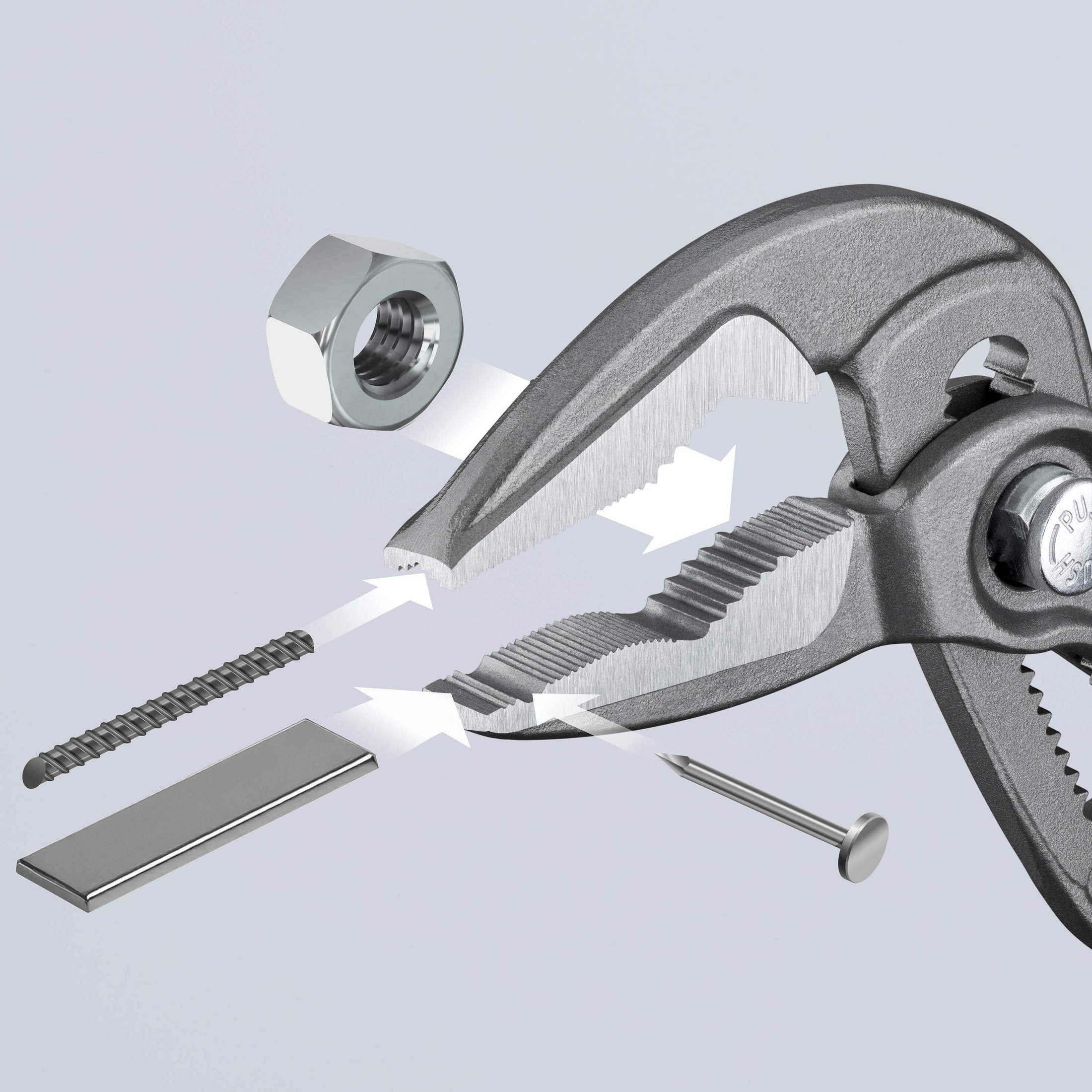
Head of the Cobra ES
Spot the double-guided box joint: its slimness is what gives the extra-slim range its name.
cdn.klium.comPublished 3 August 2026
In brief
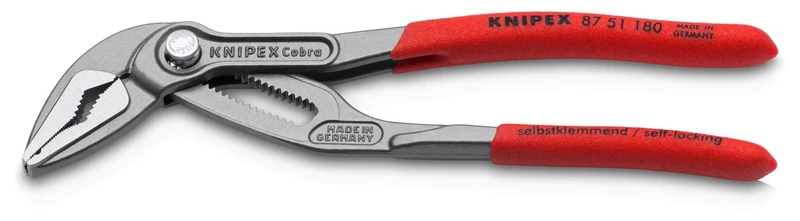
The KNIPEX 87 51 180 is not a wire stripper, despite what the most common search suggests. It is a pair of extra-slim water pump pliers, the 180 mm Cobra ES, designed for very tight spots.
This review is based on the manufacturer’s official technical data sheet and on its blog. If you are looking for a tool to strip wire, this is not the right article.
What follows: the verified technical data sheet, the electrician-relevant use cases, the selection points to check before buying, and my answers to the most frequently asked questions.
180 mm
in length, pocket-size format
18
push-button adjustment positions
32 mm
capacity on nuts and pipes
176 g
on the official data sheet
The 87 51 180 reference belongs to the Cobra ES range from KNIPEX, presented by the manufacturer as its extra-slim water pump pliers. The “ES” stands for extra slim, referring to the slimness of the head and the joint.
Head of the Cobra ES
Spot the double-guided box joint: its slimness is what gives the extra-slim range its name.
cdn.klium.comThe most common confusion comes from the reflex search “KNIPEX 87 51 180 pliers”. This number looks like those of the stripping ranges, but it refers to a water pump pliers, sometimes called pump pliers depending on the region. It is the same family as the classic Cobra: serrated jaws that adjust in steps.
On its blog, KNIPEX describes the large Cobra family: the classic Cobra (example 87 01 250, with 25 positions and a large capacity), the Cobra ES (87 51, extra-slim), the Cobra…matic (87 11, with automatic adjustment), the QuickSet (87 21 and 87 22) and the SmartGrip (85 01).
The official spec sheet for the 87 51 180 also lists the model in two lengths: 180 mm and 250 mm.

| Range | Distinguishing feature | Typical reference |
|---|---|---|
| Range Cobra | Distinguishing feature The classic water pump pliers, wide range of lengths | Typical reference 87 01 250 |
| Range Cobra ES | Distinguishing feature Extra-slim: very slim head and joint, access in confined spaces | Typical reference 87 51 180 |
| Range Cobra...matic | Distinguishing feature Automatic adjustment by pressing the button | Typical reference 87 11 250 |
| Range QuickSet | Distinguishing feature Quick adjustment by pushing the pliers onto the workpiece | Typical reference 87 21 250 |
| Range SmartGrip | Distinguishing feature Automatic adjustment to the workpiece, one hand is enough | Typical reference 85 01 250 |
The Cobra ES stands out by the slimness of its head, not by a different mechanism.
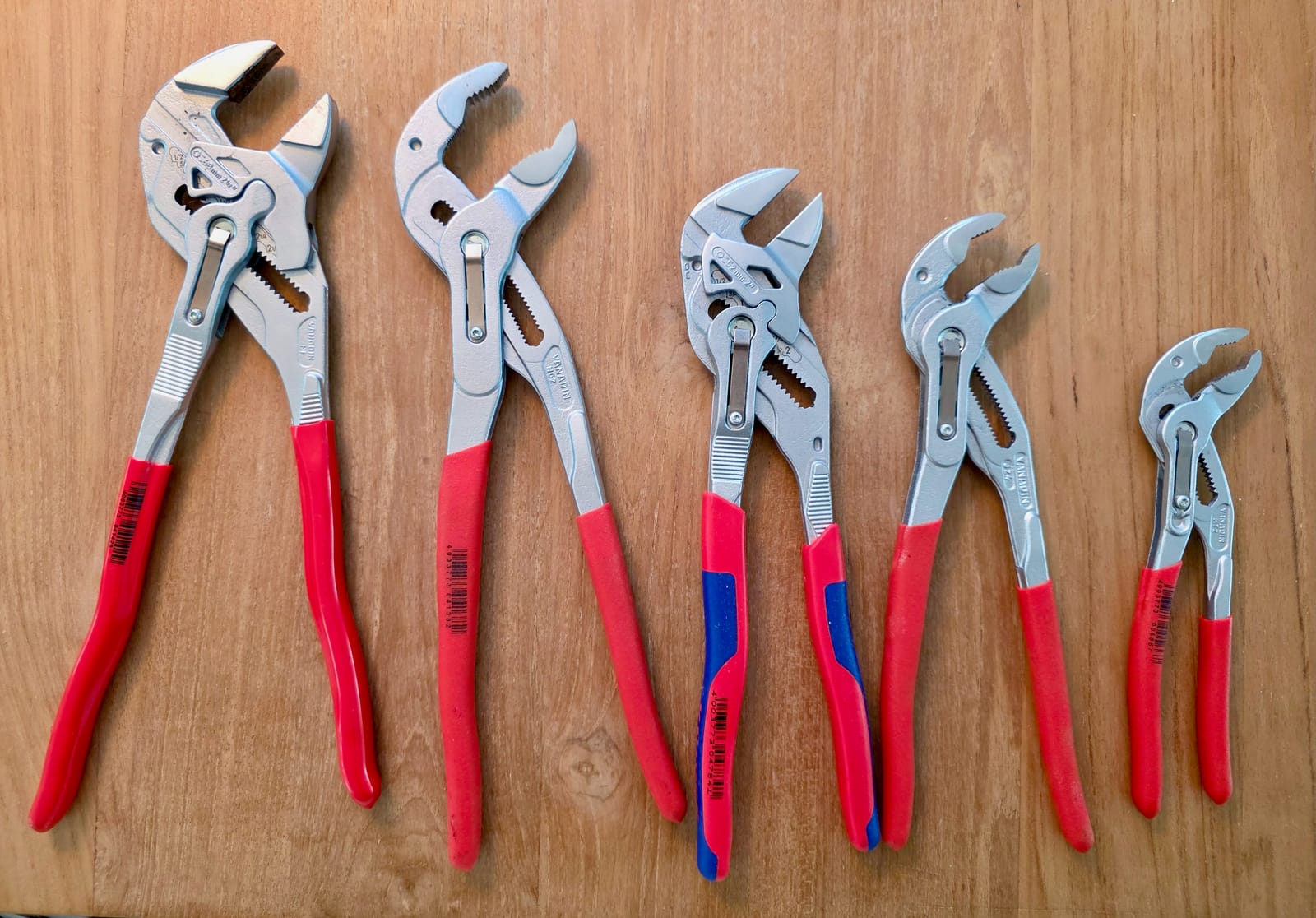
This mapping avoids a classic purchasing mistake: taking one range’s reference for another. The first reflex before paying is to re-read the full number, not just “KNIPEX Cobra”.
The official spec sheet for the 87 51 180, consulted via the Wayback archive of 10 August 2025, gives precise data, consistent with the spec sheet of the reseller Haus of Tools:
| Specification | Verified value |
|---|---|
| Specification Reference | Verified value 87 51 180, KNIPEX Cobra ES, extra-slim water pump pliers |
| Specification Length | Verified value 180 mm (7 1/4") |
| Specification Weight | Verified value 176 g on the official spec sheet (0,18 kg from the reseller) |
| Specification Dimensions | Verified value 180 x 42 x 14 mm |
| Specification Adjustment positions | Verified value 18 |
| Specification Nut capacity | Verified value 32 mm (1 1/4") |
| Specification Pipe capacity | Verified value 32 mm in diameter |
| Specification Max. parallel opening | Verified value 30 mm |
| Specification Max. gripping depth | Verified value 37 mm |
| Specification Finish | Verified value Grey atramentized body, polished head, non-slip plastic coating |
| Specification Standard | Verified value DIN ISO 8976 |
| Specification Origin | Verified value Germany (EAN 4003773088981) |
Spec sheet for the 87 51 180: the values converge between the official spec sheet and the reseller spec sheet.
The 18 positions deserves particular attention: it is the official figure, confirmed by the manufacturer’s spec sheet and by Haus of Tools. The spec sheet for the long model, the 87 51 250, may show a higher number depending on the reseller, and some sites copy it by mistake onto the spec sheet for the 180 mm.
If a listing claims 25 positions for this clamp, treat the figure with suspicion: the official spec sheet gives 18.
Three capacities not to be mixed up. The spec sheet distinguishes the maximum parallel opening of 30 mm, the 32 mm capacity on nuts and pipes and the maximum grip depth of 37 mm. The parallel opening corresponds to the gap between the jaws in the extreme position: it is the geometric limit of the head.
The 32 mm capacity indicates the maximum diameter of the part the clamp can grip, whether it is a nut or a pipe. The grip depth, finally, says how far the part can enter the jaw for a complete grip.
The dimensions 180 x 42 x 14 mm describe a clamp 180 mm long, 42 mm wide at the joint and 14 mm thick: these three figures explain why it slips into gaps where a conventional slip-joint plier does not fit.
The weight of 176 g confirms the pocket format: the tool is forgotten in a bag without weighing on the shoulder. When I compare two spec sheets, I check these values first, because they do not depend on the reseller, unlike the displayed price.
The spec sheet’s inch equivalents (7 1/4“ in length, 1 1/4“ capacity) target the Anglo-Saxon markets. On a European spec sheet, I read the values in millimeters, which are those of the field: a nut is measured with a caliper, not in fractions of an inch.
Beyond the table, the official spec sheet describes details that matter in real use:
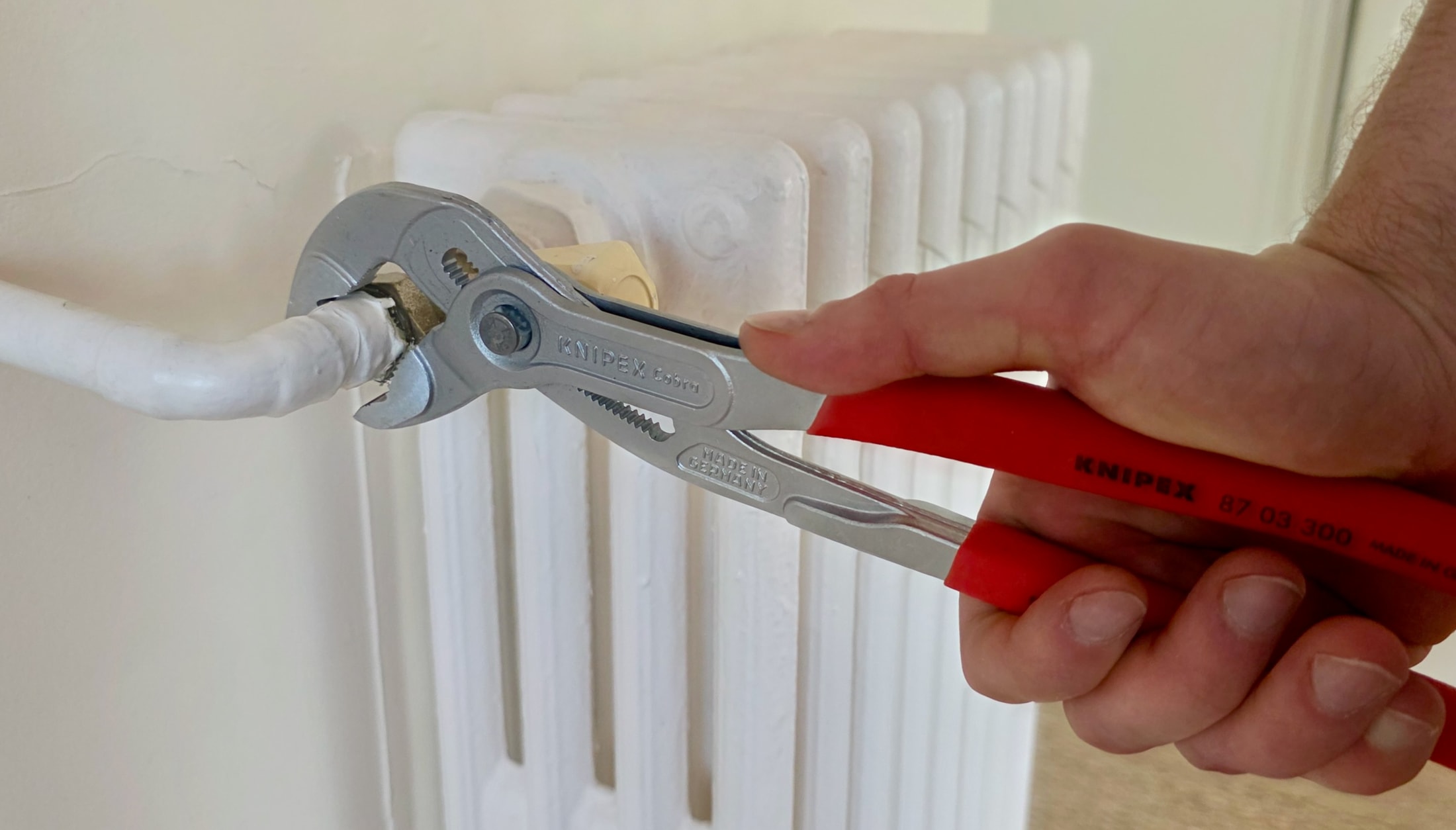
The official product sheet illustrates the fine adjustment: a finger presses the button while the pliers grip the part.
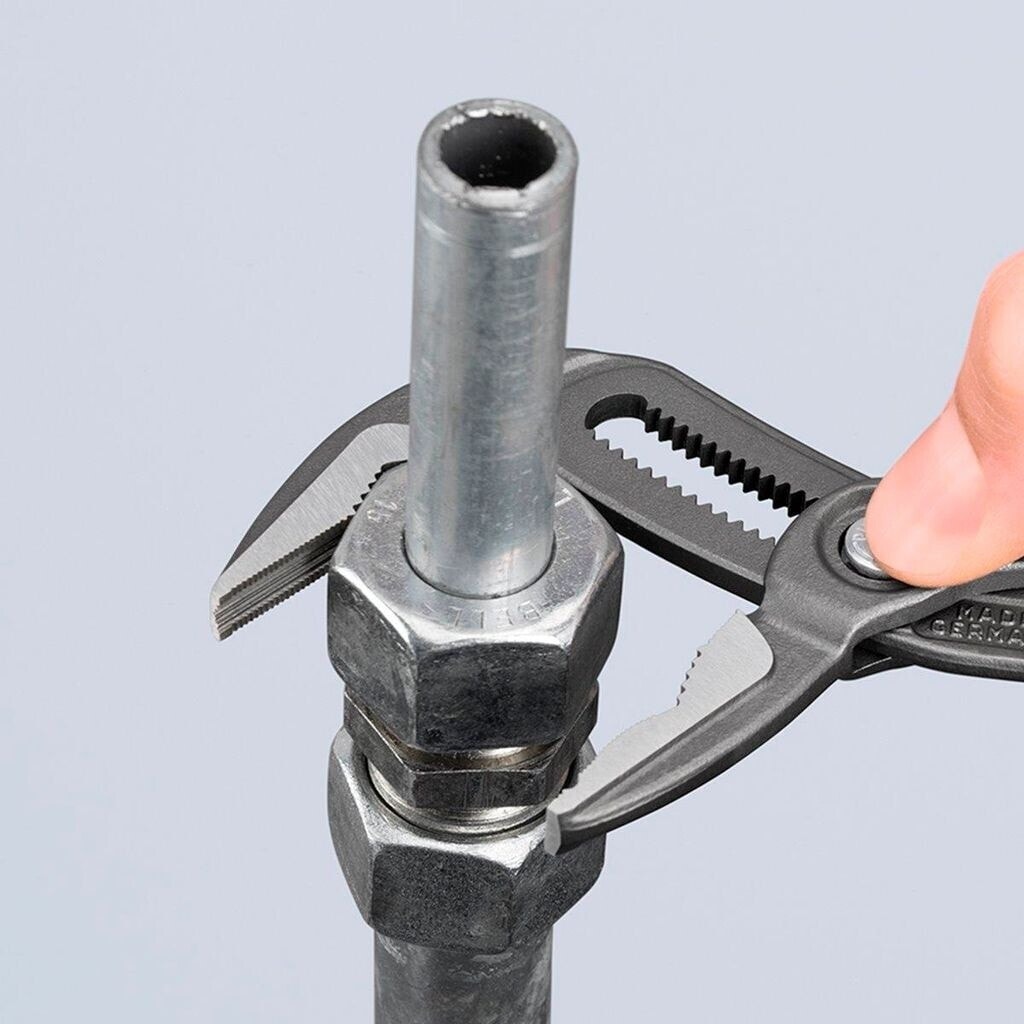
Adjustment button
A finger presses the button: the adjustment is made directly on the part, as described in the official product sheet.
cdn.idealo.comThe mention of DIN ISO 8976 deserves a clarification. It is the standard for water pump pliers, which sets their dimensions and test values, published in France under the reference NF ISO 8976 by AFNOR. It is a tool standard.
It has nothing to do with electrical insulation, contrary to a widespread idea that I often come across on job sites.
In practical terms, a pair of pliers compliant with DIN ISO 8976 meets defined dimensions and test values governed by the standard: compliance rests on standardized tests, not on a simple commercial claim.
To compare two pairs of pliers from different brands, it is a useful common basis, covering the expected geometry and mechanical strength.
The confusion with electrical insulation comes from the reflex of associating any standard with protection. Yet a tool standard says nothing about the electrical behavior of the product.
My reflex is the opposite: if a spec sheet does not explicitly mention a VDE marking or compliance with standard 60900, I consider the tool not insulated, regardless of its sheathing. The DIN ISO 8976 mention therefore reads as a sign that the manufacturer is serious, not as an open sesame for working near energy.
KNIPEX positions the Cobra ES for service, maintenance, appliance repair, the automotive sector and industry, “wherever things get very tight”. The extra-slim head and joint give access where a conventional water pump pliers cannot fit.
That is exactly the need encountered in electrical finishing: behind a panel, in an enclosure, under a kitchen. When the panel is full and there is no more room, every millimeter counts.
The rest comes from my own field experience, not from a manufacturer’s claim. With a long, slim nose, a 32 mm opening and a self-locking mechanism, these pliers cover a series of finishing tasks:
In short: at 180 mm, it’s a pocket plier for fine work, not a heavy-duty tool. To tighten cable ties in trunking over full runs, a longer pair of water pump pliers remains more comfortable.
Adjustment takes three steps: push the button, slide the jaws onto the part, then release. The 18 positions cover the opening up to 32 mm, which lets you get an exact fit on a nut or a pipe without forcing the pliers into an intermediate position.
The point of the button is that it is operated with one hand, directly on the part: you adjust by sliding until the jaws match the shape, without hunting for a notch by trial and error. On a cable gland or terminal block nut, this action saves you from putting the pliers down between each attempt.
Once the setting is found, the self-locking mechanism takes over: the toothed jaw grips the pipe or the nut, and the hold locks without continuous effort. I always check that the part is properly engaged before turning: an incomplete grip slips, and the action loses all its value.
The 180 mm format prioritizes compact access. On a badly seized nut I may choose longer pliers or a wrench for more leverage; in tight spaces and maintenance work, the short format is precisely the advantage.
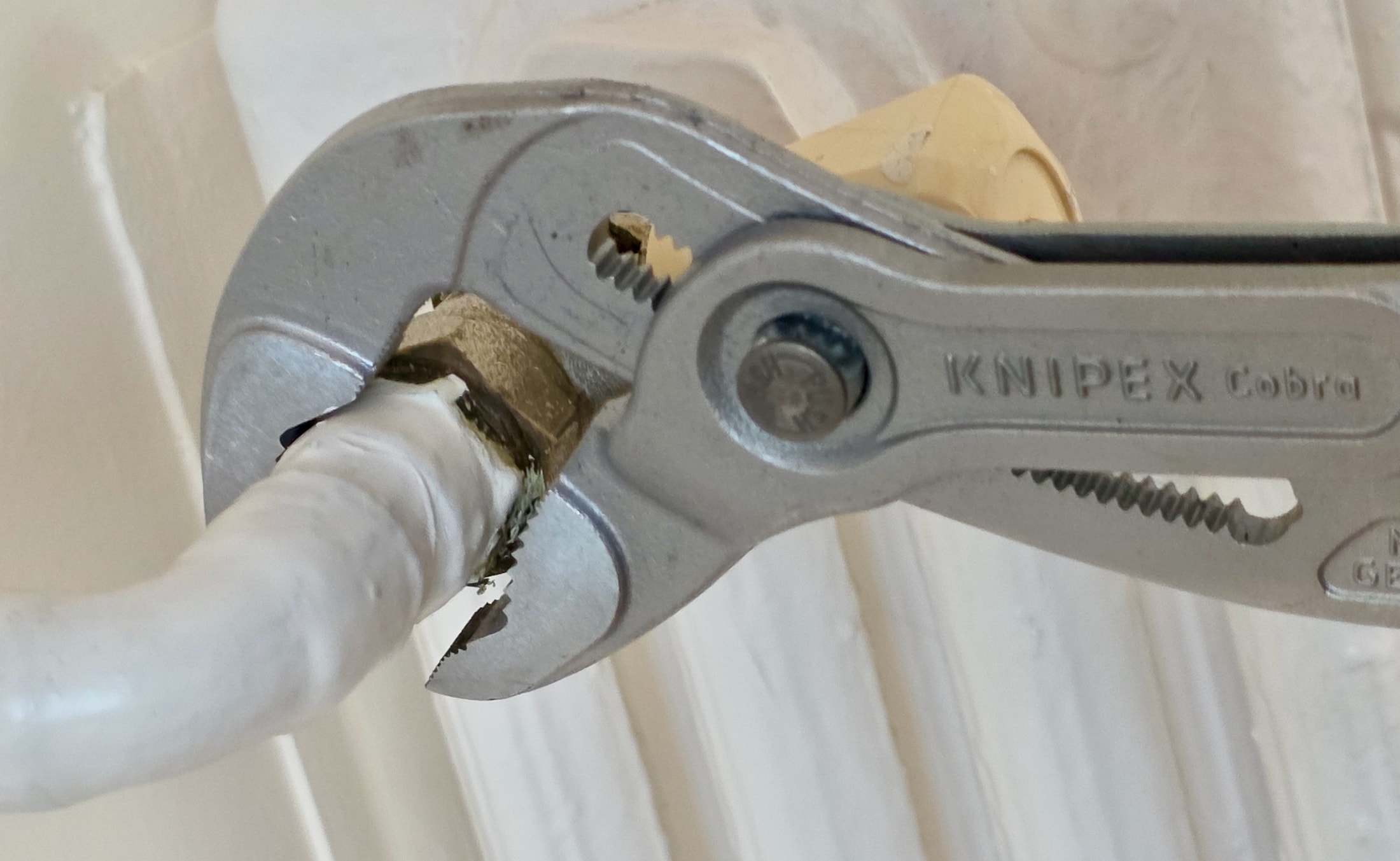
Hex nut gripped
The jaw gripping a seized nut: this is where a longer lever arm can become the more suitable choice.
The grip coating, next. The handles are coated in non-slip plastic, which is comfortable. It is not an insulating sleeve. I come back to that below, because it is the safety point of this article.
On price. The cited manufacturer sources do not publish a public price for the 87 51 180. I therefore do not use the US reseller listing as a price benchmark.
The most common mistake is clamping on the tips of the teeth. The right grip is to seat the part at the back of the jaw. A partial grip slips at the first bit of force and marks the nut.
Another reflex to correct: setting the pliers under load. The button is operated with the pliers resting on the part, with no clamping force. I set it before clamping, never during.
I never strike with water pump pliers, even short ones: the handles are there to hold the tool, not to take blows. When a part resists to the point of making the pliers slip, I switch tools instead of forcing it.
One last reflex before putting it away: wipe the tool. A jaw full of chips and cable grease grips less well, and a clogged button ends up catching.
This is the first message to remember for an audience of electricians: the official data sheet for the 87 51 180 states no electrical insulation, no VDE marking and no insulated 1000 V range. The handles are a non-slip plastic coating, not a tested insulating sleeve.
Attention
Never work on a live circuit with these pliers, nor with any non-insulated water pump pliers. On a live circuit, only 1000 V insulated tools compliant with standard 60900 are suitable, and safe isolation remains the rule.
INRS points out in its document “Hand tools: use the right tool” that the right tool, suited to the task and the risk, is part of prevention. For electrical risk, the logic is simple: isolate, check for the absence of voltage, then work. The plier then becomes just another finishing tool.
This sequence applies to every action, even the shortest: tightening a cable gland never justifies working on a live circuit. The time saved would be illusory, and risk is not measured by how long the action lasts.
So I keep the 87 51 180 for work on dead circuits, where it belongs, and I reserve 1000 V insulated tools for situations where they are explicitly required.
My habit: I never put water pump pliers in a “breakdown tools” pocket without checking that it does not contain a non-insulated tool. When choosing insulated tools is necessary, I physically separate the two sets.
On finishing an enclosure, I always follow the same sequence. Safe isolation comes first: I isolate, I check for the absence of voltage, and I do not touch anything before that check.
I then clear the space and I choose the tool according to access. If the slim head fits, I take the Cobra ES. If not, I change approach rather than forcing it through.
The adjustment is made before the grip: button pressed, jaws brought onto the nut, button released. I check that the part is firmly engaged in the jaw, not just caught at the surface.
I tighten in one firm motion, without jerking. If the part slips despite a good adjustment, I stop: that is a sign that another tool is needed.
I check the tightness by hand, I put the circuit back into service after checking, then I wipe the pliers before putting them away. This gesture seems trivial: it is what keeps the tool ready for the next job.
The most useful question to ask yourself before buying is not the brand, it is the length. Water pump pliers are chosen based on the part to grip and on the available space.
The 87 51 180 is the short version of the Cobra ES range, whose official product sheet lists both lengths. It is a complementary choice, not a replacement: if a 250 mm already dominates your bag, the 180 mm is added for the places where the large one will not fit.
| Criterion | 87 51 180 | 87 51 250 |
|---|---|---|
| Criterion Length | 87 51 180 180 mm | 87 51 250 250 mm |
| Criterion Positioning | 87 51 180 Pocket, tight access, finishing work | 87 51 250 General use, more leverage |
| Criterion Range | 87 51 180 Cobra ES extra-slim | 87 51 250 Cobra ES extra-slim |
Both lengths of the Cobra ES range: the official product sheet lists the model in 180 and 250 mm.
For an electrician equipping their first tool kit, a 180 mm alone can be enough for light repair work. For a complete installation, the 180 plus 250 pair makes more sense than a single intermediate model.
The reasoning always starts from the part to grip and the space available. A cable gland nut in an already full enclosure calls for the 180 mm: the thin nose fits in, the big one doesn’t.
Conversely, to tighten trunking clips over a full run, the lever arm of the 250 mm remains more comfortable, even if the 180 mm would do the job.
That’s why I present the 180 mm as a complement, not a replacement. The pair covers more situations than a single intermediate model, too short for heavy work and too long for tight access.
So the question to settle isn’t “which is best?”, but “which one is missing from the bag?”.
The real argument for the 180 mm is that it stays in the bag’s pocket instead of lying around in the box. When you’re doing finishing work — a socket to re-crimp, a cable gland to finish, an earth nut to re-tighten — the tool you have at hand is the one you use.
The electrician’s bag therefore gains a light tool (176 g) that weighs nothing and often comes in handy. It’s typically the kind of pliers you forget about, until the moment it saves you a round trip to the box.
The difference with a 250 mm doesn’t come down to grip quality, but to presence: a tool that stays in the bag is useful, the one sleeping in the box is not. It’s this criterion, hard to measure on a spec sheet, that in my eyes justifies having a short model in addition to the big one.
The number one risk when buying: confusing the 87 51 180 with the classic Cobra 87 02 180. Both are 180 mm, but the first is extra-slim and the second is the classic water pump pliers. The full number makes the difference, and some resellers mix up the images.
Before ordering, I therefore re-read the full number on the listing, I compare the image (long, slender jaws, extra-slim head) and I check the EAN 4003773088981 when it is displayed: a reference that doesn’t match the advertised image is a warning sign.
I mentioned the 18 versus 25 positions: the figure from the long model gets copied onto some of the 180 mm listings. Another trap: the Haus of Tools listing itself contains a typo (“8 fine adjustments” in a preview), whereas its own detailed listing and the official listing do give 18 positions.
If in doubt, the manufacturer’s official listing is authoritative.
A brand as copied as KNIPEX gets counterfeited. Check the engraving of the reference on the pliers, the quality of the black oxide finish and the asking price. My advice for recognizing a counterfeit tool applies here as elsewhere: a price that’s too low is the first warning sign.
The cited manufacturer sources do not state a public price for the 87 51 180. Rather than compare undated or non-localized reseller prices, check the full 87 51 180 reference when buying.
A water pump pliers requires little maintenance, but it needs a minimum. After a day in a cabinet, I wipe it down with a cloth, working between the teeth: that is where shavings and cable grease collect.
I also clear out the button housing. A button that catches can be felt under the thumb, and it is better to clean it than to force it: that is the condition for an accurate adjustment.
A drop of oil on the joint keeps the action smooth. I apply only a little: too much oil holds dust, and it is the dust that ends up wearing out the pivot.
Wear shows on the jaw. When a correctly adjusted grip starts slipping on a clean part, the teeth have lost their bite: I replace the pliers instead of compensating by squeezing harder.
Storage matters as much as cleaning. My Cobra ES lives in the pouch of the bag intended for it, not under the heavy tools in the toolbox: the coating and the joint stay protected from impacts.
Based on the official spec sheet and the manufacturer’s positioning, here is what I take away from it.
The Cobra ES 180 mm answers a specific need: working in confined spaces with a slim water pump pliers. Its self-gripping action, its button adjustment and its 3-point contact make it a credible finishing and maintenance pliers for the electrician.
Its usage framework is clear: de-energized work, compact 180 mm dimensions for tight access, and a longer pair when more leverage is useful. When buying, the key check is the full reference so the Cobra ES is not confused with the standard Cobra.
For finishing, panel and de-energized maintenance work, the 87 51 180 looks to me like a serious candidate as a complement to a 250 mm: fine jaws, 18 positions, self-locking, 176 g in the pocket.
I wouldn’t reach for it for heavy structural work or for stubborn, seized nuts, and never for working live. With those reservations acknowledged, its spec sheet is consistent and its manufacturer positioning is well targeted.
A few questions to sort things out before opening your wallet.
If your work is mostly finishing and de-energized maintenance, this plier has its place in your bag. Its fine jaws, its push-button adjustment and its self-locking action match those tasks exactly.
If you’re looking for a single pair of water pump pliers to do everything, seized nuts included, look instead at a longer size: the Cobra ES remains a complement.
And if you need to work on energized circuits, the answer is clear: this isn’t the reference you need, but 1000 V insulated tools.
It’s this first case that led me to adopt the 87 51 180: it joined a 250 mm I already had, and it’s this pair that covers my work today.
3 questions
InteractiveKNIPEX 87 51 180 pliers
3 questions to check the essential points
Choose an answer
No. The 87 51 180 is a pair of extra-slim water pump pliers, the 180 mm Cobra ES. The confusion comes from the number, close to some stripping product lines. To strip wire, look instead at the comparison of wire strippers.
Both are 180 mm, but the 87 51 180 has an extra-fine head and joint, with a longer and narrower nose: it is meant for difficult access. The 87 02 180 is the classic water pump pliers of the same length. Always check the full reference number.
No, never. The official datasheet states no electrical insulation for this model. For a live circuit, only 1000 V insulated tools are suitable, and lockout/tagout remains the rule.
Finishing and maintenance with the power off: PG cable glands, earth and terminal-block nuts, clamps in trunking, kitchen accessories. It is a pocket pliers that complements a 250 mm model, not a tool for heavy structural work.
The cited manufacturer sources state no public price for the 87 51 180. For a current purchase, use a dated quote for the exact 87 51 180 reference rather than a US reseller listing.
The official datasheet states a maximum grip depth of 37 mm, with a maximum parallel opening of 30 mm and a capacity of 32 mm on nuts and pipes. These three values describe what the jaw can actually grip: they matter more than the overall length when choosing the model.
The official datasheet states DIN ISO 8976, published in France as NF ISO 8976 by AFNOR: a tool standard that sets the dimensions and test values of water pump pliers. It has nothing to do with electrical insulation: this model is not insulated.
Yes. The official datasheet shows the Made in Germany marking and the EAN 4003773088981. Like any heavily copied brand, KNIPEX gets counterfeited: check the engraved reference and the price offered.
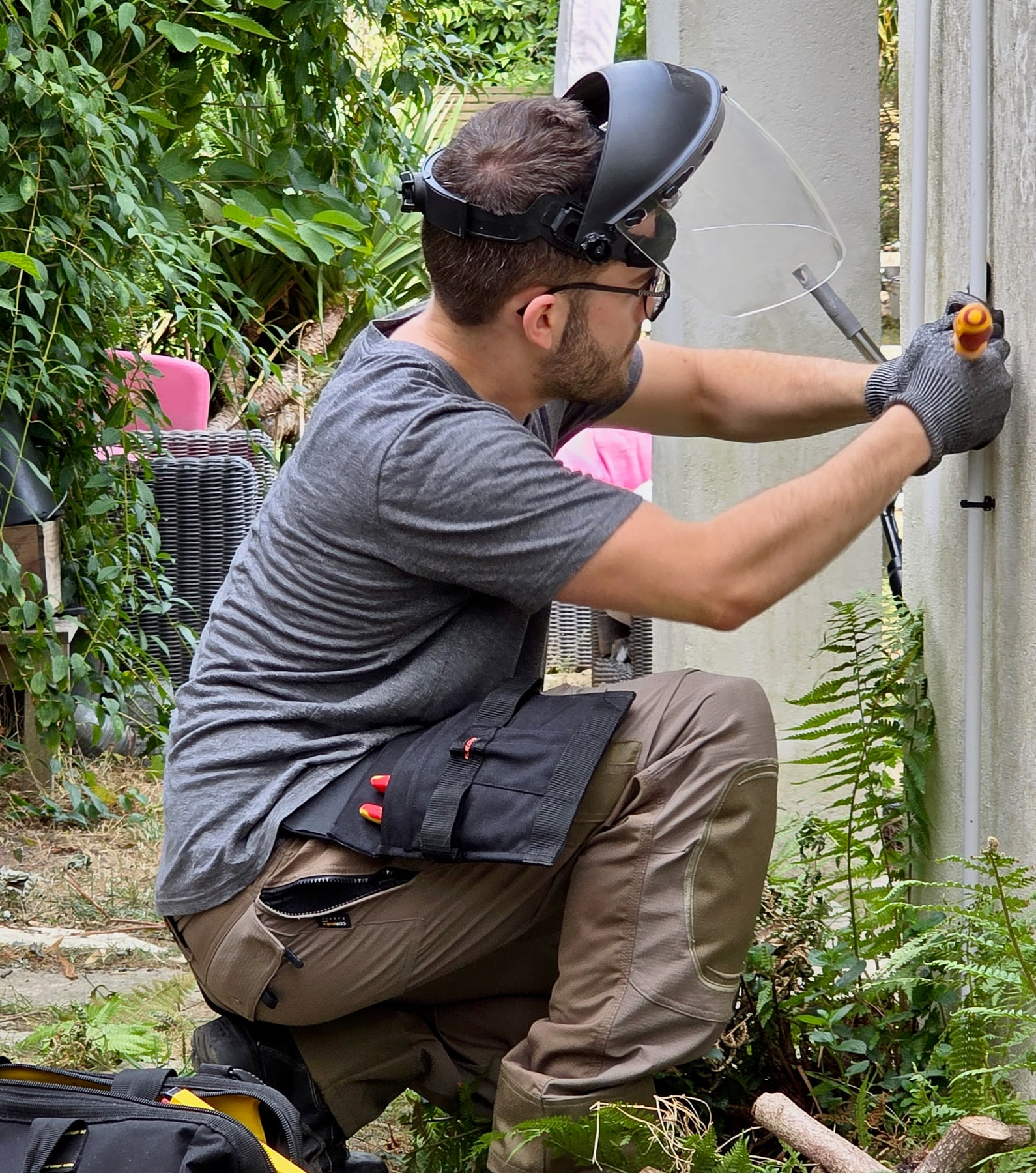
Théo Desrousseaux
Electrician and editor
I work in the field and edit this magazine. Every guide is reviewed for its target country before publication.
Sources and references
Practical electrical installation guides, diagnostic methods and tool recommendations compared against the technical wiring standards of this national edition.
Founded in 1882 in Germany, Knipex makes the pliers chosen by professional electricians: history, innovations and a lasting commitment.
Read the guide Guide KNIPEX 86 03 180: pliers wrench review KNIPEX 86 03 180 pliers wrench: 35 mm capacity, 13 positions, variants, smooth jaws, verified uses and maintenance for electricians. Read the guide Guide Knipex Cobra vs Facom: water pump pliers compared Cobra 87 01 250 vs Facom 181A.25G: 25 positions against 12, jaws, opening, ISO 8976 standard and insulation compared reference by reference. Read the guide
  Guide Knipex, Wiha or Wera: comparison for electricians Knipex, Wiha or Wera: compare VDE pliers and screwdrivers by equivalent references, ergonomics, certification and field use for electricians. Read the guide