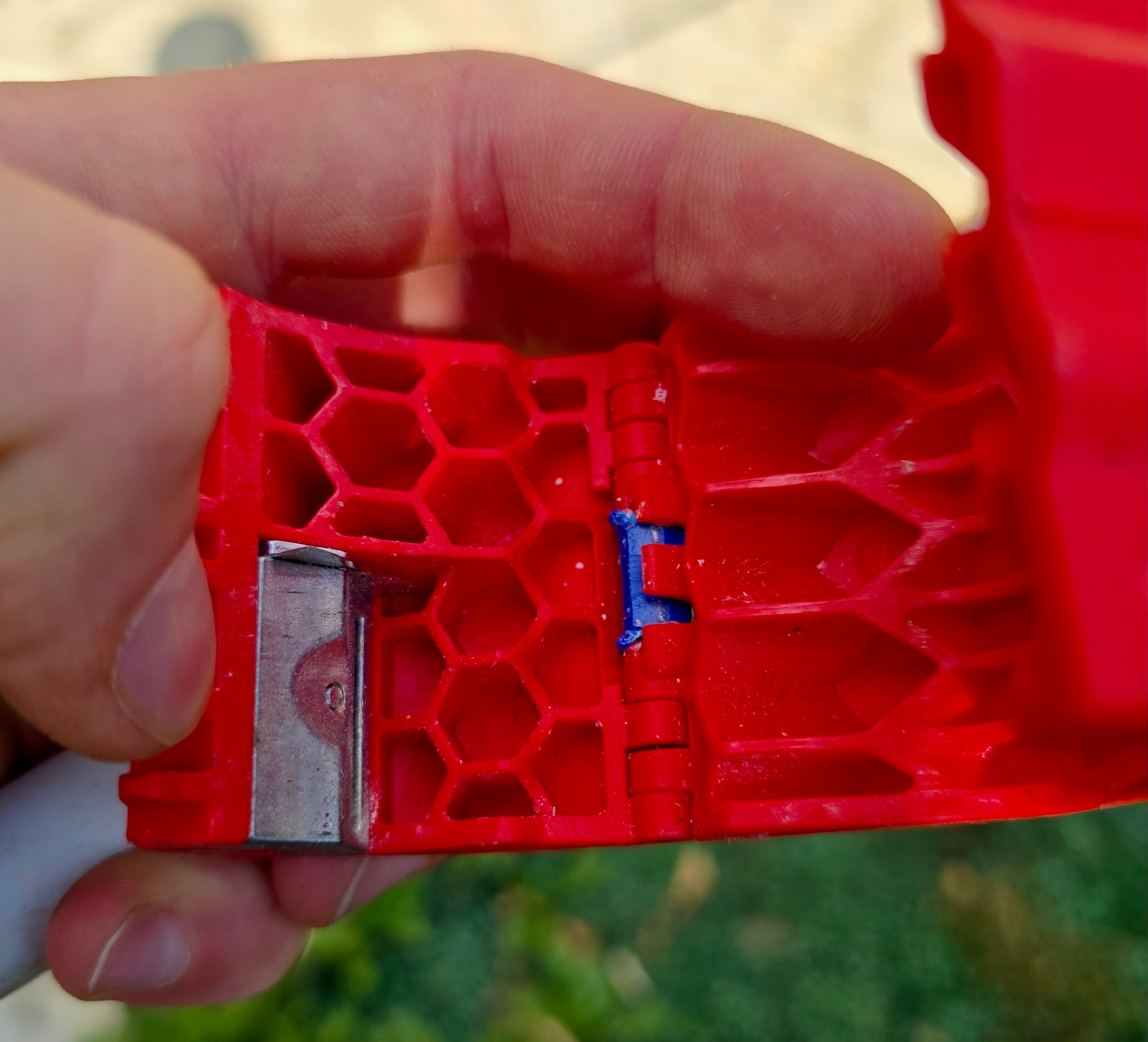
Pipe cutter blade
The open head of the Tubix shows the internal mechanism carried over by the DPT50 on thick walls.
Published 3 August 2026
In brief
The KNIPEX 90 23 02 BK is not a wire stripper. It’s the DPT50 pipe cutter, presented by the manufacturer at KNIPEXupdate summer 2025 for plastic pipes with thick walls: drainage in PVC, PP or PE, adjustable diameters of 32, 40 and 50 mm, walls of 2,5 to 3,5 mm.
This name correction is important, because a common confusion associates the reference with cable stripping.
The choice between the DPT50 and the DP50 comes down to wall thickness, not diameter, and that is the criterion I detail here.
KNIPEX publishes no recommended price for the DPT50. For a purchase decision, the useful checks are the exact 90 23 02 BK reference, the EAN and the required wall thickness.
32 to 50 mm
adjustable cutting diameters (32, 40 and 50 mm)
2,5 to 3,5 mm
wall thickness supported by the DPT50
The confusion is understandable: KNIPEX launched the DPT50 in the same wave as several wire strippers designed for photovoltaic installers, to the point that the tool has often been presented as a wire stripper in the searches that concern it.
The KNIPEXupdate summer 2025, presented by the official FAQ dated July 2, 2025, focuses on tools for professionals in photovoltaic and electrical installation: the ErgoStrip PV (16 95 03 SB), the MultiCrimp PV (97 33 03), the EvoStrip (12 40 200) and the ComStrip (12 62 180).
Added to that are two sizes of the Cobra ES and, the only non-electrical one, the DPT50.
This pipe cutter is in fact a plumbing tool, designed for drainage systems. KNIPEX strippers carry other part numbers, which I detail in my guides on wire strippers and on the Jokari Secura.
A wire stripper removes the insulation from a conductor; a pipe cutter cuts a pipe. The two actions have nothing in common, but KNIPEX ranges overlap on job sites: an electrician who also installs drainage may legitimately own both.
My article on crimping lugs and cables also mentions the KNIPEX strippers 13 66 180 and ErgoStrip: these are the ones that fall under wiring work, not the 90 23 02.
If you are looking for a KNIPEX stripper, the DPT50 is not your tool. If you are looking for a pipe cutter for thick-walled plastic pipes, it is exactly the one.
The KNIPEX range clearly separates the two families: wire strippers carry part numbers such as 13 66 180, ErgoStrip or EvoStrip, while pipe cutters carry the 90 23 01 and 90 23 02 series.
On a job site, both families can sit in the same toolbox, which fuels confusion in searches. In the current range, 90 23 xx references are plastic pipe cutters, not stripping tools: this numbering marker prevents mistakes when ordering.
The DPT50 is a hand-held pipe cutter for plastic pipes, with a rare specific feature: it chamfers the cut as it cuts, which directly prepares the fitting for gluing.
| Feature | Stated value |
|---|---|
| Feature Reference | Stated value 90 23 02 BK |
| Feature Family | Stated value Plastic pipe cutter (not a stripper) |
| Feature Cutting diameters | Stated value 32, 40 and 50 mm, adjustable |
| Feature Wall thickness | Stated value 2,5 to 3,5 mm |
| Feature Materials | Stated value PVC, PP, PE, pipes with an expanded core |
| Feature Specific feature | Stated value Cutting and chamfering in a single step |
| Feature Weight | Stated value 0,294 kg |
| Feature EAN | Stated value 4003773092186 |
| Feature Spare blade | Stated value 90 23 02 E01, official |
| Feature Availability | Stated value Since July 2025 |
Features stated by the official KNIPEX FAQ and the data sheets of the two verified resellers.
The official KNIPEX blog, in its pipe cutter presentation dated 4 July 2025, describes it as a 2-in-1 tool for plumbing: it cuts and chamfers supply pipes in pressure PVC as well as domestic thick-walled plastic wastewater drains, up to 50 mm in diameter.
The manufacturer specifically lists PVC, pressure PVC, PVC-C and PVC-U among the supported materials.
Note: the Matériel de Pro product page shows a cutting range of 30 to 50 mm, whereas KNIPEX states adjustable diameters of 32, 40 and 50 mm. The difference is minor, but it shows that reseller pages must be cross-checked against the manufacturer’s documentation.
The DPT50 is advertised for a specific family of plastics: PVC, PP and PE, complemented by pressure PVC, PVC-C and PVC-U, cited by the manufacturer in its 4 July 2025 presentation.
These acronyms designate the main families of plastic pipe the tool targets: drainage in PVC, PP or PE on one side, supply pipes in pressure PVC on the other.
PVC-C and PVC-U are variants of the same family, present in the official list of supported materials.
The case of pipes with an expanded core deserves an explanation: the term refers to a cellular structure in the wall, and it is precisely this construction that makes them fragile when cut with a standard tool.
It is for these that the DPT50’s self-adjusting rollers come into their own: they hold the pipe without letting it split or break as the blade advances, a point the official FAQ highlights.
In practice, the range of 32, 40 and 50 mm with wall thicknesses of 2.5 to 3.5 mm corresponds to common domestic drainage: toilet, shower, washbasin, sink and washing machine.
The manufacturer’s announcement adds supply pipes in pressure PVC, which broadens the use beyond wastewater alone and confirms the 2-in-1 for plumbing positioning: cutting and chamfering in a single step.
The launch context partly explains the naming confusion surrounding reference 90 23 02: the DPT50 is presented in a wave of new products heavily focused on electrical work, where the 2 July 2025 FAQ details the strippers and pliers for photovoltaic installers.
The KNIPEX blog devotes two posts to the pipe cutters, one general dated 20 June 2025, the other specifically to the DPT50 on 4 July 2025, and the pipe cutter arrives alone outside the electrical domain in this wave.
The two pipe cutters in the range, the DP50 (90 23 01 BK) and the DPT50 (90 23 02 BK), cut the same pipes: PVC, PP, PE, with the same adjustable diameters of 32, 40 and 50 mm. The only official difference, confirmed by the KNIPEX FAQ, concerns wall thickness.
| Criterion | DP50 (90 23 01) | DPT50 (90 23 02) |
|---|---|---|
| Criterion Supported wall | DP50 (90 23 01) 1.8 to 2.4 mm | DPT50 (90 23 02) 2.5 to 3.5 mm |
| Criterion Diameters | DP50 (90 23 01) 32, 40 and 50 mm | DPT50 (90 23 02) 32, 40 and 50 mm |
| Criterion Materials | DP50 (90 23 01) PVC, PP, PE | DPT50 (90 23 02) PVC, PP, PE, expanded core |
| Criterion Target users | DP50 (90 23 01) Standard drainage | DPT50 (90 23 02) Heavy drainage, thick walls |
| Criterion Launch | DP50 (90 23 01) Existing range | DPT50 (90 23 02) July 2025 |
The DPT50 does not widen the diameters: it widens the range of supported wall thickness.
This is the heart of the matter: the buying criterion is wall thickness, not diameter.
A standard 40 mm drainage pipe can be cut just as well with either tool, but a thick-walled pipe of 3 mm exceeds the DP50’s capacity. The DPT50 is aimed precisely at these heavy drainage applications and at pipes with an expanded core, which are fragile to cut with a standard tool.
The DPT50 vs the DP50 for cutting plastic
Advantages
Points to watch
The question to ask before buying is therefore simple: measure the wall thickness of your tubes. A caliper or a simple ruler is enough to decide between the two references, without needing to compare diameters.
The buying criterion between the DP50 and the DPT50 comes down to a 1 mm range: walls of 1,8 to 2,4 mm on one side, 2,5 to 3,5 mm on the other.
The measurement is taken on the edge of the pipe, where the material thickness is visible; a caliper gives an exact value, a graduated ruler is enough to decide between the two ranges.
The classic trap is to compare the diameters: both tools cover exactly the same 32, 40 and 50 mm, so a 40 mm pipe says nothing about which model to choose. Only the wall separates the references.
A standard drain pipe cuts just as well with both tools, but a 3 mm wall exceeds the advertised capacity of the DP50: the choice of the DPT50 then becomes necessary.
This measurement is all the more important because the two models look alike at first glance: same C-shaped head, same diameters, same materials. Without the wall data, the choice is made at random or on price, whereas a single figure determines it.
The official FAQ of July 2, 2025 confirms that wall thickness is the only official difference between the two references.
If the pipe is new, its data sheet or marking may give the nominal wall thickness; otherwise, direct measurement is the reliable method. The reference then follows the measurement directly: DP50 for 1.8 to 2.4 mm, DPT50 for 2.5 to 3.5 mm.
The Fixami product page and the KNIPEX blog advertise what gives the tool its value: self-adjustment and integrated chamfering.
The spring-loaded blade adjusts automatically during the cut: no adjustment while working. It is made of bearing steel, reversible to present a second cutting edge after wear, and replaceable without tools.
The manufacturer states that a spare blade is built into the tool, which limits jobsite downtime.
The self-adjusting rollers, mounted on plain bearings, guide the pipe during the cut and prevent it from splitting or breaking, a sensitive point with fragile plastics and pipes with an expanded core. The clear view of the cut point helps with positioning.
The cut is chamfered immediately: no separate deburring, and therefore less risk of jamming or damaging a seal during assembly. The KNIPEX blog insists on this point: the cut is clean, with no readjustment, and the glue spreads evenly at the joint.
Pipe cutter blade
The open head of the Tubix shows the internal mechanism carried over by the DPT50 on thick walls.
These claims correspond to the already proven mechanism of the brand’s plastic pipe cutters, including the Tubix, which I use on my jobsites and which appears in my article on useful products for electricians. The DPT50 completes this family on thick walls.
The motion is that of a conventional hand pipe cutter: the pipe is inserted into the C-shaped head, the trigger presses the blade against the pipe wall, then the tool is turned around the pipe.
The difference lies in what happens during the rotation: the spring-loaded blade self-adjusts continuously, which removes any adjustment during the work.
The self-adjusting rollers, mounted on smooth bearings, follow the pipe throughout the cut. Their role is to prevent the plastic from splitting or breaking under the pressure of the blade, a real risk on thick walls and on pipes with an expanded core.
The clear view of the cutting point makes it possible to monitor the progress without interrupting the motion.
Chamfering happens in the same motion: the cut edge is bevelled during the rotation, which directly prepares the fitting for gluing. The KNIPEX blog states a clean cut, with no readjustment, and glue that spreads evenly at the joint.
In practice, this removes the separate deburring step that this type of tool makes unnecessary.
At the end of the rotation, the blade has gone through the whole wall and the pipe is cut; the chamfered edge is ready to receive the glue and the fitting.
The manufacturer insists that the cut requires no readjustment, a time-saving argument on series of cuts on a drainage project, where each fitting must be prepared properly before gluing.
KNIPEX publishes no recommended price for the DPT50. The cited retailer pages are used here only to cross-check the EAN 4003773092186 and product data; I do not use undated retailer prices as a benchmark.
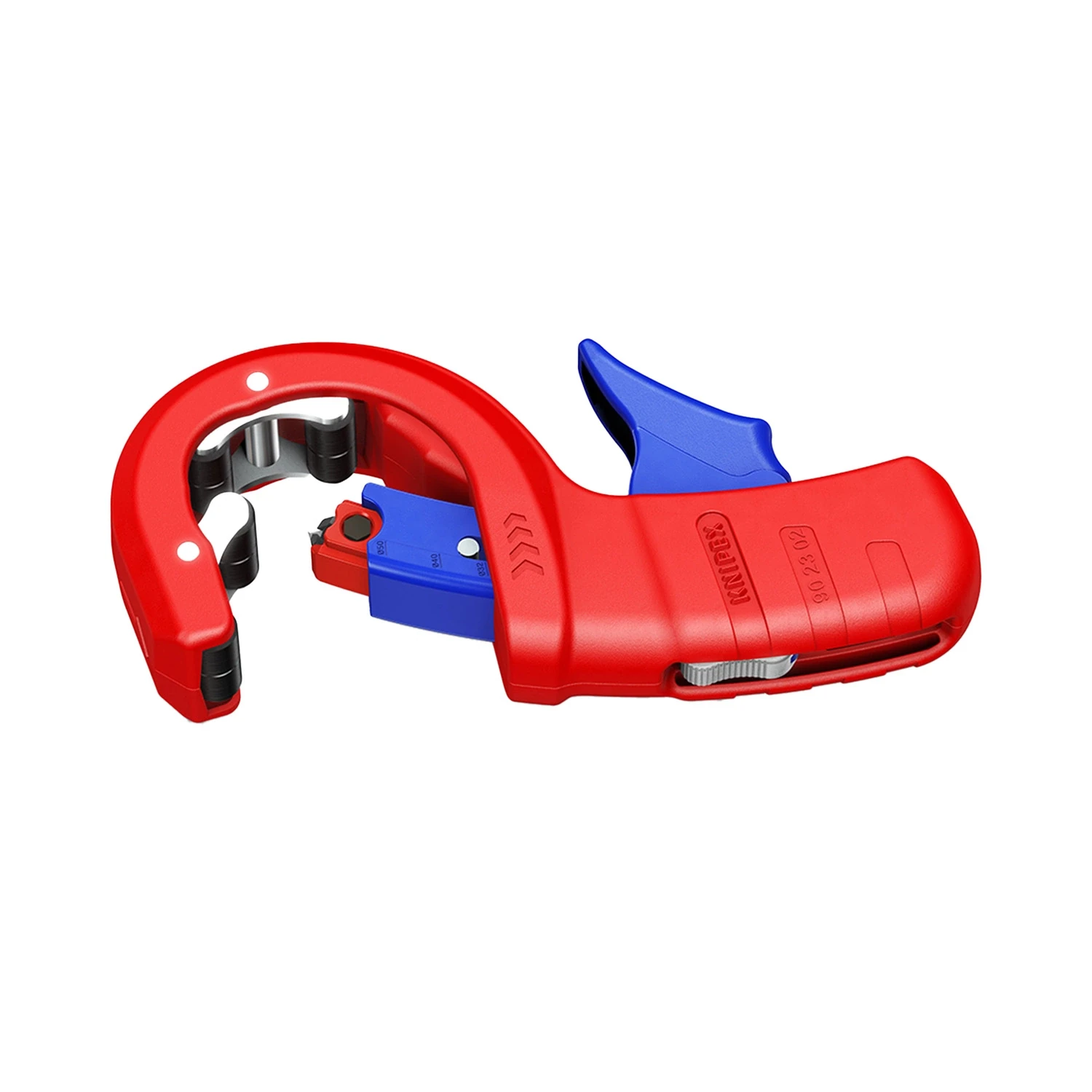
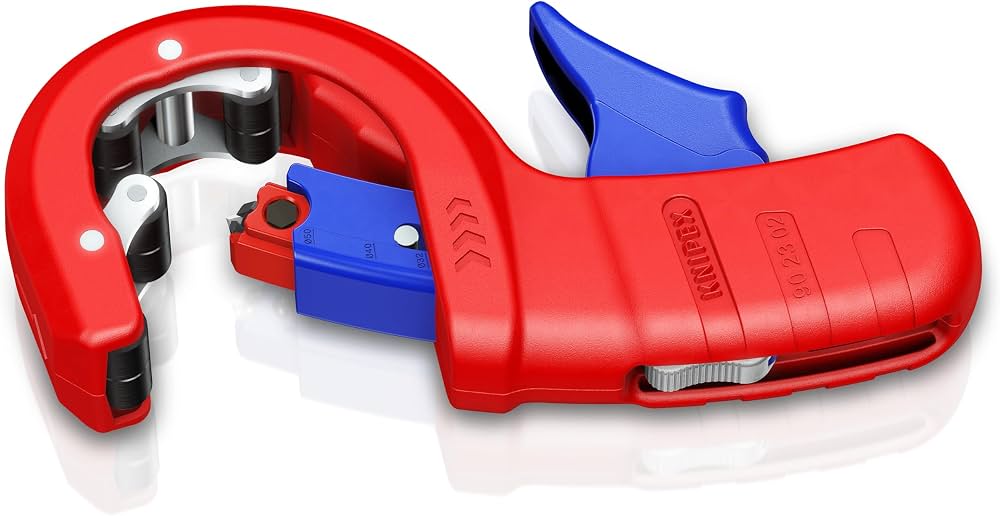
DPT50 pipe cutter
The tool shown on the cited Fixami product page, with its trigger and C-shaped head.
The buying decision depends less on a one-off retailer quote than on the product features: an integrated spare blade, a reversible blade and integrated chamfering reduce additional work steps.
The natural audience for the DPT50 is the plumber and heating engineer who installs or repairs PVC and PP drainage systems. The 32, 40 and 50 mm diameters correspond to common domestic drainage runs: toilet, shower, washbasin, sink, washing machine.
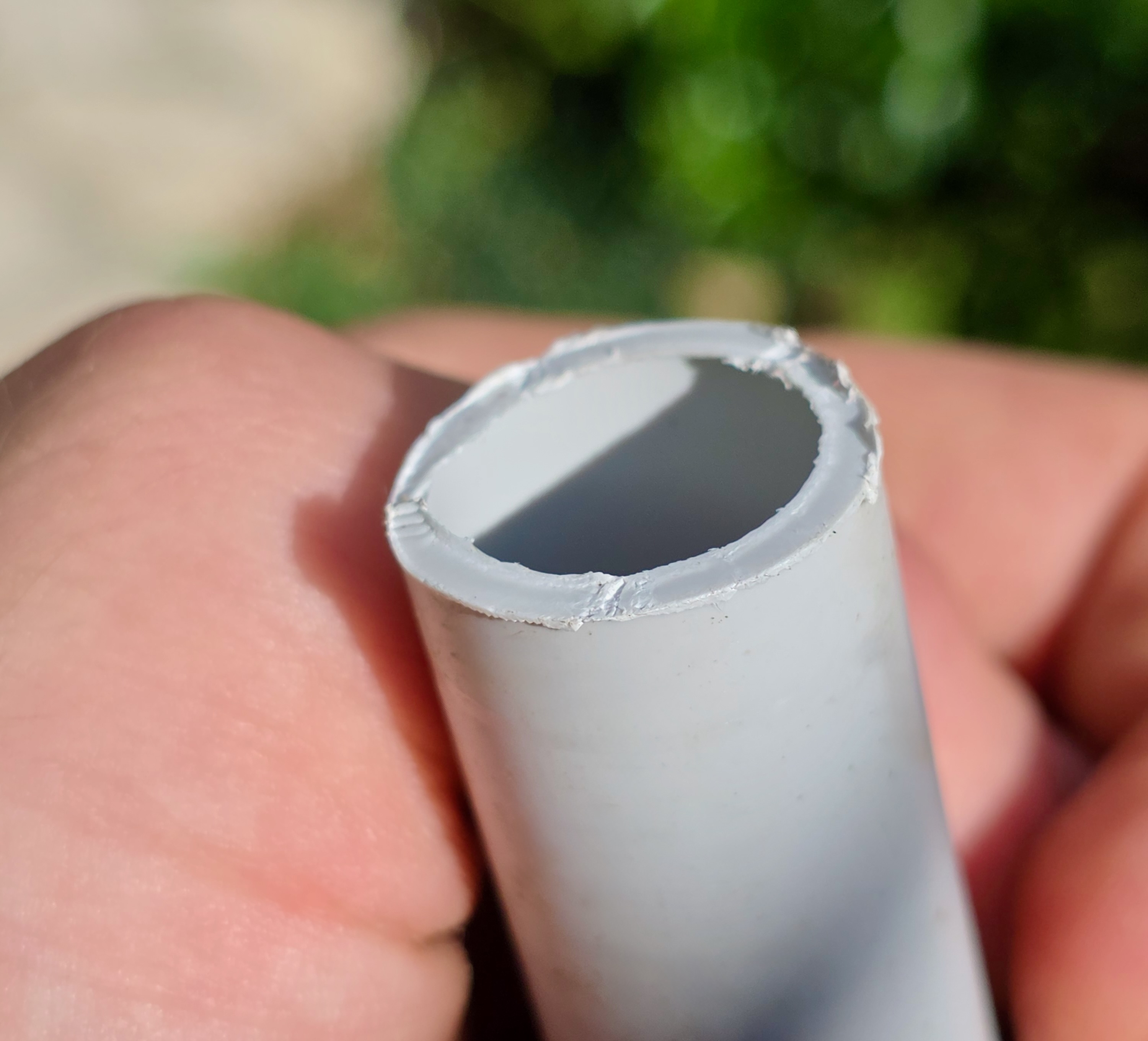
I also refer trainee plumbers to my guide on plumbing basics, from water to drainage: the choice of pipe cutter has its place in the toolbox.
The article on the distance-learning plumbing CAP also details the equipment expected in training, where this type of pipe cutter regularly appears.
The repeated cutting action on a drainage job justifies a dedicated tool: the pipe cutter produces a clean cut, ready to glue, with no separate deburring step.
For a plumber who fits one joint after another, the integrated chamfering and the integrated spare blade cut down on trips back and forth to the toolbox and on work stoppages, two items that count in a tradesperson’s day.
The DPT50’s documented use case is plastic drainage pipe in 32, 40 or 50 mm diameters with 2.5 to 3.5 mm walls. Flexible ICTA conduit and rigid cable-protection conduit are outside that product family.
On full renovations, kitchens or bathrooms, an electrician may still need to cut drainage pipe. In that case, wall thickness decides between DPT50 and DP50; for normal electrical conduit I use tools intended for that conduit family.
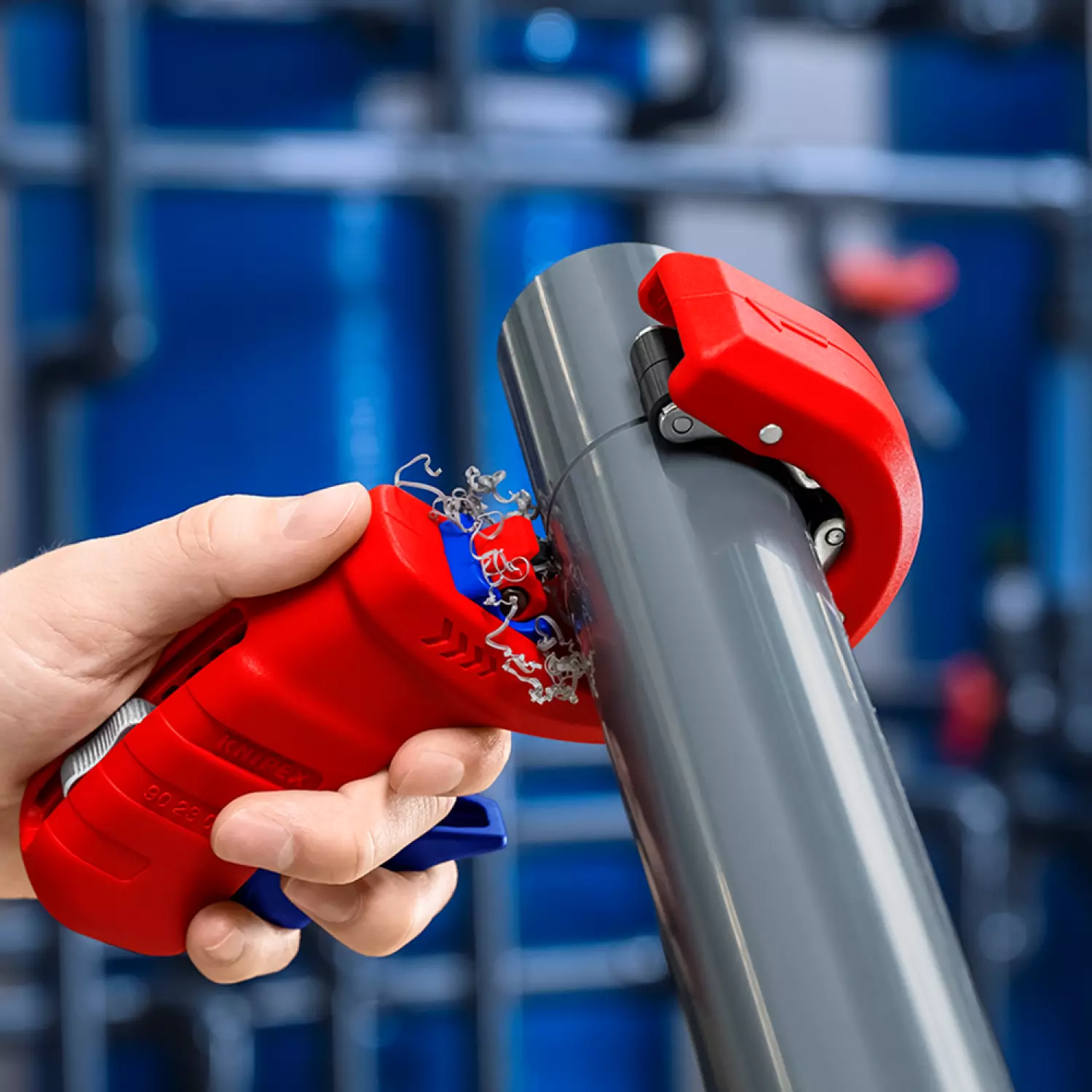
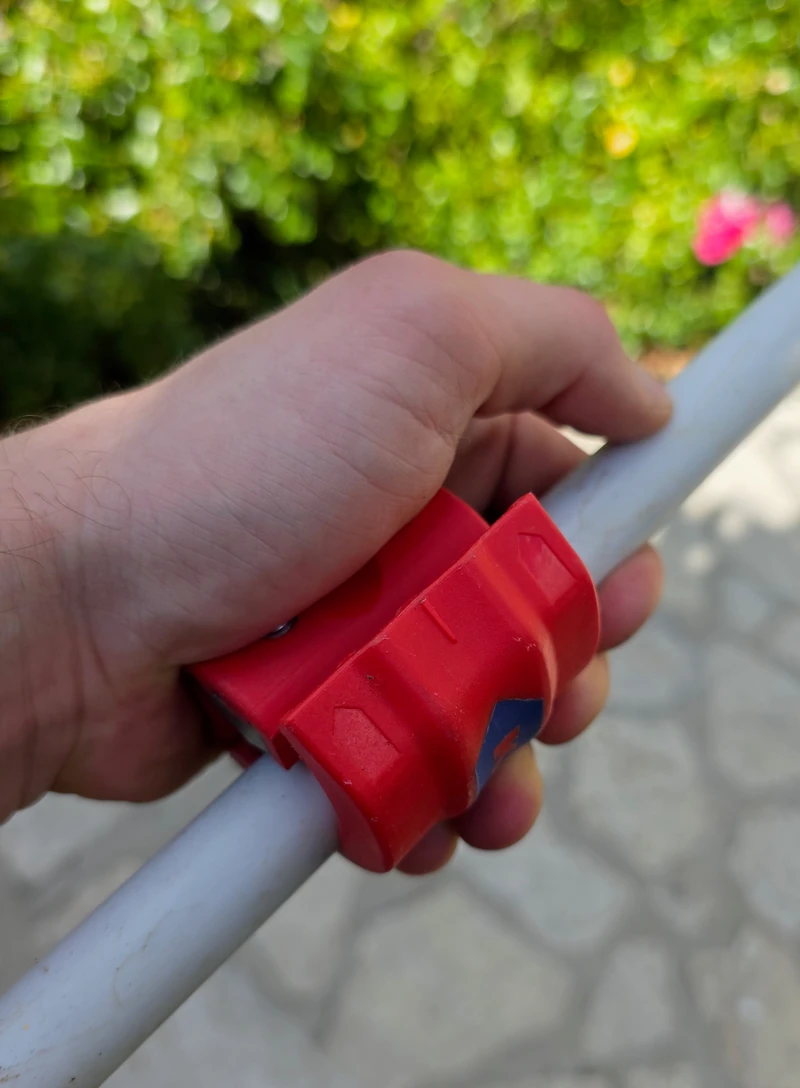
Pipe cutter in action
The rotation of the tool slices through the gray pipe, as stated in the mechanics of the DPT50.
Retour de chantier
My jobsite tip: if you regularly cut drain pipes, take a moment to measure the wall thickness of your pipes before buying. Between the DP50 and the DPT50, it’s that millimeter that decides, not the diameter announced on the shelf.
Start with the exact reference. The DPT50 is the 90 23 02 BK; the neighboring DP50 is the 90 23 01 BK. The names are close, but the supported wall thickness is not the same.
Then measure the wall thickness of the pipe itself. The DPT50 is specified for 2.5 to 3.5 mm walls. If the pipe stays in the 1.8 to 2.4 mm range, the DP50 is the reference designed for that thinner wall.
Check the outside diameter separately. The official DPT50 range is 32, 40 and 50 mm. A 40 mm marking alone does not identify the correct cutter, because both models cover that diameter.
The third check is the material. The documented scope includes PVC, PP and PE, with KNIPEX also citing pressure PVC, PVC-C and PVC-U. Pipes with an expanded core are part of the use case highlighted for the DPT50.
Do not extrapolate these specifications to every plastic conduit. Electrical ICTA and rigid cable-protection conduits are not the product family used to define the DPT50 range in the cited manufacturer material.
Finally, note the maintenance reference before the tool enters service: the official replacement blade is 90 23 02 E01. The blade is reversible, a spare is integrated into the tool, and the replacement system is part of the practical value of this cutter.
This checklist avoids the two common selection mistakes: choosing by diameter alone, or assuming that “plastic pipe” means every plastic tube. For this tool, reference, wall thickness, diameter and material all have to line up.
Blade replacement is a point professionals look at before buying a pipe cutter, and KNIPEX has thought about the tool’s life cycle:
It’s the kind of detail that changes the decision for a tradesperson who wears out several blades a year. The official availability of the part, announced from launch, is a good product-support signal.
Replacing the blade without tools matters in real-world conditions: no screwdriver to look for, no screws to remove, the blade is changed in place. Reversibility doubles the usage before the first purchase of part 90 23 02 E01, and the integrated spare covers the end of the job in case of unexpected wear.
These three levels of backup explain the attention paid to the life cycle by drainage professionals.
3 questions
InteractiveKNIPEX DPT50 pipe cutter
3 questions to check the essential reference points
Choose an answer
For selection, I check wall thickness first, then diameter and the exact 90 23 02 BK reference. That avoids treating DP50 and DPT50 as interchangeable versions.
No. The 90 23 02 BK is the DPT50 pipe cutter for thick-walled plastic pipes. KNIPEX wire strippers carry other references, such as the EvoStrip 12 40 200 or the ComStrip 12 62 180, which I detail in my article on the Jokari Secura.
Both cut the same PVC, PP and PE pipes, with the same adjustable diameters of 32, 40 and 50 mm. The only official difference is the wall thickness: 2.5 to 3.5 mm for the DPT50, 1.8 to 2.4 mm for the DP50. That makes wall thickness the first selection check before diameter or product name.
KNIPEX publishes no recommended price for the DPT50. For a current purchase, use a dated quote for the exact 90 23 02 BK reference / EAN 4003773092186.
No. The stated range of 32 to 50 mm with 2.5 to 3.5 mm walls matches drainage pipes. Flexible ICTA sheaths and rigid electrical protection conduits are not in this range: for these uses, a dedicated sheath cutter remains the right tool.
The blade is reversible and is replaced without tools, with an integrated spare blade in the tool. The official part carries reference 90 23 02 E01, confirmed by the KNIPEX FAQ from launch.
Yes, it has been announced since July 2025 by the official FAQ of 2 July 2025, and it was in stock at the retailers consulted.
No. The manufacturer's and retailers' listings mention only plastic pipes: PVC, PP, PE, PVC pressure, PVC-C, PVC-U and pipes with an expanded core. A copper, steel or PEX pipe is not part of the stated range: for these materials, a different type of tool is needed.
The retailer shows a continuous range of 30 to 50 mm, whereas KNIPEX states three adjustable diameters: 32, 40 and 50 mm. The difference is minor, but it illustrates the need to cross-check retailer listings against the manufacturer's documentation, particularly on the 2.5 to 3.5 mm wall thickness.
The official blade carries reference 90 23 02 E01, announced by the KNIPEX FAQ from launch. It is bought separately when the integrated spare blade is worn; before buying a new one, flipping the reversible blade lets you present a second cutting edge and extends the tool's use.
Théo Desrousseaux
Electrician and editor
I work in the field and edit this magazine. Every guide is reviewed for its target country before publication.
Practical electrical installation guides, diagnostic methods and tool recommendations compared against the technical wiring standards of this national edition.
KNIPEX Cobra ES 87 51 180 water pump pliers: technical specs, hands-on handling, push-button adjustment, 180 mm format and usage framework.
Read the guide Guide Knipex, Wiha or Wera: comparison for electricians Knipex, Wiha or Wera: compare VDE pliers and screwdrivers by equivalent references, ergonomics, certification and field use for electricians. Read the guide
  Guide KNIPEX 86 03 180: pliers wrench review KNIPEX 86 03 180 pliers wrench: 35 mm capacity, 13 positions, variants, smooth jaws, verified uses and maintenance for electricians. Read the guide
  Guide Wiha or Wera: which tool kit for an electrician? Wiha or Wera: VDE 1000 V screwdrivers and pliers, storage systems and a method for a tool set suited to real electrical work in the home. Read the guide