Wiha easyTorque and speedE II: Batimat review
In brief
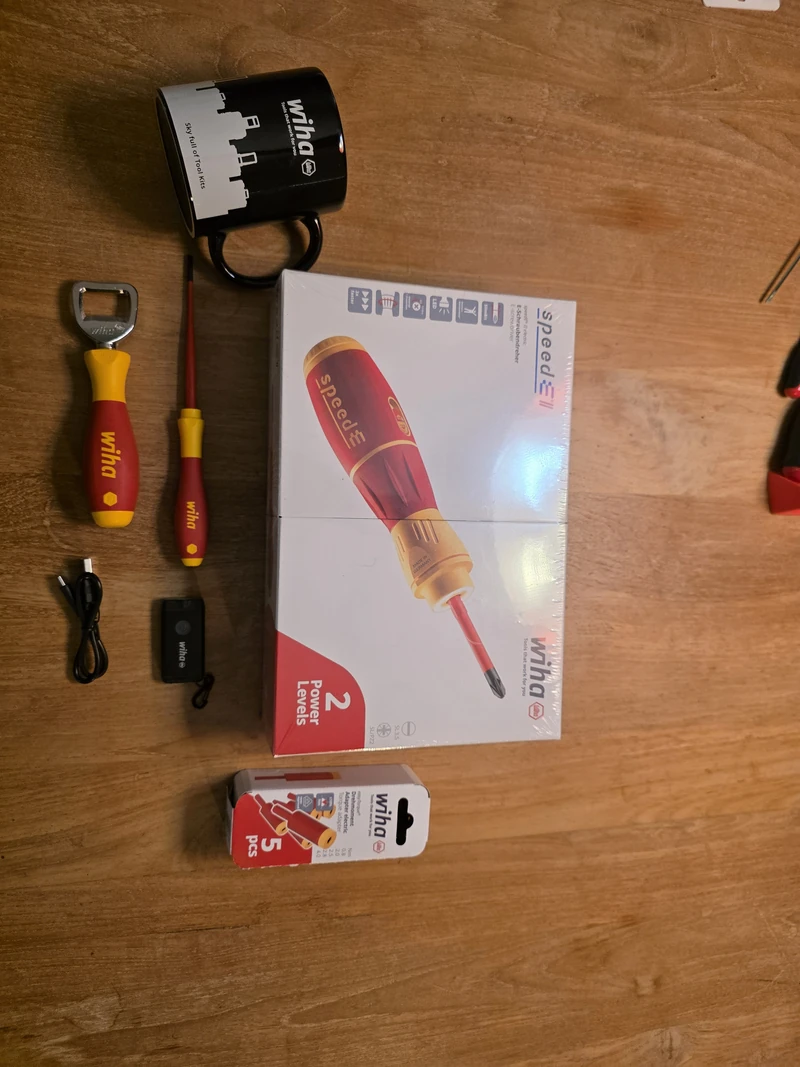
- The Wiha equipment received at Batimat includes a case marked speedE II and easyTorque accessories, documented by my photos.
- Powered assistance speeds up screwdriving; controlling a prescribed torque answers a different need.
- The VDE insulation on one supplied torque bit tore when it was removed: the part is withdrawn from use.
- I asked for a solution or a replacement on 16 October 2026; no after-sales outcome is presumed.
Wiha gave me several tools at the Batimat trade show in September 2026. My photographs show a speedE II case with powered assistance, its charging equipment, an easyTorque pack and a screwdriver fitted with torque-tightening accessories. These products have different roles: speeding up screwdriving does not mean tightening automatically to the value required by the manufacturer of the switchgear.
One fact must also be part of this review: part of the VDE insulation tore away when a bit intended for torque tightening was removed.
I reported it as unusable to Jérôme Layer, my Wiha contact, in an email sent on 16 October 2026, asking for a solution or a replacement and saying I would send an additional photo. This is an incident affecting one specific part, not a conclusion about all Wiha bits.
I already have a guide on the speedE II, devoted to its principle and the manufacturer’s data. Here I examine the equipment actually received, my photos and the bit incident, without attributing to a different reference a trial that was not carried out.
Power assistance and tightening torque: two different tools
The speedE II is a power-assisted screwdriver. On the handle photographed, the MIN/MAX control is visible. Its role is to make rotation easier, but a cut-out threshold for the assistance does not replace a final tightening operation at the torque required by a terminal.
The adapters in the easyTorque family have a different function. The blister pack photographed states five pieces, with distinct nominal values. Each value must be considered together with the intended handle, the bit and the exact instructions.
Placing several products from the same brand side by side does not prove that they are interchangeable or intended to be assembled together.
In a distribution board, I first note the torque specified for the switchgear, then I use a set designed for the relevant drive profile and value. A powered screwdriver can save time on repetitive screwdriving; a torque tool answers a requirement for controlled tightening.
In both cases, the condition of insulated parts must be inspected before use.
What the photographed speedE II case contains
You can see the handle, a charging device, two batteries, bits and their storage. This observation concerns my case and does not prove the contents of every commercial speedE II reference. The manufacturer’s data sheet must be checked against the exact reference on the box before any exhaustive list.
The storage protects small parts that are easily lost at the bottom of a tool bag. For an electrician trying to reduce the amount of kit carried, the value depends on how many profiles are genuinely useful and how much space the whole set takes up.
Having two batteries can help plan a swap, but a photograph of them provides neither a runtime nor a number of screws driven.
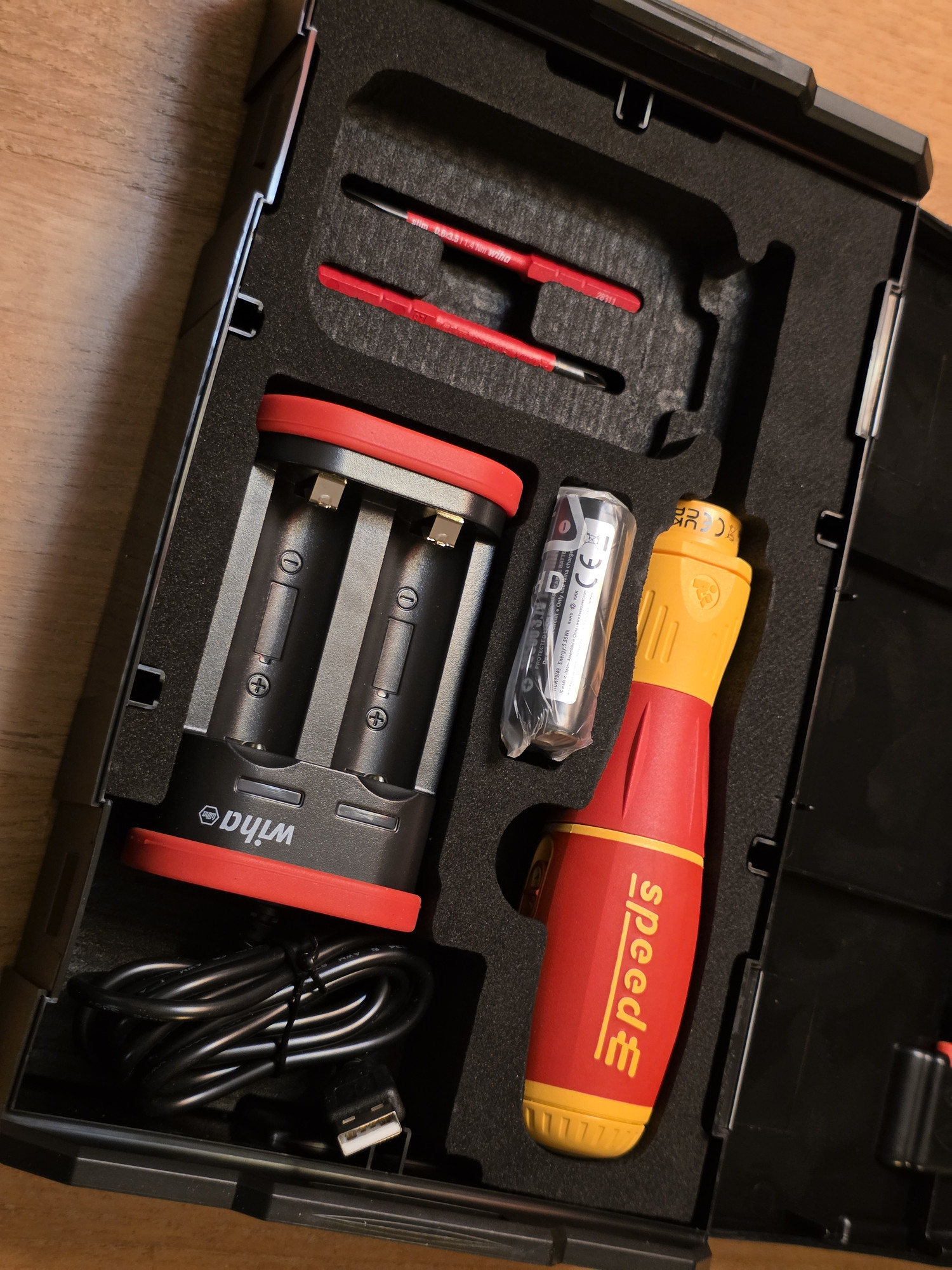
The visible contents of my case, not those of every reference sold.
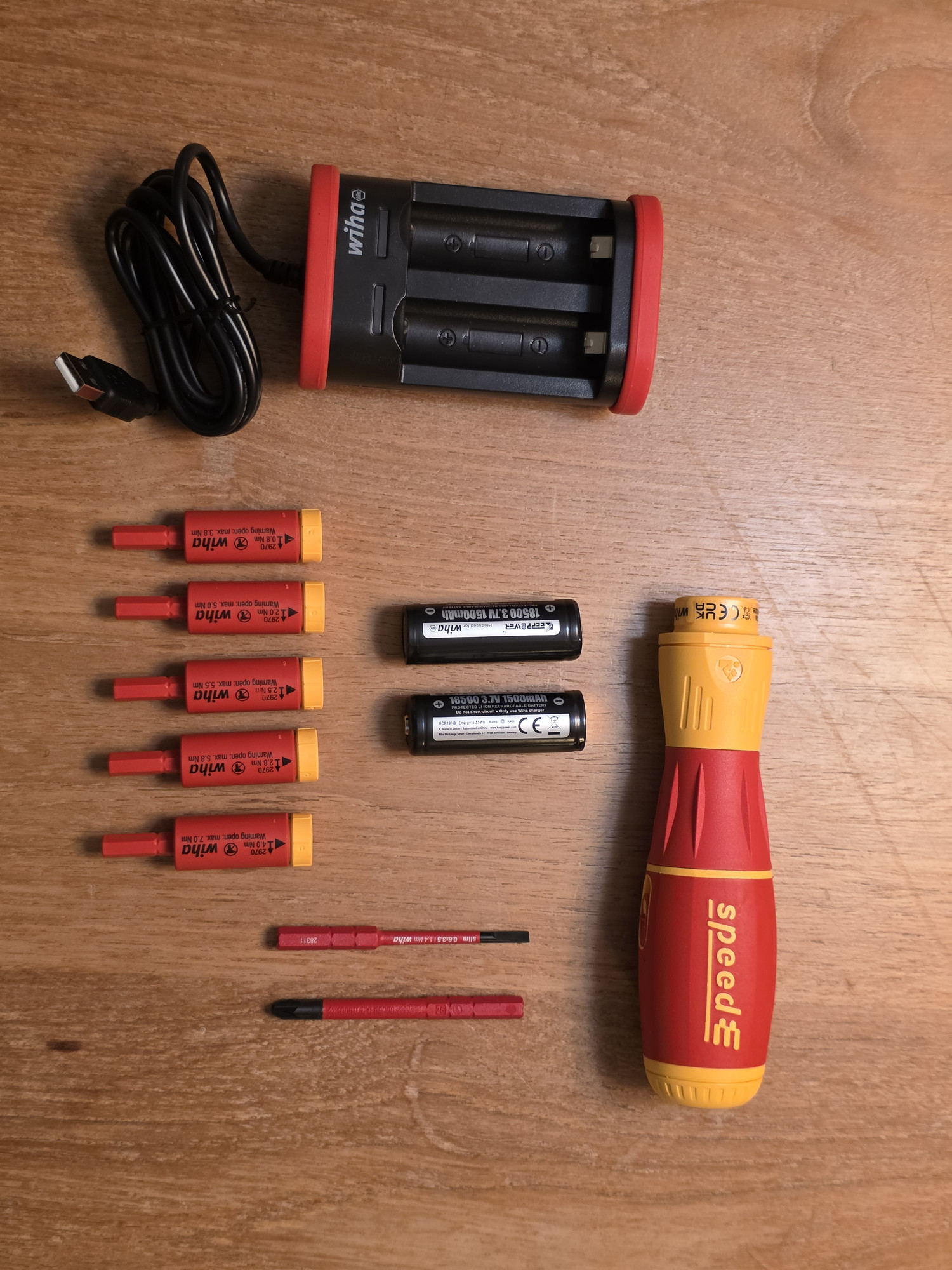
The components photographed flat so each item can be distinguished.
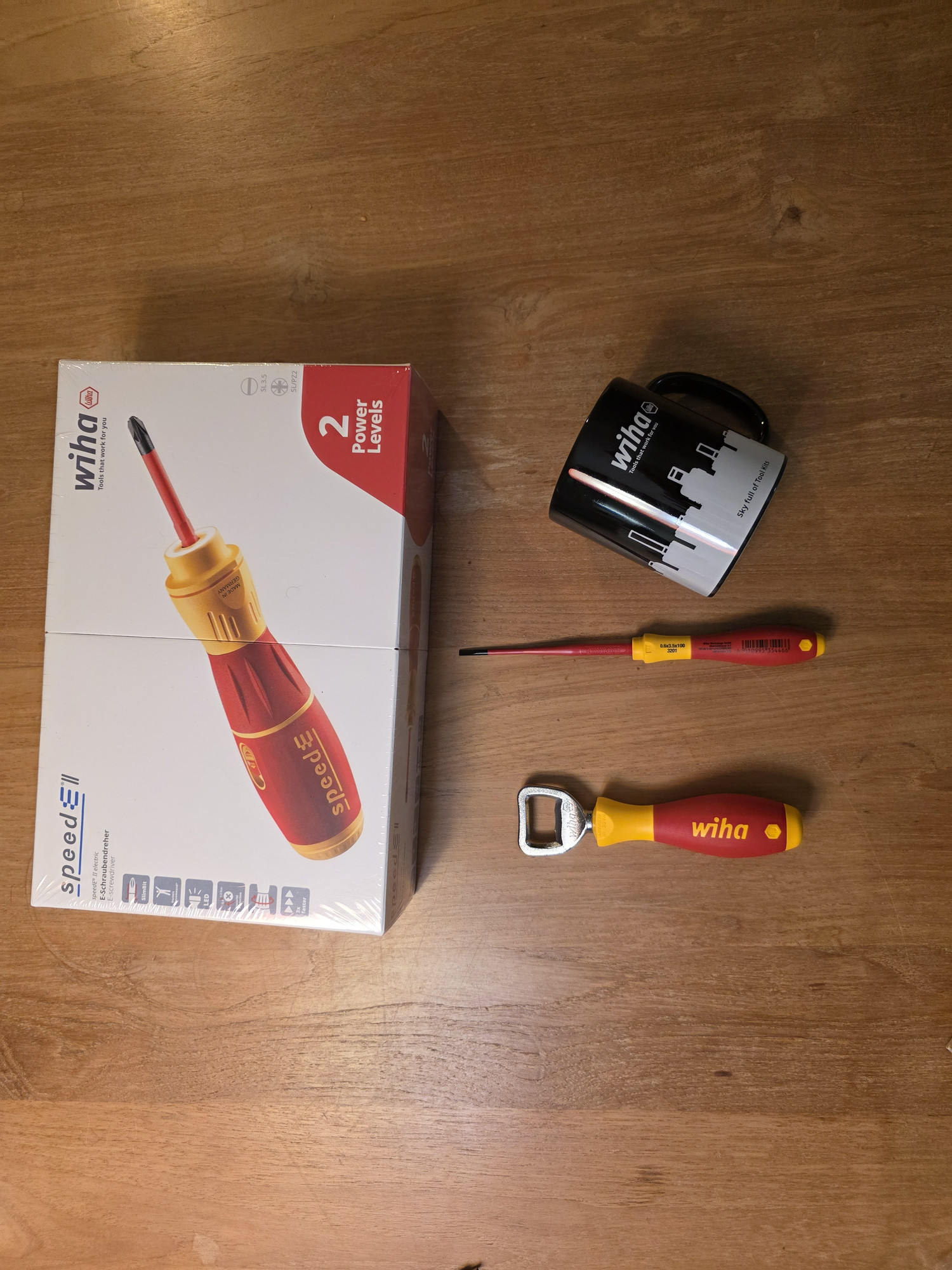
The case and accessories outside their storage slots.
MIN/MAX control, charging and bulk
The selector is easy to identify by touch and by eye, but the tool’s behaviour has to be judged in the context of the screwdriving task. For light work, the motorised handle and the bit can be bulkier than a short manual screwdriver. Over a run of screws, their usefulness is different.
You also need to allow for the power supply and the charging cable.
The case and its charger are photographed separately. They give an idea of how the equipment is organised, not of its runtime or its reliability after months on site. A productivity promise is only worth anything when related to a known task and reproducible measurements.
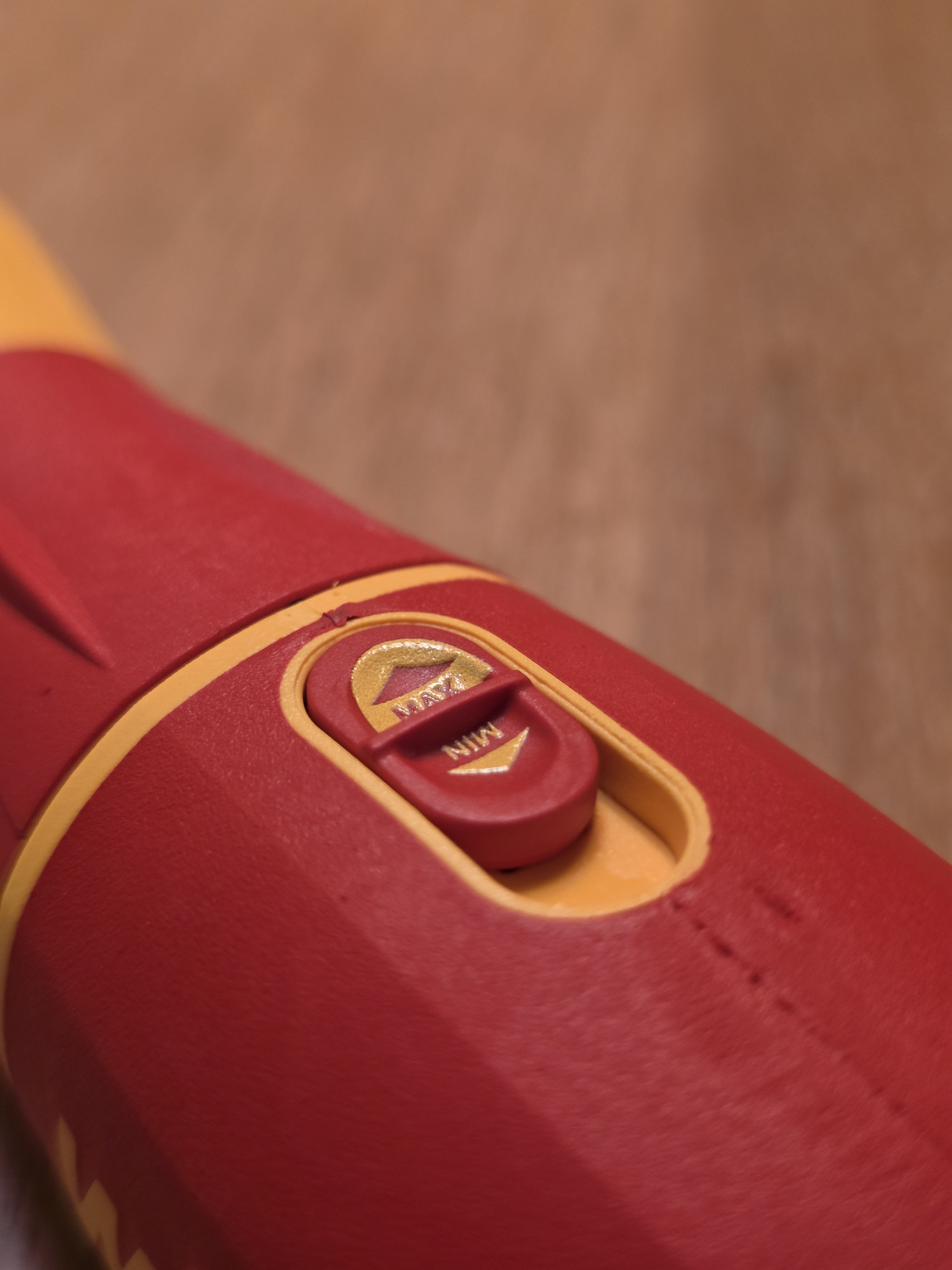
The selector is visible; this is not a measurement of final torque.
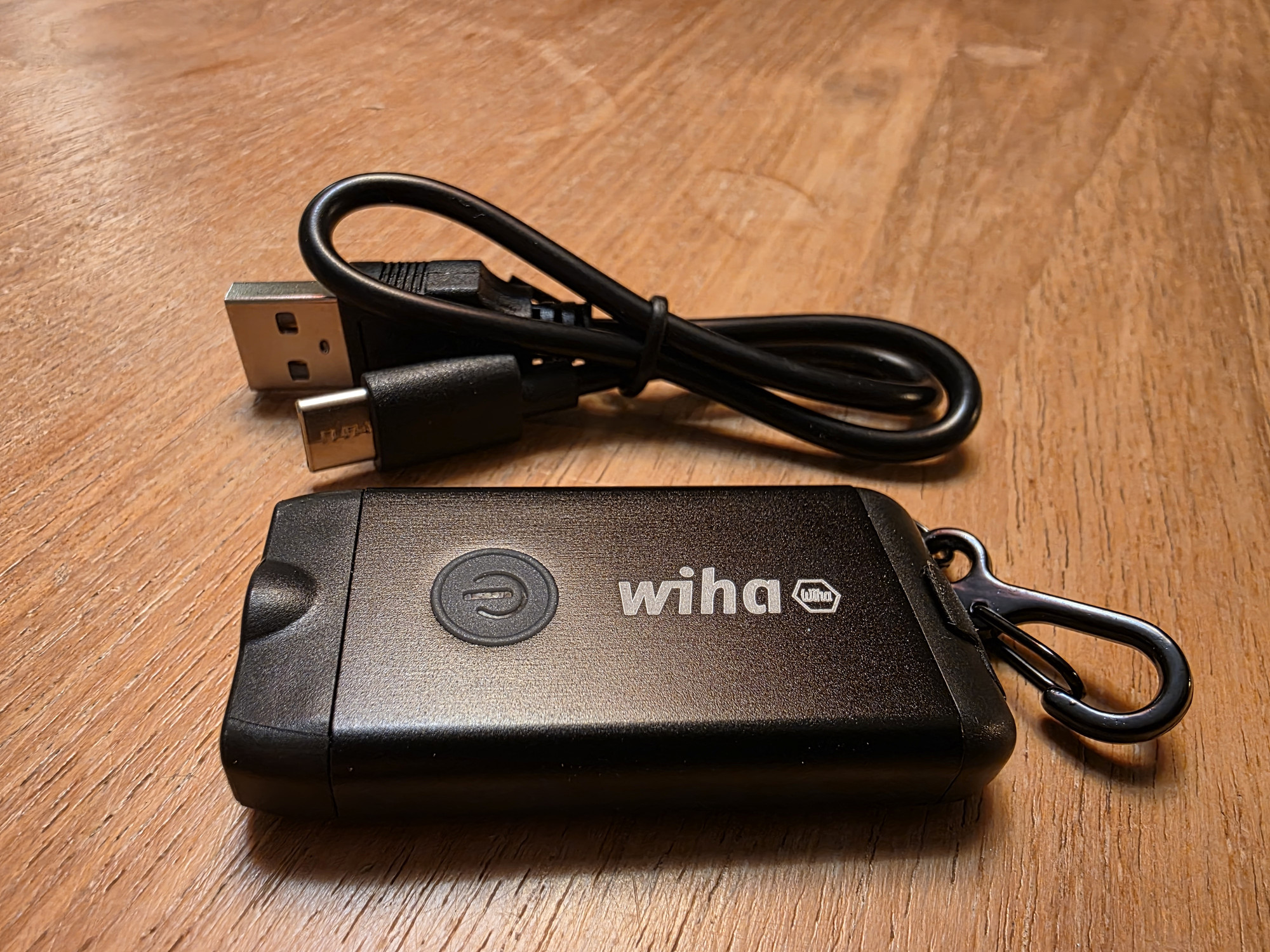
Charger and cable photographed separately.
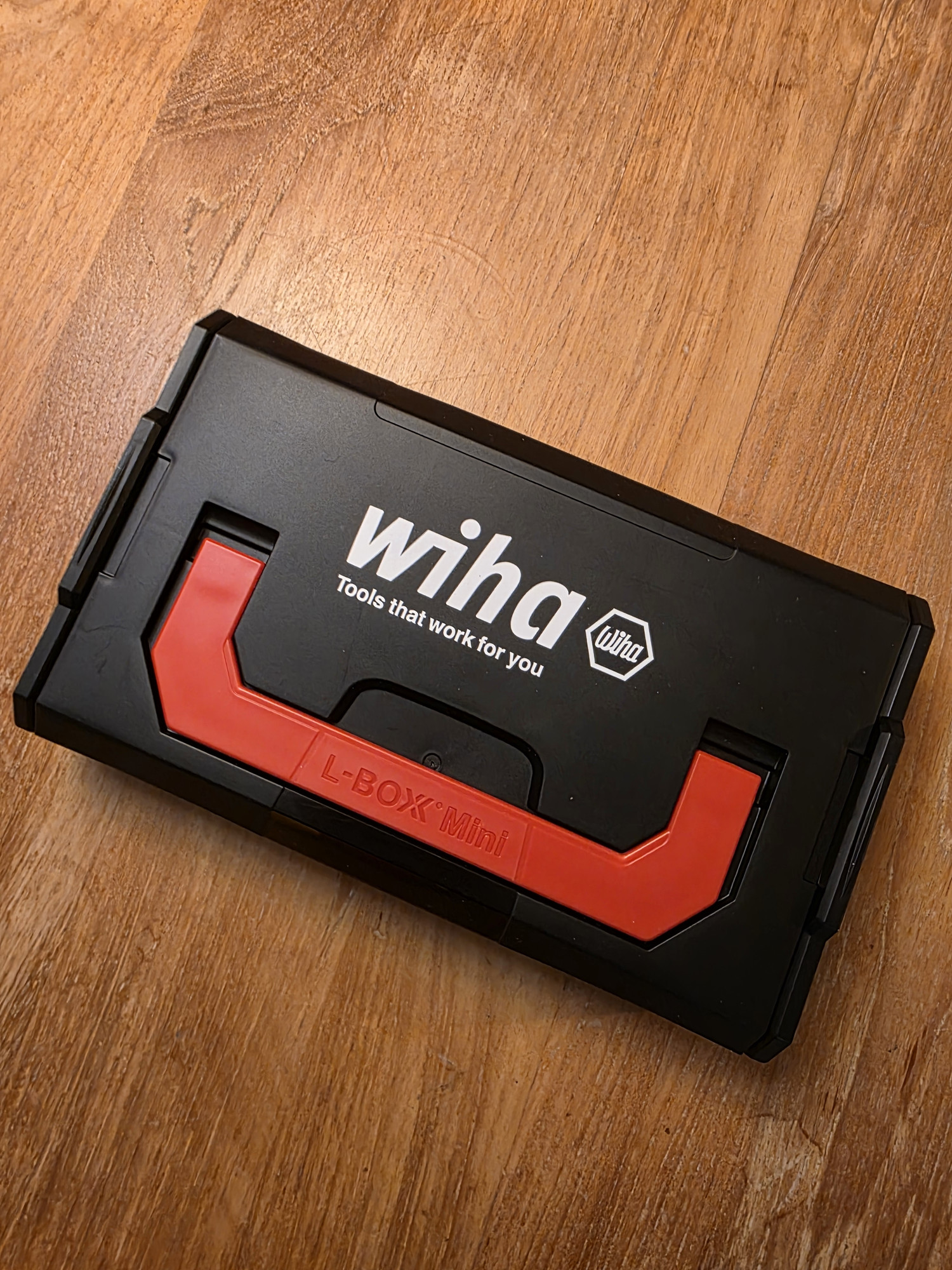
The closed case, useful for judging bulk.
The easyTorque set: understanding the adapter before tightening
The visible packaging bears the name easyTorque and the words 5 pcs. The red and yellow items can be identified as torque adapters. They must not be confused with five different screwdriving profiles.
To perform a tightening operation, you must choose the value corresponding to the device and check the markings engraved on the part being used.
The body of the red and yellow screwdriver, fitted with one insulated bit, shows the length the assembly can reach. In a board, this can matter close to a rail, against a wall or around a terminal block that is difficult to reach.
Apparent mechanical compatibility never replaces the compatibility declared for a handle–adapter–bit combination.
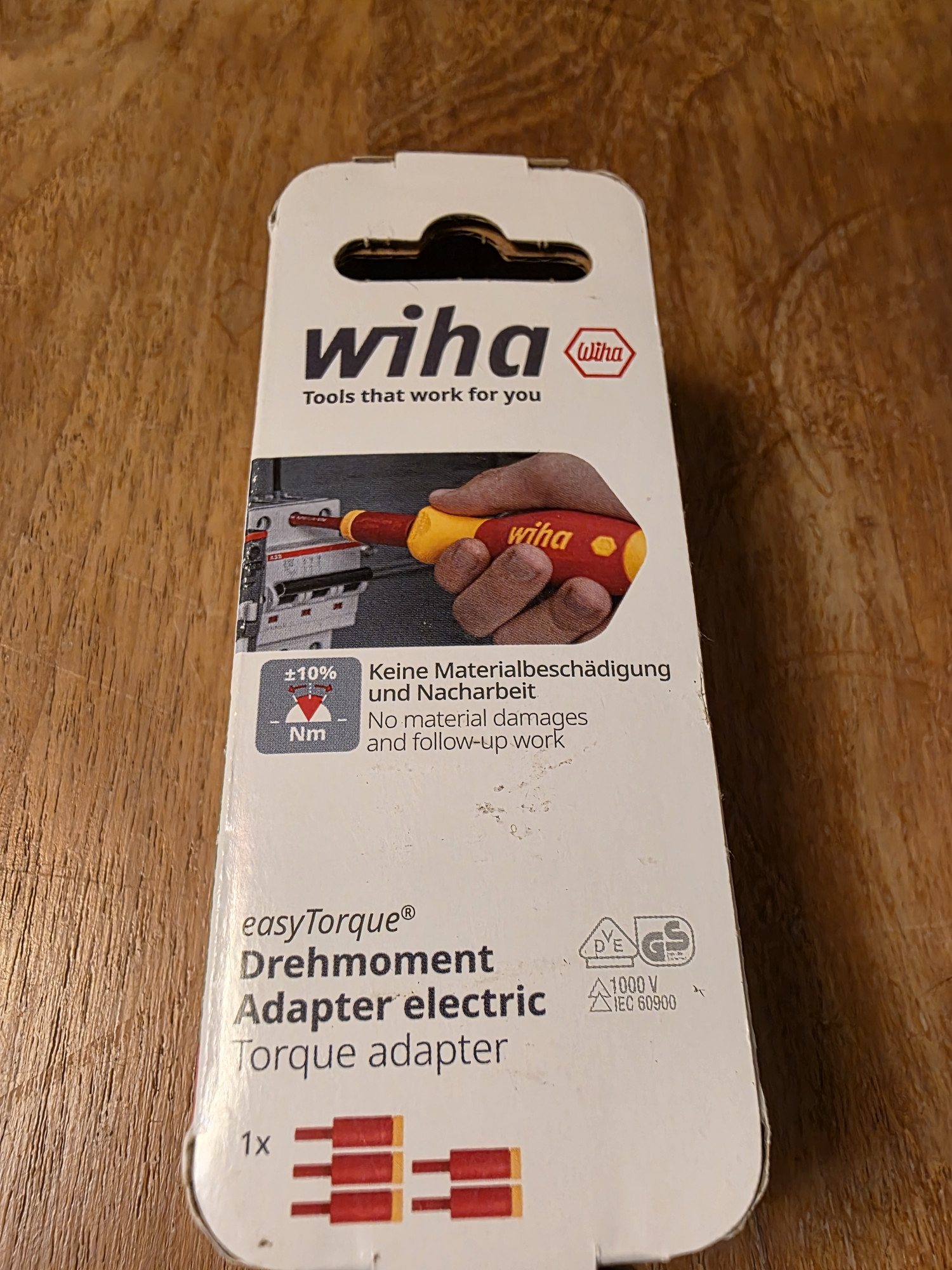
The pack shows five preset adapters and their stated values; it does not document a torque test.
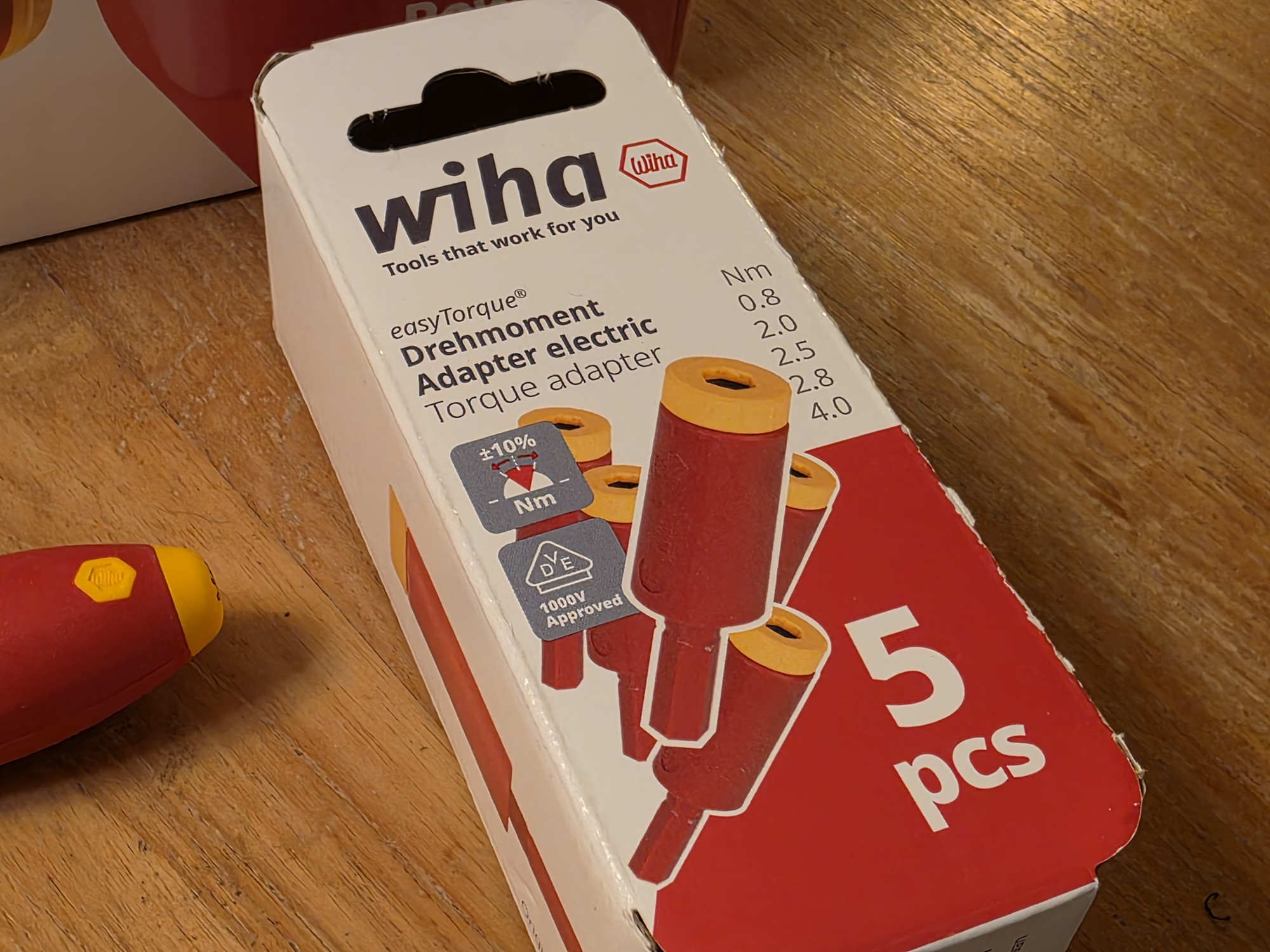
The easyTorque set label states five pieces.
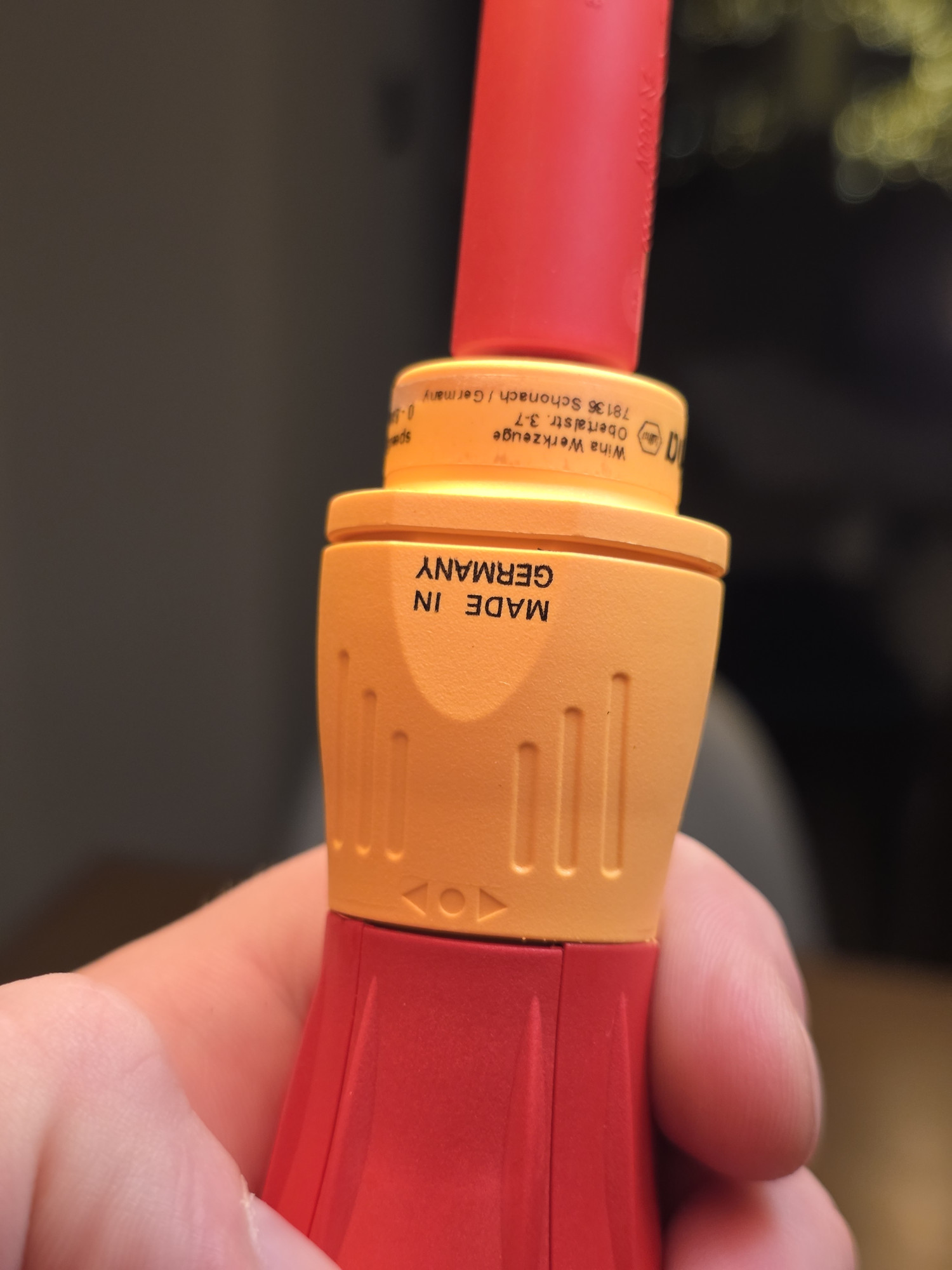
The marking on the part must guide the choice of torque.
A handy tool is not a precision measurement
The handle photographed gives an idea of grip, diameter and assembly. A good grip is useful, but it demonstrates neither the torque actually delivered nor a release that conforms to a prescribed value.
To assess these criteria, the reference, the setting or nominal value, the use and a suitable check would all have to be documented.
Even with a torque accessory, I must stop at the recommendations of the terminal concerned: its manufacturer sets the relevant value, not the apparent diameter of the screw. Isolation and safety checks remain independent of the screwdriver chosen.
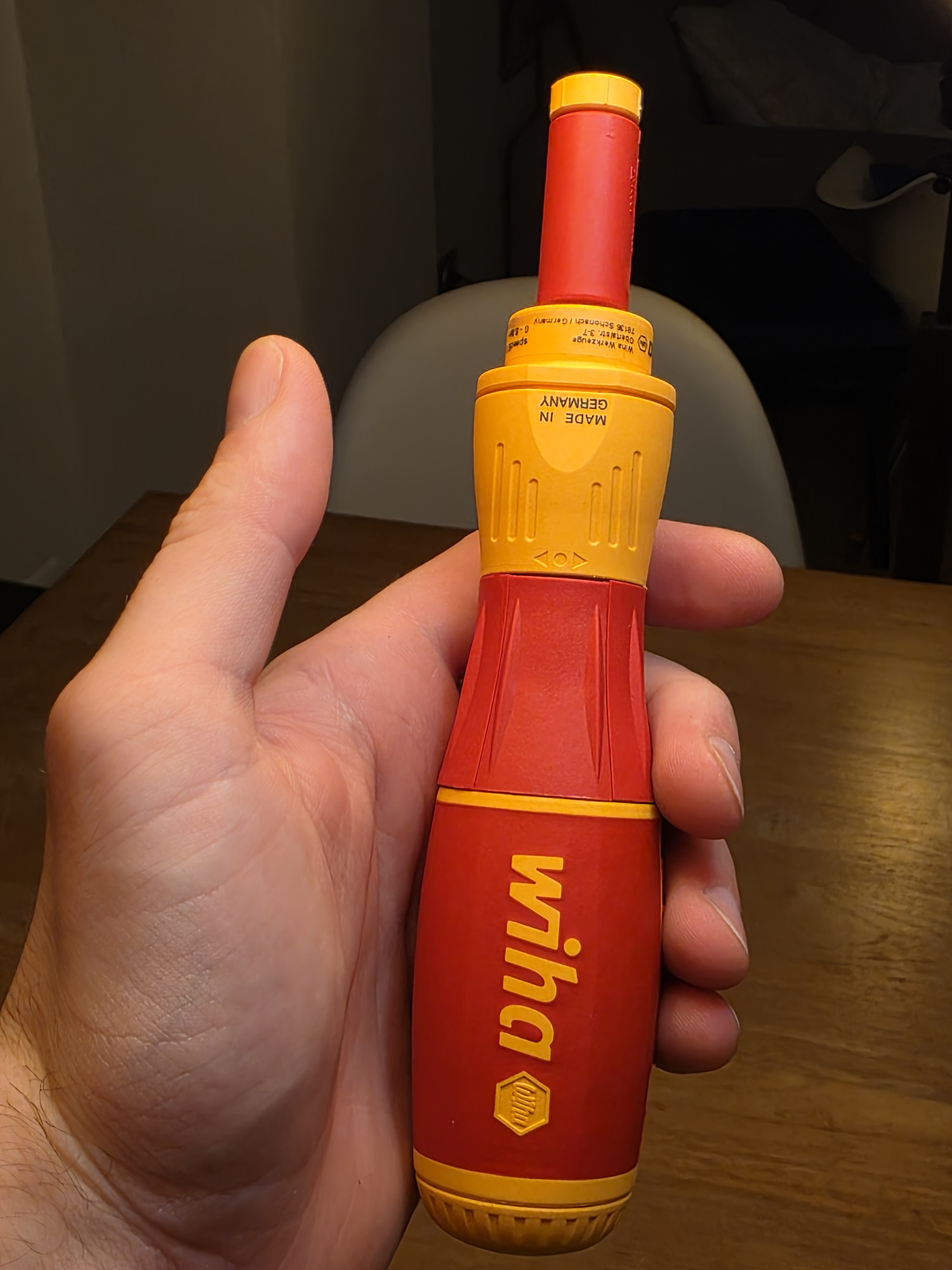
Length and grip are visible; the release effort is not.
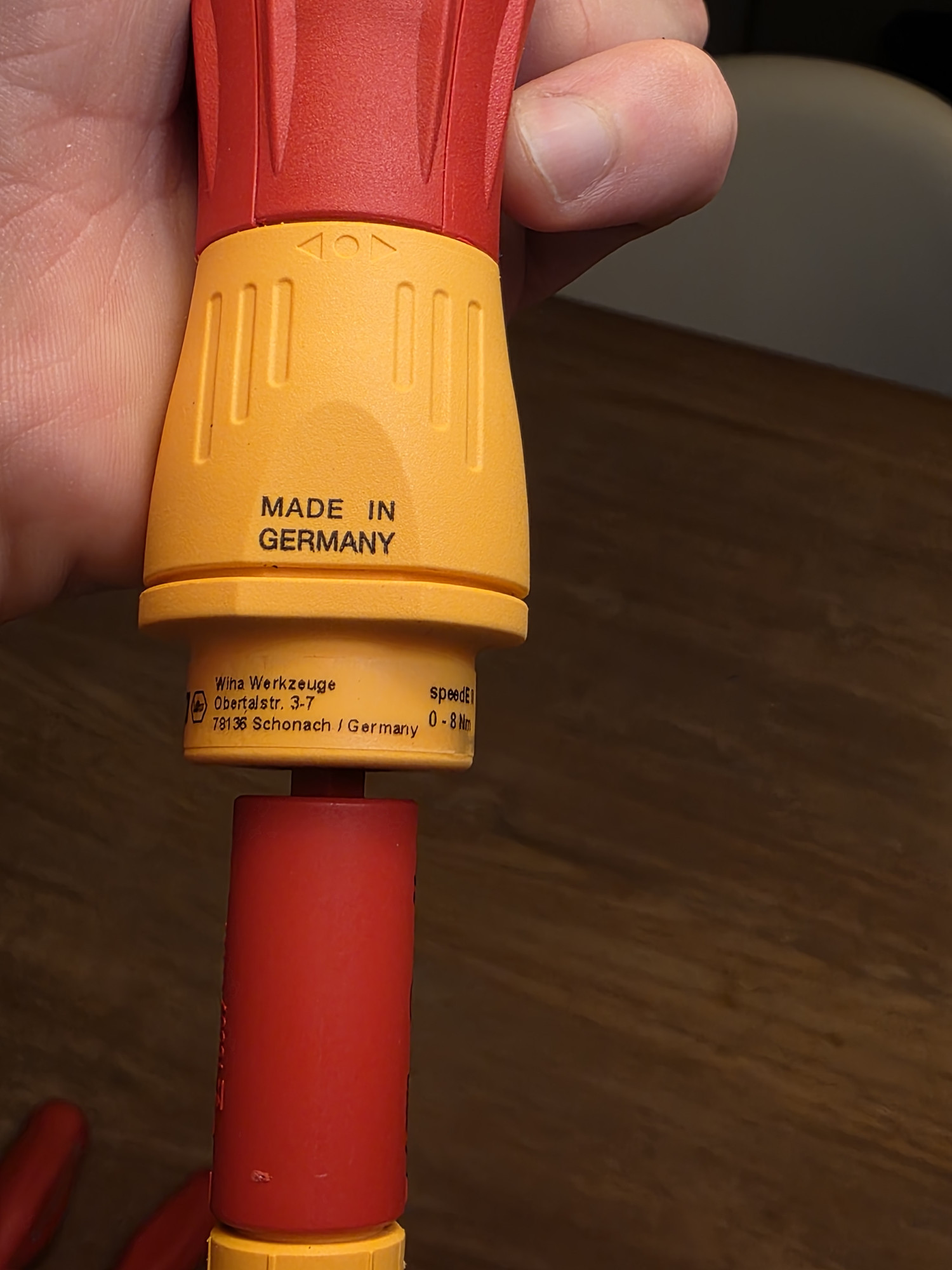
The joint photographed helps explain the construction.
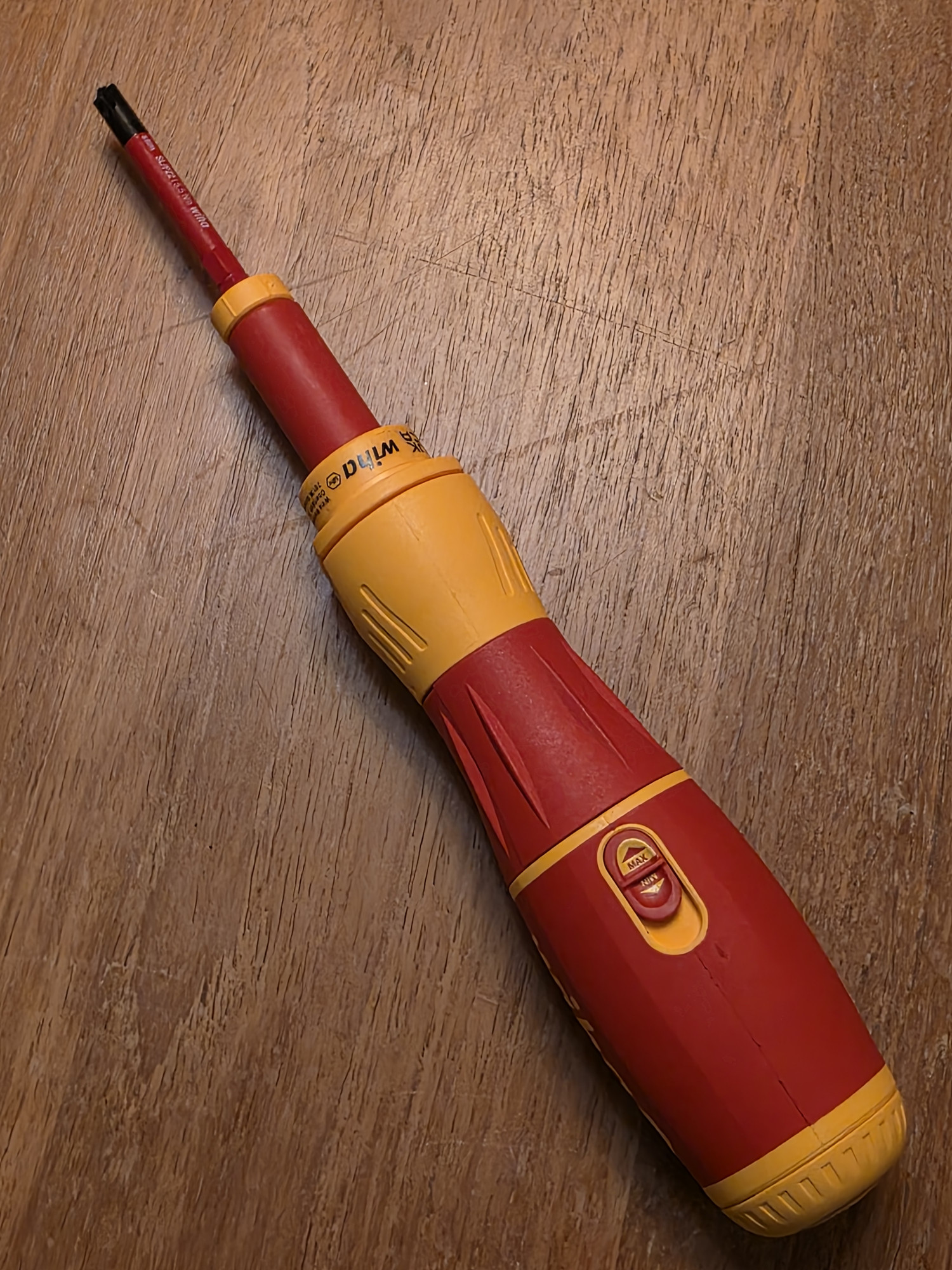
The assembly is shown, without claiming universal compatibility.
A VDE bit rendered unusable
When a bit intended for torque tightening of electrical distribution board switchgear was removed, part of the VDE insulation tore away. I reported this in an email sent on 16 October 2026 to Jérôme Layer at Wiha.
I stated that this part could no longer be used and asked how to obtain a solution or a replacement.
The incident does not establish the cause of the tearing, the exact date of the failure or the statistical behaviour of the range. I do not attribute it to the speedE II simply because the tools came from the same trade show. The message of 16 October does not contain the specific photo of the damage and does not attest to any after-sales response.
A bit whose insulating sleeve is damaged must not be put back to work as a VDE tool. Tape or an improvised repair does not restore its original certified protection. I am taking this part out of use; I am not testing it in a dangerous situation to confirm its defect.
The installation must in any case be made safe according to the relevant procedure, with lock-off and proof that it is dead.
The following three photos are views of the equipment taken in September. They show details of insulation sleeves, markings and tips, not photographic proof of the incident reported to Wiha. I therefore do not present the bit shown in one of these photos as the part that suffered the tearing.
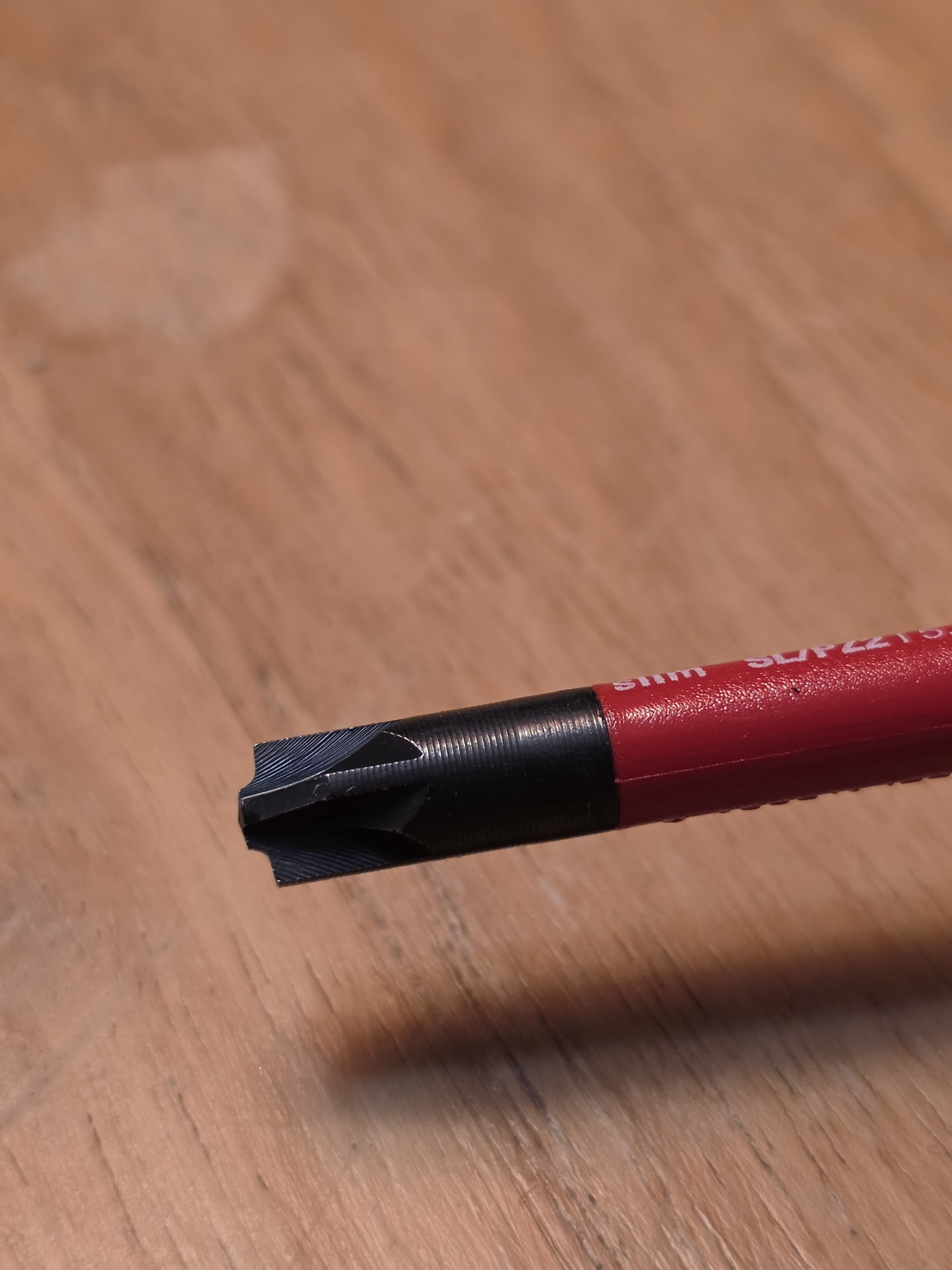
September view: this photo does not document the VDE tearing reported later.
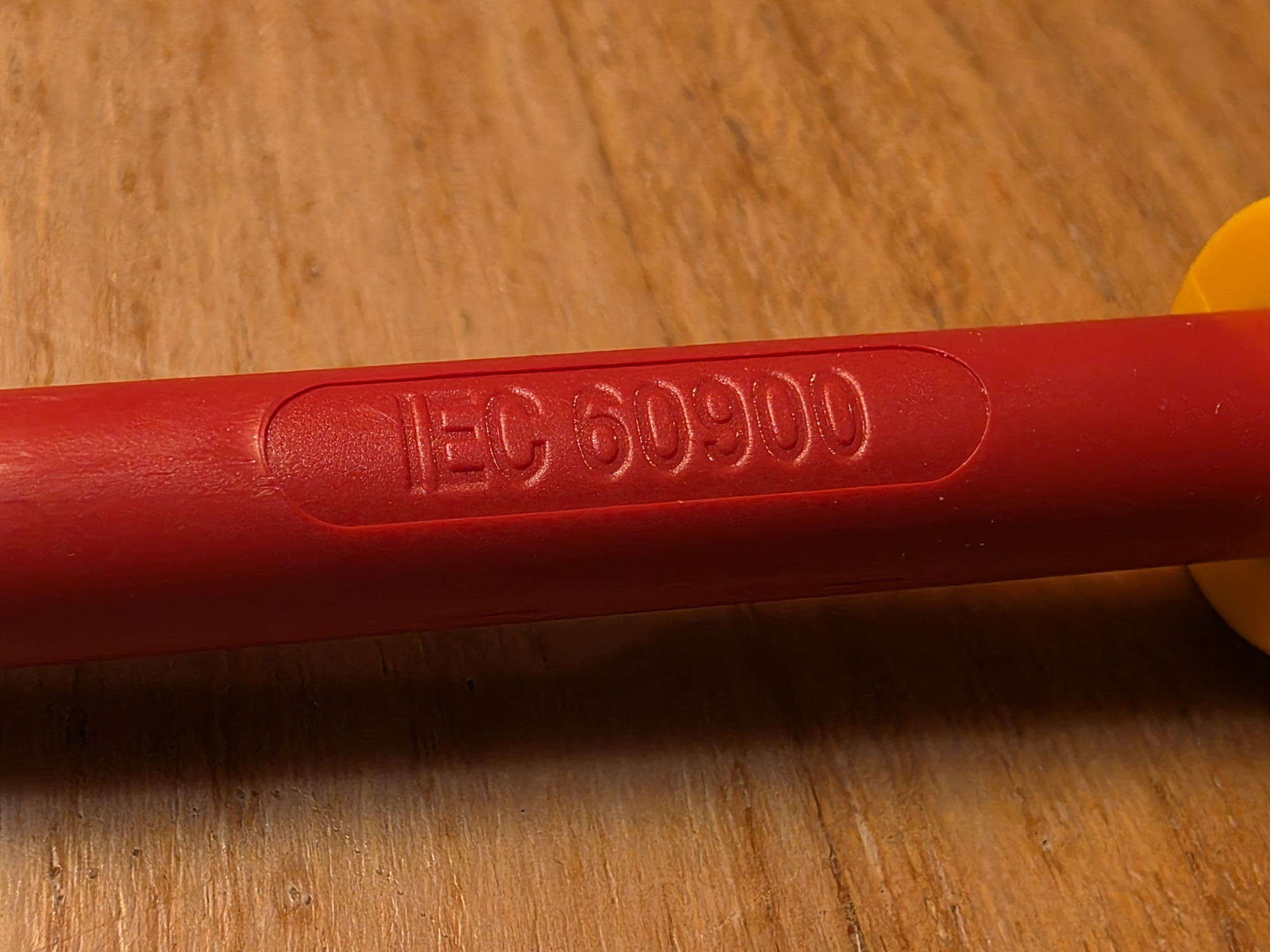
An original marking does not make a damaged sleeve acceptable.
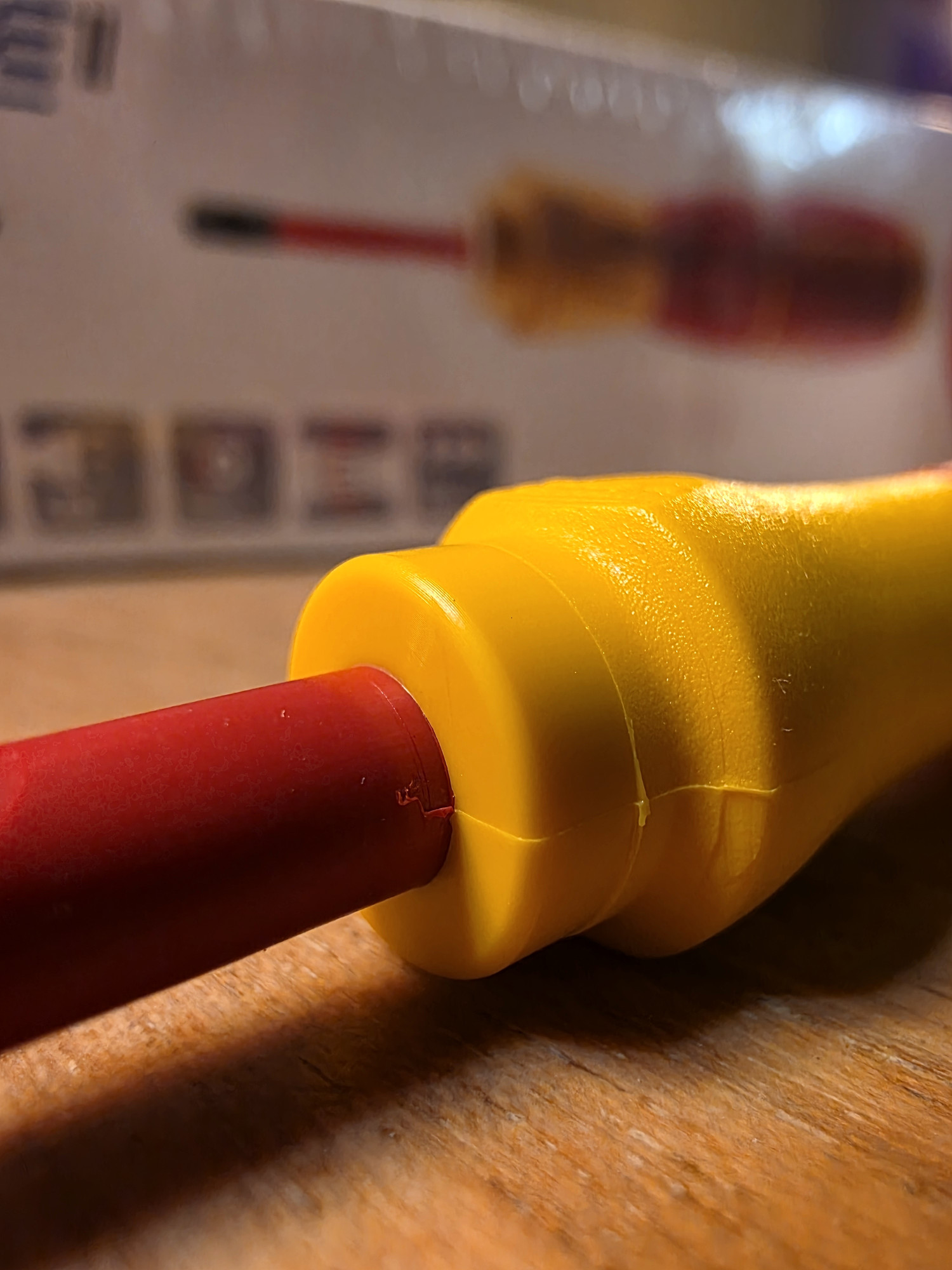
The sleeve and joints require examination before use.
What this batch changes in an electrician’s bag
Three questions decide whether I keep such a set in regular use: how many screws I handle, which profiles and torques are genuinely needed, and how much space the case takes up in the bag. Small switchgear adjustments do not have the same constraints as a day of repetitive assembly.
For a broader choice of tools, I compare Wiha and Wera for electricians and Knipex, Wiha and Wera separately. Neither comparison establishes the torque accuracy of this set.
The weak point documented today concerns a single accessory whose insulation tore away. The request to the manufacturer exists; its resolution cannot be assumed.
I am therefore not publishing a durability score, a torque-accuracy score or a final verdict until the references, the relevant tests and the condition of the part concerned make it possible to support one.
Commercial references identified from the equipment and Wiha documentation
The photos of the batch taken on 30 September 2026 show a Wiha speedE II case and an easyTorque electric 5-piece blister pack. The official data sheets allow these two designations to be matched to precise commercial references, without confusing them.
| Product identified | Catalogue reference | Function | Limit to respect |
|---|---|---|---|
| Product identified speedE II, case with charging and mini L-Boxx | Catalogue reference 44318 | Function Powered screwdriving assistance | Limit to respect Does not replace a prescribed final torque setting |
| Product identified easyTorque electric, five adapters | Catalogue reference 41479 | Function Five predefined torque limits | Limit to respect Read the slimBit and slimVario compatibility information |
| Product identified Accessory or insulated bit whose sleeve tore away | Catalogue reference Individual reference not established | Function Was intended for torque tightening of switchgear | Limit to respect The damaged bit is out of service |
The manufacturer’s data sheet for the speedE II states 7 pieces and details the handle, two 18500 batteries, USB charging, screwdriving elements and the case. The photo of my batch makes it possible to recognise this family, but I do not attribute to reference 44318 an accessory from a package placed beside it.
The manufacturer’s data sheet for the easyTorque kit states precisely the torques 0.8, 2.0, 2.5, 2.8 and 4.0 Nm. These five values describe the adapters in set 41479. They do not constitute a continuous range adjustable on a single part: the user chooses the component corresponding to the desired torque.
speedE II: 0.4 Nm and 1 Nm are not final torques
Wiha states two motor cut-out thresholds, 0.4 Nm and 1.0 Nm, selectable using the handle control. This function is intended in particular to protect sensitive items, such as certain plastic covers, during a repetitive screwdriving operation.
The manufacturer then describes a manual finish and states that the handle can transmit manually up to 8 Nm without being damaged.
The difference is crucial for electrical devices. An automatic cut-out of the assistance does not mean that the manual tightening that follows respects exactly 0.4 Nm or 1 Nm.
For a terminal whose manufacturer requires a specific torque, I choose the tooling corresponding to that value, and I do not rely on a feeling that the motor has stalled.
The activation ring and built-in LED are also among the functions highlighted by Wiha. They can help in dark areas and with repeated screwdriving; the manufacturer’s publicity claims screwdriving three times faster than by hand. That last value is not a timed gain observed during my own use.
easyTorque: triggering as an end-of-tightening indication
The easyTorque adapters have preset torques. Wiha describes an audible and perceptible triggering signal, together with relative movement of the yellow ring and the red body when the torque is reached. The tolerance stated by the brand for the adapters is ±10%.
This indication must not be presented as a measurement that I carried out on my own example.
The practical benefit is being able to choose an adapter corresponding to a real terminal specification rather than using a handle adjusted by guesswork. The trade-off is the need to have the right value available.
A set of five adapters can cover several common uses, but none of the values present becomes correct for every screw in a board.
In Wiha’s documentation, set 41479 is intended for slimBits and slimVario bit holders. It must not be inferred from that sentence that every adapter can be mounted directly on every powered handle from the brand, nor should easyTorque be equated with an adjustable TorqueVario-S system.
I check the instructions for the exact pair of accessories before assembling the equipment.
The five easyTorque pieces, reference by reference
The official Wiha catalogue details the five adapters in set 41479. This table matches each torque to the manufacturer’s reference, without claiming that every one of these parts was individually tried on a terminal:
| easyTorque electric adapter | Nominal torque | Wiha reference |
|---|---|---|
| easyTorque electric adapter First adapter in the set | Nominal torque 0.8 Nm | Wiha reference 41341 |
| easyTorque electric adapter Second adapter in the set | Nominal torque 2.0 Nm | Wiha reference 41342 |
| easyTorque electric adapter Third adapter in the set | Nominal torque 2.5 Nm | Wiha reference 41343 |
| easyTorque electric adapter Fourth adapter in the set | Nominal torque 2.8 Nm | Wiha reference 41344 |
| easyTorque electric adapter Fifth adapter in the set | Nominal torque 4.0 Nm | Wiha reference 41345 |
This list concerns the commercial contents of case 41479. It does not designate the damaged bit, whose individual reference is unknown. An accessory from the same manufacturer may have a different profile, a different sleeve or a different mechanical connection. In this situation, only the reference actually marked on the part and its damage photo can link the incident to a particular model.
For switchgear tightening, this diversity is useful if these five values are genuinely encountered. If a terminal requires, for example, an intermediate torque that is not in the set, I do not choose the higher value at random. I must use a tool whose setting is appropriate to that terminal. The range shown on a package does not turn five preset components into a universal key.
Finally, a distinction must be made between triggering at torque, the stated accuracy of the device and the conformity of the complete operation. Even a compliant adapter does not compensate for an incorrect drive profile, a damaged screw head, poor insertion of the conductor or a terminal whose instructions have not been read. The tool helps control the final action; it does not replace the connection method.
What the batch photographs show
The original set of images includes several views of the same equipment. An overall photo shows the speedE case and the accessories separately; others show the MIN/MAX button, the charger, two batteries, markings on the insulated sleeve and the easyTorque blister pack.
These details provide better evidence of the presence and shape of the products than a generic manufacturer image.
The close-up views of the handle make it possible in particular to identify the control mechanism, the position of the ring and the space needed around the grip.
On a crowded board, the choice is not only about power: the length of the assembly and access to the screw head determine whether the tool can actually fit.
The views of the easyTorque blister pack are useful for distinguishing a torque adapter from a bit with a drive profile. Confusing the two would lead to believing that a five-piece set offers five screw profiles. In fact, these are nominal torque values, to be paired with blades intended for the system.
The moulded IEC 60900 or VDE markings visible on intact tools do not demonstrate the insulation performance of another bit. A September photograph also cannot by itself illustrate the tearing reported in October. I have kept this boundary between a visible detail and a reported incident.
An IEC 60900 marking on a bit alone does not authorise live work: the applicable procedure, qualifications and suitability of the complete tool assembly remain essential.
In renovation: when to use one, the other or a manual screwdriver?
For installing a large number of small, accessible and undemanding screws, the power assistance of the speedE II can be useful. It reduces the rotations that have to be made by hand; on the other hand, you have to allow for the bulk of the handle, the battery and bit management.
For a short job in a cupboard or behind an appliance, a simple insulated screwdriver of the right size may remain more manageable. My Wiha SoftFinish versus Wera Kraftform comparison looks at that manual-tool choice.
For a terminal whose instructions specify a torque, the required torque takes priority over screwdriving speed. I begin by identifying that value, then I select a suitable tightening solution. A preset adapter is useful if its value matches the need and all the elements of the assembly are compatible.
For an enclosure where screw depth limits access, slimBits can be of interest. However, a distinction must be made between reachable depth, blade profile, insulated sleeve diameter and torque. A blade that reaches the screw is not automatically suited to the required torque.
I keep the same rule for electrical work: make safe before intervening, choose the right tool, inspect the sleeve, then follow the equipment manufacturer’s requirements. A certification marked on an intact part does not replace these steps, and does not justify putting a bit whose insulation is torn back into service.
My conclusion after handling
My overall impression of the Wiha tools I received is very positive. I liked how they felt in hand. The powered screwdriver and preset torque adapters serve two distinct purposes, but that opinion is not a measured torque result or a documented terminal-tightening test.
The original photos show enough detail to present their construction and distinguish them from products seen only in a catalogue.
The concrete reservation is not a difference in speed or a lack of functions: it concerns the tearing of the insulation on one bit, reported directly to the manufacturer. This fact is enough to withdraw the part from use.
It does not make it possible to say that all easyTorque adapters are defective, nor that Wiha refused or accepted its replacement.
I remain favourably disposed towards the principle of this equipment for suitable situations, without giving the whole set a numerical score.
For a complete long-term verdict, it would be necessary to know the exact reference of the bit concerned, verify the product combinations and observe how they hold up in use, rather than generalising from a single event.
Is the speedE II used to set the tightening torque of a terminal?
No: its role is screwdriving assistance. Final tightening must follow the switchgear manufacturer's requirements and, where necessary, use a suitable torque device.
Does an IEC 60900 bit alone permit work on live equipment?
No. A bit marking alone is not authorisation. Competence, the applicable safe-working procedure and the complete tool assembly must be considered. Work described here is carried out with the installation safely isolated.
Are easyTorque adapters compatible with all Wiha handles?
A shared logo is not enough. The exact combination of handle, adapter and bit must be checked in the associated instructions.
Can a bit whose VDE sleeve has torn away still be used?
No. A damaged bit must be withdrawn from service; a makeshift repair is not a restoration of its original rating.
Has the manufacturer already replaced the reported bit?
A request was sent on 16 October 2026. This text does not present any response or replacement delivery as having been received.
Disclosure Wiha : speedE II case and easyTorque adapters handed over at Batimat.

Théo Desrousseaux
Electrician and editor
I work in the field and edit this magazine. Every guide is reviewed for its target country before publication.
Author → Credentials → Editorial method → Report a factual correction →
No email app? Copy the correction details
Email address and prefilled context:
theo@sparx-elec.fr
Article: https://www.sparx-elec.com/gb/wiha-easytorque-speede-ii-batimat-review/
Edition: GB — English
Factual issue: [describe the factual issue]
Passage: [quote or identify the passage]
Source: [optional source URL]
Sources and references
- 1. Wiha — easyTorque electric 41479 set (0.8 to 4.0 Nm)
- 2. Wiha — speedE II 44318 case and manufacturer contents
- 3. Wiha — individual easyTorque adapters and stated tolerance
- 4. Wiha — Electric Vario Family catalogue and available assemblies
- 5. INRS (France) — French guidance on electrical risk prevention
- 6. Wiha — international data sheet speedE II 44318
More guides
Practical electrical installation guides, diagnostic methods and tool recommendations compared against the technical wiring standards of this national edition.
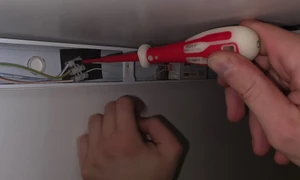
C.K Tools screwdriver review: Dextro VDE Slim
Review of the C.K Tools Dextro VDE Slim screwdrivers: slim insulated blades, Glow series, Modulo tips, magnetic ring and torque hold on terminal blocks.
Read the guide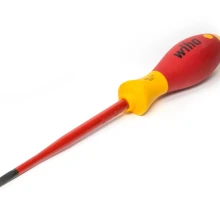 Guide Wiha or Wera: which tool kit for an electrician? Wiha or Wera: VDE 1000 V screwdrivers and pliers, storage systems and a method for a tool set suited to real electrical work in the home. Read the guide
 Guide Ilkott trousers: PY55 field review, PY56 photos First-hand review of Ilkott PY55 trousers and AA61 pouch. The cropped PY56 is photographed only; no long-wear test or knee-pad certification is claimed. Read the guide
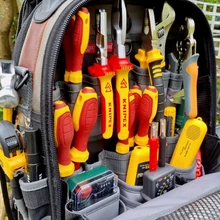 Guide Knipex, Wiha or Wera: comparison for electricians Knipex, Wiha or Wera: compare equivalent VDE pliers and screwdrivers by ergonomics, certification and field use for professional electricians. Read the guide