LOCTITE 3090: two-part gel and cure time
In brief
- LOCTITE 3090 is a two-part cyanoacrylate gel adhesive, intended for bonding parts with variable gaps.
- Henkel states gap filling up to 5 mm; that capability does not guarantee the strength of every material or every geometry.
- The technical data sheet separates open time, handling strength and full cure, the last of these generally given as around 24 h.
- The pack appears in a receipt photograph, but no real bond attributable to the 3090 has been documented yet. No field score and no verdict is published.
LOCTITE 3090 belongs to the two-part instant adhesive family, not to the family of sealants for threaded fittings. Henkel intends it for bonding parts in metal, plastic or other compatible substrates, particularly where the gap between the surfaces varies.
Its gel form avoids some of the flow problems that come with runny adhesives, but it replaces neither surface preparation nor checking the materials.
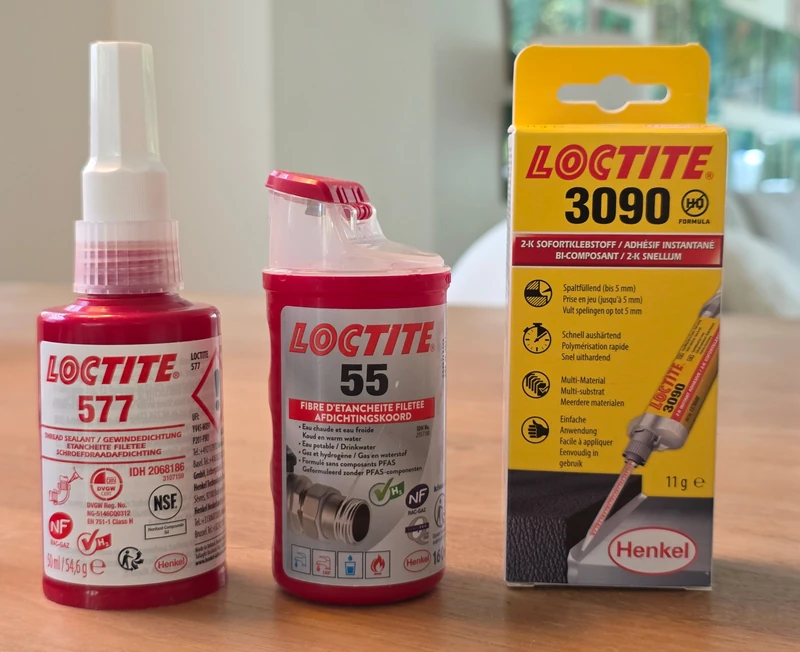
I received reference 3090 together with LOCTITE 55 and 577 on 18 September 2026. The only local photograph identified for the 3090 shows the three products side by side. It establishes the pack in that batch, without proving a bond, a cure time, a finished repair or any durability.
So I attribute to the 3090 here no job at a customer’s premises and no workshop result.
The purpose of this piece is to clarify the manufacturer’s data sheet, the role of each component, the kinds of substrate, the limits of use and the protocol a future test would need. A genuine opinion will have to describe an existing part, an identifiable assembly, the technique, the result and the reservations observed.
For now this is a documentary guide, not a field test.
What can LOCTITE 3090 do?
Henkel describes the 3090 as an adhesive using cyanoacrylate technology, made of two parts to be mixed before application. The gel that results from the mix is intended to join surfaces.
The formulation is presented for parts whose fit is not perfectly constant, with a stated filling capacity of gaps up to 5 mm according to the technical data sheet.
That figure has to be read correctly. “Up to 5 mm” means the manufacturer designed the product for assemblies that can show a wide gap for an instant adhesive. It does not mean the product will hold a given load across any 5 mm hole, and it does not make a maximum thickness better than a controlled layer.
The difference from a very runny superglue lies mainly in the viscosity of the gel. The material stays in place better on a vertical surface or on the edge of a part. If the substrate is covered in dust, grease or a fragile material, however, viscosity does not create better adhesion out of nothing.
The initial state of the surface counts as much as the pack.
The uses documented by Henkel cover many common materials. Plastic, metal, rubber and certain porous substrates can fall inside the described scope, but the data sheet presents separate test results according to substrate.
The sound approach is to identify the exact substrate, then check the surface and the mechanical loads before choosing an adhesive.
Why two components?
The technical data sheet separates a part A, with a gel consistency, and a part B, which is more fluid. The polymerisation reaction begins after mixing, under the conditions the manufacturer sets. The product therefore does not behave like an adhesive where you simply open the tube and wait for a solvent to evaporate.
Henkel specifies application through a dual syringe and a mixing nozzle. That nozzle delivers the two parts in the proportions of the formulation. The data sheet recommends discarding the first 1 to 2 cm of extruded bead before placing the parts.
That step is a manufacturer recommendation, not something I claim to have carried out with the sample received.
Mixing matters more than the apparent quantity. If one part comes out on its own, or if the nozzle is unsuitable, you cannot assume the bond will have the stated properties. A future test will have to record the pack and the nozzle used, the discarded start of the bead and the real timeline of the application.
Two components do not mean that you should improvise a ratio by eye. The dose is set by the dispensing system. Deliberately adding more of one part, water or an unspecified accelerator would amount to testing a different preparation from the one Henkel publishes. Any comparison would then be unusable.
LOCTITE 3090, 55 and 577: three different jobs
The 3090 is for bonding parts. The 577 is an anaerobic resin for metal threads. The 55 is a coated polyamide thread cord, for certain metal or plastic threads according to its own data sheet. All three carry the same logo, but they do not follow the same logic of repair.
| Reference | Function | What it does not prove |
|---|---|---|
| Reference LOCTITE 3090 | Function Bonding with a two-part gel | What it does not prove Not a resin approved by default for pressurised pipework |
| Reference LOCTITE 577 | Function Anaerobic sealing of metal threads | What it does not prove Not an all-purpose repair adhesive |
| Reference LOCTITE 55 | Function Sealing with coated polyamide cord | What it does not prove Not an adhesive and not a sanitary sealant |
| Reference GEB’ORIZON sanitary | Function Elastic silicone joint between intended substrates | What it does not prove Not a rigid-part adhesive and not a thread sealant |
Distinct products: the right choice depends on the assembly mechanism.
In a junction box, on a pipe run or around a wash basin, the difficulty is not only “making something stay”. You have to know whether the job calls for sealing, mechanical strength, regulated electrical insulation, a flexible joint or a dismantlable assembly. None of those functions is guaranteed by the word “adhesive” on its own.
That distinction avoids a common misunderstanding: the 3090 must not be presented as a variant of LOCTITE 55 thread cord or of LOCTITE 577. A product designed for bonding gaps does not automatically carry the approvals that the range holds for threaded fittings.
Which materials can be bonded?
The manufacturer’s page cites materials such as plastics, rubbers and metals, but also porous substrates including wood, paper, leather and certain fabrics. The technical data sheet gives strength values for precise test specimens. Those values do not transfer directly to an object assembled at random.
Two plastic parts can behave very differently. A thick rigid material, a fibre-loaded shell or a flexible part exposed to impact will not necessarily react the same way. Identifying something only as “plastic” is not enough: the polymer family, the surface treatment, the paint and the load applied can all change the outcome.
Metal needs checking as well. A clean surface, an oxidised metal, a plated finish or a paint layer are not identical interfaces. An adhesive can bond perfectly well to the coating while the coating itself peels away from the metal.
In a test you then have to establish where the failure actually happened: in the adhesive, at the interface or in the part.
With porous materials the product may meet absorption or a particular surface texture. The thickness applied and the condition of the part become observable facts, rather than an abstract promise of universal bonding. That is one reason to photograph the mating faces before closing the assembly.
What does a gap capacity of up to 5 mm mean?
A gap is the space between the two surfaces to be bonded. The 3090 data sheet states a filling capacity of up to 5 mm. That figure is useful when a broken object has lost a perfectly matched fit, but on its own it says nothing about the available surface area or the direction of the loads.
An open crack, a broken corner and two parallel faces do not distribute stress in the same way. The adhesive can be loaded in tension, in shear, in cleavage or in peel. A strength measured on a standard specimen does not cover all those configurations. So do not confuse filling a volume with guaranteed mechanical strength.
In a future protocol I would record at least a real gap range, the extent of the contact surfaces and the position of the part while it cures. If that geometry cannot be measured, I would write that down rather than announce a fictional dimension.
A side-on photograph with a rule is often more informative than a theoretical strength figure.
Equally, the maximum filling figure is not an invitation to dig out a cavity artificially so as to use more product. A useful test reproduces an existing material problem or a demonstration specimen that is clearly declared. The reader must be able to tell the performance of the formulation from the quality of the preparation.
Open time, handling and full cure
The French data sheet of September 2012 states a typical open time of 90 to 180 seconds at 25 °C after mixing. That is the workable handling period given in that context. It means neither that the part can always be repositioned for three minutes, nor that the joint is mechanically strong at the end of that window.
The manufacturer states that the product quickly reaches a strength that allows certain assemblies to be handled, and mentions full cure after about 24 hours. That duration relates to the documented conditions. Temperature, material type, gap and geometry can all influence what is observed.
A cure time quoted for a bond on steel does not become the guaranteed value for a polymer housing, a painted part or a porous substrate. In my future test I will separate working time, time before light movement, rest time and follow-up observations after a documented interval.
Without that separation, writing “instant” tells the reader nothing useful.
The data sheet contains cure curves on several substrates and several thicknesses. Those are manufacturer test results. Until I have used the container on an identified part, I cannot write that I reproduced their timings or their strengths.
For a more precise distinction, the Henkel UK product page lists 120 seconds fixture time on steel. That is not a universal handling time for plastic, timber or wider gaps. It is separate from the mixed adhesive’s 90–180 seconds open time at 25 °C and from the typical 24 hours before service loading.
How should the surfaces be prepared?
The Henkel data sheet recommends clean surfaces free of grease, using a suitable degreaser where the substrate allows it. You have to choose a method that does not damage the material, particularly with a plastic or a coating that is sensitive to solvents. Cleaning is not an interchangeable operation across all substrates.
Before any application, the part deserves an inspection. Is it genuinely broken, or simply unclipped? Does it have a broken lug that carries a high load? Can the area be dismantled and held while it cures? Is a cracked surface part of a safety function? Some situations call for replacement rather than bonding.
For a compatible repair case, the protocol can identify the material, remove loose debris and photograph both sides. I will not prescribe general abrasion with a particular grit without knowing the material. The wrong sanding can alter the fit or damage a functional area.
Applying a chemical product also means reading its safety data sheet. Suitable protective equipment, ventilation, the risk of skin or eye contact and waste disposal depend on the documents in force. This page is not a substitute for that safety data sheet.
Position, hold, let it cure
Henkel recommends applying the mix to the intended surface and then assembling quickly. The data sheet states that the product must not be spread with a cloth or a brush, and that the parts must be held until they can be handled. Those steps describe the manufacturer’s procedure, not a repair that has already been carried out.
An assembly closed in the wrong position can freeze a geometric fault. The important step is therefore a dry run: check the orientation, the contact surfaces, access to the area and the way the parts will be held. On an object that has to clip back together, a slight excess thickness can be enough to stop it going back on.
The final strength takes time. Handling too early can damage the adhesive joint, while waiting longer does not undo poor preparation. For a test I will record the method of holding, the time before the first handling and the resting conditions, avoiding impressions such as “solid in seconds” without a stopwatch.
Clean-up also has to plan for squeeze-out according to the substrate and the data sheet. Excess cyanoacrylate is not removed in the same way from a delicate part as from a metal specimen. A distinction has to be made between wet excess, the cured mix and the part itself.
Can it be used for electrical work?
My main trade is electrical work, but that does not turn the 3090 into an approved electrical insulating material, a sealant for junction boxes or a way to repair live equipment. A data sheet that reports electrical properties of the cured material is not enough to certify a use on a given item of equipment.
I would not recommend bonding back a safety part, a component that protects against direct contact, an enclosure subject to fire-performance requirements or a fixing that contributes to earthing without the permission of the equipment manufacturer.
That would give the adhesive a function for which the necessary evidence does not exist in this file.
The test case I would favour is a small demonstration part, de-energised, unloaded and with no safety role, for example an inert bracket with a geometry that can be documented. A test on a consumer unit or on a protective enclosure would not be justified by the wish to produce photographs alone.
For circuits and electrical connections, the compliance of the whole assembly matters more than the chemical product chosen. If a housing, a clip or a protective accessory is damaged, the right answer may be to obtain a spare part or to replace the device.
Water, heat and chemical resistance
The Henkel page states a service temperature range of -40 to +80 °C for the 3090. That is a manufacturer characteristic, not a heat test carried out with this container. You have to check the temperature the object actually sees, the durations and the cycles, as well as the limits of the other materials in the assembly.
The data sheet presents ageing tables in selected environments. The percentages of retained strength are obtained on test specimens and at defined durations. They do not support the deduction that a particular repair will resist damp, petrol, a solvent or vibration indefinitely.
The 3090 is not presented here as a sealant for pressurised pipework, nor as a sanitary silicone. A bonded part can be mechanically joined without being watertight. Conversely, a flexible sealing joint is not necessarily suited to carrying a mechanical load. The guide to thread sealing methods deals with a different family of problems.
I will publish no promise of resistance to water, UV or solvents on the basis of a bond photographed just after assembly. To talk about durability you need the real exposure time and continued monitoring of the same object.
Storing the product before a test
The technical data sheet of September 2012 recommends optimum storage between 2 and 8 °C. It asks for the product to be kept in its original packaging and for the precautions against contamination to be followed. Those instructions concern this reference and this document; they must not be copied across to LOCTITE 577 or to the 55 cord.
The date of receipt does not give the date of manufacture or the usable life remaining. To assess a container you need the label, the batch, any expiry date and the relevant storage history. I therefore do not treat a product as “new and optimal” simply because the parcel arrived recently.
For a reproducible editorial result, noting the state of the nozzle, the storage conditions and the moment of opening can explain an atypical result. This information is not meant to pass judgement on Henkel: it serves to establish what was actually tested.
SDS and regional variants: 3090 has two separate components, A and B. The UK Henkel page lists a 10 g + 1 g twin cartridge, IDH 1379599, whereas the French page lists IDH 1379570. The group receipt photo is not proof of either regional IDH.
Check the exact IDH on the pack and obtain both component A and component B safety data sheets for the UK variant before handling; an SDS for one component does not establish the hazards of the other.
The September 2012 TDS also advises against pure or oxygen-enriched systems, chlorine and other strong oxidisers; calling this an instant adhesive is not clearance for those environments.
Which checks should a future test include?
The first check is to choose a non-critical part whose two surfaces can be identified and whose function involves no safety. The initial state, the failure and the useful dimensions have to be photographed, then the material recorded as supposed and, where possible, confirmed.
Next, the test must follow the data sheet that applies to the product received: pack inspection, surface preparation, fitting the nozzle, discarding the initial extrusion, a controlled bead, assembly and holding. Every step has its timestamp or its photograph, with no staging of a job that is already finished.
The third check is monitoring over time. An immediate result is not a durability test. The object can be re-examined after the cure period and at other genuinely observed intervals. The write-up must state what load was applied: light handling, a known and suitable force, or visual inspection only.
Finally, if a failure appears, it has to be described without turning the observation into a general verdict on the range. A photograph of adhesive that stays on one half does not prove the same thing as a failure of the substrate. The result holds only for the materials and the conditions of the test described.
How does the 3090 compare with an ordinary adhesive?
A runny instant adhesive suits some close-fitting assemblies, while a two-part gel answers different demands of gap and holding. Those are categories of need; without a comparative set-up I cannot attribute universal superiority to the 3090.
The best point of comparison remains the concrete problem. If the faces fit with no gap, a product designed for wide gaps is not necessarily required. If the part is repeatedly flexed, the ability of the assembly to withstand that has to be checked.
If the part has to come apart again, a permanent adhesive may be a poor maintenance strategy.
Nor does the price per syringe reflect the cost of a repair without knowing how much product is actually dispensed, how the nozzle is used and how much is wasted. I will publish no cost per job and no time saving based only on the volume printed on the pack.
A credible comparison would need identical materials and geometries, similar preparation, documented test conditions and comparable loads. A single bond, even a successful one, will be told as one example, not as a statistical study.
How do you decide whether the 3090 is the right product?
I would start by defining the function of the object, the nature of the surfaces and the main load. Sealing a metal thread calls instead for a look at a product such as the 577; a fitting with sealing cord comes under the 55; a flexible perimeter joint on a sanitary appliance calls for a family of suitable sealants.
If the object really is a part to bond, I would then look at the gap, the access, the holding that is possible, the load in service, the exposure and the cure time that fits the repair. If a single one of those conditions is unknown and critical, the decision must not be made on the “up to 5 mm” claim.
LOCTITE 3090 has an interesting documented data sheet, particularly for bonds with irregular gaps. But my field opinion will stay suspended until I have a part, a protocol and a history I can actually show. No numeric score, no invented success, no fake workshop photograph.
Frequently asked questions about LOCTITE 3090
Is LOCTITE 3090 a one-part or a two-part adhesive?
It is a two-part instant adhesive, dispensed and mixed through the system Henkel specifies. The reaction starts after the two parts are mixed. It must not be confused with anaerobic thread products.
Can it fill a 5 mm gap?
Henkel states a filling capacity up to 5 mm under the conditions of the product. That does not guarantee a specific mechanical strength on any material, load or geometry: the substrate and the assembly both count.
What is its cure time?
The 2012 data sheet gives an open time of 90 to 180 seconds at 25 °C and a typical full cure of around 24 h. Those are not personal timings measured with the product received, and not promises that hold for every substrate.
Can it replace LOCTITE 577 on a pipe?
No. The 3090 is an adhesive for bonding parts; the 577 is an anaerobic sealant for metal threads. The LOCTITE name on both packs does not give them the same applications or the same approvals.
Is it suitable for repairing an electrical item?
No certification for repairing electrical equipment is established here. Do not treat the 3090 as an approved insulator, a structural repair or protection against electric shock without documentation specific to the equipment.
Has the product been tested on this site?
The LOCTITE 3090 has been received and appears in a group photograph; that much is established. No real bond and no test history for this reference is documented. This is a documentary guide without a field test, with no field score or verdict.
Disclosure LOCTITE (Henkel) : LOCTITE 3090 received together with references 55 and 577 on 18 September 2026 for independent editorial testing; no repair carried out with the product is established.

Théo Desrousseaux
Electrician and editor
I work in the field and edit this magazine. Every guide is reviewed for its target country before publication.
Author → Credentials → Editorial method → Report a factual correction →
No email app? Copy the correction details
Email address and prefilled context:
theo@sparx-elec.fr
Article: https://www.sparx-elec.com/gb/loctite-3090-two-part-instant-adhesive-use/
Edition: GB — English
Factual issue: [describe the factual issue]
Passage: [quote or identify the passage]
Source: [optional source URL]
Sources and references
- 1. Henkel — LOCTITE 3090, global technical data sheet, September 2012
- 2. Henkel — LOCTITE 3090, UK product data
- 3. Henkel — LOCTITE 3090 technical data sheet, September 2012
- 4. Henkel — Instant component bonding solutions
- 5. Henkel — LOCTITE 577, thread sealant technical data sheet
- 6. Henkel — LOCTITE 55, thread cord technical data sheet
- 7. Henkel — Official mySDS safety data sheet portal
More guides
Practical electrical installation guides, diagnostic methods and tool recommendations compared against the technical wiring standards of this national edition.
Jokari Secura wire strippers: review
Field test of the Jokari Secura No. 15, No. 28H and Super 4 Plus: real-world use, stripping ranges, limitations and official recommended prices.
Read the guide Guide Ilkott trousers: PY55 field review, PY56 photos First-hand review of Ilkott PY55 trousers and AA61 pouch. The cropped PY56 is photographed only; no long-wear test or knee-pad certification is claimed. Read the guide
 Guide Klauke EK 50 ML: characteristics and limitations Klauke EK 50 ML: verified specifications, compatible dies, the contents of the case and the limits for wiring and crimping before buying. Read the guide
 Guide STABILA, Stanley or Bosch: choosing a spirit level Comparison based on my visit to the STABILA factory, Stanley spec sheets and an electrician's use: vial mounting, accuracy, length and laser. Read the guide