Electric shower installation cost UK
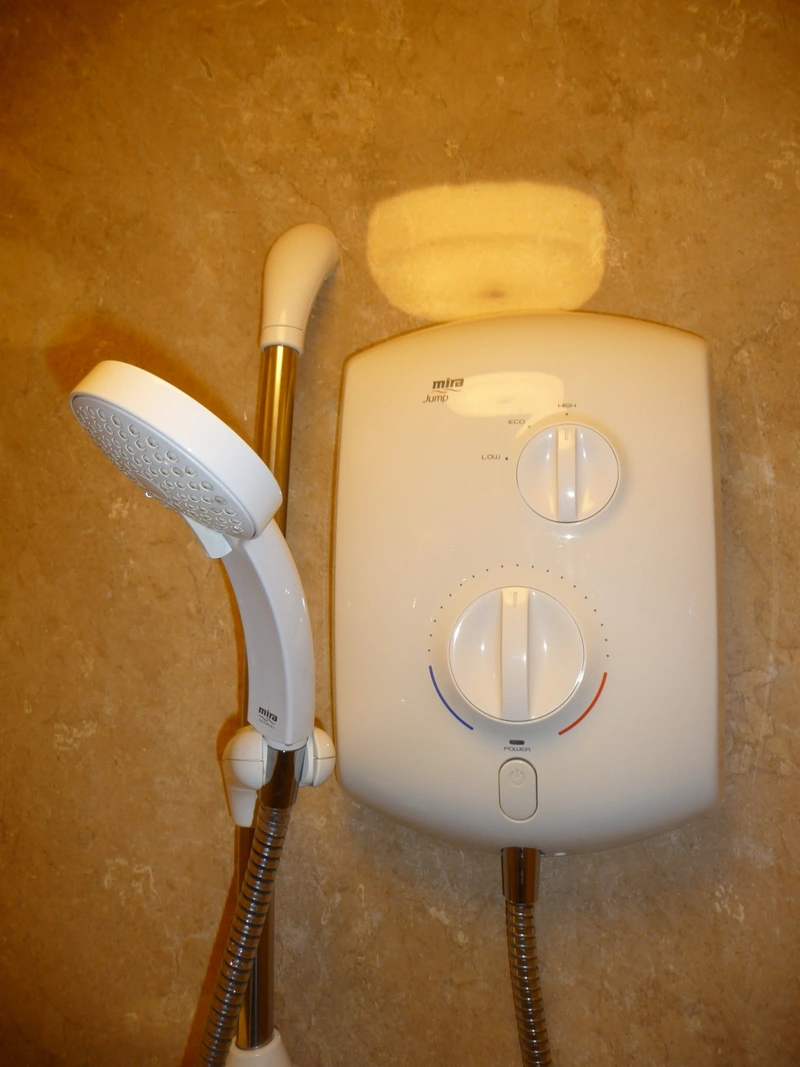 Photo : Immanuel Giel via Wikimedia Commons (CC0)
In brief
- Silver Saints advertises a London like-for-like replacement, supplied and fitted, at £299 plus VAT, or £358.80 including 20% VAT, using the existing cable and pipe positions.
- A new circuit, higher-rated shower or protection alteration needs its own itemised quote. A replacement package does not establish the cost of new wiring, board work or making good.
- For ratings declared at 230 V, 8.5 kW corresponds to roughly 37 A and 10.5 kW to 46 A; many UK models are instead rated at 240 V, which is why the cable size and the protective device move together.
- In England, a like-for-like replacement is normally non-notifiable; a new circuit or consumer unit change is notifiable. Confirm the approval route and the fee for the exact scope before work starts.
- A quote that does not mention the cable size, the breaker rating and the certificate is not a cheaper version of the same job.
An electric shower installation price needs a defined job: fitting a replacement on the existing circuit or installing new wiring and protection. A supply-and-fit package also includes a shower that a labour-only price leaves out.
It is the circuit. An electric shower is a substantial load, normally supplied by a dedicated circuit with suitable overcurrent protection and 30 mA residual-current protection.
The means of isolation must suit the product instructions and bathroom location. A pull cord may be accessible, but a switch body must not be positioned where a person using the bath or shower can touch it. I check the circuit and the model before treating the job as a simple swap.
A replacement can reuse a suitable circuit after assessment. A new cable route, changes at the board and access through finished surfaces add different work, which must be priced explicitly.
The published offers below show what two businesses include in a replacement package. I keep those offers separate from broad cost-guide estimates and from the price of a new circuit.
£358.80
Silver Saints London replacement, including 20% VAT
£239
Earth Electrical Nottingham Triton replacement; supplier states no VAT
37 A
calculated current for an 8.5 kW load rated at 230 V
New circuit
separate design and quotation, not a replacement-package assumption
What the published prices actually cover
The consumer cost guides below publish different combinations of labour, equipment and installation work. Their figures provide context; they are not provider quotes for the same bathroom.
Checkatrade puts electric shower installation at £150 to £300 in labour, with an average of £200, and notes that a like-for-like replacement takes about two hours. Add the unit and the same page lands on around £400 for supply and installation.
Housekeep gives £150 to £300 outside London and £180 to £360 in London, and prices a plumber at £75 to £90 an hour including VAT. MyBuilder quotes a wider band of £300 to £800 for the finished job and splits it into the unit at £60 to £300 and the electrical work at £150 to £800.
Labour-only and supply-and-fit figures need separate comparisons. The unit, circuit work, VAT and exclusions must match before a difference between two published figures says anything useful about your job.
| What is being priced | Published figure | Source and date |
|---|---|---|
| What is being priced Labour to fit a shower on an existing circuit | Published figure £150 to £300, average £200 | Source and date Checkatrade, cost guide updated 2026 |
| What is being priced Supply and fit, like-for-like | Published figure around £400 | Source and date Checkatrade, 2026 |
| What is being priced Full job, wide band | Published figure £300 to £800 | Source and date MyBuilder, 21 August 2026 |
| What is being priced Fitting only, outside London | Published figure £150 to £300 | Source and date Housekeep, October 2026 |
| What is being priced Fitting only, London | Published figure £180 to £360 | Source and date Housekeep, October 2026 |
Cost-guide estimates as published. VAT treatment and scope are not harmonised across these sources; these are not directly comparable contractor offers.
Three jobs hide behind one quote
The existing installation and requested work determine which costs belong in the quote.
The like-for-like swap. A suitable existing circuit and a compatible replacement unit. The installer assesses the circuit, isolates the supply, replaces the shower and verifies the work. The package must state the unit and any exclusions.
The IET’s own Part P guidance confirms the point that surprises most homeowners: replacing a shower with a like-for-like unit on an existing circuit is not notifiable work.
The new circuit. There is no shower circuit, or the old one is buried in plaster and cannot be reused. Now someone has to run a cable from the board to the bathroom, drill joists, lift boards, chase a wall, fit a double-pole isolator, test the lot and certify it. That is a day of work before any tiling.
The protection alteration. An old board without suitable RCD protection, or without capacity for the new circuit, needs assessment. Depending on its condition and the supply, a compatible alteration, a separate small enclosure or a replacement consumer unit may be possible.
A complete board replacement is not automatic. The quote should identify the chosen solution and its testing, rather than infer it from the age or appearance of the existing enclosure.
Attention
Ask how the quote provides the required protection. An old board is a reason to assess the installation, not proof that every circuit is unsafe or that a full replacement is the only solution.
The kilowatt rating decides the current
Everything downstream of the shower follows from one number: its rating in kilowatts. A 230 V resistive load draws roughly 4.35 A per kilowatt, and the arithmetic is unforgiving.
| Illustrative power at 230 V | Calculated current | What still needs checking |
|---|---|---|
| Illustrative power at 230 V 7.5 kW | Calculated current 32.6 A | What still needs checking Actual nameplate voltage and manufacturer circuit specification |
| Illustrative power at 230 V 8.5 kW | Calculated current 37.0 A | What still needs checking Cable route, length and thermal insulation |
| Illustrative power at 230 V 9.5 kW | Calculated current 41.3 A | What still needs checking Cable capacity after derating and protective-device coordination |
| Illustrative power at 230 V 10.5 kW | Calculated current 45.7 A | What still needs checking Isolator rating, supply capacity and complete circuit design |
These are P/V calculations for power declared at 230 V, not cable or breaker prescriptions. Use the actual shower manual, especially for models rated at 240 V.
Manufacturer guidance can give a typical cable size, but it is not a universal design rule. I use the selected shower’s rated voltage, input current and installation instructions, then assess the full cable route. Power alone does not establish that 6 mm² or 10 mm² is adequate.
A 6 mm² cable does not have one fixed current-carrying capacity. Installation method, insulation, grouping, temperature and length can change the result substantially. The same is true of 10 mm².
A higher-rated shower can require an upgrade, but neither its kW number nor the cable size alone proves suitability. The design coordinates the actual load, the protective device and the cable’s capacity after the applicable corrections.
One caveat on that arithmetic. Many British showers are declared at 240 V, so a unit sold as 8.5 kW draws a little less on a 230 V supply than the table implies. The circuit is sized on the declared current in the installation manual, not on the figure printed on the box.
Info
A unit rated 10.5 kW at 230 V draws about 46 A. A model rated at 240 V has different declared electrical data. Increasing the rating is not a like-for-like swap and can require changes to the circuit or supply. Ask what rating the existing circuit was designed for before buying the biggest shower in the shop.
Cable: the line that moves the price most
Cable is cheap. Installing cable is not. The difference between a 6 mm² and a 10 mm² run is a few pounds a metre in materials and potentially a day of disruption in labour.
Four things decide the size, and Triton lists them in the order that matters: the kW rating, the length of the run, the method of installation, and the derating factors.
A cable clipped to a surface sheds heat; the same cable buried under loft insulation does not, and has to be larger to carry the same current. A long run adds voltage drop on top.
This is why two houses on the same street, with identical showers, can legitimately need different cables and different quotes. It is also why a price given over the phone, before anyone has looked at the route from the board to the bathroom, is a guess.
Conseil
A quote stating cable size, protective-device rating and RCD type makes the proposed design easier to check. Those details are not proof that the calculation is correct. They should match the chosen shower, cable route and measured supply conditions.
The board is where the money goes
A shower circuit needs 30 mA RCD protection, and in a modern board that protection arrives as an RCBO on the shower way or as a dual RCD arrangement covering half the board. An older board may need an alteration or a separate protective assembly; its age alone does not settle the design.
The choice between retrofitting protection and replacing the board is a cost decision with a safety floor under it, which is the same trade-off that decides whether an RCD or an RCBO is the right device for the circuit.
Consumer unit prices are well documented. Checkatrade reports around £485 for a 10-way RCBO board installed, and gives £350 for a terraced house, £550 for a semi and £750 for a detached. The installation labour inside that figure is about £160, which tells you most of the money is the board and the devices, not the screwdriver work.
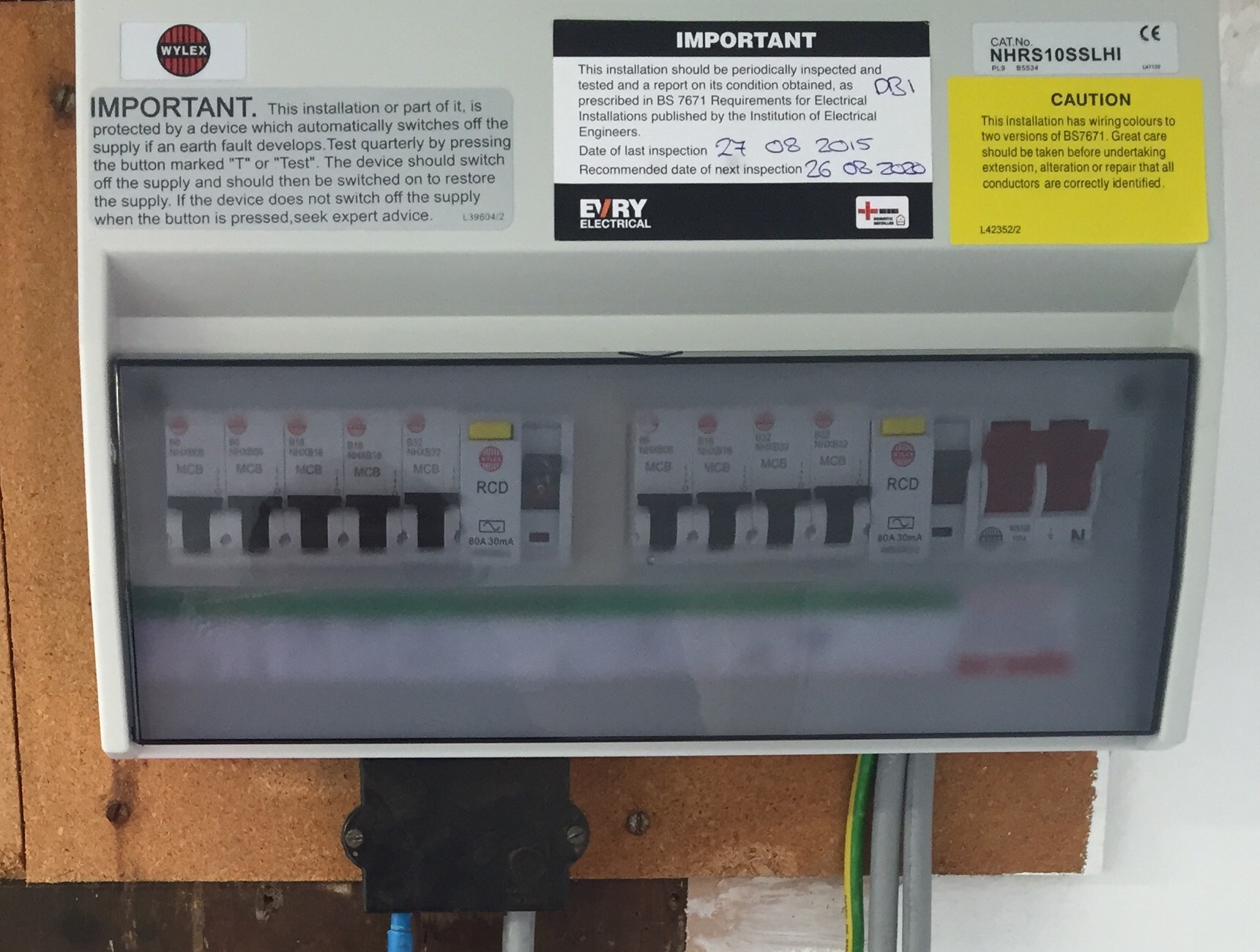
Two details on that board matter for a shower. First, a dual RCD board shares one device between several circuits, so a fault in the bathroom can take out the lights and the freezer with it, which is why many electricians now fit an RCBO per way instead.
Second, adding a circuit to a board that is already full means a larger enclosure or a second board, and either can add substantially to the installation cost.
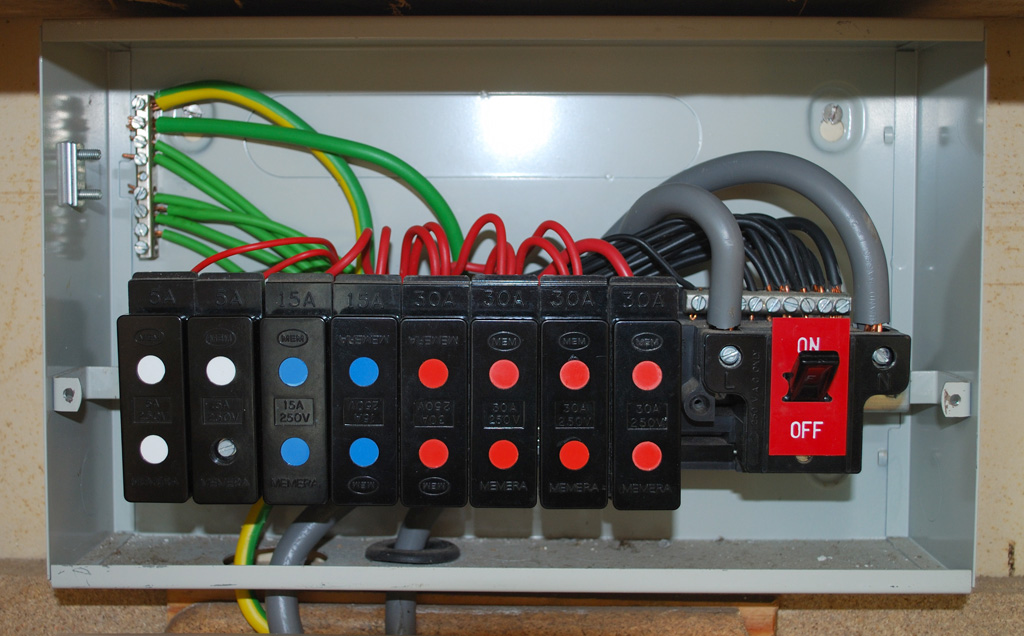
A board like the one below needs a protection assessment before adding a shower. The visible fuse carriers do not prove whether another RCD is installed elsewhere, or whether a suitable separate supply arrangement is possible.
The isolator, the zones and the switch
A shower needs a double-pole isolator so the unit can be made dead for maintenance without touching the board. In a British bathroom that isolator is usually a cord-operated ceiling switch, because the switch body sits outside the zones while the pull cord reaches inside them.
The zoning rules decide where equipment can go. For a conventional bath or shower tray, zone 0 is its interior and zone 1 is above its footprint, not an extra 0.6 m outside it. Zone 2 generally extends 0.6 m beyond zone 1.
The usual vertical reference is 2.25 m, with details such as a higher fixed water outlet and partitions affecting the boundary. A shower without a tray has different geometry, commonly a 1.2 m zone-1 radius from the fixed water outlet. The installer must apply the current Section 701 layout to the actual room.
Inside zones 1 and 2 the equipment must be at least IPX4, and IPX5 where water jets are used.
Section 701 of BS 7671 does not require a pull cord. It states that accessories such as switches and fused connection units can be installed beyond zone 2, subject to the usual rule on external influences.
The cord switch is a convention rather than a regulation, and it survives because a wall switch placed outside the zones is often on the wrong side of a tiled wall. The isolator is a small cost. The cost that surprises people is what happens when the only sensible position for it is on a wall that has just been finished.
Part P: what is notifiable and what is not
Electrical work in a bathroom is controlled work. Part P of the Building Regulations has applied in England since 1 January 2005, and the current edition is the 2013 one, published as Approved Document P.
The notifiable list is short and specific: a new circuit, a consumer unit replacement, and any addition or alteration to an existing circuit in a special location.
For notification in England, the defined special-location area is bounded in the regulations, rather than automatically covering the whole room: 2.25 m in height, 0.6 m from the bath or tray, or 1.2 m from the shower head.
That produces a split which decides several hundred pounds of the bill:
- A like-for-like shower replacement on an existing circuit is maintenance, and maintenance is not notifiable.
- A new shower circuit is notifiable, whether or not the shower is in the same place as the old one.
- A board replacement to gain RCD protection is notifiable in its own right.
Notification has a price. A registered competent person self-certifies through their scheme, and that cost sits inside the labour rate. The alternative is a building notice to the local authority, and council charges are published.
Building-control charges depend on the local authority, application route and scope. A fee published for additional electrical work within a new-dwelling application is not automatically the fee for a separate shower installation.
Ask for the applicable charge for the actual proposal. Compare a registered installer’s complete quote with the full alternative approval route, not an unrelated table entry.
So the cheapest quote and the most expensive quote are often not competing on the same regulatory footing. One includes a certificate that arrives in the post from a scheme; the other leaves you to notify, or does not mention it at all.
The same logic governs the certificate you will be offered for an existing installation, where the paper trail is the product.
The supply fuse nobody checks
One number sits upstream of everything above and is almost never on a quote: the main fuse. Most British homes have a single-phase supply fused at 60 A, 80 A or 100 A, and the shower is the largest load in the house. Add a 46 A shower to an electric cooker, an immersion heater and a tumble dryer and the arithmetic stops being theoretical.
The electrician assesses this through a maximum demand calculation, using the diversity rules in BS 7671 rather than the sum of every appliance nameplate.
Where the total is too close to the fuse rating, the options are a lower-rated shower, a load-limiting device, or an application to the network operator for an upgraded supply. Only one of those is cheap, and none of them appears in a price guide.
What else sits on the invoice
The shower and the circuit are separate cost lines. Access, plumbing and finishing work can add to the agreed total.
- Making good. Chasing, lifting boards and filling may be needed for a new route. Check what the quote includes; a straightforward replacement may avoid these works.
- Tiling and decoration. A different footprint or fixing pattern can expose holes or require tile repairs. Damage is not inevitable with every replacement.
- Water supply and pressure. An electric shower needs a cold mains feed of adequate pressure. A poor feed needs a plumbing assessment; a pump must not be added to the mains indiscriminately. The shower’s pressure and flow requirements determine the options.
- The tray and enclosure. Replacing the shower unit alone does not normally require a new tray, waste or screen; changing the whole enclosure does, which is plumbing and joinery rather than electrical work.
- Extractor fan. A bathroom without one needs one, and a fan inside a zone has its own IP and RCD requirements.
- VAT. VAT registration is generally required above £90,000 taxable turnover, and voluntary registration is also possible. Compare VAT-inclusive totals: £400 excluding standard-rate VAT is £480, but a quote already stating £400 including VAT remains £400.
Published replacement offers and their limits
These businesses’ own prices were read on 18 November 2026. They are advertised replacement offers, not paid customer invoices or a national price range.
| Provider and area | Published amount | What it covers | Limit to check |
|---|---|---|---|
| Provider and area Silver Saints, London | Published amount £299 plus VAT; £358.80 including 20% VAT | What it covers New electric shower supplied and fitted | Limit to check Like-for-like on the existing cable and pipe positions |
| Provider and area Earth Electrical, Nottingham | Published amount £239; supplier states no VAT | What it covers Triton AquaBlast/T70 8.5 kW supplied and fitted as a replacement | Limit to check Confirm model availability and suitability for the existing installation |
Silver Saints and Earth Electrical's published replacement offers. Different models, service areas and conditions prevent treating the two prices as identical jobs.
Silver Saints prices a higher-kW upgrade individually. Earth Electrical’s advertised replacement amount does not itemise a new circuit or board alteration. Ask for a separate written scope before assuming either is included.
For new wiring or protection, request the cable route, board work, testing, notification and making good as priced items. Adding unrelated labour and board-price averages does not produce a reliable total for that installation.
How to read a quote line by line
A shower quote is testable. Five questions separate a priced installation from a priced guess, and each one maps onto a line that should already be on the page.
- Cable size and length. Ask for the mm² and the route. A 10 mm² run of 18 m is a different job from a 6 mm² run of 4 m.
- Breaker rating and RCD type. The device protecting the circuit should be named, with its rating and its 30 mA trip.
- Isolator position. Where the double-pole switch goes, and whether the wall behind it is finished.
- Notification and certificate. Who certifies, under which scheme, and whether the building control fee is inside the price.
- Exclusions in writing. Tiling, making good, tray, fan and VAT, each stated as included or excluded.
Compare the answers line by line. A price difference can reflect the equipment, route, access, certification, exclusions or the business’s own rates.
Details to check at any price
A price alone does not establish the work’s scope or quality. Check the proposed cable, protection and certification against the actual installation.
Undersized cable. A shower is rated in kW, not mm². A cable becomes undersized when its capacity under the actual installation conditions is insufficient for the coordinated circuit design. A working shower is not proof of adequate cable sizing.
Borrowed protection. A shower added to a spare way relies on whatever protection that way already has. Sharing a 30 mA RCD with the rest of the house is acceptable only when the device genuinely covers the new circuit, and on many older boards it does not.
No certificate. A shower circuit is a new circuit or an alteration in a special location. Without an Electrical Installation Certificate or a Minor Works Certificate there is no record of what was done, and a future inspection will find it.
Missing certification. Where notification is required, keep the Building Regulations compliance or completion record as well as the electrical test certificate. Missing paperwork can complicate a sale, but the outcome depends on the work and the evidence available.
A useful quote names what is being installed, assessed and tested. Compare that scope and the final payable total before drawing a conclusion from the hourly rate.
The pattern is the one that runs through the whole trade, and it is worth reading what an electrician hourly rate really pays for before comparing two figures.
Set the budget from the actual circuit
The shower is the cheap part. £50 to £300 is the unit-price range in the quoted guides; it is not a promise of lifespan. The circuit is the expensive part, and its price is set by three things you cannot see from the bathroom: the cable size, the protection at the board, and whether the work is notifiable.
Use a replacement offer only when its stated conditions match the job. For a new circuit or protection changes, obtain an itemised installation quote. Ask for the cable design, protective devices and certification in writing.
A dedicated heavy-load circuit is the same exercise as the one behind a home EV charger installation: the appliance is the visible cost, the supply is the real one.
How much does it cost to install an electric shower in the UK?
Silver Saints advertises a London replacement supplied and fitted at £358.80 including 20% VAT, on the existing cable and pipe positions. Earth Electrical advertises a £239 Triton 8.5 kW replacement in Nottingham, stating no VAT. These are different packages; new wiring or protection needs a separate quote.
Is replacing an electric shower notifiable under Part P?
In England, a genuine like-for-like replacement on an existing circuit is normally non-notifiable. A new circuit, consumer-unit replacement or relevant alteration in the defined special location is notifiable. Safety and verification requirements still apply; other UK nations have different procedures.
What cable size does a 9.5 kW shower need?
The installer must calculate it for the actual circuit. Rated voltage, route length, insulation, grouping, temperature, voltage drop and protective device all matter. 10 mm² is common, not a universal answer; a 6 mm² cable may or may not be suitable under its specific installation conditions.
Do I need a new consumer unit to fit an electric shower?
Not automatically. The circuit needs suitable overcurrent and 30 mA residual-current protection. A compatible alteration or separate assembly may be possible; the installation’s condition, capacity and supply determine whether replacement is the appropriate option.
How long does an electric shower installation take?
Silver Saints gives 60 to 120 minutes for its like-for-like replacement. New wiring, access work or a protection alteration changes the job. Ask for the planned visit length, power interruption and finishing work for your installation rather than applying a replacement time to it.
Can I install an electric shower myself?
Use a competent electrical installer for the circuit design, safe isolation, connection and testing. In England, arrange the correct notification route before notifiable work begins. A like-for-like replacement and a new circuit are different cases; not every shower replacement is automatically notifiable.

Théo Desrousseaux
Electrician and editor
I work in the field and edit this magazine. Every guide is reviewed for its target country before publication.
Author → Credentials → Editorial method → Report a factual correction →
No email app? Copy the correction details
Email address and prefilled context:
theo@sparx-elec.fr
Article: https://www.sparx-elec.com/gb/electric-shower-installation-cost-uk/
Edition: GB — English
Factual issue: [describe the factual issue]
Passage: [quote or identify the passage]
Source: [optional source URL]
Sources and references
- 1. legislation.gov.uk — Building Regulations 2010, regulation 12 (notification) and special location definition Official
- 2. legislation.gov.uk — Building Regulations 2010, Schedule 1, Part P (electrical safety) Official
- 3. GOV.UK — Electrical safety: Approved Document P (England, 2013 edition) Official
- 4. IET — Part P in England and Wales: frequently asked questions Official
- 5. IET — Part P comes into force: guidance on notifiable bathroom work Official
- 6. IET — BS 7671 Section 701: locations containing a bath or shower (guidance extract) Official
- 7. IET — BS 7671, 18th Edition Wiring Regulations (Amendment 4 current since 15 October 2026) Official
- 8. NICEIC — Bathrooms and electrics: zones and requirements
- 9. Triton — What cable size does an electric shower need?
- 10. Checkatrade — Shower installation cost guide, 2026
- 11. MyBuilder — Electric shower cost, 21 August 2026
- 12. Housekeep — Shower installation cost, October 2026
- 13. Checkatrade — Consumer unit replacement cost, 2026
- 14. Erewash Borough Council — Building control fees, 2026/27 Official
- 15. GOV.UK — VAT registration: when to register Official
- 16. Crosswater — Bathroom electrical zones: footprint and zone 2
- 17. Silver Saints — London electric shower replacement price and existing-circuit scope
- 18. Earth Electrical — Nottingham shower supply-and-fit offers and VAT position
- 19. Earth Electrical — Triton AquaBlast/T70 8.5 kW replacement package
- 20. GOV.UK — standard VAT rate Official
More guides
Practical electrical installation guides, diagnostic methods and tool recommendations compared against the technical wiring standards of this national edition.
Electrician cost per hour
UK electrician hourly rates explained through published tariffs: minimum visits, VAT, emergency charges and the full price to compare before booking.
Read the guide Guide EICR cost for a 3-bed house What an EICR costs for a 3-bedroom house in 2026, what drives the price per circuit, and what C2 remedials add before the report turns satisfactory. Read the guide
 Guide Electrical safety certificate for landlords What landlords in England must do about the electrical safety certificate: EICR rules, the five-year cycle, C1 to C3 codes, 2026 costs and penalties. Read the guide