Original LÖWE 3.104 vs 3.204/20U25: key differences
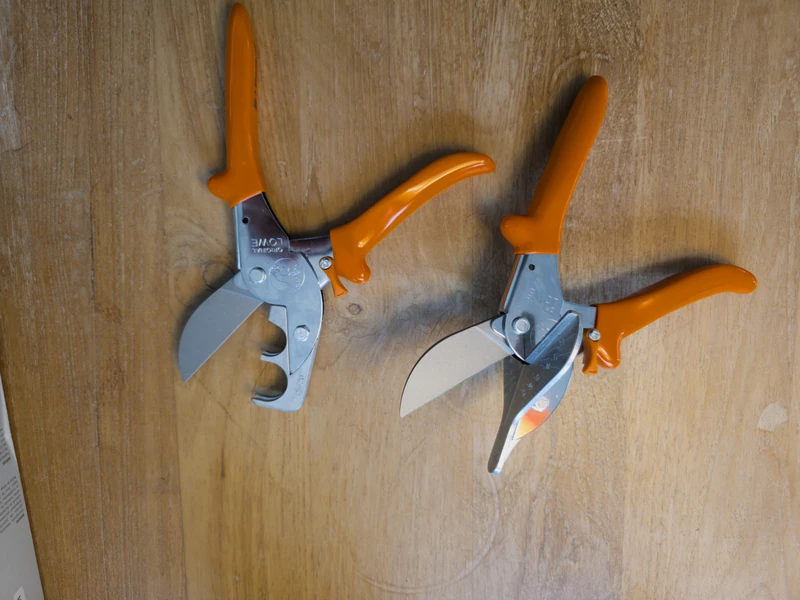
In brief
- The 3.104 is a mitre cutter with 45° stops for suitable trims and profiles; it is not a 20/25 mm pipe cutter.
- The 3.204/20U25 is designed for compatible 20 mm and 25 mm plastic pipes, with dedicated pipe supports.
- Both cutters have been received and photographed, but neither the photos nor my overall feedback establishes cutting results for each model.
The 3.104 is made for mitre cuts in compatible trim and profiles; the 3.204/20U25 is designed for suitable 20 and 25 mm plastic pipes. I received and photographed both.
On 18 October I described my overall experience of using products supplied by partner manufacturers as very positive, with no problems in my use. That broad feedback is not evidence of particular materials cut, pipe sizes tried or the results of cuts made with either LÖWE tool.
3.104: a mitre cutter, not the pipe cutter
According to the manufacturer’s 3.104 product page, this Industrial model is intended for suitable trim profiles, mouldings and sealing strips. It has 45° stops, a stated 50 mm cutting length, and a 15 mm cutting capacity.
These figures describe different dimensions, and must not be applied to round conduit as though they were pipe diameters.
For electrical work, the 3.104 could help finish suitable plastic trunking trims. It is not a copper-wire cutter. My photos show the tool and its mitre guide, but do not show a measured cut on an identified profile. The model marking on the bare 3.104 is not legible in the selected pictures.
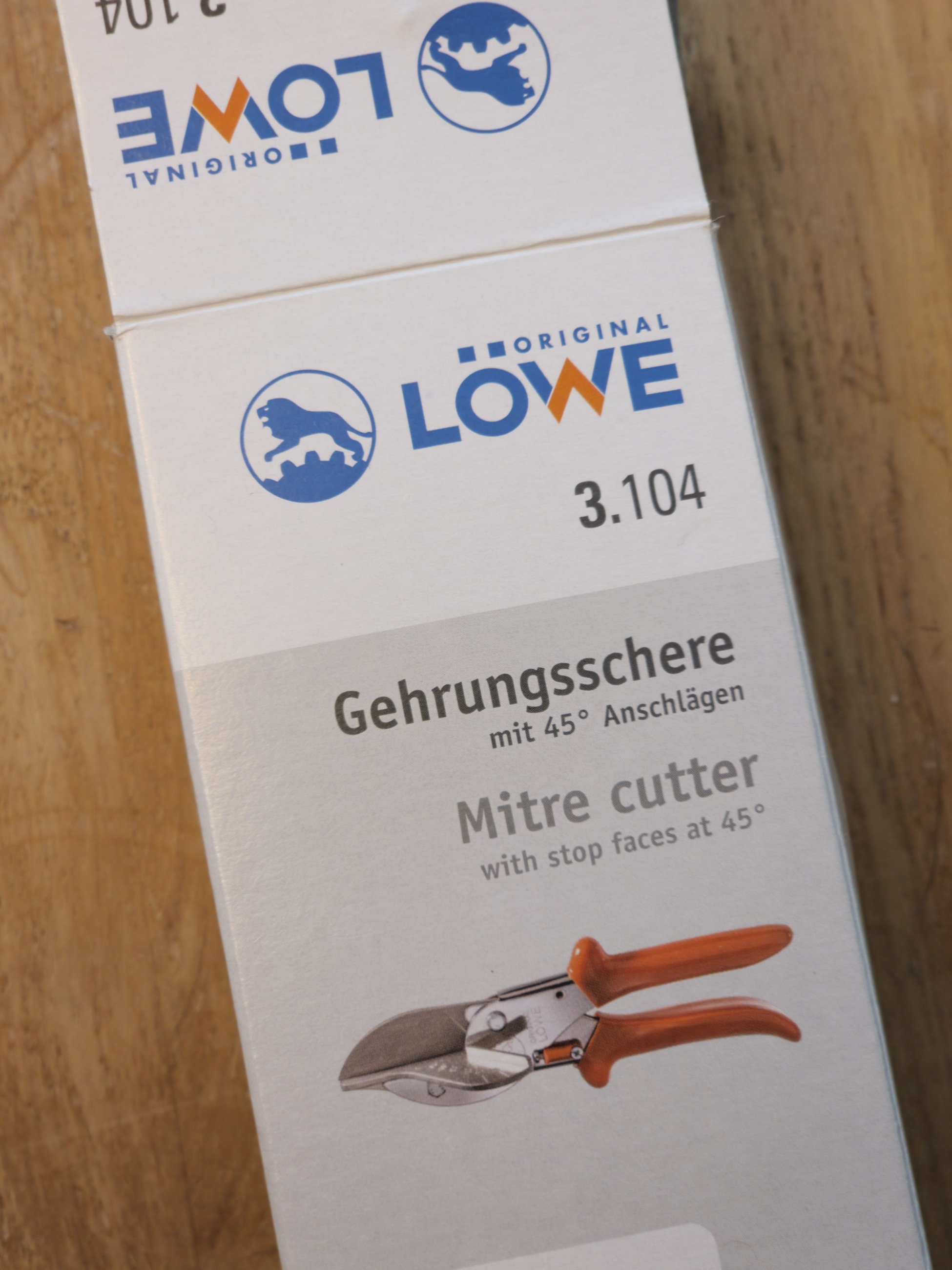
The original 3.104 box identifies the mitre cutter; it is not the 3.204/20U25 pipe cutter.
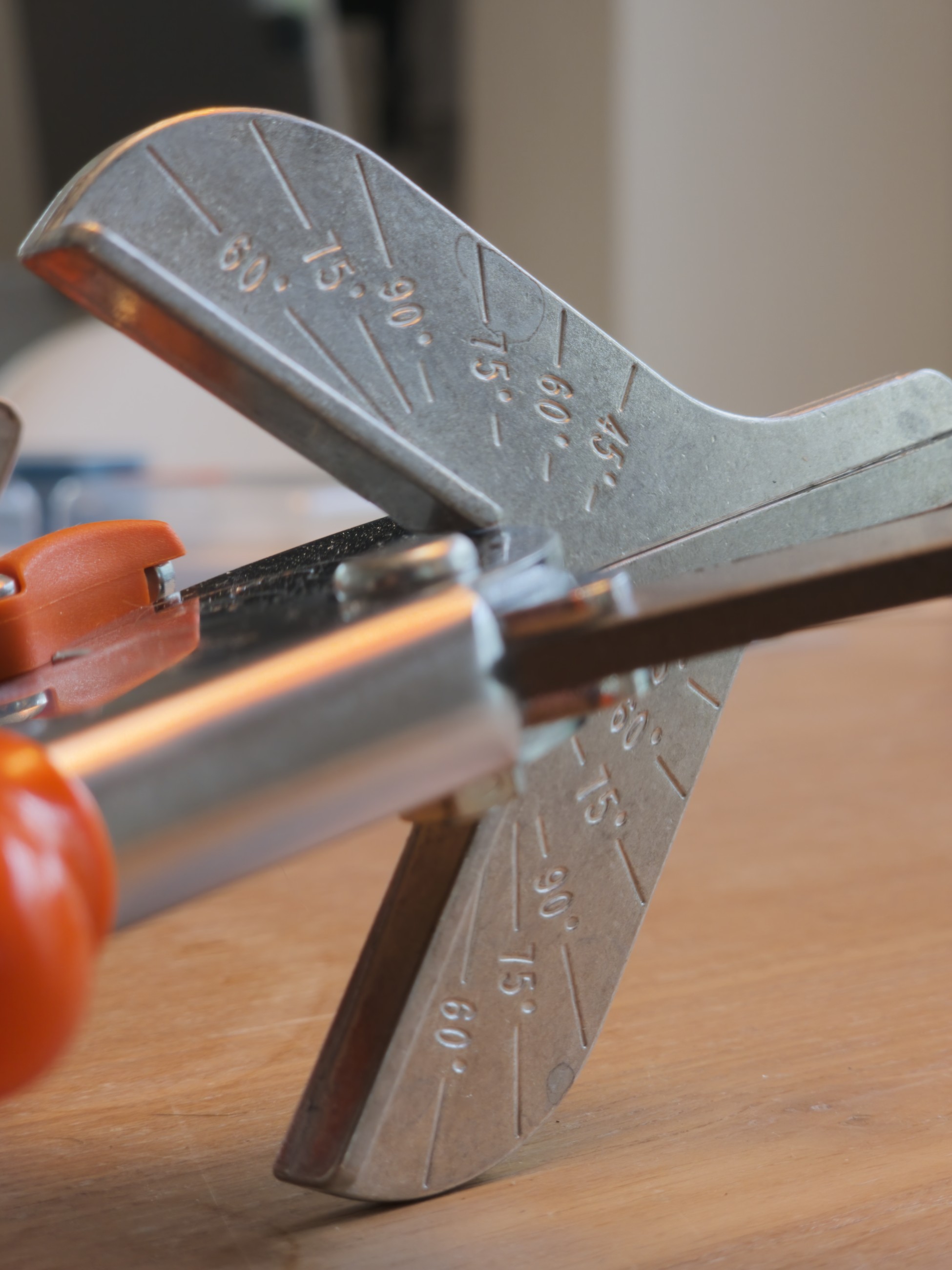
The mitre guide with its angle marks. This photo does not establish the accuracy of the cut.
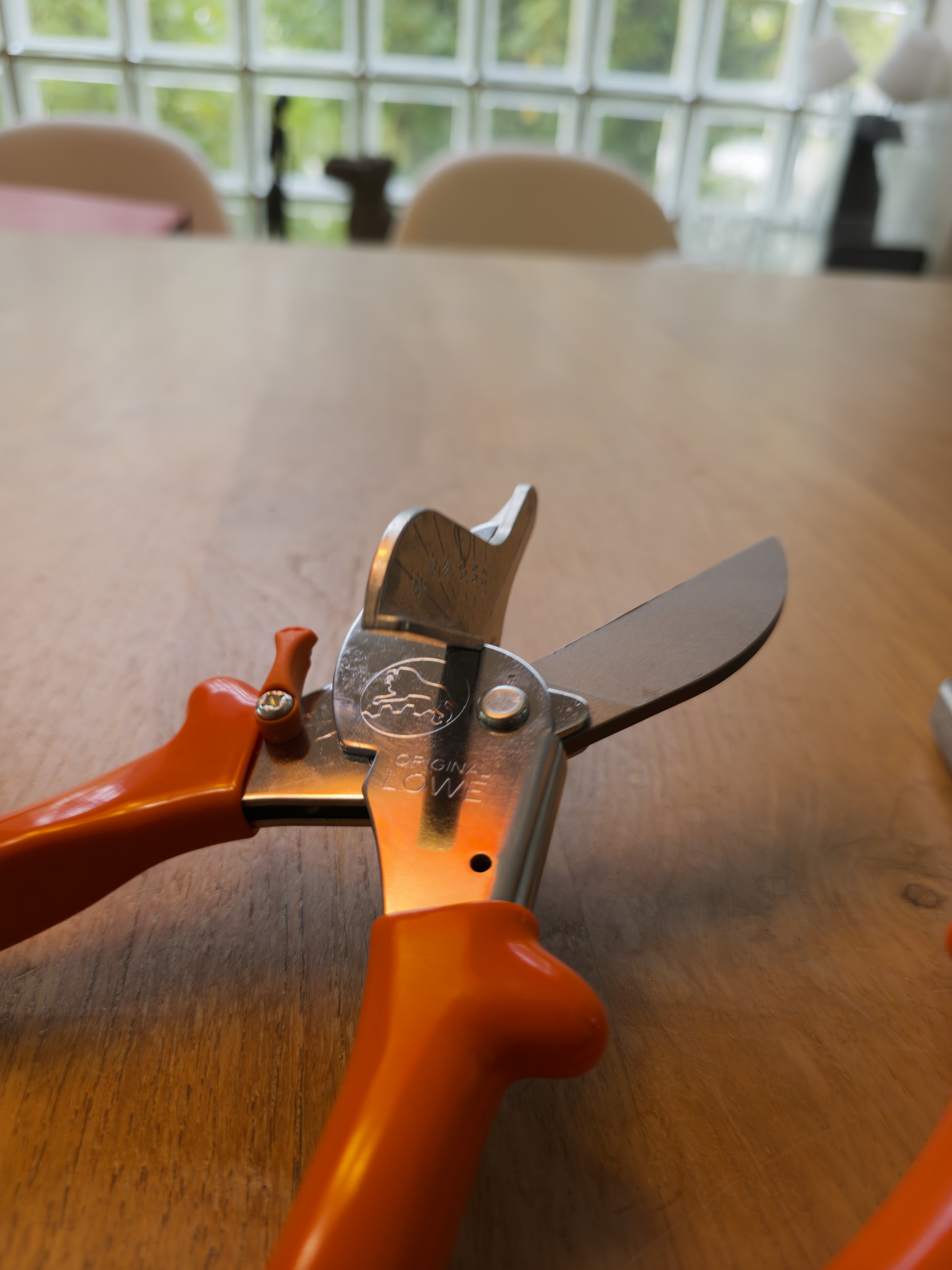
The open blade and mitre stop distinguish the 3.104 from the separate pipe cutter.
3.204/20U25: 20 and 25 mm plastic pipe
The 3.204/20U25 is specifically a plastic pipe cutter designed around 20 mm and 25 mm diameters. The manufacturer lists a total length of 21.5 cm and includes PVC pipe and electrical conduit among the intended applications. The model suffix gives the intended pipe sizes, not an angle or blade length.
This makes sense for compatible rigid plastic installation tubes. The precise polymer and support geometry still need checking against the actual workpiece. It does not make the tool suitable for cutting cables or for working on live circuits.
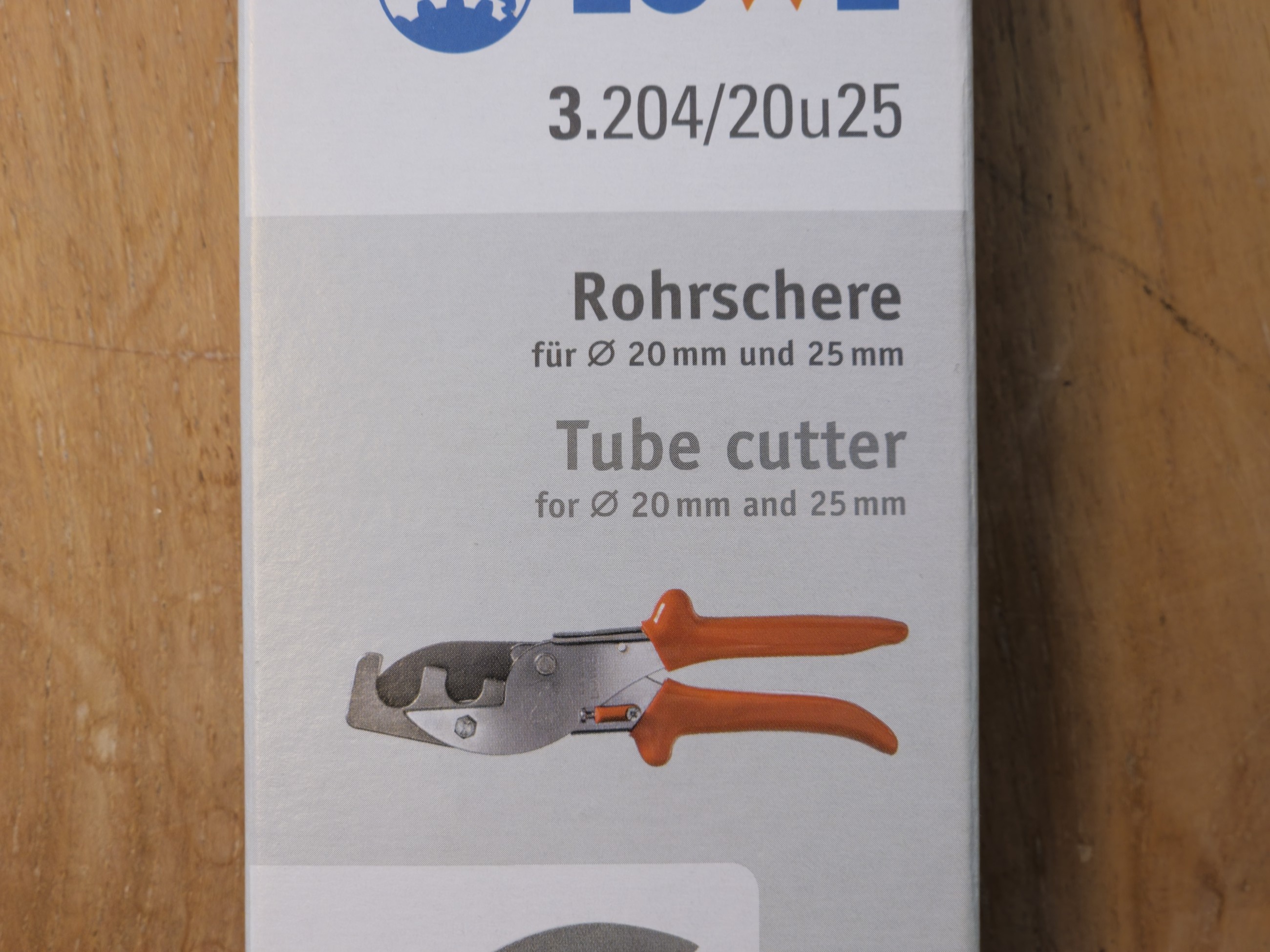
The 3.204/20U25 model is printed on its original packaging.
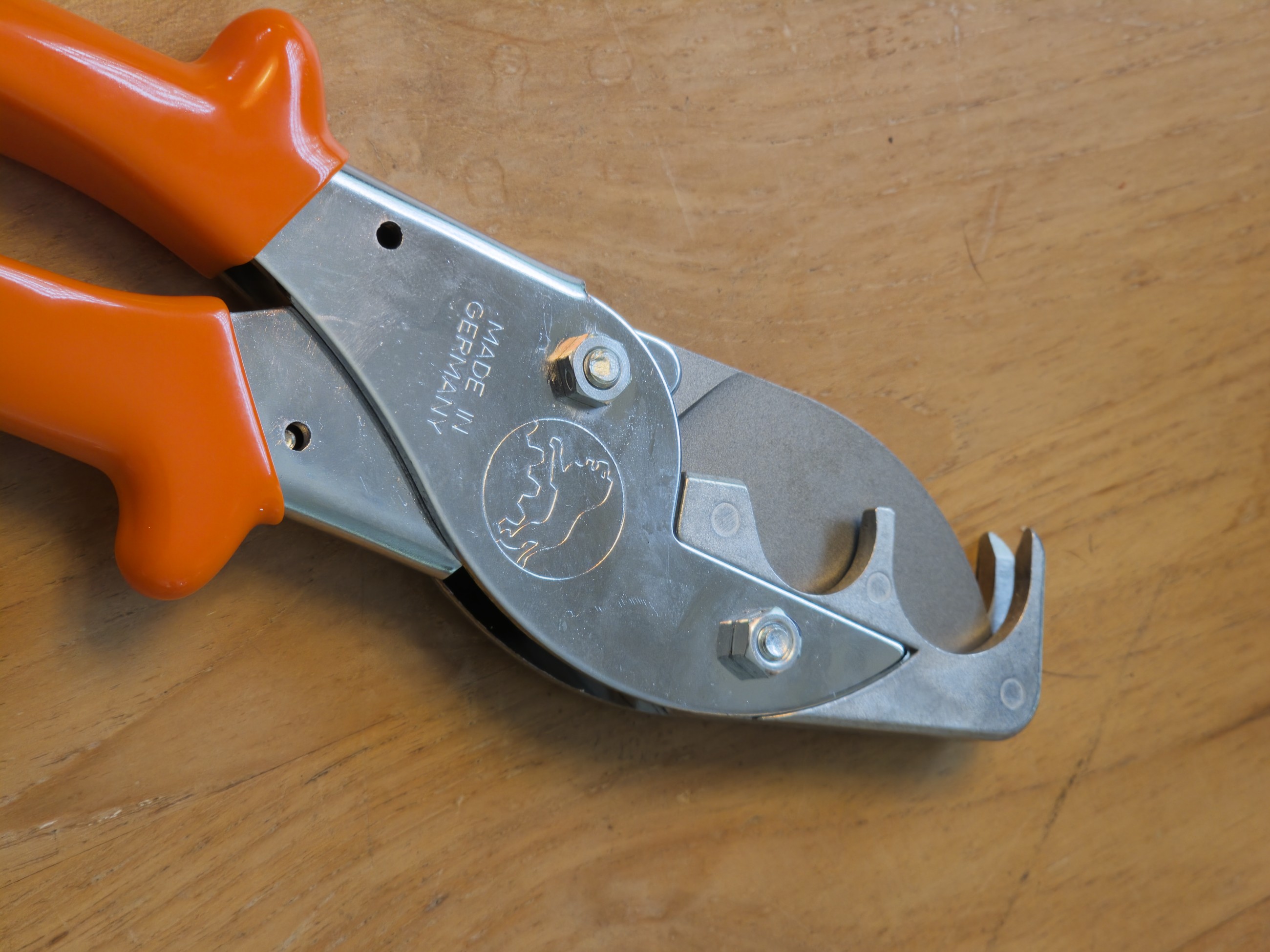
The two pipe supports, distinct from the graduated mitre guide of the 3.104.
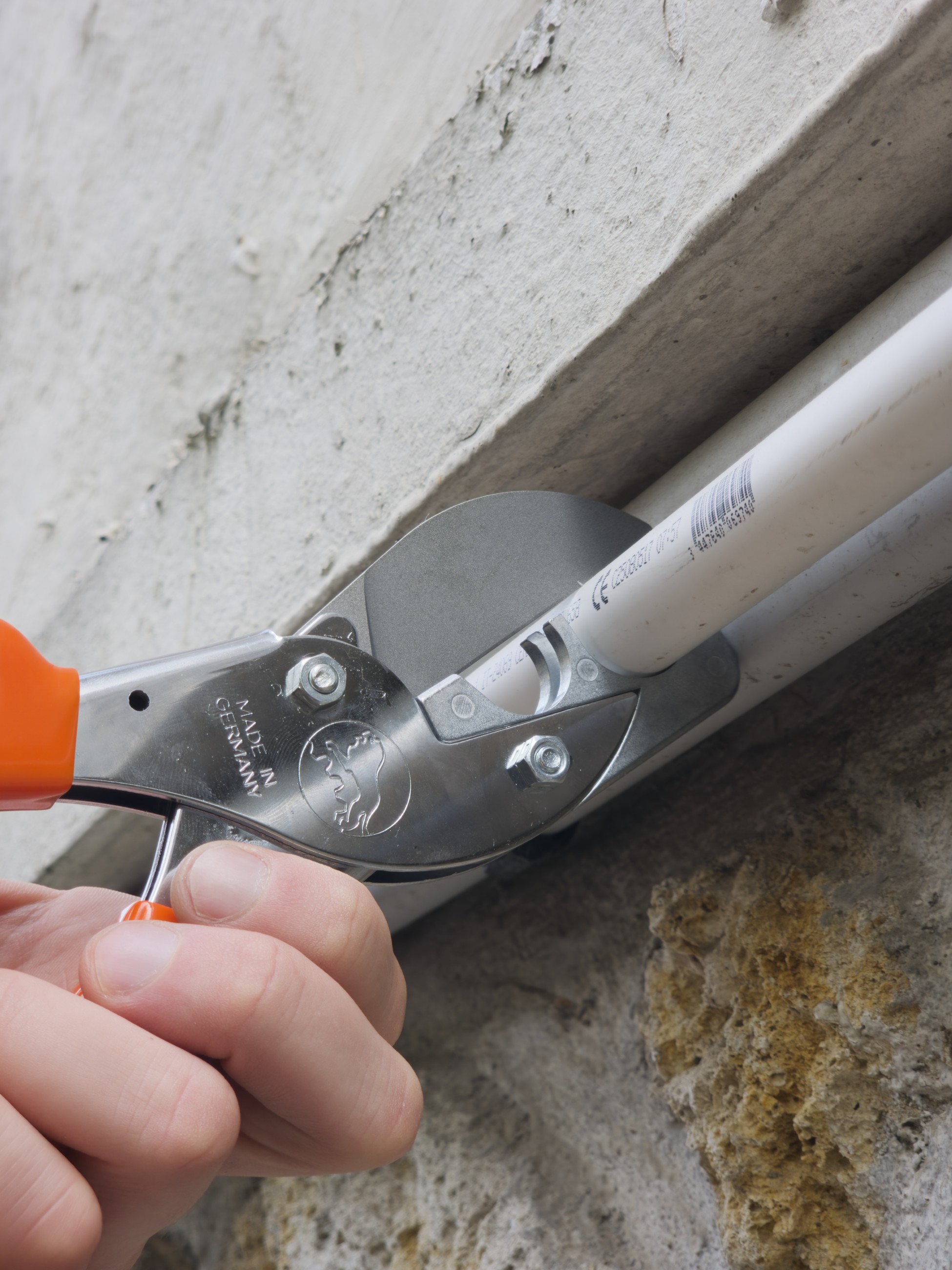
The cutter positioned around a white pipe; the pipe material and actual diameter are not identified.
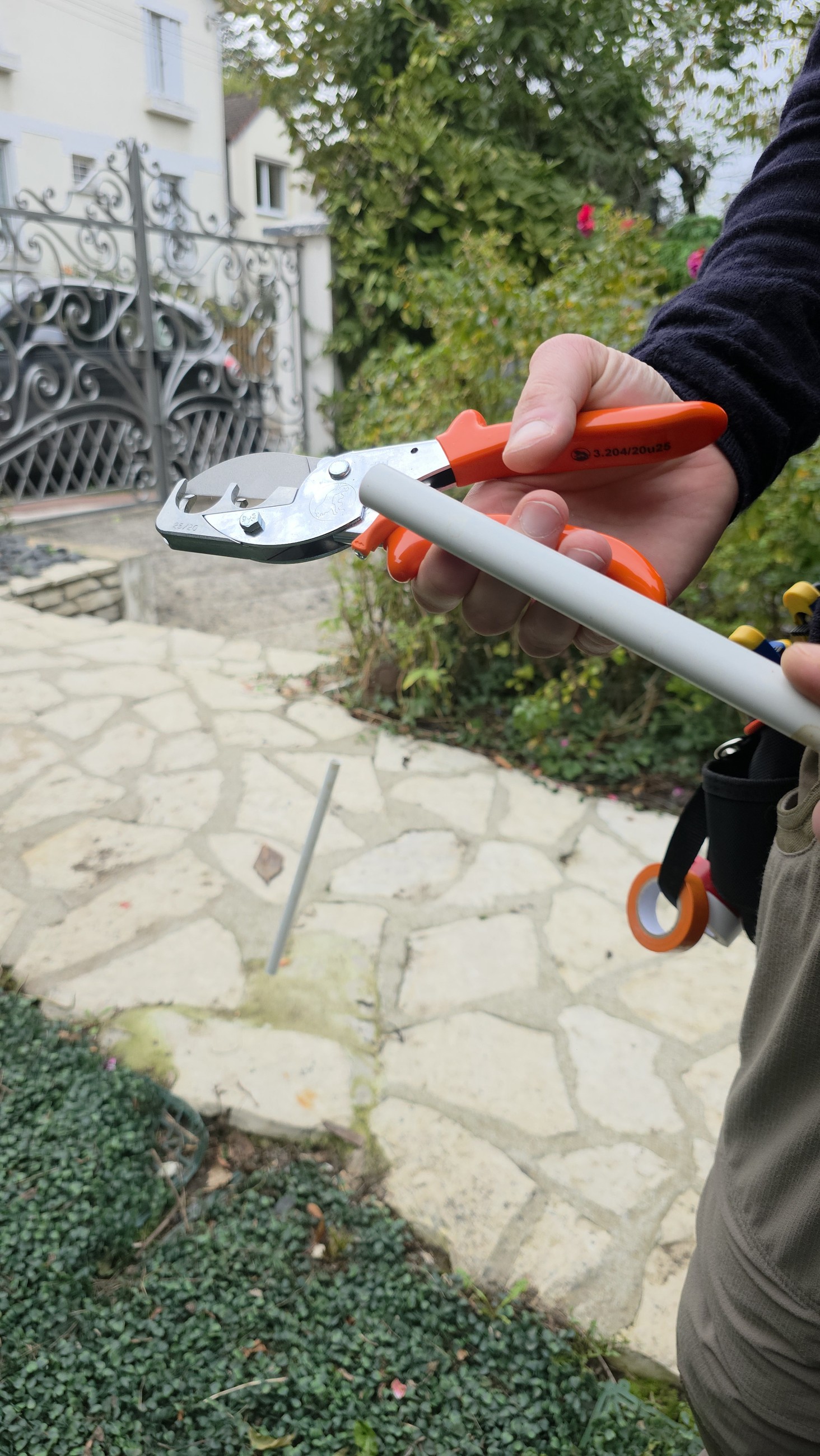
The 3.204/20U25 model code is visible on the orange handle beside the white pipe.
What the photographs actually show
Both model numbers appear on their packaging, and 3.204/20U25 can also be read on the orange handle. The pictures distinguish the 3.104 mitre guide from the 3.204 pipe supports. The white pipe is shown during handling, not as proof of a cut of known material, diameter or finish.
The 3.104 model number is not legible on the bare tool in the selected images.
Replacement blade and anvil: check the part numbers
The manufacturer’s spare-part listings specify the Original LÖWE 3 blade, part 3.001/B (one blade in a blister pack) for both cutters.
Their anvils are not interchangeable: the 3.104 mitre cutter takes the 3.002 mitre anvil, whereas the 3.204/20U25 pipe cutter uses the 3.002/3.204/20U25 shaped anvil. Here 20U25 identifies the pipe-support version, not a different moving blade. Do not assume the 16U19 or P90 anvils will fit.
Check the exact model code before ordering and follow the manufacturer’s replacement instructions.
Choose by workpiece, not by the brand name
The useful starting question is not which LÖWE cutter is more powerful. It is what shape needs cutting, and how must the cut piece fit afterwards? A decorative strip meeting another strip at a corner presents a flat reference surface and a mitre angle.
A round PVC tube needs supporting while the moving blade passes through its wall. Those are different problems, even though both tools belong to Original LÖWE’s INDUSTRIAL range.
For a mitred finish, the 3.104 offers a guide with 45° stops, provided the profile and its material are suitable. For a matching PVC tube, the 3.204/20U25 has a shaped support for either of its stated tube diameters.
The first job is about orientation and a visible joint; the second is about keeping a circular workpiece in the appropriate seat and assessing the resulting section.
This is why a comparison of headline numbers is misleading. A 50 mm cutting length is not a larger version of a 25 mm pipe capacity. The numbers describe different dimensions.
Neither tool is a general-purpose cable cutter, and a tool designed to hold one particular tube size must not be assumed to accept every adjacent size. If a proposed workpiece has an unknown composition, reinforcement or dimensions, establish those facts before choosing the cutter.
There is a practical alternative to guessing: the manufacturer’s technical FAQ says customers with an unusual material or cutting requirement can discuss it with LÖWE, even providing a sample for consideration. This is more useful than deciding solely from a photo of a similar-looking strip or pipe.
Read the specifications without mixing up the measurements
The official 3.104 product page gives 45° stop faces, a 50 mm cutting length and 15 mm cutting capacity. The 45° figure refers to the stops provided for mitre work, not to an angle I have measured on cut pieces.
The other figures describe the stated cutting geometry and capacity; they do not establish that every material of those dimensions can be cut without damage.
Even a clearly marked stop cannot correct a workpiece held against the wrong face. A hollow trim may flex, a thin edge may not rest properly on the guide, and a piece turned over can reverse the intended mitre.
A sound comparison therefore asks how the actual profile registers against the tool, how its visible face is oriented, and how the finished joint would be checked. It does not use the engraved angle as evidence that two finished pieces meet within a particular tolerance.
The 3.204/20U25 page states 20 mm and 25 mm for the designated plastic pipes and 21.5 cm for the cutter’s overall length. Those pipe sizes are neither blade lengths nor cutting angles.
Equally, an overall tool length says nothing on its own about access behind a back box, the clearance needed to operate the handles or the finish of a cut in a confined space.
Treat the dimensions as a shortlist filter, not as a test report. A verified material and section are still needed. If a purchasing decision depends on a particular tolerance, obtain the material manufacturer’s requirements and check the result with suitable measuring equipment.
What the 3.104 material list does and does not cover
LÖWE lists applications for the 3.104 including wooden strips, flat plastic mouldings, sealing strips, window and door profiles, decorative trims and certain tile-edge finishing profiles. The broader product description names wood, plastics and rubber.
These are examples of intended work, not blanket approval for every product sold under those descriptions.
Two strips that look identical can behave differently under a blade. One may be solid, another hollow; a third may contain a rigid insert. Width, wall thickness and shape determine whether the part can be supported properly.
Most importantly, the manufacturer’s general FAQ excludes metal and wire from normal cutting with these blades. The mention of tile finishing profiles is not permission to cut an aluminium tile trim. Material identification takes priority over category names.
An electrician may see a use for the 3.104 on a suitable non-metallic finishing moulding near trunking or other decorative work. But a complete cable-trunking section can be much larger, more heavily ribbed or simply shaped differently from a flat strip.
The 50 mm cutting length does not demonstrate that a bulky trunking body will fit through the tool or retain its section. If that cannot be established, use a cutting method designed for the actual workpiece.
A useful buying question is therefore more specific than “does it cut plastic?” Ask which plastic, which cross-section, how thick, and which side must remain visible? If the manufacturer of the profile has its own cutting instructions, those conditions matter alongside LÖWE’s general application list.
This avoids treating a compatibility suggestion as a promise of performance.
Preparing a mitre without pretending to have measured one
With a mitre cut, handedness and orientation matter before cutting force comes into the picture. Two ends intended to meet at a corner may need mirrored cuts. The exterior or decorative face must remain on the correct side, and the reference edge must register consistently.
If the workpiece is marked while lying upside down, a perfectly straight cut in the wrong direction is still the wrong cut.
Before making an irreversible cut, identify the final installed orientation. Mark the part to be kept, not merely the offcut. Where appropriate, check the corner itself: an actual wall or trim joint may differ from the nominal 90° corner assumed by two 45° mitres.
A dry assembly shows whether the two pieces are intended to meet, before adhesive or fixings remove the option to adjust them.
A short offcut of the same identified material can be useful for checking the geometry and finish. Look for the cut edge distorting, a hollow profile collapsing at its support, or the visible faces refusing to align.
An angle square or another suitable reference can support an assessment, but it is not evidence of measurements performed with the 3.104 in this article.
The manufacturer describes cutting without the chips normally associated with sawing and promotes clean edges for its intended profiles. That is a manufacturer claim about the cutting method.
It would be inappropriate to turn it into “my 3.104 cut dozens of profiles perfectly”: no such model-specific series is documented in the evidence available here.
Why the 3.204/20U25 has a different anvil
The 3.204/20U25 does not rely on the 3.104’s mitre guide. It has a shaped pipe-supporting anvil, with two different seats associated with the advertised diameters. Their purpose is to locate the round workpiece in relation to the moving blade.
This physical detail is what makes the 20U25 suffix important; it is more than a decorative part of the model name.
LÖWE identifies the intended use as PVC pipes of 20 or 25 mm diameter, and the product page includes electrical installation conduit among its applications. That is narrower than “any tube made of plastic”.
It does not automatically extend to PE, multilayer pipe, metal-reinforced tubing, corrugated conduit, thick-walled specialist pipe or hoses of unknown composition. The shape and hardness of those products may call for a different cutter.
A tube should sit naturally in the appropriate support. If it rocks, is visibly oval, is too wide for either seat or has to be squeezed into position, that is a reason to stop and recheck the chosen variant.
Extra handle force is not a substitute for correct fit. No claim about either the effort required or the quality achieved with my particular 3.204 follows from looking at the support.
The white pipe in the existing photographs shows the cutter being held around a workpiece. Those pictures illustrate the operating geometry; they do not establish the tube’s polymer, actual outside diameter, wall thickness or whether a successful cut was produced.
The visual distinction between the anvils is useful evidence, but not a test result.
Check actual diameter and conduit material
A number printed on a conduit and the same number on a cutter can appear to settle compatibility. In practice, different pipe and conduit systems may use different conventions for nominal and physical dimensions.
Before purchasing the 3.204/20U25, find the conduit manufacturer’s specification and establish the dimension intended to fit into the cutter’s support. Do not assume that every item sold as “20 mm conduit” presents exactly the same outside geometry.
The material is the second part of that check. LÖWE specifies PVC in the model’s use description, while the general heading refers to plastic pipes. Neither statement confirms every thermoplastic, every wall thickness or every level of flexibility.
Smooth rigid conduit, flexible conduit and corrugated sleeving do not behave identically simply because they belong to an electrical installation.
A third question is whether the piece is new and empty or installed and potentially containing conductors. A cutter must not be placed around occupied conduit without establishing what is inside and how to avoid damaging it.
Isolation and proving dead remain fundamental where electrical work is involved. Neither LÖWE cutter is presented as an insulated tool for live working; a smooth operating mechanism gives no electrical protection.
When the material sheet, outside dimensions or contents cannot be established, the responsible answer is to delay that cut and choose an appropriate method. It is better to leave an uncertain conduit untouched than to try to force a promising-looking tool around it.
What would count as a good cut?
A successful result depends on its end use. A mitred decorative strip is judged by how its visible edge looks and how the two pieces meet. A tube intended for a connector may require an acceptably square end, an undistorted section and no defects that compromise the joint.
Neither should be judged solely by a marketing photo or a close-up of a blade.
These are inspection criteria for future work, not recorded results from either LÖWE cutter:
| Check | Suitable mitre profile | Matching PVC tube |
|---|---|---|
| Workpiece support | Reference face correctly against the stop | Tube seated in the intended anvil recess |
| Geometry | Correct orientation and joint alignment | Cut plane suitable for the intended connection |
| Edge condition | No unacceptable chipping or collapse | No crushing, splitting or obstructive burr |
| Repeatability | Same orientation and reference on comparable pieces | Consistent seating and workpiece positioning |
| Stop condition | Wrong material, unstable profile or metal insert | Wrong diameter, occupied conduit or poor support |
The table is designed to make an assessment repeatable and explainable. It does not give measured acceptance limits. Those should come from the profile or connector system involved. A visually tidy tube end is not, by itself, proof that a sealed joint will comply with its required tolerances.
For a meaningful model-specific review, one would need to identify the exact materials, measure the workpieces and cutting conditions, document both the starting and finished sections, and report any defects as well as acceptable cuts.
I have not documented such a series for either the 3.104 or the 3.204/20U25. No numerical angular error, number of cuts, wear rate or “perfectly burr-free” percentage is therefore claimed.
Three practical jobs, three different decisions
A pair of finishing strips meeting at a corner: start with the strip’s composition and cross-section. If it is suitable for the 3.104 and sits against the mitre guide as intended, that is the relevant candidate.
The 3.204/20U25’s round supports will not provide the same reference for a flat moulding. If the finishing piece includes metal reinforcement, the material constraint changes the decision.
A new, empty PVC pipe requiring shortening: if its verified outside diameter and construction correspond to one of the 3.204/20U25’s seats, the pipe cutter is the more logical option. A 45° mitre stop on the 3.104 would not solve the problem of supporting a round tube.
After cutting, the pipe end would still need checking against the requirements of its subsequent use; an intended square cut is not proof of the outcome.
A corrugated sleeve or already-wired electrical conduit: neither should be cut solely because the word “conduit” appears on a product page. First establish its composition, shape and contents.
Protecting conductors and working safely may require a different tool, a different point of access, or not making a cut at all. Distinguishing between “the jaws can close” and “this is suitable and safe” is central to choosing correctly.
These examples explain how to decide, rather than attributing three completed jobs to my own site experience. They are particularly relevant to electrical contractors who encounter a mixture of decorative trims, rigid PVC conduit and flexible cable protection in a typical project.
Locate these tools within the INDUSTRIAL range
The digits 3.204 identify a family rather than a universal pipe-size setting. LÖWE’s INDUSTRIAL range separates 3.204/16U19 for 16 and 19 mm PVC pipes, 3.204/20U25 for 20 and 25 mm, and 3.204/P90, a different pipe-and-hose cutter whose range includes a stated maximum diameter of 32 mm.
Those are distinct products; the P90 figure must not be transferred to the 20U25.
Similarly, there are related mitre cutters and versions with geared leverage, including models carrying the HU suffix. The ordinary 3.104 should not acquire a geared mechanism merely because an adjacent model has one.
A range overview is helpful for finding alternatives, but only the full individual product code establishes which dimensions and parts apply.
The same distinction matters when ordering spares. A support marked for 16U19 or P90 is not automatically interchangeable with the 20U25 anvil, even if the cutters have similar handles and belong to the same series. Reading the support’s own fitment list is more reliable than matching shapes by eye.
If a trader can only tell you “it is a LÖWE 3 cutter”, ask for the reference printed on the tool or packaging. Otherwise there is not enough information to order the right shaped anvil confidently.
Blade, anvil and spare kit are three separate buying decisions
The moving cutting component is the Original LÖWE 3 blade, part 3.001/B, which the manufacturer lists for both tools as a single blade in a blister pack. The designation 3.001 is also used for a different pack quantity. That distinction concerns packaging, not a claim that the 20U25 employs a proprietary moving blade.
The fixed supporting part is different. The 3.104 uses the 3.002 mitre anvil, while the dedicated 20U25 support has the longer reference 3.002/3.204/20U25. The manufacturer expressly names the 3.204/20U25 as the suitable tool for that support. A common blade therefore does not mean the rest of the cutting assembly is common.
The 3.007 spare-parts kit contains a blade, anvil and associated components, and its fitment listing includes the 3.104. It does not list the 3.204/20U25 in that compatibility list. The sensible response is to check individual components for the pipe cutter rather than assume the whole kit will fit.
An anvil need not be discarded merely because a blade is being changed. LÖWE’s FAQ advises judging anvil replacement on the condition of the existing component. A severely worn support may justify replacement; one with little wear may not.
Purchase by the full part number and the model’s fitment list, not by a photograph of a similar orange-handled cutter.
Cleaning, sharpening and looking after the mechanism
The manufacturer’s care advice starts with removing residues after use. A normal brush, cloth and soapy water may be used for cleaning, followed by thorough drying. LÖWE recommends dry storage rather than leaving cutters exposed to the weather, and lubrication when required, not an indiscriminate soaking of the mechanism.
If the handles become stiff or the action feels irregular, the manufacturer’s general guidance is to look for dirt, excessive joint tightness or insufficient lubrication. That suggests a diagnostic order before replacing the whole tool.
It does not justify turning screws at random or forcing the mechanism through a reluctant cut. Stop using a cutter whose movement or support is doubtful until the cause has been identified.
The FAQ discusses sharpening with tools intended for LÖWE blades and cautions against unsuitable grinding methods that could alter a blade’s shape. It also states that a blade can be replaced and that a dealer or the manufacturer can assist if the owner is uncertain.
These are general LÖWE maintenance recommendations, not a step-by-step strip-down manual specifically verified for either cutter in this article.
For an actual blade or anvil change, consult the instructions appropriate to the exact model and replacement part. Check that the correct support is present, that assembly is sound and that the mechanism moves normally before putting the tool back into service.
I am not claiming to have sharpened, dismantled or worn out either of the cutters photographed here.
Buying on useful criteria rather than unverified prices
For a contractor who mainly needs decorative mitres, a suitable 3.104 might solve a more frequent problem than a pipe cutter. For someone routinely preparing verified 20 or 25 mm PVC conduit, the 3.204/20U25 is the closer match. Buying both makes sense only if both forms of work genuinely arise.
Neither should win a comparison solely because the manufacturer calls its cutting edges precise.
A good purchasing checklist starts with the actual materials and dimensions encountered most often. Follow that with the available clearance at the workbench or installation, the need for a visible mitre or a square pipe end, the location of suitable spares, and whether dealer support is available.
A detailed photograph and data sheet for the intended workpiece can settle more than a generic “professional quality” label.
Retail prices, taxes, postage, stock and promotions depend on seller, market and date. I have not fixed an allegedly current price, calculated a cost per cut or ranked either tool by lifetime value.
Replaceable parts are a documented point in favour of repairability, but that does not supply a measured service life for the pair I received.
If the workpiece is outside the manufacturer’s documented application, contact the manufacturer or choose an appropriate alternative. A cautious purchasing decision is better than paying for a tool which merely resembles the one needed.
What my photographs prove, and where this comparison stops
The photographic record identifies both models by their original packaging. It shows the 3.104 mitre guide and the distinct 3.204/20U25 pipe support. The latter also has its full model code visible on the orange handle, and a photograph shows it held around a white tube.
These are useful facts about the received items and their appearance.
They do not establish whether the white tube is PVC of 20 or 25 mm; they do not show a measured perpendicularity, a series of cut ends or the blade’s performance after many cycles. Likewise, the presence of a 45° stop in a photograph is not proof of a measured 45° result.
No repeatability, crushing rate, edge roughness or wear figure can legitimately be inferred from these images.
On 18 October I described my overall experience with partner-supplied products I had used as very positive and free of problems in that broader use. It would be a mistake to reword that statement as an individual, completed and measured test of these two LÖWE cutters.
Their receipt and identification are documented; model-by-model cutting results are not.
This article is therefore a documented buying and application comparison supported by manufacturer’s specifications, original photographs and clearly stated limits. It is not a head-to-head endurance test or a promise that either model will suit every piece of material named in a catalogue.
Questions worth answering before the first cut
What is the exact material? If the profile, conduit or tube lacks an identifiable specification, obtain it before attempting the cut. Colour, flexibility or the broad word “plastic” are not enough.
Which measurement matters? For the 3.104, inspect the profile’s section relative to cutting length and capacity; for the 3.204/20U25, confirm the outside geometry that must sit in one of the two seats.
How will the piece be supported? A mitre needs the right reference face and orientation; the tube needs a stable fit in the appropriate support without being forced. How will success be judged? A visible corner joint and the end of a pipe for a connector have different acceptance criteria.
Decide what to inspect before making an irreversible cut.
Is the operation safe? Metal inserts, hidden conductors, occupied conduit and live electrical parts all change the answer. Neither cutter substitutes for isolation, proving dead or selecting a specialist tool suited to the material.
The shortest sound conclusion is this: 3.104 for compatible non-metallic profiles to be mitred; 3.204/20U25 for matching 20 or 25 mm PVC pipes; neither without checking the actual workpiece first.
Which cutter suits the job?
| Task | Cutter to consider | Check before using |
|---|---|---|
| Compatible trim, moulding or mitred profile | 3.104 | Material, thickness, width and required angle |
| Compatible 20 or 25 mm plastic pipe | 3.204/20U25 | Actual diameter, plastic type and pipe support |
| Electrical conductor or live cable | Neither | Correct specialist tool and safe isolation |
Frequently asked questions
What is the difference between the Original LÖWE 3.104 and 3.204/20U25?
The 3.104 is a mitre cutter for suitable profiles, with manufacturer-specified 45° stops. The 3.204/20U25 is designed for compatible 20 and 25 mm plastic pipes. The two tools have different cutting supports.
Can the 3.204/20U25 cut every kind of plastic pipe?
No. The manufacturer names 20 and 25 mm pipe sizes, not every polymer, wall thickness or pipe construction. Check the exact workpiece against the manufacturer's instructions before cutting.
What do the photographs and my feedback establish?
The photographs identify both supplied models and show the 3.204/20U25 held around a white pipe. My overall experience of the partner-supplied products I used was very positive, but these pictures do not establish the workpiece material or individual cutting results.
Are either of these tools suitable for cables or live electrical work?
No. Neither is presented as an insulated live-working tool or an electrical cable cutter. Use the appropriate specialist equipment and follow the required isolation and dead-testing procedures before electrical work.
Do both models take the same replacement blade?
Yes: the moving blade is 3.001/B on both. Their anvils differ: 3.002 for the 3.104 and 3.002/3.204/20U25 for the pipe cutter. The 3.007 kit lists the 3.104, not the 20U25.
Will any conduit labelled 20 mm fit the pipe cutter?
Not automatically. Check the actual conduit material and dimensions against the matching support and the manufacturer's stated application, rather than relying solely on a nominal trade size.
Disclosure Original LÖWE : 3.104 mitre cutter and 3.204/20U25 pipe cutter.
Théo Desrousseaux
Electrician and editor
I work in the field and edit this magazine. Every guide is reviewed for its target country before publication.
Author → Credentials → Editorial method → Report a factual correction →
No email app? Copy the correction details
Email address and prefilled context:
theo@sparx-elec.fr
Article: https://www.sparx-elec.com/gb/original-loewe-3104-3204-review/
Edition: GB — English
Factual issue: [describe the factual issue]
Passage: [quote or identify the passage]
Source: [optional source URL]
Sources and references
- 1. Official 3.104 mitre cutter specification
- 2. Official 3.204/20U25 plastic pipe cutter specification
- 3. Official electrician product range
- 4. Manufacturer: dedicated 3.204/20U25 cutting anvil
- 5. Original LÖWE - maintenance, repairs and materials FAQ
- 6. Original LÖWE - 3.204/16U19 variant
- 7. Original LÖWE - 3.204/P90 variant
- 8. Original LÖWE - 3.007 kit and fitment
- 9. Original LÖWE - INDUSTRIAL range
More guides
Practical electrical installation guides, diagnostic methods and tool recommendations compared against the technical wiring standards of this national edition.
Electrician's tool belt: a complete guide
How to choose a belt-mounted tool holder for electricians: types, stability and retention criteria, and the Ilkott AA61 pouch tested in the field.
Read the guide