Ilkott safety shoes: Mid G review
In brief
- My verdict: the Ilkott Mid model G safety shoes are very comfortable and very breathable; from the first wear at work, the fit stays stable with no pressure points or heel chafing.
- The dial lacing, ski-boot style, tightens in a single twist and keeps the foot secure, with no laces to retie on site.
- The S3S FO SR protection may suit other trades where the site risk assessment finds those markings sufficient; it does not establish electrical insulation.
- The S3S FO SR label is not an EN 50321-1 insulating-footwear certification. Electrical work requires safe isolation where possible, and any specialised PPE must match the assessed hazards.
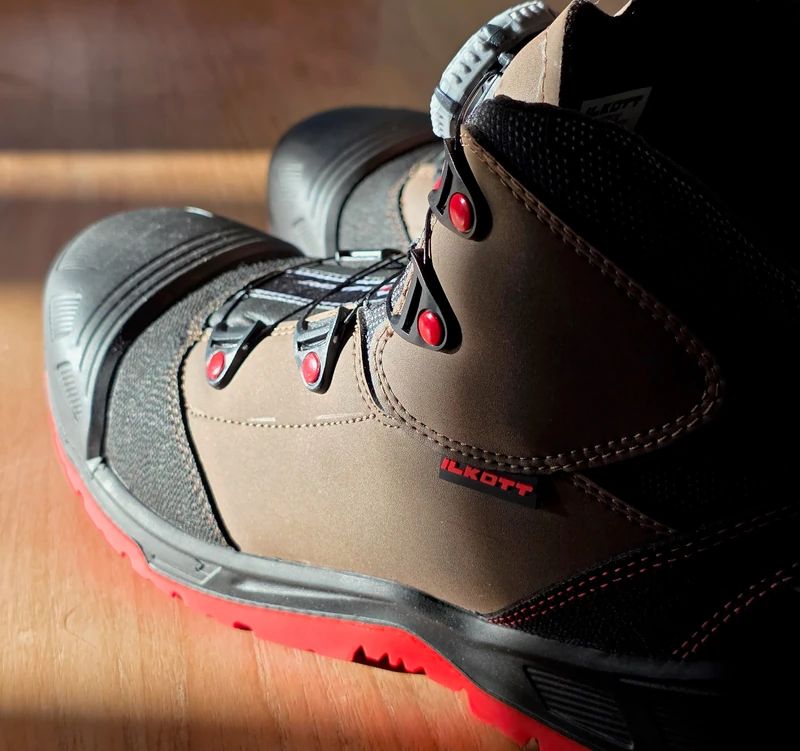
Ilkott sent me a pair of safety shoes, Mid model G, product code A30NILKOTT G, in size 42. I wore them on the job.
Straight answer: they are very comfortable and very breathable shoes over a full day. The dial lacing, ski-boot style, tightens with one twist and keeps the foot locked in.
They may also suit plumbing or masonry work where the assessed hazards match their S3S FO SR markings. These markings alone do not certify insulating footwear to EN 50321-1.
A30NILKOTT G
the reference of the pair received
42
the size worn on the job
S3S FO SR
the markings read on the label
3,0 mm
the test nail for the S3S penetration-resistant insert
The Mid model G at a glance
The pair I received is a mid-height shoe: brown nubuck-like finish and black mesh panels, red sole, collar rising to ankle height. The exact reference is stitched inside, on the label.
Manufacturer specifications differ: Ilkott’s product page calls the upper nubuck leather and the toe cap composite; its A30NILKOTT G PDF instead lists a nubuck-finish microfibre upper and a steel toe cap. These photos do not settle that discrepancy. I do not claim to have verified the precise upper or toe-cap material.
The brand offers this range in its safety footwear section, alongside the low-cut and high-cut versions and the Mid model K. The model I wear is the Mid G, in brown, available in sizes 38 to 47.
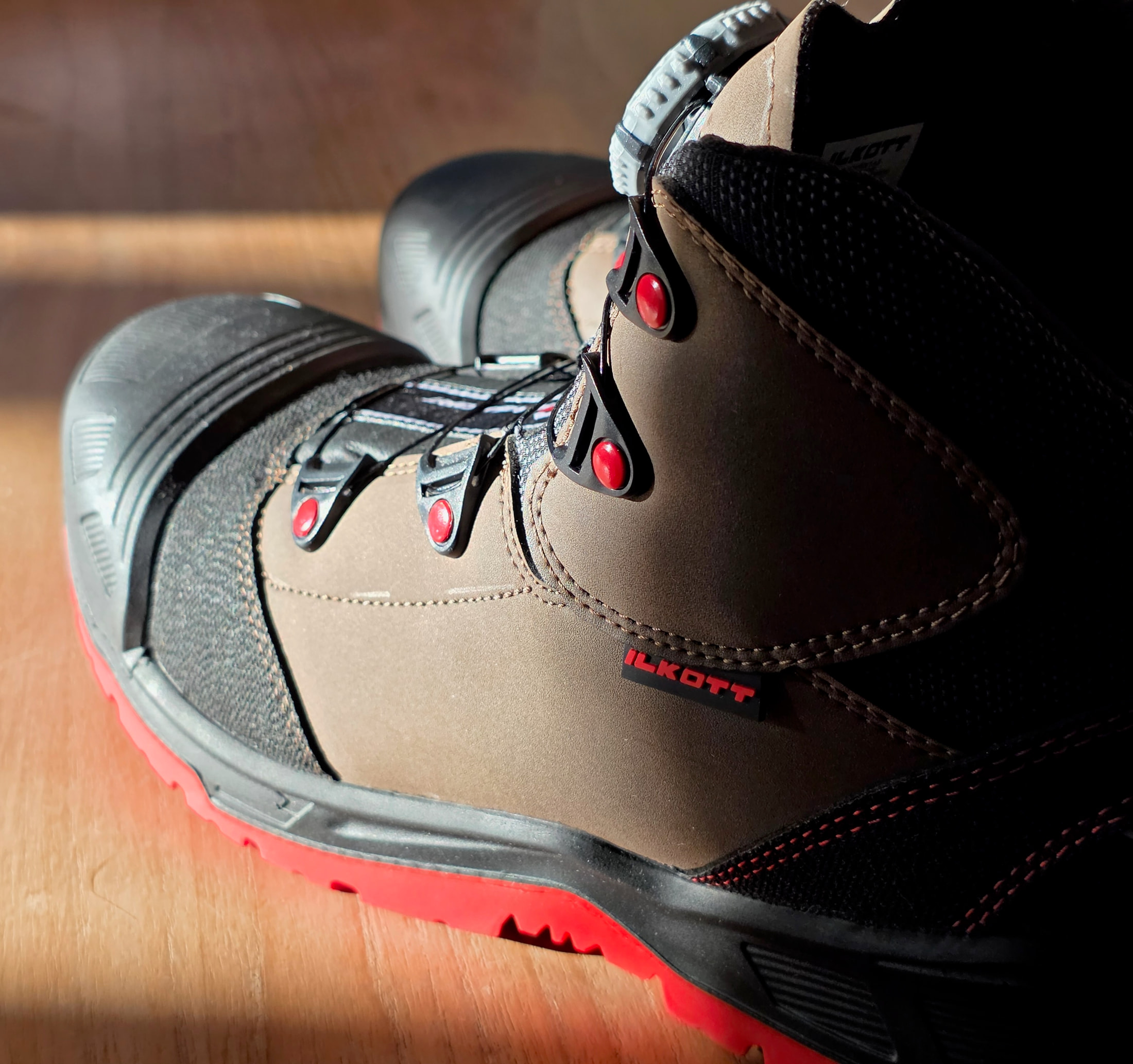
The dial lacing system, adopted straight away
The lacing system is the first thing I notice about this pair. Ilkott promises “BOA® lacing technology”, and the action is instantly clear: one twist and it’s tight, just like a ski boot.
With classic laces, the fit has to be tightened again during the day. Here, one turn of the dial adjusts the fit without taking the shoe off, and the foot stays locked in.
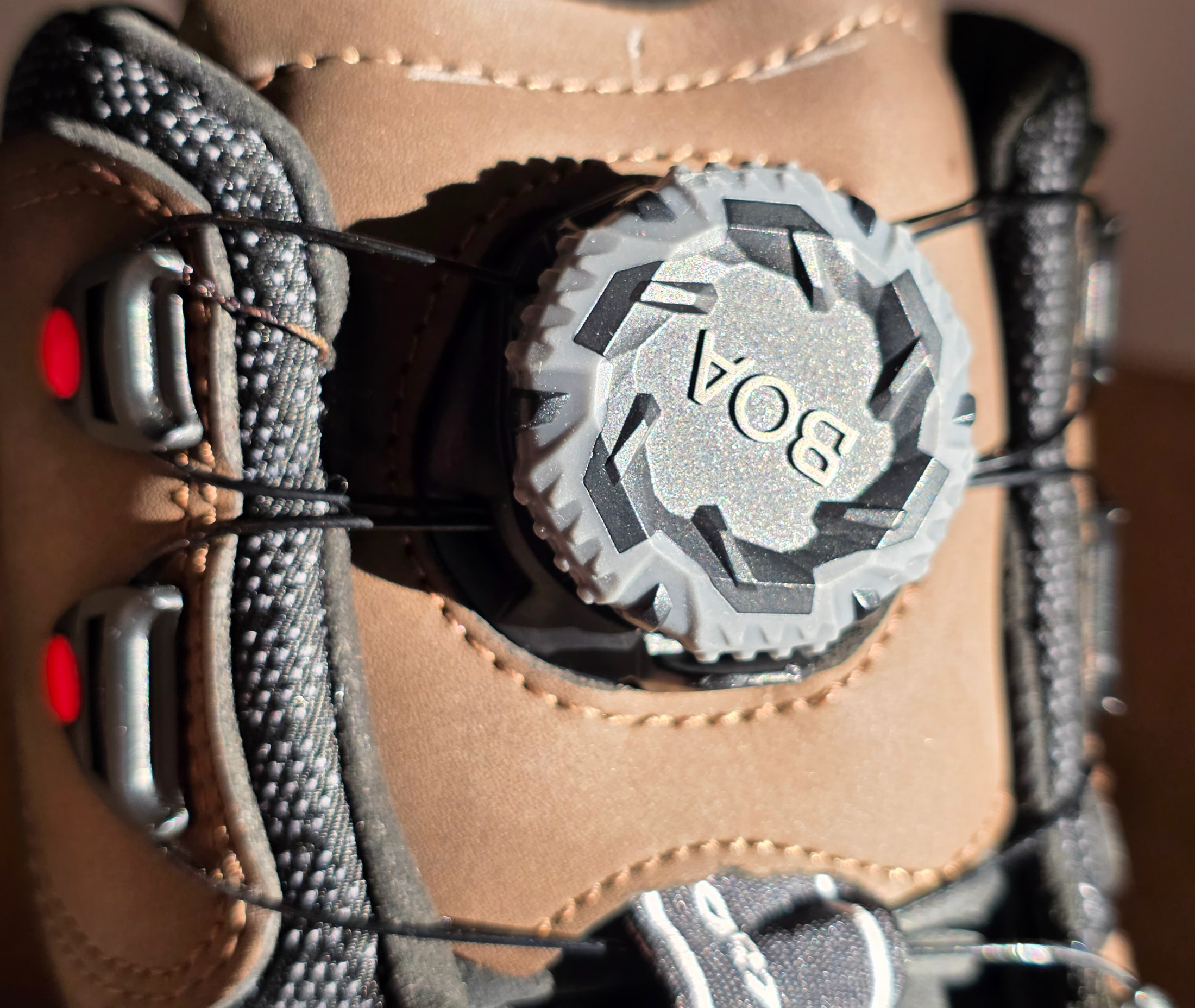
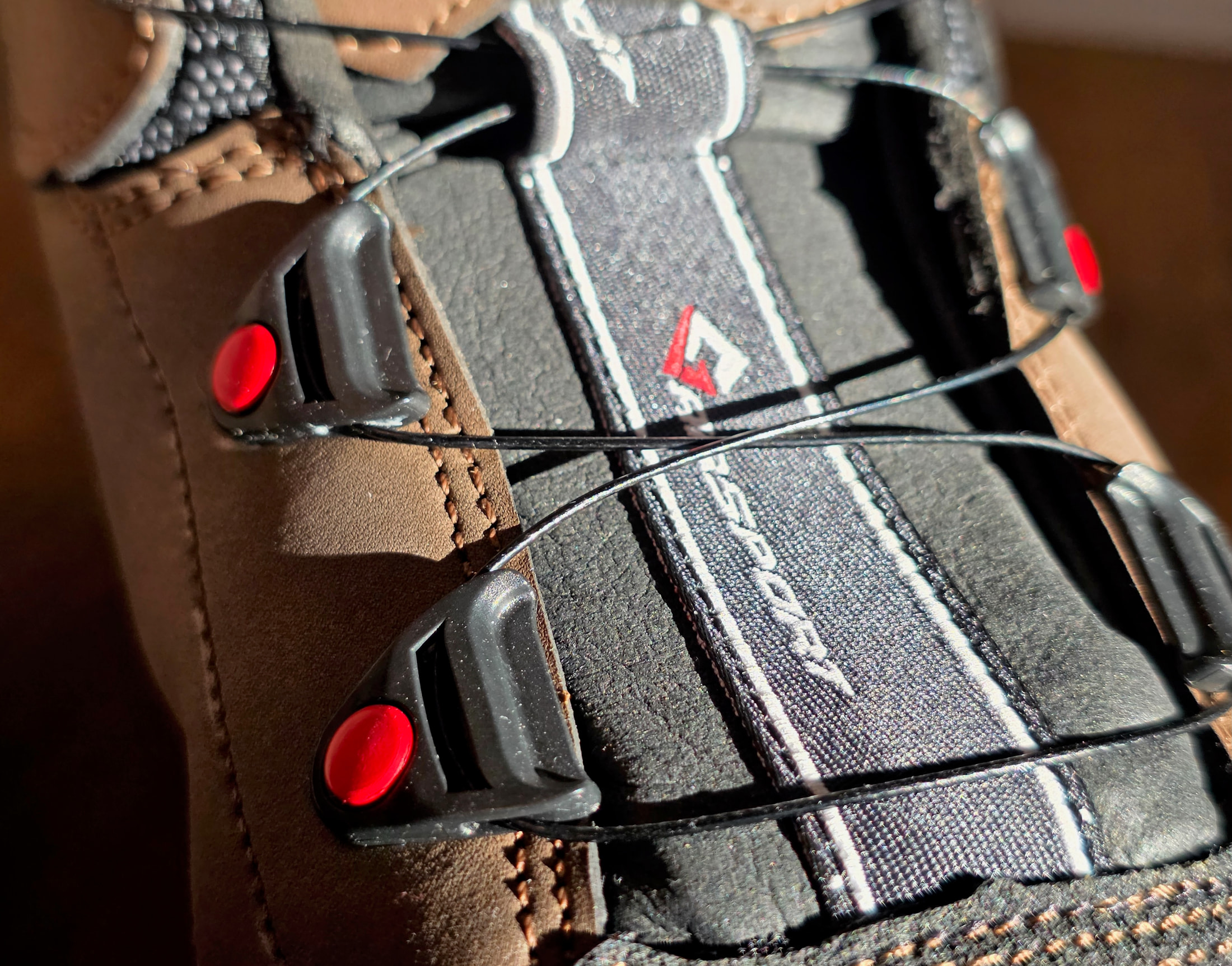
I wasn’t starting from scratch with this type of closure: the quick-tightening principle is already documented on another pair on the site. But this is the first time I’ve actually worn it on a job, and the verdict comes down to one sentence: the tightening stays put.
What I gain day to day is one less step getting them on and an adjustment possible at any time, without putting my tools down. On a high-cut boot, a lace that comes undone up high is still a risk, and this system takes that worry away.
Another benefit shows in use: the tightening is even across the top of the foot, rather than pinching at points like a knotted lace. The foot stays held without being squeezed, which matters when you move between positions all day.
Tightening and loosening through the day
The dial tightens without retying the laces. For release, follow the instructions for the exact BOA dial fitted to the pair: some models release by pulling the dial up, not by turning it in the opposite direction.
I tighten them at the start, then check the heel is held before climbing a ladder or crouching for long spells. When the day mixes up positions, I adjust again at the break: the dial can be turned without taking the shoe off and without retying anything.
This is exactly what I ask of a pair of site boots, because lacing you never re-adjust ends up being forgotten in the wrong way: too loose high up, or too tight at the end of a long day.
What I check before putting a new pair on
A new pair of safety boots should be checked before its first day on site. I start with the label: reference, size and marking codes, to confirm the pair matches the model ordered.
Then I run my hand inside: the toe cap should be smooth, with no sharp edges, and the insole properly seated. A faulty toe cap is obvious to the touch straight away, and it justifies returning the pair to the seller.
I finish with a short trial on both feet, standing and then crouching, with the lacing tightened as it would be for work. If something pinches at that point, that is not something you want to discover in use.
Comfort and breathability on first wear
On first wear on site, I check whether the foot stays stable as I alternate between walking, standing and crouching. On the Mid G I received, the heel stays locked in place and the fit creates no immediate pressure point under the arch.
The upper visibly combines black mesh panels with a brown nubuck-like finish. The manufacturer documents disagree about the upper material. On the pair I received, air circulates with no immediate stuffiness around the foot, including when I move from walking to crouching.
I check three simple signals: no pressure point under the arch, no rubbing at the heel and no urge to loosen the pair after the first movements. They stay green throughout this first hands-on test on site.
This first wear lets me judge the fit and the support, not yet how it holds up over several weeks. Above all, I will be watching the heel, the seams, the sole-to-upper junction and the lacing cable path: these are the areas that will show whether the initial comfort holds up in use.
Where the Mid G fits, and where it does not
I do not reserve this pair for electrical work. Its S3S FO SR protection can fit different site tasks when the hazards have been checked; it does not replace electrical insulating PPE or other task-specific protection.
The quick lacing, breathability and initial fit are useful across various working situations. They do not establish suitability for every site: that depends on the assessed hazards and required PPE.
The Mid height protects the ankle without going up to a full-height boot, a compromise I find just right for days split between the workshop, the outdoors and time on the road.
To place the model in context on the shelf, the safety footwear brand comparison sets out the benchmarks on standards and product ranges. And for the brand’s spirit on the clothing side, I also wear the Ilkott Fresh Collection trousers on site.
What the S3S FO SR markings mean
The official data sheet states “EN ISO 20345:2022 S3S SR”. On my pair, the label sewn inside reads S3S FO SR, along with the reference, the size and the country of manufacture. Every code has a precise meaning.
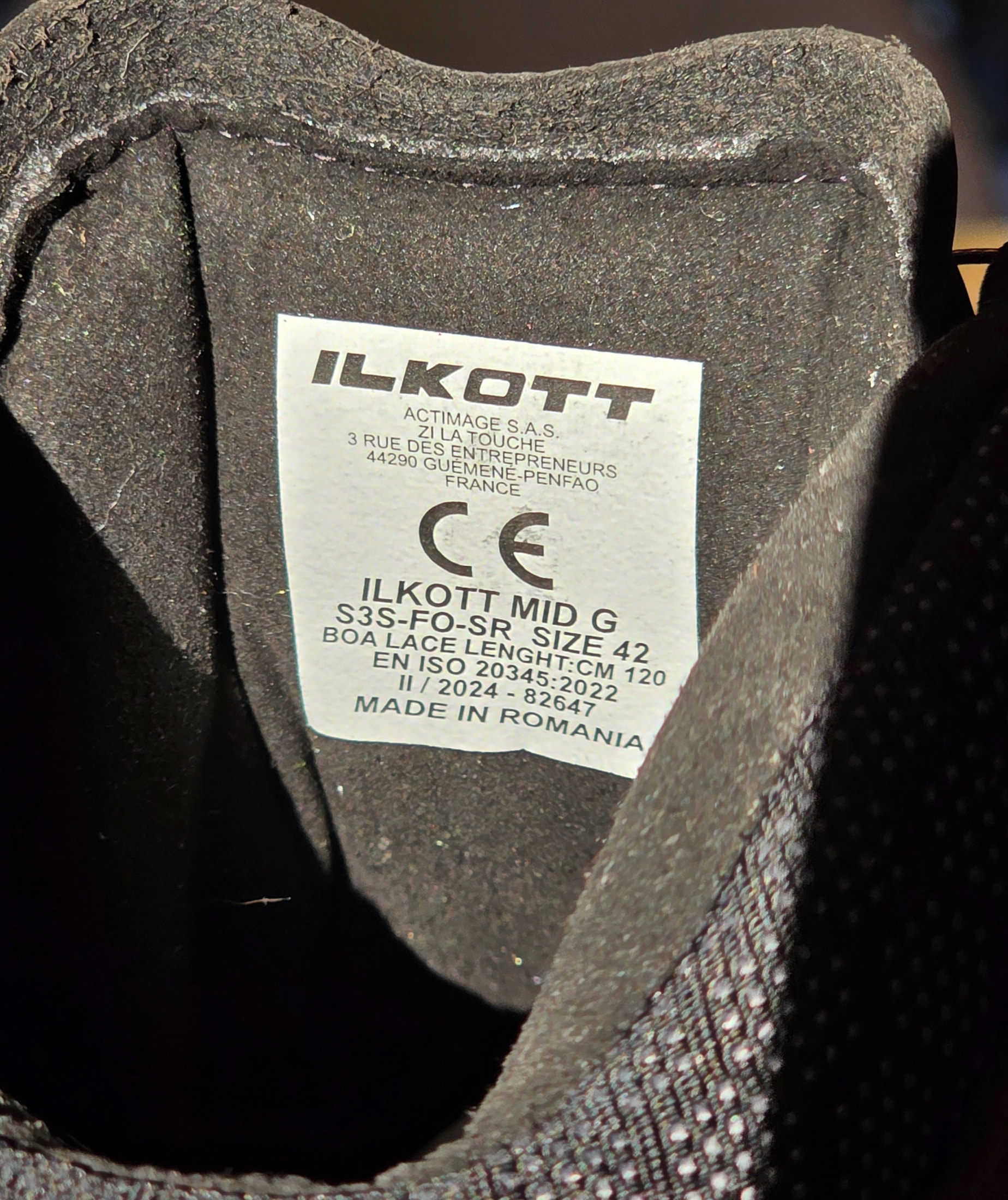
S3S adds a cleated outsole and a non-metallic puncture-resistant insert tested with a 3.0 mm nail to the S2 requirements. S1 includes antistatic properties and heel energy absorption. S2 adds water-penetration and absorption resistance of the upper (WPA): that is not the same as whole-footwear water resistance (WR).
| Code | Meaning | What it covers day to day |
|---|---|---|
| Code S3 | Meaning S2 + penetration resistance + cleated outsole | What it covers day to day Nails, debris and uneven floors |
| Code S3S | Meaning Non-metallic penetration-resistant insert, 3.0 mm test nail | What it covers day to day Flexible sole, no metal insert |
| Code FO | Meaning Resistance to fuels and oils | What it covers day to day Workshops and greasy floors |
| Code SR | Meaning Slip resistance on ceramic tile with glycerol | What it covers day to day Slippery floors, replacing the former SRC |
The codes recorded on the pair, decoded with the manufacturers’ guides.
The final S in S3S specifies the penetration-resistant insert: it is non-metallic, and the test is carried out with a 3.0 mm nail, thinner than the 4.5 mm nail used for standard metal inserts — so a more severe test.
FO indicates resistance to fuels and oils. SR stands for the enhanced slip resistance test, on ceramic tile with glycerol; it replaces the old SRC, while basic slip resistance is now required for safety footwear.
Underpinning all of this, the toe cap has to withstand a 200 joule impact and a static pressure of 15 kilonewtons, the equivalent of a 20 kg weight dropping from around one metre. This mechanical base says nothing about electrical insulation: for that, head to our PPE for electricians.
Toe cap, toe reinforcement and heel in photos
Three zones concentrate the wear on a site shoe: the front, the heel and the junction with the sole. The photos of the pair let you look at them up close.
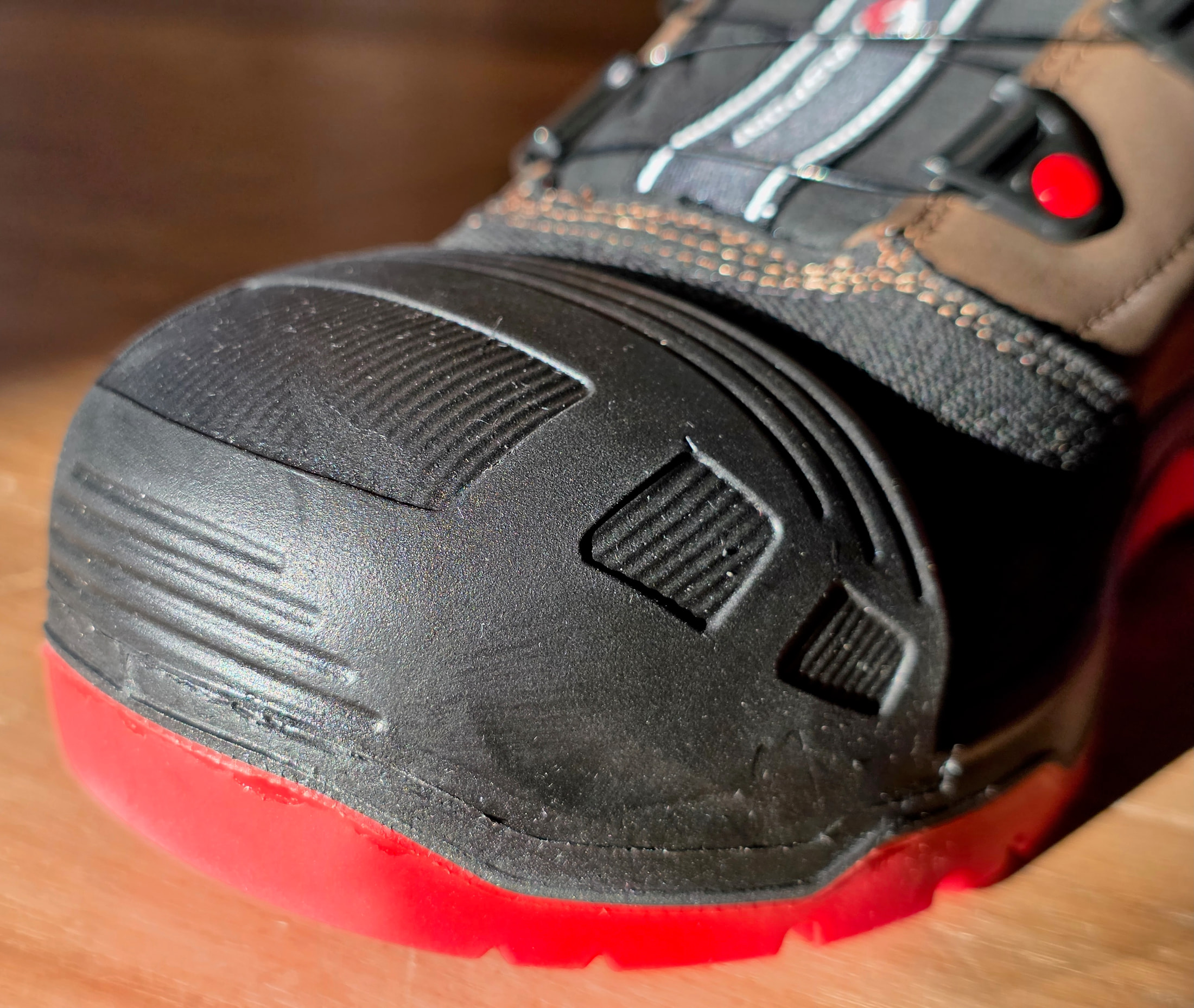
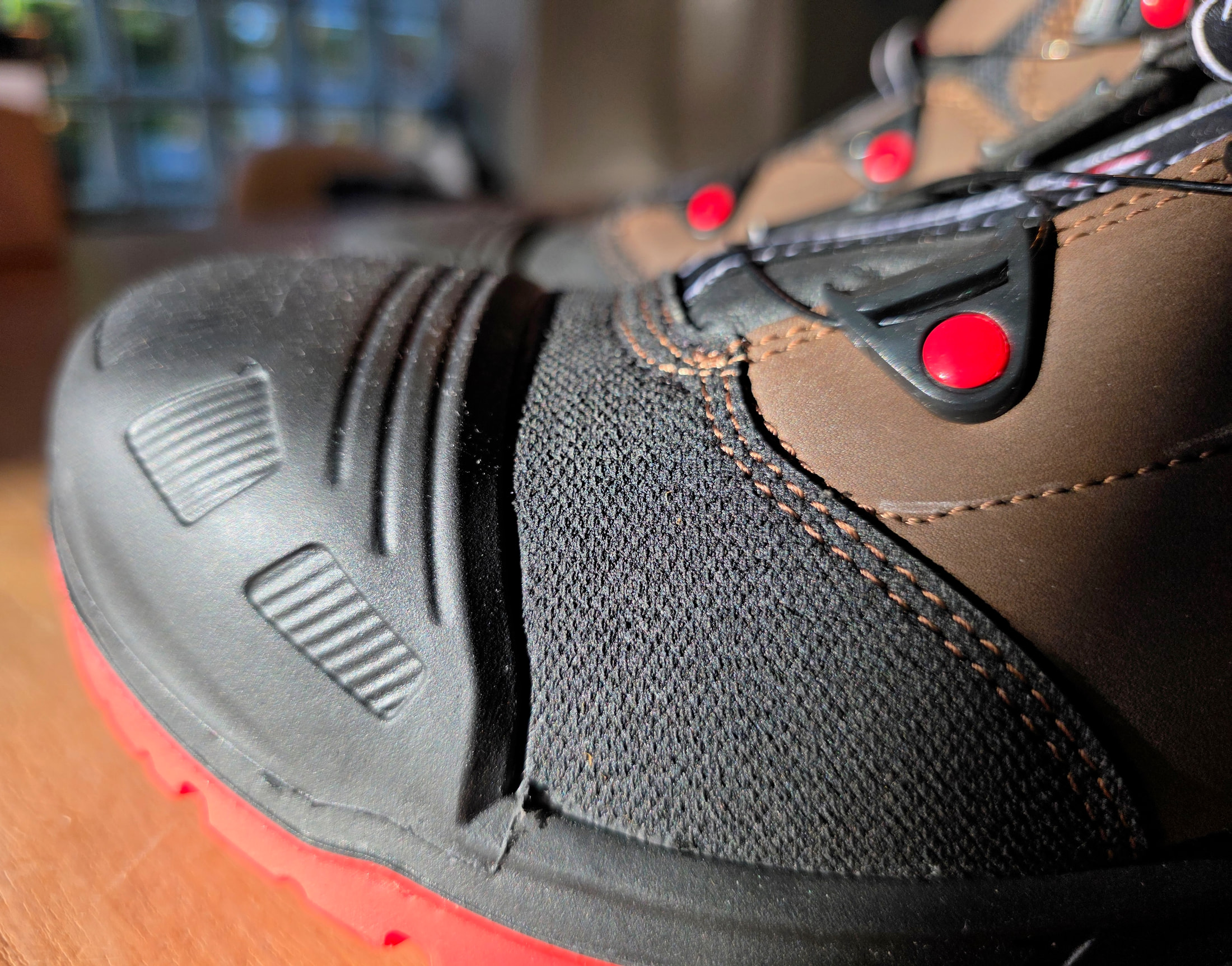
The first thing I look at is how consistent the whole pair is: on this pair, the upper is neatly finished across the front and the sole overhang covers the most exposed corner.
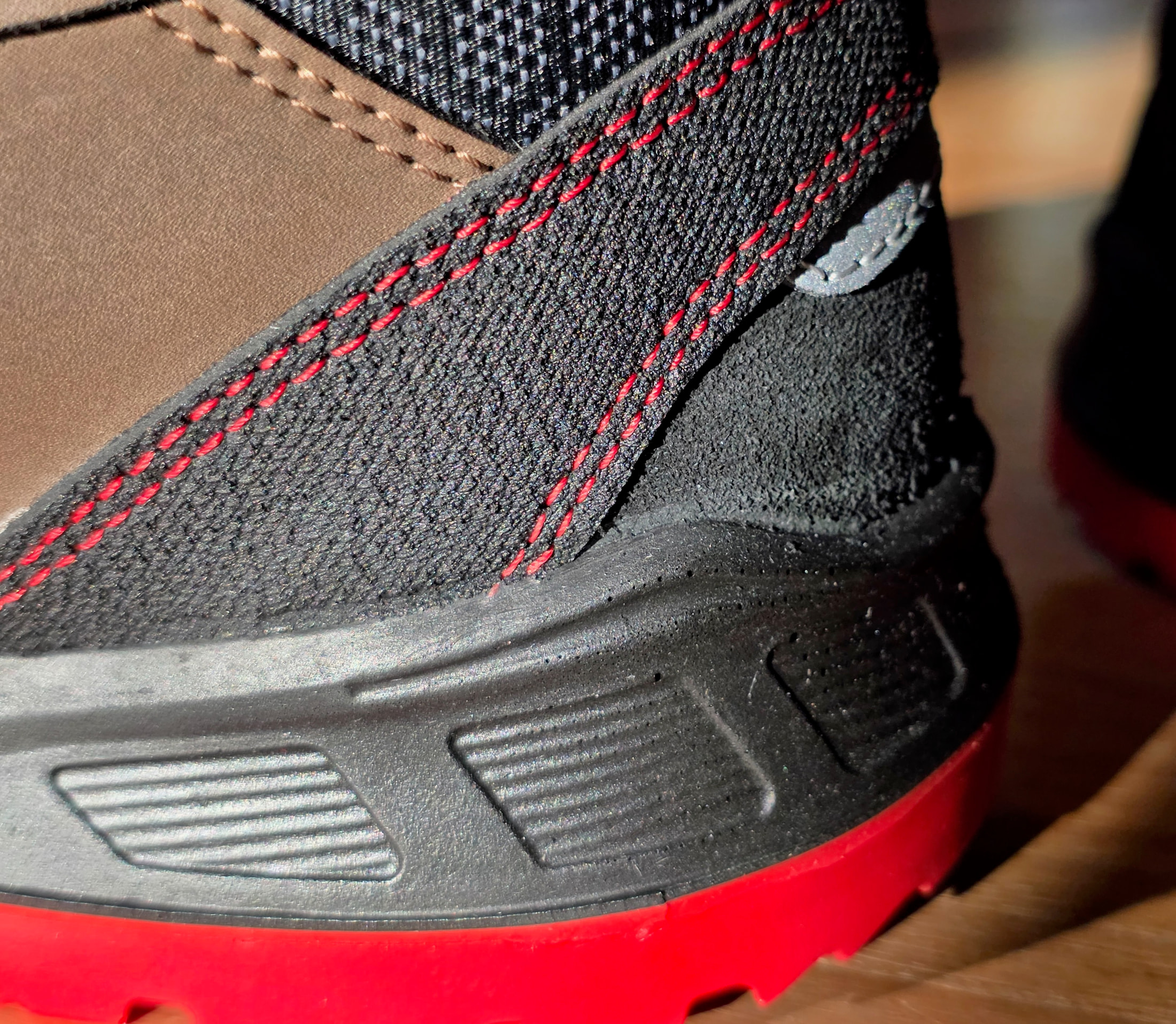
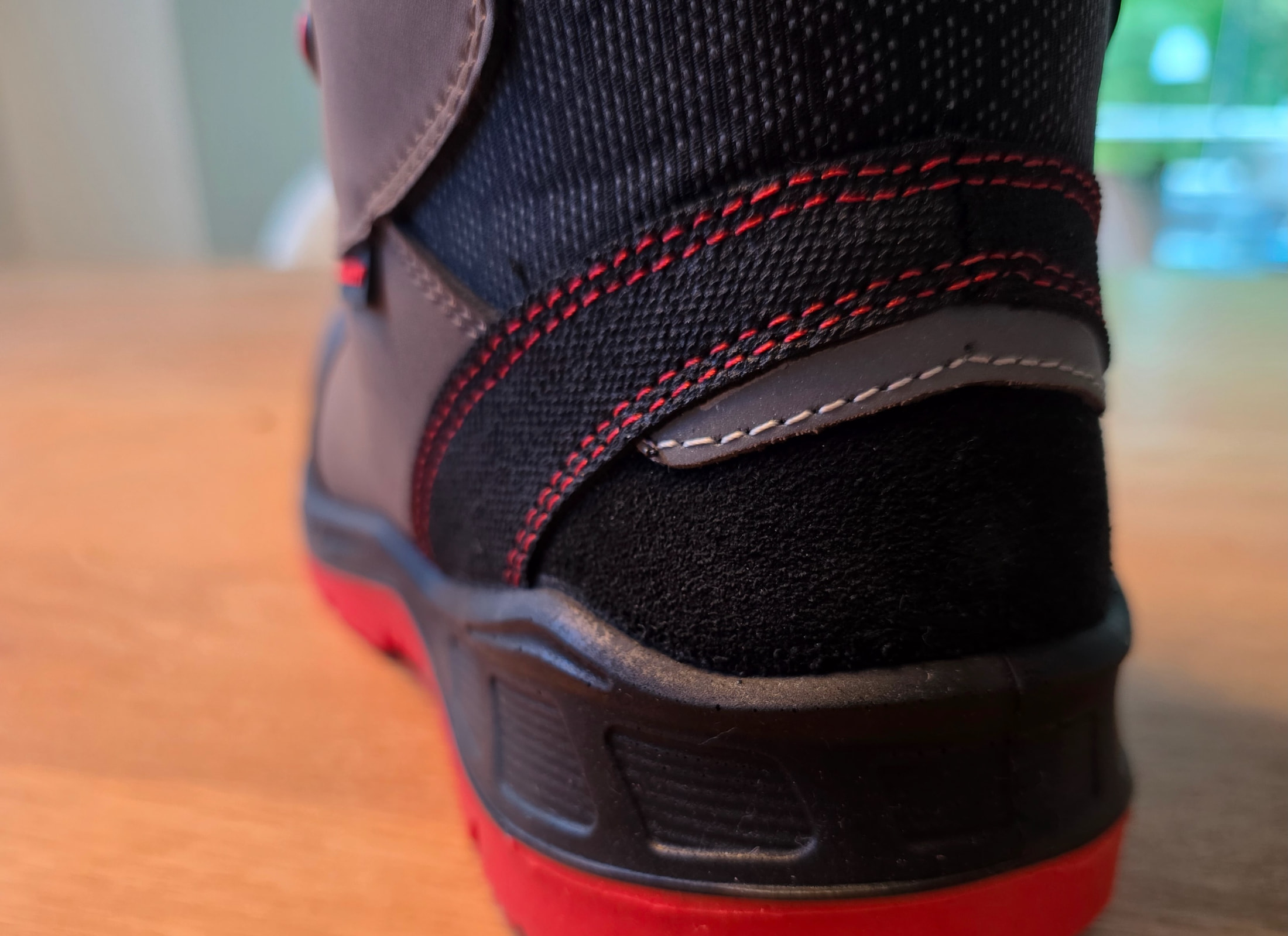
The heel brings together the red topstitching of the heel counter and a black midsole between the upper and the sole. This is the area I keep an eye on as it wears, because it takes the strain on every step.
From the back, the pair stays just as consistent, with the red overstitching and the sole overhanging slightly. On first wear, no visible defects show up in these areas.
The sole, its lugs and the SR marking
The underside of the sole is red, with geometric lugs spread across the whole surface. This is also where the grip claims are made.
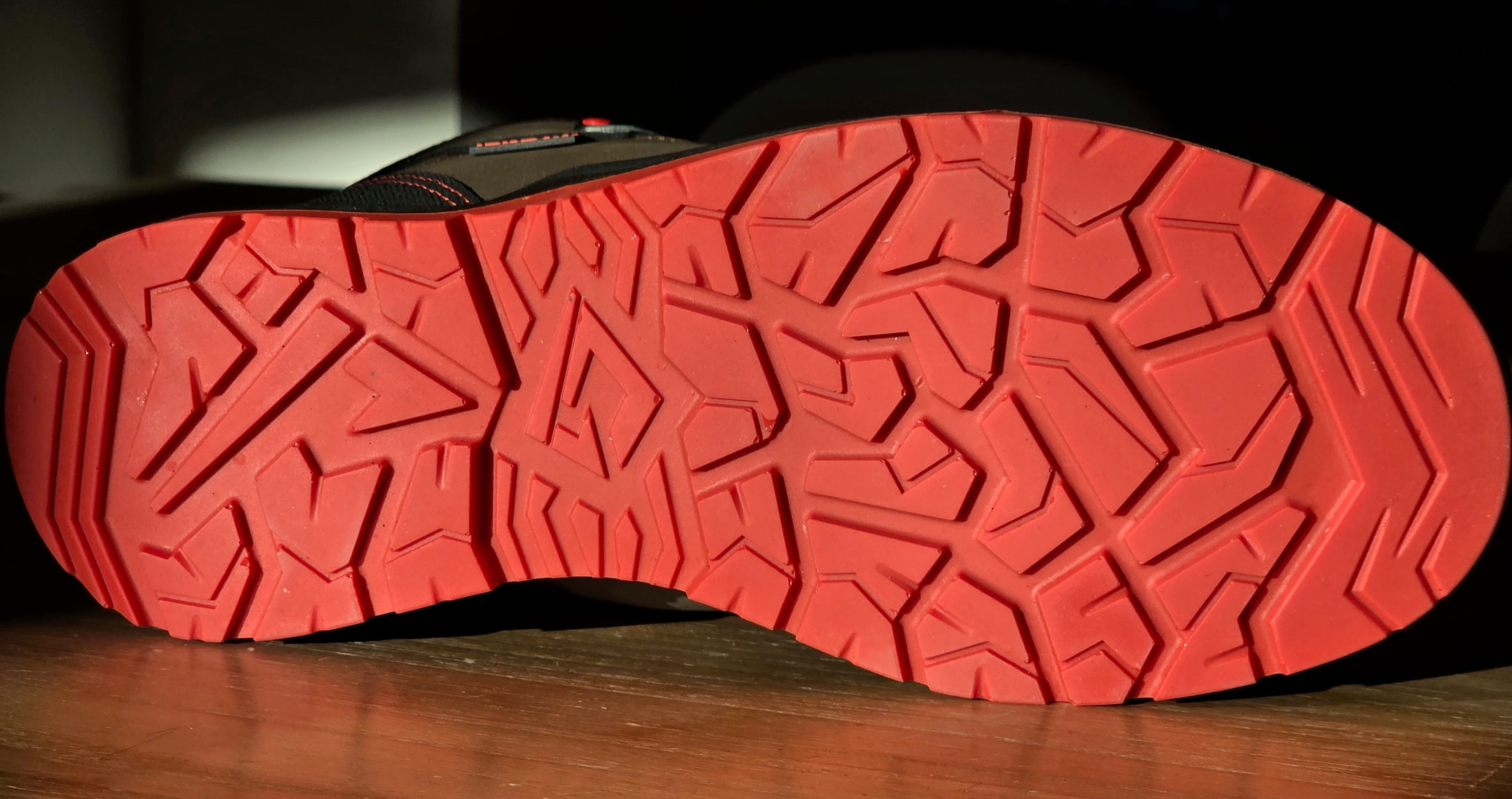
The SR test covers the heel and forefoot, two contact points that matter on the job. On a greasy or wet floor, it’s this combination of tread lugs and rubber compound that makes the difference day to day.
The FO marking completes the picture where the sole is concerned, with resistance to fuels and oils. It’s the kind of detail that counts in a workshop or on a stained floor.
EN 50321-1: S3S does not certify electrical insulation
This is the point that changes a buying decision depending on the application: the S3S FO SR marking does not certify insulating footwear to EN 50321-1.
The EN ISO 20345 standard classifies mechanical protection. Its list of additional requirements includes no electrical insulation: the only electrical codes are A, for antistatic, and C, for partially conductive. The S3S FO SR marking alone does not certify electrical insulation.
The Mid G label shown here does not indicate a class under EN 50321-1; an S3S shoe could only claim that separate protection with its own valid certification.
Don’t confuse the two: A means antistatic, not insulating. An antistatic sole dissipates charges; it does not protect against contact with a live part.
Electrical insulation is covered by EN 50321-1, which defines separate insulating-footwear classes for electrical work, including higher-voltage classes. These models can be fitted with a safety toe cap, but first and foremost they meet their own tests.
The usual classes range from class 00, up to 500 V AC and 750 V DC, to class 0, up to 1,000 V AC and 1,500 V DC. Each shoe undergoes an individual test: 2,500 V with a current limit of 3 mA for class 00, 5,000 V and 5 mA for class 0, applied for one minute.
EN 50321-1:2018 defines six insulating-footwear classes, 00 to 4. Class 4 is rated for use up to 36 kV AC; 50 kV AC is the dielectric withstand-test voltage, not a permitted operating voltage.
The logic is the same as for insulating gloves or an insulating ladder: each piece of protection meets its own standard. I have already detailed class 0 and the EN 50321 tests on a dedicated pair.
This limitation is not a product defect: the Mid G bears S3S FO SR markings rather than a certified insulating class. For electrical work, safe isolation wherever possible and any further PPE selected against the hazards take priority.
Sizing and break-in
The brand lists sizes 38 to 47; the pair I received is a 42, and that is my usual size.
For the try-on, I keep it simple: at the end of the day, when your feet are slightly swollen, with work socks on. The heel has to stay locked in without slipping, and the toes need room in front of the toe cap.
I then check the hold by walking and then squatting. If the heel lifts or the foot slides forward towards the toe cap, I go back to the fit first: the dial cannot compensate for a badly matched size or volume.
I will reassess the fit after several wears. The upper has a nubuck-like finish and visible mesh, but the conflicting Ilkott documents do not establish its exact material.
Before ordering: ask about the exact version
When contacting a supplier, give the A30NILKOTT G reference and ask which technical document covers the pair being offered. Include a photograph of its label if one is available. A general answer about the Ilkott range does not resolve the conflicting descriptions of this model.
Ask about the upper material and the toe-cap material separately. The product page and the PDF disagree on both. Neither the nubuck-like surface nor the shape visible in my photographs identifies what is inside the protective toe cap.
The answer matters for care as well as for comparing products. Ask which cleaning products are compatible with the stated upper material. The general Sixton guidance is useful, but a treatment suitable for one material should not be chosen simply because another looks similar.
Keep the supplier’s written answer with the technical sheet for that purchase. If a different Ilkott model is offered as an alternative, use its own label and documentation. The Mid G photographs cannot establish the specification of a neighbouring model in the range.
Treat sizing as a separate question. My size 42 and positive first impression are a starting point for this review, not a fitting result for another wearer. Discuss the available fit and exchange arrangements before relying on the same number.
Care: nubuck-look upper, mesh and lugs
A shoe that lasts is a shoe you look after. The Sixton care guide offers general pointers, not Mid G-specific instructions; Ilkott’s documents disagree on the upper material.
Day to day, I start by removing the insole to let the inside dry. They are left to air-dry at room temperature, never above 30 °C, away from a radiator and direct sunlight.
For the nubuck-look finish, I would start with a soft brush, confirming any cleaning product is compatible with the actual material. For the visible mesh, a slightly damp cloth may suffice; I would avoid machine washing unless the manufacturer expressly permits it.
Never use benzene, acids or solvents. These products damage the upper and the adhesive bonds.
I regularly check the insoles, dial cable and cable guides, replacing parts based on wear and manufacturer instructions rather than a fixed interval.
Finally, I clean the treads (or lugs) regularly. Clogged treads can reduce grip. Cleaning the soles does not make these S3S shoes electrically insulating.
Long-term perspective
The long-term durability of the upper, the stitching and the lacing system will only be judged over time. A single first wear is not enough to judge how they will wear.
Over time, I keep an especially close eye on the areas that flex with every step: sole/upper junction, nubuck-look panels and mesh stitching, heel hold and lacing cable. A change at any of these points matters more than a superficial mark on the sole.
Whenever I clean them, I also check the dial cable’s routing, its lace guides (the cable guides) and the sole’s perimeter bonding. Any play that appears or a cut in the cable is worth addressing before it becomes a nuisance on site.
The pair I received is a 42, my usual size. To replace the pair later, I’ll go back to the same fitting routine: work socks, foot slightly swollen at the end of the day, heel locked in place and space kept in front of the toe cap.
| Point | What I noticed | What to know before buying |
|---|---|---|
| Point Comfort | What I noticed You don’t notice them day to day, on site | What to know before buying The strongest point of the pair |
| Point Breathability | What I noticed Breathable during initial wear; nubuck-like finish and mesh | What to know before buying Ilkott’s documents disagree about the upper material |
| Point Dial lacing | What I noticed Tightens in one move, holds the foot | What to know before buying BOA® lacing system as stated by Ilkott |
| Point Markings | What I noticed S3S FO SR on the pair’s label | What to know before buying Check the reference, size and codes on your pair |
| Point Electrical insulation | What I noticed Not evidenced: no EN 50321-1 class on the label | What to know before buying Dedicated insulating pair for live working |
Summary of the points checked on the pair on site.
- Comfort on the job: no hard spots under the arch and no heel rubbing during the wear described.
- Good initial breathability with visible mesh panels; the exact upper material is not established.
- Fast, stable dial lacing, adjusted in one move without taking the shoe off.
- May suit different trades where the assessed hazards match the S3S FO SR protection.
- S3S FO SR markings: check the exact PPE requirements for each task.
- Label on the pair you can check: reference, size and codes right there.
- No insulating EN 50321-1 class on this pair: S3S FO SR does not certify electrical insulation.
- Safe isolation wherever possible, with certified PPE selected for the assessed electrical hazards.
My review of the Ilkott Mid model G shoes
The Mid model G made a good first impression: its nubuck-look panels, visible mesh, red stitching, cleated outsole and dial closure form a coherent whole. My comfort observations are from the wear described here, not a promise for every worker or trade. The S3S FO SR marking must be matched to each site’s hazards; it is not an EN 50321-1 electrical-insulation claim. For electrical tasks, isolate the supply wherever possible and select any additional certified PPE through the risk assessment.
Are the Ilkott Mid model G shoes insulating shoes?
The pair pictured is marked S3S FO SR, not with an EN 50321-1 insulating class. Those EN ISO 20345 markings alone do not prove electrical insulation. The separately certified EN 50321-1 classes include 00 (500 V AC use), 0 (1,000 V AC use) and higher classes; class 4 is 36 kV AC use, not 50 kV. PPE selection cannot replace safe isolation and a risk assessment.
What does the S3S FO SR marking on the pair mean?
S3 adds penetration resistance and a cleated outsole to class S2. The second S indicates a non-metallic penetration-resistant insert, tested with a 3.0 mm nail. FO covers resistance to fuels and oils, and SR the enhanced slip test on ceramic tile with glycerol, which replaces the old SRC.
Does the dial lacing really hold your foot in place?
Yes, it is the point that struck me most the first time I put them on: you tighten them in one twist, like on a ski boot, and your foot stays held in place from the first movements. You can readjust with a turn of the dial, even without taking the shoe off.
Are these shoes suitable for trades other than electrical work?
Potentially. The S3S FO SR protection and dial closure are not electrician-only features, but suitability for another trade depends on that site’s hazards, the shoe’s actual markings and any additional PPE requirements.
How do you care for the Mid G upper and mesh?
For the nubuck-look finish, start with a soft brush, checking the actual upper material and the maker’s instructions first. Gently clean visible mesh with a damp cloth. Avoid machine washing unless expressly authorised, and air-dry away from direct heat.
What sizes are available for the Mid G model?
The brand lists sizes 38 to 47; I wear a 42, the size of the pair I received. I recommend trying them on with work socks, ideally at the end of the day, then checking the heel hold and the space between the toes and the toe cap.
Disclosure Ilkott : Mid model G safety shoes (A30NILKOTT G).
Théo Desrousseaux
Electrician and editor
I work in the field and edit this magazine. Every guide is reviewed for its target country before publication.
Author → Credentials → Editorial method → Report a factual correction →
No email app? Copy the correction details
Email address and prefilled context:
theo@sparx-elec.fr
Article: https://www.sparx-elec.com/gb/ilkott-safety-shoes-review/
Edition: GB — English
Factual issue: [describe the factual issue]
Passage: [quote or identify the passage]
Source: [optional source URL]
Sources and references
- 1. Ilkott — Model G mid safety shoe (A30NILKOTT G)
- 2. Ilkott — Mid G A30NILKOTT G technical datasheet (PDF)
- 3. Ilkott — the design of the brand's safety shoes
- 4. Sixton — safety footwear maintenance
- 5. Emma Safety Footwear — EN ISO 20345 marking and classification
- 6. Sievi — what changes with EN ISO 20345:2022
- 7. Nitras — EN ISO 20345:2011 edition versus 2022 edition
- 8. Etche Sécurité — the EN 50321 standard for insulating footwear
- 9. Workmaster — insulating footwear for live working
- 10. uvex safety — guide to EN ISO 20345:2022, testing and markings
More guides
Practical electrical installation guides, diagnostic methods and tool recommendations compared against the technical wiring standards of this national edition.
Electrician's tool belt: a complete guide
How to choose a belt-mounted tool holder for electricians: types, stability and retention criteria, and the Ilkott AA61 pouch tested in the field.
Read the guide