FACOM ATD2X125 vs ATF6.5X150 screwdrivers
In brief
- ATD2X125 is a Pozidriv PZ2 screwdriver; ATF6.5X150 is a 6.5 mm slotted screwdriver. They fit different screw heads.
- Both PROTWIST tools were received and photographed in France. My overall impression of the FACOM tools supplied was positive, but I have no controlled torque or wear tests for this particular pair.
- FACOM's French catalogue lists lifetime replacement for both references; UK coverage must be checked against the applicable terms, not assumed from a French page.
- These are standard screwdrivers, not 1,000 V insulated VE models. Their plastic handles do not make them appropriate for live electrical work.
These two FACOM PROTWIST screwdrivers are not alternatives to each other. The ATD2X125 is for a Pozidriv PZ2 screw. The ATF6.5X150 has a 6.5 mm slotted blade. Picking the wrong one because both have the same brand on their handles is a poor way to start a job.
I received and photographed this pair in France. My overall impression of the FACOM tools supplied was very positive and I have not reported a fault with the shipment. That is an appraisal of real equipment, not a laboratory comparison of these two blade profiles.
The useful questions for a UK reader are straightforward: which recess does each tool actually fit, what reach does it offer, is it electrically insulated, and what does the manufacturer’s warranty mean for a UK purchase? I address those separately.
I have not measured the twisting strength, carried out repeated tightening cycles or claimed a FACOM warranty replacement. Those would be different kinds of evidence, and none should be invented merely to make a product review sound more comprehensive.
What the two model numbers tell you
FACOM groups the ATD2X125 in its round-shank PROTWIST Pozidriv range. Its designation corresponds to a PZ size 2 working end and a 125 mm blade length, as shown in the manufacturer’s published French reference table.
The ATF6.5X150 sits in the PROTWIST forged-blade slotted range. Here, 6.5 mm is the nominal slot-blade width and 150 mm is the blade length. Its tip shape is different from the ATD, not merely longer.
| Specification | ATD2X125 | ATF6.5X150 |
|---|---|---|
| Specification Recess type | ATD2X125 Pozidriv PZ2 | ATF6.5X150 Straight slot 6.5 mm |
| Specification Blade length | ATD2X125 125 mm | ATF6.5X150 150 mm |
| Specification Blade family | ATD2X125 Round shank, ATD range | ATF6.5X150 Forged blade, ATF range |
| Specification Standards stated by FACOM | ATD2X125 ISO 8764-1, ISO 8764-2 | ATF6.5X150 ISO 2380-1, ISO 2380-2 |
| Specification French warranty listing | ATD2X125 Lifetime replacement, E | ATF6.5X150 Lifetime replacement, E |
| Specification Choose it when | ATD2X125 The screw has a matching PZ2 recess | ATF6.5X150 The straight slot accepts this blade |
Specifications from the FACOM France product families. This is not a personal measurement table or a statement of UK warranty entitlement.
The final row matters more than the apparent similarity of the handles. There is no sensible winner in a comparison between different recesses. Each screwdriver is useful where its tip matches the screw.
For a tradesperson working with several kinds of fixings, owning both can make sense. For someone who almost never sees a 6.5 mm slot, that size may be less valuable than another PZ, PH or combination-profile screwdriver. The answer comes from the fixings, not the catalogue photograph.
The French ATD and ATF product pages each include a broader range of sizes. Those references prove that alternatives exist within the ranges; they do not prove that I have received or tested all of them.
ATD2X125: a proper PZ2 recess matters
It is tempting to treat all cross-headed screws as the same job. A Pozidriv recess and a Phillips recess can look similar at a glance, but PZ and PH are different drive profiles.
That distinction has practical consequences. Using a point that does not match properly may make it easier to slip, chew the head or apply load through the wrong contact areas. A famous brand on the handle cannot correct the wrong drive geometry.
The ATD2X125 is explicitly identified as Pozidriv PZ2 in the FACOM French catalogue. I would choose it only after checking that the head really calls for that profile and size.
The 125 mm blade offers a particular reach. It does not prove that the entire shank will pass through a recessed terminal opening or that the handle has enough room to rotate behind an enclosure.
Those questions depend on the surrounding equipment. In electrical work, the access corridor can be narrower than the screw head itself. Even a correctly shaped tip may not reach properly if a shoulder or a broad shank obstructs it.
I therefore check both access and engagement. The point has to seat cleanly and the tool has to sit sufficiently in line with the screw for the operation. The quoted blade length is only one element of that decision.
FACOM states ISO 8764-1 and ISO 8764-2 for the ATD family. That is a manufacturer declaration concerning this screwdriver category, not an ISO test that I have reproduced in a workshop.
ATF6.5X150: the width of the slot is decisive
The second model is a straight-slot screwdriver. Its blade is designed for a corresponding slotted screw head. That sounds obvious, but a slot has more than one relevant dimension.
A blade that is much narrower than the slot may concentrate force on small sections of the head. A blade that is too wide may fail to enter. Nominal width alone does not prove a perfect fit, because the blade thickness and the actual geometry of the slot also matter.
FACOM identifies the ATF6.5X150 as having a 6.5 mm nominal blade width and a 150 mm blade length. The manufacturer’s table also lists a 1.2 mm blade thickness for this size.
The family is described as using forged blades. I can repeat that construction detail because the official French product information says so. I cannot turn it into a personally measured torsion strength or a lifetime-use result.
FACOM also lists ISO 2380-1 and ISO 2380-2 for the ATF family. These specifications belong to the slotted screwdriver range and should not be misapplied to the PZ2 family.
I would not choose this model simply because it looks like a substantial flat-blade screwdriver. Its usefulness depends on a slotted head of the right dimensions, and on whether there is space for a 150 mm shank and the handle.
Nor is it a cold chisel, scraper or pry bar. Those are different tools. Using a screwdriver beyond its intended purpose is not an interesting product defect; it is a mismatch between tool and task.
Why a 25 mm difference does not decide this comparison
The two blades differ in nominal length by 25 mm. That is a genuine arithmetic difference between the two listed dimensions, but it is not a performance test and it does not settle which tool has better access.
For a PZ2 head, a longer slotted screwdriver is still the wrong tool. For a wide slot, a PZ2 point is not a substitute for a flat blade. Fit comes before reach.
Once the correct drive is established, the required length matters. A deep opening may call for a longer shank; a cabinet with limited room for the handle may be easier to work in with a shorter one.
Neither situation can be established merely by holding a pair of screwdrivers for a photograph. I have not documented controlled access trials across identical fixings or enclosures with these exact models.
This is also why I would not publish separate pages declaring an ATD winner and an ATF winner. They answer different questions, and the same decision framework is more valuable than two nearly identical catalogues.
Some people may need two lengths of the same PZ2 screwdriver. Others may need several slot widths. Both are legitimate equipment decisions; neither follows automatically from having one example of each on a bench.
What the original photograph actually establishes
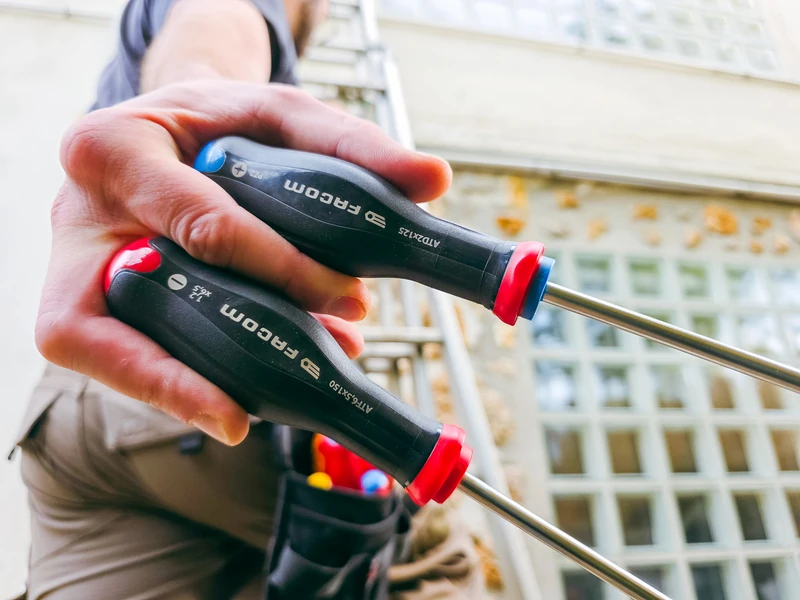
The picture accompanying this article is an original photograph of two FACOM screwdrivers in hand. It is not a stock image representing an invented site installation or a screenshot of a completed durability experiment.
The accompanying archive identifies the pair as ATD2X125 and ATF6.5X150. The manufacturer’s listings confirm that these part numbers correspond to the tip types and dimensions discussed here.
A photograph is useful evidence of receipt, presence and handling. It does not establish that the exact tools have completed hundreds of electrical installations or survived a measured load.
It would be easy to attach a detailed tightening story to this image. I have not done so. An account of a torque test needs a defined test, a measurement and the circumstances under which it was taken.
The same applies to long-term wear. A new tool can look promising and feel reassuring, but photographic appearance is not a lifetime guarantee test. Such a conclusion would require observations over time.
My favourable overall impression of the supplied FACOM equipment remains genuine. It simply has a different evidential weight from a published specification or an instrumented measurement.
This separation is important for the reader. When I refer to a number, a range or a standard below, it comes from FACOM documentation. When I describe my preference, it is an opinion, not a claim that I tested every possible use.
PROTWIST handles: what can be said without inventing an experiment
Both models belong to the PROTWIST family. Their photograph shows related handles, and FACOM describes the family’s grip construction and intended ergonomics in its official literature.
I find the supplied FACOM tools appealing overall. That is consistent with my experience of handling the shipment, but I cannot rank these two individual handles by measured comfort or claim a percentage improvement in torque delivery.
Grip preferences vary with gloves, hand size, the positioning of a screw and the working environment. Someone doing delicate positioning in a narrow enclosure may have different priorities from someone assembling bench hardware.
This variability is normal. I would not invent a disadvantage about the ATF handle because it feels longer in a picture, nor praise the ATD as universally more precise because the blade is shorter.
For an actual purchase, I would look at the tip first, then grip comfort and available clearance. If possible, handling the exact model is more informative than assuming all screwdrivers labelled PROTWIST are physically identical.
The stated ISO standards, manufacturing claims and warranty description are manufacturer information. They do not become field findings simply by being repeated in the first person.
Similarly, the absence of a published comparative torque reading in my notes does not mean FACOM performs poorly. It means that no such personal measurement can responsibly be quoted.
Standard screwdrivers are not 1,000 V insulated tools
For a UK electrician, this is the most important distinction on the page. These exact references are listed as standard PROTWIST screwdrivers, not the manufacturer’s VE 1,000 V insulated screwdriver variants.
A synthetic grip does not make a tool electrically rated. Nor does a handle colour, a similar shape or the reputation of the manufacturer confer an IEC 60900 approval on a different product reference.
FACOM sells separate insulated models and explicitly describes their insulation and testing. The product page for a VE variant should not be used as evidence that ATD2X125 or ATF6.5X150 carries the same protection.
I therefore regard this pair as tools for operations where the appropriate safe isolation procedure has already been carried out. Work near electrical equipment requires planning, safe systems of work and test methods appropriate to the actual installation.
A test lamp, proving unit or suitable voltage indicator has a distinct safety role. It cannot be replaced by touching a tool to a terminal, and a standard screwdriver must not be treated as a voltage detector.
When I need an insulated tool, I choose a specific certified insulated reference, with the correct tip profile for the equipment. I do not infer certification from the shape of a nearby product in a catalogue.
This distinction is not a fault with FACOM. Standard hand tools and electrically insulated screwdrivers serve different applications. A fair product comparison should make that boundary explicit.
PZ2, PH2 and combination-drive terminal screws
Another easy mistake is to assume the first screwdriver automatically suits every cross-headed screw in a consumer unit or wiring accessory. The ATD2X125 is specifically PZ2.
Some electrical manufacturers use different or combination-drive profiles for their terminals. A combination PZ/slotted head may be designed for a specific combination bit, and the correct form should be determined from the equipment maker’s instructions.
Similarly, a Phillips head is not simply another name for Pozidriv. Even when an incorrect driver appears to enter, its contact and tendency to slip may be different.
This matters particularly where the terminal manufacturer specifies a tightening torque. Choosing a compatible tip is one requirement; applying the prescribed torque with the appropriate tool is another.
Neither of these standard screwdrivers should be described as a calibrated torque screwdriver. A comfortable grip does not guarantee that a particular number of newton metres has been applied.
If the fixing is unfamiliar, I would rather stop and identify the screw than damage the recess or compromise the joint. That is a practical lesson about fasteners, not an implied failure of the tools discussed here.
The same caution applies to the ATF. A 6.5 mm flat blade is not automatically correct for every slot on an electrical connector. Both width and thickness have to suit the actual screw.
Warranty: French E marking versus UK purchasing conditions
FACOM France states lifetime exchange on the official ATD and ATF family listings. On that site, the E category describes a product replacement for an eligible defect arising during normal use.
That is a meaningful manufacturer commitment. The French warranty page distinguishes E for lifetime replacement, R for lifetime repair, and the time-limited D2, D3 and D5 categories for other tool families.
The distinction matters because the word lifetime alone does not specify the remedy. A repair entitlement is not the same as a replacement, and coverage for a defect is not blanket insurance against every kind of damage.
In France, the official E/R procedure describes treatment without requiring the original purchase receipt when the tool bears the FACOM marking. I would not tell a UK buyer that the same receipt rule is automatically part of their contract.
For a UK purchase, I would start from the international FACOM warranty terms, the exact model number and any locally supplied terms. The manufacturer or retailer can then confirm the channel and documentation required. My FACOM lifetime warranty guide explains the broader distinctions.
Wear, improper use and damage outside the intended application may be excluded. I have not personally submitted either screwdriver for warranty inspection, so I do not know how a particular claim would be decided.
I also distinguish a manufacturer’s commercial guarantee from rights against a seller under UK consumer law. The latter depend on the buyer’s status and transaction. A tradesperson buying for business use should not simply assume all consumer remedies apply.
A warranty offers reassurance, but it cannot replace an appropriate tool choice. The right drive, safe application and access conditions still matter on every job.
Should you buy the pair or select one size?
I would choose the ATD2X125 when I regularly encounter genuine PZ2 fixings and the 125 mm blade gives suitable access. It offers a clearly identified function rather than an undefined promise to deal with every cross-headed screw.
I would choose the ATF6.5X150 for slots that accept a 6.5 mm, 1.2 mm-thick flat blade, provided its 150 mm reach and handle clearance suit the work.
Buying both makes sense only if both recesses are relevant. The difference in tip geometry is not a marketing nuance: it is the decisive reason these two models sit beside each other in a tool bag.
If I needed only one screwdriver for a particular fastener, I would identify the fastener first, not automatically buy the larger or more expensive-looking model.
I would not select this pair as my entire electrical screwdriver set. There are other recesses, smaller dimensions, specialist combination tips and dedicated insulated versions to consider.
The appropriate kit also depends on whether the task is assembling general hardware or working on electrical installations. An electrician’s kit needs a clear separation between ordinary hand tools and tools required for electrical safety.
For someone who already owns an impact driver or cordless drill, a manual screwdriver may still be useful for positioning or working where a powered tool is awkward. That does not make either of these models an instrument for controlled tightening.
Looking after the tips
My first recommendation for keeping a screwdriver useful is use the right profile. A wrong driver can damage the fastener and produce a misleading impression that the tool itself has an inadequate tip.
I also check the state of the recess. A corroded, rounded or obstructed screw may need a different approach. Applying extra force with an unsuitable point is not a meaningful test of build quality.
A slotted blade should enter properly across the intended width; a PZ2 point should seat in an intact corresponding head. Poor engagement is a reason to stop, not to force the tool further.
After ordinary use, removing debris from a point helps make its condition visible. Keeping tools organised avoids unnecessary contact between exposed tips and other heavy objects.
I would not grind a tip into a different shape in an attempt to obtain a missing size. A modified blade may no longer engage properly and can also affect how a manufacturer views a warranty claim.
A safety-related application needs the correct tool rating as well as the correct profile. Cleaning an ordinary screwdriver does not convert it into an electrical safety tool.
These are normal handling principles. They should not be dressed up as proof that one manufacturer has a defect or that the pair I photographed has survived a specific endurance trial.
My verdict on the FACOM ATD2X125 and ATF6.5X150
I have a positive impression of the supplied FACOM equipment, and these two references provide a practical example of how a seemingly similar pair can serve two genuinely different purposes.
The ATD2X125 offers the documented PZ2 profile and 125 mm blade. The ATF6.5X150 offers the documented 6.5 mm slotted profile and 150 mm blade. That is enough information for a reader to begin an informed choice.
FACOM’s French listing of lifetime replacement cover for both is a useful feature, subject to the terms that apply to the buyer and the defect. I have not claimed a UK warranty outcome or an end-to-end turnaround time.
My view is favourable without a manufactured rating for torque, wear resistance or years of service. Those figures cannot be extracted from a photograph or from a manufacturer description of a product family.
If there is one decision I would want a reader to remember, it is this: match the recess, check the dimensions, then verify electrical safety and local warranty terms. The brand becomes useful only once those essentials are correct.
Is the FACOM ATD2X125 a Phillips PH2 screwdriver?
No. The French FACOM listing identifies the ATD2X125 as Pozidriv PZ2. A Phillips head is a different drive profile.
What tip does the FACOM ATF6.5X150 have?
It is a slotted screwdriver with a nominal 6.5 mm blade width, 1.2 mm thickness and 150 mm blade length on the French manufacturer's specification table.
Are either of these FACOM models VDE insulated for 1,000 V?
Not under these exact standard part numbers. The cited entries are ordinary PROTWIST hand screwdrivers, not the separate VE 1,000 V insulated variants.
Do they have a lifetime warranty in the UK?
FACOM France marks both ranges for lifetime exchange (E). A buyer in Britain should check FACOM's applicable international and UK purchase terms rather than treating the French procedure as automatically binding.
Is the 150 mm slotted screwdriver better than the 125 mm PZ2?
They are made for different screw heads. The 25 mm difference in nominal blade length does not make one a substitute for the other's tip.
Have these two screwdrivers been torque tested?
Their receipt and presence are photographed, and my overall impression is positive. I have no documented controlled torque, wear or endurance trial for this particular pair.
Can I use the PZ2 on a combined terminal screw?
Not automatically. A combination-drive terminal may call for a specific tip. Check the equipment maker's guidance and the actual screw head before tightening.
Is an original receipt always unnecessary for a FACOM warranty claim?
FACOM France states a specific E/R marking-based procedure, but that does not establish the receipt rules for every UK claim. Check the terms applicable to the purchase.
Disclosure FACOM : PROTWIST ATD2X125 and ATF6.5X150 screwdrivers.

Théo Desrousseaux
Electrician and editor
I work in the field and edit this magazine. Every guide is reviewed for its target country before publication.
Author → Credentials → Editorial method → Report a factual correction →
No email app? Copy the correction details
Email address and prefilled context:
theo@sparx-elec.fr
Article: https://www.sparx-elec.com/gb/facom-atd2x125-atf6-5x150-screwdrivers-review/
Edition: GB — English
Factual issue: [describe the factual issue]
Passage: [quote or identify the passage]
Source: [optional source URL]
Sources and references
- 1. FACOM — worldwide warranty terms and exclusions
- 2. FACOM France — ATD PROTWIST Pozidriv range, including ATD2X125
- 3. FACOM France — ATF forged-blade slotted range, including ATF6.5X150
- 4. FACOM France — warranty classes E, R, D2, D3 and D5
- 5. FACOM France — warranty handling and repair service
- 6. FACOM France — separate VE insulated screwdriver product
More guides
Practical electrical installation guides, diagnostic methods and tool recommendations compared against the technical wiring standards of this national edition.
FACOM lifetime warranty: UK cover and exclusions
FACOM lifetime warranty explained for UK buyers: replacement, repair, limited terms, exclusions, returns, consumer rights and professional tool costs.
Read the guide Guide Knipex Cobra vs Facom: water pump pliers compared Cobra 87 01 250 vs Facom 181A.25G: 25 positions against 12, jaws, opening, ISO 8976 standard and insulation compared reference by reference. Read the guide
 Guide Knipex, Wiha or Wera: comparison for electricians Knipex, Wiha or Wera: compare equivalent VDE pliers and screwdrivers by ergonomics, certification and field use for professional electricians. Read the guide
 Guide KNIPEX DPT50 pipe cutter (90 23 02): review KNIPEX DPT50 pipe cutter (90 23 02) : diameters 32, 40 and 50 mm, price, blade durability and relevance for the work of an electrician. Read the guide