LOCTITE 577 thread sealant: cure time and use
In brief
- LOCTITE 577 is a single-component anaerobic thread sealant for sealing threaded metal fittings, not a PTFE tape and not a sealing cord.
- Henkel’s May 2026 data sheet distinguishes immediate sealing at moderate pressure on properly tightened fittings from at least 24 hours’ cure for maximum pressure and solvent resistance.
- The technical data sheet cites EN 751-1 class H and DVGW for the gas applications concerned; those references require checking the system and the documents in force.
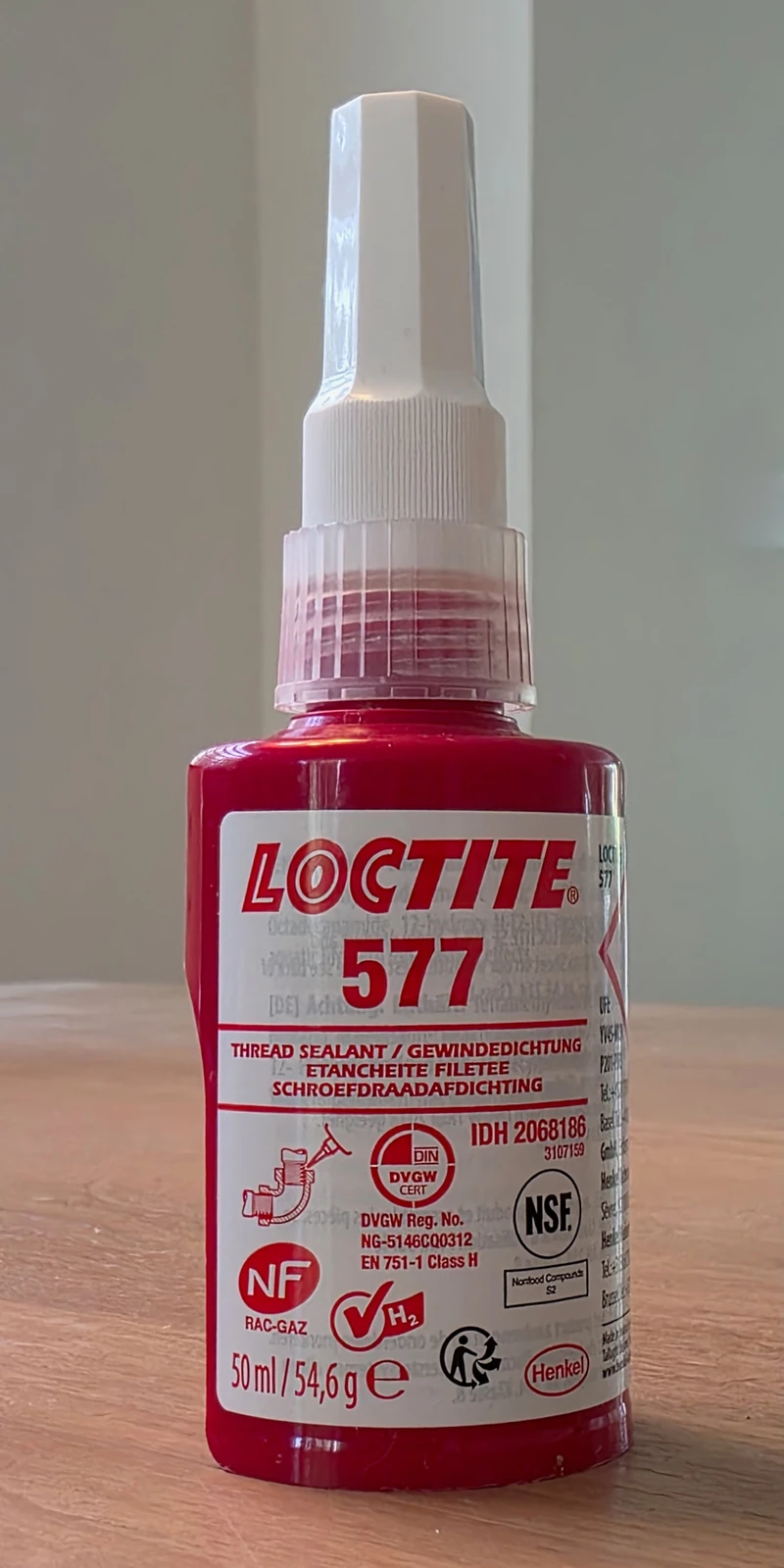
- The bottle has been received and photographed, but no personal leak, pressure or long-term test is established: this content remains documentary.
LOCTITE 577 is a yellow sealing product for threaded metal joints. It fills the space between the threads, then cures once it is confined between two metal surfaces with no contact with air. Henkel classifies it among medium-strength anaerobic sealants.
It is a different technology from LOCTITE 55 thread cord and from a hemp strand used together with a jointing compound.
I received this product together with LOCTITE 55 and 3090 on 18 September 2026 as part of an independent editorial testing project. The photograph of the bottle proves it is here; it does not prove it has been used.
I have no documented installation result to publish for the 577: no identified fitting, no fluid actually put through it, no measured cure time, no seal check attributable to this reference.
This page therefore sets out what the manufacturer documents, the precautions to take when choosing it, and the protocol that will later make a real field report possible.
What is LOCTITE 577 for?
The manufacturer intends it for metal threaded pipes and fittings, in straight-to-straight or straight-to-tapered assemblies. In that kind of joint, the thread geometry and the mechanical tightening bring the parts together, but they do not always make the fluid path leak-tight.
The resin fills the remaining volume and hardens under the conditions set by its chemistry.
The 577 is described as thixotropic: its consistency limits how far it runs after application. In practice, that word is not a guarantee against dripping and it does not remove the need to clean up the excess. It describes a behaviour of the paste that Henkel associates with controlled application to the male thread.
An anaerobic sealant does not answer the same need as a standard instant adhesive. The 577 works inside a threaded assembly, where the material is confined. It is not there to glue a broken part back together flat, to redo a flexible joint under a sink, or to replace an O-ring.
For those jobs, the nature of the assembly matters more than the logo on the bottle.
| Product | Principle | Use to examine |
|---|---|---|
| Product LOCTITE 577 | Principle Anaerobic single-component resin | Use to examine Sealing of metal threads |
| Product LOCTITE 55 | Principle Coated polyamide cord, no curing | Use to examine Compatible threads in metal or plastic, commissioned according to the data sheet |
| Product GEBATOUT 2 + RT1 | Principle Jointing compound and flax fibre | Use to examine Metal threaded fitting and compatible assembly |
| Product LOCTITE 3090 | Principle Two-part instant adhesive gel | Use to examine Bonding parts and gaps, not thread sealing |
Four documented technologies: different functions and different methods of use.
How does anaerobic curing work?
In its French technical data sheet of August 2016, Henkel describes a single-component acrylic resin based on dimethacrylate ester. The product stays workable before assembly, then its cure starts in the confined areas where the conditions of contact with metal are met.
The reaction therefore has nothing to do with letting paint dry or waiting for the water in a filler to evaporate.
The document separates so-called active metals, for example certain copper alloys, from passive metals, notably stainless steel. It explains that the curing speed can change with the substrate. The same product may therefore look fast on one part and slower on another, even though both carry the same trade reference.
The data sheet cites gaps up to 0.25 mm within its performance conditions. That figure does not mean that any crack of that width can be filled with the 577. The gap here is the one found in a threaded assembly designed for the resin; it depends on the dimension, the profile and the quality of the threads.
A damaged, stripped or incompatible thread does not become repairable just because more product is used.
Temperature plays a part as well. Henkel provides separate curves for reactions at several temperatures, and for the use of an activator where necessary. A laboratory curve is not a stopwatch you can apply to every site.
To claim “set in ten minutes” or “back in service after an hour”, you would have to state what was actually measured and on which assembly.
Cure time: can it be pressurised immediately?
The manufacturer’s page mentions low-pressure initial sealing. At the same time it states that the product cures progressively. Both statements can be true because they do not characterise the same stage: the behaviour immediately after assembly, and the strength developed by the reaction.
That distinction matters. An initial seal stated at low pressure does not allow a circuit to be put back at any pressure, at any temperature, immediately after tightening.
On real equipment, the decision comes from the current data sheet, the requirements of the manufacturer of the assembly and the test protocol that applies to the network in question.
In its study, Henkel follows how performance develops over several hours and several days. The document varies the metal, the gap and the temperature, which rules out turning one particular curve into a universal delay.
In a future test I would separate the time between application and tightening, holding at the first check, rest time before the joint is loaded and the result after observation.
LOCTITE 55 thread cord differs on this point: its data sheet classifies it among coated cords with no curing. But “immediate” does not spare you from choosing a compatible fitting or from checking for leaks. Comparing the 55 and the 577 purely on the word “fast” hides the conditions that make the difference.
Active metals, stainless steel and contaminated surfaces
Henkel presents the 577 as compatible with stainless steels under the conditions of its formulation, without systematically needing an activator. That is not the same as recommending no surface preparation.
Surfaces have to stay suitable for the product and the fitting, with the cleaning required by the procedure and the real condition of the substrate.
The data sheet cites tolerance to light surface contamination: traces of cutting fluids, lubricants or protective products. That word does not mean “compatible with a fitting dripping with oil”. It describes a formulation margin stated by the manufacturer, not a licence to apply the product to a greasy or dirty thread.
In trade practice, the diagnosis of the fitting comes before the choice of product. I first check whether the thread shows crushed sections, significant corrosion, misalignment or an uncertain dimension. A resin is not there to hide a part that should be replaced.
The same control principle applies when tracing a leak under a sink: find the source before adding a seal.
Passive materials can change the cure speed and justify the use of an activator in some cases. On the other hand, you cannot add an activator out of habit: the reference, its instructions, the application and any approvals have to stay consistent.
For editorial tracking, I would note precisely any auxiliary product actually used, without attributing the result to the 577 alone.
LOCTITE 577 on water, gas and other fluids
Compatibility with a fluid cannot be deduced from the colour of the paste or from the fact that it seals a metal thread. It depends on the approvals that apply to the reference, to the service conditions and to the installation.
The product may appear in several industrial sectors, but that does not turn every possible use into an authorised job.
The 577 data sheet cites EN 751-1 class H and a DVGW certificate for the gas applications concerned. That is important documentary information, and it is distinct from the EN 751-2 approval mentioned for LOCTITE 55 cord. You cannot transfer the attestations of one reference to another on the grounds that they carry the same brand.
The data sheet also mentions an NSF P1 category linked to uses in food processing areas. NSF P1 does not read as a general approval for drinking water. Where a Henkel page mentions other approvals or conditions with an activator, the certificate of the exact variant and the market concerned have to be checked.
The right to use a product on a given network also depends on the requirements of the installation and on the competent trade.
I am not going to propose a makeshift “gas test” to manufacture a job-site photograph. Gas networks carry specific risks and require suitable equipment, checks and qualifications.
A future article can discuss a real, properly identified case if that evidence exists, but a demonstration leak test would be organised on an off-network water assembly and would not count as validation for gas.
Whether a product may be used on a gas installation is decided by the rules of the country concerned, by the assembly and by who is qualified to carry out the work there, not by the data sheet alone.
The same logic applies to drinking water: suitability depends on the exact approvals of the reference and of the configuration, checked against the regime in force where the installation is.
Henkel’s May 2026 global TDS does not recommend 577 for pure or oxygen-enriched systems, chlorine or strong oxidisers. A separate Henkel France product FAQ mentions BAM approval for certain oxygen applications.
The statements do not establish identical conditions: the certificate for the exact product IDH, fluid, pressure, temperature and country would need checking first. This article does not authorise any oxygen-system installation.
Which thread, and which application method?
Henkel presents the 577 for metal threads. Before application, you have to distinguish the nominal diameter, the profile, parallel and tapered assemblies, the seating of the parts and the fitting manufacturer’s requirements.
The product is designed to provide a sealing function under given conditions, not to mechanically create a joint that does not hold.
The French page recommends cleaning and degreasing the surfaces, then applying a 360° bead on the male thread, avoiding the first thread. The assembly then follows the manufacturer’s mechanical recommendations.
I am reproducing these points as Henkel instructions: they are not the steps of a job I would claim to have carried out with the bottle I received.
Avoiding the first thread can in particular reduce the amount of excess product pushed towards the inside of the pipework. It cannot guarantee that no material ends up in the circuit without inspection.
On technical installations, the excess and the debris from a dismantling operation have to be handled according to the context and the manufacturer’s documents.
A bead that is too large is not necessarily more protective. A poor choice of substrate or thread cannot be rescued by extra resin. In a test, the traceability of the quantity applied is more useful than a flattering photo: you have to be able to compare an initial state, an application, a tightening, a check and a possible dismantling.
What to do if the cure seems slow?
Before concluding that the product is at fault, separate the variables. Is the metal active or passive? Does the fitting have a normal gap? Is the application temperature consistent with the data sheet figures? Has the surface been cleaned? Was an activator planned? Has the assembly been loaded too early?
The curing speed can vary without the final strength of the formulation necessarily being identical from one assembly to another. Conversely, a tightening that feels firm does not prove a seal under pressure. The checking method has to be documented, rather than describing by touch that the product is “dry”.
A useful workshop check consists in recording the temperature, identifying the metal, dating the stages and noting the response of each assembly. Without that record, two experiments carried out several days apart do not give a reliable comparison.
For a later test, I would therefore not publish a precise delay in the form of a general promise.
Sealing and resistance to loosening
According to Henkel, the 577 combines a sealing function with medium disassembly strength. “Medium” is a technical category, not a guarantee that a fitting will come apart by hand, nor that it will never loosen. The torque values given in data sheets come from identified test assemblies.
Dismantling can depend on the metal, the diameter, the surfaces, the initial tightening torque, the ageing time and the treatment of the fitting. The installation around it has to be preserved as well: nothing justifies damaging a pipe or a piece of equipment simply to demonstrate the strength of a product.
In the protocol I would keep the result of the seal check and the ease of dismantling separate.
The older method of GEBATOUT 2 paste with hemp raises other questions: how much hemp, how it is coated, the speed of assembly, how it responds to readjustment. The 577 should not be presented as better or worse than that method without a comparison on genuinely comparable fittings.
LOCTITE 577, 55 and 3090: do not mix up the uses
The number matters. 577 here means a thread-sealing anaerobic resin; 55, a coated polyamide cord; 3090, a two-part instant adhesive. The 3090 is intended above all for bonding with gap filling, but it is not a thread resin meant to take the place of the 577.
The three products were supplied in the same parcel for testing purposes. Receiving them together does not turn them into a technical kit to be applied one after the other to a single fitting. The right product depends first on the function you need, the materials and the data sheet of the exact reference.
Hemp and jointing compound, PTFE tape and coated cord cover other needs. This page stays with the 577 and its anaerobic behaviour so as not to repeat a third generic guide to the same methods.
What a serious test would have to show
The first condition is to identify the fitting actually used: diameter, material, thread type, initial condition, origin, nominal pressure of the test assembly. Its dry condition then has to be photographed, along with any cleaning, the product applied and the assembled fitting.
The images have to be real views; a photo of the bottle does not replace those steps.
The second point is to separate the timings. I would record the time the resin was applied, the time of assembly, the time of the first check allowed by the technical conditions and the later observations. The temperature and the activator, if there is one, would appear on the test record.
The result could not be extrapolated to another size or another metal.
Finally, the check would have to be carried out on a dedicated water assembly, not connected to a live network, with a pressure-limiting device and a procedure suited to the equipment. No pressure would be claimed until it has been measured with the corresponding equipment and protocol.
The mere fact that nothing drips to the naked eye is not the same as a standard test.
I would also preserve the limits: a thread that is difficult to tighten, a need to start again, an application that is awkward in practice, or the absence of a usable photo.
A test that does not allow a conclusion has to stay described as inconclusive. That separation between the action, the source and the result is what will make a useful trade report possible, rather than disguised advertising.
How should the manufacturer’s pressure tests be read?
Data sheets can give torques, temperatures and pressures from test benches. Those values help place the formulation, but they replace neither the allowable pressure of the fitting nor that of the rest of the installation.
A result obtained on an industrial thread does not automatically become the pressure allowed for domestic plumbing fittings.
A spectacular figure presented on its own easily misleads the reader. I prefer to know what the result was obtained on, with what protocol and after what cure time. For the comparison between LOCTITE 55 cord and GEB paste, the published tests already rest on different fittings.
That is data to be presented side by side, not a ranking that came out of our workshop.
The 577 calls for the same discipline. If a certificate covers a geographical area or a particular use, its scope is limited to what is stated. The existence of gas certifications, for example, is not authorisation to improvise work on a domestic gas fitting, and it is not automatic validation of an existing installation.
Storage, safety and reading the documents
A technical data sheet gives properties and application recommendations. A safety data sheet covers hazards, precautions and handling conditions. Both are needed, for different reasons. Henkel makes the technical data sheets available through TDX and the safety data sheets through its mySDS service.
I will not transfer the storage information of the 3090 to the 577, or the other way round. Technical chemical products do not all have the same carrier, the same reaction or the same working life after opening. The exact limits remain those of the reference and of the batch used.
For a tradesperson, noting the date of receipt, the packaging and the version of the data sheet reduces ambiguity when a result is published later. It is also worth keeping a legible photograph of the label and setting aside doubtful packaging.
That does not replace the storage, protection and waste-handling procedures laid down by the manufacturer.
577 storage: Henkel’s May 2026 global TDS gives 8–21 °C as optimal for an unopened container in a dry place, with potential deterioration below 8 °C or above 28 °C. Do not substitute the 3090’s refrigerated storage instructions.
The UK product listing includes the 50 ml accordion (IDH 2068186) and 250 ml tottle (IDH 2068187); an image of a 50 ml bottle does not identify the exact UK pack.
For handling, select the current UK safety data sheet for the exact IDH printed on the pack, and check the applicable PPE, ventilation, contact and disposal instructions. A regulatory declaration or a different-country SDS is not a substitute. Henkel says that some product SDS documents need to be requested if they cannot be found online.
Should you choose LOCTITE 577?
The 577 deserves consideration when you are looking for an anaerobic resin for a metal threaded fitting and the service conditions, the substrate and the approvals match. It is not a universal recommendation. Its potential value lies in thread sealing, the stated medium strength and the documented compatibility with several metals.
Where the aim is to be able to adjust a fitting straight away without curing, LOCTITE 55 cord follows a different logic. For a hemp joint, the GEBATOUT 2 + RT1 combination requires yet another method. And when the job is to glue a broken part back together rather than to seal a thread, it is a bonding adhesive that has to be examined.
For now, I do not rate LOCTITE 577 and I attribute no observed performance to it from customer work. The receipt and the documentation make it possible to explain where it sits in the range; they are not enough to issue a test verdict. The observations will come only with a real, traceable assembly.
Frequently asked questions about LOCTITE 577
Is LOCTITE 577 a glue for fixing broken parts?
No: the 577 is first of all an anaerobic product for sealing metal threads. For bonding parts that present a gap, the Henkel range includes in particular LOCTITE 3090, whose function and chemistry are different.
How long should you wait before repressurising?
There is no universal recommissioning time. Henkel's May 2026 data sheet says properly tightened fittings can seal immediately at moderate pressure, but at least 24 hours' cure is needed for maximum pressure and solvent resistance. Fitting and system requirements take priority; no field cure time was measured here.
Is LOCTITE 577 suitable for plastic fittings?
LOCTITE 577 is intended for metal threads and is not normally recommended on plastic. LOCTITE 55 cord can seal certain compatible plastic threads under its own data sheet and fluid conditions; that does not make 577 suitable for plastic fittings.
Does the NSF P1 mention certify drinking water?
No. NSF P1 designates a category of use in food processing areas, under its conditions. Suitability for a drinking water installation is checked against the exact approvals of the reference and of the configuration concerned, under the rules in force where the installation is.
Does the DVGW certification allow you to install a gas fitting yourself?
No. Henkel documents EN 751-1 class H and DVGW requirements for the 577; that replaces neither the local requirements nor the qualification and the checks of the installer on a gas network.
Does this text constitute a review after testing?
No. The LOCTITE 577 bottle has been received and photographed, but no personal assembly or pressure test is established. The content is a documentary guide without a field pressure test; a future site report will require verifiable evidence.
Disclosure LOCTITE (Henkel) : LOCTITE 577 product received on 18 September 2026 for independent editorial testing; no site result attributable to this bottle is documented yet.

Théo Desrousseaux
Electrician and editor
I work in the field and edit this magazine. Every guide is reviewed for its target country before publication.
Author → Credentials → Editorial method → Report a factual correction →
No email app? Copy the correction details
Email address and prefilled context:
theo@sparx-elec.fr
Article: https://www.sparx-elec.com/gb/loctite-577-thread-sealant-cure-time/
Edition: GB — English
Factual issue: [describe the factual issue]
Passage: [quote or identify the passage]
Source: [optional source URL]
Sources and references
- 1. Henkel — LOCTITE 577, global technical data sheet, May 2026
- 2. Henkel — LOCTITE 577, UK product range and variants
- 3. Henkel — LOCTITE 577 technical data sheet, new formulation, August 2016
- 4. Henkel — LOCTITE 577, 250 ml pack and application information
- 5. Henkel — LOCTITE 55 technical data sheet, May 2024
- 6. GEB — GEBATOUT 2, jointing paste for threads
- 7. Henkel — Official mySDS safety data sheet portal